

Shiny vs shiney can be confusing because both spellings look almost the same. However, only one is correct! If you want to describe something bright, glossy, or reflective, shiny is the word to use. Shiney is a common spelling mistake, so that extra “e” has no place in your sentence. Think of shiny shoes, a shiny car, or shiny hair. In each example, the same spelling rule applies. This guide will help you understand the difference between shiny vs. shiney, learn how to use the correct word, and avoid this simple mistake in your everyday writing.
Quick answer
| Feature | Shiny | Shiney |
|---|---|---|
| Spelling | Standard and correct | Generally a misspelling |
| Meaning | Bright, glossy, or reflective | Usually intended to mean shiny |
| Part of speech | Adjective | Not the standard spelling of this adjective |
| Dictionary usage | Established English word | Not a standard alternative spelling |
| Formal writing | Appropriate | Avoid when describing appearance |
| Example | Her shoes look shiny. | Her shoes look shiney. |
The main difference is simple: use shiny when describing something that reflects light or has a glossy appearance. Major English dictionaries, including Cambridge Dictionary, recognize shiny as an adjective with this meaning.
Understand confusing English more words simply
Macaroon vs Macaron Difference and which is correct?
What Does Shiny Mean?
The shiny meaning in English refers to something that looks bright because it reflects light. The word can describe a smooth, polished, or glossy surface, although a shiny object doesn’t always feel smooth to the touch.
For example, a polished silver spoon may reflect the light from a kitchen window. Similarly, a shiny black car may catch your attention because sunlight bounces off its paint.
You can use shiny to describe many things, including:
- Shiny shoes that have been polished.
- A shiny new car with a reflective finish.
- Shiny metal that catches the sunlight.
- Shiny hair that reflects light.
- A shiny kitchen counter after cleaning.
- A shiny floor with a polished finish.
- Shiny fabric that reflects light under stage lighting.
In each case, the word describes appearance rather than an action.
Shiny as an Adjective
Shiny is an adjective because it describes a person, place, or thing. You can place it before a noun or use it after a linking verb.
Examples include:
- The shiny coin fell beneath the table.
- She wore shiny black shoes.
- The kitchen counter looks shiny.
- His newly polished watch became shiny.
- The silver surface appeared shiny under the lamp.
Notice how the word adds information about the noun. In the sentence “The shiny coin fell beneath the table,” shiny describes the coin, while fell tells you what happened.
This distinction makes shiny easy to use in everyday writing. Whenever you want to describe a bright or glossy appearance, the adjective may fit.
Common Synonyms for Shiny
Several English words express a similar idea. However, each has a slightly different meaning, so choose the word that best fits the situation.
| Synonym | Meaning | Example |
|---|---|---|
| Glossy | Having a smooth, reflective finish | The magazine has a glossy cover. |
| Gleaming | Shining brightly | The polished silverware was gleaming. |
| Lustrous | Having a rich, attractive sheen | The fabric had a lustrous appearance. |
| Polished | Made smooth or bright through treatment | He wore polished leather shoes. |
| Reflective | Able to reflect light or images | The reflective surface showed her face. |
| Sparkling | Giving off bright flashes of light | The sparkling diamonds caught her eye. |
| Shimmering | Producing a soft, changing light | The lake looked shimmering at sunset. |
| Glittering | Shining with many points of light | Glittering decorations covered the tree. |
| Radiant | Bright or glowing in appearance | Her face looked radiant in the sunlight. |
For instance, glossy often describes a magazine cover or a painted surface. Reflective is more precise when you want to emphasize how a surface sends light back. Meanwhile, sparkling suggests small, bright flashes rather than a general shine.
Learn how to use confusing more words correctly
Realist vs Realest difference and usage ?
What Does Shiney Mean?
The shiney definition usually comes from a spelling mistake. Writers often intend to describe something glossy or reflective but keep the final e from shine when forming the adjective.
For example:
Incorrect: The shiney floor reflected the ceiling lights.
Correct: The shiny floor reflected the ceiling lights.
Both sentences communicate the same idea, but only the second uses the standard spelling.
You may encounter shiney in informal messages, usernames, personal names, or creative spellings. However, these uses don’t make it the standard adjective for describing something bright or glossy.
Is Shiney a Word?
If you’re asking whether shiney is the correct spelling of the adjective meaning bright or reflective, the answer is no. Standard English uses shiny.
However, context matters. An individual might use Shiney as a surname, username, character name, or other proper name. That use differs from writing the ordinary adjective.
For schoolwork, professional emails, blog posts, and product descriptions, choose shiny.
Likewise, when checking the shiny word meaning, consult an established dictionary such as Merriam-Webster, Oxford, or Cambridge. These references help confirm standard spelling and usage instead of relying on how a word looks or sounds.
Learn the difference between confusing more English words
Unphased vs Unfazed difference and correct usage?
Why Do People Confuse Shiny vs Shiney?
The shiny vs. shiney spelling mistake often begins with a reasonable assumption: if the root word is shine, the adjective should keep the same final e.
Unfortunately, English spelling doesn’t always work that way.
Several factors explain why writers make this mistake.
The Influence of the Root Word
The word shine ends in a silent e. As a result, someone may assume that adding y produces shiney.
That assumption seems logical, but the established adjective is shiny.
Pronunciation Can Be Misleading
The standard pronunciation of shiny has two syllables, with stress on the first. In both American and British English, the word is commonly pronounced /ˈʃaɪ.ni/.
Because shiney may be read with the same intended pronunciation, speaking the word doesn’t necessarily help you identify the correct spelling.
Typing Habits Encourage Mistakes
Writers often type quickly, especially when sending messages or drafting social media captions. The extra e can slip into a sentence without attracting attention.
Spell-checking tools may catch the mistake, but they aren’t a substitute for knowing the correct form.
Repeated Online Errors Look Familiar
Seeing a misspelling repeatedly can make it look normal. However, frequency alone doesn’t establish a spelling as standard English.
If you encounter shiney in a comment or product listing, check the context before copying the form into your own writing.
Learn the difference between confusing more English words
Writen vs Written correct spelling and usage ?
Why Is Shiny the Correct Spelling?

The correct spelling of shiny comes from established English usage. Standard dictionaries recognize shiny as the adjective that describes something bright because it reflects light.
The relationship between shine and shiny is easy to understand when you compare their grammatical roles.
| Word | Part of speech | Example |
|---|---|---|
| Shine | Verb | The stars shine at night. |
| Shine | Noun | The polish restored the table’s shine. |
| Shiny | Adjective | The table has a shiny surface. |
| Shining | Verb form | The sun is shining through the clouds. |
The word shine can name an action or the quality of brightness. Shiny describes an object that has a bright or glossy appearance. Shining often emphasizes the action or state of giving off or reflecting light.
Why Is Shiny Spelled Without E?
The answer to why shiny is spelled without e is that shiny is the established form of the adjective. The final e in shine doesn’t appear in the standard spelling.
English has several spelling patterns involving silent e and suffixes, but you shouldn’t assume that every word follows one universal rule. Different suffixes can lead to different spelling changes.
For this word, the easiest reminder is:
Shine becomes shiny, not shiney.
You can also compare shine and shiny with other related forms to see how English words change according to their grammatical roles.
Learn the difference between commonly mixed-up more words
Dysregulated vs Disregulated correct usage ?
Shiny vs Shiney Grammar and Word Forms
Understanding shiny grammar helps you use the word correctly instead of memorizing a single spelling.
As an adjective, shiny describes a noun. It can appear before a noun or after a linking verb such as look, seem, or become.
For example:
- The shiny metal reflected the sunlight.
- Her shoes look shiny.
- The surface became shiny after polishing.
- The cleaner left a shiny finish on the wood.
Shiny also has comparative and superlative forms. These forms let you compare the appearance of two or more objects.
Shiny, Shinier, and Shiniest
The comparative form is shinier, while the superlative form is shiniest.
| Form | When to use it | Example |
|---|---|---|
| Shiny | Describes an appearance | This coin is shiny. |
| Shinier | Compares two things | This coin is shinier than the old one. |
| Shiniest | Identifies the most shiny item in a group | This is the shiniest coin in the collection. |
The spelling changes from y to i before adding -er or -est. You can see the same pattern in happy, happier, and happiest.
Therefore, don’t write shineyer or shineyest when you mean the comparative or superlative forms of shiny.
Shiny vs Shining
The Shiny and shining share a connection, but they often play different roles in a sentence.
Shiny usually describes an object’s appearance. Shining often emphasizes the action or state of emitting or reflecting light.
Compare these examples:
- The shiny metal looked brand-new.
- The metal was shining in the sunlight.
- She has shiny hair.
- Her hair was shining under the studio lights.
The first and third sentences use shiny as an adjective. The second and fourth use shining as part of a verb phrase.
The distinction helps you choose a word that fits both the meaning and the sentence structure.
Shine vs Shiny
Shine and shiny are related words, but they aren’t interchangeable.
Use shine as a verb when describing an action or as a noun when referring to brightness. Use shiny as an adjective when describing an object’s appearance.
For example:
- The silver ring will shine after polishing.
- The silver ring has a shiny finish.
- A little polish restored the ring’s shine.
Each sentence communicates a related idea while using a different grammatical form.
Shiny vs Shiney Pronunciation
Shiny is commonly pronounced with two syllables and stress on the first syllable. Cambridge Dictionary gives the pronunciation as /ˈʃaɪ.ni/ in both British and American English.
The spelling shiney doesn’t represent a separate standard pronunciation for this adjective. When people use it as a misspelling, they generally intend the same word.
Keep these points in mind:
- Shiny is the standard spelling.
- Shine is the related root word.
- Shiney is generally incorrect when used to mean glossy or reflective.
- Pronunciation alone may not reveal the spelling mistake.
If you’re unsure how to spell the word, remember the standard written form rather than trying to identify a difference in sound.
Learn the difference between commonly mixed-up more words
Offered vs Offerred which one is correct ?
Shiny vs Shiney Examples in Sentences
Sentence examples show how the correct spelling works in different contexts. They also help you recognize the extra e when editing your own writing.
Correct Examples Using Shiny
Everyday objects:
- The shiny new coin fell beneath the sofa.
- She cleaned the shiny kitchen counter after dinner.
- His shiny shoes looked perfect for the wedding.
- The shiny metal object reflected the afternoon sun.
- The shiny black car stood out in the parking lot.
Personal appearance:
- Her shiny hair reflected the light near the window.
- The stylist gave the client’s hair a shiny finish.
- She wore a shiny dress that caught the stage lights.
Home and decoration:
- The shiny floor reflected the chandelier.
- A shiny finish made the wooden table look polished.
- The children hung shiny decorations on the tree.
Nature and light:
- Rain left the leaves shiny and wet.
- The lake looked shiny beneath the afternoon sun.
- A shiny shell lay among the sand and small stones.
These examples demonstrate that shiny can describe different materials and appearances. However, context matters. A wet surface may look shiny because it reflects light, while a polished surface may have a glossy finish.
Incorrect Examples Using Shiney
| Incorrect sentence | Correct sentence |
|---|---|
| She wore shiney shoes. | She wore shiny shoes. |
| The shiney black car caught everyone’s attention. | The shiny black car caught everyone’s attention. |
| The kitchen counter looked shiney. | The kitchen counter looked shiny. |
| He bought a shiney new coin. | He bought a shiny new coin. |
| The shiney metal reflected the sunlight. | The shiny metal reflected the sunlight. |
Each correction removes the unnecessary e without changing the intended meaning.
A Practical Editing Example
Imagine you’re writing a product description for an online store.
Your first draft reads:
“The watch features a shiney silver finish that looks elegant in natural light.”
The description communicates the intended idea, but the spelling mistake makes the text look less polished.
A corrected version reads:
“The watch features a shiny silver finish that looks elegant in natural light.”
This small change improves the presentation without changing the product information. The same principle applies to business emails, academic assignments, articles, and marketing copy.
Learn the difference between commonly mixed-up more words
Stellar vs Steller difference and usage?
Shiny vs Shiney in Everyday and Professional Writing

The correct spelling remains shiny across standard English writing. However, the setting can affect how important it is to catch and correct a mistake.
Everyday Conversation and Text Messages
In casual messages, people sometimes type quickly and make spelling errors. A friend will probably understand what you mean if you write shiney instead of shiny.
Still, using the correct spelling builds good writing habits.
Incorrect: I bought some shiney new shoes.
Correct: I bought some shiny new shoes.
The correction takes only a moment, so there’s little reason to keep the extra letter.
Academic Writing
Students should use shiny in essays, assignments, examinations, and classroom exercises.
Correct spelling matters because teachers assess how clearly students communicate their ideas. One spelling mistake may not change the meaning of a sentence, but repeated errors can distract readers.
For example:
“The experiment showed that the shiny metal reflected light under the lamp.”
This sentence uses the adjective correctly and communicates the observation clearly.
Professional Writing
Professional content benefits from accurate spelling, especially when readers use it to evaluate a business or product.
Imagine a jewelry store describing a ring as having a “shiney finish.” The mistake may not prevent customers from understanding the description, but it can make the business look less careful.
The same rule applies to:
- Product descriptions and online listings
- Business emails and reports
- Marketing materials and advertisements
- Educational websites and blog posts
- Newsletters and social media captions
Use shiny whenever you mean bright, glossy, or reflective.
Learn the difference between tricky grammar words
Suit vs Suite correct spelling and usage ?
Shiny American English Spelling vs British English Spelling
Some English words have different accepted spellings in American and British English. For example, American English generally uses color, while British English commonly uses colour.
Shiny doesn’t follow that pattern.
The standard spelling is shiny in American, British, Canadian, and Australian English.
| English variety | Standard spelling | Spelling to avoid |
|---|---|---|
| American English | Shiny | Shiney |
| British English | Shiny | Shiney |
| Canadian English | Shiny | Shiney |
| Australian English | Shiny | Shiney |
If you’re writing for a US audience, use shiny. If your readers live in the UK, Canada, or Australia, use shiny there, too.
This isn’t a regional spelling difference. It’s a matter of using the standard form.
Common Mistakes to Avoid When Using Shiny
Even familiar words can cause spelling problems. Fortunately, the most common shiny spelling mistakes are easy to correct.
Keeping the Final E
The most obvious mistake is writing shiney because the root word shine contains an e.
Incorrect: The watch had a shiney finish.
Correct: The watch had a shiny finish.
When you need the adjective, use shiny.
Assuming Pronunciation Determines Spelling
English spelling doesn’t always match pronunciation perfectly. Two spellings may look similar or sound alike when spoken, but that doesn’t make them equally correct.
Rely on standard spelling rather than the way a word sounds.
Following Incorrect Online Usage
A spelling error may appear repeatedly online without becoming standard English.
If you see shiney in a comment or product listing, consider the context. It may be a typo or an intentional name. Neither use changes the standard spelling of the adjective.
Confusing Shiny With Related Words
Shine, shiny, and shining share a connection, but they serve different grammatical roles.
- Shine: The stars shine at night.
- Shiny: The polished shoes look shiny.
- Shining: The sun is shining through the clouds.
Choose the form that fits your sentence.
Using Shiny When a More Precise Word Fits Better
Although shiny is correct, it may not always be the most descriptive choice.
Glossy may suit a magazine cover, while reflective may be more precise when discussing a surface’s ability to reflect light. Sparkling works well when describing a diamond that produces bright flashes.
Use shiny for a general description, but choose a more specific adjective when it better expresses what you mean.
Learn the difference between tricky grammar words
Arial vs Aerial correct spelling and usage ?
How to Remember the Correct Spelling of Shiny
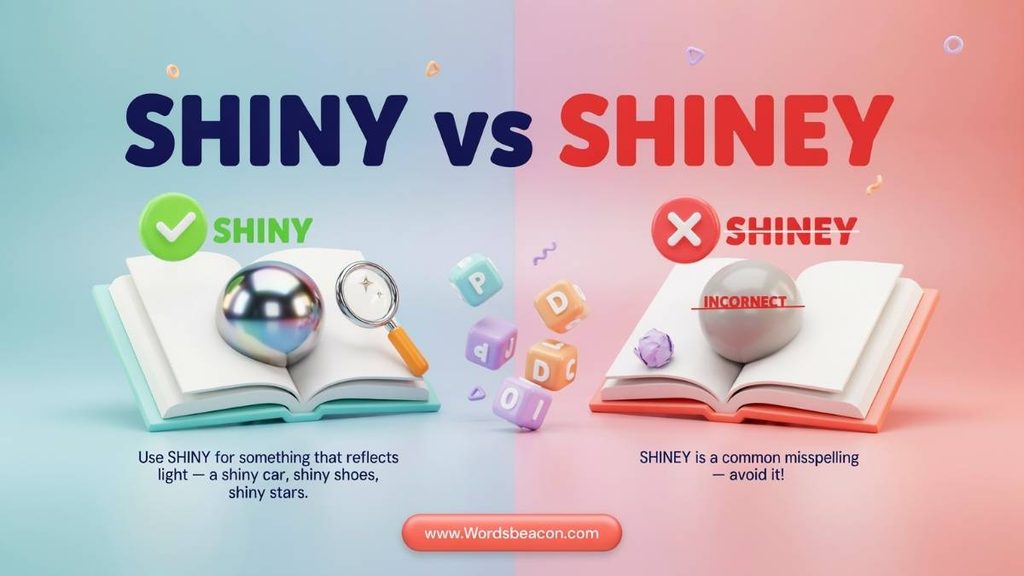
A simple memory trick can help you avoid the shiny vs. shiney spelling mistake.
Remember this phrase:
“Shine becomes shiny, not shiney.”
You can also reinforce the correct form in a few practical ways:
- Practice the related words shine, shiny, shinier, and shiniest.
- Use the word in a sentence, such as “The shiny shoes looked new.”
- Check for an extra e when editing your writing.
- Read your work aloud to catch awkward sentences, while remembering that spelling errors may sound correct.
- Consult a reliable dictionary when you’re uncertain.
The goal is to recognize shiny as the established adjective rather than trying to rebuild its spelling every time you use it.
Learn the difference between tricky grammar words
Emaculate vs Immaculate correct spelling and usage ?
practice session Shiny vs Shiney
Complete each sentence with the correct spelling: shiny vs shiney. Remember, shiny is the correct spelling.
- The little girl wore a pair of ______ shoes to the party.
- After polishing the car, its surface looked bright and ______.
- He bought a new watch with a ______ silver finish.
- The sun reflected off the ______ windows.
- She used a cloth to make the kitchen faucet look ______.
- My brother loves his ______ black motorcycle.
- The puppy had a ______ coat after its bath.
- We decorated the room with ______ balloons.
- Her new handbag has a ______ golden buckle.
- The floor looked clean and ______ after we mopped it.
- He wore a ______ jacket that caught everyone’s attention.
- The stars looked ______ in the clear night sky.
- I found a ______ coin under the sofa.
- The artist painted the metal gate with a ______ finish.
- She brushed her hair until it looked smooth and ______.
- The children picked up ______ stones near the river.
- His new phone has a ______ screen.
- The polished table looked bright and ______.
- The jeweler displayed a collection of ______ rings.
- After cleaning the mirror, it looked perfectly ______.
Answers
- shiny
- shiny
- shiny
- shiny
- shiny
- shiny
- shiny
- shiny
- shiny
- shiny
- shiny
- shiny
- shiny
- shiny
- shiny
- shiny
- shiny
- shiny
- shiny
- shiny
Here’s a trusted source for clear more words Comparison:
FAQs
Which is correct, shiny or shiney?
Shiny is the correct spelling in English. It describes something that reflects light or has a bright, polished appearance. Shiney is a common spelling mistake, so always use shiny in your writing.
Is “shiney” a real word?
Shiney is not a standard English spelling. People sometimes use it by mistake when they mean shiny. Although the two spellings look similar, only shiny is correct in standard English.
What does “shiney” mean?
Shiney is usually an incorrect spelling of shiny. If you want to describe something bright, glossy, or reflective, use shiny instead. For example, you would write, “The shiny shoes looked brand-new.”
Is shiny a positive or negative word?
Shiny usually has a positive meaning because it suggests something bright, clean, or attractive. However, the context can change its meaning. For example, shiny shoes may look polished, while shiny skin might suggest excess oil.
What is the opposite of shiny?
The most common opposites of shiny are dull and matte. Dull describes something that lacks brightness or gloss, while matte refers to a surface that does not reflect much light. For example, a matte wall has a less reflective finish than a glossy one.
What are some synonyms for shiny?
Common synonyms for shiny include glossy, gleaming, lustrous, polished, sparkling, and radiant. Each word adds a slightly different meaning. For instance, glossy works well for smooth surfaces, while radiant often describes a person’s glowing appearance.
What is a fancy word for shiny?
Lustrous is an elegant alternative to shiny. It describes something with a rich, attractive sheen, such as lustrous hair or fabric. You can also use gleaming for something that shines brightly or resplendent for something impressively brilliant.
What does shiny mean in slang?
In informal speech, shiny can describe something attractive, impressive, or new. However, its meaning depends on the situation and the group using it. In standard English, shiny usually refers to something that reflects light.
What does it mean to call someone shiny?
Calling someone shiny might suggest that they look radiant, polished, or full of energy. The meaning can also depend on a particular online community, fictional story, or personal joke. Therefore, consider the context before interpreting the phrase.
How do you use shiny in a sentence?
Use shiny as an adjective to describe a bright or reflective surface. For example, “She wore shiny black shoes to the party.” You can also place it after a linking verb, as in “The kitchen floor looks shiny.”
What is the adjective form of shine?
Shiny is the common adjective formed from shine. It describes something that reflects light, as in “a shiny coin.” Shining can also describe something that gives off or reflects light, as in “the shining stars.”
What is the difference between shiny and shining?
Shiny describes the appearance of an object, while shining often emphasizes the visible action or effect of light. For example, “shiny shoes” describes the shoes’ polished appearance, while “the sun is shining” describes the sun giving off light.
Conclusion
Choosing between shiny vs. shiney is easy once you remember one simple rule: shiny is correct, and shiney is a misspelling. Use shiny when describing something bright, glossy, or reflective, such as shiny shoes, a shiny car, or shiny hair. You don’t need an extra “e” to make something shine! Although both spellings may look right at first, only shiny belongs in standard English. Keep this little spelling tip in mind, and your writing will stay clear, correct, and polished. After all, it’s better to make your words shine than let a spelling mistake steal the spotlight!

Luna AJS is an experienced blogger and dedicated language enthusiast at Words Beacon. She specializes in making English grammar, spelling, vocabulary and commonly confused words easy to understand. She provides clear explanations, practical examples to help readers write with confidence.