English spelling can turn one missing letter into a surprisingly big problem. The confusion over Writen vs Written is a good example. The two forms look almost the same, but only one is correct in standard English. If you have ever typed “writen” and then stopped to wonder whether you made a mistake, the answer is simple: “written” is correct, with two t’s. It is the past participle of “write” and is commonly used with “have,” “has,” or “had,” as in “I have written a letter.” In this guide, you will learn why “written” is correct and how to use it confidently.
quick answer
| Word | Correct? | Meaning | Main Use |
|---|---|---|---|
| Written | Yes | Expressed or recorded in writing | Past participle and adjective |
| Writen | No | No standard English meaning | Common spelling mistake |
Fix common more word mistakes in English
Emaculate vs Immaculate correct spelling and usage ?
Is It Writen vs Written?
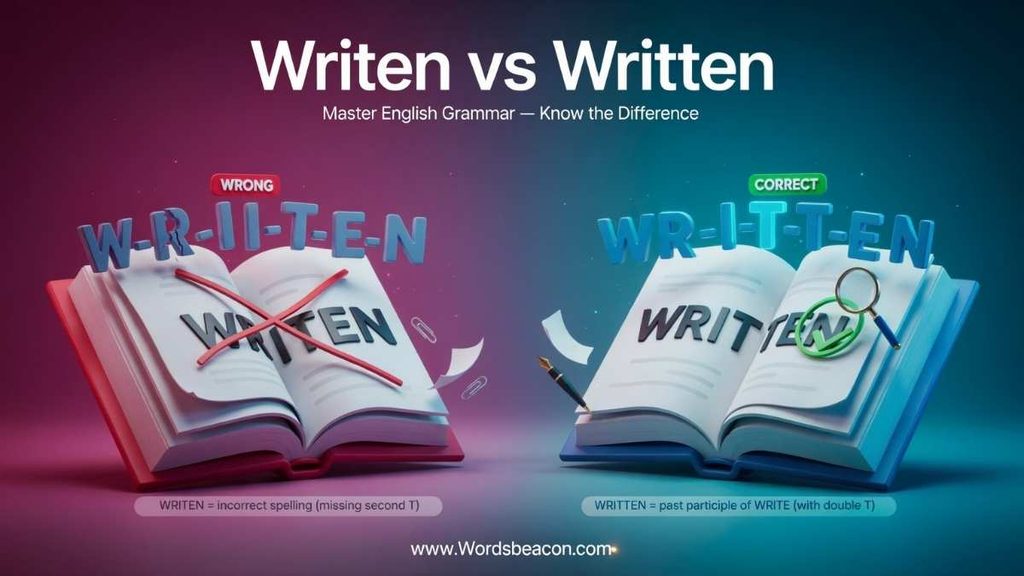
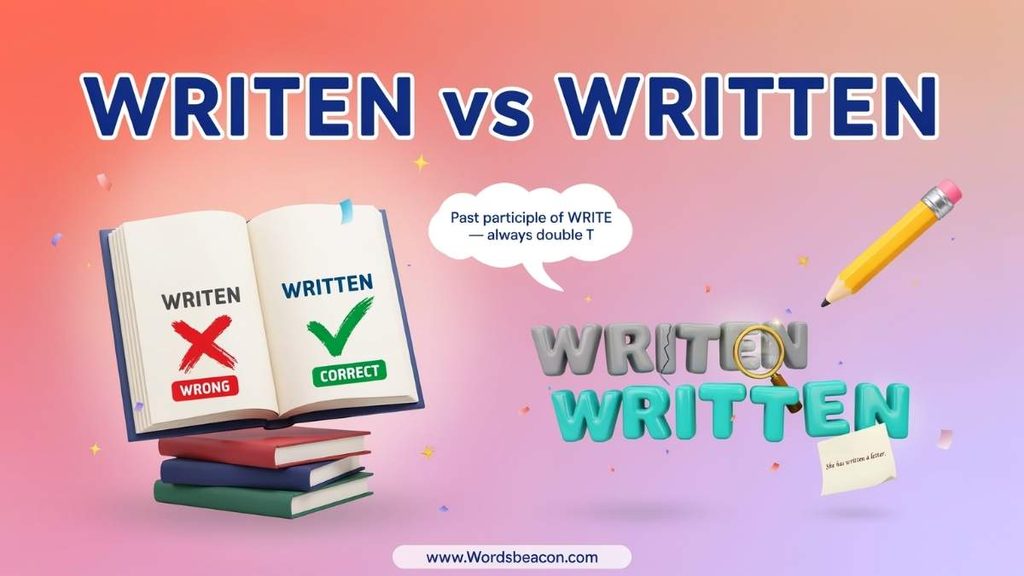
If you are wondering, “Is it writen vs written?” the answer is simple: written is correct.
The word written contains two t’s:
Written
The incorrect form leaves one of them out:
Writen
That missing t may look like a tiny mistake, but standard English recognizes only written as the correct spelling.
For example, you should write:
“I have written a letter.”
“She has written a detailed report.”
“The instructions were written clearly.”
You should not write:
“I have writen a letter.”
“She has writen a detailed report.”
“The instructions were writen clearly.”
The reason this mistake happens is understandable. When people say written aloud, the two t’s do not sound like two clearly separate consonants. As a result, writers sometimes hear the word and spell it according to the sound rather than the established spelling.
However, English spelling does not always follow pronunciation perfectly. Written is one of those words where you need to remember the spelling rather than build it entirely from the sound.
Written vs Writen Correct Spelling
The written vs writen question is really a spelling question, not a difference in meaning.
Written is the standard English word. Writen is an incorrect spelling of written.
Cambridge Dictionary identifies written as the past participle of write and also lists it as an adjective meaning expressed in writing or involving writing.
That means the correct spelling stays written whether you are talking about a letter, an exam, a report, a message, a book, or something that someone recorded in writing.
Consider these examples:
“The contract was written in clear language.”
“I have written three emails today.”
“She wrote the article last year.”
“The article was well written.”
Notice something important here. Written does not change into writen depending on the type of sentence. The spelling remains written.
So, if you are searching for the written correct spelling, remember the double t.
What Does Written Mean?
The written meaning becomes easier to understand when you connect it to the verb write.
Written generally refers to something expressed, recorded, or created through writing. It can describe something that someone has put into words on paper, a screen, a document, or another medium.
For example:
“She has written a novel.”
This means she has created a novel through writing.
Now consider:
“The rules are written on the wall.”
Here, written describes the rules because someone recorded them in written form.
The dictionary meaning also supports this distinction. Cambridge lists written as both the past participle of write and an adjective describing something expressed in writing or involving writing.
Written as the Past Participle of Write
Written is the past participle form of write.
The three main forms are:
Write → Wrote → Written
Write is the present form.
Wrote is the simple past form.
Written is the past participle.
This distinction matters because written usually needs a helping verb when you use it to form a perfect tense.
For example:
1.“I write every day.”
2.“I wrote yesterday.”
3.“I have written today.”
4.“I had written the letter before dinner.”
The structure changes because each verb form performs a different grammatical job.
Cambridge specifically identifies wrote as the past simple form of write and written as the past participle.
Written as an Adjective
Written can also function as an adjective.
In this use, it describes something that exists in written form or relates to writing.
For example:
“We received written instructions.”
“She passed the written exam.”
“Please provide written confirmation.”
“The company issued a written statement.”
In these sentences, written describes instructions, exam, confirmation, and statement.
This use explains why you often see written before nouns. It does not mean that written has suddenly become a different word. Instead, the same form performs a different grammatical role.
Learn the difference between often confused words
Who’s vs Whose difference and correct usage ?
Why Is Written Spelled With Two T’s?
If you have ever wondered why written has two t’s, you are certainly not alone.
The spelling comes from the established form of the irregular verb write. English has many irregular verbs that do not form their past and participle forms by simply adding -ed.
For example:
Go → Went → Gone
See → Saw → Seen
Take → Took → Taken
Write → Wrote → Written
So, written is not created by simply adding an ordinary ending to write. It is a historical verb form that English speakers have used and standardized over time.
The double t is therefore part of the standard spelling pattern. You cannot remove one t and still produce the correct word.
The Double T Is Easy to Miss
The biggest problem with written is visual rather than grammatical.
When you look at the word, you can clearly see the two t’s. When you hear it, however, the spelling does not announce itself.
That creates a common situation:
1.You know the word.
2.You know what it means.
3.You know how to pronounce it.
Yet somehow one t disappears when you type it.
English loves these little traps.
The safest solution is to connect written with the complete verb pattern:
Write → Wrote → Written
Once that pattern becomes familiar, writen starts to look incomplete.
Pronunciation Does Not Reveal Every Letter
Pronunciation can help you recognize a word, but it cannot always tell you how to spell it.
Written is a good example.
Cambridge gives the US pronunciation as approximately /ˈrɪt̬.ən/ and the UK pronunciation as /ˈrɪt.ən/.
The pronunciation does not clearly pronounce two separate t sounds. Therefore, spelling written based only on what you hear can lead to the common mistake writen.
This is why spelling knowledge and pronunciation knowledge need to work together rather than replace each other.
Learn the difference between often confused words
Wich vs Which difference and correct usage ?
How to Use Written in a Sentence
Understanding written grammar is easier when you look at the structures that normally surround the word.
Written often appears with have, has, or had.
For example:
“I have written the report.”
“She has written a new article.”
“They had written the instructions before the meeting.”
These sentences use written as the past participle.
Written also appears in passive constructions.
For example:
“The letter was written yesterday.”
“The report was written by the research team.”
“The instructions were written in plain English.”
In these sentences, forms of be combine with written.
You can also use written as an adjective:
“We need a written agreement.”
“She received a written warning.”
“The student completed a written test.”
The meaning stays connected to writing, but the grammatical role changes according to the sentence.
Written vs Wrote What’s the Difference?
One of the most important parts of written grammar is knowing the difference between wrote and written.
Wrote is the simple past form of write.
Written is the past participle.
That means you generally use wrote by itself to describe a completed action in the simple past.
For example:
“She wrote the letter yesterday.”
“He wrote a book last year.”
“They wrote the report after the meeting.”
Written usually appears with a helping verb when it functions as a past participle.
For example:
“She has written the letter.”
“He has written a book.”
“They have written the report.”
A useful comparison makes the difference clearer:
| Form | Grammar Role | Example |
|---|---|---|
| Write | Present form | I write emails every morning. |
| Wrote | Simple past | I wrote an email yesterday. |
| Written | Past participle | I have written an email today. |
| Writing | Present participle/gerund | I am writing an email now. |
The mistake “I have wrote the report” happens because writers sometimes treat wrote and written as interchangeable. They are not.
The correct sentence is:
“I have written the report.”
The simple past version is:
“I wrote the report.”
The difference is small in appearance, but the grammar changes completely.
Learn the difference between similar English words
Offense vs Offence difference and correct usage ?
Write, Wrote, and Written Verb Forms
The verb write is irregular, so its forms do not follow the ordinary pattern used by regular verbs.
A regular verb such as walk becomes walked in the simple past and past participle. Write does something different:
Write → Wrote → Written
This pattern appears throughout English grammar.
Write
Write is the present form.
“I write in my journal every evening.”
“He writes technical reports.”
“They write letters to their clients.”
Wrote
Wrote is the simple past.
“She wrote the message yesterday.”
“He wrote a short story last weekend.”
“They wrote the report after lunch.”
Written
Written is the past participle.
“She has written the message.”
“He had written a short story before the class began.”
“They have written the report.”
Written can also act as an adjective:
“It was a beautifully written story.”
That last example is especially useful because it shows how naturally written can move beyond its role as a verb form.
Learn the difference between similar English words
Man vs Men difference and Correct Usage ?
Written Sentence Examples
The best way to understand a word is often to see it doing real work in different sentences.
Everyday Written Examples
“I have written your address down.”
“She has written a note for you.”
“The message was written on a piece of paper.”
“Have you written your name on the form?”
These examples show how written works in ordinary communication.
Academic Written Examples
“The student has written a detailed essay.”
“The exam included a written section.”
“Students must submit a written response.”
“The professor requested a written explanation.”
Academic English frequently uses written because schools and universities distinguish between spoken and written communication.
Professional Written Examples
“We need written confirmation before proceeding.”
“The manager has written a formal response.”
“The company issued a written statement.”
“The agreement must be written clearly.”
Professional communication often relies on written records because they provide a stable record of what someone communicated.
Formal and Legal Writing
Written also appears frequently in formal documents.
For example:
“The parties entered into a written agreement.”
“The decision was provided in written form.”
“The organization submitted a written statement.”
Here, written emphasizes that information exists as an official record rather than only as something spoken.
Learn the difference between similar English words
Savior vs Saviour Difference and Usage?
Writen vs Written Examples
When you compare writen vs written examples, the difference becomes immediately obvious.
| Incorrect | Correct | Reason |
|---|---|---|
| I have writen a letter. | I have written a letter. | Written has two t’s. |
| She has writen the report. | She has written the report. | Written is the past participle. |
| The note was writen yesterday. | The note was written yesterday. | The standard spelling is written. |
| He writen the answer. | He wrote the answer. | Wrote is needed for simple past. |
| The essay is well writen. | The essay is well written. | Written is the correct adjective form. |
The fourth example is especially important. Replacing writen with written does not automatically fix every sentence. Sometimes the real problem is the verb form.
For example:
“He writen the answer.”
is wrong for two reasons.
First, writen is misspelled.
Second, the sentence needs the simple past form wrote:
“He wrote the answer.”
If you want written, you need an appropriate grammatical structure:
“He has written the answer.”
That is why understanding writen vs written grammar involves more than memorizing two t’s.
Is Writen a Word?
If you are asking, “Is writen a word?” the answer in standard English is no.
Writen is generally treated as a misspelled version of written. It does not serve as a standard alternative spelling in modern English.
You may encounter writen in informal online writing, messages, comments, student work, or typing errors. Its appearance in real-world text does not make it an accepted spelling.
The correct word is written.
So, if a grammar checker underlines writen, it is identifying a spelling error rather than suggesting another legitimate English variant.
Is Written a Word?
Yes. Written is a standard English word.
It has two main grammatical uses. First, it functions as the past participle of write. Second, it can function as an adjective describing something expressed in writing or related to writing. Cambridge lists both uses in its dictionary entry.
For example:
“I have written a letter.”
This uses written as a past participle.
“I received written instructions.”
This uses written as an adjective.
Writen vs Written Grammar
The most useful way to understand writen vs written grammar is to separate spelling from grammar.
The spelling question has a simple answer:
Written is correct.
The grammar question requires more attention because written has several uses.
Written With Have, Has, and Had
Written commonly follows have, has, or had in perfect constructions.
Examples include:
“I have written the report.”
“She has written three pages.”
“They had written the letter before the meeting.”
These structures show completed actions in relation to another time or situation.
Written in Passive Constructions
Written can also appear after forms of be.
For example:
“The letter was written yesterday.”
“The reports were written by the team.”
“The instructions are written in simple language.”
The word written remains unchanged even though the form of be changes.
Written as an Adjective
Written can directly describe a noun.
For example:
1.“written agreement”
2.“written exam”
3.“written statement”
4.“written instructions”
5.“written communication”
The meaning generally relates to something recorded in writing.
Learn the difference between similar English words
Parent’s vs Parents’ Difference and usage?
Why Writen Is a Common Spelling Mistake
The spelling error does not usually happen because writers misunderstand the meaning of written. Most people who type writen already know exactly what they want to say.
The problem usually comes from the relationship between spelling and pronunciation.
Written sounds compact. The two t’s do not appear as two clearly separate sounds. As a result, someone may naturally type what they think they hear.
Fast typing can make the problem worse. When you type quickly, repeated letters are easy to skip, especially in familiar words. A missing consonant can slip through before you notice it.
There is also a pattern problem. Some English words contain doubled consonants, while others do not. Because spelling rules do not always behave consistently across English vocabulary, learners often memorize individual word forms.
The easiest solution is to remember written as part of the irregular verb sequence rather than as an isolated word.
Write → Wrote → Written
That sequence gives you a reliable spelling anchor.
Written Pronunciation
The written pronunciation can vary slightly between major English varieties, but the word remains the same in spelling.
Cambridge lists a US pronunciation around /ˈrɪt̬.ən/ and a UK pronunciation around /ˈrɪt.ən/.
The first syllable receives the main stress.
The important point for spelling is that pronunciation does not give you a perfect letter-by-letter map. English contains many words where spelling preserves historical forms that pronunciation has changed over time.
Written is one of them.
So, if you are looking for written pronunciation and spelling together, remember that the sound may not reveal the double t.
Learn the difference between confusing more English words
Manual vs Manuel Difference and usage ?
Written in Different Types of Writing
Written appears across nearly every area of English communication.
Everyday Messages
People use written when talking about notes, texts, emails, reminders, and other forms of communication.
For example:
“I have written the address in my notebook.”
“Have you written to your friend?”
“She has written a quick message.”
The word works naturally in both casual and formal contexts.
Academic Writing
Academic contexts use written frequently because schools and universities distinguish between spoken and written work.
Examples include written exam, written assignment, written response, written analysis, and written explanation.
For example:
“The students completed a written exam.”
“The professor requested a written explanation.”
Professional Communication
In workplaces, written often describes documents that create a record.
You may encounter written agreement, written confirmation, written notice, written statement, or written communication.
For example:
“Please provide written confirmation.”
“The company sent a written response.”
“The employee received written instructions.”
Formal Documents
Written also appears in official and legal contexts because formal communication often needs a documented record.
For example:
“The agreement was provided in written form.”
“The organization submitted a written statement.”
“The terms were included in the written contract.”
In each case, written emphasizes the recorded nature of the information.
Written vs Writen in American English
American English uses written as the standard spelling.
There is no American spelling variation that changes written to writen.
The same standard form appears in common expressions such as written agreement, written statement, written exam, and written communication.
Cambridge’s American Dictionary entry identifies written as the past participle of write and gives the same core spelling.
Therefore, if you are writing for an American audience, use written.
Written vs Writen in British, Canadian, and Australian English
The spelling remains written across major English varieties.
British English uses written.
Canadian English uses written.
Australian English uses written.
American English uses written.
This is different from spelling pairs such as color and colour or center and centre, where regional conventions can produce different standard spellings.
Written does not have that kind of regional variation.
Key Regional Takeaway
Whether you are writing an American email, a British essay, a Canadian report, or an Australian article, the correct form is written.
The form writen is not a regional alternative.
It is simply a spelling mistake.
Learn the difference between confusing more English words
Molding vs Moulding which one is correct and usage ?
Written Word Forms and Related Words
Understanding related forms makes the spelling easier to remember.
The main forms are:
Write → Wrote → Written → Writing
Each form has its own grammatical role.
Write refers to the present form.
Wrote refers to the simple past.
Written refers to the past participle and can also function as an adjective.
Writing refers to the present participle or gerund.
Consider this short sequence:
1.“I write every morning.”
2.“I wrote yesterday.”
3.“I have written today.”
4.“I am writing now.”
The sentence structure changes, but the connection between all four forms remains clear.
Written vs Writing
The Written and writing are related, but they do not perform the same grammatical job.
Written usually describes something completed, recorded, or expressed in writing.
Writing often describes the activity or process of creating written material.
For example:
“She has written a novel.”
“She is writing a novel.”
The first sentence focuses on the completed result. The second focuses on the activity in progress.
Cambridge also defines writing as the activity of creating written work, as well as something that has been written or a person’s style of forming letters.
How to Remember the Correct Spelling
The easiest way to remember the correct spelling of written is to stop treating it as a random collection of letters.
Connect it to the verb family:
Write → Wrote → Written
Then remember one visual fact:
Written has double t.
If you type writen, your brain has dropped one of the two t’s.
You can also use a simple sentence test.
If the sentence contains have, has, or had and you need the past participle of write, written is usually the form you need.
For example:
“I have written the email.”
“She has written the report.”
“They had written the instructions.”
If you are describing a noun, written can also work as an adjective:
1.“written instructions”
2.“written agreement”
3.“written exam”
When you mean a completed action in the simple past, however, use wrote:
“She wrote the email yesterday.”
That small distinction will solve many written grammar problems.
Learn the difference between confusing more English words
Farther vs Further difference and usage ?
Practice Session Writen vs Written
Fill in each blank with the correct form: write, wrote, written, or writing.
- I have ______ a letter to my teacher.
- She ______ the report yesterday.
- The instructions were clearly ______.
- He is ______ an email to his manager.
- Have you ______ your name on the form?
- They ______ a short story last weekend.
- The student submitted a ______ assignment.
- We have ______ several pages today.
- She ______ the message before leaving.
- The agreement was ______ in simple language.
- I am ______ a note for you right now.
- He has ______ three articles this month.
- Maria ______ the letter yesterday afternoon.
- The company sent a ______ statement to its employees.
- They had ______ the report before the meeting started.
- Please ______ your answer in the space provided.
- The essay was well ______ and easy to understand.
- She ______ a detailed explanation last night.
- I have ______ everything you asked for.
- The instructions are ______ on the notice board.
Answers
- written
- wrote
- written
- writing
- written
- wrote
- written
- written
- wrote
- written
- writing
- written
- wrote
- written
- written
- write
- written
- wrote
- written
- written
Here’s a trusted source for clear more words Comparison:
FAQs
Why does “written” have two t’s?
“Written” has two t’s because that is the standard spelling of the past participle of “write.” The correct verb pattern is “write, wrote, written,” so “writen” is a spelling mistake.
Can “written” be used as an adjective?
Yes, “written” can function as an adjective when it describes something expressed or recorded in text. For example, “Please read the written instructions before starting.”
Can “written” describe a document?
Yes. You can use “written” to describe documents, agreements, reports, statements, instructions, and other forms of text. For example, “We received a written confirmation from the company.”
When should you use “written” instead of “wrote”?
Use “written” when the grammar calls for a past participle, often with “have,” “has,” or “had.” Use “wrote” for the simple past. For example, “I wrote the letter yesterday” but “I have written the letter.”
Can “written” be used without “have,” “has,” or “had”?
Yes. “Written” can appear without these helping verbs when it works as an adjective or occurs in a passive construction. For example, “The written instructions were easy to understand.”
What are the main verb forms of “write”?
The main forms are “write,” “wrote,” “written,” and “writing.” “Write” is the base form, “wrote” is the simple past, “written” is the past participle, and “writing” is the present participle or gerund.
Why do people accidentally spell “written” as “writen”?
The mistake usually happens because the second “t” is easy to overlook. The pronunciation does not clearly highlight both letters either. However, standard English spelling requires “written” with two t’s.
Can “written” refer to something created earlier?
Yes. “Written” can describe something created in the past, particularly when it appears with a perfect tense or passive construction. For example, “She has written several articles this year.”
What is the opposite of written communication?
Depending on the context, the opposite may be spoken, oral, or verbal communication. Written communication uses text, while spoken communication relies primarily on speech.
Does “written” only refer to handwriting?
No. “Written” does not mean handwriting alone. It can refer to handwritten, typed, printed, or digitally produced text, including emails, reports, books, messages, and online articles.
Can “written” describe digital content?
Yes. Digital content can be described as “written” because it uses text-based communication. For example, an email, online article, report, or text message can all be written content.
What is the grammatical difference between “written” and “wrote”?
“Wrote” is the simple past form of “write,” while “written” is the past participle. For example, “She wrote the report yesterday” uses the simple past, whereas “She has written the report” uses the past participle.
Can “written” be used with “will have”?
Yes. “Will have written” is the future perfect form. It describes something that will be completed before a specific point in the future. For example, “By Monday, I will have written the final draft.”
How is “had written” used in a sentence?
“Had written” is the past perfect form of “write.” It shows that one writing action happened before another past event. For example, “He had written the report before the meeting started.”
Is “written” appropriate in formal writing?
Yes. “Written” is standard English and works well in both everyday and formal contexts. You can use it in academic papers, business documents, professional emails, reports, and official communication.
Can “written” be followed by “by”?
Yes. In a passive sentence, “written by” can identify the person who created a piece of text. For example, “The report was written by the research team.”
What does “written record” mean?
A “written record” is information preserved in text so it can be read, checked, or used as a reference later. It might be a report, note, agreement, log, or official document.
What is a “written statement”?
A “written statement” is an explanation, declaration, or account provided in written form. It can appear in professional, academic, personal, legal, or official situations.
What does “written communication” mean?
“Written communication” means exchanging information through text. Letters, emails, reports, notices, instructions, and messages are all common forms of written communication.
What is an easy way to remember the spelling of “written”?
Remember the pattern “write → wrote → written.” The final form contains two t’s: “written.” If you type “writen,” remember that one t has gone missing and add the second one.
conclusion
The difference between “writen” and “written” is easy to fix once you remember one small detail: written has two t’s. “Writen” is not the standard spelling, so avoid it in your writing.
The easiest way to remember the correct form is the verb pattern “write → wrote → written.” Use “wrote” when talking about a completed action in the past, such as “She wrote a letter yesterday.” Use “written” with helping verbs such as “have,” “has,” or “had,” as in “She has written a letter.”
So, the next time you type “writen,” stop for a second and check those t’s. One extra letter may seem tiny, but in English spelling, that little “t” does some serious work.

Luna AJS is an experienced blogger and dedicated language enthusiast at Words Beacon. She specializes in making English grammar, spelling, vocabulary and commonly confused words easy to understand. She provides clear explanations, practical examples to help readers write with confidence.