
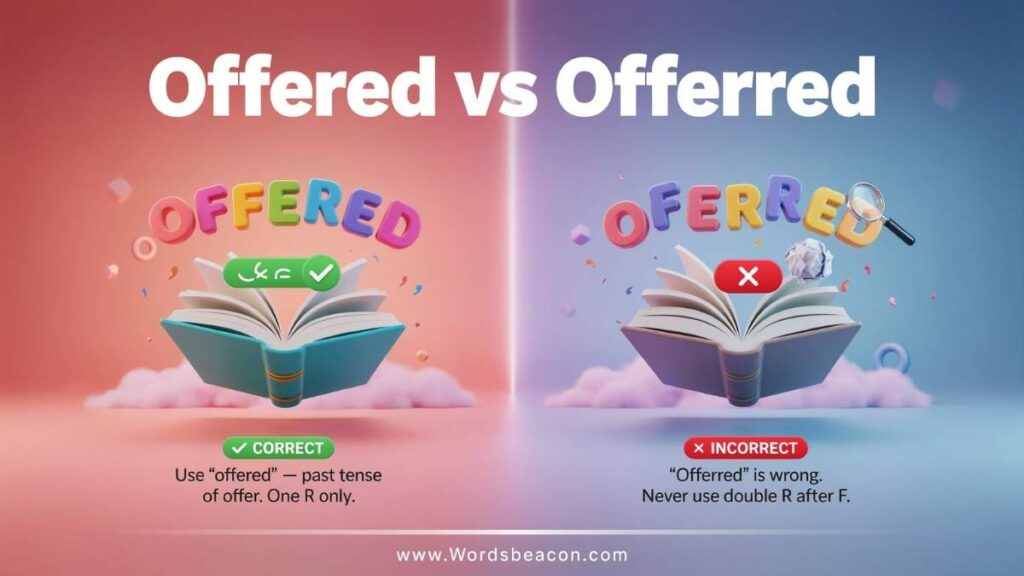
English spelling can make even a familiar word look suspicious. If you have ever paused between offered vs offerred, you are definitely not alone. The extra r may seem tempting, especially when words like referred and preferred use two r’s. However, offered vs offerred has a simple answer: offered is correct, while offerred is a misspelling. In this guide, you’ll learn what offered means, how to spell it correctly, and how to use it naturally in a sentence. You’ll also see why the extra r does not belong there. By the end, this small spelling mystery should feel much easier, with no unnecessary r causing trouble.
quick answer
| Feature | Offered | Offerred |
|---|---|---|
| Correct spelling | Yes | No |
| Base verb | offer | offer |
| Past tense | offered | Incorrect |
| Past participle | offered | Incorrect |
| Meaning | gave, proposed, provided, or made available | No standard meaning |
| Standard English | Yes | No |
| American English | Yes | No |
| British English | Yes | No |
Fix common more word mistakes in English
Stellar vs Steller difference and usage?
Offered vs Offerred Understanding the Difference
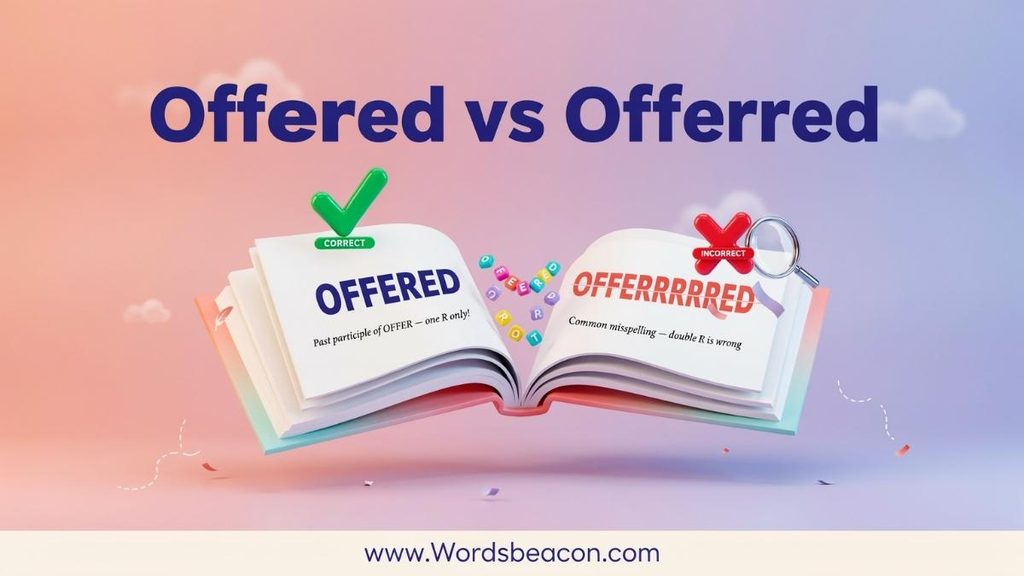
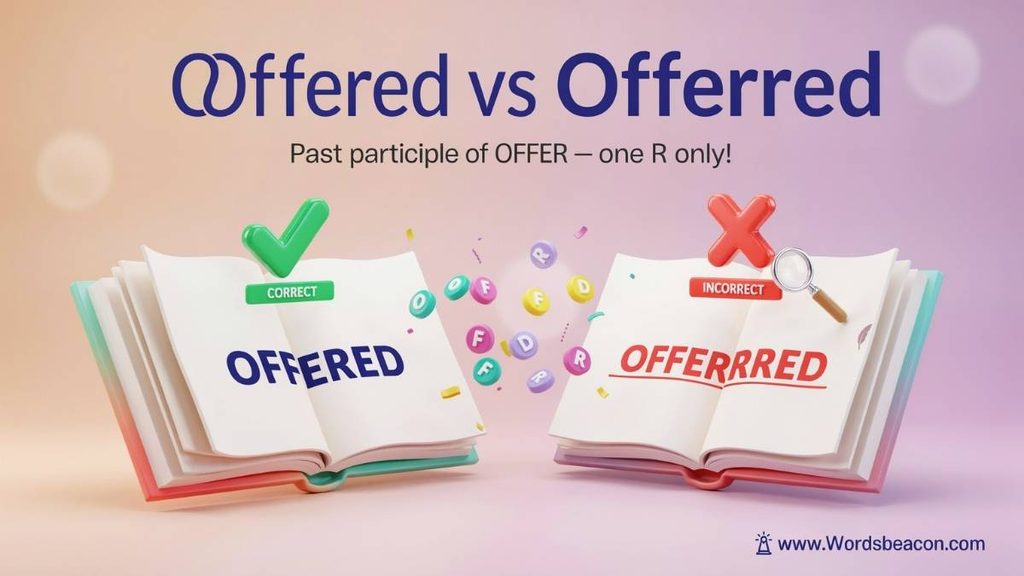
The correct spelling is offered.
The spelling “offerred” is incorrect in standard English. It contains an extra r that does not belong in the past tense or past participle of “offer.”
For example:
She offered me a seat.
The company offered him a new position.
They offered to help with the project.
In each sentence, offered has only one r.
The confusion usually happens because English has several verbs that double a final consonant when they take an ending. For example, “refer” becomes “referred,” and “prefer” becomes “preferred.” That pattern can make “offerred” look reasonable at first glance.
However, English spelling does not apply the same pattern to every verb. The correct form is offered, not offerred.
What Does Offered Mean?
Offered Definition
Offered is the past tense and past participle of the verb “offer.” It describes something that someone gave, proposed, presented, made available, or said they were willing to do.
The exact meaning depends on the sentence.
For example:
The manager offered me a promotion.
Here, offered means the manager proposed or presented a promotion.
In another sentence:
She offered to drive us home.
Here, offered means she said that she was willing to drive.
Consider one more example:
The store offered a discount to students.
In this case, offered means the store made a discount available.
Therefore, the offered meaning can change slightly with context, but the basic idea remains connected to giving, proposing, providing, or making something available.
How Offered Is Used
The verb “offer” has several common uses, so its past form offered appears in many types of writing.
You can use offered when someone gives something to another person:
He offered me a glass of water.
You can also use it when someone proposes an action:
Maya offered to help with the presentation.
It can describe something made available:
The website offered several useful resources.
It can also describe a financial proposal:
The buyer offered $20,000 for the car.
The surrounding words tell you which meaning applies. That is why offered is such a flexible word.
Offered in Different Contexts
In everyday conversation, offered often describes kindness or willingness.
My neighbor offered to watch the dog.
In professional communication, it may describe a job, service, opportunity, or proposal.
The company offered her a full-time position.
In academic writing, offered can describe an explanation, interpretation, solution, or argument.
The researchers offered several possible explanations.
In business writing, it may refer to products, prices, services, or opportunities.
The company offered customers a lower introductory price.
So, although the spelling remains exactly the same, the meaning can shift according to context.
Learn the difference between similar English words
Suit vs Suite correct spelling and usage ?
Is Offerred a Word?
No. “Offerred” is not the standard spelling of the past tense or past participle of “offer.”
If you write “offerred,” most readers will understand what you mean. However, they will still recognize it as a spelling mistake. That matters in professional emails, academic assignments, resumes, articles, applications, and other polished writing.
The correct spelling is offered.
Why People Write Offerred
The most common reason for writing offerred is simple confusion about consonant doubling.
English contains many verbs that double their final consonant before adding an ending. Consider these examples:
stop → stopped
plan → planned
refer → referred
prefer → preferred
Because “refer” becomes “referred” and “prefer” becomes “preferred,” it is easy to assume that “offer” should become “offerred.”
It does not.
The brain often recognizes spelling patterns before it remembers individual words. Once you have seen several words with double consonants, “offerred” can look surprisingly believable.
Unfortunately, believable is not the same as correct.
Offerred Correct Spelling vs Offered Correct Spelling
When comparing offerred spelling with offered spelling, there is only one standard choice:
offered
The word contains one r.
The incorrect form contains two r’s:
offerred
That extra r is the entire spelling problem.
A quick visual comparison makes the difference easier to remember:
offer → offered
offer → offerred
The first form is correct. The second adds an unnecessary r.
What to Use Instead of Offerred
Whenever you are tempted to write offerred, replace it with offered.
Incorrect:
The company offerred me a position.
Correct:
The company offered me a position.
Incorrect:
She offerred to pay for dinner.
Correct:
She offered to pay for dinner.
The correction is small, but it makes the sentence standard and polished.
Learn the difference between similar English words
Arial vs Aerial correct spelling and usage ?
Why Is Offered Correct?
The easiest way to understand the correct spelling is to start with the base verb.
The Base Verb Offer
The base form is offer.
You use this form for the present tense and after certain helping verbs.
They offer free delivery.
We offer several options.
I can offer some advice.
When you need the past form, the correct word is offered.
They offered free delivery last year.
We offered several options.
I offered some advice.
The spelling does not become offerred.
Offered as the Past Tense and Past Participle
Offered serves as both the past tense and past participle of offer. Standard grammar references list offered as both forms.
As a past tense verb:
The company offered me a discount.
As a past participle:
The company has offered me a discount.
It can also appear with forms of “be”:
I was offered a discount.
She was offered a position.
The form remains offered throughout these structures.
Why Not Offerred?
The answer is not that English never doubles consonants. It does.
The important point is that consonant doubling follows specific spelling patterns rather than a simple “double the last consonant” rule.
For offer, the standard past form is offered.
Therefore:
offer + ed → offered
Not:
offer + red → offerred
The extra r does not belong in the standard form.
Offered Spelling Rule Explained
The offered spelling often becomes confusing when learners compare it with verbs such as refer and prefer.
When Final Consonants Double
English sometimes doubles a final consonant before adding a suffix. This happens in forms such as:
stop → stopped
plan → planned
admit → admitted
refer → referred
prefer → preferred
However, you cannot apply this pattern blindly to every verb ending in a consonant.
Spelling depends on the structure and history of individual words, as well as established English conventions.
That is why memorizing one broad rule can sometimes create a new spelling mistake while fixing another.
Why Offer Does Not Double the R
The correct form of offer in the past tense is offered.
The word already ends in “r,” but that does not mean you automatically add another r before “ed.”
Compare the forms:
offer → offered
refer → referred
prefer → preferred
The visual difference is easy to notice. Yet the words follow different spelling patterns.
The safest approach is to learn the standard form of common verbs rather than assume that every similar-looking verb behaves identically.
Preferred, Referred, and Other Confusing Examples
Words such as preferred and referred can create the biggest confusion because they really do contain double r’s.
For example:
She preferred the blue design.
He referred me to another specialist.
They referred to the earlier report.
Those spellings are correct.
However:
She offerred the blue design.
is incorrect.
The correct version is:
She offered the blue design.
The difference becomes much easier to remember when you treat offer as its own word rather than forcing it into the spelling pattern of refer or prefer.
Learn the difference between similar English words
Writen vs Written correct spelling and usage ?
Grammar of Offered
Offered Past Tense
The past tense of offer is offered.
Use it when an action happened in the past.
She offered me a ride yesterday.
The teacher offered extra help after class.
They offered a reasonable price for the house.
The time expression can make the past meaning especially clear, but the verb itself already carries the past form.
Offered Past Participle
The past participle of offer is also offered.
It commonly appears with helping verbs such as has, have, had, or forms of be.
They have offered several solutions.
She had offered to help before the meeting started.
He was offered a better position.
The form does not change to offerred.
Common Sentence Patterns
Offered frequently appears in several useful structures.
One common pattern is offered + someone + something:
The company offered her a scholarship.
Another is offered + to + verb:
He offered to carry the bags.
You can also use offered + something + to + someone:
She offered some advice to her friend.
Another common structure uses the passive voice:
I was offered a seat.
Although passive constructions are grammatically correct, active sentences often sound more direct:
The receptionist offered me a seat.
Understanding these patterns makes it easier to use offered naturally rather than simply memorizing its spelling.
Learn the difference between confusing word pairs
Offense vs Offence difference and correct usage ?
Offered vs Offerred Examples That Make the Difference Clear
The quickest way to settle the offered vs offerred question is to see the word working in real sentences.
| Base Verb | Correct Past Form | Common Mistake | Example |
|---|---|---|---|
| offer | offered | offerred | She offered to help. |
| refer | referred | refered | He referred to the report. |
| prefer | preferred | prefered | She preferred the smaller room. |
| plan | planned | planed | We planned the trip carefully. |
This comparison shows why spelling can be tricky. Different verbs use different patterns.
Correct Examples With Offered
The teacher offered extra practice before the exam.
She offered me a cup of coffee.
The company offered him a promotion.
They offered to repair the damaged equipment.
The hotel offered free breakfast.
He offered a reasonable explanation.
The store offered customers a seasonal discount.
Each example uses the same correct spelling: offered.
Common Incorrect Examples With Offerred
The company offerred me a position.
She offerred to drive home.
The teacher offerred extra help.
They offerred several solutions.
These sentences contain the same mistake. Replace offerred with offered, and the problem disappears.
Offered in Everyday Communication
Offered is common in ordinary conversation.
You might say:
I offered to pick her up.
He offered me some advice.
They offered us a place to stay.
She offered to help with dinner.
Because the word appears so frequently, learning the correct spelling pays off quickly. One small spelling mistake can otherwise repeat itself across emails, messages, assignments, and documents.
Learn the difference between confusing word pairs
Emaculate vs Immaculate correct spelling and usage ?
Offered vs Offerred in Formal and Academic Writing
Professional Writing
Professional writing rewards accuracy. A spelling error such as offerred can make an otherwise polished email look rushed.
Consider this sentence:
We are pleased to confirm that the company offered you the position.
It looks clear and professional.
Now compare it with:
We are pleased to confirm that the company offerred you the position.
The meaning remains understandable, but the spelling error distracts the reader.
When writing resumes, cover letters, business emails, reports, or proposals, always use offered.
Academic Writing
Academic writing requires careful word choice and spelling.
For example:
The study offered several possible explanations for the results.
The researchers offered a different interpretation.
The evidence offered limited support for the theory.
In each sentence, offered works as the correct past form of offer.
Everyday Messages
Casual writing gives you more freedom with tone, but correct spelling still matters.
A text message such as “She offerred to help” may not cause a serious problem. Still, the standard spelling is offered.
Once the correct form becomes familiar, there is little reason to use the incorrect one.
Offering or Offerring?
The same spelling confusion can appear with the present participle.
The correct form is offering.
The incorrect form is offerring.
For example:
She is offering free advice.
The store is offering a discount.
They are offering several options.
Notice that offering contains one r.
The word follows the established spelling of offer when the “-ing” ending is added.
So the correct forms are:
offer
offered
offering
offers
The incorrect forms are:
offerr
offerred
offerring
If you remember the word family, several common spelling mistakes become easier to avoid.
Offer or Offerr?
The base verb is offer.
Offerr is not the standard spelling.
For example:
Correct: I want to offer some advice.
Incorrect: I want to offerr some advice.
Correct: They offer several services.
Incorrect: They offerr several services.
The extra r does not belong in the base form, either.
This gives you a useful word-family check:
offer → offers → offered → offering
Once you know the base form, the related forms become much easier to recognize.
Learn the difference between confusing word pairs
Who’s vs Whose difference and correct usage ?
Offered Pronunciation
How to Pronounce Offered
In American English, offer is commonly pronounced with the first syllable receiving the main stress. Offered follows the same basic sound pattern, with the added “-ed” forming the past tense and past participle.
A simple approximation is:
offered → “AW-ferd”
The exact pronunciation can vary slightly depending on accent.
Does Pronunciation Explain the Spelling?
Not completely.
English pronunciation and spelling do not always match perfectly. That is one reason spelling mistakes survive even when a word sounds familiar.
You may hear “offered” many times without noticing whether the written form contains one r or two.
That is why visual memory helps.
Think:
offer → offered
not:
offer → offerred
The pronunciation will not reliably tell you how many r’s to write.
Offered in American and British English
American English
Offered is the standard spelling in American English.
For example:
The company offered me a new position.
The school offered several scholarships.
She offered to help.
British English
Offered is also the standard spelling in British English.
For example:
The company offered him a position.
The university offered several courses.
She offered to help with the project.
Therefore, there is no American-versus-British spelling difference here.
You do not need to switch between offered vs offerred depending on the country. And Offered is correct in both varieties of English.
Learn the difference between often confused words
Wich vs Which difference and correct usage ?
Offered Synonyms and Related Words
Offered Synonyms
The best synonym depends on the context.
1.When offered means “gave,” you might use gave or provided.
2.When it means “suggested,” proposed or suggested may work.
3.When it means “made available,” provided or made available may fit better.
4.When it describes willingness, volunteered or agreed may sometimes work.
For example:
1.She offered help.
2.She provided help.
3.She volunteered to help.
These sentences are related, but they do not always carry exactly the same meaning.
That distinction matters because synonyms should match the situation rather than simply replace one word mechanically.
Offer vs Provide
1.Offer and provide are closely related, but they are not always interchangeable.
2.Offer often focuses on making something available or showing willingness.
She offered to help with the project.
Provide usually emphasizes actually supplying something.
The company provided technical support.
Consider another example:
The hotel offered free breakfast.
This emphasizes that the breakfast was available as part of the service.
The hotel provided breakfast.
This can sound more focused on the actual supplying of breakfast.
The difference is subtle, but context determines which word sounds most natural.
Learn the difference between often confused words
Man vs Men difference and Correct Usage ?
A Simple Way to Remember the Spelling

Remember the Word Family
One of the easiest ways to remember offered is to keep the entire word family together:
offer
offers
offered
offering
Once you know that family, the extra r in offerred starts to look out of place.
You can also remember the simple pattern:
offer → offered
The spelling changes only as needed for the standard verb form. It does not become offerred.
Use the One-R Check
When you are unsure how to spell offered, pause for a second and look at the middle of the word.
Correct:
offered
Incorrect:
offerred
The correct word has one r.
This tiny visual check can prevent a surprisingly common spelling mistake.
Compare It With a Known Word
If you remember that offer is spelled with one r, connect the past form directly to it:
offer → offered
Do not build the past form by guessing from words such as referred or preferred. Those words can follow different spelling patterns.
Learn the difference between often confused words
Parent’s vs Parents’ Difference and usage?
Practice Session Offered vs Offerred
Fill in each blank with the correct form: offered vs offerred.
- The company ________ me a full-time position.
- She ________ to help with the project.
- The restaurant ________ us a free dessert.
- He ________ a reasonable price for the car.
- They ________ several solutions to the problem.
- My teacher ________ some useful advice before the exam.
- The hotel ________ free breakfast to its guests.
- Sarah ________ to drive me home after work.
- The manager ________ him a promotion last week.
- The store ________ a discount to new customers.
- I was ________ a chance to join the team.
- The company has ________ several training programs.
- She ________ me a cup of coffee.
- They ________ to repair the damaged equipment.
- The organization ________ free legal assistance.
- He ________ an explanation for the mistake.
- The school ________ students extra time to finish the test.
- We ________ them a better deal.
- The job applicant was ________ an interview.
- She ________ to pay for the meal.
Answers
- offered
- offered
- offered
- offered
- offered
- offered
- offered
- offered
- offered
- offered
- offered
- offered
- offered
- offered
- offered
- offered
- offered
- offered
- offered
- offered
Here’s a trusted source for clear more words Comparison:
FAQs
Why is “offerred” commonly misspelled?
“Offerred” often appears because writers compare “offer” with verbs such as “refer” and “prefer,” which become “referred” and “preferred.” However, “offer” follows a different spelling pattern. Its correct past form is “offered,” with one r.
Does the word “offer” become “offered” in the past tense?
Yes. “Offered” is the simple past tense of “offer.” For example, “The company offered me a position” describes an offer that happened in the past.
Does “offered” work as a past participle?
Yes. “Offered” serves as both the past tense and past participle of “offer.”
For example, “She offered to help” uses the past tense, while “They have offered several solutions” uses the past participle.
How many r’s are in “offered”?
“Offered” contains one r. Its spelling is o-f-f-e-r-e-d. The form “offerred” contains an extra r and is incorrect.
Why does “preferred” have two r’s but “offered” has one?
English spelling patterns do not work identically for every verb. “Prefer” becomes “preferred,” while “offer” becomes “offered.” Therefore, the spelling of “preferred” should not be used as a model for spelling “offered.”
Can “offered” mean “made available”?
Yes. “Offered” can mean that something was made available for someone to use, receive, buy, or consider.
For example, “The store offered free delivery” means free delivery was available.
Can “offered” mean that someone was willing to help?
Yes. When followed by “to” and a verb, “offered” can show willingness to do something.
For example, “James offered to help with the move.”
What sentence structure commonly follows “offered to”?
“Offered to” is commonly followed by the base form of a verb.
For example, “She offered to explain the problem.” Here, “offered” shows willingness, while “explain” describes the action she was willing to perform.
Can “offered” describe a job or position?
Yes. “Offered” frequently describes a job, promotion, position, or opportunity that someone receives.
For example, “Mia was offered a position at the company.”
Can “offered” describe a price?
Yes. In buying and selling, “offered” can describe a price someone proposed for something.
For example, “The buyer offered $10,000 for the car.”
What is the difference between “offered” and “gave”?
“Offered” usually suggests that something was proposed or made available, while “gave” generally indicates that someone actually transferred or handed something to another person.
For example, “She offered me some advice” means she made the advice available. “She gave me some advice” indicates that she actually provided it.
What is the difference between “offered” and “provided”?
“Offered” often focuses on making something available or expressing willingness, while “provided” usually emphasizes actually supplying something.
For example, “The company offered technical support” focuses on the support being available. “The company provided technical support” emphasizes that the support was supplied.
Can “offered” be used in formal writing?
Yes. “Offered” works naturally in professional, academic, business, and formal writing.
For example, “The research offered a possible explanation for the findings.”
Can “offered” be used in passive sentences?
Yes. “Offered” commonly appears in passive constructions when the person receiving something matters more than the person making the offer.
For example, “She was offered a promotion.”
What is the difference between “offered” and “was offered”?
“Offered” can describe what someone did, while “was offered” focuses on what someone received.
For example, “The manager offered Sarah a position” focuses on the manager’s action. “Sarah was offered a position” focuses on Sarah receiving the opportunity.
Is “offerring” related to the same spelling mistake?
Yes. “Offerring” is another incorrect form that adds an unnecessary r. The correct present participle is “offering.”
The correct word family is offer, offers, offered, and offering.
Is “offered” spelled the same way in American and British English?
Yes. “Offered” is the standard spelling in both American and British English. Neither variety uses “offerred” as the standard form.
Can pronunciation help you remember how to spell “offered”?
Pronunciation can help you recognize the word, but it does not reliably show how many letters to write. The safest approach is to remember the spelling as “offer + ed,” giving “offered.”
What are the main forms of the verb “offer”?
The main forms are offer, offers, offered, and offering. Learning these forms together makes the correct spelling easier to remember and helps prevent mistakes such as “offerred” and “offerring.”
What is the easiest way to remember “offered”?
Connect the past form directly to the base verb: offer → offered. Remember that the correct form keeps one r. If you see “offerred,” the extra r is your clue that the spelling needs correction.
conclusion
The offered vs offerred confusion is easy to fix once you spot the extra letter. The correct spelling is offered, while offerred is simply a misspelling. If you are talking about something that happened in the past, use offered: “She offered to help me.” The same form also works as the past participle: “They have offered several solutions.”
The tricky part is that English has words such as referred and preferred, which really do double the r. That can make offerred look perfectly reasonable at first glance. However, offer does not follow that pattern. Just remember the simple word family: offer, offers, offered, offering.
So, when you are stuck between offered vs offerred, do not overthink it. Choose offered. One r is enough, and your spelling will be right every time.

Luna AJS is an experienced blogger and dedicated language enthusiast at Words Beacon. She specializes in making English grammar, spelling, vocabulary and commonly confused words easy to understand. She provides clear explanations, practical examples to help readers write with confidence.