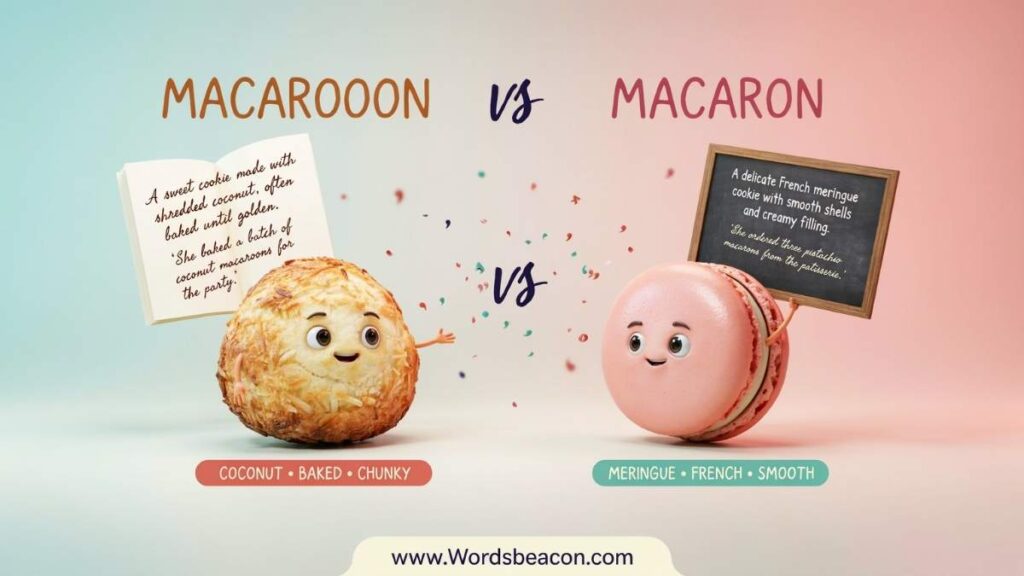
Macaron vs macaroon can be confusing because the two words look and sound almost alike. However, they describe two very different cookies. A macaron is a colorful French cookie made with almond flour, featuring smooth shells and a sweet filling. A macaroon, on the other hand, is usually a chewy coconut cookie with a golden, rough surface. Mix up the names, and you might end up with a different dessert than you expected! Luckily, the difference is easy to remember once you know what makes each cookie special. This guide will help you understand their spellings, ingredients, textures, and flavors.
Quick Answer
A macaron is a delicate French-style sandwich cookie made with almond flour, egg whites, and sugar. It usually has two smooth, colorful shells joined by a filling such as buttercream, ganache, or jam.
A macaroon is a small, sweet cookie commonly made with shredded coconut, egg whites, and sugar. It has a rough, lumpy appearance and a soft, chewy center.
Here’s a simple comparison to help you remember the difference.
| Feature | Macaron | Macaroon |
|---|---|---|
| Main ingredient | Almond flour | Usually shredded coconut |
| Appearance | Smooth, round shells | Rough, rounded mounds |
| Texture | Crisp outside, soft inside | Chewy and moist |
| Shape | Two shells with a filling | Usually one small cookie |
| Common flavors | Vanilla, chocolate, pistachio, raspberry | Coconut, chocolate, almond |
| Difficulty | Requires careful preparation | Usually easier to make |
| Typical pronunciation | Mack-ah-ROHN | Mack-ah-ROON |
In short, a macaron is usually a colorful sandwich cookie, while a macaroon is often a chewy coconut cookie. Their names may look almost identical, but their appearance makes them easy to tell apart.
Learn how to use confusing more words correctly
Realist vs Realest difference and usage ?
What Is a Macaron?
A macaron is a small, round cookie made with almond flour, egg whites, and sugar. Bakers combine these ingredients to create a smooth batter, then pipe it into small circles and bake it until the cookies develop their signature shape.
Most macarons have two shells with a filling in the middle. The filling might be chocolate ganache, buttercream, fruit jam, or another sweet mixture. Together, the shells and filling create a dessert with several layers of flavor and texture.
Macarons are especially popular in French bakeries and pastry shops. You’ll often find them arranged in colorful rows or packed into elegant gift boxes.
What Are Macarons Made Of?
Traditional macarons use a short list of ingredients, but each one plays an important role.
Almond flour gives the cookies their delicate flavor and helps create their smooth texture. Egg whites provide structure and help the batter rise. Powdered sugar adds sweetness, while granulated sugar helps stabilize the whipped egg whites.
Bakers may also add food coloring, extracts, or other flavorings. After baking, they sandwich the shells together with a filling.
The main ingredients usually include:
- Almond flour
- Egg whites
- Granulated sugar
- Powdered sugar
- A filling such as buttercream, ganache, or jam
Although the ingredient list looks simple, making macarons takes practice. The baker must whip the egg whites correctly, mix the batter carefully, and control the baking conditions.
What Do Macarons Taste Like?
Macarons have a sweet, delicate flavor that changes depending on the filling. The shells usually taste mildly nutty because they contain almond flour.
However, the filling often provides the strongest flavor. A chocolate macaron may taste rich and creamy, while a raspberry macaron offers a fruity, slightly tangy taste. Pistachio macarons have a nutty flavor, and vanilla macarons offer a familiar sweetness.
Their texture also makes them special. The outside has a thin, crisp shell, while the inside stays soft and slightly chewy. The filling adds another layer of creaminess.
As a result, macarons offer more than simple sweetness. They combine different textures and flavors in one small dessert.
What Do Macarons Look Like?
Macarons usually have smooth, round tops and flat bottoms. A well-made macaron often develops a ruffled edge around its base, known as its feet.
Bakers can make macarons in many colors, including pink, yellow, green, blue, brown, and purple. These colors often help identify the flavor, although appearance alone doesn’t guarantee what’s inside.
Most macarons also have a neat sandwich shape. Two similar-sized shells hold a layer of filling in the middle.
Their polished appearance makes them popular for weddings, birthdays, afternoon tea, and other special occasions.
Learn the difference between commonly mixed-up more words
Unphased vs Unfazed difference and correct usage?
What Is a Macaroon?
A macaroon is a small cookie that often contains shredded coconut, sugar, and egg whites. Unlike a macaron, it usually has a rough surface and a soft, chewy center.
Macaroons are often shaped into little mounds before baking. Their uneven edges and golden-brown tops give them a homemade appearance.
Many recipes use sweetened shredded coconut, which gives the cookies their familiar flavor and texture. Some versions include condensed milk, chocolate, almonds, or other ingredients.
Macaroons are generally easier to prepare than macarons because their recipes usually require fewer delicate steps. You can often mix the ingredients, shape the cookies, and bake them without worrying about creating perfectly smooth shells.
What Are Macaroons Made Of?
Coconut macaroons typically contain shredded coconut, sugar, and egg whites. Depending on the recipe, they may also include sweetened condensed milk, vanilla extract, or a little salt.
Some recipes use condensed milk to bind the coconut together and create a rich, moist texture. Others rely on whipped egg whites to help hold the cookies in shape.
Common ingredients include:
- Shredded coconut
- Sugar or sweetened condensed milk
- Egg whites
- Vanilla extract
- A pinch of salt
Not every macaroon recipe uses the same ingredients. Some bakers make almond-based versions, while others add melted chocolate or dip the bottoms in chocolate after baking.
Therefore, coconut is the most familiar ingredient in macaroons, but recipes can vary.
What Do Macaroons Taste Like?
Coconut macaroons have a sweet, rich flavor with a noticeable coconut taste. Their texture is usually chewy and moist inside, while the outside may become lightly crisp and golden during baking.
The coconut provides most of the flavor, so these cookies are especially appealing to people who enjoy tropical ingredients.
Chocolate also pairs well with macaroons. Some bakers mix chocolate chips into the batter, while others drizzle melted chocolate over the finished cookies. This addition creates a richer taste without taking away the coconut flavor.
Almond extract, vanilla, and toasted coconut can also add extra flavor.
Unlike macarons, which often feature a separate filling, macaroons usually deliver their flavor in one bite. You don’t need to pull apart two shells to discover what’s inside.
What Do Macaroons Look Like?
Macaroons usually look like small piles or rounded mounds of coconut. Their surfaces are rough because the shredded coconut remains visible after baking.
The cookies often turn golden brown around the edges and on top. Their size and shape depend on how the baker portions the mixture.
Some macaroons are dipped in chocolate, while others have a chocolate coating on the bottom. You may also find versions shaped into small rounds or compact clusters.
The easiest way to recognize a traditional coconut macaroon is to look for its uneven shape and visible coconut strands.
Can a Macaroon Be Made Without Coconut?
Yes. Although coconut macaroons are the most familiar type, some macaroon recipes use other ingredients, including ground almonds.
However, if a recipe or bakery menu simply says “macaroon,” the ingredients may depend on the local tradition or the recipe being used. Check the ingredient list if you have a particular preference or food allergy.
Don’t assume that every macaroon contains coconut or that every cookie with almonds is a macaron. The recipe and preparation method matter.
Learn the difference between commonly mixed-up more words
Dysregulated vs Disregulated correct usage ?
Macaron vs Macaroon The Main Differences
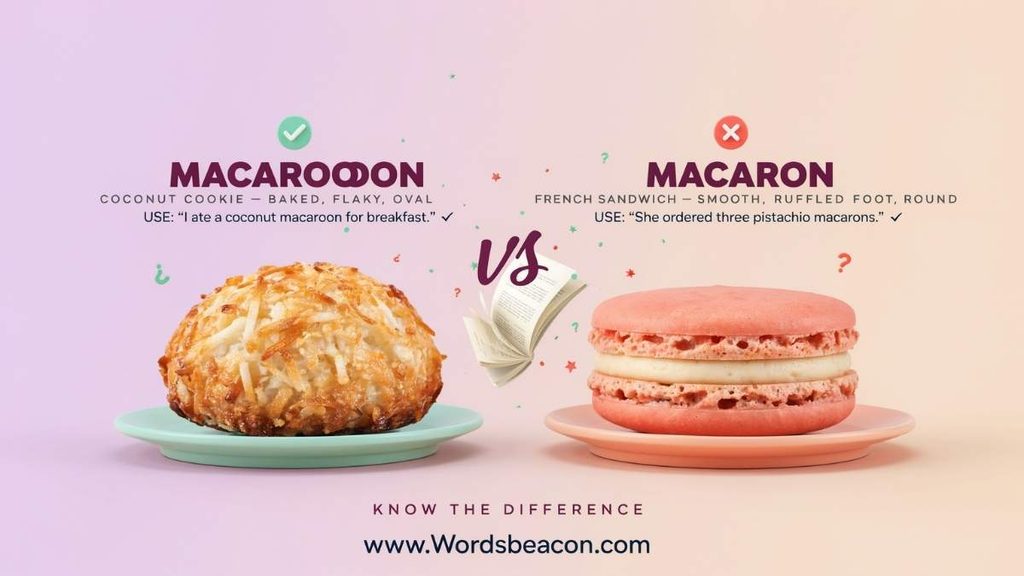
Now that you know what each cookie contains, let’s look at their differences more closely.
The biggest difference is the way bakers make and serve them. Macarons use a carefully prepared almond-flour batter that forms two shells. Macaroons usually combine coconut with other ingredients to create one chewy cookie.
Their ingredients, appearance, texture, and preparation methods help distinguish them.
| Difference | Macaron | Macaroon |
|---|---|---|
| Flour or base | Finely ground almonds | Usually shredded coconut |
| Structure | Two separate shells | One solid cookie |
| Surface | Smooth and even | Rough and textured |
| Inside | Soft center with a separate filling | Dense, moist, and chewy |
| Preparation | Requires careful mixing and baking | Usually involves simpler mixing |
| Typical serving | Filled sandwich cookie | Individual mound or cluster |
For example, imagine opening a bakery box and seeing six pastel-colored cookies with smooth tops and creamy centers. Those are probably macarons.
Now imagine a plate of golden coconut mounds with chocolate drizzled over them. Those are probably macaroons.
Both are delicious, but their appearance gives you a useful clue before you even take a bite.
Macaron vs Macaroon Pronunciation
The names differ by only a few letters, so it’s easy to mix them up when speaking. Fortunately, their usual pronunciations have different ending sounds.
Macaron is commonly pronounced “mack-ah-ROHN.” The final syllable sounds similar to “own.”
Macaroon is commonly pronounced “mack-ah-ROON.” The final syllable sounds similar to “moon.”
| Word | Simple pronunciation | Ending sound |
|---|---|---|
| Macaron | Mack-ah-ROHN | Own |
| Macaroon | Mack-ah-ROON | Moon |
The difference is small, but it can help you remember which cookie you’re talking about.
When you order a macaron, you’re asking for the almond-flour sandwich cookie. When you order a coconut macaroon, you’re usually asking for the chewy coconut treat.
Of course, people may pronounce words differently depending on their accents and regional habits. Still, these pronunciations are useful guides in everyday American English.
Learn the difference between confusing more English words
Emaculate vs Immaculate correct spelling and usage ?
The History Behind Macarons and Macaroons
Macarons and macaroons share a historical connection. Both belong to a broad family of almond-based sweets with roots in European baking traditions.
Over time, however, recipes developed in different directions. Bakers adapted ingredients and methods to suit local tastes and the products available to them.
Where Did Macarons Come From?
Macarons developed from earlier almond-based confections. French pastry makers refined the cookie over time, and the filled sandwich version became especially well known.
Modern French macarons usually have two almond-meringue shells joined by a flavored filling. Their bright colors and delicate appearance have helped them become a familiar feature of French pastry shops.
Today, bakers make macarons in countless flavors. Traditional choices include chocolate, vanilla, pistachio, and raspberry, while modern bakeries experiment with coffee, caramel, citrus, and seasonal ingredients.
Although the modern macaron is strongly associated with France, its history reflects a wider European tradition of almond sweets.
Where Did Macaroons Come From?
Macaroons also developed from older almond-based sweets. As recipes spread and ingredients changed, different versions emerged.
Coconut became a defining ingredient in many modern macaroon recipes. Shredded coconut helped create a moist, chewy cookie that was easier to shape than delicate French macarons.
Today, coconut macaroons are popular in home kitchens and bakeries, especially in the United States. Their simple preparation and strong coconut flavor make them a convenient dessert.
The two cookies therefore share historical roots, but modern recipes have given them very different identities.
Learn the difference between confusing more English words
Offered vs Offerred which one is correct ?
Macaron vs Macaroon in the United States, the United Kingdom, Canada, and Australia
Regional baking traditions can influence which cookie people recognize most easily.
In the United States, macarons are common in specialty bakeries and upscale dessert shops. Coconut macaroons are also familiar, especially during holidays and family gatherings.
In the United Kingdom, French-style macarons appear in pastry shops and cafés, while coconut macaroons remain available in bakeries and supermarkets. The exact name may depend on the recipe and local baking tradition.
In Canada, both cookies are available, although their popularity can vary by region and bakery. French-style macarons are especially familiar in areas with strong French culinary influences.
In Australia, you can also find both varieties. French macarons appear in cafés and patisseries, while coconut macaroons are sold as a separate type of sweet treat.
The main lesson is simple: don’t rely on location alone to identify a cookie. Look at its ingredients and appearance, or check the menu description.
Which Is Easier to Make Macarons vs Macaroons?
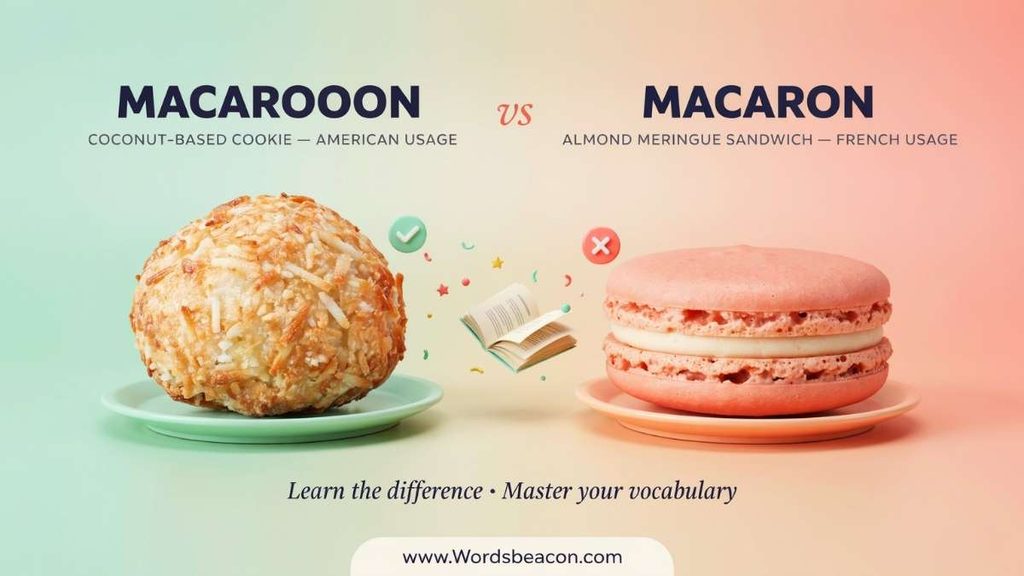
If you’re new to baking, macaroons are usually the easier option.
Coconut macaroons generally require fewer precise steps. You mix the ingredients, shape the mixture into small mounds, and bake them until the edges turn golden.
Macarons require more attention. The baker must prepare a stable meringue, combine the ingredients without ruining the batter, pipe even shells, and control the baking process. Small mistakes can affect their appearance and texture.
Common Mistakes When Using Macaron and Macaroon
A common mistake is treating macaron and macaroon as interchangeable words. Although their spellings look similar, they refer to different cookies. A macaron is a colorful French sandwich cookie, while a macaroon is usually a coconut-based cookie.
For example, “She bought chocolate macarons” refers to French sandwich cookies, while “She bought coconut macaroons” refers to coconut cookies.
Another mistake is thinking that the extra “o” in macaroon is optional. Both spellings are correct, but they have different meanings. Using the wrong word can confuse your readers, especially when you’re writing about desserts, sharing a recipe, or describing something you ate.
How to Remember the Difference Between Macaron and Macaroon
An easy way to remember the difference is to connect macaroon with coconut. The word macaroon has an extra “o,” just as coconut has a round “o” sound in its name. This simple memory trick can help you recall which cookie usually contains coconut.
Macaron, with one “o,” refers to the French sandwich cookie with smooth shells and a sweet filling.
Macaron vs. Macaroon: Which Spelling Should You Use?
The correct spelling depends on the cookie you want to describe. Use macaron when referring to the French sandwich cookie, and use macaroon when referring to the coconut cookie.
For example, write “The bakery sells pistachio macarons” when talking about French sandwich cookies. However, write “The bakery sells chocolate-dipped macaroons” when talking about coconut cookies.
Neither spelling is wrong. The key is to choose the word that matches your meaning.
Learn the difference between confusing more English words
Stellar vs Steller difference and usage?
Macaron vs Macaroon Examples in Sentences
The easiest way to understand the difference between macaron vs macaroon is to see how each word works in a sentence.
Examples of Macaron
- I bought a box of colorful macarons from a French bakery.
- The chocolate-filled macaron looked almost too beautiful to eat.
- She served pistachio macarons at the party.
Examples of Macaroon
- My grandmother makes delicious coconut macaroons.
- He dipped the macaroon in melted chocolate.
- The bakery sells chewy macaroons with toasted coconut.
Remember, use macaron when you mean the delicate, usually colorful sandwich cookie. Use macaroon when you mean the chewy cookie commonly made with coconut. Choosing the right spelling helps you communicate clearly and avoid confusing your readers.
Learn the difference between confusing more English words
Suit vs Suite correct spelling and usage ?
Are Macarons and Macaroons Gluten-Free?
Both cookies can be gluten-free, but you should always check the ingredients and preparation methods.
Traditional macarons use almond flour rather than wheat flour. Their basic ingredients are often naturally gluten-free. However, some fillings, flavorings, or commercial products may contain gluten or face cross-contact during production.
Coconut macaroons also often contain no wheat flour. Many recipes rely on coconut, egg whites, sugar, or condensed milk. Still, certain recipes include additional ingredients that may contain gluten.
If you need to avoid gluten for medical reasons, read the packaging carefully and check with the bakery about its ingredients and preparation practices.
Don’t assume a cookie is safe just because it contains almonds or coconut. The complete recipe matters.
Are Macarons and Macaroons Dairy-Free?
Neither cookie is automatically dairy-free.
Traditional macaron shells usually contain almond flour, egg whites, and sugar, which means the shells themselves may not contain dairy. However, many common fillings use butter, cream, or milk chocolate.
Macaroons can also vary. Some recipes use coconut, sugar, and egg whites without dairy, while others contain sweetened condensed milk.
If you avoid dairy, check the ingredients for butter, milk, cream, condensed milk, and milk-based chocolate. Bakeries may also use shared equipment, so ask about cross-contact if you have an allergy.
Macaron vs Macaroon Calories and Nutrition
The calorie content of macarons and macaroons depends on their size, ingredients, and preparation method.
A macaron contains sugar, almond flour, and usually a sweet filling. Almond flour contributes fat and some protein, while the filling can add extra sugar and calories.
A coconut macaroon often contains shredded coconut, sugar, and sometimes condensed milk. Coconut contributes fat and fiber, while sweeteners increase the overall sugar content.
Neither cookie is automatically healthier than the other. A small macaron may contain fewer calories than a large, rich macaroon, but the opposite can also be true.
If nutrition matters to you, compare serving sizes and nutrition labels instead of judging a cookie by its name.
Learn the difference between tricky grammar words
Arial vs Aerial correct spelling and usage ?
How to Store Macarons and Macaroons
Macarons and macaroons need slightly different storage approaches because their textures differ.
Storing Macarons
Macarons often benefit from refrigeration after you fill them. Place them in an airtight container to protect their delicate shells from moisture and strong odors.
Many filled macarons taste better after resting in the refrigerator for a period recommended by the recipe. This allows the filling and shells to settle together, creating a more balanced texture.
Before serving, let them sit briefly at room temperature if the recipe recommends it. Avoid leaving them exposed to air for long periods because they can dry out or absorb moisture.
Storing Macaroons
Store coconut macaroons in an airtight container once they’ve cooled completely. This helps them maintain their chewy centers and prevents them from drying out.
Depending on the recipe and room temperature, they may keep well for several days. If your recipe contains perishable ingredients or the kitchen is very warm, refrigeration may be more appropriate.
You can also freeze many macaroons in a sealed, freezer-safe container. Separate layers with parchment paper to prevent sticking, then thaw them before serving.
Always follow food-safety guidance for recipes containing perishable ingredients.
Learn the difference between tricky grammar words
Writen vs Written correct spelling and usage ?
Common Mistakes When Using Macaron vs Macaroon
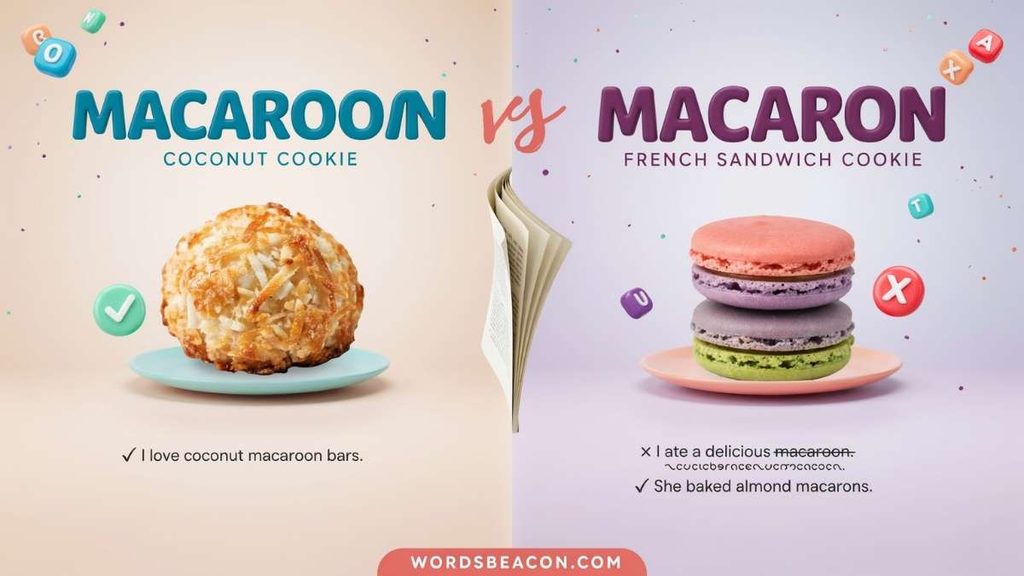
Because the names look similar, people often confuse them in writing and conversation. A few simple habits can help you choose the right word.
Using Macaron When You Mean Macaroon
If you’re talking about a chewy coconut cookie, macaroon is usually the correct word.
For example:
“I made coconut macaroons for the family gathering.”
Calling these cookies macarons may confuse someone who expects colorful almond-flour sandwich cookies.
Using Macaroon When You Mean Macaron
If you’re describing two smooth shells joined by buttercream or ganache, macaron is the right term.
For example:
“She bought a box of chocolate macarons from the bakery.”
Using macaroon here could make the reader picture coconut cookies instead.
Assuming Both Cookies Have the Same Ingredients
Macarons typically use almond flour, while coconut macaroons usually use shredded coconut.
Still, recipes can vary. Check the ingredient list when you need to know exactly what’s inside, especially if you have a food allergy.
Thinking the Names Are Just Different Spellings
Macaron vs macaroon are not simply two spellings of the same cookie. They usually refer to different desserts with distinct ingredients, textures, and shapes.
Remembering that difference helps you avoid mistakes when shopping, baking, or writing a recipe.
Macaron vs Macaroon Example Sentences
The easiest way to understand the difference is to see both words in everyday sentences.
| Word | Example sentence |
|---|---|
| Macaron | I chose a raspberry macaron with a smooth pink shell. |
| Macaron | The bakery sells pistachio macarons in small gift boxes. |
| Macaron | Making French macarons requires patience and careful mixing. |
| Macaroon | She baked coconut macaroons for the weekend picnic. |
| Macaroon | He dipped each macaroon in melted chocolate. |
| Macaroon | The golden coconut macaroons had soft, chewy centers. |
Notice how the context helps identify the correct word. Macarons often appear in descriptions of filled pastry-shop cookies, while macaroons frequently appear alongside coconut and chewy textures
Learn the difference between tricky grammar words
Who’s vs Whose difference and correct usage ?
practice session Macaron vs Macaroon
Complete each sentence with the correct word: macaron vs macaroon. Use the clues about ingredients, texture, shape, and preparation to help you choose.
1. The French bakery sells colorful __________ with chocolate ganache filling.
2. My grandmother baked coconut __________ for our family gathering.
3. A traditional __________ has two smooth shells joined by a sweet filling.
4. The chewy __________ had a golden-brown surface and a rich coconut flavor.
5. Making a perfect __________ requires careful mixing and precise baking.
6. She decorated the dessert table with pink, green, and purple __________.
7. I dipped each coconut __________ in melted chocolate.
8. Almond flour is a key ingredient in a traditional __________.
9. The baker arranged the __________ neatly in a gift box.
10. We made __________ using shredded coconut, egg whites, and sugar.
11. A raspberry __________ usually contains a fruity filling between its shells.
12. The rough, rounded shape of the coconut __________ made it easy to recognize.
13. My sister wants to learn how to make French __________ at home.
14. The chocolate-covered coconut __________ tasted sweet and chewy.
15. Pistachio is a popular flavor for a French-style __________.
16. Unlike a __________, a traditional coconut macaroon usually doesn’t have two shells with a filling between them.
17. The bakery offers a __________ with a crisp shell and a soft center.
18. We prepared coconut __________ because the recipe was simple and beginner-friendly.
19. The pastry chef filled each __________ with vanilla buttercream.
20. If you prefer a chewy coconut dessert, a __________ may be the right choice.
Answers
- Macarons
- Macaroons
- Macaron
- Macaroon
- Macaron
- Macarons
- Macaroon
- Macaron
- Macarons
- Macaroons
- Macaron
- Macaroon
- Macarons
- Macaroon
- Macaron
- Macaron
- Macaron
- Macaroons
- Macaron
- Macaroon
Here’s a trusted source for clear more words Comparison:
FAQs
What is the difference between a macaron, a macaroon, and Macron?
A macaron is a French-style sandwich cookie made with almond flour and a sweet filling. A macaroon is usually a chewy cookie made with shredded coconut. Macron, without the extra “o,” is a surname best known through Emmanuel Macron, the French president.
What do Americans mean by macaroon?
In American English, a macaroon usually refers to a small, chewy coconut cookie. It often contains shredded coconut, sugar, and egg whites or sweetened condensed milk. Some recipes also include chocolate, almonds, or vanilla.
Are macaroons originally French?
Macaroons have roots in older European almond-based sweets, with connections to Italian and French baking traditions. Over time, bakers adapted the recipes, and coconut macaroons became especially popular in the United States.
Why are macarons and macaroons so easy to confuse?
Their names look and sound similar, and both cookies share historical roots. However, a macaron usually has two smooth almond-based shells with a filling, while a macaroon is often a rough, chewy coconut cookie.
What are French macarons called in France?
In France, these colorful sandwich cookies are called macarons. They usually feature two delicate almond-meringue shells joined by a filling such as chocolate ganache, buttercream, or fruit jam.
Why are macarons so expensive?
Macarons require precise measurements, careful mixing, controlled baking, and individual assembly. Their delicate shells can crack or develop uneven shapes, so making a consistent batch takes skill and time. Specialty ingredients, fillings, packaging, and bakery location can also affect the price.
What is the most popular macaron flavor?
Chocolate, vanilla, pistachio, and raspberry are among the most popular macaron flavors. Preferences vary by bakery and customer. Chocolate offers a rich taste, pistachio adds a nutty flavor, and raspberry provides a fruity contrast to the sweet shells.
What is the filling inside a macaron called?
The filling is usually described by its type, such as buttercream, chocolate ganache, fruit jam, or flavored cream. It sits between the two shells and adds flavor, sweetness, and moisture to the cookie.
Why do homemade macarons crack or turn out hollow?
Cracked or hollow macarons can result from an unstable meringue, incorrect batter consistency, trapped air, insufficient resting time, or an unsuitable oven temperature. Overmixing and undermixing can also affect the shells. Following a reliable recipe and changing one step at a time can help you identify the problem.
What can you do with failed macarons?
Don’t throw away macarons just because their shells look uneven. If they’re safe to eat, crumble them over ice cream, layer them into dessert cups, or use them as a topping for mousse and pudding. However, discard any that show signs of spoilage or have been stored unsafely.
How many macarons should you serve per person?
If you’re serving several desserts, plan for about two or three macarons per person. For an event where macarons are the main sweet treat, you may need more. Adjust the amount based on the number of guests, the size of each cookie, and the other food available.
How long do macarons stay fresh?
Filled macarons generally keep for several days in an airtight container in the refrigerator, although their shelf life depends on the filling. Cream-based fillings may spoil faster than some other options. Follow the bakery’s storage instructions and avoid leaving perishable macarons at room temperature for too long.
Can you bring macarons from Paris to the United States?
Many commercially prepared baked goods may be allowed into the United States, but the rules depend on their ingredients, packaging, and current import requirements. Check official US customs and agricultural guidance before traveling, declare food when required, and keep perishable fillings at a safe temperature.
Are macarons considered a luxury dessert?
Macarons are often viewed as a luxury dessert because of their delicate appearance, wide range of flavors, careful preparation, and elegant packaging. However, you don’t have to visit an expensive patisserie to enjoy them. Grocery stores and everyday bakeries may offer more affordable options.
What is the difference between French and Italian macaron methods?
Both methods make French-style macarons, but they prepare the meringue differently. The French method whips sugar into egg whites, while the Italian method uses hot sugar syrup poured into whipped egg whites. Italian meringue can provide a more stable structure, whereas the French method involves fewer steps. Both methods require careful technique.
Why can macarons taste bad even when they look perfect?
An attractive macaron can still disappoint if the filling tastes artificial, the shells contain too much coloring, or the ingredients have lost their freshness. Poor storage can also affect the flavor and texture. A well-made macaron should have balanced sweetness, a delicate shell, and a soft interior.
What does gifting macarons mean?
Gifting macarons often expresses appreciation, affection, or a wish to celebrate. Their colorful appearance and neat packaging make them popular for birthdays, weddings, holidays, and thank-you gifts. The meaning depends on the occasion and the relationship between the people exchanging them.
Are there different types of coconut macaroons?
Yes. Coconut macaroons vary according to their ingredients and preparation methods. Some recipes use egg whites and sugar, while others rely on sweetened condensed milk. Bakers may also add chocolate chips, dip the cookies in chocolate, or include almonds and flavor extracts.
How is a macaron different from a regular sandwich cookie?
A traditional macaron has two delicate almond-meringue shells joined by a filling. A regular sandwich cookie may use wheat-based biscuits, wafers, or other types of cookies. Macarons also require a specific preparation method to develop their smooth tops and characteristic ruffled feet.
How can you tell when a macaron is properly baked?
A properly baked macaron usually has a smooth top, defined feet, and a shell that releases from the baking surface after cooling. The inside should be soft rather than wet or gummy. The exact texture depends on the recipe, but the shells shouldn’t collapse or remain raw in the center.
Conclusion
Understanding the difference between macaron vs macaroon is simple once you know what to look for. A macaron is a colorful sandwich cookie made with almond flour and a sweet filling, while a macaroon is usually a chewy coconut cookie with a golden, rough surface. Their names may look similar, but their ingredients, textures, and shapes set them apart. Here’s an easy way to remember: macarons have smooth shells and creamy fillings, while macaroons often contain coconut. So, next time you order dessert or write a recipe, you’ll know which word to use. After all, confusing the names is easy, but getting the cookie you didn’t want? That’s a whole different kind of mix-up!

Luna AJS is an experienced blogger and dedicated language enthusiast at Words Beacon. She specializes in making English grammar, spelling, vocabulary and commonly confused words easy to understand. She provides clear explanations, practical examples to help readers write with confidence.