
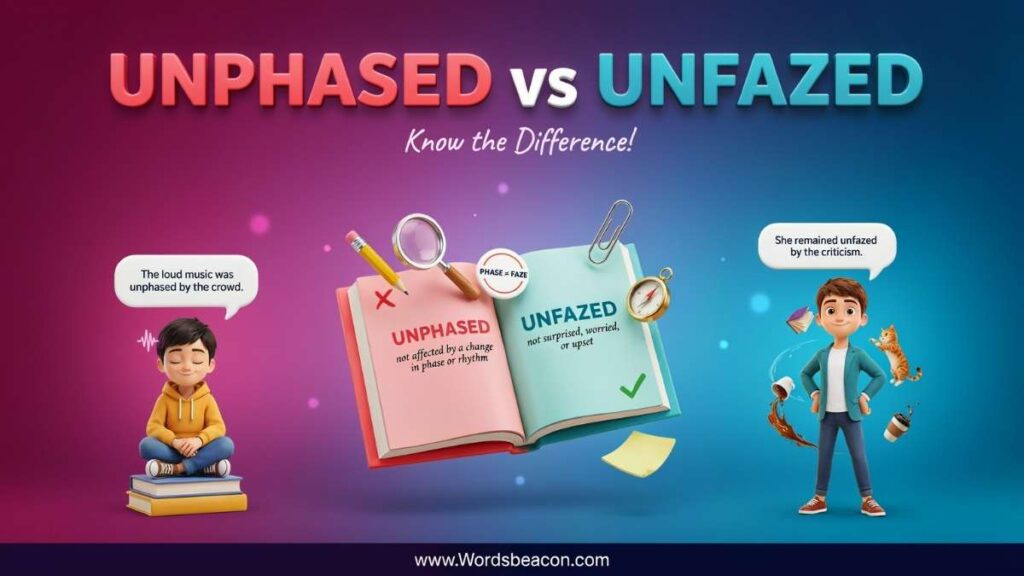
Unphased vs unfazed can be confusing because the words look almost identical, but they don’t always mean the same thing. One small spelling mistake can change your message, even when your mind is perfectly clear! The good news is that choosing the right word is simple once you know the difference. Unfazed describes someone who stays calm and isn’t bothered by a problem, criticism, or surprise. Unphased can describe something that happens all at once instead of in stages. In this guide, you’ll learn what each word means, how to use it correctly, and how to avoid this common grammar mistake.
quick answer
| Feature | Unfazed | Unphased |
|---|---|---|
| Main meaning | Not worried, disturbed, or surprised | Not carried out gradually in separate stages |
| Root word | Faze, meaning to disturb | Phase, meaning a stage or period |
| Common usage | Everyday conversations and professional writing | Less common contexts involving processes and stages |
| Example | She remained unfazed by the criticism. | The company chose an unphased increase in fees. |
| Best choice for describing a calm person | Yes | Usually no |
Fix common more word mistakes in English
Dysregulated vs Disregulated correct usage ?
Unphased vs Unfazed The Main Difference
The main difference between unfazed and unphased lies in what you want to describe. Unfazed refers to a person’s reaction, while unphased can describe a process that does not happen gradually in separate stages.
Use unfazed when someone remains calm despite criticism, pressure, embarrassment, or unexpected news.
For example:
She was unfazed by the difficult questions.
This sentence means the questions did not visibly upset or intimidate her.
Unphased has a different use. It can describe a change that happens all at once rather than through several stages.
For example:
The company introduced an unphased increase in its fees.
Here, unphased describes how the increase takes place, not how someone feels about it.
The distinction is simple: use unfazed for emotional reactions and consider unphased when discussing something that happens without a gradual, staged process. Although some dictionaries also list unphased as an uncommon variant of unfazed, unfazed remains the preferred spelling for the everyday meaning of “not disturbed.”
Unfazed Meaning and Definition
What Does Unfazed Mean?
Unfazed means not worried, disturbed, surprised, or discouraged by something. It describes someone who remains calm when a situation might make another person nervous or uncomfortable.
Imagine giving a presentation when your manager suddenly asks a question you did not expect. You pause, gather your thoughts, and answer without losing your composure. Your manager might describe you as unfazed by the unexpected question.
That does not necessarily mean you felt no stress. You may have felt nervous inside, but you handled the situation without appearing shaken.
For example:
The teacher remained unfazed by the unexpected interruption.
Despite the negative comments, Maya looked unfazed.
The experienced driver seemed unfazed by the heavy rain.
In each sentence, unfazed describes a reaction to a situation. It tells readers that something did not noticeably disturb the person.
Unfazed Definition in Simple English
A simple unfazed definition is “not bothered or disturbed by something.”
Depending on the context, unfazed can also suggest that someone remains composed, confident, or untroubled when facing a challenge.
For example, a student who continues working calmly after seeing a difficult exam question may appear unfazed. Similarly, a manager who handles criticism without becoming defensive might be described as unfazed.
However, the word does not always mean fearless or completely relaxed. Someone can feel nervous and still remain unfazed on the outside. The important point is that the situation does not noticeably shake their composure.
How to Use Unfazed in a Sentence
Unfazed is an adjective. You can use it after verbs such as be, seem, look, appear, and remain.
For example:
He was unfazed by the sudden announcement.
The children seemed unfazed by the noise.
She remained unfazed throughout the interview.
You can also place unfazed before a noun to describe someone or something directly.
For example:
The unfazed speaker answered every question.
The unfazed player continued the match.
These sentence patterns help you use unfazed naturally in everyday, academic, and professional writing.
Learn the difference between often confused words
Offered vs Offerred which one is correct ?
Unphased Meaning and Definition
What Does Unphased Mean?
Unphased can describe something that happens all at once rather than gradually in separate stages. This meaning comes from phase, a word that refers to a stage or period in a process.
For example, a company might introduce a new policy in stages. It could begin with one department, review the results, and then extend the policy to the rest of the organization. This would be a phased approach.
Alternatively, the company might introduce the policy to everyone on the same date. A writer could describe that approach as unphased.
For example:
The organization considered an unphased increase in membership fees.
The sentence suggests that the increase would happen all at once instead of through several smaller changes.
Because this use of unphased is less common, you should consider your audience. In many cases, wording such as “an increase applied all at once” communicates the idea more clearly.
Is Unphased a Word?
Yes, unphased appears in dictionaries, but its meaning depends on the context.
It can describe something that is not introduced gradually in separate stages. Some dictionaries also recognize it as an uncommon variant of unfazed.
Therefore, it would be inaccurate to say that unphased is never a word. However, its existence does not mean it is the best choice for every sentence.
Compare these examples:
Less suitable for the intended meaning: She was unphased by the criticism.
Preferred: She was unfazed by the criticism.
The second sentence uses the standard spelling for an emotional reaction.
Now consider this example:
The company adopted an unphased approach to the fee increase.
Here, unphased refers to the way the company implements the change.
When you understand the intended meaning, choosing between the two spellings becomes much easier.
Unphased Definition in Simple English
When unphased refers to a process, it means that the process does not happen gradually in separate stages.
For example, a phased rollout might introduce a new application to a small group before making it available to everyone. An unphased rollout would make it available to everyone at once.
Still, unphased is relatively uncommon in this sense. If your goal is clear communication, phrases such as “introduced all at once” or “not introduced in stages” may work better.
These alternatives make your meaning clear without relying on a word that some readers may find unfamiliar.
Learn the difference between confusing word pairs
Stellar vs Steller difference and usage?
Faze vs Phase Why the Difference Matters

Understanding faze and phase is the easiest way to remember unfazed vs unphased. Although these words sound alike, they have different meanings.
What Does Faze Mean?
Faze is a verb that means to disturb, unsettle, worry, or embarrass someone.
For example:
The difficult question did not faze her.
His criticism failed to faze the experienced speaker.
The loud noise seemed to faze the young child.
When something fazes you, it affects your confidence or composure. When something does not faze you, you remain unfazed.
This connection gives you a simple memory trick:
Faze means to disturb.
Unfazed means not disturbed.
What Does Phase Mean?
Phase can function as both a noun and a verb.
As a noun, phase means a stage or period in a process.
For example:
The project has entered its final phase.
As a verb, phase can describe introducing or removing something gradually.
For example:
The school will phase in the new schedule over several weeks.
Because phase relates to stages and processes, unphased can fit certain contexts where something does not happen in separate stages.
Why Do People Confuse Unphased and Unfazed?
The biggest reason is pronunciation. Faze and phase sound alike, so you cannot reliably identify the correct spelling by hearing the word alone.
Their spellings can also seem logical in different ways. Someone who knows the word phase might assume that unphased means unaffected. That assumption is understandable, but it misses the standard everyday meaning of unfazed.
Repeated exposure to misspellings can add to the confusion. When writers frequently use unphased to describe someone who remains calm, readers may start to assume that both spellings are equally suitable in every context.
However, the intended meaning matters more than how familiar a spelling looks. If you are describing someone’s reaction to pressure, criticism, or surprise, choose unfazed.
Learn the difference between confusing word pairs
Wich vs Which difference and correct usage ?
Unfazed vs Unphased Examples
Examples help you see how each word works in context. Pay attention to whether the sentence describes a person’s emotional reaction or the way a process takes place.
| Example sentence | Best choice | Explanation |
|---|---|---|
| She was unfazed by the bad news. | Unfazed | Describes an emotional reaction |
| The goalkeeper remained unfazed after missing a save. | Unfazed | Shows that a setback did not shake him |
| He seemed unfazed by the interviewer’s questions. | Unfazed | Describes a calm response |
| The company chose an unphased increase in fees. | Unphased | Describes an increase that happens all at once |
| The project entered its final phase. | Phase | Refers to a stage in a process |
| The school will phase in the new rules gradually. | Phase | Describes introducing something in stages |
The first three examples focus on people’s reactions. The fourth focuses on how a change happens. The final two use phase directly to describe a stage or a gradual process.
This is the distinction to remember: emotional reactions point to unfazed, while stages and implementation point to phase-related vocabulary.
Unfazed in a Sentence
Here are additional examples of unfazed in everyday English.
The teacher was unfazed by the unexpected interruption.
Even after receiving negative feedback, Maya remained unfazed.
The experienced driver looked unfazed during the storm.
My brother was unfazed when the power went out during the movie.
The team seemed unfazed by its opponent’s reputation.
The new employee remained unfazed by the demanding workload.
In each sentence, unfazed means that something did not visibly disturb, worry, or discourage the person.
Unphased in a Sentence
Unphased is less common, but it can fit when the sentence describes a change that does not happen gradually in separate stages.
The board considered an unphased increase in annual fees.
The proposal called for an unphased change rather than a gradual adjustment.
The organization discussed an unphased implementation of the new policy.
Because readers may interpret unphased differently, consider whether a clearer expression would work better.
For example:
The board approved an increase that would take effect all at once.
This version communicates the intended meaning directly and avoids unnecessary confusion.
Learn the difference between confusing word pairs
Suit vs Suite correct spelling and usage ?
Unfazed vs Unphased in American and British English

The Unfazed vs Unphased in American English
In American English, unfazed is the standard spelling when you want to describe someone who is not worried, surprised, or disturbed.
For example:
The manager was unfazed by the unexpected delay.
The student remained unfazed during the difficult exam.
The criticism did not faze the candidate.
American English does not normally replace unfazed with unphased for this meaning. The difference comes from the words’ meanings, not from a regional spelling rule.
Unfazed vs Unphased in British English
The same distinction applies in British English. Use unfazed when describing someone who remains calm or unaffected.
For example:
She was unfazed by the announcement.
He remained unfazed by the pressure.
Some English words have different regional spellings, such as color in American English and colour in British English. Unfazed and unphased do not follow that pattern. British English does not require unphased as an alternative spelling for the emotional meaning.
Whether you write for readers in the United States, the United Kingdom, Australia, or elsewhere, unfazed is the preferred everyday choice when you mean “not bothered.”
Learn the difference between tricky grammar words
Arial vs Aerial correct spelling and usage ?
Unfazed Synonyms and Opposites
Learning synonyms helps you vary your writing while keeping the intended meaning. However, no two words match perfectly in every context, so choose an alternative that suits your sentence.
Common Synonyms for Unfazed
Useful synonyms for unfazed include:
- Unbothered
- Untroubled
- Unperturbed
- Composed
- Calm
- Unruffled
- Undisturbed
- Unshaken
- Unintimidated
For example:
She remained composed during the interview.
He was unbothered by the negative comments.
The experienced nurse stayed calm during the emergency.
These words share a similar idea, but their emphasis can differ. Composed highlights self-control, while unbothered emphasizes a lack of concern.
What Is the Opposite of Unfazed?
Fazed is often the most direct opposite of unfazed. Other alternatives include worried, nervous, disturbed, upset, unsettled, intimidated, and disconcerted.
For example:
The unexpected question left him fazed.
She looked nervous before the presentation.
The sudden change unsettled the team.
The best opposite depends on the situation. Someone can feel nervous without being overwhelmed, while someone who feels intimidated may be especially affected by another person or a challenging circumstance.
Learn the difference between tricky grammar words
Writen vs Written correct spelling and usage ?
How to Remember the Correct Spelling
You do not need to memorize a complicated grammar rule to distinguish unfazed from unphased. A simple connection between each word and its root can help you remember the correct spelling.
Connect Unfazed With Faze
Remember that faze means to disturb or unsettle someone.
If a difficult situation does not disturb a person, that person is unfazed.
For example:
The criticism did not faze her, so she remained unfazed.
Because both words contain faze, this sentence reinforces the correct spelling and meaning.
Connect Unphased With Phase
Remember that phase refers to a stage in a process.
For example:
The project entered its next phase.
The school will phase in the new rules gradually.
When your sentence concerns stages or gradual changes, think about phase. When it concerns someone’s feelings, think about faze.
Ask Yourself One Question
Before choosing a spelling, ask yourself: Am I describing someone’s reaction, or am I describing how something happens?
If you are describing a person’s reaction, use unfazed.
If you are describing a process that does not happen in separate stages, unphased may fit.
This quick question is more reliable than choosing the word that simply looks familiar.
Learn the difference between similar English words
Emaculate vs Immaculate correct spelling and usage ?
Common Mistakes to Avoid

Using Unphased to Describe Feelings
This is the main mistake writers make when confusing the two words.
Less suitable: He was unphased by the criticism.
Preferred: He was unfazed by the criticism.
The second sentence clearly describes someone who remains unaffected by negative comments.
Assuming Unphased Is Never a Word
Although unfazed is the preferred everyday word for an emotional reaction, unphased has a documented use related to something happening all at once rather than gradually in stages. Some dictionaries also list it as an uncommon variant of unfazed.
Rather than treating every instance of unphased as automatically incorrect, consider the meaning and context.
Treating the Words as Interchangeable
The words sound the same, but they do not always communicate the same idea.
Unfazed relates to being undisturbed.
Unphased can relate to stages or phases.
Using the wrong word may leave readers wondering whether you mean a person’s reaction or the way a process works.
Relying Only on Spellcheck
Spellcheck can catch many spelling errors, but it may not identify every word-choice mistake. A word can be spelled correctly and still be unsuitable for the sentence.
Learn the difference between similar English words
Who’s vs Whose difference and correct usage ?
Unphased vs Unfazed Practice Session
Fill in the blanks with Unphased vs Unfazed, or faze.
- Sarah stayed ______ after the criticism.
- The news did not ______ him.
- The company made an ______ change.
- Loud noises never ______ her.
- He remained ______ during the storm.
- They chose an ______ approach.
- The thunder left him ______.
- The coach stayed ______ after the loss.
- The company made an ______ adjustment.
- Her comments did not ______ me.
- She remained ______ under pressure.
- The team chose an ______ rollout.
- Daniel looked ______ during the exam.
- The news did not ______ her.
- They introduced an ______ fee increase.
- The athlete stayed ______.
- The delay began to ______ passengers.
- The manager remained ______.
- They planned an ______ change.
- Maria stayed ______ after the news.
Answers
- Unfazed
- Faze
- Unphased
- Faze
- Unfazed
- Unphased
- Unfazed
- Unfazed
- Unphased
- Faze
- Unfazed
- Unphased
- Unfazed
- Faze
- Unphased
- Unfazed
- Faze
- Unfazed
- Unphased
- Unfazed
Here’s a trusted source for clear more words Comparison:
FAQs
What is the difference between unphased vs unfazed?
Unfazed means calm and unbothered by something that might upset, worry, or surprise you. Unphased can describe something that happens all at once instead of in separate stages. When you describe someone who stays calm under pressure, unfazed is the correct choice.
Is unfazed the correct spelling?
Yes, unfazed is the standard spelling when you mean that someone is not bothered or disturbed by something. For example, “She remained unfazed by the unexpected criticism.”
Is unphased a real word?
Yes, unphased is a word, but its use depends on the context. It can describe something that does not happen in separate stages. However, when you mean calm or unbothered, unfazed is the usual and clearest choice.
What does unfazed mean in slang?
In slang, unfazed means not bothered, worried, or impressed by something. For example, “Everyone was arguing, but she stayed unfazed” means she remained calm while others reacted emotionally.
What is another word for unfazed?
Common synonyms for unfazed include unbothered, calm, composed, unruffled, undisturbed, and unshaken. Choose the word that best matches the situation. For example, composed emphasizes self-control, while unbothered suggests that something does not cause concern.
What is the opposite of unfazed?
The opposite of unfazed can be rattled, shaken, disturbed, anxious, or flustered. For example, if unexpected criticism makes someone nervous or uncomfortable, you could say the person felt rattled rather than unfazed.
What does “it doesn’t faze me” mean?
The phrase “it doesn’t faze me” means that something does not bother, worry, or upset you. For example, “Speaking in front of a crowd doesn’t faze me” means public speaking does not make the speaker nervous.
Is fazed a word in English?
Yes, fazed is the past tense and past participle of the verb faze, which means to disturb, unsettle, or embarrass someone. For example, “The difficult question fazed him” means the question made him feel uncomfortable or uncertain.
Is it fazed or phased?
Both words are correct, but they have different meanings. Fazed means bothered or unsettled, while phased relates to stages in a process. Write “I wasn’t fazed by the news” when you mean that the news did not upset you.
What does phased mean?
Phased describes something introduced, arranged, or completed in stages over time. For example, “The company introduced a phased rollout” means the company implemented the changes gradually rather than all at once.
What is the difference between faze and phase?
Faze is a verb that means to disturb or unsettle someone. Phase can refer to a stage in a process or describe the gradual introduction of something. For example, a surprising question might faze you, while a project might have several phases.
How do you use unfazed in a sentence?
Use unfazed to describe someone who remains calm despite a challenging or surprising situation. For example, “Despite the unexpected delay, the team remained unfazed and continued working.”
What is another word for unphased?
If you mean that something does not happen in separate stages, alternatives may include immediate, simultaneous, or non-staged, depending on the context. If you mean someone is not bothered, use unfazed, unbothered, or unruffled instead.
What word type is unfazed?
Unfazed is an adjective because it describes a person’s reaction or emotional state. In the sentence “The speaker remained unfazed by the criticism,” the word unfazed describes how the speaker reacted.
Is unfaze a word?
Unfaze is not the standard form for describing someone who remains calm. Use unfazed as the adjective or faze as the verb. For example, write “The criticism did not faze her” or “She remained unfazed by the criticism.”
What does not fazed mean?
Not fazed means not bothered, worried, embarrassed, or unsettled by something. For example, “He was not fazed by the audience’s questions” means the questions did not shake his confidence.
What do you call someone who doesn’t get bothered easily?
Unflappable describes someone who stays calm even under pressure. Other suitable words include composed, unruffled, resilient, and unbothered. In everyday conversation, unbothered is a simple and natural choice.
What do you call someone who doesn’t get angry easily?
A person who rarely gets angry may be described as even-tempered, patient, calm, or mild-mannered. Even-tempered works especially well when someone stays steady and reasonable during stressful situations.
What does unbothered mean?
Unbothered means not worried, upset, or concerned about something. People often use it in casual conversation to describe someone who does not react to criticism, drama, or other people’s opinions. For example, “She stayed unbothered by the negative comments.”
What is the difference between unfazed and unaffected?
Unfazed emphasizes a calm reaction to something that could cause worry or surprise. Unaffected means not changed or influenced by something. A person might appear unfazed while still being affected in other ways, so the two words are not always interchangeable.
How can I remember when to use unfazed instead of unphased?
Remember that faze means to disturb or unsettle. If something does not bother you, you remain unfazed. Phase refers to a stage in a process, so phased usually relates to changes that happen in stages. This simple distinction can help you choose the right word.
Learn the difference between similar English words
Offense vs Offence difference and correct usage ?
Conclusion
Understanding the difference between unphased vs unfazed is simple once you remember what each word means. Use unfazed when someone stays calm and does not get upset or worried. Use unphased when you mean something happens all at once instead of in stages. Here’s an easy trick to remember: faze means to bother, while phase means a stage in a process. So, if criticism doesn’t bother you, you remain unfazed. Get these words right, and you’ll avoid a common spelling mistake without letting grammar faze you!

Luna AJS is an experienced blogger and dedicated language enthusiast at Words Beacon. She specializes in making English grammar, spelling, vocabulary and commonly confused words easy to understand. She provides clear explanations, practical examples to help readers write with confidence.