
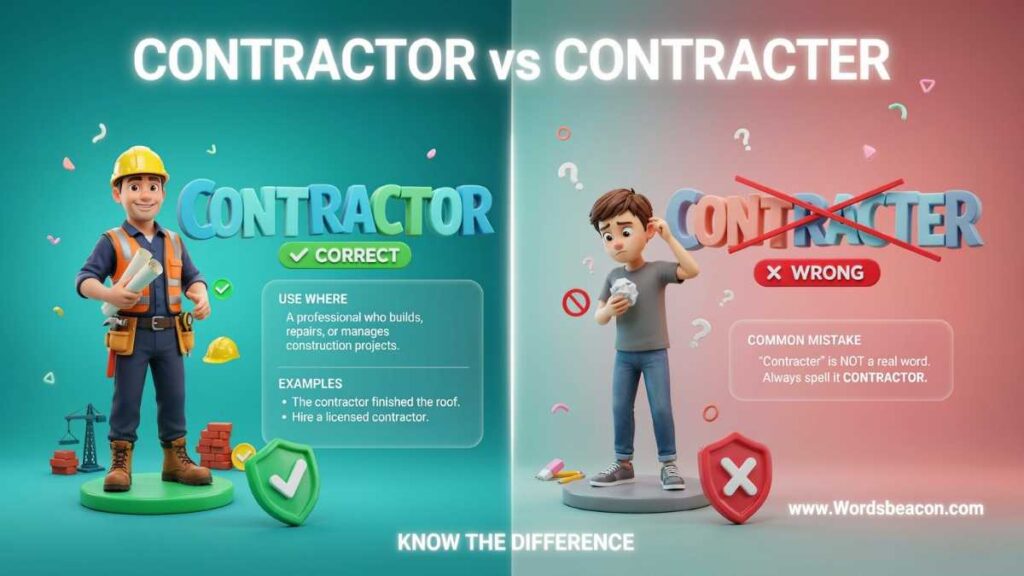
English spelling has a funny way of making simple words confusing. Contractor vs Contracter are a perfect example. Both look believable, and the familiar endings in words like teacher and worker can make contracter seem perfectly acceptable. However, there’s only one correct choice: contractor. The other version is a common spelling mistake that can sneak into emails, business documents, and everyday writing. So, why does contractor end in -or instead of -er? Let’s clear up the confusion, explore the correct meaning and usage, and discover an easy way to remember the spelling without second-guessing yourself.
quick comparsion
| Comparison | Contractor | Contracter |
|---|---|---|
| Spelling | Correct | Incorrect |
| Meaning | A person or business that performs work under an agreement | No standard meaning in this context |
| Word ending | -or | -er |
| Dictionary recognition | Standard English word | Nonstandard spelling |
| Professional usage | Accepted | Should be avoided |
| Example | We hired a contractor. | We hired a contracter. |
Understand confusing English more words simply
Career vs Carrer Correct Spelling and Difference
Is Contractor vs Contracter Correct?
If you’re wondering whether contractor vs contracter is correct, the answer is straightforward: contractor is the accepted spelling in standard English.
A contractor is a person or business that agrees to complete specific work or provide services for another party, usually in exchange for payment. The arrangement often includes agreed responsibilities, deadlines, and compensation.
For example:
- Correct: The contractor will repair the roof next week.
- Incorrect: The contracter will repair the roof next week.
The same spelling applies in American and British English. There isn’t a regional spelling difference that makes contracter an acceptable alternative.
This distinction matters in everyday communication as well as professional writing. A spelling mistake in a casual message might not cause confusion, but the same error in a proposal, invoice, or business agreement can make a document look less polished.
Contractor vs Contracter Quick Definition
- Contractor: A person or business that agrees to perform work or provide services under a contract.
- Contracter: An incorrect spelling of contractor when referring to someone who performs contracted work.
Simply put, whenever you write about construction professionals, independent workers, or business service providers, choose contractor.
What Does Contractor Mean?
The contractor meaning is closely connected to the idea of an agreement. A contractor is a person or business that agrees to complete specific work or provide services for another party.
For example, imagine that you want to remodel your bathroom. You hire a professional who agrees to remove the old fixtures, install new tiles, update the plumbing, and complete the project for an agreed price. That professional may be a contractor.
However, contractors don’t work exclusively in construction. Businesses also hire them for marketing, software development, accounting, consulting, graphic design, and other specialized services.
Contractor Definition in English
A contractor is a person or organization that enters into an agreement to perform work or provide services for another party.
In simple terms, a contractor is someone you hire to complete a particular job under agreed conditions.
A typical contractor arrangement includes:
- Services: The specific work the contractor agrees to perform.
- Payment: The agreed amount or method of compensation.
- Deadline: The expected completion date or service period.
- Responsibilities: The duties of each party.
- Agreement: The terms that explain the working relationship.
A written contract often records these details. However, some arrangements may involve verbal agreements, depending on the nature of the work and applicable laws.
Common Types of Contractors
Although people often associate contractors with construction, the word covers many professional fields.
| Type of contractor | Meaning | Example |
|---|---|---|
| General contractor | Manages an overall construction project | A professional coordinating a home renovation |
| Building contractor | Handles building and related construction work | Someone hired to construct a house |
| Construction contractor | Performs or manages construction services | A company building commercial properties |
| Electrical contractor | Provides electrical installation and repair services | A professional installing new wiring |
| Plumbing contractor | Handles plumbing installation and repairs | A professional replacing bathroom pipes |
| Independent contractor | Provides services independently rather than as an employee | A freelance graphic designer |
| Government contractor | Supplies services or products under a government agreement | A company providing equipment to a government agency |
Each term describes a different professional role. Nevertheless, the spelling remains contractor in every case.
Contractor Job Description and Responsibilities
A contractor’s job description depends on the services they provide and the terms of their agreement. A construction contractor, for instance, may manage workers, purchase materials, schedule inspections, and monitor project progress.
Meanwhile, a freelance contractor might communicate with clients, prepare proposals, complete assignments, and submit invoices.
Common contractor responsibilities include:
- Completing agreed work within the specified timeframe.
- Following relevant safety rules and industry standards.
- Providing the services described in the agreement.
- Communicating with clients about progress and delays.
- Managing materials, equipment, and necessary resources.
- Meeting agreed quality requirements.
- Receiving and documenting payments.
Importantly, these responsibilities don’t automatically make someone an employee. The legal relationship depends on the actual working arrangement and applicable classification rules.
What Does Contracter Mean?
Contracter is generally a spelling mistake rather than a separate standard English vocabulary word. It doesn’t have an established independent definition referring to someone who performs work under a contract.
If you search for a contracter definition, you might encounter informal discussions, incorrectly written documents, or webpages that repeat the mistaken spelling. However, seeing a word online doesn’t automatically make it standard English.
The confusion becomes easier to understand when you consider familiar words such as teacher, worker, painter, and builder. These nouns use the suffix -er to describe someone who performs an action.
Consequently, someone might assume that a person who contracts work should be called a contracter. However, the established English noun is contractor.
Contracter Meaning Is It a Real English Word?
When someone asks what contracter means, the most useful answer is that it usually represents an incorrect attempt to spell contractor.
You might encounter contracter in:
- Informal online discussions.
- Search queries containing spelling errors.
- Incorrectly prepared business documents.
- Emails and messages written quickly.
- Websites with proofreading mistakes.
Nevertheless, these appearances don’t establish contracter as an accepted alternative spelling.
For ordinary writing, use contractor instead. If Contracter appears in an official brand name, company name, or another proper noun, preserve that name when referring to the organization. That exception doesn’t change the standard English spelling.
Why Contracter Is an Incorrect Spelling
The problem comes from choosing the wrong suffix.
English uses several endings to create nouns describing people who perform actions. Consider these examples:
| Base word | Correct noun |
|---|---|
| Teach | Teacher |
| Work | Worker |
| Paint | Painter |
| Act | Actor |
| Invent | Inventor |
| Contract | Contractor |
Both -er and -or appear in English vocabulary. However, writers can’t freely exchange these endings whenever a word seems to follow a familiar pattern.
Contractor has an established spelling with -or. Therefore, contracter doesn’t become correct simply because other English words use -er.
Understand confusing English more words simply
Focusing vs Focussing Which Spelling Is Correct ?
Why Do People Confuse Contractor vs Contracter?
At first glance, contractor vs contracter look almost identical. Both begin with the same letters, and their endings can sound similar in everyday speech.
However, several factors explain why people make this common spelling mistake.
Similar Pronunciation
One major reason behind the confusion is pronunciation.
In many American English accents, the final unstressed syllable of contractor has a relaxed sound. Consequently, someone who relies mainly on pronunciation might choose -er instead of -or when writing the word.
English spelling doesn’t always match pronunciation perfectly. Therefore, hearing a word correctly doesn’t necessarily tell you how to spell it.
Confusion About Words Ending in OR and ER
Another source of confusion is the way English forms nouns.
Consider these examples:
| Words ending in -er | Words ending in -or |
|---|---|
| Teacher | Actor |
| Worker | Creator |
| Builder | Director |
| Painter | Inventor |
| Driver | Contractor |
Both groups contain words that describe people who perform particular activities.
Nevertheless, the endings aren’t interchangeable. You can’t automatically choose -er simply because another word describing a person uses that suffix.
The established spelling of contractor uses -or.
Influence of Other English Words
Familiar vocabulary can sometimes create misleading spelling habits.
For instance, people regularly write teacher, worker, and builder. Since these words describe people who perform actions, the -er ending may feel like a natural choice for someone who works under a contract.
However, English contains many spelling patterns that don’t follow one universal rule. The correct form depends on the established spelling of each word.
Typing and Autocorrect Mistakes
Fast typing creates another opportunity for spelling errors.
Someone writing a quick email might type contracter without noticing the final letters. Depending on the device and software, autocorrect may not always identify an unfamiliar or incorrectly spelled word.
Search behavior can reinforce the confusion, too. People sometimes search for an incorrect spelling simply because they’re unsure which version is right.
A useful habit is to proofread professional documents and remember frequently used industry terms.
Contractor vs Contractee What’s the Difference?
Although contractor and contractee look related, they describe different roles in a contractual relationship.
A contractor is the person or business that agrees to perform work or provide services. A contractee generally refers to the party that engages the contractor or receives the agreed services.
For example, if a homeowner hires a building company to construct a garage, the building company acts as the contractor, while the homeowner may be described as the contractee.
Contractee Meaning
The contractee meaning refers to a person or organization that enters into an agreement with another party and receives the contracted work or services.
The term appears less frequently in everyday conversation than client, customer, or contracting party. Its exact use can also depend on the wording of a particular agreement.
Consider these examples:
- A homeowner hires a contractor to repair a roof.
- A business engages a contractor to develop its website.
- A company hires a service provider to maintain its office equipment.
In each situation, the party receiving the contracted service may be described as the contractee.
Contractor Contractee Relationship
The contractor contractee relationship involves two parties who agree on specific responsibilities, services, and payment terms.
A typical arrangement works like this:
| Party | Main responsibility |
|---|---|
| Contractor | Performs the agreed work or provides the services |
| Contractee | Engages the contractor and provides the agreed payment |
Their agreement may cover several important details:
| Contract element | Contractor’s role | Contractee’s role |
|---|---|---|
| Work description | Performs agreed services | Explains the required work |
| Payment | Receives compensation | Pays according to the agreement |
| Deadlines | Completes work on schedule | Provides necessary access or information |
| Quality | Meets agreed standards | Reviews the completed work |
| Communication | Reports progress | Shares instructions and feedback |
For example, a homeowner might agree to pay a contractor $8,000 to renovate a kitchen. The contractor completes the agreed work, while the homeowner makes payments according to the contract.
This is an illustrative arrangement, not a standard market price.
Remember that contractor and contractee describe different roles within an agreement. They aren’t alternative spellings of the same word.
Learn the difference between tricky more English words
Center vs Centre Difference and Which one Is Correct?
Independent Contractor vs Employee
The distinction between an independent contractor and an employee is important in American business and employment law.
Although both may perform work for the same organization, their working relationships can differ significantly.
An independent contractor generally operates an independent business or provides services on a self-employed basis. An employee, on the other hand, works within an employer’s employment relationship and may receive wages, workplace protections, and employment benefits.
Independent Contractor Meaning and Definition
An independent contractor is a self-employed person or business that provides services to clients under an independent working arrangement.
For example, a company might hire a freelance web designer to create a website. The designer agrees to deliver the finished project for an agreed fee and may also work with other clients.
Common examples include:
- Freelance writers.
- Graphic designers.
- Independent consultants.
- Electricians operating their own businesses.
- Self-employed construction professionals.
- Independent accountants.
- Certain delivery and transportation service providers.
According to the Internal Revenue Service (IRS), independent contractors generally operate their own trades, businesses, or professions. However, the IRS determines a worker’s classification by examining the actual working relationship rather than relying solely on the job title or written agreement.
Contractor vs Employee: Main Differences
| Feature | Independent contractor | Employee |
|---|---|---|
| Working relationship | Independent business arrangement | Employment relationship |
| Payment | Often project-based or invoiced | Usually wages or salary |
| Tax withholding | Generally handles own tax payments | Employer generally withholds applicable taxes |
| Work control | Usually has greater independence | Employer generally directs work |
| Benefits | Usually arranges personal benefits | May receive employer-sponsored benefits |
| Clients | May serve multiple clients | Usually works for an employer |
| Business expenses | May have eligible business deductions | Generally cannot deduct ordinary unreimbursed employee expenses under current federal rules |
These are general differences, not a universal classification checklist.
The U.S. Department of Labor examines the economic reality of the working relationship under the Fair Labor Standards Act (FLSA). The question is whether the worker operates an independent business or depends economically on the potential employer for work.
Understanding Contractor Employment Status
Contractor employment status can become confusing when a company calls someone an independent contractor but manages that person’s daily activities like an employee.
For example, imagine a marketing agency hires a designer under an independent contractor agreement. However, the agency requires the designer to work fixed office hours, follow detailed daily instructions, and work exclusively for the agency.
Those circumstances may raise questions about the actual employment relationship.
The Department of Labor’s 2024 FLSA rule identifies several factors that help evaluate worker classification:
- Opportunity for profit or loss.
- Investments made by the worker and the potential employer.
- Permanence of the working relationship.
- Nature and degree of control.
- Whether the work forms an integral part of the business.
- Skill and initiative.
No single factor automatically determines a worker’s status. Instead, the overall circumstances matter.
There is also an important regulatory development. On February 26, 2026, the Department of Labor announced a proposed rule concerning independent contractor classification under the FLSA, the Family and Medical Leave Act, and the Migrant and Seasonal Agricultural Worker Protection Act. A proposed rule isn’t automatically a final rule, so businesses should distinguish proposed changes from effective requirements.
Learn the difference between tricky more English words
Persuing vs Pursuing Difference and Correct Spelling
Contractor Agreement What Should It Include?
A contractor agreement is a document that explains the terms under which a contractor provides services to another party.
Whether you’re hiring a construction professional or engaging a freelance specialist, a clear agreement helps both sides understand their responsibilities.
A well-prepared contractor agreement commonly includes:
- Names of the parties: Identifies the contractor and the client.
- Scope of work: Describes the services and expected results.
- Payment terms: Explains fees, deposits, milestones, and payment deadlines.
- Project timeline: Establishes start dates and completion targets.
- Materials and expenses: Clarifies who supplies equipment and pays additional costs.
- Changes to the project: Explains how both parties approve extra work.
- Termination conditions: Describes how either party can end the agreement.
- Liability and insurance: Addresses relevant risks and coverage.
- Signatures: Records the parties’ acceptance of the terms.
A written contract can prevent misunderstandings, especially when the project involves substantial money or several stages of work.
For example, if a homeowner hires a construction contractor, the agreement should explain whether the quoted price includes materials, labor, permits, and cleanup. Otherwise, an unexpected expense could turn a straightforward renovation into a frustrating dispute.
However, signing an independent contractor agreement doesn’t automatically establish independent contractor status for employment or tax purposes. Authorities examine the actual relationship under the applicable law.
Contractor Taxes and Salary in the USA
The phrases contractor vs contracter taxes and contractor vs contracter salary relate to employment and compensation rather than spelling. Nevertheless, understanding their connection to the word contractor helps explain its everyday use.
Independent Contractor Taxes in the USA
Independent contractors generally handle their own tax obligations because clients don’t normally withhold federal income tax, Social Security, and Medicare taxes from their payments in the same way employers withhold taxes from employee wages.
According to the IRS, independent contractors generally count as self-employed individuals for federal tax purposes.
Their tax responsibilities may include:
- Reporting business income.
- Paying federal income tax.
- Paying self-employment tax when applicable.
- Making estimated tax payments.
- Keeping records of business income and expenses.
- Reporting eligible business deductions.
Self-employment tax generally covers Social Security and Medicare contributions.
The IRS generally requires individuals to file an income tax return when their net earnings from self-employment reach $400 or more. Other filing requirements can apply as well.
How Contractor Payments and Tax Forms Work
In the United States, businesses may use Form 1099-NEC to report qualifying payments for services provided by nonemployees.
Independent contractors generally report business income on Schedule C and calculate self-employment tax using Schedule SE when applicable.
They may also need to make quarterly estimated tax payments.
The correct forms and reporting requirements depend on the individual’s circumstances. For that reason, contractors should keep accurate financial records and check current IRS instructions before filing.
Contractor vs Contracter Salary How Much Does a Contractor Earn?
Contractors don’t always receive a traditional salary. Many charge hourly rates, fixed project fees, daily rates, or monthly retainers.
Their compensation depends on several factors:
- Industry and professional experience.
- Location and local demand.
- Type of service.
- Project complexity.
- Business expenses.
- Client budget.
- Time required to complete the work.
For example, a freelance writer may charge a fixed fee for an article, while a construction contractor may price an entire renovation project. An IT consultant might charge by the hour or work under a monthly service agreement.
Therefore, there isn’t one reliable salary figure that applies to every contractor.
When researching contractor vs contracter salary, remember that the spelling difference doesn’t represent two different occupations or pay categories. The correct professional term remains contractor.
Contractor vs Contracter Cost
Similarly, contractor vs contracter cost isn’t a comparison between two different service providers.
The spelling has no effect on hiring costs. A contractor’s price depends on the work involved, labor, materials, expertise, location, and contract terms.
For example, hiring a contractor to repair a small section of drywall will usually cost less than hiring a general contractor to renovate an entire house.
Before agreeing to a project, compare written estimates and confirm what’s included in the quoted price.
Fix common more word mistakes in English
Holistic vs Wholistic Difference and Correct Spelling
Contractor vs Contracter Examples in Sentences
Seeing the correct spelling in real sentences makes it easier to remember. These examples cover everyday conversations, professional writing, and business communication.
Correct Contractor Examples
- We hired a contractor to remodel our kitchen.
- The contractor completed the electrical installation on time.
- Our company needs an independent contractor for a short-term project.
- The building contractor submitted a detailed project estimate.
- The general contractor manages several construction workers.
- The homeowner signed a contractor agreement before work began.
- Each contractor must follow the applicable safety requirements.
- The company paid its freelance contractor after receiving the completed work.
- The construction contractor ordered additional materials for the project.
- The contractor explained the payment schedule to the client.
In each sentence, contractor describes a person or business providing agreed services.
Incorrect Contracter Examples
The following examples show how the spelling mistake appears and how to correct it.
| Incorrect sentence | Correct sentence |
|---|---|
| We hired a contracter to repair the roof. | We hired a contractor to repair the roof. |
| The contracter submitted an invoice. | The contractor submitted an invoice. |
| Our company needs an experienced contracter. | Our company needs an experienced contractor. |
| The contracter signed the agreement. | The contractor signed the agreement. |
| Several contracters applied for the job. | Several contractors applied for the job. |
The easiest way to correct these sentences is to replace contracter with contractor. Remember to use contractors when you mean more than one.
A Practical Example Hiring a Contractor for Home Renovation
Consider a homeowner named Sarah who wants to renovate her kitchen.
She contacts a general contractor who provides an estimate covering labor, materials, installation, and project management. After reviewing the proposal, Sarah agrees to the price and signs a written contract.
During the project:
- The contractor arranges the necessary workers.
- Sarah provides access to the property.
- The contractor purchases the agreed materials.
- Both parties follow the payment schedule.
- The contractor completes the renovation according to the agreement.
In this situation, Sarah is the client or contractee, while the professional managing the renovation is the contractor.
If Sarah writes an online review saying, “The contracter did an excellent job,” readers may understand what she means. Nevertheless, contractor is the correct spelling.
This example shows how the word appears in real-life situations and why correct spelling matters even outside formal documents.
Fix common more word mistakes in English
Different vs Diffrent Which Spelling Is Correct?
Contractor Pronunciation and Syllable Breakdown
Correct spelling is important, but pronunciation also helps you recognize and remember a word.
The standard American English pronunciation of contractor is:
IPA: /ˈkɑːn.træk.tɚ/
The word has three syllables:
- First syllable: CON
- Second syllable: TRAC
- Third syllable: TOR
The main stress falls on the first syllable. In American English, the final syllable usually has an unstressed sound.
Common Contractor Pronunciation Mistakes
Some speakers make small pronunciation errors when saying contractor.
Common mistakes include:
- Putting too much stress on the final syllable.
- Blending the middle consonant sounds too quickly.
- Pronouncing the word as though it had an extra syllable.
- Confusing pronunciation with spelling.
Remember that contractor has three syllables in standard pronunciation. Also, don’t assume that similar-sounding endings must have the same spelling.
Contractor Word Origin and Etymology
The contractor word origin provides another useful way to understand its spelling.
The word developed from contract, which comes through Latin contractus, associated with drawing together or entering into an agreement. The Latin verb contrahere combines elements meaning together and draw or bring.
Over time, English adopted contract to describe an agreement between parties. The noun contractor developed to describe someone who undertakes work or services under such an agreement.
The relationship between these words is easy to understand:
| Word | Meaning |
|---|---|
| Contract | An agreement between parties |
| Contractual | Relating to a contract |
| Contracting | The act or process of entering into contracts or undertaking contracted work |
| Contractor | A person or business that undertakes work under a contract |
| Subcontractor | A person or business hired by a main contractor to perform part of the work |
Why Does Contractor Use the -or Suffix?
The contractor suffix is -or, an established ending in English nouns that describe people who perform certain actions or functions.
Consider these examples:
- Act → Actor
- Create → Creator
- Direct → Director
- Invent → Inventor
- Contract → Contractor
English also has many words ending in -er, such as teacher, painter, and worker.
However, these patterns aren’t interchangeable spelling rules. You can’t replace -or with -er simply because another word uses that ending.
The correct form has developed through established English usage. That’s why contractor is accepted while contracter isn’t the standard spelling.
Fix common more word mistakes in English
Across vs Accross Which Is the Correct Spelling?
Grammar Rules for Using Contractor
Once you know the correct spelling, the next step is learning how to use contractor properly in a sentence.
Contractor is a countable noun. This means you can refer to one contractor or several contractors.
Part of Speech
Contractor functions as a noun.
It identifies a person or organization that agrees to perform work or provide services.
Examples:
- The contractor arrived early.
- We contacted three contractors.
- Our company hired a professional contractor.
In these sentences, contractor identifies the person or business performing the work.
Singular and Plural Forms
The singular form is contractor. To create the plural, add -s.
| Form | Example |
|---|---|
| Singular | The contractor is experienced. |
| Plural | The contractors are experienced. |
Don’t write contracters as the plural form of contractor. The correct plural is contractors.
Possessive Forms
Contractor also follows ordinary English possessive rules.
- Contractor’s: Shows possession by one contractor.
- Contractors’: Shows possession by multiple contractors.
- Contractors: Ordinary plural without possession.
Examples:
- The contractor’s equipment is stored outside.
- The contractors’ schedules have changed.
- Several contractors attended the meeting.
Pay attention to the apostrophe because it changes the meaning.
Articles and Determiners
You can use contractor with articles and other determiners.
Examples include:
- A contractor: A contractor called the homeowner.
- The contractor: The contractor finished the project.
- One contractor: One contractor submitted a proposal.
- Several contractors: Several contractors applied for the job.
- Experienced contractors: Experienced contractors understand project requirements.
Use a before contractor because the word begins with a consonant sound.
Subject-Verb Agreement
The verb must agree with whether contractor is singular or plural.
| Incorrect | Correct |
|---|---|
| The contractor are busy. | The contractor is busy. |
| The contractors is working. | The contractors are working. |
| A contractor have arrived. | A contractor has arrived. |
| The contractor work every day. | The contractor works every day. |
A simple rule helps: use singular verbs with contractor and plural verbs with contractors.
Adjectives Commonly Used With Contractor
Adjectives can describe a contractor’s experience, professional role, or working arrangement.
Common combinations include:
- Licensed contractor
- Experienced contractor
- Independent contractor
- General contractor
- Local contractor
- Professional contractor
- Residential contractor
- Commercial contractor
- Qualified contractor
- Self-employed contractor
For example, “We hired an experienced contractor to manage the renovation” describes the professional’s experience without changing the noun’s spelling.
Learn how to use confusing more words correctly
Sleeve vs Sleave Difference and which is correct ?
Contractor in Different Real-Life Contexts
Contractor appears in many industries. Understanding these contexts helps you recognize the word beyond its construction-related meaning.
Construction and Home Improvement
Construction is one of the most familiar fields associated with contractors.
A construction contractor may handle building projects, coordinate workers, arrange materials, and oversee different stages of construction.
A general contractor often manages the overall project and coordinates subcontractors who handle specialized tasks.
For example, a general contractor might hire separate electricians, plumbers, painters, and flooring specialists to complete a house renovation.
Business and Professional Services
Businesses also hire contractors for work that requires specialized knowledge or temporary support.
A company might hire:
- A freelance writer to prepare website content.
- A software developer to build an application.
- A marketing consultant to manage a campaign.
- An accountant to organize financial records.
- A graphic designer to create promotional materials.
These professionals may work independently and serve several clients.
Legal and Business Documents
The word contractor frequently appears in professional documents, including:
- Service agreements.
- Construction contracts.
- Project proposals.
- Invoices.
- Business correspondence.
- Vendor agreements.
- Independent contractor agreements.
Correct spelling matters in these situations because professional documents should identify parties and responsibilities clearly.
A contractor agreement that repeatedly uses contracter contains a spelling error. Although readers may understand the intended meaning, the document should still receive proper proofreading.
Contractor vs Subcontractor
A contractor and a subcontractor can both perform services under an agreement. However, their positions in a project are different.
A contractor generally accepts work directly from a client. A subcontractor receives a separate assignment from the main contractor.
| Feature | Contractor | Subcontractor |
|---|---|---|
| Main relationship | Usually works directly with the client | Usually works for the main contractor |
| Responsibilities | Handles agreed project work | Handles an assigned portion |
| Project management | May manage the overall project | Usually manages specialized tasks |
| Payment | Receives payment from the client | Usually receives payment from the contractor |
For example, a homeowner hires a general contractor to renovate a house. The general contractor then hires a plumbing subcontractor to install new pipes.
Both terms are correct English words, but they describe different roles.
Contractor vs Consultant
A contractor and consultant may both provide professional services. However, their work often differs.
A contractor usually agrees to complete specific tasks or deliverables. A consultant primarily provides advice, analysis, or recommendations.
For instance, a business might hire a contractor to develop its website and a consultant to recommend a better digital marketing strategy.
Some professionals perform both roles, so the distinction depends on the services they actually provide.
Contractor vs Freelancer
Freelancer and contractor sometimes describe similar working arrangements.
A freelancer typically offers services independently to different clients. A contractor may also work independently, although the term can cover a wider range of professional and business arrangements.
For example, a freelance writer hired to produce five articles may also be described as an independent contractor under the relevant agreement.
However, not every person called a contractor is necessarily self-employed for every legal purpose. The applicable classification rules still matter.
How to Remember the Correct Spelling of Contractor
If you frequently confuse contractor vs contracter, a simple memory technique can help.
Remember the -or Ending
The easiest approach is to memorize contractor with its established -or ending.
Think of familiar words such as actor, director, and inventor. They can remind you that English uses -or in several nouns describing people who perform particular roles.
Associate Contractor With Contract
Another useful trick is to connect contractor with contract.
A contractor works under a contract. Both words share the same beginning, which makes the relationship easy to remember.
Learn It Through Real Examples
Instead of memorizing the spelling in isolation, practice familiar expressions:
- General contractor.
- Independent contractor.
- Building contractor.
- Construction contractor.
- Licensed contractor.
The more often you see these combinations, the easier it becomes to recognize the correct spelling.
Learn how to use confusing more words correctly
Symptomatology Vs Symptomology Difference and usage
Practice Session Contractor vs Contracter
Fill in each blank with the correct word: contractor vs contracter. Pay attention to the spelling and meaning of each sentence.
1. We hired a professional __________ to renovate our kitchen.
2. The __________ agreed to complete the construction project within three months.
3. Our company needs an independent __________ to design its new website.
4. The building __________ provided a detailed estimate for the project.
5. Sarah contacted a local __________ to repair her roof.
6. The __________ signed the agreement before starting the work.
7. A general __________ usually manages different workers on a construction project.
8. The business hired a freelance __________ to write website content.
9. Every __________ must follow the responsibilities outlined in the agreement.
10. The homeowner paid the __________ after the renovation was complete.
11. An experienced __________ can help manage a large construction project.
12. The company is looking for a skilled electrical __________.
13. The __________ submitted an invoice for the completed services.
14. Several __________ applied for the construction job.
15. An independent __________ may work with multiple clients.
16. The homeowner discussed the project timeline with the __________.
17. Our business hired a professional __________ for a short-term assignment.
18. The construction __________ arranged the materials and equipment.
19. A reliable __________ should clearly explain the project’s costs.
20. The client signed a written agreement with the __________.
Answers
- Contractor
- Contractor
- Contractor
- Contractor
- Contractor
- Contractor
- Contractor
- Contractor
- Contractor
- Contractor
- Contractor
- Contractor
- Contractor
- Contractors
- Contractor
- Contractor
- Contractor
- Contractor
- Contractor
- Contractor
Here’s a trusted source for clear word meanings:
FAQs
Is Contractor vs Contracter the Correct Spelling?
Contractor is the correct spelling in standard English. Contracter is a common spelling mistake and isn’t an accepted alternative when referring to someone who performs work under an agreement.
What Is the Meaning of Contractor in English?
A contractor is a person or business that agrees to complete specific work or provide services for another party. For example, a homeowner may hire a contractor to repair a roof or renovate a kitchen.
What Does Contracter Mean?
Contracter is generally an incorrect spelling of contractor. It doesn’t have a standard English definition for someone who provides services under a contract. Use contractor in professional documents, emails, and everyday writing.
Why Is Contractor Spelled With OR Instead of ER?
Contractor uses the established suffix -or. Although many English words that describe people end in -er, such as teacher and worker, these endings aren’t interchangeable. The accepted spelling of this particular word is contractor.
Is Contracter a Real Word or Just a Spelling Mistake?
Contracter is not a standard English alternative to contractor. You may encounter it in online searches, informal messages, or documents containing errors, but those appearances don’t make it an accepted spelling.
What Is the Plural of Contractor?
The plural of contractor is contractors. Simply add -s to the singular form. For example: “Three contractors submitted estimates for the construction project.” Contracters is incorrect.
What Is the Difference Between a Contractor and a Contractee?
A contractor agrees to perform work or provide services, while a contractee generally refers to the party that engages the contractor and receives those services. Their agreement explains their respective responsibilities and payment terms.
What Is an Independent Contractor?
An independent contractor is a self-employed individual or business that provides services to clients under an independent working arrangement. Freelance writers, consultants, designers, and some construction professionals may work as independent contractors.
What Is the Difference Between an Independent Contractor and an Employee?
An independent contractor generally operates an independent business, while an employee works within an employer’s employment relationship. The distinction can affect taxes, benefits, and legal protections. Actual working conditions, rather than job titles alone, help determine worker classification.
What Is a General Contractor?
A general contractor manages an overall construction project and coordinates the work needed to complete it. Responsibilities may include hiring subcontractors, arranging materials, managing schedules, and overseeing construction activities.
What Is a Building Contractor?
A building contractor is a person or business hired to carry out building-related work. This may include constructing homes, renovating properties, coordinating workers, and arranging materials according to an agreed project plan.
What Is the Difference Between a Contractor and a Subcontractor?
A contractor usually accepts work directly from a client, while a subcontractor performs a specific part of the project under an agreement with the main contractor. For example, a general contractor may hire a plumbing subcontractor to install pipes.
What Is a Contractor Agreement?
A contractor agreement is a document that explains the terms of a working arrangement. It commonly identifies the services, payment, deadlines, responsibilities, project requirements, and conditions for ending the agreement.
How Do You Pronounce Contractor?
In American English, contractor is pronounced /ˈkɑːn.træk.tɚ/. It has three syllables, with the main stress on the first syllable: CON-trac-tor.
Is Contractor a Noun or a Verb?
Contractor is a noun because it identifies a person or business that performs work under an agreement. Contract is the related noun and verb. For example, “The company hired a contractor” uses contractor as a noun.
What Is the Possessive Form of Contractor?
The singular possessive is contractor’s, while the plural possessive is contractors’. For example, “The contractor’s estimate was approved” refers to one contractor, while “The contractors’ schedules changed” refers to multiple contractors.
Is Contractor the Same Spelling in American and British English?
Yes. Contractor is the standard spelling in both American and British English. Neither variety uses contracter as an accepted alternative, so you don’t need to change the spelling when writing for different English-speaking audiences.
Can a Business Be Called a Contractor?
Yes. A contractor can be an individual or a business that agrees to provide services or complete work under a contract. For example, a construction company hired to build a commercial property can be called a contractor.
What Is a Better Word for Contractor?
The best alternative depends on the person’s role and the services provided. Possible terms include service provider, consultant, freelancer, tradesperson, builder, or independent professional. However, these words aren’t always exact synonyms, so choose one that accurately describes the working relationship.
What Are Common Examples of Contractor in a Sentence?
Here are three examples:
- We hired a contractor to renovate our bathroom.
- The independent contractor submitted an invoice for the completed work.
- Our company signed an agreement with a professional contractor.
Each sentence uses contractor correctly to describe someone providing services under an agreement.
Learn how to use confusing more words correctly
Channel vs Chanel difference and usage
Conclusion
So, contractor vs contracter? The answer is simple: contractor is always the correct spelling in standard English. Contracter may look right at first, especially when you think of familiar words like teacher and worker, but that doesn’t make it correct. The key is to remember that contractor ends in -or, not -er. Whether you’re talking about a general contractor, an independent contractor, or someone handling a home renovation, the spelling stays the same. Once you remember this small difference, you’ll no longer have to second-guess yourself. After all, hiring a contractor should be complicated enough without letting one little spelling mistake join the project!

Luna AJS is an experienced blogger and dedicated language enthusiast at Words Beacon. She specializes in making English grammar, spelling, vocabulary and commonly confused words easy to understand. She provides clear explanations, practical examples to help readers write with confidence.