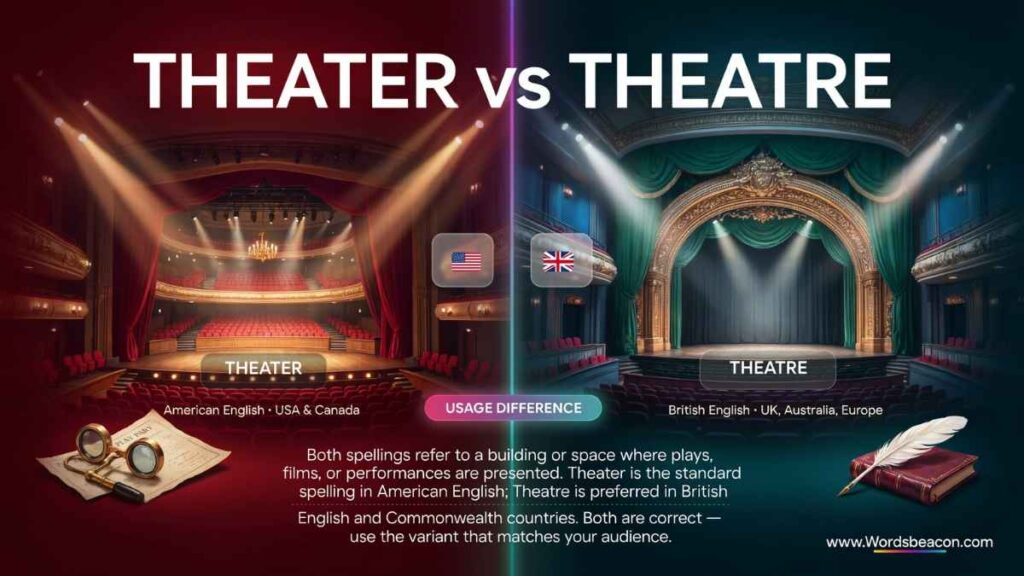
Is it theater vs theatre? If you’ve ever paused while writing this word, you’re not alone! These two spellings often confuse writers, but the good news is that neither is wrong. The difference is simply regional: Americans usually write theater, while British writers prefer theatre. Both words have the same meaning, whether you’re talking about a movie venue, a stage performance, or the performing arts. So, how do you know which spelling to choose? Let’s break down the difference with simple explanations and everyday examples so you can write with confidence and avoid this little spelling drama!
quick comprasion
| Comparison | Theater | Theatre |
|---|---|---|
| Standard spelling | American English | British English |
| Common in | United States | United Kingdom |
| Meaning | A place for performances or films; the art of drama | A place for performances or films; the art of drama |
| Pronunciation | Usually pronounced thee-uh-ter | Usually pronounced thee-uh-tuh |
| Canadian usage | Also appears | Commonly preferred |
| Australian and New Zealand usage | Less common | Generally preferred |
| Correct in English? | Yes | Yes |
Understand confusing English more words simply
Contractor vs Contracter Which Spelling Is Correct?
Theater vs Theatre The Quick Answer
Both theater and theatre are correct English spellings. The main difference is where writers use them.
- Theater is the standard American English spelling.
- Theatre is the traditional British English spelling.
- Both words describe a building where people watch performances, the art of dramatic performance, or a venue for films.
- Neither spelling is more correct or more formal than the other.
- Your choice should depend on your audience, location, and preferred style guide.
For example:
- American English: We watched a new film at the movie theater.
- British English: We watched a new film at the cinema, then visited the theatre for a play.
If you’re writing for an American audience, choose theater. On the other hand, if your readers are primarily in the UK, use theatre. Most importantly, stay consistent throughout your writing.
What Do Theater and Theatre Mean?
Although their spellings differ, theater and theatre share the same basic meaning. Both refer to places where people watch performances and to the art of presenting stories through acting, dialogue, music, and movement.
The words can serve several purposes depending on the context.
Theater or Theatre as a Building
A theater or theatre can refer to a building or designated space where performers present plays, musicals, concerts, and other live entertainment.
For example:
- The new theater has comfortable seats and excellent sound equipment.
- The historic theatre attracts visitors from across the country.
- Our school plans to renovate its small theater next year.
In this context, both spellings describe the same kind of place. The regional spelling preference determines which version you should use.
Theater or Theatre as an Art Form
The word can also describe dramatic performance as an art form rather than a physical building.
For example:
- She studied theater at a university in California.
- He has a deep interest in British theatre.
- Their children participate in community theater programs.
Here, the word refers to acting, stage production, dramatic writing, and performance.
Theater or Theatre in the Film Industry
In the United States, people commonly use movie theater to describe a venue where audiences watch films on a large screen.
For example:
- We bought tickets for the new movie theater.
- The local theater offers discounted tickets on Tuesdays.
In British English, people generally use cinema when referring to a place that shows films. However, theatre can still appear in British names and descriptions of entertainment venues.
Understand confusing English more words simply
Career vs Carrer Correct Spelling and Difference
American English vs British English Why Are There Two Spellings?
The main reason behind theater vs theatre is the difference between American and British spelling conventions.
English has several regional spelling variations. For instance, Americans write color while British writers use colour. Similarly, Americans generally prefer center, whereas British English uses centre.
The same pattern explains theater and theatre.
Theater Is the Standard American Spelling
American English generally uses theater in everyday writing, education, journalism, and professional communication.
Examples include:
- The school opened a new theater for student performances.
- We visited a historic movie theater downtown.
- She hopes to build a career in musical theater.
- The university offers several theater courses.
American dictionaries generally list theater as the standard US spelling. However, some American organizations deliberately use theatre in their official names.
For example, a company might choose Theatre in its name to reflect its artistic identity, history, or preferred branding. That choice does not change the standard American spelling.
Theatre Is the Standard British Spelling
British English generally prefers theatre. You’ll see this spelling in newspapers, school materials, entertainment listings, and everyday British writing.
Examples include:
- The theatre is hosting a new musical this weekend.
- She works for a well-known theatre company.
- The town recently restored its historic theatre.
- He studied theatre at university.
Although British English traditionally uses theatre, you may occasionally encounter theater in American publications, company names, or international contexts.
What About Canada, Australia, and New Zealand?
English-speaking countries don’t always follow the exact same spelling conventions.
- Canada: Theatre is commonly preferred, although theater also appears. Canadian spelling can reflect both British and American influences.
- Australia: Theatre is the usual spelling in Australian English.
- New Zealand: Theatre is generally preferred in New Zealand English.
- United States: Theater is the standard spelling.
- United Kingdom: Theatre is the standard spelling.
When writing for an international audience, consider your readers and the publication’s style guide. A spelling that looks natural in one country may look unfamiliar in another.
Learn how to use confusing more words correctly
Focusing vs Focussing Which Spelling Is Correct ?
Theater vs Theatre Are They Pronounced Differently?
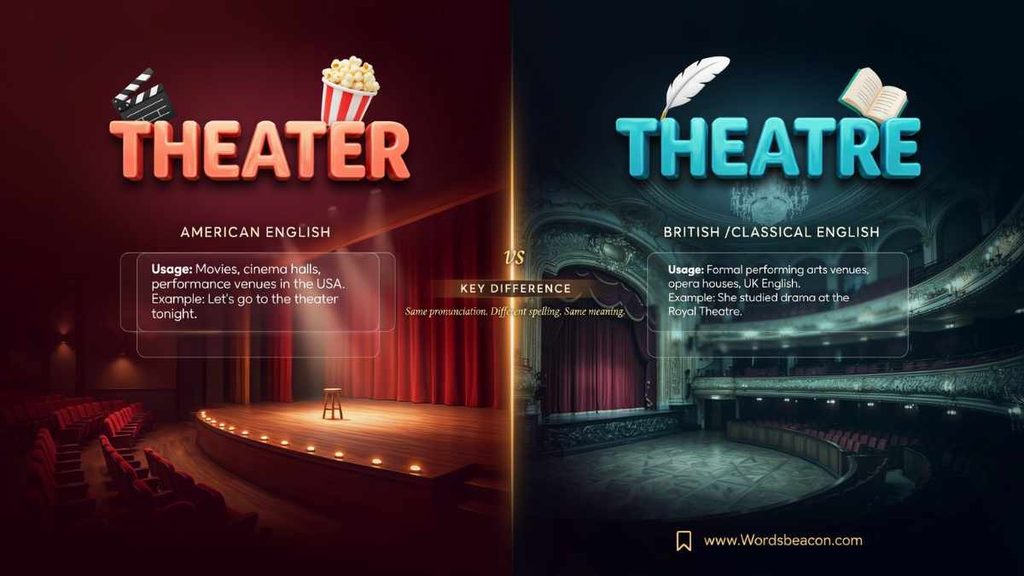
The spellings may look different, but their pronunciation is very similar. In most English accents, both words begin with the same sound and follow nearly the same rhythm.
The main differences come from regional accents rather than the spelling itself.
American Pronunciation
In American English, theater is commonly pronounced:
THEE-uh-ter
The first syllable receives the strongest stress. The final syllable often has a clear American R sound.
British Pronunciation
In British English, theatre is commonly pronounced:
THEE-uh-tuh
The final R is generally not pronounced in non-rhotic British accents. However, pronunciation varies across the UK, and some British accents pronounce the final R.
Do Theater and Theatre Sound Different?
Not necessarily. A speaker may pronounce both spellings in almost exactly the same way.
For example, an American speaker might say theater, while a British speaker says theatre. The spelling reflects the speaker’s regional writing convention, not a completely different word or meaning.
Movie Theater vs Movie Theatre Is There a Difference?
This question often creates confusion because people sometimes assume that theater refers to films while theatre refers to live performances.
That distinction is not a general English grammar rule.
Both spellings can describe venues for live performances and film screenings. However, regional vocabulary affects how people use these terms.
Movie Theater in American English
In the United States, movie theater is the common expression for a building where people watch films.
Examples:
- We arrived at the movie theater fifteen minutes early.
- The new movie theater has twelve screens.
- They opened a luxury movie theater near the shopping mall.
Americans also use cinema, but movie theater is a familiar everyday expression.
Movie Theatre in British and Canadian English
In British English, cinema is generally the more common term for a place where people watch films. In Canada, movie theatre is a familiar expression, and theatre is a common spelling.
Examples:
- We visited the local cinema after dinner.
- The new movie theatre has comfortable reclining seats.
- The historic theatre hosts both films and live performances.
Therefore, don’t assume that theater and theatre describe two different types of entertainment. The regional vocabulary and context matter more than the final spelling.
Learn how to use confusing more words correctly
Persuing vs Pursuing Difference and Correct Spelling
Theater and Theatre in Live Performances
Both spellings work when discussing live performances, including plays, musicals, dramatic productions, and stage shows.
For example:
- The theater company announced its upcoming season.
- The theatre production received excellent reviews.
- Students performed a comedy at their school theater.
- The city plans to restore its historic theatre.
The word also appears in several related expressions.
Musical Theater and Musical Theatre
Musical theater combines acting, singing, dancing, and music to tell a story on stage.
In American English, musical theater is the usual spelling. British English generally uses musical theatre.
Examples:
- She wants to study musical theater in New York.
- The university offers a musical theatre program.
- Broadway is famous for its musical theater productions.
Community Theater and Community Theatre
Community theater refers to local productions organized by amateur or volunteer performers. These groups often provide opportunities for people to act, direct, design sets, and participate in stage productions.
Examples:
- My sister performs with a community theater group.
- The local theatre organizes productions for young actors.
- Community theater gives beginners a chance to develop their skills.
Again, the spelling depends on the regional convention.
Fix common more word mistakes in English
Holistic vs Wholistic Difference and Correct Spelling
Theater vs Theatre in Medical and Military Terminology
The word also appears in specialized contexts. These uses can seem unrelated to entertainment, but they follow the same spelling distinction.
Operating Theater vs Operating Theatre
An operating theater or operating theatre is a room in a hospital where surgeons perform operations.
Both spellings are correct, although regional preferences differ.
Examples:
- The hospital built a modern operating theater.
- The surgical team prepared the operating theatre.
- Nurses checked the equipment before the patient entered the operating theatre.
In American English, operating room is also a very common expression. In British English, operating theatre is widely used.
Theater of War
In military terminology, a theater of war refers to a large geographical area where military operations take place.
The term does not describe a building for entertainment.
Examples:
- The general studied the history of that theater of war.
- Military leaders discussed the changing conditions across the theatre of operations.
- The region became an important theater of conflict.
American military writing generally uses theater. British military writing generally uses theatre.
This is another example of how the same word can carry different meanings depending on its context.
Theater vs Theatre Examples in Everyday Sentences
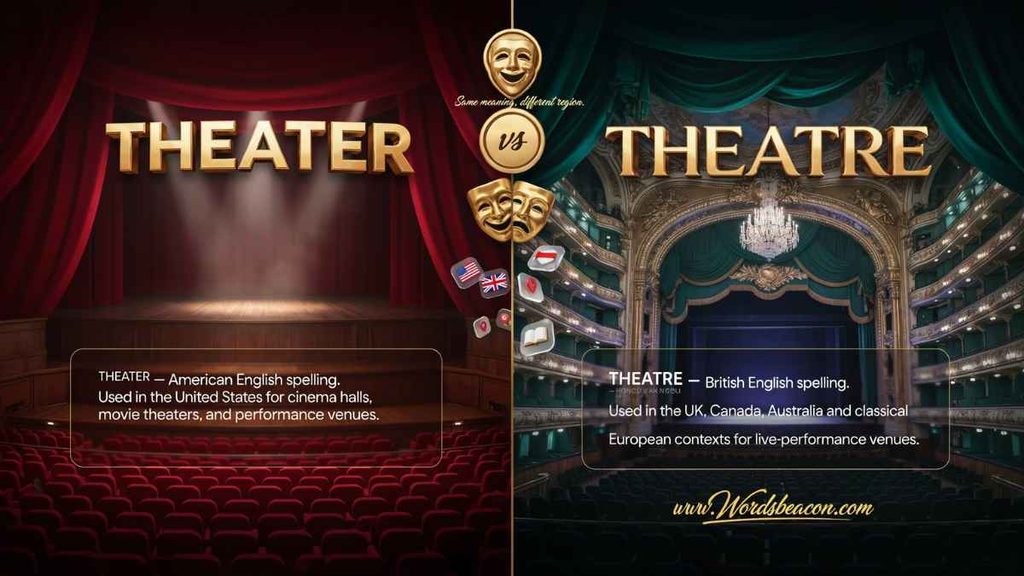
The easiest way to understand the difference is to see both spellings in natural sentences.
| American English: Theater | British English: Theatre |
|---|---|
| The theater opens at noon. | The theatre opens at noon. |
| She studies theater at college. | She studies theatre at university. |
| We visited a historic theater. | We visited a historic theatre. |
| The theater company announced a new play. | The theatre company announced a new play. |
| He works in musical theater. | He works in musical theatre. |
More Examples of Theater
Use theater when following standard American spelling.
- The city invested in a new theater for local artists.
- Our school organized a theater competition.
- She bought tickets for a Broadway theater production.
- The university offers a degree in theater studies.
- We watched an old film at the downtown theater.
- The director has worked in professional theater for twenty years.
More Examples of Theatre
Use theatre when following standard British spelling.
- The theatre welcomed a new group of performers.
- They attended a live performance at the Royal Theatre.
- The school introduced a theatre course.
- She enjoys working behind the scenes in theatre.
- The historic theatre reopened after extensive repairs.
- The production received praise from theatre critics.
Fix common more word mistakes in English
Across vs Accross Which Is the Correct Spelling?
Theater vs Theatre Grammar and Word Forms
Both words follow the same grammatical rules. The spelling changes according to regional preference, but their role in a sentence remains the same.
Theater and Theatre as Nouns
Both forms function as nouns. They can describe a building, a performance venue, or the art of dramatic performance.
Examples:
- The theater is crowded tonight.
- The theatre has a new stage.
- She enjoys studying theater.
- He works in professional theatre.
Plural Forms: Theaters and Theatres
To form the plural, add -s to either spelling.
- American English: theaters
- British English: theatres
Examples:
- Several new theaters opened across the city.
- London’s historic theatres attract visitors every year.
- The company manages three theaters in California.
- Many regional theatres support emerging performers.
Related Words and Expressions
The spelling difference also appears in related expressions.
| American English | British English |
|---|---|
| Theater | Theatre |
| Movie theater | Cinema / movie theatre |
| Musical theater | Musical theatre |
| Community theater | Community theatre |
| Theater company | Theatre company |
| Theater production | Theatre production |
| Theater studies | Theatre studies |
| Theater director | Theatre director |
Not every expression has a direct regional equivalent. For instance, British speakers commonly say cinema instead of movie theater.
Fix common more word mistakes in English
Different vs Diffrent Which Spelling Is Correct?
The Origin and History of Theater and Theatre
The story behind theater vs theatre goes back several centuries. Both spellings trace their roots to the same ancient Greek word.
The English word entered the language through French and Latin, eventually developing into the forms used today.
Greek and Latin Roots
The word comes from the ancient Greek theatron, which referred to a place for viewing or watching a performance. It relates to the Greek verb theasthai, meaning to look at or observe.
Latin adopted the word as theatrum. From there, it passed into Old French as theatre before entering English.
The original meaning connected the word with a place where people gathered to watch performances.
How Did Theater Become the American Spelling?
The spelling history is more complicated than saying one person invented the American form.
English used several spellings over time, including theatre and theater. The form theater appeared in English long before Noah Webster became influential.
During the late eighteenth and early nineteenth centuries, American spelling conventions began to develop more independently from British conventions.
Noah Webster supported simpler and more consistent American spellings. His spelling books and dictionaries helped establish several differences between American and British English.
As a result, theater became the standard American form, while theatre remained the traditional British spelling.
So, did Noah Webster create the word theater? No. He helped promote and standardize American spelling conventions, but the spelling existed earlier.
Common Mistakes When Using Theater and Theatre
Although both spellings are correct, writers can still make mistakes when choosing between them.
Mixing American and British Spellings
One common problem is switching between regional spelling systems in the same article.
For example:
Incorrectly inconsistent:
- The theater opened last month.
- The theatre company announced a new production.
This combination isn’t necessarily grammatically wrong, but it can look inconsistent in an article written entirely in American English.
Better for American readers:
- The theater opened last month.
- The theater company announced a new production.
Better for British readers:
- The theatre opened last month.
- The theatre company announced a new production.
Assuming Theatre Is More Formal
Some writers believe theatre sounds more artistic or sophisticated than theater. However, the spelling alone doesn’t make a word more formal.
Both versions are standard. The difference comes mainly from regional spelling preferences.
Thinking Theater Only Means Movies
Another common misunderstanding is that theater refers to movies while theatre refers to live stage performances.
This distinction does not apply as a general spelling rule. Both forms can describe live performance venues and the art of drama.
Changing Official Names
A theater or theatre company may use a spelling that differs from the regional standard.
For example, an American organization may officially call itself a Theatre Company. Don’t change its name to Theater Company simply to match American spelling.
Proper names, business names, and official titles should retain their established spelling.
Learn the difference between tricky more English words
Center vs Centre Difference and Which one Is Correct?
Which Spelling Should You Use Theater vs Theatre?
The best spelling depends on your intended audience.
If you’re writing for American readers, use theater. If you’re writing for British readers, use theatre.
Here’s a simple guide:
- US websites and blogs: Use theater.
- American academic writing: Follow the institution’s style guide, which will generally favor theater.
- British publications: Use theatre.
- Australian publications: Theatre is generally preferred.
- New Zealand publications: Theatre is generally preferred.
- Canadian publications: Theatre is commonly preferred, but check the publication’s style guide.
- International websites: Choose one spelling system and use it consistently.
If you’re unsure, check the dictionary or style guide used by your publication. Consistency matters more than choosing one version over the other.
A Simple Trick to Remember Theater vs Theatre
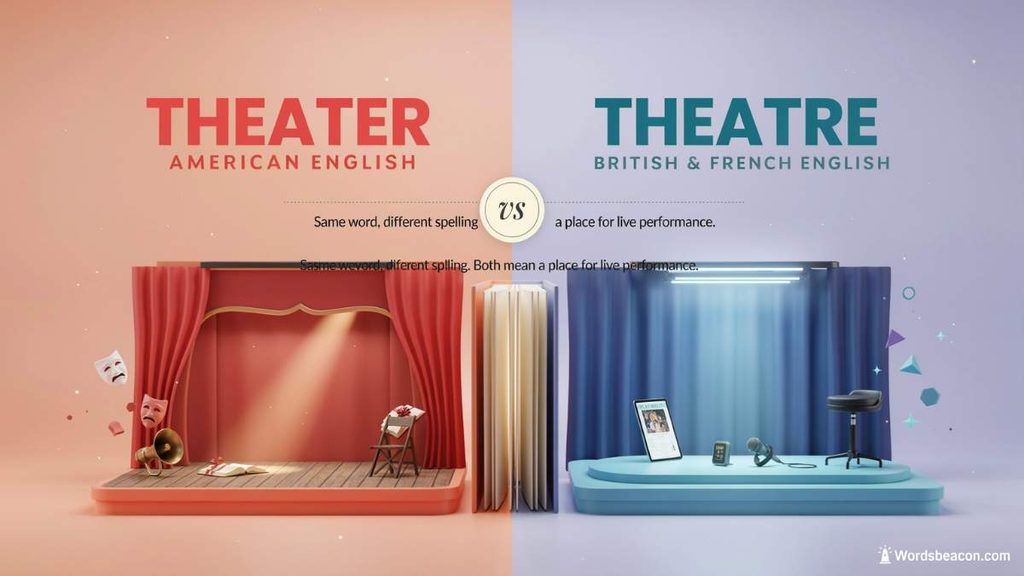
You don’t need to memorize complicated spelling rules to remember the difference.
Just connect each spelling with its most familiar regional form:
- Theater = American English
- Theatre = British English
Think of the final letters as a regional spelling clue. American English often uses -er in words such as theater, center, and meter. British English traditionally uses -re in theatre, centre, and metre.
This pattern makes the distinction easier to remember.
However, don’t apply it blindly to every English word. Regional spelling conventions include exceptions, so check unfamiliar words when necessary.
Learn the difference between tricky more English words
Symptomatology Vs Symptomology Difference and usage
Practice session Theater vs Theatre
Choose the correct spelling according to the Theater vs Theatre. These questions will help you recognize the difference and use each form naturally.
- We watched a new movie at the local ______. (American English)
- The historic ______ reopened after several months of renovation. (British English)
- She wants to study musical ______ at a university in New York. (American English)
- The London ______ company announced its new season. (British English)
- Our school built a small ______ for student performances. (American English)
- The actor has worked in professional ______ for more than ten years. (British English)
- Several new ______ opened across the city. (American English)
- The city is famous for its historic ______. (British English)
- He bought tickets for a Broadway ______ production. (American English)
- The university offers a degree in ______ studies. (British English)
- The hospital opened a modern operating ______. (American English)
- The surgeon entered the operating ______ before the procedure. (British English)
- The military command studied the history of that ______ of war. (American English)
- The local ______ hosts plays and musical performances. (British English)
- The director plans to renovate the old movie ______. (American English)
- The students performed a comedy at their school ______. (British English)
- She joined a community ______ group in Chicago. (American English)
- The historic ______ attracts visitors from around the world. (British English)
- The historic ______’s new seating arrangement improved the audience’s experience. (American English)
- Many regional ______ support new and emerging performers. (British English)
Answers
- Theater
- Theatre
- Theater
- Theatre
- Theater
- Theatre
- Theaters
- Theatres
- Theater
- Theatre
- Theater
- Theatre
- Theater
- Theatre
- Theater
- Theatre
- Theater
- Theatre
- Theater
- Theatres
Here’s a trusted source for clear word meanings:
FAQs
Why Do Americans Spell It Theater Instead of Theatre?
Americans use theater because American English gradually adopted the -er spelling in place of the traditional -re ending. This spelling became widely accepted through American usage and the influence of spelling reformers such as Noah Webster. Today, theater is the standard spelling in the United States.
Is It Movie Theater or Movie Theatre?
Both spellings are correct, but movie theater is standard in American English. Movie theatre also appears in Canadian and other varieties of English. In the United Kingdom, people generally use the word cinema instead.
What Do British People Call Movie Theaters?
British people generally call movie theaters cinemas. For example, an American might say, “We’re going to the movie theater,” while someone in the UK would more naturally say, “We’re going to the cinema.”
Why Are Movie Cinemas Sometimes Called Theaters?
The word theater originally described a place where audiences gathered to watch performances. As motion pictures became popular, the word also came to describe venues that screened films. This development explains why Americans commonly use the expression movie theater.
What Is the Difference Between Acting and Theater?
Acting is the art of portraying a character through dialogue, movement, facial expressions, and emotion. Theater is the broader performing art that includes acting, directing, scriptwriting, stage design, lighting, costumes, and production. In other words, acting is one part of theater, while theater covers the entire stage-performance experience.
What Are the Four Main Types of Theater?
Four widely recognized forms of theater are tragedy, comedy, musical theater, and experimental theater.
- Tragedy: Explores serious subjects such as suffering, conflict, loss, and difficult decisions.
- Comedy: Uses humor, amusing situations, and entertaining characters to engage audiences.
- Musical theater: Combines acting, singing, dancing, and music to tell a story.
- Experimental theater: Uses unconventional techniques, staging, or storytelling to explore new forms of performance.
These categories can overlap, and many productions combine elements of more than one type.
What Do You Call an Actor in a Theater Production?
A person who performs a character in a theater production is called an actor or performer. The term actor can refer to performers of any gender, while actress is also commonly used for a female performer. Depending on the role, someone may be described as a lead actor, supporting actor, or cast member.
What Does Going Dark Mean in Theater?
In theater, going dark means a venue temporarily stops presenting live performances. A theater might go dark between production seasons, during renovations, on holidays, or because of financial difficulties. The expression doesn’t necessarily mean the venue has closed permanently.
Is It Theater of War or Theatre of War?
Both spellings are correct. American English generally uses theater of war, while British English prefers theatre of war. The expression refers to a geographical area where military operations take place, rather than a venue for entertainment.
Is It AMC Theaters or AMC Theatres?
The cinema chain’s official name is AMC Theatres. Although theater is the standard American spelling in general writing, company names follow their official branding. Therefore, use AMC Theatres when referring to the business.
What Is the Difference Between a Theater and an Auditorium?
A theater is a venue designed for performances, films, or other entertainment. An auditorium is a large room or hall where audiences gather for presentations, speeches, concerts, or performances. A theater may contain an auditorium, but not every auditorium qualifies as a theater.
Why Do Some American Theaters Spell Their Names With -Re?
Some American venues and performing arts organizations use theatre in their official names because of tradition, branding, or historical identity. An organization’s name doesn’t have to follow the most common American spelling. For that reason, you may see Theatre on an American building even though theater remains the standard US spelling.
Learn the difference between tricky more English words
Sleeve vs Sleave Difference and which is correct ?
Conclusion
So, is it theater vs theatre? The answer is simple: both are correct! The only difference is where you use them. American English prefers theater, while British English uses theatre. Both spellings have the same meaning, whether you’re talking about a movie venue, a live performance, or the performing arts. Just remember your audience and stick to one spelling throughout your writing. There’s no need to turn a simple spelling choice into a full stage production! Once you know this little regional difference, you’ll never have to second-guess theater vs theatre again.

Luna AJS is an experienced blogger and dedicated language enthusiast at Words Beacon. She specializes in making English grammar, spelling, vocabulary and commonly confused words easy to understand. She provides clear explanations, practical examples to help readers write with confidence.