

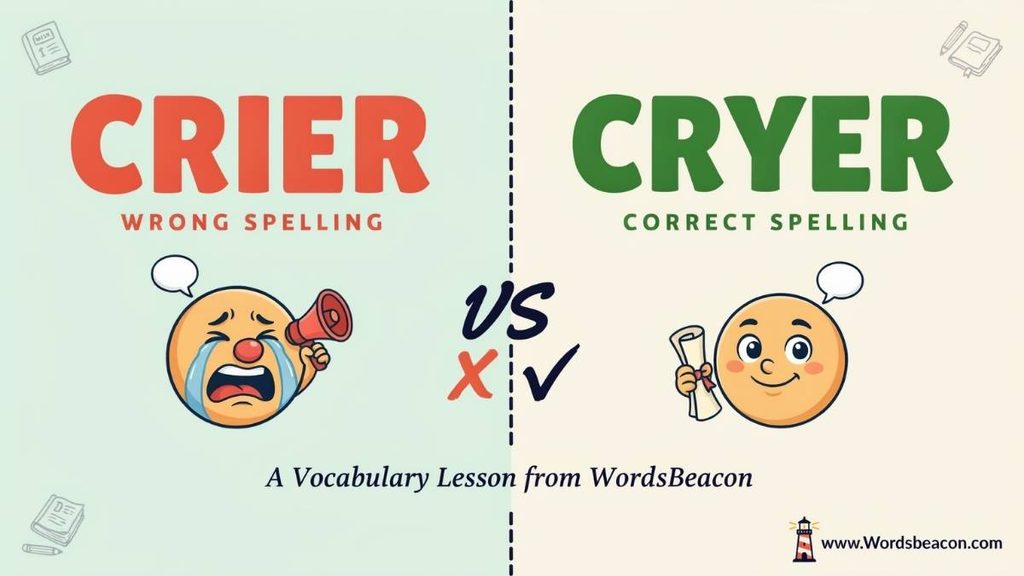
Crier vs cryer can be confusing because both spellings look like they should describe someone who cries. So, which one should you use? The answer is simple: crier is the standard spelling in modern English. Cryer may appear as a surname or an uncommon variant, but it isn’t the usual choice when you mean someone who cries. There’s another twist, too. Crier can also mean a public announcer, as in town crier. English may have a talent for making easy words tricky, but this one doesn’t have to leave you in tears. Let’s clear up the meanings, spelling, pronunciation, and correct usage.
Quick Answer
The crier vs cryer meaning becomes much easier when the two forms are placed side by side.
| Word | Standard use | Meaning | Example |
|---|---|---|---|
| Crier | Standard | A person who cries or a person who makes a public announcement | “She is a frequent crier.” |
| Cryer | Usually not the standard common noun | Can occur as a surname or in less common historical uses | “Jon Cryer is an actor.” |
If you mean a person who cries, crier is the correct standard spelling.
The easiest way to remember it is this: a crier cries. If Cryer appears with a capital letter, it may be a person’s surname rather than the common noun.
Learn the difference between confusing more English words
Honor vs Honour difference and usage?
Crier vs Cryer Meaning What Does Crier Mean?
The most common crier meaning is a person who cries. The word is a noun that describes someone who cries, whether that happens often or only in a particular situation.
For example, you might say, “The baby was a loud crier.” You could also say, “She has always been an emotional crier.” In both sentences, crier refers to someone who cries.
The word does not tell you exactly why the person is crying. A person can cry because of sadness, pain, frustration, happiness, fear, or even relief. The surrounding context explains the reason.
You may also see crier used for someone who cries frequently. In everyday conversation, though, many people would simply say “someone who cries a lot” because it sounds more natural.
Crier Definition A Person Who Cries
The basic crier definition is straightforward: a person who cries.
It can describe a child, an adult, or anyone else who cries. For example:
“The child was a frequent crier.”
“He was not usually a crier, but the ending of the movie made him emotional.”
“She was a crier when she was younger.”
In each case, crier works as a common noun. It identifies the person through the action of crying.
You can also use the word more generally to describe someone who tends to express emotion through tears. However, crier does not necessarily mean that the person is overly emotional or cries all the time. Context matters.
Learn the difference between confusing more English words
Accept vs Except difference and usage?
Crier Has Another Meaning
Crier is not limited to emotional crying. The word also has a historical meaning connected with calling out or making announcements.
That is where the familiar expression town crier comes in.
A town crier was traditionally a person who announced important news or official information publicly. Before newspapers, radio, television, and the internet became common, communities needed ways to spread important information. A town crier could walk through a town, ring a bell, and call out an announcement so people could hear it.
The word therefore has two important meanings. A crier can be someone who cries emotionally, or it can be someone who cries out information publicly.
Those meanings may seem unrelated at first. However, they are connected through the older use of cry to mean calling out or shouting.
The Meaning of Town Crier
The phrase town crier is still familiar today, even though the traditional occupation has largely disappeared.
A town crier might announce an official proclamation, an important piece of news, or information that the community needed to hear. Historical descriptions often portray the crier standing in a public place and calling out the message loudly.
That is why crier is also associated with words such as announcer, public crier, street crier, and historical official.
The expression survives in modern English because it refers to a recognizable historical role.
Learn the difference between confusing more English words
Sergeant vs Sargeant difference and usage?
Crier vs Cryer Which Spelling Is Correct?

If you are wondering, “Is crier or cryer correct?” the answer depends on what you mean. For the ordinary noun referring to a person who cries, crier is the standard spelling.
For example:
“She is a frequent crier.”
“The baby was a loud crier.”
“I am not much of a crier.”
These sentences use the standard form.
Writing cryer in these sentences would not be the preferred choice in standard modern English.
The confusion happens because cryer looks logical. You might naturally think that adding the suffix -er to cry should produce cryer. English spelling, however, does not always work by simply attaching a suffix to the visible form of a word.
The established noun is crier.
Crier vs Cryer Difference Why Is Crier Spelled With an I?
The question of why is it crier and not cryer causes much of the confusion.
At first glance, cry + er appears to give cryer. Yet the standard form is crier.
The important point is that crier has its own established spelling and history. It is not simply a modern spelling created by adding -er to the word cry. The word developed through earlier forms of English and French, which helps explain why its modern spelling does not look exactly like a straightforward combination of cry and -er.
It is also useful to avoid treating every English spelling pattern as a fixed mathematical rule. English contains many spelling patterns, but it also contains exceptions, older forms, borrowed words, and words whose modern spelling reflects their historical development.
So, rather than trying to force the word into a simple formula, remember the established form:
cry → crier
That is the spelling used in standard modern English.
Crier vs Cryer Grammar
From a grammar perspective, crier is a noun.
When you say, “The child is a crier,” the word crier identifies the child. It functions as a common noun.
The same noun appears in town crier.
For example:
“The town crier announced the news.”
Here, town describes what kind of crier the person is. The crier is an announcer rather than someone who is crying.
The plural form is also simple:
crier → criers
For example:
“The babies were frequent criers.”
“Several criers gathered outside.”
The spelling keeps the i in the plural form.
Learn the difference between similar English words
Insite vs Insight difference and usage?
Crier Pronunciation vs Cryer Pronunciation
Crier and Cryer can sound very similar, and in many cases they are pronounced the same.
In American English, crier is commonly pronounced /ˈkraɪər/.
This similarity in sound creates another spelling trap. When you hear the word, you may naturally spell it according to the sound of cry. That can lead to cryer.
However, pronunciation does not always tell you the correct spelling. English contains many words that sound alike but have different spellings. Names create even more possibilities because surnames can preserve spellings that differ from ordinary vocabulary.
That is why crier pronunciation and Cryer pronunciation should not be used as the deciding factor when choosing the written form.
When you mean the common noun, use crier.
Is Crier a Word?
Yes. If you are asking, “Is crier a word?” the answer is definitely yes.
Crier is an established English noun. It can mean a person who cries, and it can also refer to a person who makes public announcements.
The word appears naturally in expressions such as town crier and in descriptions of people who cry frequently.
For example:
“He is a crier when he watches emotional movies.”
“The town crier announced the news.”
The meaning changes because the context changes, but the spelling remains crier.
Learn the difference between similar English words
Gluing vs Glueing difference and usage?
Is Cryer a Word?
The question “Is cryer a word?” needs a more careful answer.
Cryer can appear in English, especially as a surname. It may also occur in historical or uncommon contexts. Therefore, it would be too broad to say that the spelling can never exist.
However, that does not make cryer the standard spelling for a person who cries.
This distinction is important. A word can appear somewhere in English without being the preferred form for a particular meaning.
For ordinary modern writing, crier is the form to use when you mean someone who cries.
Cryer as a Surname
Cryer can function as a proper noun, especially as a surname.
A well-known example is Jon Cryer, the American actor. His surname is spelled Cryer.
That spelling should not be changed simply because crier is the standard common noun.
For example:
“Jon Cryer is an actor.”
In this sentence, Cryer is a name. It is not the noun meaning a person who cries.
This is an important difference between a common noun and a proper noun. Common nouns describe general people, places, things, or ideas. Proper nouns identify specific people or entities and normally retain their established spelling.
Learn the difference between similar English words
Advise vs Advice difference and Usage?
Cryer Meaning What Does Cryer Mean?
The cryer meaning depends on context.
If someone uses cryer to mean a person who cries, the intended meaning may be clear from the sentence. However, crier is the preferred standard spelling for that meaning in modern English.
Cryer is much more likely to appear as a surname or in an unusual historical context.
Therefore, the best practical rule is not “cryer never exists.” A better rule is this:
Crier is the standard modern spelling for the common noun meaning a person who cries.
Cryer may occur as a name or as a less common historical or variant form.
That distinction gives you a more accurate understanding of the two spellings.
Crier vs Cryer Usage in Modern English
The crier vs cryer usage question is easiest to answer by looking at the situation.
| Situation | Best choice | Example |
|---|---|---|
| A person who cries | Crier | “She is a crier.” |
| Someone who cries frequently | Crier | “He was a frequent crier as a child.” |
| A baby who cries often | Crier | “The baby was a loud crier.” |
| A town announcer | Crier | “The town crier made the announcement.” |
| A person’s surname | Cryer, if that is the person’s name | “Jon Cryer appeared on television.” |
| Standard school or professional writing | Crier | “The child was a frequent crier.” |
This makes the practical difference clear.
If you are writing an essay, article, assignment, or professional document and you need a noun meaning someone who cries, crier is the safest standard choice.
Crier vs Cryer for Crying?
If the question is specifically “Crier or cryer for crying?” the answer is crier.
You can call someone a crier when that person tends to cry.
For example:
“She is a crier during emotional movies.”
“He became a crier after the difficult experience.”
“The baby was a frequent crier.”
You can also avoid the noun entirely and use a longer phrase such as “a person who cries” or “someone who cries often.” In fact, those expressions may sound more natural in casual conversation.
Still, when you need the single noun, crier is the standard choice.
Learn the difference between confusing word pairs
Laid Down vs Lied Down Difference and usage?
Common Mistakes With Crier and Cryer
One common mistake happens because cryer looks like the obvious combination of cry and -er. That spelling makes sense at first glance, but standard English uses crier for the common noun.
Another mistake is assuming that every appearance of Cryer must be wrong. That can lead to incorrect corrections of people’s names. If someone’s surname is Cryer, the spelling should remain Cryer.
A third mistake comes from relying entirely on pronunciation. Because crier and Cryer can sound alike, hearing the word does not tell you which spelling belongs in a particular sentence.
Finally, some writers assume that crier always means someone who cries. The expression town crier shows why context matters. In that phrase, crier refers to an announcer.
Crier vs Cryer Examples
Consider a few everyday examples.
“The baby was a loud crier.”
Here, crier means a baby who cries frequently.
“She is not usually a crier, but the speech made her cry.”
Again, crier describes a person who tends to cry in emotional situations.
Now consider a historical example:
“The town crier rang his bell before announcing the news.”
Here, crier means a public announcer. No tears are involved.
Finally, look at a proper name:
“Jon Cryer appeared in the television series.”
Cryer is a surname in this sentence. Replacing it with Crier would change the person’s name.
These examples show why the context matters more than the similarity between the spellings.
Crier vs Cryer A Simple Case Study
Imagine that a student writes this sentence:
“The child was a frequent cryer.”
The student means that the child cried often.
The standard correction is:
“The child was a frequent crier.”
Now imagine a different sentence:
“Jon Crier appeared in the television series.”
If the writer is referring to Jon Cryer, the correction goes in the opposite direction:
“Jon Cryer appeared in the television series.”
The first example involves a common noun. The second involves a proper noun.
This is the key lesson. You should not decide whether crier or cryer is correct by looking at the letters alone. First identify what the word is doing in the sentence.
Learn the difference between confusing word pairs
Seel vs Seal Difference and usage?
Why Crier Looks Like a Spelling Mistake

Crier looks unusual because the word cry is so familiar.
When you see cry, your brain naturally expects related words to keep the same spelling. That makes cryer feel perfectly reasonable.
English does not always cooperate with that expectation.
The standard noun is crier, and its spelling has developed over centuries. Historical forms help explain why the modern word does not simply look like cry with -er attached.
The word also has an interesting connection to the older meaning of cry as a public call or announcement. That connection helps explain the historical sense of crier as an announcer.
So although crier may look strange at first, it is not an arbitrary spelling. It is an established English word with a long history.
Crier Spelling How to Remember It
The easiest way to remember the crier spelling is to connect it with the familiar phrase town crier.
Think:
town crier
Then remember:
a crier cries
That gives you both major modern meanings and the same spelling.
Another useful reminder is:
cry → crier
Do not let the tempting cry + er pattern push you toward cryer when you need the standard common noun.
A simple sentence can make the distinction stick:
“A crier cries, while a Cryer may be a name.”
It is short, clear, and useful when you need to make a quick spelling decision.
Crier vs Cryer Which One Should You Use?
1.If you are writing about a person who cries, use crier.
2.If you are writing about a historical public announcer, use crier.
3.If you are referring to a specific person whose surname is Cryer, keep Cryer.
4.If you are reproducing an old text, historical spelling may need to remain unchanged for accuracy.
For ordinary modern English, however, there is little reason to choose cryer when you mean a person who cries. Crier is the standard and preferred spelling.
Learn the difference between confusing word pairs
Truly vs Truely difference and usage?
Practice Session Crier vs Cryer
Fill in each blank with the correct word: crier vs cryer.
- The baby was such a loud ______ that everyone in the house woke up.
- The town ______ walked through the streets announcing the important news.
- She is a frequent ______ who tears up during emotional movies.
- The historical ______ used a bell to attract people’s attention before making announcements.
- The word “______” is the standard spelling for a person who cries.
- The little boy became a loud ______ after falling and hurting his knee.
- The town ______ announced the royal proclamation to the crowd.
- Although “______” may appear logical, it is not the usual modern spelling for someone who cries.
- The courtroom ______ once had the job of making official announcements.
- Her parents jokingly called her a happy ______ because she cried whenever she was excited.
- A ______ can refer to someone who cries frequently or easily.
- The street ______ called out to attract customers to his goods.
- The spelling “______” is preferred in standard modern English when referring to a person who cries.
- The old-fashioned town ______ shouted the announcement through the village.
- The baby was a restless little ______ throughout the night.
- “______” can also describe a public announcer, especially in the expression “town crier.”
- In the sentence “The child is a loud ______,” the correct spelling refers to someone who cries.
- The historical ______ rang a bell before delivering the public announcement.
- Some people mistakenly write “______” because it seems natural to add -er directly to “cry.”
- The word “______” has a long history in English and can refer to both a person who cries and a public announcer.
Answers
- crier
- crier
- crier
- crier
- crier
- crier
- crier
- cryer
- crier
- crier
- crier
- crier
- crier
- crier
- crier
- crier
- crier
- crier
- cryer
- crier
Here’s a trusted source for clear more words Comparison:
FAQs
Is someone who cries a crier vs cryer?
Crier is the standard spelling for someone who cries. Although cryer may seem natural because it combines cry with -er, crier is the preferred form in modern English.
Is crier a real word?
Yes, crier is a genuine English word. It can describe someone who cries, but it can also refer to a public announcer, as in town crier.
Is cryer a word?
Cryer does appear in English, but it isn’t the usual spelling for a person who cries. It may appear as a surname or an uncommon spelling variant. For the ordinary noun, crier is the better choice.
What is the difference between crier and cryer?
Crier is the standard noun for someone who cries. It also has another established meaning: a person who makes public announcements. Cryer is much less common and is sometimes found as a surname or spelling variant.
Which is correct, crier or cryer?
Crier is correct when you mean a person who cries. For example, “The baby is a frequent crier.” In standard modern English, crier is the spelling you should normally use.
Why is it spelled crier instead of cryer?
The spelling comes from an established English pattern. When cry takes the suffix -er, the final y changes to i, giving us crier. The same spelling pattern appears in words such as tries and tried.
What does crier mean?
Crier usually means a person who cries. However, the word has another well-known meaning. A town crier, for example, was a person who publicly announced news, proclamations, or other important information.
What does cryer mean?
Cryer is an uncommon form that may be encountered in historical or specialized usage. It can also be a surname. However, when you mean someone who cries, crier is the standard modern spelling.
How do you pronounce crier?
Crier is generally pronounced like “cry-er,” with two syllables. The first syllable sounds like cry, followed by a short unstressed “er” sound.
Is town crier the correct spelling?
Yes. Town crier is the established expression. A town crier was traditionally responsible for announcing news or official proclamations publicly. Town cryer is not the standard spelling.
What do you call a person who cries easily?
A person who cries easily can be called a crier. Depending on the situation, you could also describe the person as tearful or easily moved to tears.
Can cryer mean someone who cries?
People may understand cryer as someone who cries because the spelling seems to follow the verb cry directly. However, crier is the standard form used for this meaning in modern English.
Is Cryer a surname?
Yes. Cryer can be a surname and therefore functions as a proper noun when it refers to a person’s family name. This use is separate from crier, the common noun used for someone who cries.
What is a town crier?
A town crier was a public announcer who delivered news, proclamations, and other important information to people in a town. The crier would often call out the announcement in a public place so people could hear it.
Is crier a noun?
Yes. Crier is a noun because it names a person. For example, in “The child is a frequent crier,” the word crier identifies the person who cries.
What is the plural of crier?
The plural of crier is criers. For example, you could say, “The town criers announced the news throughout the community.”
Is crier correct in formal writing?
Yes. Crier is the appropriate spelling in standard formal English when you mean a person who cries. It is also the established spelling in the expression town crier.
Is cryer a spelling mistake?
It depends on the context. Cryer can appear as a surname or an uncommon spelling variant, so it isn’t automatically a mistake. However, if you mean a person who cries, crier is the standard choice.
Should I use crier or cryer for a baby?
Use crier. For example, “The newborn was a frequent crier.” Although cryer may look logical, it isn’t the preferred spelling for this meaning.
Does crier come from the verb cry?
Yes. Crier is connected to the verb cry and refers to someone associated with the action. English spelling conventions give us crier rather than cryer.
Is crier different from crying?
Yes. Crier is a noun that refers to a person who cries, while crying refers to the act of shedding tears or expressing emotion. For example, “The crying baby was a frequent crier.”
What is the easiest way to remember crier vs cryer?
Remember this simple rule: when you mean “a person who cries,” use crier with an i. Think of it as cry → crier. If you see Cryer as a name, treat it as a proper noun rather than the standard spelling of the common noun.
Learn the difference between confusing word pairs
Begun vs Began difference and usage?
Conclusion
The crier vs cryer confusion is easy to settle once you know which spelling is standard. When you mean a person who cries, use crier. Although cryer looks like the obvious spelling, it isn’t the usual form in modern English. Crier can also describe a public announcer, as in town crier.
Cryer can still appear as a surname or an uncommon spelling variant, so seeing it doesn’t always mean someone made a mistake. However, for everyday writing, crier is the safe and correct choice when you mean someone who cries.
In short, remember this simple pattern: cry → crier. Choose crier, and you can leave the spelling tears behind.

Luna AJS is an experienced blogger and dedicated language enthusiast at Words Beacon. She specializes in making English grammar, spelling, vocabulary and commonly confused words easy to understand. She provides clear explanations, practical examples to help readers write with confidence.