
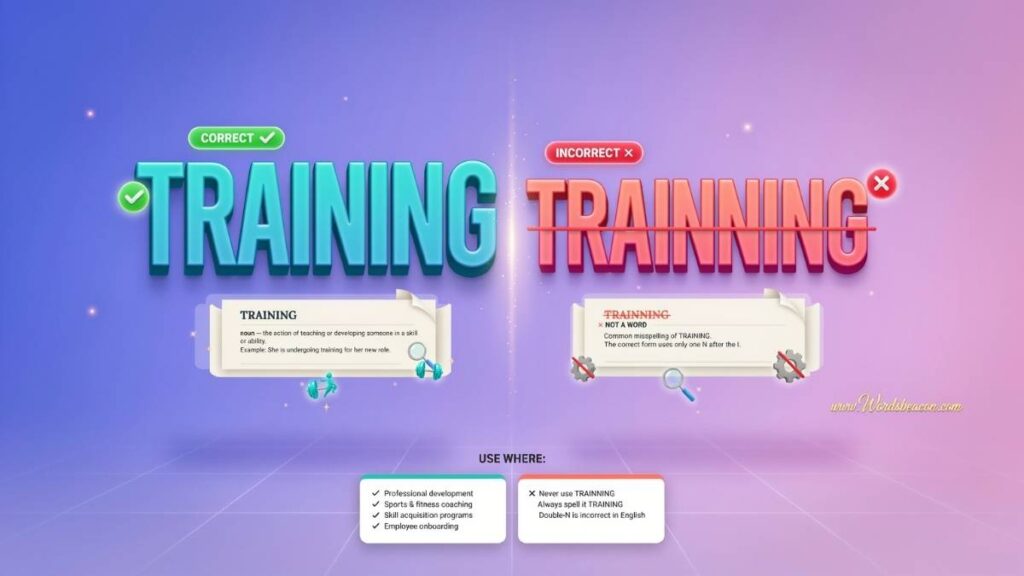
English spelling can be confusing, especially when one extra letter makes a word look right when it isn’t. The difference between training vs trainning is a perfect example. At first glance, both spellings might seem correct, but only one follows standard English rules. So, which one should you use? The answer is simple: training is correct, while trainning is a common spelling mistake. Whether you’re writing about employee development, a training course, or sports practice, correct spelling helps keep your writing clear and professional. Fortunately, there’s no tricky rule to memorize. Once you understand why training has only one n, you can avoid this mistake with confidence.
quick comparison
| Feature | Training | Trainning |
|---|---|---|
| Spelling status | Correct | Incorrect |
| Meaning | Learning skills or preparing for an activity | No separate standard meaning |
| Word formation | Train + -ing | Adds an unnecessary extra n |
| Correct usage | The training starts tomorrow. | The trainning starts tomorrow. |
| Standard English | Yes | No |
Learn how to use confusing more words correctly
Laser vs Lazer Correct Spelling and Usage ?
Quick Answer Is It Training vs Trainning?
The correct spelling is training, with one n after the ai vowel combination and one n before the ending -ing. Trainning is a common spelling mistake, not a standard English word.
For example, you should write:
- The company provides training for new employees.
- She is training for a marathon.
- Our training course begins next week.
In each sentence, training refers to learning, practice, or preparation. Although trainning may look plausible, it adds a letter that the word does not need.
Therefore, whenever you’re unsure whether to write training vs trainning, choose training. This spelling is correct in both American and British English.
What Does Training Mean?
Training refers to the process of learning, practicing, or developing the skills needed to perform a task. Depending on the situation, it can involve instruction, repeated practice, physical exercise, or professional development.
For instance, a new employee may receive training before starting a job. Similarly, an athlete may follow a training plan to improve strength and endurance. In both cases, training helps someone prepare for a specific goal.
Training Definition and Word Meaning
Training refers to the process of gaining knowledge, learning new skills, or improving an ability through teaching and practice. In addition, it can describe preparation for a particular activity, especially in sports, education, and the workplace. In simple terms, training helps people learn how to do something better.
For example, training can take different forms depending on a person’s needs and goals:
- Employee training helps workers understand their responsibilities and perform their jobs more effectively.
- Physical training improves fitness, strength, and stamina through regular exercise.
- Professional training helps people develop useful skills and prepare for career opportunities.
- Safety training teaches workers how to recognize potential dangers and reduce risks.
- Technical training helps learners understand and use specific tools, systems, or equipment.
As these examples show, training involves more than simply gaining information. Instead, it helps people apply what they learn in real-life situations. Consequently, effective training can build confidence, improve performance, and make everyday tasks easier to manage.
Is Training a Noun or a Verb?
Training can function as a noun or as the -ing form of the verb train. However, its grammatical role depends on how you use it in a sentence. Understanding this difference can help you avoid confusion and use the word correctly.
As a noun, training refers to the process of learning or practicing a skill.
Example: The training was useful and practical.
In this sentence, training names the learning process. Therefore, it functions as a noun.
On the other hand, training can form part of a verb phrase to describe an ongoing action.
Example: The instructor is training the new staff.
Here, is training describes an action that is happening now. As a result, training functions as the present participle of the verb train.
Additionally, training can act as a gerund. A gerund is an -ing form of a verb that functions as a noun.
Example: Training regularly improves performance.
In this example, training refers to the activity of practicing regularly. Therefore, it acts as the subject of the sentence.
Although training serves different grammatical purposes, its spelling never changes. In every case, training is correct, while trainning remains a misspelling.
Fix common more word mistakes in English
Bony vs Boney Which Spellin Is Correct?
Training vs Trainning Key Differences Explained
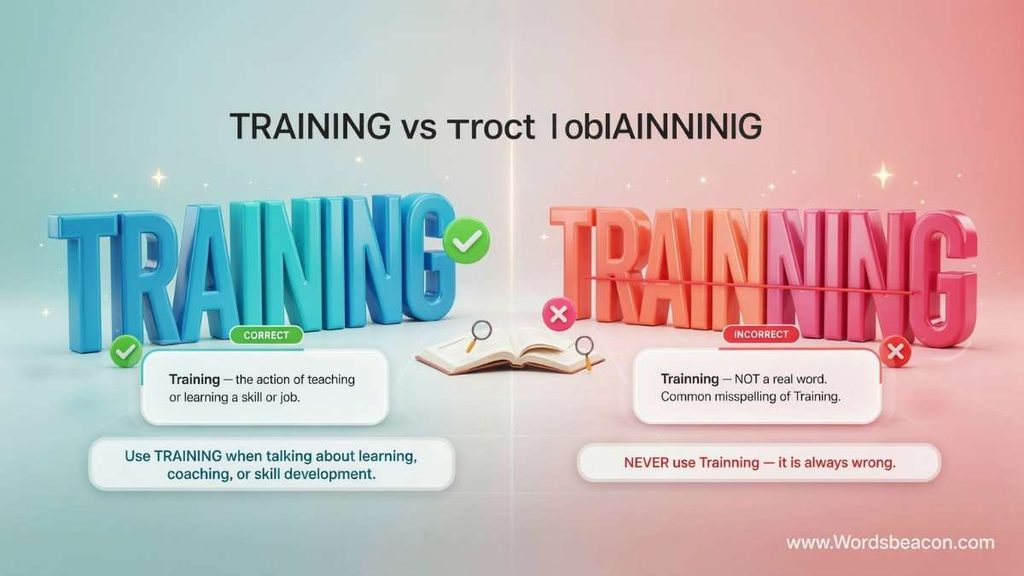
The main difference between training vs trainning is their spelling. Training is the standard English form, whereas trainning is an incorrect spelling. Although the two forms may look similar, only training is accepted in standard English.
Furthermore, understanding this difference can help you avoid similar spelling mistakes when adding endings to other words.
| Point of comparison | Training | Trainning |
|---|---|---|
| Standard spelling | Correct | Incorrect |
| Dictionary usage | Recognized English word | Not a standard alternative |
| Grammar | Noun or verb form | Misspelling |
| Appropriate in formal writing | Yes | No |
| Example | He completed his training. | He completed his trainning. |
Because training is the correct form, you should use it in emails, school assignments, reports, résumés, websites, and other professional documents. In contrast, writing trainning may distract readers and make your work appear less carefully edited.
Moreover, spell-checking tools and dictionaries generally recognize training as the standard spelling. Nevertheless, you might still encounter trainning in online posts, informal messages, or search queries. Even so, seeing a spelling mistake repeatedly does not make it correct.
Ultimately, the easiest way to avoid confusion is to remember the base word train. Once you know how the word is formed, choosing the correct spelling becomes much simpler.
Learn how to use confusing more words correctly
Developed vs Developped Which Spelling Is Correct?
Why Is Training Spelled With One N?
To understand the spelling, start with the base word train. When you add the ending -ing, the word becomes training.
The correct formation is:
train + ing = training
Notice that train already ends with the letter n. Therefore, you simply add -ing without inserting another n. Although trainning might look reasonable at first, it contains an unnecessary extra letter.
The Spelling Rule Behind Training
English spelling rules can sometimes seem confusing because certain words double their final consonants before adding -ing. However, this pattern does not apply to every word.
Generally, a one-syllable word ending in a single consonant after a short vowel often doubles that consonant before an ending such as -ing. For example:
- Run becomes running.
- Sit becomes sitting.
- Stop becomes stopping.
In each case, the final consonant doubles because the word follows this spelling pattern.
By comparison, train contains the vowel combination ai. Since this vowel combination does not follow the same short-vowel pattern found in run, sit, and stop, the final n does not double when you add -ing.
Consequently, the correct spelling is training, not trainning.
Training Spelling Rules at a Glance
| Base word | Correct form with -ing | Why |
|---|---|---|
| Train | Training | The final n does not double |
| Run | Running | The final consonant doubles |
| Sit | Sitting | The final consonant doubles |
| Read | Reading | The final consonant does not double |
| Help | Helping | The final consonant does not double |
As these examples demonstrate, it helps to consider the base word instead of adding letters based only on how a word sounds. Once you recognize the pattern in train, you can form training correctly every time.
In short, remember the simple rule: keep the original spelling of train and add -ing. That way, you can avoid the common mistake of writing trainning.
How to Remember the Correct Spelling of Training
A simple memory trick can make this spelling easier to remember: train already has one n at the end, so adding -ing does not require another one.
Think of the word in two parts:
- Base word: train
- Ending: ing
- Final word: training
You can also remember this short sentence: “I train, so I am training.”
Because both train and training share the same base spelling, the extra n in trainning has no place there. If you use a spell-checking tool, add the correct spelling to your vocabulary through repeated use rather than relying on the incorrect version.
Learn how to use confusing more words correctly
Encorporate vs Incorporate correct Usage
Training vs Trainning Sentence Examples

Examples make the difference between the two spellings easier to recognize. In everyday writing, training appears in sentences about jobs, education, sports, and personal development. Trainning, however, should be corrected before you publish or submit your work.
| Incorrect sentence | Correct sentence |
|---|---|
| The trainning begins on Monday. | The training begins on Monday. |
| She needs more trainning at work. | She needs more training at work. |
| The coach planned a new trainning schedule. | The coach planned a new training schedule. |
| I completed my online trainning course. | I completed my online training course. |
| Their trainning program lasts six weeks. | Their training program lasts six weeks. |
Training Examples in Everyday English
Here are more examples showing how to use training naturally in different situations.
Workplace training:
The company provides training to help employees use the new software.
Sports training:
He follows a strict training schedule before every competition.
Education and learning:
The school offers teacher training throughout the year.
Personal development:
She enrolled in a communication training course to improve her presentation skills.
Safety instruction:
All new workers must complete safety training before entering the facility.
In each example, training describes a process that helps someone gain knowledge, improve an ability, or prepare for a task. As a result, it works in many contexts without changing its spelling.
How to Use Training in a Sentence
When using training in a sentence, first decide whether you mean a general process of learning or a specific course or session.
For example, “The staff needs additional training” describes the process in general. Meanwhile, “The staff attended a training session” identifies a particular event.
You can also use training with common verbs and phrases:
- Receive training
- Provide training
- Complete training
- Attend a training session
- Begin a training program
- Develop through training
These combinations sound natural in professional and everyday English. Most importantly, they all use the same correct spelling.
Learn how to use confusing more words correctly
Wholly vs Wholey correct Spelling and usage ?
Common Training Spelling Mistakes
Training is not the only word that writers sometimes misspell when adding an ending. However, understanding its structure helps you avoid several related errors.
Training, Trainned, Trainner, and Trainie
Some misspellings occur when writers apply the wrong spelling pattern to a word related to train.
| Incorrect form | Correct form | Explanation |
|---|---|---|
| Trainning | Training | The n does not double |
| Trainned | Trained | The correct past-tense form uses one n before -ed |
| Trainner | Trainer | The suffix -er does not require an extra n |
| Trainie | Trainee | The correct spelling ends in -ee |
These words have different meanings, so choosing the right form matters as much as spelling it correctly.
A trainer is someone who teaches or coaches others. A trainee is someone who receives training. Trained is the past-tense or past-participle form of train. Training refers to the learning process or the action of teaching and preparing.
Consequently, checking the word’s meaning and structure can help you catch errors that a quick spell-check might overlook.
Why Does Trainning Look Correct to Some Writers?
The spelling trainning may seem reasonable because English has many words that double their final consonant before adding -ing. For example, running and swimming both use a doubled consonant.
However, spelling patterns depend on the base word. Since train contains the vowel combination ai, it does not follow the same doubling pattern as run or swim.
In addition, people may repeat a spelling error after seeing it in a message, online post, or document. Familiarity can make an incorrect form look right, even when it does not follow standard spelling rules.
The best solution is to remember the base word: train becomes training.
Fix common more word mistakes in English
Using vs Useing Correct Spelling and usage ?
Training Pronunciation and Spelling
Training is commonly pronounced /ˈtreɪ.nɪŋ/. The first syllable sounds like “train,” and the second sounds like “ing.”
Breaking the word into syllables can make it easier to recognize:
- Train
- Ing
- Training
Although pronunciation helps you identify the word, it does not always tell you exactly how to spell it. English includes many words whose spelling patterns are not immediately obvious from their sounds.
For that reason, learning the word’s written form alongside its pronunciation is a useful habit. When you read training in books, articles, or workplace materials, pay attention to its single n at the end of the base word.
Training Word Origin and Formation
Training comes from the verb train, which has long been used to describe teaching, guiding, preparing, or developing a person or ability. The ending -ing helps form a word that can describe an ongoing action or the process associated with it.
For example, the verb train appears in the sentence “They train new employees.” When you describe the activity itself, you can say, “Employee training takes time.”
Likewise, “She is training for a race” uses training as part of a continuous verb form.
Although the grammatical function changes from one sentence to another, the word keeps its spelling. You do not need to add an extra n when changing train to training.
Is Training Spelled the Same in American and British English?
Yes. Training is spelled the same way in American and British English. Neither variety uses trainning as the standard spelling.
Some related words do differ between the two varieties, particularly words involving endings such as -er and -re. Nevertheless, those regional differences do not affect the spelling of training.
| American English | British English | Difference |
|---|---|---|
| Training center | Training centre | Center and centre differ |
| Training program | Training programme | Program and programme may differ by context |
| Training course | Training course | Same spelling |
| Training session | Training session | Same spelling |
| Training | Training | Same spelling |
Therefore, if you are writing for an American audience, you might use training center. For a British audience, training centre is common. In both cases, training remains unchanged.
Understand confusing English more words simply
Chef vs Cheff Which Is Correct and usage ?
Training Grammar How to Use the Word Correctly
Correct spelling is only one part of clear writing. You should also understand how training works grammatically so that your sentences sound natural.
Is Training a Countable or Uncountable Noun?
Training is usually an uncountable noun when it refers to the general process of learning or developing skills.
For example:
- The team needs more training.
- Staff training is essential.
- She received training in customer service.
In these sentences, training describes an overall process rather than separate items.
However, you can use countable nouns to refer to individual activities or events related to training. For instance, you can attend a training session, complete a training course, or join a training workshop.
Instead of saying “I attended three trainings” in a context where that sounds unnatural, you can write “I attended three training sessions.” This phrasing makes the meaning more precise.
Training as a Verb Form
Training also functions as the present participle of train. You can use it with forms of the verb be to describe an action in progress.
| Verb form | Example |
|---|---|
| Base form | They train new employees. |
| Present participle | They are training new employees. |
| Past tense | They trained new employees yesterday. |
| Past participle | The staff has trained for the new system. |
| Noun | The training begins tomorrow. |
Although these forms are related, each has a different grammatical role. For example, trained describes a completed action in many contexts, while training can describe an ongoing action or the process itself.
Training vs Education What Is the Difference?
Training and education are related, but they do not always mean the same thing.
Education often focuses on broader knowledge, concepts, and understanding. Training usually emphasizes practical skills or preparation for a particular task.
For example, a student might study business management as part of an education program. Later, that student might receive training in a company’s accounting software.
Nevertheless, the two can overlap. A professional development course might include both theoretical lessons and hands-on training. The best word depends on what you want to emphasize.
Fix common more word mistakes in English
Choosing vs Chosing Which Is Correct and Usage ?
Common Phrases and Expressions With Training
Training appears in many everyday and professional expressions. Learning these combinations can improve your vocabulary and help you use the word naturally.
| Phrase | Meaning | Example |
|---|---|---|
| Training course | A structured learning course | I signed up for a training course. |
| Training program | An organized set of learning activities | The company launched a training program. |
| Training session | A specific period of instruction or practice | Our training session lasts an hour. |
| Training day | A day set aside for instruction or practice | Friday is our training day. |
| Training materials | Resources used during instruction | Please review the training materials. |
| Training schedule | A plan showing when training takes place | The manager shared the training schedule. |
| Training objectives | Goals that a course or session aims to achieve | The instructor explained the training objectives. |
| Training assessment | An evaluation of learning or performance | Participants completed a training assessment. |
These phrases show how widely training is used. Whether you are discussing a classroom, a sports team, or a workplace, the spelling remains the same.
Training vs Train, Trained, Trainer, and Trainee
The word training belongs to a family of related words. Although they share the same base, each one serves a different purpose.
| Word | Meaning | Example |
|---|---|---|
| Train | To teach, coach, or prepare | They train every morning. |
| Training | The process of learning or preparing | The training starts today. |
| Trained | Taught or prepared for a task | She trained the new team last month. |
| Trainer | A person who teaches or coaches | The trainer explained the exercise. |
| Trainee | A person receiving training | The trainee asked a question. |
| Trainable | Capable of being trained | The skill is trainable with practice. |
How Do You Spell Trainee?
The correct spelling is trainee, with two e’s at the end. A trainee is a person who is learning a skill or preparing for a role.
For example, “The trainee completed the first part of the course.”
By contrast, a trainer is the person who provides instruction or guidance. Although the two words look similar, their meanings are different.
Training or Train Which Word Should You Use?
Use train when you mean the action of teaching, coaching, or preparing someone. Use training when you mean the learning process or when you describe an action that is currently happening.
For example:
- The company will train its employees next month.
- The company is training its employees this month.
- The employees need additional training.
Each sentence is correct because the word matches the intended meaning and grammar.
Understand confusing English more words simply
Planing vs Planning Spelling Rules, and Common Mistakes
Practice Session Training vs Trainning
Fill in each blank with the correct spelling: training vs trainning.
- The company provides ______ for all new employees.
- She is ______ for an important tennis tournament.
- Our safety ______ begins at 9 a.m.
- He completed a professional ______ course last month.
- The coach prepared a new ______ schedule.
- Regular ______ helps employees improve their skills.
- The school offers teacher ______ throughout the year.
- I am attending a customer service ______ session.
- The manager discussed the ______ objectives with the team.
- Physical ______ can improve strength and endurance.
- All workers must complete safety ______ before starting the job.
- She signed up for an online ______ program.
- The instructor prepared the ______ materials.
- Our company provides technical ______ to its staff.
- He needs additional ______ before using the equipment.
- The athletes are ______ for the upcoming competition.
- The new employee received workplace ______ on her first day.
- We have a ______ workshop scheduled for Friday.
- Good ______ methods can make learning easier.
- The organization invests in employee ______ and development.
Answers
- training
- training
- training
- training
- training
- training
- training
- training
- training
- training
- training
- training
- training
- training
- training
- training
- training
- training
- training
- training
Here’s a trusted source for clear word meanings:
FAQs
Which is the correct spelling of Training vs Trainning?
The correct spelling is training, with one n at the end of train before adding -ing. In contrast, trainning is a common misspelling and is not accepted in standard English. To remember the correct form, simply combine train + ing to make training.
Is trainings the plural of training?
Training is generally an uncountable noun, so it usually does not take a plural form. For example, you would say, “The employees need more training.” However, when referring to separate learning activities, use clearer expressions such as training sessions, training courses, or training programs. Although trainings appears in some specialized contexts, training is the more natural choice in everyday English.
How do you spell train when talking about teaching someone a skill?
The correct spelling is train. When someone teaches or prepares another person, you can say, “I train new employees.” If the action is happening now, add -ing to form training: “I am training new employees.” Notice that the final n does not double. Therefore, training is correct, while trainning is not.
What does training mean in simple words?
Training means learning or practicing the skills needed to perform a task. For example, a new employee may receive training to learn workplace procedures. Similarly, a person might follow a training plan to improve a particular ability. In both cases, training helps someone gain knowledge, build confidence, and perform more effectively.
What are the common types of training?
Common types of training include technical training, soft-skills training, safety training, and professional development. Technical training focuses on job-specific skills, whereas soft-skills training improves communication and teamwork. Meanwhile, safety training teaches people how to reduce risks, and professional development helps them build skills for future career opportunities. The exact categories may vary depending on the organization and its goals.
What are the main differences between on-the-job and off-the-job training?
On-the-job training takes place while employees perform their regular duties, often with guidance from an experienced colleague. By contrast, off-the-job training happens away from normal work tasks, such as in a classroom, workshop, or dedicated learning session. Both methods can be effective. However, the best choice depends on the skill being taught, the available resources, and the learner’s needs.
What are the stages of a typical training process?
A typical training process begins by identifying learning needs and setting clear objectives. Next, the instructor or organization designs suitable materials and activities. Afterward, participants complete the training and practice their new skills. Finally, the results are evaluated to determine whether the training met its objectives. This structured approach makes it easier to identify gaps and improve future sessions.
What are the basic steps of effective training?
Effective training usually involves preparing the learner, demonstrating the task, providing an opportunity to practice, and offering feedback. First, the instructor explains what the learner needs to do. Then, the instructor demonstrates the correct method. After that, the learner practices the task, while feedback helps correct mistakes and strengthen understanding. As a result, learning becomes more practical and easier to apply.
Which type of training is commonly used in the workplace?
On-the-job training is widely used because employees can learn while completing real work tasks. For example, an experienced colleague might demonstrate how to operate equipment or use a company system. Consequently, employees can apply what they learn immediately. Nevertheless, organizations may also use online courses, workshops, and classroom sessions when those methods better suit their training objectives.
What makes a training program effective?
An effective training program has clear goals, useful learning materials, practical activities, and regular feedback. First, participants should understand what they are expected to learn. In addition, relevant examples help them connect new information with real situations. Practice then allows them to develop confidence, while evaluation shows whether they have achieved the intended results. Together, these elements make training more useful and measurable.
What is a professional alternative to the word training?
Depending on the context, suitable alternatives include instruction, coaching, skills development, and professional development. For example, instruction may describe a specific lesson, while coaching often involves personal guidance and ongoing feedback. Similarly, skills development emphasizes improving abilities over time. However, these terms are not always interchangeable, so choose the one that most accurately describes the learning activity.
Is there a short form or acronym for training?
There is no universally accepted abbreviation for training. Although informal notes may use shortened forms such as “trng,” the full word is clearer in articles, reports, emails, and professional documents. Likewise, abbreviations for basic training can vary between organizations and industries. Therefore, unless your audience already understands a particular abbreviation, writing training in full is the safest option.
What is the difference between training, a trainer, and a trainee?
Training refers to the process of learning or developing skills. A trainer is the person who provides instruction or guidance, whereas a trainee is the person receiving that instruction. For example, during workplace training, a trainer may show a trainee how to use new software. Understanding these differences helps you choose the correct word and communicate your meaning clearly.
Understand confusing English more words simply
Blankie vs Blanky Which Spelling Is Correct?
Conclusion
The difference between training vs trainning is easy to remember once you know the rule. Training is the correct spelling, while trainning has one unnecessary n. Think of it this way: train + ing = training. Simple, right? There’s no need to squeeze in an extra letter!
Whether you’re writing about employee training, a training course, or sports practice, always use training. Moreover, understanding the training vs trainning spelling difference can help you avoid this common mistake. Although trainning might look correct at first, it isn’t standard English. So, whenever you’re unsure about training vs trainning, remember to keep it simple. After all, good spelling doesn’t need extra letters to do its job. One n in the right place, and you’re ready to go!

Luna AJS is an experienced blogger and dedicated language enthusiast at Words Beacon. She specializes in making English grammar, spelling, vocabulary and commonly confused words easy to understand. She provides clear explanations, practical examples to help readers write with confidence.