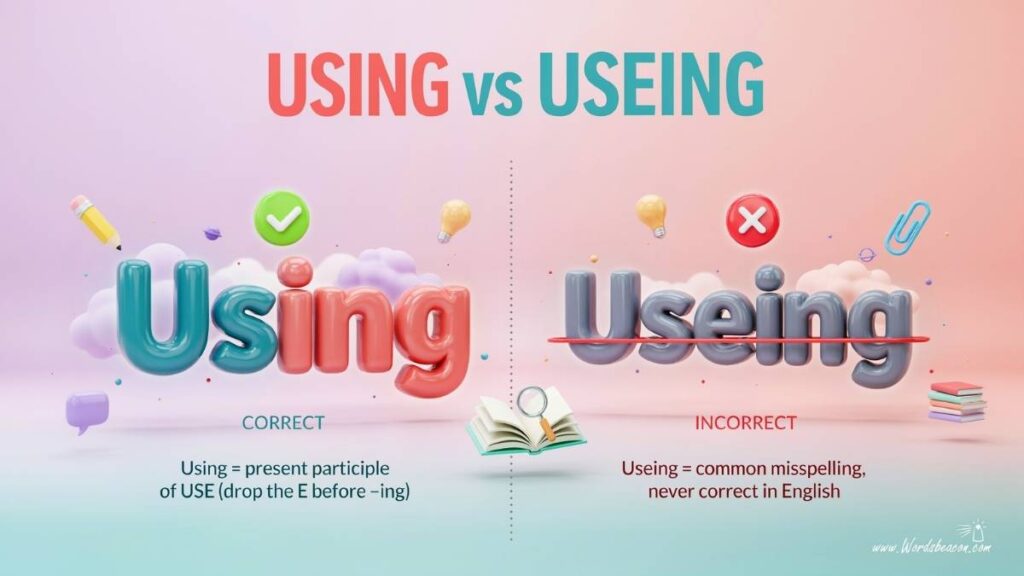
English spelling can be tricky, especially when one extra letter turns a correct word into a mistake. The confusion between using vs useing is a good example. Both spellings might look right at first, but only “using” is correct. So, why does the e disappear? The answer is simple: when you add -ing to “use,” you drop the final silent e. The same rule applies to words like “make” and “write,” which become “making” and “writing.” Once you understand this simple spelling rule, choosing the correct word becomes much easier. Let’s clear up the confusion and make this common spelling mistake a thing of the past!
comparison table
| Feature | Using | Useing |
|---|---|---|
| Spelling status | Correct | Incorrect |
| Base verb | Use | Use |
| Word formation | Use + ing → using | Use + ing → useing |
| Spelling rule | Drops the final silent e | Incorrectly keeps the e |
| Standard English usage | Yes | No |
| Example | I’m using my laptop. | I’m useing my laptop. |
Learn the difference between confusing English words step by step
Chef vs Cheff Which Is Correct and usage ?
Using vs Useing The Quick Answer
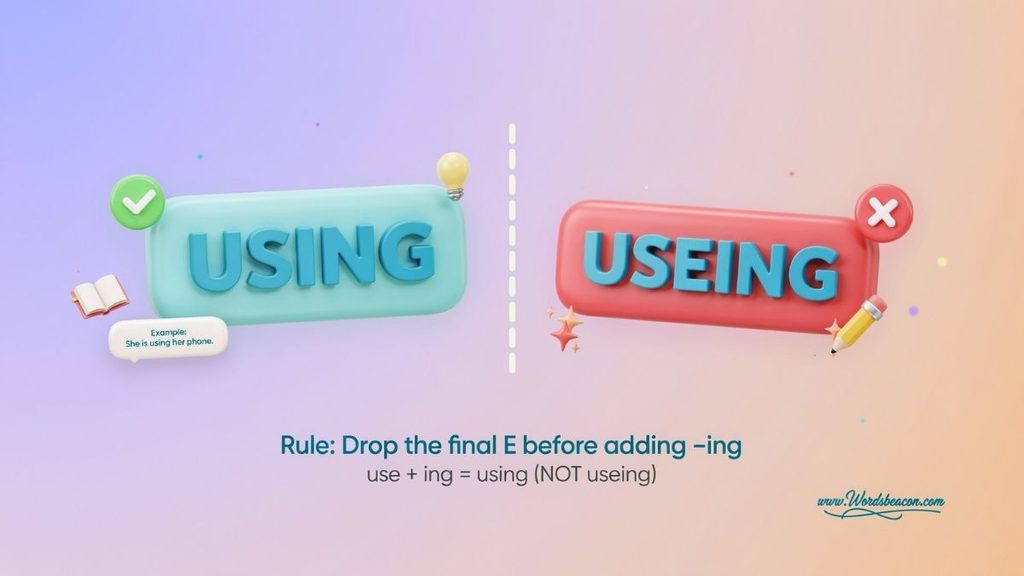
When comparing using vs useing, the answer is simple: using is the correct spelling, while useing is a spelling mistake.
The base verb is use. When you add the suffix -ing, you remove the final silent e and attach the suffix to the remaining letters.
The spelling process looks like this:
- Base verb: use
- Remove the final e: us
- Add -ing: using
For example:
- Correct: She is using a new computer.
- Incorrect: She is useing a new computer.
The same rule applies whether you’re writing American, British, Canadian, or Australian English. Unlike words such as color and colour, using doesn’t have different standard spellings across these varieties of English.
If you’re ever unsure whether to write using vs useing, remember this simple rule: drop the final silent e before adding -ing.
What Does Using Mean?
The word using comes from the verb use. It generally means employing something for a purpose, putting something into action, or making use of a person, object, skill, or resource.
The exact meaning depends on the sentence. For instance, you might use a tool to repair a chair, use a strategy to solve a problem, or use your time to learn a new skill.
Here are some common meanings of using.
Using Means Employing Something
When you use an object, you employ it to complete a task or achieve a goal.
Examples:
- I’m using a pencil to complete the exercise.
- He is using his laptop to prepare a report.
- We are using a new system to organize customer records.
In these sentences, using describes how someone employs a particular object or resource.
Using Means Applying a Method or Skill
You can also use the word when someone applies knowledge, a technique, or a particular approach.
Examples:
- She is using her experience to guide the team.
- The students solved the problem using a simple formula.
- You can improve your writing by using clear language.
Here, using explains the method or skill involved in an action.
Using Can Describe Taking Advantage of Someone
The word can also have a negative meaning when someone treats another person unfairly for personal benefit.
Examples:
- He was using his friend to get ahead at work.
- She realized that the company was using her skills without giving her proper credit.
- A healthy friendship should never involve using people for personal gain.
The context determines whether using carries a neutral, positive, or negative meaning.
Using as a Word Form of Use
Using is a grammatical form of the verb use. Writers commonly use it to describe an action in progress or to express an activity as the subject or object of a sentence.
For example:
- Verb form: They are using the new software.
- Gerund: Using new software takes practice.
- After a preposition: She improved her work by using a checklist.
Although the grammatical roles differ, the spelling remains the same in every example.
Learn the difference between confusing English words step by step
Choosing vs Chosing Which Is Correct and Usage ?
Why Is Using Correct?
The reason using is correct comes from a common English spelling convention called the silent e rule.
Many English verbs end in a silent e. When you add a suffix that begins with a vowel, you usually remove that final e.
Since the suffix -ing begins with the vowel i, the final e in use disappears.
The correct word formation is:
Use + ing = Using
The incorrect form, useing, results from adding -ing without applying the spelling rule.
The Silent E Rule Explained
The silent e rule helps explain why several familiar English words change their spelling when they take a suffix.
Consider these examples:
| Base verb | Correct -ing form | Incorrect form |
|---|---|---|
| Make | Making | Makeing |
| Write | Writing | Writeing |
| Take | Taking | Takeing |
| Give | Giving | Giveing |
| Have | Having | Haveing |
| Come | Coming | Comeing |
| Use | Using | Useing |
Notice the pattern. Each base verb ends in a silent e, and the correct -ing form drops that letter.
This rule makes many English verb forms easier to recognize once you learn to look at the ending of the base word.
Why Doesn’t the Final E Stay in Using?
The final e in use helps represent the pronunciation of the base word. However, English spelling conventions don’t require that e to remain when you add -ing.
When the suffix changes the word form, the spelling changes as well.
For example:
- I use a calculator.
- I am using a calculator.
The first sentence uses the base verb use. The second uses the -ing form, using.
You don’t need to write useing to preserve the original spelling. The standard form already communicates the intended meaning.
Is the Silent E Rule Always the Same?
The silent e rule is common, but English spelling has exceptions. Some words retain their final e to preserve pronunciation or distinguish them from other words.
For example:
- See → seeing
- Agree → agreeing
- Dye → dyeing
- Singe → singeing
These examples show why it’s helpful to learn the general rule while checking unusual forms when necessary.
However, use does not create an exception. The standard spelling remains using.
Learn the difference between confusing English words step by step
Developed vs Developped Which Spelling Is Correct?
Using vs Useing Key Differences
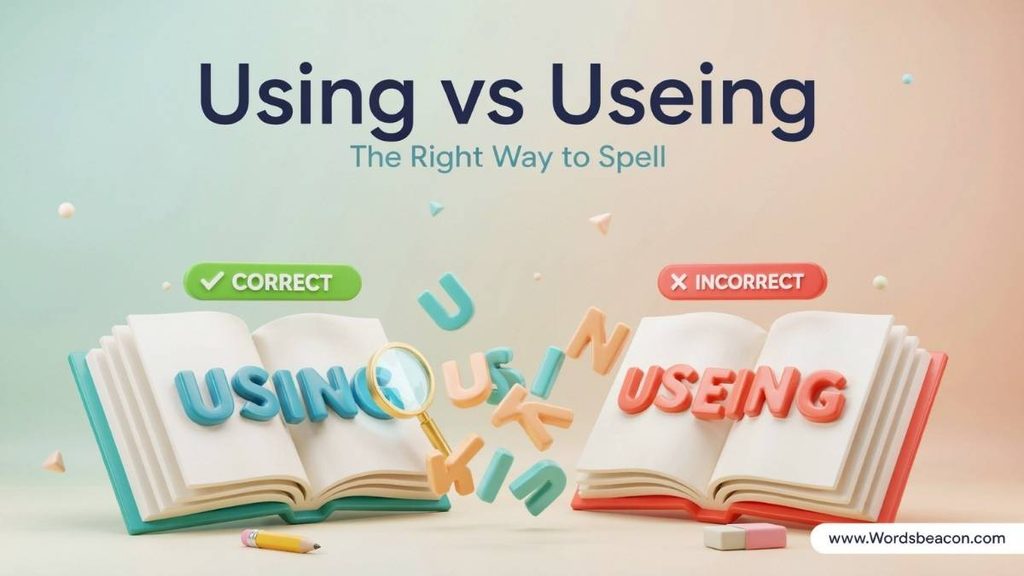
The difference between using vs useing involves more than one letter. It also reflects the difference between a standard English word form and a spelling error.
Spelling Difference
Using follows the standard spelling rule for verbs ending in a silent e. Useing does not.
The correct form removes the e before adding the suffix. The incorrect form retains it.
- Correct: I’m using your notes to study.
- Incorrect: I’m useing your notes to study.
Grammar Difference
Using can function as a present participle or a gerund. Useing is not a standard grammatical form in edited English.
For example:
- Present participle: They are using the conference room.
- Gerund: Using the conference room requires a reservation.
Both sentences use the same correct spelling, even though the word serves a different grammatical purpose.
Meaning Difference
There is no standard difference in meaning between using vs useing because useing is a misspelling, not an accepted alternative form.
If a reader encounters useing in an email or article, the intended word is usually clear from the context. Still, the spelling error can make the writing appear careless or distract readers from the message.
Usage Difference
Writers use using in everyday communication, professional documents, academic work, and digital content.
By contrast, useing may appear in unedited messages, typing errors, or informal online posts. Its appearance does not make it an accepted spelling.
Learn the difference between similar English words the easy way
Shakey vs Shaky Which Spelling Is Correct?
Using Grammar Rules How to Use the Word Correctly
Understanding the spelling of using is only part of the picture. You should also know how the word works in a sentence.
The word using commonly functions as a present participle or a gerund. It can also appear in participial phrases and after prepositions.
Using as a Present Participle
A present participle often appears with a form of the verb be to describe an action in progress.
Examples:
- I am using the office printer.
- She is using a new study method.
- They are using the latest version of the software.
- We were using the wrong address.
In these sentences, using helps form a continuous verb tense. The form stays the same whether the sentence refers to the present or the past.
Using as a Gerund
A gerund is an -ing form of a verb that functions as a noun.
Examples:
- Using a planner helps me stay organized.
- Using public transportation can save money.
- She enjoys using her creativity at work.
- Using too many technical terms can confuse readers.
In the first example, using a planner acts as the subject of the sentence. In the third, using follows the verb enjoys.
Although gerunds perform a noun-like function, they retain the spelling of the verb’s -ing form.
Using After a Preposition
English often uses an -ing form after a preposition.
Examples:
- He improved his grades by using a study schedule.
- She left without using her phone.
- They succeeded through using a more effective strategy.
- You can learn faster by using practical examples.
The last two sentences may sound more natural if you revise them slightly. For example, “They succeeded by using a more effective strategy” is more concise than “They succeeded through using a more effective strategy.”
The key point is that using remains the correct spelling after a preposition.
Using in Participial Phrases
A participial phrase can provide additional information about a person, object, or action.
Examples:
- Using the available data, the team identified the problem.
- Using a simple checklist, Maria finished the report on time.
- Using the wrong password, he locked himself out of the account.
These phrases explain how an action happens or what method someone uses.
Make sure the phrase clearly connects to the person or thing performing the action. For example, “Using the available data, the team identified the problem” clearly identifies the team as the people using the data.
Learn the difference between similar English words the easy way
Planing vs Planning Spelling Rules, and Common Mistakes
Using in a Sentence Practical Examples
The easiest way to understand using is to see how it works in different situations.
Everyday Examples
- I’m using your pen because mine ran out of ink.
- She is using a recipe to prepare dinner.
- We are using the front door today.
- He keeps using the same excuse.
- They’re using a map to find the museum.
These sentences show how using appears in ordinary conversation.
Academic Examples
- The students are using online resources to complete their assignments.
- Using clear examples can make a difficult topic easier to understand.
- The researcher is using a survey to collect information.
- Students can improve their vocabulary by using new words in context.
In academic writing, using often describes a research method, learning strategy, or tool.
Professional Examples
- Our team is using a new system to manage customer requests.
- The manager is using the report to evaluate the project’s progress.
- We are using customer feedback to improve the service.
- Using accurate information helps prevent costly mistakes.
These examples show why correct spelling matters in workplace communication. Small errors can distract readers, especially in reports, proposals, and client emails.
Technology Examples
- I’m using my laptop to attend the meeting.
- The developer is using a new programming language.
- The company is using software to protect its files.
- Users can improve security by using strong passwords.
In technology-related writing, using commonly describes how people operate devices, programs, tools, and systems.
A Small Comparison of Incorrect and Correct Sentences
| Incorrect sentence | Correct sentence |
|---|---|
| She is useing a calculator. | She is using a calculator. |
| I’m useing the new system. | I’m using the new system. |
| He enjoys useing his laptop. | He enjoys using his laptop. |
| They are useing online resources. | They are using online resources. |
| We improved the report by useing clear language. | We improved the report by using clear language. |
Each correction follows the same rule: remove the final e from use before adding -ing.
Learn the difference between similar English words the easy way
Blankie vs Blanky Which Spelling Is Correct?
Is Useing Ever a Correct English Word?
In standard English spelling, useing is incorrect. Dictionaries and conventional grammar guidance recognize using as the correct -ing form of use.
However, you might still encounter useing in a few situations.
Useing as a Typing Mistake
Someone might type useing because they remember the base word use and add -ing without dropping the final e.
For example:
Incorrect: “I’m useing a different approach.”
Correct: “I’m using a different approach.”
The intended meaning remains understandable, but the spelling needs correction.
Useing in Informal Online Writing
People sometimes make spelling mistakes in text messages, comments, forums, and social media posts. The appearance of useing in these places does not make it a standard English spelling.
If you’re writing casually, readers may understand the intended word. Nevertheless, using the correct form is a good habit.
Useing as a Name or Deliberate Spelling
A business, product, username, or fictional character could deliberately use the spelling Useing as a name. In that specific context, the spelling may be an intentional label rather than an attempt to write the ordinary verb.
That possibility does not change the standard spelling rule. When you mean the verb form of use, write using.
Learn the difference between similar English words the easy way
Cocoon vs Cacoon which spelling is correct ?
Using in American English vs British English
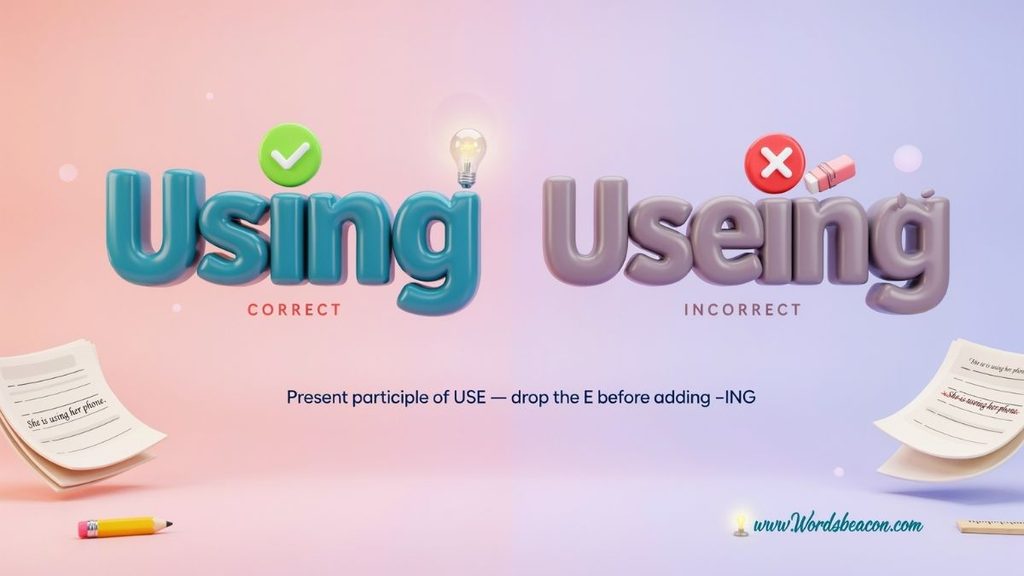
One useful point in the using vs useing discussion is that regional spelling differences do not affect this word.
American English and British English sometimes use different spellings for the same word. Examples include color and colour, center and centre, and organize and organise.
However, using is standard in both American and British English.
| English variety | Correct spelling | Incorrect spelling |
|---|---|---|
| American English | Using | Useing |
| British English | Using | Useing |
| Canadian English | Using | Useing |
| Australian English | Using | Useing |
You can use using confidently in schoolwork, professional documents, articles, and everyday writing across these English varieties.
The main spelling question is not which regional convention you follow. It’s whether you apply the silent e rule correctly.
Common English Spelling Errors Related to Using
The mistake in using vs useing belongs to a broader group of English spelling errors. Many writers struggle when they add suffixes to verbs.
Fortunately, recognizing a few common patterns can make proofreading easier.
Writing Makeing Instead of Making
The correct form is making, not makeing.
The verb make ends in a silent e. Remove that e before adding -ing.
- Correct: She is making a presentation.
- Incorrect: She is makeing a presentation.
Writing Writeing Instead of Writing
The correct form is writing.
- Correct: He is writing a report.
- Incorrect: He is writeing a report.
As with using, the final e disappears before the suffix.
Writing Takeing Instead of Taking
The correct form is taking.
- Correct: They are taking notes.
- Incorrect: They are takeing notes.
The same spelling rule explains this change.
Writing Giveing Instead of Giving
The correct form is giving.
- Correct: She is giving a speech.
- Incorrect: She is giveing a speech.
Remember that the final e disappears even though the base verb ends with a vowel sound.
Writing Haveing Instead of Having
The correct form is having.
- Correct: We’re having lunch at noon.
- Incorrect: We’re haveing lunch at noon.
This is another example of the silent e rule.
Writing Comeing Instead of Coming
The correct form is coming.
- Correct: He is coming to the office.
- Incorrect: He is comeing to the office.
The final e disappears before -ing, just as it does in using.
Learn the difference between tricky words and use them correctly
Brite vs Bright Correct Spelling and usage ?
How to Avoid Spelling Mistakes When Adding -ing
You don’t need to memorize every verb form individually. Instead, follow a simple process whenever you add -ing to a verb.
Step 1: Identify the Base Verb
Start with the original verb before adding the suffix.
For example:
- Use
- Make
- Write
- Take
- Give
Identifying the base word helps you see which spelling rule applies.
Step 2: Check the Ending
Look at the final letters of the verb.
If it ends in a silent e, you will usually drop that e before adding -ing.
For example:
- Use → using
- Make → making
- Write → writing
- Take → taking
If the verb follows another spelling pattern, apply that pattern instead.
Step 3: Apply the Correct Rule
Different verbs change in different ways when you add -ing.
| Spelling pattern | Base verb | Correct -ing form |
|---|---|---|
| Drop final silent e | Use | Using |
| Drop final silent e | Write | Writing |
| Double final consonant | Run | Running |
| Double final consonant | Sit | Sitting |
| Keep the final e after ee | See | Seeing |
| Change ie to y | Lie | Lying |
This table highlights an important point: English spelling has several patterns. Don’t apply the silent e rule to every verb without checking its ending.
Step 4: Read the Sentence Again
After writing a sentence, look for words that may contain common spelling errors.
For example:
Draft: “I’m useing the report to prepare the presentation.”
Corrected: “I’m using the report to prepare the presentation.”
Reading the sentence aloud can help you notice awkward wording, but it won’t always reveal spelling errors. Since using vs useing may look similar at a glance, visual proofreading is also useful.
Step 5: Use a Grammar or Spelling Checker
A grammar checker can help identify common spelling mistakes, including useing.
Still, don’t depend entirely on automated tools. A spelling checker may miss errors that involve valid words used in the wrong context. Review the sentence yourself to make sure the spelling and meaning both fit.
A Simple Case Study Correcting Useing in a Report
Imagine that you’re preparing a report for your manager. You write the following sentence:
“Our team is useing a new system to organize customer records.”
The message is clear, but the spelling of useing is incorrect.
To correct it, identify the base verb, use. Then apply the silent e rule by removing the final e before adding -ing.
The corrected sentence becomes:
“Our team is using a new system to organize customer records.”
This revision changes only one letter, yet it makes the sentence conform to standard English spelling.
Now consider a few more sentences from the same report.
- Incorrect: “We are useing customer feedback to improve the service.”
- Correct: “We are using customer feedback to improve the service.”
- Incorrect: “The team is useing a spreadsheet to track progress.”
- Correct: “The team is using a spreadsheet to track progress.”
- Incorrect: “Employees can save time by useing the new tool.”
- Correct: “Employees can save time by using the new tool.”
The same correction works in every example. Once you understand the rule, you don’t have to treat each sentence as a separate spelling puzzle.
Learn the difference between tricky words and use them correctly
Enrol vs Enroll correct Spelling and usage ?
Practice Session Using vs Useing
Fill in each blank with the correct form of the word: using vs useing. Write your answers first, then check the answer key at the end.
1. I am ______ my laptop to complete the assignment.
2. She enjoys ______ a planner to organize her daily tasks.
3. They are ______ a new system to manage customer records.
4. He improved his writing by ______ simple words.
5. We are ______ online resources for our research.
6. The teacher is ______ examples to explain the grammar rule.
7. My brother is ______ a calculator to check his answers.
8. The company started ______ new software last month.
9. You can save time by ______ a checklist.
10. She is ______ her experience to guide the team.
11. They were ______ the wrong address to find the office.
12. I prefer ______ a pen instead of a pencil.
13. The students are ______ the internet to gather information.
14. He succeeded by ______ a better strategy.
15. We are ______ customer feedback to improve our service.
16. She learned the spelling rule by ______ several examples.
17. The manager is ______ a report to evaluate the project’s progress.
18. You should avoid ______ complicated words when simple ones will work.
19. The team is ______ a new method to solve the problem.
20. ______ clear language makes instructions easier to understand.
Answers
- using
- using
- using
- using
- using
- using
- using
- using
- using
- using
- using
- using
- using
- using
- using
- using
- using
- using
- using
- using
Here’s a trusted source for clear word meanings:
FAQs
Is “useing” ever a correct spelling?
No. “Useing” is a misspelling in standard English. The correct spelling is “using,” formed by dropping the final silent e in “use” before adding -ing.
Why is “using” spelled without the second e?
The word “use” ends in a silent e. When you add -ing to most verbs ending in a silent e, you drop the e first. Therefore, “use” becomes “using,” not “useing.”
Does every verb ending in e drop the e before -ing?
No. Most verbs with a silent final e drop it before adding -ing, as in “make” becoming “making.” However, some words keep the e to preserve their pronunciation or meaning. For example, “see” becomes “seeing,” while “dye” becomes “dyeing.”
Can spell-checkers detect the mistake “useing”?
Most modern spell-checkers recognize “useing” as a spelling error and suggest “using” instead. However, automatic tools can miss mistakes, so understanding the spelling rule is a more reliable way to improve your writing.
Is “using” appropriate in both formal and informal writing?
Yes. “Using” is the standard spelling in all types of English writing, including school assignments, professional reports, business emails, and casual messages. The word itself is appropriate in both formal and informal contexts.
How is “using” different from “usage”?
“Using” generally describes an action, while “usage” refers to the way something is used or a customary practice. For example, “She is using the software” describes an action, whereas “Software usage has increased” refers to how much the software is used.
Can you start a sentence with “using”?
Yes. You can begin a sentence with “using” when an introductory phrase explains how someone performs an action. For example, “Using a checklist, Mia reviewed the entire report.” Make sure the person performing the action is clear to avoid a dangling modifier.
Is “using” a gerund or a present participle?
“Using” can be either a gerund or a present participle, depending on its role in the sentence. In “Using a calculator saves time,” it acts as a gerund because it functions like a noun. In “He is using a calculator,” it is a present participle that forms part of the verb phrase.
What is the easiest way to remember the spelling of “using”?
Remember the pattern: drop the final silent e before adding -ing to most verbs that end in e. For example, “use” becomes “using,” “write” becomes “writing,” and “take” becomes “taking.” Practicing these patterns can help you avoid common spelling mistakes.
Does “using” have the same spelling in American and British English?
Yes. “Using” is spelled the same way in American, British, Canadian, and Australian English. There is no regional spelling variation, so you can use “using” confidently in any standard form of English.
Learn the difference between tricky words and use them correctly
Panel vs Pannel Spelling and Correct usage?
Conclusion
The difference between “using vs useing” is simple: “using” is correct, while “useing” is a spelling mistake. Understanding “using vs useing” is easy once you learn the rule. When you add -ing to “use,” you drop the final silent e. The same rule applies to words like make (making) and write (writing). So, the next time you wonder which spelling to choose, remember to leave that extra e behind. English spelling can be tricky, but knowing the difference between “using vs useing” makes the choice clear. Keep practicing, and you’ll be using the correct spelling with confidence in no time!

Luna AJS is an experienced blogger and dedicated language enthusiast at Words Beacon. She specializes in making English grammar, spelling, vocabulary and commonly confused words easy to understand. She provides clear explanations, practical examples to help readers write with confidence.