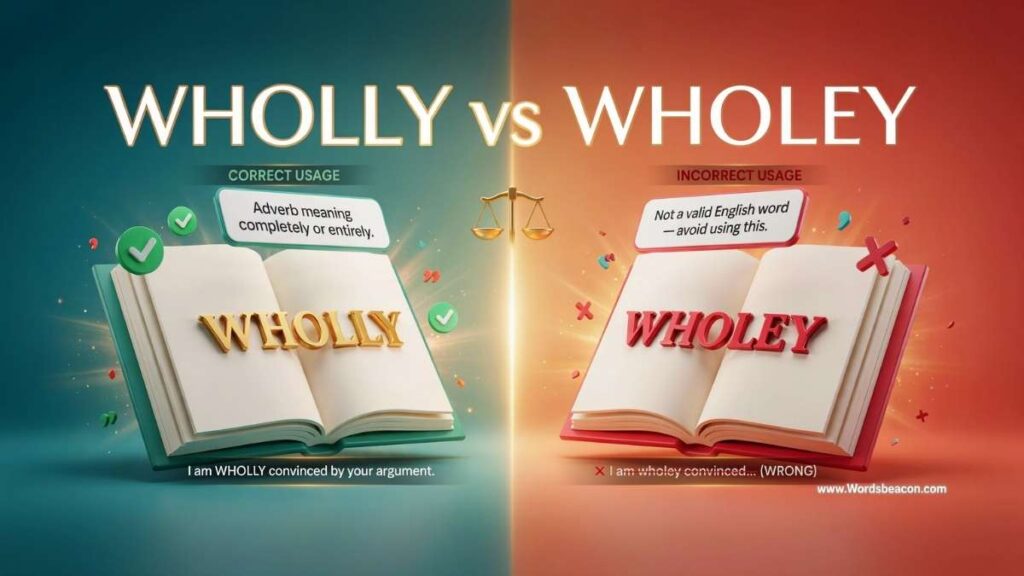
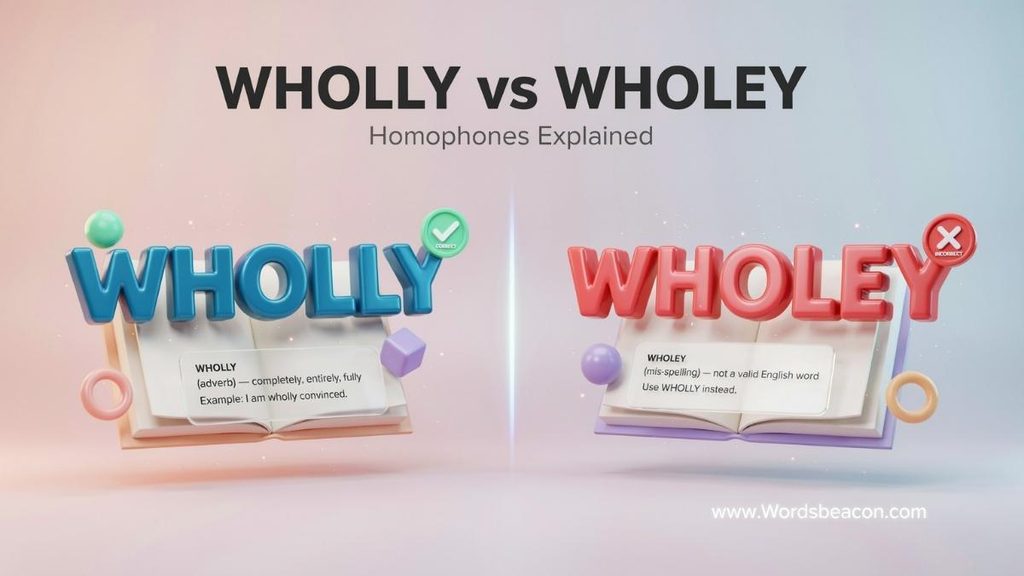
The difference between Wholly vs Wholey can be confusing, especially when one tiny spelling change makes you question your grammar. You know what you want to say, but suddenly, even a simple word feels like a spelling test! Here’s the easy answer: “Wholly” means completely or entirely, while “Wholey” may appear in names or brands but isn’t the standard spelling of this adverb. The tricky part? “Whole” has an E, but “wholly” doesn’t. English loves these little surprises! Once you learn this simple difference, you can avoid the mistake, choose the right spelling, and keep your writing clear and correct.
Quick Comparison
| Feature | Wholly | Wholey |
|---|---|---|
| Standard spelling for “completely” | Correct | Incorrect |
| Meaning | Completely, entirely, or fully | No standard adverb meaning completely |
| Part of speech | Adverb | Can appear as a proper name |
| Example | The claim was wholly inaccurate. | “The claim was wholey inaccurate” is incorrect. |
| Formal writing | Appropriate | Avoid as a substitute for wholly |
| Memory tip | Two L’s, no E before Y | Don’t use for the meaning “completely” |
The main rule is straightforward: use “wholly” when you mean completely or entirely. However, if you see “Wholey” in a company name or surname, don’t automatically treat it as a mistake. Proper names can have their own established spellings.
Learn how to use confusing more words correctly
Using vs Useing Correct Spelling and usage ?
What Does Wholly Mean?
The wholly meaning is completely, entirely, or fully. The word describes the extent to which something is true, accepted, finished, owned, or experienced.
For example, if someone says, “I wholly agree with your decision,” they mean they agree completely. They aren’t expressing partial support or leaving room for doubt.
Wholly is an adverb. In English grammar, an adverb can modify a verb, an adjective, or another adverb. Here, it usually strengthens an idea by showing that something applies in full rather than in part.
Consider these examples:
- “The explanation was wholly inaccurate.” The explanation was completely inaccurate.
- “She was wholly devoted to her work.” She was entirely dedicated to it.
- “The outcome was wholly unexpected.” Nobody anticipated the result.
- “The property is wholly owned by the company.” The company owns all of it.
- “His opinion was wholly different from mine.” His opinion differed completely.
In each example, wholly emphasizes completeness. It helps the reader understand the full extent of a condition, action, or difference.
Wholly Definition and Adverb Meaning
The wholly definition centers on the idea of completeness or entirety. Depending on the sentence, you can often replace it with “completely,” “entirely,” or “fully” without changing the main idea.
For instance:
- “The decision was wholly justified.”
- “The organization is wholly independent.”
- “The proposal is wholly unsuitable for our needs.”
You could use “completely” in all three sentences. Nevertheless, wholly often suits formal writing, academic discussions, business documents, and careful explanations.
The word can also emphasize that something applies without exception. For example, a statement that is wholly inaccurate is not merely inaccurate in one small detail; the speaker means that the statement is completely wrong.
Wholly Different Meaning
The phrase “wholly different” means completely different, not just slightly different.
Imagine two plans for a community project. One relies on volunteers, while the other hires paid contractors and uses commercial services. You could describe the second plan as wholly different from the first because the two approaches differ fundamentally.
Here are more examples:
- “The revised design is wholly different from the original.”
- “Their priorities are wholly different.”
- “The new findings suggest a wholly different explanation.”
In each case, wholly strengthens the adjective “different.” It signals a substantial difference rather than a minor variation.
Wholly Owned Meaning
The expression “wholly owned” commonly appears in business and finance. It generally means that a person or organization owns 100% of a business or asset, depending on the context.
For example:
“The parent company operates a wholly owned subsidiary.”
This means the parent company owns all the subsidiary’s ownership interests. It contrasts with a partially owned company, in which other investors also hold an ownership stake.
The phrase is useful in corporate reports, business descriptions, and financial discussions because wholly communicates complete ownership rather than majority ownership.
Learn how to use confusing more words correctly
Chef vs Cheff Which Is Correct and usage ?
Is Wholey a Word?
The question “Is Wholey a Word?” needs context. In ordinary English, wholey isn’t the standard spelling of the adverb that means completely. If you write “I wholey agree,” you should change it to “I wholly agree.”
However, the spelling can appear in proper names, including surnames and business names. A name doesn’t have to follow the spelling conventions of a common English word.
That distinction matters. A spelling can be incorrect for one purpose but perfectly legitimate in another.
Wholey Meaning and Dictionary Definition
When people search for a wholey dictionary definition, they usually want to know whether the spelling has a recognized meaning of its own.
For standard contemporary English, the practical answer is that wholey should not replace wholly when you mean completely or entirely. If you encounter the spelling in a specialized context, check the name or source rather than assuming it is a standard adverb.
For example:
- Incorrect: “The results were wholey unexpected.”
- Correct: “The results were wholly unexpected.”
The second sentence follows standard modern spelling.
It’s also worth distinguishing “wholey” from “wholely.” Both spellings commonly arise from the same confusion, but “wholly” remains the recommended form in contemporary writing. Older texts may contain alternative forms, so historical usage should not be confused with today’s standard spelling.
Wholey as a Surname or Company Name
Wholey can appear as a proper noun, including in surnames and business names. One example is Robert Wholey & Co., a seafood business associated with Pittsburgh, Pennsylvania.
In this context, Wholey is part of the company’s name. Changing it to “Wholly” would alter the official name rather than correct a spelling mistake.
This is useful to remember when editing articles, company profiles, or business documents. Spell-checkers sometimes flag names that aren’t in their dictionaries. Before accepting a suggested correction, check whether the spelling belongs to a person, company, product, or other named entity.
Wholey Scrabble Word Is It Accepted?
People also search for “Wholey Scrabble word” when checking whether a particular spelling is allowed in a word game.
Scrabble acceptance depends on the official word list used for the game. A surname or company name doesn’t automatically qualify as a playable word simply because it appears online.
For competitive play, consult the current official word list for your region. Don’t assume that Wholey is acceptable just because it is a legitimate surname or company name.
Learn how to use confusing more words correctly
Choosing vs Chosing Which Is Correct and Usage ?
Wholly vs Wholey Key Differences
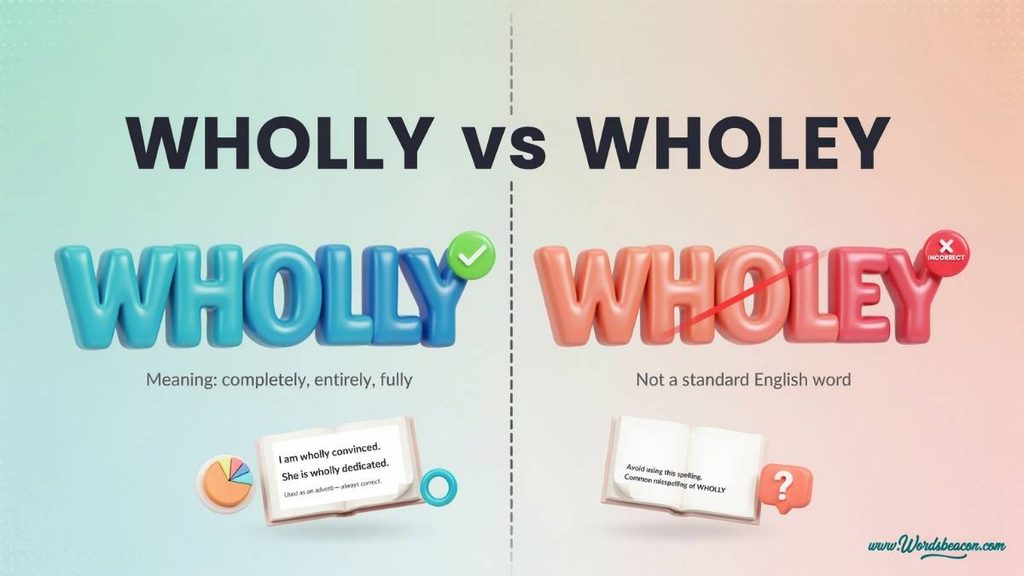
The difference between wholly vs wholey becomes clearer when you compare spelling, meaning, grammar, and usage.
| Comparison point | Wholly | Wholey |
|---|---|---|
| Standard spelling | Correct for the intended meaning | Incorrect for the intended meaning |
| Meaning | Completely or entirely | No standard equivalent adverb meaning |
| Grammatical role | Adverb | Usually a proper name when intentionally used |
| Formal documents | Suitable | Not suitable as a substitute for wholly |
| Example | “The report was wholly accurate.” | “The report was wholey accurate.” |
| Best correction | Keep wholly | Change to wholly if completeness is intended |
Wholly Spelling Why Two L’s Matter
The correct spelling of wholly is W-H-O-L-L-Y.
Notice the two consecutive L’s near the end. The word doesn’t retain the E from “whole,” and it doesn’t lose one of the L’s.
Although the spelling may look unusual, wholly is the established form in standard English. Learning the complete word is more reliable than trying to reconstruct it every time you write it.
Wholey Spelling Why the Error Happens
The wholey spelling mistake often happens because writers recognize “whole” and assume they can add a Y to form an adverb.
That guess seems reasonable, but the result isn’t the standard form.
For example:
Incorrect: “I’m wholey responsible for the mistake.”
Correct: “I’m wholly responsible for the mistake.”
A useful editing habit is to check words that look like familiar words with a different ending. If the intended meaning is completely, entirely, or fully, choose wholly.
Wholly vs Wholey Which Form Should You Use?
The standard contemporary spelling is wholly. Although wholely appears in some historical or alternative-spelling discussions, modern writers should use wholly in schoolwork, professional communication, published articles, and other formal contexts.
| Spelling | Recommendation |
|---|---|
| Wholly | Use in standard modern English |
| Wholey | Don’t use for the meaning “completely” |
| Wholely | Avoid in contemporary standard writing |
The same practical rule applies when you search for “wholely vs wholly”: choose wholly when you want to express completeness.
Learn how to use confusing more words correctly
Brite vs Bright Correct Spelling and usage ?
Whole vs Wholly Understanding the Grammar
To understand why wholly is correct, it helps to examine its relationship with “whole.”
Although the two words share a root, they perform different grammatical jobs. Choosing between them depends on what you want to describe.
Whole Word Meaning
Whole commonly functions as an adjective meaning complete or entire. It can also function as a noun referring to something considered as a complete unit.
Examples:
- “She read the whole book.” Whole describes the book.
- “The whole family attended.” Whole describes the family.
- “The whole is greater than the sum of its parts.” Whole functions as a noun.
By contrast, wholly is an adverb meaning completely or entirely.
| Sentence | Grammatical role |
|---|---|
| The whole team agreed. | Whole describes the team. |
| The team wholly supported the proposal. | Wholly modifies supported. |
| He ate the whole cake. | Whole describes the cake. |
| The cake was wholly consumed. | Wholly emphasizes the completeness of the action. |
The difference between whole vs wholly isn’t just a spelling issue. It’s also a question of grammar and sentence structure.
Wholly Grammar Rules
Three practical rules can help you use wholly correctly.
- Use wholly to express completeness. Example: “The claim was wholly unfounded.”
- Use whole to describe an entire person, object, group, or unit. Example: “The whole department attended.”
- Check the word that wholly modifies. It often appears before an adjective or alongside a verb phrase to express the extent of an action or condition.
You can also place wholly before descriptive expressions:
- “The system is wholly dependent on electricity.”
- “The proposal remains wholly unacceptable.”
- “The organization is wholly committed to the project.”
These structures appear frequently in professional and academic writing because they express the extent of a condition precisely.
Adverb Formation and the Silent E Spelling Rule
A common source of confusion is the English spelling pattern for adding the suffix “-ly.” Many adjectives form adverbs by adding this suffix. For example, quick becomes quickly, and careful becomes carefully.
However, not every word follows the same pattern.
The standard adverb formed from whole is wholly. Writers shouldn’t simply preserve every letter of the base word and add “-ly,” because that would produce wholely.
English spelling reflects established word forms and historical developments. Therefore, learning the accepted spelling of common words is often more reliable than applying one rule mechanically.
Fix common more word mistakes in English
Developed vs Developped Which Spelling Is Correct?
Wholly vs Holy Are They the Same Word?
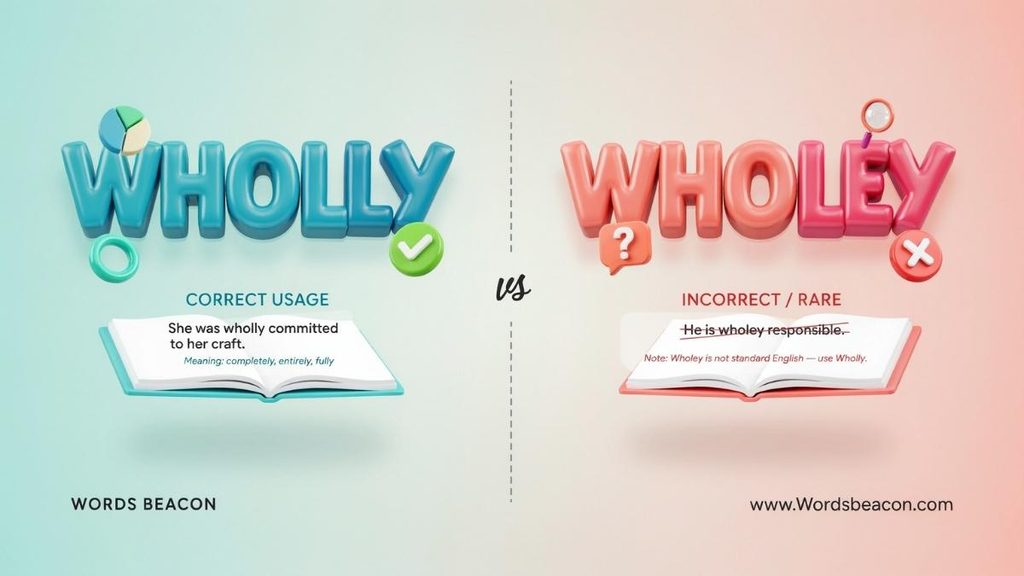
No. Although wholly and holy look similar and sound alike in many English accents, they have different meanings and grammatical roles.
- Holy means sacred or associated with religious significance.
- Wholly means completely or entirely.
Consider these examples:
- “The proposal was wholly rejected.” The proposal was rejected completely.
- “The temple is a holy place.” The temple is considered sacred.
Replacing one word with the other can change a sentence’s meaning dramatically.
For instance, “a holy book” refers to a book regarded as sacred. “A wholly different book” means a book that is completely different.
Holy vs Holey vs Wholly
Adding holey to the comparison makes the distinction even clearer. These three words have similar spellings and can sound alike, but they have different meanings.
| Word | Meaning | Example |
|---|---|---|
| Holy | Sacred or religious | They visited a holy site. |
| Holey | Full of holes | He wore holey socks. |
| Wholly | Completely or entirely | The plan was wholly impractical. |
The base words provide a useful memory aid:
- Holy relates to holiness.
- Holey relates to holes.
- Wholly relates to completeness.
Holey comes from hole and describes something containing holes. A holey sweater, for example, has gaps in its fabric. It doesn’t mean sacred or complete.
Are Holy and Wholly Pronounced the Same?
In many standard American English accents, holy and wholly are homophones. That means they share a pronunciation but differ in spelling and meaning. Holey is also commonly pronounced the same way.
The standard US pronunciation of wholly is /ˈhoʊl.li/, while the UK pronunciation is /ˈhəʊl.li/. Both typically have two syllables, with stress on the first.
Because these words can sound alike, pronunciation alone won’t tell you which spelling to use. You must consider the meaning of the sentence.
- “The old sweater was holey.” The fabric had holes.
- “The ceremony took place at a holy site.” The site was sacred.
- “The decision was wholly unexpected.” The decision was completely unexpected.
A quick meaning check usually resolves the confusion.
Fix common more word mistakes in English
Planing vs Planning Spelling Rules, and Common Mistakes
How to Spell Wholly Correctly
If you often pause over the correct spelling of wholly, use a simple memory trick: connect the word with the idea of completeness, then remember that the standard adverb is wholly.
The spelling is W-H-O-L-L-Y. It contains two L’s and no E before the Y.
A Simple Way to Remember Wholly
Try this three-step method:
- Start with the idea of something whole or complete.
- Think of the adverb that means completely.
- Write wholly, with two L’s and no E before the Y.
You can also memorize a short sentence: “I wholly agree.”
Because the sentence is easy to remember, it gives you a reliable example whenever you hesitate.
Common Spelling Mistakes in English
Wholly vs wholey is one example of a broader issue in English: familiar words can encourage incorrect spelling guesses.
| Incorrect or confused form | Correct form | Example |
|---|---|---|
| Wholey, when meaning completely | Wholly | I wholly support the plan. |
| Wholely | Wholly | The claim was wholly false. |
| Definately | Definitely | She will definitely attend. |
| Seperate | Separate | Keep the documents separate. |
| Recieve | Receive | Please receive the package. |
The practical lesson is to learn the correct form of frequently used words and check unfamiliar spellings rather than relying entirely on how a word looks or sounds.
Wholly Pronunciation Guide
The standard US pronunciation of wholly is /ˈhoʊl.li/. It has two syllables, with the stress on the first. The word begins with the same sound as whole.
You don’t pronounce an E separately because the correct adverb doesn’t contain that letter.
Pronunciation can help you recognize the word in conversation, but it doesn’t settle the spelling question. Wholly, holy, and holey can sound alike in many English accents.
When writing, let the meaning guide your choice:
- If you mean completely, use wholly.
- If you mean sacred, use holy.
- If you mean full of holes, use holey.
Fix common more word mistakes in English
Shakey vs Shaky Which Spelling Is Correct?
Wholly Synonyms and Antonyms
Knowing synonyms can help you use wholly more naturally. Although several words share its basic meaning, each has slightly different uses.
What Is Another Word for Wholly?
A wholly synonym is a word that expresses completeness or entirety. Common alternatives include completely, entirely, fully, totally, and altogether.
| Synonym | Example | Typical use |
|---|---|---|
| Completely | The room was completely empty. | General conversation and writing |
| Entirely | The decision was entirely reasonable. | Formal and everyday writing |
| Fully | The team fully understands the risks. | Emphasizing extent or readiness |
| Totally | I totally agree with you. | Often conversational |
| Altogether | The proposal was altogether different. | Describing the overall nature of something |
| Absolutely | The claim was absolutely false. | Strong emphasis; not interchangeable in every sentence |
Consider the tone of your sentence before choosing a replacement. Totally may sound natural in casual conversation, while entirely or wholly may suit a formal report better.
What Is the Wholly Antonym?
A wholly antonym expresses partiality rather than completeness. Common opposites include partly, partially, and incompletely.
For example:
- “The damage was wholly repaired.” This suggests complete repair.
- “The damage was partially repaired.” This means some repair work remains.
The contrast is useful when describing ownership, responsibility, agreement, or the completion of a task.
However, not every antonym works in every sentence. Choose the opposite that matches the specific meaning you want to express.
Fix common more word mistakes in English
Blankie vs Blanky Which Spelling Is Correct?
How to Use Wholly in a Sentence
The easiest way to master wholly is to see how it works in different situations. These examples illustrate common sentence structures.
Everyday Conversation
- “I wholly agree with your suggestion.”
- “That explanation is wholly unnecessary.”
- “The situation was wholly unexpected.”
- “I’m not wholly convinced that this will work.”
In everyday speech, completely or totally may sound more casual. Nevertheless, wholly remains appropriate when it suits the tone.
Academic Writing
- “The findings were wholly consistent with the original hypothesis.”
- “The argument is not wholly supported by the available evidence.”
- “The results suggest a wholly different interpretation.”
In academic writing, wholly can help express the extent to which evidence supports a conclusion. Be careful not to use it when the evidence supports only part of a claim.
Professional Communication
- “The department is wholly responsible for maintaining the records.”
- “The new process is wholly dependent on accurate data.”
- “The organization remains wholly committed to the project.”
These examples show how wholly can express responsibility, dependence, and commitment.
A Practical Editing Example
Imagine a student submits this sentence:
“The results were wholey different from the original prediction.”
The meaning is understandable, but the spelling is incorrect. An editor should change wholey to wholly.
Now consider another sentence:
“The entire team reviewed the whole report.”
This sentence is correct, but whole functions as an adjective. Changing it to wholly would require restructuring the sentence.
For example, “The team wholly reviewed the report” sounds less natural in many contexts than “The team reviewed the report in its entirety.”
The lesson is simple: spelling and word choice work together. A correct spelling doesn’t automatically make every sentence the clearest possible sentence.
Understand confusing English more words simply
Cocoon vs Cacoon which spelling is correct ?
Practice Session Wholly vs Wholey
Fill in each blank with the correct word: “Wholly vs Wholey.” Use the context of each sentence to decide. The answers are at the end, so try not to peek!
1. I am ______ satisfied with the results of the project.
2. The company was ______ owned by a single investor.
3. She ______ disagreed with the decision made by the committee.
4. Robert ______ is associated with a seafood business.
5. The plan was ______ unrealistic given our limited budget.
6. The manager was ______ responsible for organizing the event.
7. The report was ______ based on the information collected during the survey.
8. The ______ family name appeared on the old document.
9. His explanation was ______ different from what we had expected.
10. The decision was ______ unexpected to everyone in the room.
11. The business associated with the ______ name sells seafood products.
12. I ______ support the idea of making the school library larger.
13. The two proposals are not ______ different from each other.
14. The historical record mentioned a person with the surname ______.
15. The project was ______ completed before the deadline.
16. She was ______ unaware of the changes to the schedule.
17. The organization is ______ independent of the government.
18. The document included the name Robert ______ & Co.
19. The team was ______ unprepared for the sudden change in plans.
20. The success of the event was ______ dependent on good teamwork.
Answers
- wholly
- wholly
- wholly
- Wholey
- wholly
- wholly
- wholly
- Wholey
- wholly
- wholly
- Wholey
- wholly
- wholly
- Wholey
- wholly
- wholly
- wholly
- Wholey
- wholly
- wholly
Here’s a trusted source for clear word meanings:
FAQs
Is “Wholey” a valid Scrabble word?
“Wholey” is not a standard English word commonly accepted in Scrabble. “Wholly” is the correct spelling of the adverb meaning completely or entirely. For competitive play, check the official word list for your game edition.
What does “Wholey” mean?
“Wholey” is not the standard spelling of an English word meaning completely. However, it may appear as a surname, brand name, or part of a proper name. If you mean entirely or completely, use “wholly.”
What is another word for “Wholey”?
If you mean “wholly,” synonyms include completely, entirely, totally, and altogether. For example, “The decision was wholly unexpected” can also be written as “The decision was completely unexpected.”
How do you spell “wholely”?
The correct spelling is “wholly,” with two Ls and no E before the Y. Although “wholely” may look logical because the word comes from “whole,” it is not the standard modern spelling.
Which is correct: “Wholey” or “Wholy”?
The correct spelling is “wholly” when you mean completely or entirely. Both “wholey” and “wholy” are incorrect for this meaning. For example, write “I wholly agree with you.”
Is “Wholly” a proper word?
Yes, “wholly” is a standard English adverb meaning completely, entirely, or in every respect. For example, “The results were wholly unexpected” means the results were completely unexpected.
What is the opposite of “wholly”?
Common opposites of “wholly” include “partly,” “partially,” and “incompletely.” The best choice depends on the sentence. For example, something that is wholly finished is complete, while something that is partially finished still needs work.
Which is correct: “fully” or “wholly”?
Both words are correct, but they emphasize different aspects of completeness. “Fully” often describes the extent or degree of something, as in “I fully understand.” “Wholly” emphasizes the entirety of something, as in “The decision was wholly unexpected.”
What does “wholely” mean?
“Wholely” is a misspelling of “wholly” in standard modern English. Use “wholly” to mean completely or entirely. For example, “The project was wholly successful” is correct.
Is “Wholly vs Wholey” the correct spelling?
“Wholly” is correct when you mean completely or entirely. “Wholey” may occur in names, but it is not the standard spelling of this adverb. Remember that the correct form has two Ls and no E before the Y.
What is the correct spelling of “wholly”?
The correct spelling is W-H-O-L-L-Y. It contains two Ls and ends in Y. For example, “The team was wholly prepared for the challenge.”
What is a homophone of “wholly”?
“Wholly” sounds like “holy” and “holey” in many English accents. “Holy” refers to something sacred, while “holey” describes something containing holes. Although these words may sound alike, their meanings and spellings are different.
Is “wholly” a real word?
Yes, “wholly” is a recognized English word used in everyday and formal writing. It means completely or entirely. For example, “The claim was wholly inaccurate” means the claim was completely inaccurate.
Understand confusing English more words simply
Enrol vs Enroll correct Spelling and usage ?
Conclusion
The difference between Wholly vs Wholey is simple once you know which word to use. In the Wholly vs Wholey spelling debate, “wholly” is the correct spelling when you mean completely or entirely. “Wholey” may appear in names or brands, but it isn’t the standard spelling of this adverb. The tricky part is that “whole” contains an E, yet “wholly” doesn’t. English spelling likes to keep us guessing! To avoid this common mistake, remember that when you mean “completely,” you should write “wholly.” Understanding Wholly vs Wholey will help you choose the correct spelling and keep your writing clear, accurate, and free from a whole lot of confusion.

Luna AJS is an experienced blogger and dedicated language enthusiast at Words Beacon. She specializes in making English grammar, spelling, vocabulary and commonly confused words easy to understand. She provides clear explanations, practical examples to help readers write with confidence.