
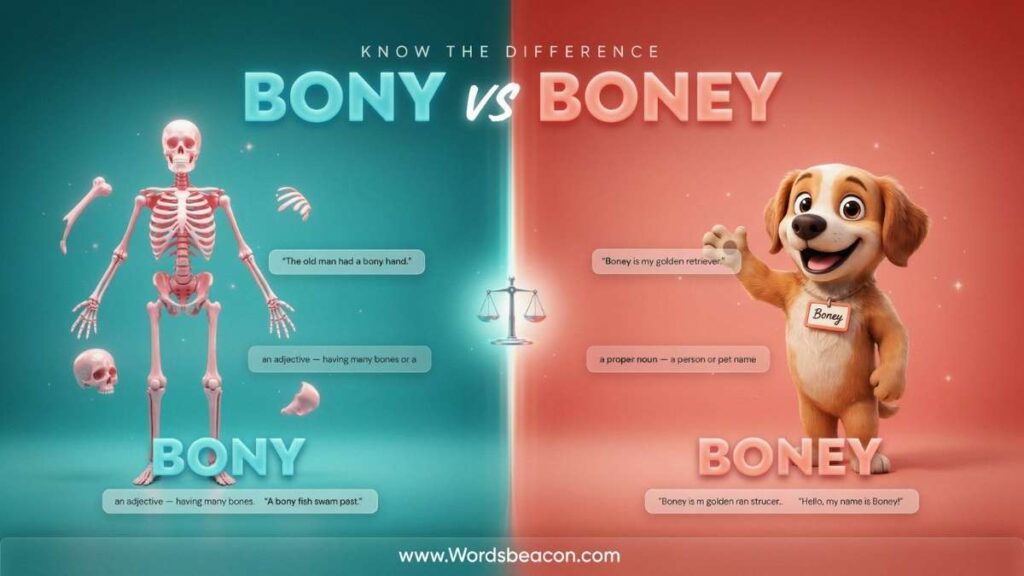
Bony vs boney may look like a simple spelling choice, but that extra “e” can cause surprising confusion. Which spelling should you use, and does the difference change the meaning? The good news is that both forms are recognized, although one is much more common in everyday writing. Think of that extra letter as an unexpected bone in your soup: it may catch your attention, but it doesn’t need to spoil the meal! In this guide, you’ll discover what bony and boney mean, how to use them correctly, and which spelling is the safest choice for clear, confident writing.
quick comparison
| Feature | Bony | Boney |
|---|---|---|
| Spelling | Standard and more common | Recognized alternative spelling |
| Meaning | Thin, prominent-boned, or related to bone | Generally the same as bony |
| Grammar | Adjective | Adjective |
| Pronunciation | BOH-nee | Usually the same |
| Formal writing | Preferred choice | Less common; use consistently |
| Example | The fish has a bony skeleton. | The animal had boney plates. |
Learn how to use confusing more words correctly
Encorporate vs Incorporate correct Usage
Bony vs Boney The Quick Answer
If you’re unsure whether to write bony vs boney, choose bony. It is the conventional spelling in most everyday, academic, professional, and formal writing.
Nevertheless, boney appears as an accepted variant in major dictionary usage. The Cambridge Dictionary, for example, lists boney as an alternative spelling under bony. That means the extra “e” doesn’t automatically make the word incorrect.
The difference is mainly about spelling preference, not meaning.
- Use bony when you want the most familiar and widely accepted form.
- Recognize boney as a valid alternative in contexts where that spelling appears.
- Keep your spelling consistent throughout an article, essay, report, or other document.
For example, “She had bony fingers” and “She had boney fingers” express essentially the same idea. However, the first version is the safer choice when you’re writing for a broad audience.
What Does Bony Mean?
Bony is an adjective that describes something thin enough for its bones to stand out, something made of or resembling bone, or something that contains many bones.
Although these meanings share a connection to bones, the context determines which meaning the reader understands.
Bony Meaning When Describing a Person
When you describe someone as bony, you usually mean that the person’s bones are prominent because they have little flesh covering them.
For example:
- The child had bony knees and long legs.
- He rested his bony hands on the table.
- Her face looked bony after a long illness.
The word can describe a person’s hands, shoulders, face, knees, or other body parts. It doesn’t always mean someone is unhealthy. Some people naturally have prominent bones, while illness or weight loss can also make bones more noticeable.
Be thoughtful when using bony to describe another person. Depending on the situation, the word can sound blunt or unkind. If you simply mean that someone has a slender build, words such as slim or slender may sound more considerate.
Bony Meaning in Anatomy and Medicine
Bony also describes structures made of bone or related to bone. This meaning appears frequently in anatomy, medical writing, and scientific discussions.
Examples include:
- The injury affected the bony structure around the joint.
- The surgeon examined the bony growth near the knee.
- The skull protects the brain with a strong bony structure.
In these sentences, bony doesn’t mean skinny. Instead, it describes the physical structure or composition of something.
This distinction matters because a bony growth and a bony person use the same adjective in different ways. The surrounding words tell you which meaning applies.
Bony Meaning When Describing Fish
When you describe fish as bony, you usually mean that it contains many bones, especially small bones that can make eating it difficult.
For example:
- The fish tasted delicious, but it was very bony.
- We chose another fish because this one had too many bones.
- Carefully remove the bony sections before serving the meal.
The term bony fish can also have a scientific meaning. In biology, it refers to fish belonging to the group commonly known as bony fishes, which have skeletons made largely of bone rather than cartilage.
Therefore, a bony fish in a dinner conversation might mean a fish that’s difficult to eat because of its bones. In a biology textbook, the same phrase may refer to a major group of fish.
Learn how to use confusing more words correctly
Wholly vs Wholey correct Spelling and usage ?
What Does Boney Mean?
Boney is a recognized spelling variant of bony. It generally carries the same meanings, including having prominent bones, containing many bones, or resembling bone.
The extra “e” doesn’t create a separate meaning in ordinary adjective use.
Boney Meaning in Everyday English
You may see boney in descriptions of people, animals, fish, or physical structures.
Examples include:
- The old dog had a boney frame.
- The fish was boney and difficult to eat.
- The creature had boney plates along its back.
These sentences communicate much the same ideas as their versions using bony. However, boney appears less often in conventional writing, so readers are more likely to expect bony.
Is Boney a Real Word?
Yes. Boney is a recognized alternative spelling, not simply a random spelling mistake.
Still, its recognition as a variant doesn’t mean it’s equally common in every context. Most writers should use bony unless they have a specific reason to preserve boney, such as matching a source’s spelling or following a particular publication’s style.
It’s also important to distinguish the adjective from a name. Boney can appear in surnames, nicknames, and other proper names. In those cases, its spelling depends on the name itself, not the usual adjective spelling rule.
Learn how to use confusing more words correctly
Blankie vs Blanky Which Spelling Is Correct?
What Is the Main Difference Between Bony vs Boney?
The main difference is spelling preference rather than meaning. Both forms can describe prominent bones or something related to bone, but bony is generally the better choice for clear, standard writing.
Spelling and Usage
Bony is the form most readers will recognize immediately. It’s also the spelling used as the main dictionary headword in many learner dictionaries.
Boney, meanwhile, is an alternative spelling. A reader may encounter it in informal writing, published material, or a particular source that uses the variant.
For most situations, this simple approach works well:
- In school assignments, use bony.
- In professional reports, use bony.
- In general articles and blog posts, use bony.
- When quoting or reproducing a source that uses boney, preserve the original spelling when appropriate.
Meaning and Context
The two spellings generally mean the same thing. Neither spelling automatically describes a different body type, bone structure, or type of fish.
Compare these examples:
| Sentence | Meaning |
|---|---|
| The child had bony elbows. | The elbows had prominent bones. |
| The child had boney elbows. | The same meaning, using the alternative spelling. |
| The fish was bony. | The fish contained many bones. |
| The fish was boney. | The same general meaning, using the variant. |
Notice that the noun and the surrounding sentence explain the meaning. The additional “e” doesn’t change the idea.
Formal and Informal Writing
For formal writing, bony is the most practical choice because it’s familiar and widely established.
Boney isn’t automatically an error, but some readers may interpret it as a misspelling because they’re less accustomed to seeing it. That can distract from your message, especially in an essay or professional document.
In creative writing, you have more flexibility. However, the best choice is still the one that keeps the spelling consistent and helps your readers understand your meaning without stopping to question it.
Fix common more word mistakes in English
Using vs Useing Correct Spelling and usage ?
Why Is Bony Spelled Without an Extra E?
The spelling becomes easier to remember when you look at how English forms adjectives.
Bony comes from bone with the adjective-forming ending -y. In this word, the final e in bone is dropped before the ending is added.
The spelling pattern looks like this:
- bone + y = bony
- shine + y = shiny
- ice + y = icy
- grease + y = greasy
These examples show a common English spelling pattern. When a word ends in a silent e, the e often disappears before a suffix that begins with a vowel, as in -y.
However, English spelling has exceptions and alternative forms. Boney is one of those recognized alternatives, so the spelling rule explains why bony is the usual choice without making boney nonexistent.
Is Bony vs Boney More Grammatically Correct?
Bony is the conventional choice for standard writing. Boney is a recognized variant, so it’s more accurate to call it less common than to declare it universally incorrect.
Grammar and spelling aren’t exactly the same thing. Grammar determines how a word functions in a sentence, while spelling determines how you write it.
Both bony vs boney function as adjectives in ordinary use:
- The bony hand gripped the railing.
- The boney hand gripped the railing.
Both sentences follow the same grammatical structure. The difference lies in the spelling choice.
Fix common more word mistakes in English
Cocoon vs Cacoon which spelling is correct ?
Bony vs Boney Example Sentences
The Examples make the difference easier to understand because they show how the words work in real sentences.
Examples Using Bony
- The old man rested his bony fingers on the windowsill.
- The fish was so bony that we had to eat it carefully.
- The doctor examined the bony growth near her knee.
- The dog looked bony after spending several days without enough food.
- She wore gloves to protect her hands from the cold and rough surface.
- The skeleton had a strong bony structure.
- His bony shoulders showed through the loose shirt.
- The chef warned us that the fish was particularly bony.
- The medical scan revealed a change in the bony tissue.
- A bony hand appeared from beneath the old blanket.
Examples Using Boney
- The old dog had a boney frame.
- The fish was boney, so we checked each bite carefully.
- The creature’s boney plates protected its back.
- She described the character as a thin, boney figure.
- The illustration showed a boney hand reaching through the doorway.
These examples demonstrate that boney can communicate the same general ideas as bony. Nevertheless, bony remains the more familiar spelling for most readers.
How to Choose the Right Spelling in a Sentence
When you’re editing your work, ask yourself two questions: Am I using the word as an adjective, and do I need to follow a standard spelling preference?
If the answer to both is yes, bony is usually the best option.
For example, if you’re writing an article about fish, “This species has a bony skeleton” is clear and conventional. If you’re describing a fictional creature, “The monster had bony fingers” is equally straightforward.
You don’t need to change the sentence structure to accommodate the spelling. Simply use the conventional form and focus on making the meaning clear.
Fix common more word mistakes in English
Chef vs Cheff Which Is Correct and usage ?
Common Mistakes When Using Bony and Boney
Even though this spelling difference is small, a few common mistakes can create unnecessary confusion.
Assuming Boney Is Always Wrong
One of the biggest mistakes is treating every instance of boney as an obvious spelling error.
Although bony is the preferred form for general writing, dictionaries recognize boney as a variant. Therefore, it’s better to describe it as less common rather than always incorrect.
If you see boney in a published text, check the context before correcting it. The writer may be using a recognized variant or reproducing a specific name.
Assuming Both Spellings Are Equally Common
The opposite mistake is assuming that bony vs boney are interchangeable in every editorial situation.
Their meanings generally overlap, but their familiarity differs. Bony is the more conventional spelling and is usually the better choice for readers who expect standard written English.
For that reason, using bony consistently helps avoid unnecessary distractions.
Confusing Bony With Skinny
Bony and skinny can both describe a person with little body fat, but they don’t emphasize exactly the same thing.
Bony focuses on visible or prominent bones. Skinny focuses more generally on a lack of body fat.
For example:
- She had bony wrists. This emphasizes the appearance of her wrists.
- She was skinny. This describes her overall body shape.
Depending on the context, skinny can sound critical, while bony may sound clinical, blunt, or descriptive. Neither word is automatically polite, so consider your audience and purpose.
Using Bony When You Mean Boneless
Bony and boneless have nearly opposite meanings when you describe food.
A bony fish contains many bones. A boneless fish fillet has had its bones removed, although you should still check for any remaining small bones.
For example:
- Correct: The bony fish was difficult to eat.
- Correct: The boneless fillet was easier to prepare.
- Incorrect for the intended meaning: The fish was bony, so it contained no bones.
The last sentence contradicts itself. Remember that bony points to the presence or prominence of bones, not their absence.
Fix common more word mistakes in English
Choosing vs Chosing Which Is Correct and Usage ?
How to Pronounce Bony and Boney
Bony and boney are generally pronounced the same way. Both have two syllables, and the stress falls on the first syllable.
The American pronunciation is commonly represented as /ˈboʊ.ni/. In British English, the vowel in the first syllable differs slightly and is commonly represented as /ˈbəʊ.ni/.
The extra e in boney doesn’t normally create another syllable or change the pronunciation.
If you’re speaking aloud, focus on the first syllable and keep the ending short and clear. You don’t need a different pronunciation simply because the alternative spelling contains an extra letter.
Grammar Rules for Bony and Boney
Understanding the grammar helps you use the adjective correctly, regardless of which spelling appears in a source.
Is Bony an Adjective?
Yes. Bony is an adjective, which means it describes a noun.
Examples include:
- A bony hand
- A bony shoulder
- A bony fish
- A bony structure
In each example, bony gives the reader more information about the noun.
Boney can also function as an adjective when it’s used as the alternative spelling.
What Are the Comparative and Superlative Forms of Bony?
The comparative form is bonier, and the superlative form is boniest.
Use bonier when comparing two people or things. Use boniest when identifying the most bony member of a group.
Examples:
- His hands looked bonier than they had last winter.
- Of the three fish, this one was the boniest.
- The older dog appeared bonier than the younger dog.
Notice that these forms use i rather than keeping the y. You don’t normally write “bonyer” or “bonyest.”
The same comparative and superlative forms are used even when a source uses the alternative spelling boney.
What Is the Noun Form of Bony?
Boniness is a noun that describes the quality or condition of being bony.
For example:
- The boniness of the fish made it difficult to eat.
- The artist emphasized the boniness of the character’s hands.
You won’t need this noun form in every sentence, but it’s useful when you’re discussing the quality itself rather than simply describing a person or object.
Understand confusing English more words simply
Developed vs Developped Which Spelling Is Correct?
Synonyms and Related Words for Bony

Choosing a suitable synonym can make your writing clearer and more natural. However, not every word related to thinness or bones has exactly the same meaning.
Words That Describe a Thin Person
- Skinny: Having little body fat; can sound critical.
- Slim: Having a slender build; often more positive or neutral.
- Slender: Thin in an elegant or graceful way.
- Scrawny: Unpleasantly thin or poorly developed.
- Gaunt: Very thin, often with a tired or unhealthy appearance.
- Skeletal: Extremely thin or resembling a skeleton.
For example, “slender fingers” may sound more graceful than “bony fingers.” In contrast, “bony fingers” emphasizes the visible shape of the bones.
Choose the word that best matches the tone you want.
Words That Describe Bone Structure
When you mean that something consists of or resembles bone, different terms may fit better.
- Osseous: Relating to bone; often used in scientific or medical contexts.
- Skeletal: Relating to the skeleton or its structure.
- Boneless: Having no bones or having bones removed, depending on context.
- Bone-like: Resembling bone in appearance or texture.
For example, a medical report may use osseous when discussing bone tissue. In everyday writing, bony is usually simpler and easier to understand.
Understand confusing English more words simply
Planing vs Planning Spelling Rules, and Common Mistakes
Practice Session Bony vs Boney
Complete the sentences by filling in each blank with the correct word or form. Use “Bony vs Boney” where appropriate. Check your answers at the end.
1. The old man had ______ fingers and thin wrists.
2. The fish was so ______ that we had to eat it carefully.
3. The doctor examined the ______ structure around the injured joint.
4. The extra “e” in ______ makes it a recognized alternative spelling of bony.
5. After losing weight, the dog’s ribs became more ______.
6. Of all the fish on the plate, this one was the ______.
7. The artist drew a skeleton with a strong ______ frame.
8. The creature had ______ plates covering its back.
9. His ______ shoulders were visible beneath his loose shirt.
10. The comparative form of bony is ______.
11. The superlative form of bony is ______.
12. The ______ hand reached out from beneath the blanket.
13. The chef warned us that the fish was particularly ______.
14. The medical report described the growth as a ______ structure.
15. The word “boney” is a recognized spelling ______ of bony.
16. The child had ______ knees and long, thin legs.
17. The noun that describes the quality of being bony is ______.
18. The fish was difficult to eat because it was too ______.
19. For formal writing, ______ is generally the preferred spelling.
20. The character looked thin and ______, with prominent cheekbones.
Answers
- bony
- bony
- bony
- boney
- bony
- boniest
- bony
- bony
- bony
- bonier
- boniest
- bony
- bony
- bony
- variant
- bony
- boniness
- bony
- bony
- bony
Here’s a trusted source for clear word meanings:
FAQs
Can you use “boney” in formal writing?
Yes. “Boney” is a recognized spelling variant of “bony.” However, “bony” is more common and generally the better choice for formal writing, academic work, and professional communication.
Why is “bony” spelled without the e in “bone”?
When forming “bony,” English drops the final e in “bone” before adding the suffix “-y.” The result is “bony,” which follows a common English spelling pattern.
Can “bony” describe animals as well as people?
Yes. “Bony” can describe people, animals, or body parts with prominent bones. For example, you might describe a bony hand, a bony dog, or a bony frame.
What does “bony frame” mean?
A “bony frame” describes a body build in which the bones appear prominent. The phrase often refers to someone with a naturally slender build or little soft tissue covering their bones.
Can you describe fish as bony?
Yes. A fish is described as bony when it contains many bones that make eating it more difficult. For example, “The fish tasted delicious, but it was too bony to eat comfortably.”
Is “boney” acceptable in everyday English?
Yes. “Boney” is an alternative spelling of “bony” and carries the same general meaning. Still, “bony” is more widely used, so it is the safer choice when you are unsure which spelling to use.
Does “bony” have a plural form?
No. “Bony” is an adjective, and adjectives do not change to match singular or plural nouns. You can say “a bony finger” or “several bony fingers.”
What are the comparative and superlative forms of “bony”?
The comparative form is “bonier,” while the superlative form is “boniest.” For example, “His hands looked bonier after he lost weight” compares their appearance, while “Those were the boniest fingers in the group” identifies the most prominent example.
Is calling someone bony considered rude?
It can be. Although “bony” is a valid descriptive word, using it to comment on someone’s body may sound insensitive or critical. Consider the context and your audience before using it to describe a person.
Should you use “bony vs boney” in an article?
Use “bony” in most articles because it is the more common spelling. You can use “boney” when discussing spelling variations or quoting a source that uses that form. Choosing “bony” helps keep your writing clear and consistent.
Understand confusing English more words simply
Brite vs Bright Correct Spelling and usage ?
Conclusion
The difference between bony vs boney is simple once you know which spelling to choose. Both are recognized, but bony is the more common and preferred spelling in everyday writing. Use it when describing someone with prominent bones, a bony hand, or fish that contains lots of bones. Boney has the same general meaning, but you’ll see it less often. So, if you’re writing an article, completing a school assignment, or sending a message, choose bony to keep things clear and natural. There’s no need to let one little letter rattle your bones! Remember this simple rule, and you’ll avoid the confusion next time.

Luna AJS is an experienced blogger and dedicated language enthusiast at Words Beacon. She specializes in making English grammar, spelling, vocabulary and commonly confused words easy to understand. She provides clear explanations, practical examples to help readers write with confidence.