

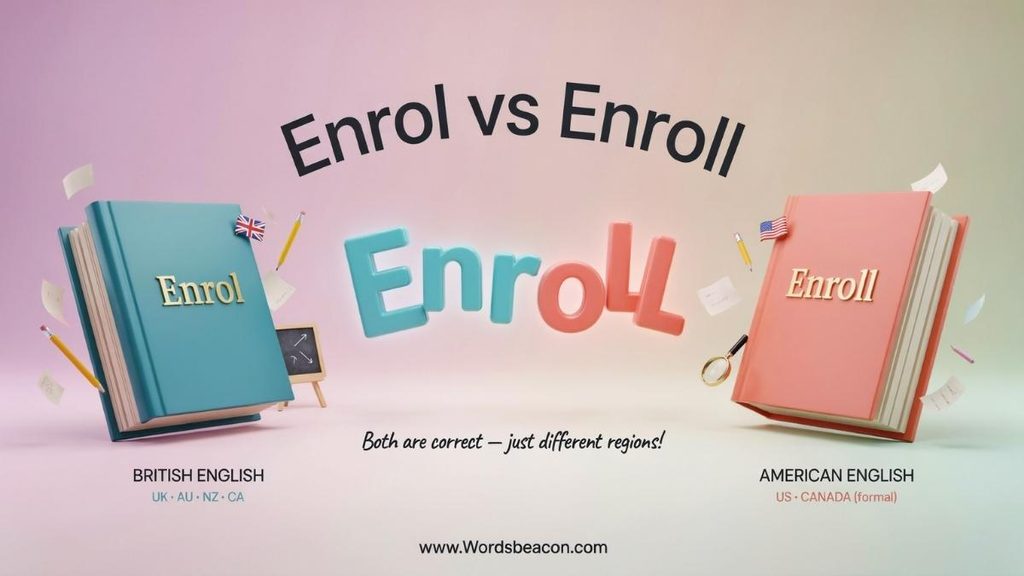
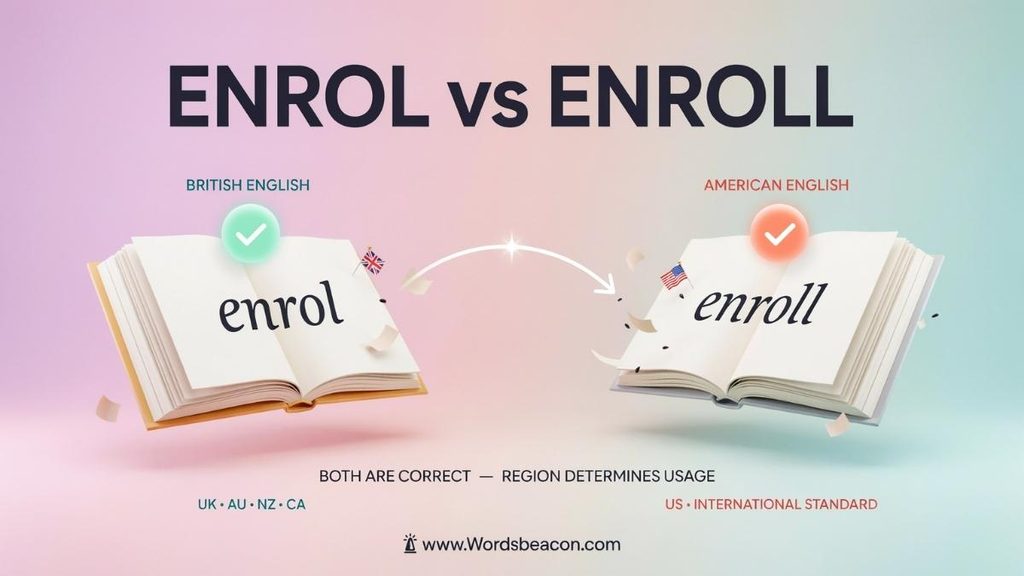
The difference between enrol vs enroll is simple once you know which spelling to use. Both words mean officially joining a school, college, course, or training program. The only difference is regional spelling: American English uses “enroll,” while British English prefers “enrol.” The same rule applies to enrollment and enrolment. So, which version belongs in your writing? Don’t worry, you don’t need a spelling class to figure it out! This guide explains the differences with clear examples, simple grammar rules, and helpful tips to prevent common mistakes. By the end, you’ll know which spelling to choose and when to use it.
Quick Comparison Table
| Feature | Enrol | Enroll |
|---|---|---|
| Preferred spelling | British English | American English |
| Meaning | To register officially | To register officially |
| Noun form | Enrolment | Enrollment |
| Third-person singular | Enrols | Enrolls |
| Past tense | Enrolled | Enrolled |
| Past participle | Enrolled | Enrolled |
| Present participle | Enrolling | Enrolling |
| Common uses | Education, training, membership | Education, training, membership |
| Standard in American English | Generally not preferred | Yes |
| Standard in British English | Yes | Generally not preferred |
The main difference is regional spelling, not grammar or meaning. Although the base verbs look different, most of their other grammatical forms use the same spelling.
Fix common more word mistakes in English
Panel vs Pannel Spelling and Correct usage?
What Is the Difference Between Enrol and Enroll?
The difference between enrol and enroll comes down to regional spelling conventions. Both words are verbs that describe officially registering someone or entering a person’s name into a program, school, organization, or other structured activity.
Consider these examples:
- British English: Emma plans to enrol in a university course.
- American English: Emma plans to enroll in a university course.
Both sentences express the same idea. Neither spelling is more formal or more meaningful than the other.
This difference reflects a broader pattern in English spelling. American and British English often use different forms of the same word. For example, American English typically uses color, while British English uses colour. Similarly, Americans usually write traveling, while British writers commonly use travelling.
However, these regional differences don’t always follow one universal rule. Each word has its own established spelling conventions, so writers should check the specific word rather than assume that every spelling difference works the same way.
Enrol vs Enroll Meaning
The phrase enrol vs enroll meaning refers to the definition shared by both spellings: to register officially for something or arrange for another person to participate in a course, program, or organization.
For example:
- A student may enrol vs enroll in a college.
- A parent may enrol vs enroll a child in a summer program.
- An employee may enrol vs enroll in a benefits plan.
- A volunteer may enrol vs enroll as a member of an organization.
In each example, the verb describes an organized registration process. The spelling changes according to regional preference, but the action remains the same.
Although people often associate these words with education, their use extends beyond schools and universities. Businesses, professional training providers, membership organizations, and benefit programs also use them.
Enrol Meaning and Enroll Meaning
The enrol meaning and enroll meaning are identical. Both words describe the act of officially registering or arranging for someone to participate in something.
The main difference is where each spelling is preferred:
- Enrol: The usual spelling in British English.
- Enroll: The standard spelling in American English.
For instance, a British university may ask applicants to enrol before the academic year begins. An American college may instruct students to enroll before classes start.
Both institutions communicate the same message. The spelling simply reflects their regional writing conventions.
Fix common more word mistakes in English
Grately vs Greatly difference and Correct usage?
Enroll in American English
In American English, enroll is the standard spelling. American dictionaries, schools, colleges, and organizations commonly use this form in admission instructions, registration documents, and administrative communications.
If you’re writing for a US audience, choose enroll unless an organization specifies another spelling. This applies to college applications, online courses, workplace training, school enrollment, and membership programs.
Here are some examples:
- Students must enroll before the registration deadline.
- She wants to enroll in an online business course.
- Parents can enroll their children in the after-school program.
- Employees may enroll in the company’s health insurance plan.
- The college enrolls thousands of students each year.
Notice the final example uses enrolls. The third-person singular form retains the double l.
How Do You Spell Enroll in American English?
The correct spelling of enroll in standard American English is E-N-R-O-L-L. It contains two l’s at the end.
If you’re wondering whether to enroll with one L or two, the answer is two l’s for the base form.
| Grammatical form | American spelling | Example |
|---|---|---|
| Infinitive | Enroll | I plan to enroll. |
| Third-person singular | Enrolls | He enrolls every fall. |
| Past tense | Enrolled | She enrolled yesterday. |
| Past participle | Enrolled | They have enrolled. |
| Present participle | Enrolling | We are enrolling now. |
| Noun | Enrollment | Enrollment begins in June. |
These forms matter because the regional spelling difference affects both the base verb and the related noun. The past tense and present participle follow their own spelling patterns.
Why Does American English Use Enroll?
English spelling developed over centuries, and regional differences emerged as dictionaries, publishers, and educational systems established their preferred forms.
American English uses several spellings that differ from common British usage. Enroll is one example. British English generally retains the single-l form in the base verb, while American English uses the double-l form.
The extra letter doesn’t change the word’s meaning. It’s simply part of the accepted American spelling convention.
Therefore, if you’re writing an American English article, use enroll and enrollment consistently. Switching between enroll and enrolment can make an otherwise polished document look inconsistent.
Fix common more word mistakes in English
Excel vs Accel Which Spelling Is Correct?
Enrol in British English
In British English, enrol is the standard spelling. You’ll commonly find it in school admission instructions, university registration information, professional training materials, and organizational documents.
For example:
- Students can enrol in the course beginning Monday.
- She hopes to enrol at a local college.
- The organization will enrol new members next month.
- Parents must enrol their children before the term starts.
- The training center enrols apprentices each year.
For British readers, enrol is the natural choice. Although most readers will understand enroll, the double-l spelling may look inconsistent in a document that otherwise follows British English conventions.
How Do You Spell Enrol in British English?
The correct spelling of enrol in standard British English is E-N-R-O-L. It contains one l at the end.
The main forms are:
| Grammatical form | British spelling | Example |
|---|---|---|
| Infinitive | Enrol | I plan to enrol. |
| Third-person singular | Enrols | He enrols every fall. |
| Past tense | Enrolled | She enrolled yesterday. |
| Past participle | Enrolled | They have enrolled. |
| Present participle | Enrolling | We are enrolling now. |
| Noun | Enrolment | Enrolment begins in June. |
One detail often surprises writers: British English uses enrol with one final l, but the past tense is still enrolled, and the present participle is enrolling.
When you add certain suffixes, the spelling changes. You don’t keep one l throughout every form of the verb.
Is Enrol Correct in the UK?
Yes. Enrol is the usual British spelling, so it’s the appropriate choice for most UK-focused writing.
For instance, a British college might publish the instruction, “Please enrol before the start of term.” An American institution would normally write, “Please enroll before the start of the semester.”
The difference also appears in the related noun:
- British English: Enrolment is now open.
- American English: Enrollment is now open.
Both forms are correct in their respective regional conventions. Neither should be treated as the universal spelling for all English-speaking countries.
Enrol vs Enroll UK Which Should You Choose?
If you’re writing for a UK audience, use enrol and enrolment unless the publication or organization specifies another style.
This recommendation applies to:
- University websites and admission instructions
- School registration forms
- Professional training materials
- Membership applications
- Workplace policies and internal communications
When writing for an international audience, follow the organization’s preferred style guide. Consistency is more useful than switching between spellings based on which one looks familiar.
Understand confusing English more words simply
Journeys vs journies Correct Spelling and usage ?
Enrolment vs Enrollment Which Noun Is Correct?

The difference between enrolment and enrollment follows the same regional pattern as the difference between enrol and enroll.
Enrolment is the usual British spelling, while enrollment is the standard American spelling. Both nouns refer to the act or process of registering, or to the number of people registered in a school, course, or program.
| British English | American English | Example |
|---|---|---|
| Enrolment | Enrollment | Enrolment opens in May. |
| Student enrolment | Student enrollment | Student enrollment increased this year. |
| Enrolment form | Enrollment form | Complete the enrollment form. |
| Enrolment period | Enrollment period | The enrollment period ends Friday. |
The noun can describe the registration process itself or the number of people registered, depending on the context.
For example, “Enrollment closes on Friday” refers to the registration period. In contrast, “The college’s enrollment increased” refers to the number of registered students.
How to Use Enrollment in a Sentence
Use enrollment when writing in American English and enrolment when writing in British English.
Examples:
- American English: Enrollment for the fall semester opens in April.
- British English: Enrolment for the autumn term opens in April.
- American English: The school reported an increase in enrollment.
- British English: The school reported an increase in enrolment.
- American English: Please complete the enrollment form online.
- British English: Please complete the enrolment form online.
Notice that fall and autumn, as well as semester and term, also reflect common regional preferences. These words don’t have to change in every sentence, but they illustrate how spelling and vocabulary differences can appear together.
What Is the Noun Form of Enroll?
The noun form of enroll is enrollment in American English. In British English, the corresponding noun is enrolment.
Don’t confuse either noun with enrolled, which functions as a verb form or participial adjective.
Compare these sentences:
- Enrollment begins next week. (Noun)
- She enrolled last week. (Past-tense verb)
- She is an enrolled student. (Participial adjective)
Understanding the grammatical role of each word helps you choose the right form, not just the right spelling.
Understand confusing English more words simply
Drier vs Dryer Differences and Correct Usage ?
Enrolled vs Enroled Which Is Correct?
The standard spelling is enrolled, with two l’s, in both American and British English. Although the base verbs differ, their past-tense forms are the same.
- American English: He enrolled in the course.
- British English: He enrolled in the course.
The spelling enroled appears occasionally, but it isn’t the standard form writers should generally use in contemporary American or British English.
This is an important exception to the one-l-versus-two-l distinction. British English uses enrol as the base form, yet doubles the final l when forming enrolled.
What Is the Past Tense of Enroll?
The past tense of enroll is enrolled. The past tense of enrol is also enrolled.
Examples:
- I enrolled in a photography course last month.
- She enrolled her son in a summer camp.
- They enrolled in the program before registration closed.
The same spelling applies to the past participle, which appears with auxiliary verbs:
- I have enrolled in the course.
- She had enrolled before the deadline.
- They were enrolled in the program.
The past tense describes a completed action. Meanwhile, the past participle helps form perfect tenses and passive constructions.
Enrolling Spelling One L or Two?
Enrolling is spelled with two l’s in both American and British English.
Examples:
- American English: The college is enrolling new students.
- British English: The college is enrolling new students.
The present participle of enroll and the present participle of enrol are both enrolling. This form can describe an action in progress or function as a gerund, a verb form that acts as a noun.
For example:
- The school is enrolling new students. (Ongoing action)
- Enrolling in a course takes only a few minutes. (Gerund)
The spelling rule is straightforward: when adding -ing to either enrol vs enroll, double the final l.
Third-Person Singular Enrols vs Enrolls
The third-person singular forms are enrols in British English and enrolls in American English.
Examples:
- British English: The university enrols international students.
- American English: The university enrolls international students.
To form the third-person singular, add -s to the base form while keeping the regional spelling.
These forms describe what one person, institution, or organization does. They aren’t interchangeable within a document that follows a consistent regional spelling convention.
Understand confusing English more words simply
Whiny vs Whiney Correct Spelling and How to Use Each
Enrol vs Enroll Grammar Rules
Understanding the enrol vs enroll grammar rules makes it easier to use both words correctly. They follow the same basic grammatical patterns, and the main distinction appears in the base spelling and related noun.
Part of Speech
Both enrol and enroll are verbs. They describe an action rather than a person, place, or thing.
Examples:
- She wants to enroll in a business course.
- They plan to enrol their daughter in the school.
- The organization enrolls new members each year.
The nouns enrolment and enrollment, however, name the registration process or the resulting group of registered participants.
Common Sentence Patterns
The verb appears in several common structures.
| Sentence pattern | Example |
|---|---|
| Enrol vs enroll in something | He enrolled in a writing course. |
| Enrol vs enroll someone in something | They enrolled their child in swimming lessons. |
| Be enrolled in something | She is enrolled in a university program. |
| Enrol vs enroll as something | He enrolled as a new member. |
Use in when referring to participation in a course or program. When the verb takes a direct object, as in “They enrolled their child,” the object identifies the person being registered.
These patterns work with both spellings. Your regional convention determines which base form you should write.
Enrolled vs Enrolling
Enrolled commonly describes a completed registration or a person’s current status. Enrolling usually describes an ongoing action or the process of registration.
For example:
- She enrolled in the course yesterday.
- She is enrolled in a computer science program.
- The university is enrolling new students.
- Enrolling in the course takes only a few minutes.
The difference is grammatical rather than regional. Both American and British English use these forms in the same way.
Understand confusing English more words simply
Suing vs Sueing Which Spelling Is Correct?
Enrol vs Enroll Examples in Sentences
Examples make the difference easier to remember because they show how the words work in everyday situations.
Enrol Examples
The following sentences use enrol in British-style spelling:
- I plan to enrol in a creative writing course this summer.
- Students must enrol before the application deadline.
- She enrolled her daughter in a local primary school.
- The company allows employees to enrol in professional development programs.
- New members can enrol through the organization’s website.
- He has enrolled in a training course to improve his skills.
- Enrolling in the program requires a completed application.
These examples also show why you shouldn’t assume every form retains one l. The base verb is enrol, but the past tense and present participle use two l’s.
Enroll Examples
These sentences use enroll, the standard American spelling:
- I want to enroll in an online marketing course.
- Students can enroll after receiving their admission letters.
- She enrolled her son in a summer reading program.
- Employees must enroll in their benefits plan during the designated period.
- The college enrolls new students every semester.
- He has enrolled in a course on computer programming.
- Enrolling early may help students secure a place in the class.
The meaning stays the same as in the British examples. Only the base verb’s regional spelling changes.
Enrol vs Enroll Now What Does It Mean?
The phrase enrol now or enroll now is a call to action that encourages someone to register immediately.
You’ll often find it on course websites, school admission pages, training platforms, and event registration pages.
Examples:
- British English: Enrol now to reserve your place.
- American English: Enroll now to reserve your place.
Both phrases are correct. The word now adds urgency rather than changing the verb’s meaning.
Learn how to use confusing more words correctly
Nosy vs Nosey Which one Is Correct?
Regional Usage American, British, Australian, and Canadian English
English spelling isn’t identical across every country. Although American and British conventions explain the main difference between enrol and enroll, other English-speaking regions also have established preferences.
American English
American English uses enroll and enrollment.
For US-focused articles, forms, emails, and academic writing, these are the usual choices. The same applies to related expressions such as student enrollment and enrollment period.
British English
British English generally uses enrol and enrolment. These spellings are common in school, university, and professional training contexts.
Writers should follow the spelling conventions of their intended institution or publication.
Australian English
Australian English commonly uses enrol and enrolment. If you’re writing for an Australian school, university, or organization, these forms are generally appropriate.
Should you use enrol vs enroll in Australia? In most Australian contexts, choose enrol. Check an organization’s style guide if it specifies a different preference.
Canadian English
Canadian English combines features of British and American spelling, and its conventions vary by word and publisher. The choice between enrol and enroll may depend on the dictionary, publication, or institution being followed.
If you’re writing for a Canadian university or government organization, consult its preferred style guide rather than assuming every word follows British or American rules.
New Zealand English
New Zealand English generally follows British-style spelling for this word, so enrol and enrolment are common choices.
For official forms and educational materials, use the spelling preferred by the relevant institution.
Philippine English
Philippine English has been influenced by American English, including many American spelling conventions. As a result, enroll and enrollment are common choices in Philippine contexts.
However, local institutions and publications may have their own preferences. When accuracy matters, follow the style used by the organization you’re writing for.
Learn how to use confusing more words correctly
Conex vs Connex Which one Is actually Correct?
Common Mistakes When Using Enrol and Enroll
A few spelling errors can make an otherwise polished document look inconsistent. Fortunately, most are easy to avoid.
Assuming One Spelling Is Wrong
Neither enrol nor enroll is universally incorrect. Each belongs to an accepted regional spelling convention.
Instead of marking one as wrong in every context, consider your audience and the style guide you’re following.
Mixing Regional Spellings
A document that uses enroll in one paragraph and enrolment in another may look inconsistent.
For example:
Inconsistent: “Students can enroll in the program. Enrollment closes Friday, and enrolment forms are available online.”
Consistent American English: “Students can enroll in the program. Enrollment closes Friday, and enrollment forms are available online.”
Consistent British English: “Students can enrol in the program. Enrolment closes Friday, and enrolment forms are available online.”
Consistency makes your writing easier to follow and shows attention to detail.
Misspelling Enrolling and Enrolled
Remember that both standard regional forms double the final l when adding -ed or -ing.
| Incorrect or nonstandard form | Standard form |
|---|---|
| Enroled | Enrolled |
| Enroling | Enrolling |
| Enrolls in British-style writing | Enrols |
| Enrolment in standard American-style writing | Enrollment |
The last two examples concern regional preference rather than an absolute grammatical error. In contrast, enrolled and enrolling are the standard forms in both major conventions.
Ignoring the Audience
A US college application should generally use American spelling, while a British institution will usually prefer British spelling.
Before publishing an article or sending a professional document, check whether the intended readers follow American, British, Australian, Canadian, or another English spelling convention.
Enrol vs Enroll vs Register vs Sign Up
Although these terms overlap, they don’t always carry precisely the same emphasis.
| Word or phrase | Typical meaning | Example |
|---|---|---|
| Enrol | Officially register, especially in British English | She will enrol in the course. |
| Enroll | Officially register, especially in American English | She will enroll in the course. |
| Register | Record details or officially sign up | Please register for the conference. |
| Sign up | Join or agree to participate, often informally | I’ll sign up for the workshop. |
Enrol and enroll are particularly common in education, organized programs, and membership contexts. Register is broader and can refer to recording information or reserving a place. Sign up often sounds more conversational.
For example, you might sign up for a free newsletter, register for a conference, or enroll in a university course. These choices aren’t rigid rules, but they reflect common usage.
Learn how to use confusing more words correctly
Bougie vs Boujee which one is correct?
practice session Enrol vs Enroll
Complete the sentences below by choosing the correct spelling: Enrol vs Enroll enrolment, enrollment, enrolled, or enrolling. Pay attention to the type of English used in each sentence.
1. Students can ______ in the course through the university’s website.
2. She plans to ______ at a British university next year.
3. The school’s ______ numbers increased this year.
4. The college’s ______ process begins in September.
5. I have already ______ in an online writing course.
6. He is ______ in a training program this week.
7. Parents must complete the ______ form before the school year begins.
8. You can ______ for the workshop by visiting our office.
9. The university has ______ more international students this semester.
10. She is considering whether to ______ in a language course.
11. The ______ deadline is approaching, so submit your application soon.
12. Many students choose to ______ in evening classes.
13. I am currently ______ in a professional development program.
14. The school’s ______ figures have improved over the past year.
15. He ______ in the course last Monday.
16. New students should ______ before classes begin.
17. The college offers online ______ for students who cannot visit the campus.
18. She has ______ at the local college to study business.
19. The university is ______ new students for the spring semester.
20. Please check the ______ requirements before submitting your application.
Answers
- enroll
- enrol
- enrollment
- enrolment
- enrolled
- enrolling
- enrollment
- enrol
- enrolled
- enrol
- enrollment
- enrol
- enrolling
- enrolment
- enrolled
- enrol
- enrollment
- enrolled
- enrolling
- enrolment
Here’s a trusted source for clear word meanings:
FAQs
What is the difference between enrolment and registration?
Enrolment usually means officially joining a school, college, university, or course. Registration is a broader term that can also refer to signing up for events, services, or other activities.
Can you enrol in more than one course at a time?
Yes. You can enrol in multiple courses at the same time, provided the institution allows it and you meet the requirements for each course.
Is enrol a verb or a noun?
Enrol is a verb that means to officially join a school, course, or program. Its noun form is enrolment in British English and enrollment in American English.
Why does American English use a double L in enroll?
American English uses enroll with two Ls as its standard spelling. The double L also appears in related forms such as enrolled and enrolling.
Should I use enrol vs enroll on a university application?
Follow the spelling used by the university. American institutions generally prefer enroll, while British institutions typically use enrol. Matching the institution’s preferred spelling helps keep your application consistent.
Is there a difference between enrolment and enrollment numbers?
No. Both terms refer to the number of people registered in a school, course, or program. Enrolment is the standard British spelling, while enrollment is the standard American spelling.
Can you enrol in professional training?
Yes. You can enrol in professional training courses, certification programs, workshops, and workplace development programs. In American English, use enroll instead.
Is enrol used outside the United Kingdom?
Yes. Enrol is also common in countries that follow British spelling conventions, including Australia and New Zealand. However, individual institutions may follow their own style guidelines.
What happens after you enrol in a course?
After enrolment, the institution may confirm your place, provide course materials, share the class schedule, and explain any remaining payment or orientation requirements.
Is enrolment the same as admission?
No. Admission means an institution has accepted your application, while enrolment generally means you have officially registered for the program. Depending on the institution, you may need to complete additional steps after admission to finalize your enrolment.
Conclusion
The difference between enrol vs enroll comes down to regional spelling, not meaning. Both words mean to officially join a school, course, or program. American English uses enroll, while British English uses enrol. Their noun forms follow the same pattern: enrollment in American English and enrolment in British English.
The easiest way to remember the difference is to think about your audience. If you’re writing for an American university, choose enroll. For a British institution, use enrol. Just keep your spelling consistent throughout your writing.
So, don’t let one little letter turn a simple word into a grammar puzzle! Once you know which spelling to use, you can enrol or enroll with confidence and save your worries for the actual coursework.

Luna AJS is an experienced blogger and dedicated language enthusiast at Words Beacon. She specializes in making English grammar, spelling, vocabulary and commonly confused words easy to understand. She provides clear explanations, practical examples to help readers write with confidence.