
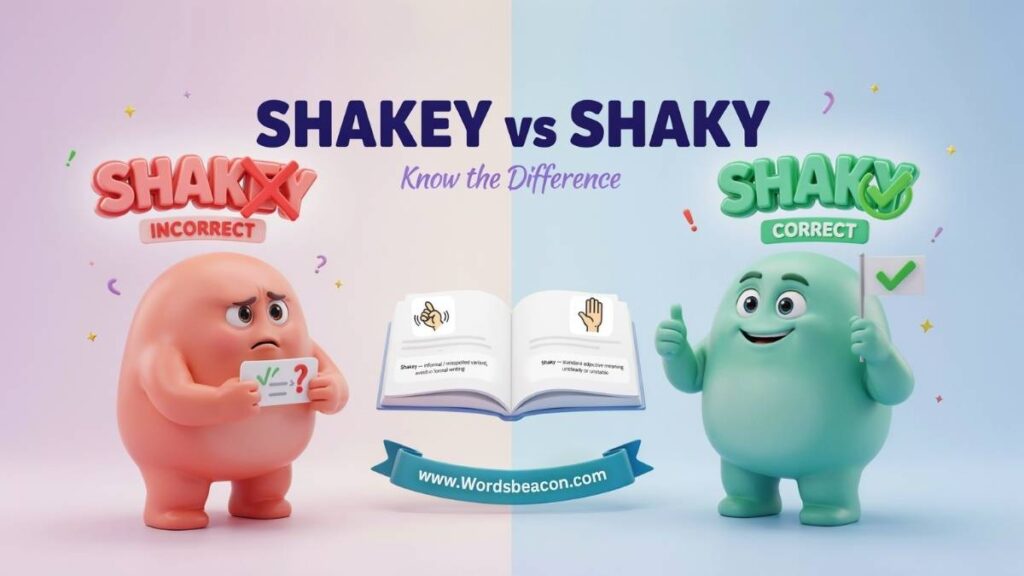
The difference between shakey vs shaky may seem small, but one extra letter can make your spelling incorrect. So, which one should you use? The answer is simple: “shaky” is the correct spelling when describing trembling hands, an unsteady chair, or an uncertain situation. “Shakey” is generally used in names, nicknames, or brand names. There’s no need to let this little spelling puzzle shake your confidence! In this guide, you’ll learn the meaning of each spelling, see clear examples, discover helpful synonyms, and understand common mistakes. By the end, you’ll know exactly which word to use and why.
quick comparison table
| Topic | Shaky | Shakey |
|---|---|---|
| Standard English spelling | Correct | Not standard for the adjective |
| Meaning | Trembling, unsteady, weak, or uncertain | Usually a name or a misspelling |
| Part of speech | Adjective | Often a proper name or informal spelling |
| Example | My hands feel shaky. | Shakey is his nickname. |
| Formal writing | Recommended | Avoid unless it is a proper name |
Understand confusing English more words simply
Enrol vs Enroll correct Spelling and usage ?
What Is the Difference Between Shakey vs Shaky?
The main difference between Shakey vs Shaky is spelling and usage. “Shaky” is the standard adjective recognized by major English dictionaries. It describes something that shakes, lacks stability, or seems uncertain. “Shakey,” on the other hand, is not the standard spelling of that adjective.
For example, you might feel shaky after running a long distance, or you might describe a table as shaky if it wobbles whenever someone touches it. Similarly, a business plan may seem shaky if it lacks reliable evidence.
However, you may see “Shakey” used as a person’s nickname, a username, or part of a business name. In those cases, the spelling may be intentional.
The easiest rule is to use “shaky” when describing movement, stability, confidence, or reliability. Use “Shakey” only when you need to preserve a particular name or title.
What Does Shaky Mean?
“Shaky” is an adjective that describes something trembling, unsteady, weak, or uncertain. According to standard dictionary definitions, it can refer to physical movement as well as emotional feelings, unstable objects, and unreliable situations.
The exact meaning depends on the context.
Shaky Meaning in Physical Movement
When something moves uncontrollably or trembles slightly, you can describe it as shaky.
For example:
- Her hands were shaky after the difficult exam.
- The puppy stood on its shaky legs.
- He wrote a shaky signature on the form.
- The old ladder felt shaky beneath my feet.
In each sentence, “shaky” describes movement or a lack of steadiness. The word doesn’t necessarily mean that something will fall or fail. It simply suggests that the movement isn’t firm or controlled.
Shaky Meaning in Emotions
People can also feel shaky when they experience fear, stress, nervousness, or a sudden emotional shock.
For example:
- I felt shaky before my first job interview.
- She sounded shaky while explaining what happened.
- The unexpected announcement left him feeling shaky.
- He took a few deep breaths because he felt shaky.
Here, the word describes a physical or emotional reaction. A person may experience trembling, feel unsettled, or struggle to speak steadily.
Shaky Meaning in Uncertain Situations
“Shaky” can also describe something weak, unreliable, or unlikely to succeed.
For example:
- The company has a shaky financial position.
- His argument rests on shaky evidence.
- Their relationship has been shaky for months.
- The team had a shaky start to the season.
In these examples, nothing necessarily shakes physically. Instead, the word suggests that something lacks a strong foundation or may not hold up under pressure.
Fix common more word mistakes in English
Panel vs Pannel Spelling and Correct usage?
What Does Shakey Mean?
“Shakey” is not the standard spelling of the common adjective meaning trembling or unstable. If you write “shakey hands” or “a shakey ladder” in ordinary English, readers will generally recognize the intended meaning, but the spelling is incorrect for formal and standard writing.
Nevertheless, “Shakey” can be correct when it appears as a proper noun.
Shakey as a Nickname
People sometimes use “Shakey” as a nickname. A nickname can have an unusual spelling, and that spelling doesn’t have to follow the rules for ordinary English adjectives.
For example:
- Shakey joined the team last summer.
- Everyone called him Shakey because he used to shake his leg when nervous.
- Shakey is the character’s name in the story.
In these sentences, “Shakey” identifies a person rather than describing a condition.
Shakey as a Brand Name
“Shakey” also appears in the name Shakey’s Pizza, a restaurant brand associated with Sherwood “Shakey” Johnson. In this context, the spelling is part of the established name.
A proper name follows its own spelling conventions. Therefore, changing “Shakey’s Pizza” to “Shaky’s Pizza” would alter the name rather than correct an ordinary adjective.
The distinction matters: a spelling can be unsuitable for general descriptive writing and still be correct as part of a name.
Is Shakey a Real Word?
The answer depends on what you mean by “real word.” People use “Shakey” in names, nicknames, and informal contexts. However, major dictionaries list “shaky” as the standard adjective.
If you’re writing an essay, report, business email, or article, choose “shaky” when you mean unsteady or uncertain. If you’re referring to someone or something officially named “Shakey,” preserve that spelling.
Fix common more word mistakes in English
Grately vs Greatly difference and Correct usage?
Shakey vs Shaky Key Differences at a Glance
The following table makes the distinction easier to remember.
| Feature | Shaky | Shakey |
|---|---|---|
| Standard adjective | Yes | No |
| Describes trembling | Yes | Not in standard usage |
| Describes instability | Yes | Not in standard usage |
| Describes uncertainty | Yes | Not in standard usage |
| Can be a proper name | Yes, in some cases | Yes |
| Suitable for formal writing | Yes, when appropriate | Only when preserving a name or title |
| Example | The bridge looks shaky. | Shakey is the name of the character. |
As the table shows, the choice usually comes down to context. If you’re describing something, use “shaky.” If you’re writing a specific name, follow the official spelling.
Shaky Hands or Shakey Hands Which Is Correct?
“Shaky hands” is the correct standard phrase. It describes hands that tremble or move unsteadily.
For example:
- My hands were shaky after the long hike.
- She had shaky hands when she signed the document.
- The cold weather left his fingers and hands shaky.
The phrase can describe ordinary trembling caused by cold, nervousness, fatigue, or exertion. However, persistent or unexplained hand tremors may have other causes and shouldn’t automatically be attributed to anxiety.
“Shakey hands” is a spelling error in ordinary writing because “shakey” isn’t the standard adjective.
Examples of Shaky Hands in Sentences
Here are a few more examples:
- The student had shaky hands while giving his presentation.
- Her shaky hands made it difficult to thread the needle.
- After carrying heavy boxes, he noticed that his hands felt shaky.
- He tried to hold the camera steady, but the footage still looked shaky.
Notice how “shaky” describes the condition of the hands. It doesn’t replace the noun “hands”; it modifies it.
Fix common more word mistakes in English
Nosy vs Nosey Which one Is Correct?
Shaky Ground or Shakey Ground Which Is Correct?
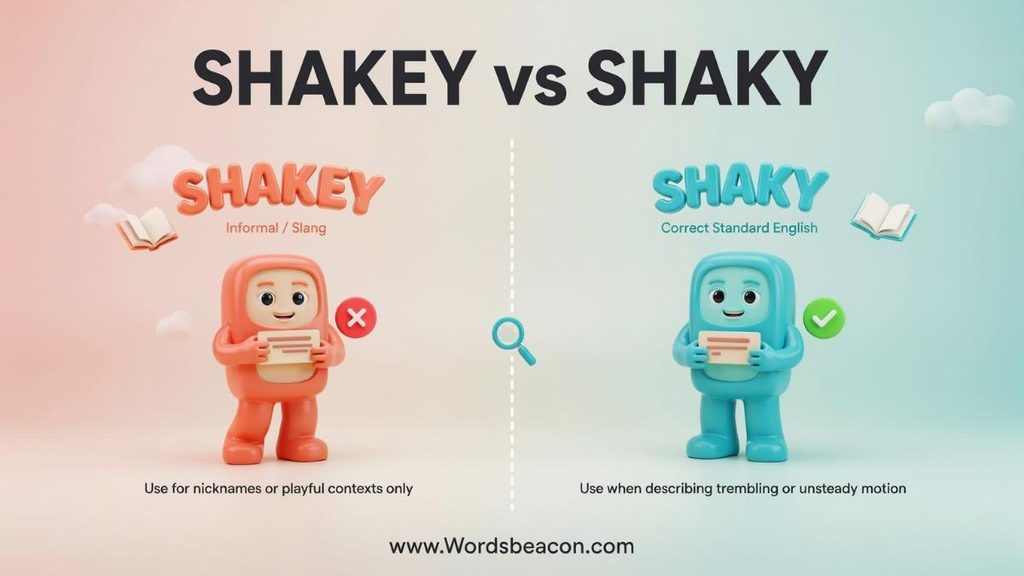
The Shaky ground” is the correct phrase. It can describe literal ground that feels unstable, but it also has a common figurative meaning: a situation in which someone lacks a secure position or strong evidence.
Literal Meaning of Shaky Ground
When the ground moves, shifts, or feels unsafe, you can describe it as shaky or unstable.
Examples:
- The hikers crossed a patch of shaky ground.
- The workers avoided the shaky ground near the damaged slope.
- The path felt unstable after several days of rain.
In practical situations, “unstable ground” may be more precise, particularly when describing a safety risk.
Figurative Meaning of Shaky Ground
The expression “on shaky ground” often means that a claim, relationship, decision, or position lacks support.
For example:
- His argument is on shaky ground because the facts don’t support it.
- The company is on shaky ground after losing several major clients.
- Their friendship was on shaky ground after the disagreement.
- The proposal is on shaky ground until the team confirms its budget.
In these sentences, “shaky” suggests uncertainty or weakness rather than physical movement.
Shaky Ground vs Shakey Ground
| Phrase | Correct usage | Example |
|---|---|---|
| Shaky ground | Standard English | The claim is on shaky ground. |
| Shakey ground | Nonstandard spelling | Avoid in ordinary writing. |
The same rule applies to “shaky evidence,” “shaky finances,” and “shaky relationships.” Use the spelling “shaky” whenever the word functions as the ordinary adjective.
Learn how to use confusing more words correctly
Excel vs Accel Which Spelling Is Correct?
Shaky Synonyms and Antonyms
Learning synonyms can help you use “shaky” more precisely. Although several words share its meaning, they don’t all fit every situation.
Common Synonyms for Shaky
| Synonym | Meaning | Example |
|---|---|---|
| Unsteady | Lacking balance or stability | She walked with unsteady steps. |
| Trembling | Shaking slightly or repeatedly | He spoke in a trembling voice. |
| Wobbly | Moving from side to side | The chair has a wobbly leg. |
| Unstable | Not firmly fixed or reliable | The ladder feels unstable. |
| Weak | Lacking strength or support | The proposal has a weak foundation. |
| Uncertain | Not definite or reliable | The project’s future remains uncertain. |
| Insecure | Not safe or firmly established | The structure has an insecure base. |
| Unsound | Not based on reliable reasoning or construction | The argument rests on unsound logic. |
Choose the synonym that best matches your intended meaning. For example, “trembling” works well for hands and voices, while “uncertain” may suit a plan or prediction.
Antonyms of Shaky
Antonyms express the opposite idea.
| Antonym | Meaning | Example |
|---|---|---|
| Steady | Firm and controlled | Keep your hand steady. |
| Stable | Not likely to shift or collapse | The platform is stable. |
| Secure | Safe and firmly established | The company has a secure financial base. |
| Firm | Solid and well supported | She gave a firm answer. |
| Reliable | Dependable and trustworthy | The report uses reliable evidence. |
| Certain | Known or definite | We have a certain date for the meeting. |
These alternatives can improve your writing by making your meaning more specific.
Learn how to use confusing more words correctly
Journeys vs journies Correct Spelling and usage ?
Grammar Rules for Shaky, Shakier, and Shakiest
One reason people confuse “shaky” and “shakey” is that English spelling rules can seem inconsistent. Fortunately, the correct forms are straightforward once you understand how the adjective works.
Why Is Shaky Spelled With a Y?
The word “shaky” comes from “shake” plus the suffix “-y.” When the suffix is added, the final silent “e” in “shake” is dropped.
The result is “shaky,” not “shakey.”
The word follows a familiar pattern in which a base word changes slightly before taking a suffix. This is why the spelling “shakey” may look plausible but isn’t the standard form.
Comparative Form: Shakier
Use “shakier” when comparing two people or things.
Examples:
- This table is shakier than the one in the kitchen.
- His explanation sounded shakier after the witnesses spoke.
- My handwriting gets shakier when I’m tired.
The final “y” changes to “i” before the comparative ending “-er.”
Superlative Form: Shakiest
Use “shakiest” when comparing three or more things or identifying the least stable option in a group.
Examples:
- That was the shakiest ladder in the garage.
- This is the shakiest part of the argument.
- Of all the teams, they had the shakiest start.
The final “y” changes to “i” before the superlative ending “-est.”
Related Word Forms
| Word | Part of speech | Example |
|---|---|---|
| Shaky | Adjective | The bridge looks shaky. |
| Shakier | Comparative adjective | This bridge looks shakier. |
| Shakiest | Superlative adjective | That is the shakiest bridge. |
| Shakily | Adverb | He walked shakily across the room. |
| Shakiness | Noun | The shakiness of the table worried us. |
| Shake | Verb | Don’t shake the bottle. |
These are standard forms. Avoid spellings such as “shakey,” “shakeyer,” “shakeyest,” or “shakeyly” when you intend the ordinary English word.
Shaky Pronunciation
“Shaky” is pronounced with two syllables and stress on the first syllable. Major English dictionaries give its pronunciation as /ˈʃeɪki/.
The spelling “shakey” is generally intended to sound the same, especially when it appears as an informal spelling or a name. However, pronunciation doesn’t determine whether a spelling is standard.
For example, “shaky hands” and “shakey hands” may sound alike when spoken, but only the first is standard for the adjective.
This is why checking the spelling matters even when both forms appear to sound correct.
Learn how to use confusing more words correctly
Drier vs Dryer Differences and Correct Usage ?
Shaky vs Shakey Example Sentences
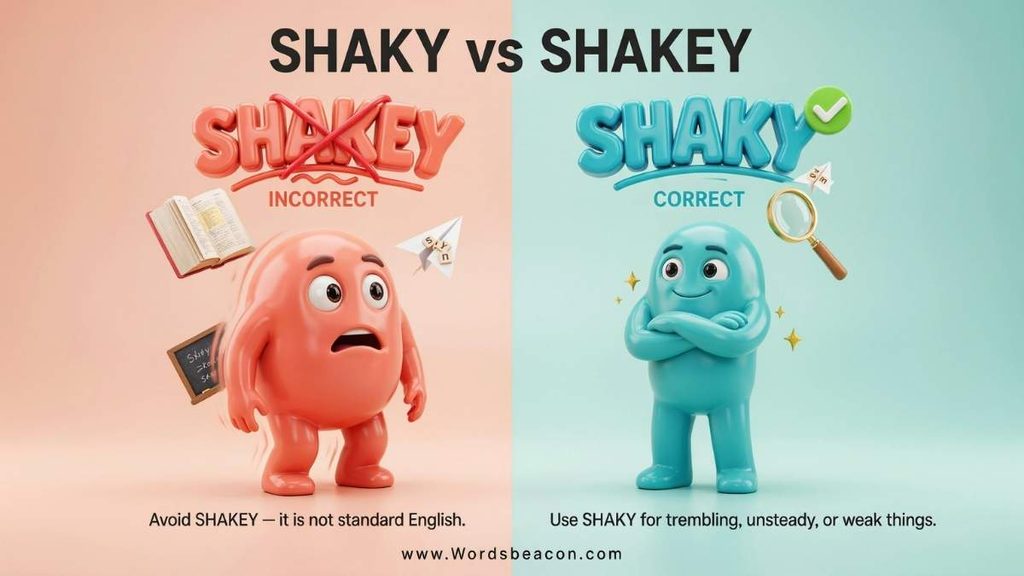
Examples make the difference easier to recognize. The sentences below show how to use “shaky” correctly and when “Shakey” may be appropriate as a name.
Correct Examples Using Shaky
- My hands felt shaky after the exhausting workout.
- The old wooden chair has a shaky leg.
- She gave a shaky answer because she wasn’t sure of the facts.
- His voice sounded shaky during the interview.
- The company is facing a shaky financial future.
- The evidence behind the claim seems shaky.
- I felt shaky before stepping onto the stage.
- The ladder looked shaky, so we found a safer one.
- Their relationship became shaky after several arguments.
- The team recovered from a shaky start and won the match.
Each sentence uses “shaky” as an adjective to describe trembling, instability, nervousness, or uncertainty.
Examples Using Shakey as a Name
- Shakey is the nickname of the main character.
- We met Shakey at the community event.
- The restaurant’s official name includes “Shakey’s.”
- Shakey posted a new video on his account.
In these examples, “Shakey” serves as a name or part of a proper title. It isn’t being used as the standard adjective.
Common Mistakes and Corrections
| Incorrect sentence | Correct sentence |
|---|---|
| My hands are shakey. | My hands are shaky. |
| The ladder looks shakey. | The ladder looks shaky. |
| His voice sounded shakey. | His voice sounded shaky. |
| The evidence is shakey. | The evidence is shaky. |
| Their financial position seems shakey. | Their financial position seems shaky. |
The correction is simple: replace “shakey” with “shaky” whenever you mean the ordinary adjective.
Learn how to use confusing more words correctly
Whiny vs Whiney Correct Spelling and How to Use Each
Shaky vs Shakey in American and British English
The standard spelling is “shaky” in both American and British English. The word doesn’t follow a regional spelling difference like “color” and “colour.” Instead, major dictionaries recognize “shaky” as the standard adjective across English varieties.
| English variety | Standard spelling | Example |
|---|---|---|
| American English | Shaky | I felt shaky after the ride. |
| British English | Shaky | The ladder looks shaky. |
| Canadian English | Shaky | His explanation sounded shaky. |
| Australian English | Shaky | The table is a little shaky. |
Although you may encounter “shakey” in informal writing, usernames, or names, that doesn’t make it a standard regional alternative.
For school assignments, workplace documents, articles, and other formal writing, use “shaky.”
How to Remember the Correct Spelling of Shaky
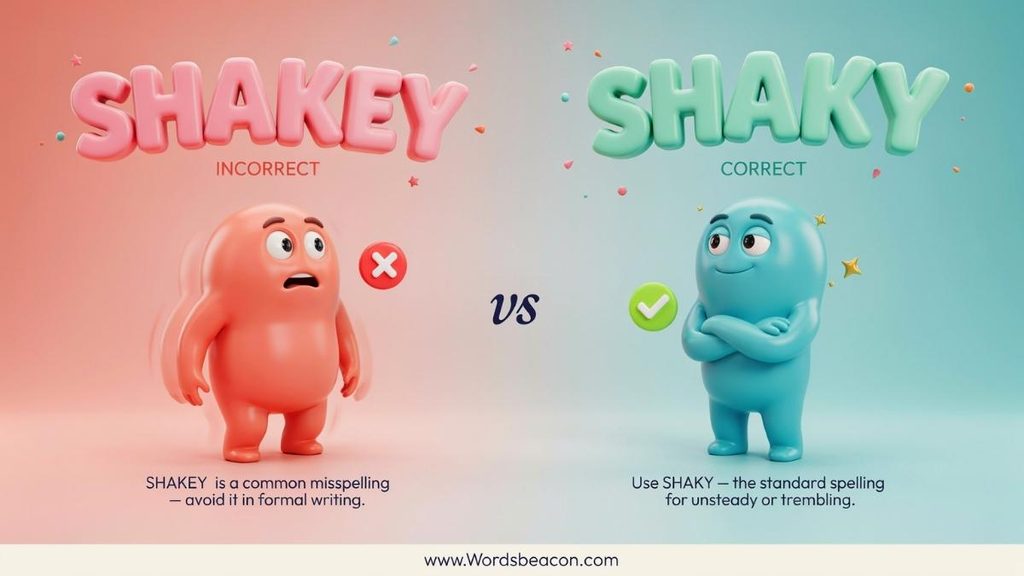
A simple memory trick can help you avoid the mistake.
Think of “shake” and “shaky.” When you add “-y,” the silent “e” disappears. You don’t need to keep it in the middle of the word.
Remember these related forms:
- Shake
- Shaky
- Shakier
- Shakiest
- Shakily
- Shakiness
The pattern becomes easier to recognize with practice. If you’re describing trembling hands, an unstable chair, or an uncertain plan, choose “shaky.” Save “Shakey” for names that officially use that spelling.
Learn how to use confusing more words correctly
Suing vs Sueing Which Spelling Is Correct?
practice session Shakey vs Shaky
Complete these sentences by choosing the correct word or word form. Pay attention to the difference between “shaky vs Shakey,” including their meanings and uses.
1. My hands felt ______ after the long workout.
2. The old wooden chair looks ______, so don’t sit on it.
3. ______ is the nickname of the main character in the story.
4. Her voice sounded ______ when she spoke in front of the audience.
5. The company is on ______ financial ground after losing several clients.
6. The correct standard spelling of the adjective is ______, not “shakey.”
7. The ladder was ______ than the one we used yesterday.
8. Of all the chairs in the room, this one is the ______.
9. He walked ______ across the narrow bridge.
10. The student gave a ______ answer because he wasn’t sure of the facts.
11. The phrase “______ hands” describes hands that tremble or move unsteadily.
12. The argument rests on ______ evidence that doesn’t support the claim.
13. The restaurant’s name is Shakey’s Pizza, so we should preserve the spelling of its ______ name.
14. The baby stood on his ______ legs for the first time.
15. After the frightening experience, she felt nervous and ______.
16. The comparative form of “shaky” is ______.
17. The superlative form of “shaky” is ______.
18. In both American and British English, the standard adjective is spelled ______.
19. The table wobbled whenever someone touched it, so we described it as ______.
20. “Shakiness” is a noun, while “shaky” is an ______.
Answers
- shaky
- shaky
- Shakey
- shaky
- shaky
- shaky
- shakier
- shakiest
- shakily
- shaky
- shaky
- shaky
- proper
- shaky
- shaky
- shakier
- shakiest
- shaky
- shaky
- adjective
Here’s a trusted source for clear word meanings:
FAQs
Is it spelled shaky vs shakey?
“Shaky” is the correct spelling of the adjective in standard English. It describes something that trembles, feels unstable, or lacks confidence. “Shakey” is generally a misspelling unless it appears in a proper name.
Is Shakey a real word?
“Shakey” appears in names, nicknames, and brand names, but it isn’t the standard spelling of the adjective. Use “shaky” when describing trembling hands, an unsteady object, or an uncertain situation.
What does shaky mean?
“Shaky” means trembling, unsteady, weak, or uncertain. For example, shaky hands may tremble, while a shaky argument may lack strong evidence.
What is another word for shaky?
Common synonyms for “shaky” include unsteady, wobbly, unstable, trembling, nervous, weak, and uncertain. Choose “wobbly” for something that moves unsteadily and “uncertain” for a doubtful decision or situation.
What is the opposite of shaky?
The opposite of “shaky” depends on the context. Common antonyms include steady, stable, firm, solid, secure, and confident. For example, a steady hand is the opposite of a shaky hand.
What does it mean to feel shaky?
Feeling shaky means experiencing trembling, weakness, nervousness, or physical unsteadiness. The phrase can describe a bodily sensation or emotional uncertainty. Its exact meaning depends on the context.
What is the difference between shaky and shaking?
“Shaky” is an adjective that describes an unsteady condition, while “shaking” usually refers to the action of trembling or moving rapidly back and forth. For example, “My hands feel shaky” describes their condition, whereas “My hands are shaking” describes their movement.
What are the comparative and superlative forms of shaky?
The comparative form is “shakier,” and the superlative form is “shakiest.” For example, “This table is shakier than the other one” compares two tables, while “This is the shakiest table in the room” identifies the least stable one.
Can Shakey be used in a name?
Yes. “Shakey” can be used in a person’s nickname, a fictional character’s name, or a business name. Proper names can have their own spellings, so retain “Shakey” when it is part of an established name.
What does shaky mean in slang?
In informal English, “shaky” can describe something doubtful, unreliable, or poorly supported. For example, “His excuse sounds shaky” means his explanation seems unconvincing. It can also describe a person’s uncertain confidence or performance.
Learn how to use confusing more words correctly
Conex vs Connex Which one Is actually Correct?
Conclusion
The difference between “shakey” and “shaky” is simple once you know the rule. “Shaky” is the correct spelling when you describe trembling hands, an unsteady chair, nervous feelings, or something unreliable. “Shakey” is usually incorrect in these contexts, but it can be correct when used in a name or brand. The easiest way to remember the difference is to stick with “shaky” whenever you’re describing how something feels or moves. You don’t need to shake your head over this spelling anymore! Choose the right word, keep your writing clear, and save “Shakey” for names that use that exact spelling. With this simple rule in mind, you can avoid the common mistake and write with confidence.

Luna AJS is an experienced blogger and dedicated language enthusiast at Words Beacon. She specializes in making English grammar, spelling, vocabulary and commonly confused words easy to understand. She provides clear explanations, practical examples to help readers write with confidence.