

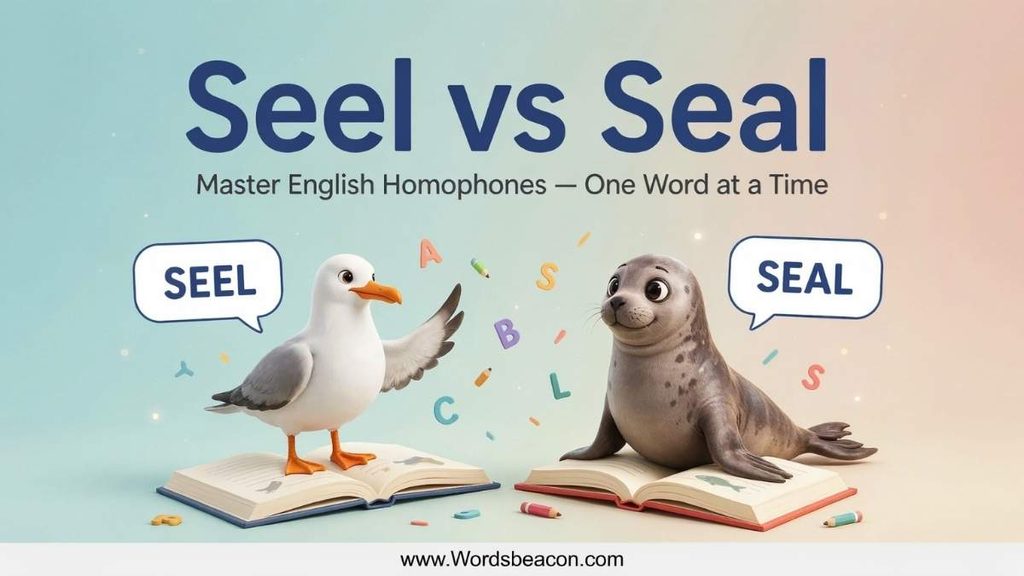
The words “Seel vs Seal” look almost identical, so it is easy to mix them up. However, they have very different meanings. If you are writing about closing an envelope, securing a package, or making an agreement final, seal is the word you need. Seel, on the other hand, is a rare historical word mainly connected with falconry. In the Seel vs Seal confusion, one word belongs in everyday English, while the other usually appears in old texts about hawks and falcons. That small spelling difference can cause a big grammar mistake. So, let’s clear up the confusion and see when to use each word correctly.
Quick Answer
Seal is the standard modern word used when you mean to close, secure, authenticate, or finalize something. It is also the word for the marine mammal.
Seel is a rare historical verb connected with falconry. It traditionally meant to stitch or sew the eyelids of a hawk or falcon closed.
| Word | Meaning | Modern Use | Example |
|---|---|---|---|
| Seal | Close, secure, authenticate, finalize, or a marine mammal | Very common | Please seal the envelope. |
| Seel | A historical falconry term involving a bird’s eyelids | Very rare | The text describes the old practice of seeling a falcon. |
Therefore, if you need the correct spelling of seal in ordinary writing, use seal.
Fix common more word mistakes in English
Truly vs Truely difference and usage?
Seal vs Seel The Main Difference
The main difference between seal and seel is their meaning and usage.
Seal works as both a noun and a verb. As a verb, it can mean to close something tightly or make something secure. You can seal an envelope, seal a package, seal a container, or create a waterproof seal around an opening.
Seal can also mean to make something final. For example, when someone seals the deal, they finalize an agreement.
As a noun, seal can describe a closure, an official mark, or a marine mammal. An official seal can authenticate a document, while a seal on a bottle can show whether it has been opened.
Seel has a much narrower history. It is mainly known as a historical falconry term. In older falconry practices, to seel a bird meant to stitch or sew its eyelids closed. Because this practice belongs to historical vocabulary, the word seel is rarely needed in modern communication.
That is why similar spelling does not mean similar usage.
What Does Seal Mean?
The seal definition changes slightly depending on how the word appears in a sentence.
Seal as a Verb
As a verb, seal often means to close something tightly or shut it securely.
For example:
“Please seal the envelope before mailing it.”
Here, seal means to close the envelope so it stays shut.
The word also appears when something needs protection from air, water, dust, or other substances. A container may have an airtight seal, while a window may need a waterproof seal to prevent rain from getting inside.
Seal can also describe making an agreement final.
“They signed the contract and sealed the deal.”
In this sentence, sealed does not mean that anyone physically closed anything. It means the agreement became final.
Seal as a Noun
As a noun, seal has several common meanings.
A seal can be a physical closure that keeps something shut. For example, a bottle may have a protective seal under its cap.
It can also be an official mark or emblem used to authenticate a document. Government offices, universities, courts, and other organizations may use an official seal to represent their authority.
A wax seal is another familiar example. Historically, people pressed a design into warm wax attached to a letter or document. The mark helped show authenticity and, in some cases, whether the document had been opened.
Seal also has a completely different meaning as a marine mammal.
“We saw a seal resting on the rocks.”
Here, seal refers to the ocean animal rather than a closure or official mark.
Understand confusing English more words simply
Humour vs Humor difference and usage?
What Does Seel Mean?

The seel definition is much more specialized.
Seel is an old verb associated with falconry. Historically, it referred to stitching or sewing the eyelids of a hawk or falcon closed.
The word appears in historical writing about falconry and older English vocabulary. Some dictionary sources also record broader archaic meanings related to closing or blinding the eyes.
Today, however, seel is a rare word. Most people will never need it in normal conversation or everyday writing.
That distinction is important. Seel is a real English word, but it is not another spelling of seal.
So, the correct spelling seel exists, but it is correct only when the context calls for that historical word.
Seel vs Seal Comparison
The easiest way to remember the difference is to connect each word with its usual context.
| Feature | Seal | Seel |
|---|---|---|
| Modern everyday word | Yes | No |
| Common noun | Yes | No |
| Common verb | Yes | Rare |
| Marine mammal | Yes | No |
| Official mark | Yes | No |
| Closing an envelope | Yes | No |
| Closing a package | Yes | No |
| Finalizing an agreement | Yes | No |
| Historical falconry | No | Yes |
| Connected with hawk or falcon eyelids | No | Yes |
The table makes the seal vs seel difference clear: seal belongs to modern everyday English, while seel mainly belongs to historical falconry vocabulary.
Understand confusing English more words simply
Grey vs Gray difference and usage?
Seal vs Seel Which One Should You Use?
When you are deciding between seal or seel, look at the meaning first.
If you mean to close an envelope, use seal.
“Please seal the envelope before you send it.”
If you mean to close or protect a package, use seal.
“The worker sealed the package carefully.”
If you mean to prevent air or water from passing through, use seal.
“The new gasket creates a watertight seal.”
If you mean to finalize an agreement, use seal.
“The final signature sealed the deal.”
If you mean the ocean animal, use seal.
“We watched a seal swimming near the shore.”
Only use seel when you are discussing its specific historical meaning, particularly in relation to falconry.
Seal an Envelope or Seel an Envelope?
The correct expression is seal an envelope.
An envelope needs to be closed securely, so seal is the standard modern verb.
Correct:
“Please seal the envelope before putting it in the mailbox.”
Incorrect:
“Please seel the envelope before putting it in the mailbox.”
This is one of the easiest ways to understand the seal or seel spelling difference. If something needs to be closed, sealed, or secured, seal is the word you want.
Seal the Deal or Seel the Deal?
The correct phrase is seal the deal.
For example:
“After several hours of discussion, both companies sealed the deal.”
The expression means to finalize an agreement or make an outcome certain.
Seel the deal is not standard English. Although seel is a genuine historical word, it does not belong in this modern expression.
So, if you are asking, “Is it seal or seel the deal?” the answer is clearly seal.
Learn the difference between confusing more English words
Gluing vs Glueing difference and usage?
Seal of Approval or Seel of Approval?
The correct expression is seal of approval.
A seal of approval means a clear sign of acceptance, support, or endorsement.
For example:
“The new design received the manager’s seal of approval.”
The word seal works here because the expression comes from the idea of an official mark or sign confirming something.
Seel of approval is incorrect in modern English.
Seal as a Marine Mammal
Seal also refers to a marine mammal that lives in and around the ocean.
Seals are members of the pinniped group, which also includes sea lions and walruses. They have bodies adapted for swimming and spend time both in water and on land or ice.
For example:
“We saw several seals near the coastline.”
This meaning has no connection with the historical word seel. If you are talking about an ocean animal, the correct word is seal.
Learn the difference between tricky more English words
Begun vs Began difference and usage?
The History Behind Seel
The history of seel explains why the word looks unusual today.
The word appears in older English and developed through historical forms connected with words for the eyelid. Its strongest surviving association is with falconry.
Historical falconers used the term when describing the practice of closing a bird’s eyelids with stitches. The purpose was connected with controlling and training birds of prey.
Because modern falconry and animal-care practices differ greatly from historical practices, this vocabulary is mostly encountered when people study older texts, literature, or the history of falconry.
This makes seel an interesting example of an archaic English word that still appears in dictionaries even though most modern speakers do not use it.
Seel vs Seal Pronunciation
Seal and seel can sound very similar, which makes the spelling confusion understandable.
Seal has the long e sound found in words such as feel and meal. Seel has a similar pronunciation in many English varieties.
Because the words can sound alike, pronunciation does not always help you choose the spelling.
Instead, think about the meaning.
If you hear someone say that they need to close an envelope, they mean seal. If an old historical text discusses a falconer and the bird’s eyelids, seel may be the intended word.
Context solves the problem when sound cannot.
Learn the difference between confusing more English words
Honor vs Honour difference and usage?
Common Mistakes With Seel and Seal
One common mistake is writing seel when the intended meaning is to close something.
“She seeled the package” is incorrect.
“She sealed the package” is correct.
Another mistake is treating seel as an alternative spelling of seal. It is not. Although both words appear in dictionaries, they have different meanings and different histories.
People also sometimes write seel in familiar expressions such as seel the deal or seel of approval. These forms are incorrect.
The standard expressions are seal the deal and seal of approval.
The key is simple: do not choose the word based only on how it sounds. Choose it based on what you mean.
Seel vs Seal in Sentences
Here are a few examples that show the difference naturally.
“Please seal the container tightly.”
“The package was sealed before shipping.”
“The company finally sealed the agreement.”
“The document carries an official seal.”
“The product received a seal of approval.”
“We saw a seal near the harbor.”
Now compare those with the rare historical use of seel:
“The historical text describes the practice of seeling a falcon’s eyelids.”
“The author explains seel as a term from traditional falconry.”
The modern examples overwhelmingly use seal because that is the word people normally need today.
How to Remember Seal vs Seel
A simple memory trick can save you from this spelling confusion.
Think of seal as the everyday word.
You seal an envelope. You seal a package. And You seal a container. You seal a deal. You can see a seal in the ocean. or You can also find an official seal on a document.
Think of seel as the historical falconry word.
If the sentence involves a hawk, falcon, eyelids, and old falconry terminology, seel may be appropriate.
Otherwise, seal is almost certainly the correct choice.
Learn how to use confusing more words correctly
Sergeant vs Sargeant difference and usage?
Why Does Seel Look Like a Spelling Mistake?
At first glance, seel looks like someone accidentally changed the spelling of seal. That is understandable because seal is a familiar word, while seel is rarely seen in modern writing.
However, seel is a genuine historical word. Its unusual appearance does not automatically make it incorrect.
The important thing is context. If a sentence discusses sealing a package, closing an envelope, approving an agreement, or a marine animal, seal is the correct choice.
On the other hand, if the sentence discusses traditional falconry and the historical practice involving a bird’s eyelids, seel may be correct.
So, do not correct seel simply because it looks unfamiliar. First, check what the sentence is actually describing.
Seel vs Seal in Historical Writing
Historical writing can contain words that sound strange to modern readers. Seel is one of them.
You may find the word in older literature, historical accounts, or texts describing traditional falconry. In those contexts, seel has a specific meaning connected with closing a bird’s eyelids.
Modern readers might expect the writer to have used seal, but that would change the meaning.
This is why context matters so much when reading older English. A word that looks unusual may be completely correct for the period or subject being discussed.
In everyday modern writing, however, seal remains the natural choice.
Seal Has More Uses Than You Might Expect
The word seal is useful because it can describe several completely different things without changing its spelling.
You can seal a letter by closing it securely. And You can seal a container to prevent air or liquid from getting through. You can also seal an agreement when you make it final.
Then there is the animal: a seal can be the marine mammal that spends time both in water and on land.
There is also the noun seal, which can refer to an official mark or symbol used to authenticate something.
So, although the meanings change, the spelling stays the same. That makes seal much more versatile than seel in modern English.
Seel vs Seal Look at the Word Around It
When two words cause confusion, the surrounding words often provide the answer.
Consider these examples:
Seal the envelope clearly refers to closing something.
Seal the agreement refers to making an agreement final.
A seal rested on the rocks refers to the marine animal.
However, seel a hawk’s eyelids points to the historical falconry term.
This simple context check can prevent many spelling mistakes. Instead of choosing a word because it looks familiar, look at what the sentence is trying to say.
Seeling and Sealing Are Not the Same
The difference becomes even more noticeable when these words take the -ing ending.
Sealing comes from the modern verb seal. You might talk about sealing a box, sealing a container, or sealing an agreement.
Seeling, however, comes from the historical verb seel. It appears in discussions of the old falconry practice.
The two forms may look almost identical, but they come from different words and carry different meanings.
Therefore, do not treat seeling as a strange spelling of sealing. The context should tell you which form belongs.
Learn how to use confusing more words correctly
Insite vs Insight difference and usage?
A Common Proofreading Mistake With Seel

Sometimes an unfamiliar word looks wrong simply because you do not see it often.
That can happen with seel. A writer may use the word correctly in a historical passage, but a reader might immediately change it to seal because seal is much more familiar.
That correction would not always be appropriate.
For example, if a historical text discusses traditional falconry, replacing seel with seal could remove the specific meaning the writer intended.
The better approach is simple: check the meaning before correcting the spelling.
This is a useful proofreading habit for any unfamiliar word, not just seel.
Why Is Seal Common but Seel Rare?
The two words have very different places in modern English.
Seal remains common because it has several everyday meanings. People regularly talk about sealing packages, sealing containers, sealing agreements, official seals, and marine seals.
Seel, however, has a much narrower historical use. Its connection with traditional falconry means most modern speakers have little reason to use it.
As a result, you are far more likely to encounter seal in an ordinary conversation, email, article, or school assignment.
That does not make seel incorrect. It simply makes it rare.
A Quick Context Test for Seel vs Seal
Still unsure which word to choose? Try this quick test.
1.If you can replace the word with close, secure, or finalize, use seal.
2.If you are talking about a marine mammal, use seal.
3.If you mean an official mark or symbol, use seal.
4.If you are describing the historical falconry practice involving a bird’s eyelids, use seel.
This test will handle most situations without making you stop and stare at the dictionary for five minutes.
Do Not Let an Unfamiliar Word Fool You
English has plenty of rare words that look unusual to modern readers. Seel is a good example.
Because seal is so familiar, your first instinct may be to assume that seel is simply misspelled. However, unusual does not always mean incorrect.
The real question is whether the word fits the context.
If you are writing about everyday actions, agreements, official marks, or marine animals, choose seal. If you are discussing historical falconry, seel may be exactly right.
Once you focus on meaning instead of appearance, the seel vs seal confusion becomes much easier to handle.
Learn the difference between tricky more English words
Advise vs Advice difference and Usage?
Practice Session Seel vs Seal
Fill in each blank with the correct form of “Seel vs Seal.”
- Please ______ the envelope before you put it in the mailbox.
- The factory worker checked the ______ on the container for damage.
- They finally ______ the deal after several hours of negotiation.
- We saw a young ______ swimming near the shore.
- The official document carries the government’s ______.
- Make sure you ______ the package securely before shipping it.
- The bottle needs a new ______ to prevent air from entering.
- The committee gave the project its ______ of approval.
- The plumber repaired the pipe and created a watertight ______.
- The historian explained the meaning of the old falconry term ______.
- The company ______ the agreement with both parties’ signatures.
- The old text describes how a falconer might ______ a bird’s eyelids.
- The broken window needs to be ______ to keep rainwater outside.
- The researchers observed a ______ resting on the rocks.
- The letter had an old-fashioned wax ______ attached to it.
- The technician replaced the damaged rubber ______ around the machine.
- The historical book uses ______ as a specialized falconry verb.
- She carefully ______ the box after placing the documents inside.
- The new lid provides a tight ______ that keeps the container closed.
- The company’s official ______ appeared at the bottom of the certificate.
- The final goal ______ the team’s victory.
- The historical passage discusses ______ a hawk’s eyelids during traditional falconry.
- Please ______ the container tightly so nothing leaks out.
- The children watched a ______ swimming beside the boat.
- The old manuscript contains several examples of ______ in historical falconry.
Answers
- seal
- seal
- sealed
- seal
- seal
- seal
- seal
- seal
- seal
- seel
- sealed
- seel
- sealed
- seal
- seal
- seal
- seel
- sealed
- seal
- seal
- sealed
- seeling
- seal
- seal
- seeling
Here’s a trusted source for clear more words Comparison:
FAQs
Can “seel” replace “seal” in modern English?
No. “Seel” is not an alternative spelling of the modern word “seal.” When you mean to close, secure, confirm, or authenticate something, “seal” is the correct choice.
When should I use “seel” instead of “seal”?
Use “seel” only when you are referring to its rare historical meaning, especially in falconry. The word describes the practice of sewing or stitching a hawk or falcon’s eyelids closed.
Why does “seel” appear in older texts?
“Seel” was once used as a specialized falconry term. As a result, you may come across it in older books, historical documents, or writings about traditional falconry.
Is “seel” used in everyday English?
Not usually. “Seel” is extremely rare in modern English. Unless you are discussing historical language or falconry, “seal” is almost certainly the word you need.
What does “seal” mean as a verb?
As a verb, “seal” means to close or secure something so it stays shut or protected. It can also mean to make an agreement final. For example, you can seal a package, seal an envelope, or seal an agreement.
Why is “seal” correct in “seal the deal”?
“Seal” means to make something final, secure, or official. Therefore, the correct expression is “seal the deal,” while “seel the deal” is incorrect.
Why do we say “seal of approval”?
A “seal of approval” is a sign that something has been officially accepted or approved. The correct spelling is “seal,” not “seel.”
Can “seel” mean to close something?
Only in its historical sense. In traditional falconry, “seel” referred to closing a bird’s eyelids by stitching them. However, it is not the modern verb used for closing packages, containers, envelopes, or other objects.
Is “seel” connected to the animal called a seal?
No. Although the words look and sound similar, they have different meanings and histories. “Seal” can refer to a marine mammal, while “seel” is mainly known as a historical falconry term.
Can “seal” be both a noun and a verb?
Yes. As a noun, “seal” can refer to a marine mammal, an official mark, or a closure. As a verb, it can mean to close, secure, or finalize something.
What does “seel” mean in historical falconry?
In historical falconry, “seel” means to stitch or sew the eyelids of a hawk or falcon closed. It is a specialized term associated with older falconry practices.
Why are “seel” and “seal” easy to confuse?
The words look and sound very similar, but their meanings are quite different. The bigger difference is usage: “seal” is common in modern English, while “seel” is rare and mostly historical.
Is “seel” suitable for formal writing?
Only when its historical meaning is relevant. In ordinary formal writing, use “seal” when you mean to close, secure, authenticate, or finalize something.
What is the easiest way to remember “seel” and “seal”?
Think of “seal” as the everyday word. You can seal an envelope, seal a package, or seal an agreement. Reserve “seel” for its rare historical falconry meaning.
Is “seeling” related to “seel”?
Yes. “Seeling” is the -ing form of the historical verb “seel.” It appears mainly in historical or specialized writing about falconry.
Can “seel” describe sealing a package?
No. When you close or secure a package, the correct word is “seal.” “Seel” does not work as an alternative spelling in this modern context.
Should I use “seal” for an envelope?
Yes. The correct phrase is “seal an envelope.” Using “seel an envelope” would be incorrect in modern standard English.
Should I use “seal” for an agreement?
Yes. When you make an agreement final, use “seal.” For example, “The two companies sealed the agreement.”
Does “seal” have more than one meaning?
Yes. “Seal” has several meanings. It can refer to a marine mammal, an official mark, a closure, or the act of closing, securing, or finalizing something.
Can “seel” be used in modern packaging or business language?
No. In modern contexts involving packaging, contracts, agreements, or business decisions, use “seal.” “Seel” belongs mainly to its historical meaning.
Is “seel” an alternative spelling in American English?
No. American English does not use “seel” as a standard alternative spelling of “seal.” The two words are separate terms with different meanings.
What should I write if I am unsure whether to use “seel” or “seal”?
In ordinary modern writing, choose “seal.” Use “seel” only when the context specifically refers to its historical falconry meaning. That simple rule will solve most cases of the confusion.
Learn the difference between tricky more English words
Accept vs Except difference and usage?
conclusion
The confusion between seel vs seal is easy to clear up once you know what each word means. In modern English, “seal” is the word you’ll use almost every time. You seal an envelope, seal a package, seal an agreement, or watch a seal swimming in the ocean.
“Seel,” on the other hand, is a rare historical word mainly connected with falconry. It referred to stitching a hawk or falcon’s eyelids closed. You won’t normally need it in everyday writing.
So, here’s the simple rule: use “seal” for modern English, and use “seel” only when the historical falconry meaning fits. One little letter can cause a surprising amount of confusion, but now you know exactly which word belongs where.

Luna AJS is an experienced blogger and dedicated language enthusiast at Words Beacon. She specializes in making English grammar, spelling, vocabulary and commonly confused words easy to understand. She provides clear explanations, practical examples to help readers write with confidence.