
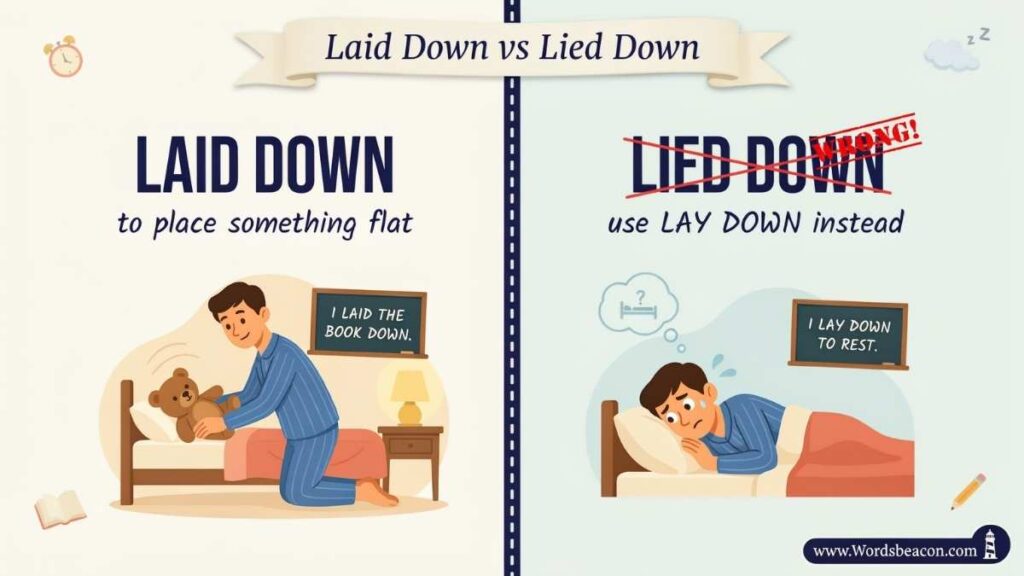
The words “laid” and “lied” look so similar that it is easy to mix them up, especially when talking about resting or lying down. However, they have completely different meanings. The confusion gets trickier because “lay” can be the past tense of “lie” when someone rests. “Laid” means someone placed something somewhere, while “lied” means someone told something untrue. So, “I lay down” is correct when you mean you rested, but “I laid the book down” means you placed the book somewhere. Once you understand these simple differences, Laid down vs lied down becomes much easier to use correctly. Laid down vs lied down no longer needs to be a grammar headache.
Quick Answer
| Phrase | Meaning | Example |
|---|---|---|
| Laid down | Put or placed something somewhere | She laid the book down. |
| Lied down | Incorrect when you mean rested or reclined | She lied down on the bed. |
| Lay down | Past tense of lie when someone rested or reclined | She lay down on the bed. |
So, if you mean that someone rested, use “lay down” for the past tense.
For example:
Yesterday, I lay down on the bed for an hour.
If you mean that someone placed something somewhere, use “laid down.”
For example:
I laid the keys down on the table.
The word “lied” belongs to a different verb altogether. It is the past tense of “lie” when “lie” means to tell a falsehood.
For example:
He lied about where he had been.
This small difference causes a surprisingly large amount of confusion. Once you separate the meanings, however, the pattern becomes much easier to remember.
Learn the difference between confusing more English words
Grey vs Gray difference and usage?
Laid Down Meaning
“Laid down” comes from the verb “lay,” which means to put or place something somewhere.
Unlike “lie,” “lay” normally needs a direct object. In simple terms, something has to be placed.
Consider this sentence:
She laid the baby down gently.
Here, “the baby” is the thing being placed in a lying position. That is why “laid” works.
You can also use it with ordinary objects:
He laid the phone down on the desk.
They laid the blanket down on the floor.
I laid the book down beside my chair.
In each example, someone places something somewhere. That is the key idea behind “laid down.”
The past tense and past participle of “lay” are both “laid.”
Lay → laid → laid
This makes “laid” fairly straightforward once you know which verb it belongs to.
Lied Down Meaning
This is where the confusion usually begins.
“Lied” is the past tense of “lie” when “lie” means to tell something untrue.
For example:
She lied to her parents.
He lied about the missing money.
They lied about what happened.
So, “lied down” does not mean that someone rested or reclined. The word “lied” tells the reader that someone told a falsehood.
That is why this sentence is incorrect if the intended meaning is resting:
I lied down on the bed.
The correct sentence is:
I lay down on the bed.
The difference is only one letter, yet the meaning changes completely. “Lay” describes the past action of reclining. “Lied” describes the past action of telling an untruth.
Why “I Lied Down” Is Incorrect
If you say, “I lied down,” most readers will recognize what you probably meant. Still, it is not the standard grammatical form for saying that you rested or reclined.
The mistake happens because English uses several forms of “lie” and “lay,” and their forms overlap in confusing ways.
For the meaning “recline or rest,” the verb forms are:
Lie → lay → lain
For example:
I lie down when I feel tired.
Yesterday, I lay down after lunch.
I have lain down for a few minutes.
Notice that “lay” is the past tense of “lie.” This is the part that often feels backwards.
For the meaning “put or place,” the forms are:
Lay → laid → laid
For example:
I lay the book on the desk.
Yesterday, I laid the book on the desk.
I have laid the book on the desk.
Then there is the completely separate meaning of “lie,” which means to tell a falsehood:
Lie → lied → lied
For example:
1.He lies when he is nervous.
2.He lied yesterday.
3.He has lied before.
Once these three patterns are separated, “laid” and “lied” become much easier to distinguish.
Lay Down vs Laid Down
The difference between “lay down” and “laid down” depends on the verb and the tense.
“Lay down” can mean two different things, which is one reason this topic causes so much trouble.
First, “lay down” can mean to put something somewhere:
1.Lay the book down.
2.Lay the clothes down on the chair.
3.Lay the baby down carefully.
Here, “lay” is the base or present form of the verb meaning “place.”
However, “lay down” can also be the past tense of “lie down”:
I lay down after work.
She lay down on the couch.
They lay down for a short rest.
In these sentences, “lay” means “reclined.” It is the past tense of “lie.”
Now compare that with “laid down”:
I laid the book down.
She laid the baby down.
They laid the blankets down.
Here, “laid” means that someone placed something somewhere.
The easiest question to ask is: Did someone place something, or did someone rest?
If something was placed, use “laid.”
If someone rested or reclined, use “lay” for the past tense.
Lie Down Past Tense
The past tense of “lie down” is “lay down.”
This is one of the most important rules to remember.
Present:
I lie down on the bed when I am tired.
Past:
I lay down on the bed yesterday.
Past participle:
I have lain down on the bed.
So, if someone asks, “What is the past tense of lie down?” the answer is “lay down.”
Not “lied down.”
For example:
I lie down every afternoon.
Yesterday, I lay down for a nap.
I have lain down for a while.
The word “lain” normally appears with a helping verb such as “have,” “has,” or “had.”
For example:
She had lain down before the phone rang.
He has lain down for a few minutes.
That pattern is different from “lied,” which means told a falsehood.
Lay Down Past Tense
The past tense of “lay down,” when “lay” means “place,” is “laid down.”
For example:
Present:
I lay the keys down on the table.
Past:
I laid the keys down on the table.
Past participle:
I have laid the keys down on the table.
Here, the object matters. “The keys” are being placed somewhere.
This gives you a useful comparison:
“I lay down” means I reclined.
“I laid the book down” means I placed the book somewhere.
Although the words look similar, the grammar behind them is different.
Learn the difference between confusing more English words
Seel vs Seal Difference and usage?
Is “I Laid Down” Grammatically Correct?
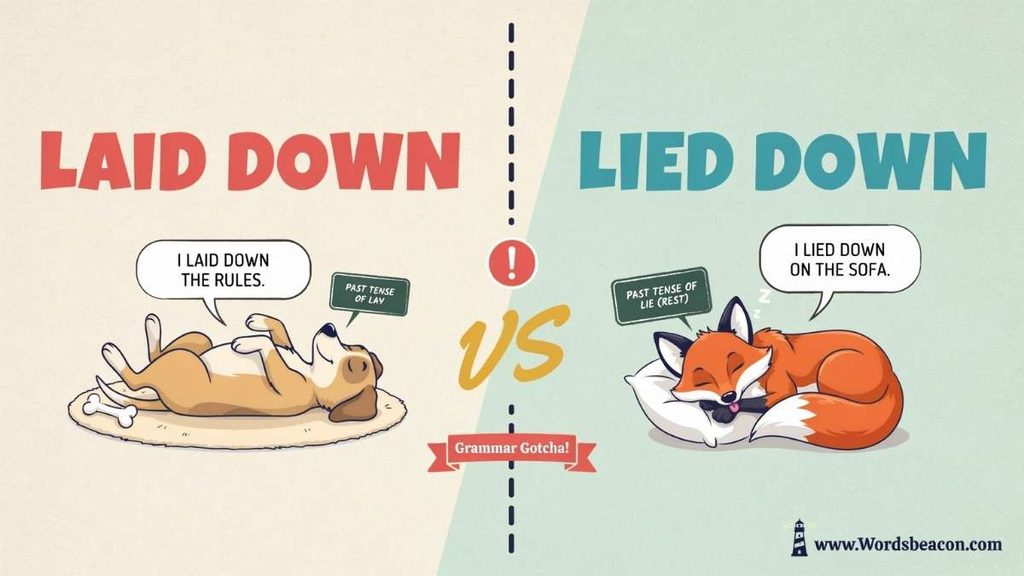
It can be grammatically correct, but the meaning matters.
If you say:
I laid down the book.
The sentence is correct because “the book” is the object being placed.
However, if you mean that you personally rested, this sentence is not standard:
I laid down on the bed.
In standard English, the natural form is:
I lay down on the bed.
The same distinction applies in many everyday situations.
She lay down on the couch.
She laid the pillow down on the couch.
In the first sentence, she reclined. In the second, she placed the pillow.
That small object rule can save you from most mistakes with “lay” and “lie.”
Can You Say “I Laid Down on the Bed”?
If you mean that you rested on the bed, standard English uses:
I lay down on the bed.
“I laid down on the bed” sounds natural to many speakers because people often use “lay” and “lie” interchangeably in casual speech. However, traditional standard grammar distinguishes them.
Compare these sentences:
I lay down on the bed.
I laid the blanket down on the bed.
The first describes your position or movement into a resting position. The second describes placing the blanket.
That is the distinction worth remembering.
Laid Down vs Lied Down?
Between “laid down” and “lied down,” neither is the correct choice when you simply mean that you rested.
The correct past-tense expression is “lay down.”
For example:
I lay down after dinner.
She lay down because she was tired.
We lay down on the grass.
“Lied down” is incorrect for this meaning because “lied” means told something untrue.
“Laid down” can be correct when an object is being placed:
He laid the book down.
She laid the baby down.
They laid the tools down.
So the three phrases have three different grammatical roles:
“Lay down” can mean recline in the past or place something in the present.
“Laid down” means placed something in the past.
“Lied down” does not mean reclined in standard English.
That is the central distinction. Once you understand it, the confusion becomes much less intimidating.
Learn the difference between confusing more English words
Truly vs Truely difference and usage?
Lie vs Lay The Basic Difference
The confusion between “lie” and “lay” becomes much easier when you focus on one simple question: Is someone resting, or is someone placing something?
“Lie” means to recline or rest. It does not normally take a direct object.
For example:
I lie down when I feel tired.
She likes to lie down after work.
The dog is lying on the floor.
On the other hand, “lay” means to put or place something somewhere. It normally takes an object.
For example:
I lay the book on the table.
She lays the blanket on the bed.
He laid his phone beside the chair.
The tricky part comes in the past tense. The past tense of “lie” is “lay.”
So you get this pattern:
Lie → lay → lain
Meanwhile, the verb “lay” follows this pattern:
Lay → laid → laid
That overlap explains why people sometimes write “I laid down” when they mean “I lay down.”
Lay vs Lie Down
When you want to describe someone moving into a resting position, use “lie down” in the present tense.
For example:
I need to lie down.
You should lie down and rest.
The child wants to lie down.
However, when you talk about the past, “lie” changes to “lay.”
For example:
I lay down after lunch.
She lay down for a few minutes.
He lay down on the couch.
This can feel strange because “lay” usually means “put something somewhere.” Nevertheless, in these sentences, “lay” is simply the past tense of “lie.”
Now compare:
I lie down every afternoon.
Yesterday, I lay down in my room.
I lay the book down every afternoon.
Yesterday, I laid the book down on the desk.
The first pair deals with resting. The second pair deals with placing something.
Laid vs Lay
The words “laid” and “lay” can both describe placing something, but they do not always appear in the same tense.
Consider:
I lay the keys on the table every evening.
I laid the keys on the table yesterday.
The first sentence describes a present or habitual action. The second describes a completed action in the past.
However, “lay” can also be the past tense of “lie”:
I lay down yesterday.
That is why you cannot decide whether “lay” is correct simply by looking at the word. You have to look at the meaning and the rest of the sentence.
If “lay” means “place,” it is the present form.
If “lay” means “recline,” it is the past form of “lie.”
That sounds complicated at first. In practice, the object usually gives you the clue.
The Object Rule
The object rule is one of the easiest ways to clear up this entire grammar problem.
If you are placing something, you need an object.
For example:
She laid the phone down.
He laid the papers on the desk.
I laid my jacket on the chair.
The phone, papers, and jacket are the things being placed.
If you are talking about yourself or another person resting, you do not need a direct object.
For example:
She lay down.
He lay on the couch.
I lay down on the bed.
The person is not placing an object. The person is reclining.
This gives you a quick mental check:
1.Someone lies down.
2.Someone lays something down.
3.Someone lay down yesterday.
4.Someone laid something down yesterday.
The word “something” is the giveaway. If something is being placed, “lay” or “laid” is usually the form you need.
Learn the difference between confusing word pairs
Gluing vs Glueing difference and usage?
Lay Down on the Bed vs Laid Down on the Bed

The phrase “on the bed” often makes this confusion even worse because both “lay” and “laid” can appear near it.
If you mean that you rested on the bed, say:
I lay down on the bed.
She lay down on the bed for a nap.
They lay down on the bed after a long day.
If you mean that you placed an object on the bed, use “laid”:
I laid the book down on the bed.
She laid her clothes down on the bed.
He laid the keys down on the bed.
Notice what changes. In the first group, the person rests. In the second group, someone places something.
So “lay down on the bed” and “laid down on the bed” are not interchangeable.
Lay Down in a Sentence
“Lay down” can appear in a sentence in more than one way because “lay” has two grammatical uses.
When it is the past tense of “lie,” it describes resting:
I lay down because I was exhausted.
She lay down for a quick nap.
We lay down on the grass and watched the clouds.
When it is the present form of “lay,” it describes placing something:
Lay the towel down here.
Please lay the papers down carefully.
Lay the baby down gently.
Context tells you which meaning applies.
For example, “I lay down” usually means “I reclined.” There is no object after “lay.”
However, “I lay the book down” means “I place the book down.” The word “book” acts as the object.
Laid Down in a Sentence
“Laid down” normally describes an action that happened in the past.
For example:
She laid the keys down on the counter.
He laid the jacket down beside the chair.
I laid the book down and walked away.
The phrase can also describe placing a person or animal in a particular position:
The nurse laid the patient down carefully.
The owner laid the injured dog down gently.
In each example, “laid” has an object. Someone or something is being placed.
There is another use of “laid down” that does not involve physically placing an object. The phrase can also mean established, stated, or formally introduced.
For example:
The company laid down new safety rules.
The agreement laid down clear conditions.
The teacher laid down the expectations for the class.
Here, “laid down” means something like “established” or “set out.” It still comes from the verb “lay,” not from “lie.”
Learn the difference between confusing word pairs
Accept vs Except difference and usage?
Why “Lied Down” Causes So Much Confusion
The phrase “lied down” seems logical because the present form is “lie down.” Many learners naturally expect the past tense to be “lied.”
That would be reasonable if English followed a regular pattern.
However, “lie” meaning “recline” is an irregular verb:
Lie → lay → lain
Therefore:
1.I lie down today.
2.I lay down yesterday.
3.I have lain down already.
The form “lied” belongs to a different meaning of “lie”:
Lie → lied → lied
For example:
He lied to me yesterday.
She lied about the situation.
They have lied before.
So, although both verbs are spelled “lie” in the present tense, they follow different patterns because they have different meanings.
That is one of those moments when English decides to make a simple idea unnecessarily interesting.
Common Mistakes With Laid and Lied
One of the most common mistakes is writing “I lied down” when you mean “I rested.”
Incorrect:
I lied down on the couch after work.
Correct:
I lay down on the couch after work.
Another common mistake is using “laid” without an object when “lie” is intended.
Incorrect in standard English:
I laid down because I was tired.
Correct:
I lay down because I was tired.
However, “laid” becomes correct when something is being placed:
I laid the blanket down because the floor was cold.
Another mistake involves the present tense:
Incorrect:
I lay down every night at ten.
If you mean a regular present action, use:
I lie down every night at ten.
The sentence “I lay down” is correct when “lay” is the past tense of “lie”:
I lay down at ten last night.
The time expression can often help you spot the correct form.
A Simple Tense Guide
For “lie” meaning to rest or recline, remember:
Present: lie
Past: lay
Past participle: lain
For example:
I lie down when I need to rest.
Yesterday, I lay down for an hour.
I had lain down before the guests arrived.
For “lay” meaning to place something, remember:
Present: lay
Past: laid
Past participle: laid
For example:
I lay the book on the desk.
Yesterday, I laid the book on the desk.
I have laid the book on the desk.
For “lie” meaning to tell a falsehood, remember:
Present: lie
Past: lied
Past participle: lied
For example:
1.He lies when he wants to avoid trouble.
2.He lied about his mistake.
3.He has lied several times.
Seeing these forms together makes the difference much easier to recognize.
Learn the difference between confusing word pairs
Begun vs Began difference and usage?
What Is the Difference Between Lie, Lay, and Lain?
“Lie,” “lay,” and “lain” belong to the same verb when the meaning is to recline or rest.
Lie is the present form.
Lay is the simple past form.
Lain is the past participle.
For example:
I lie on the couch when I am tired.
Yesterday, I lay on the couch.
I have lain on that couch many times.
The important point is that “lain” does not normally stand alone. It usually appears with a helping verb such as “has,” “have,” or “had.”
For example:
She has lain down.
He had lain down before the movie started.
They have lain on the beach all afternoon.
Using “lain” may sound formal in everyday conversation, but it remains the standard past participle of “lie” in this sense.
What Is the Difference Between Lie and Lied?
The difference between “lie” and “lied” depends on the meaning of the verb.
When “lie” means to recline, its forms are:
Lie → lay → lain
When “lie” means to tell something untrue, its forms are:
Lie → lied → lied
For example:
1.I lie down when I am tired.
2.I lay down yesterday.
3.I have lain down already.
Now compare:
1.I lie when I do not want to tell the truth.
2.I lied yesterday.
3.I have lied before.
The first group concerns physical position. The second concerns honesty.
That distinction makes “lied down” especially easy to reject when you mean resting. “Lied” carries the meaning of telling a falsehood.
A Real-Life Example
Imagine Jordan comes home after a long day at work. Jordan feels exhausted and decides to rest for a while.
Jordan says:
“I lay down on the couch for thirty minutes.”
That sentence is correct because Jordan is describing a past action of reclining.
Now imagine Jordan picks up a book and puts it on the coffee table.
Jordan says:
“I laid the book down on the table.”
That sentence is also correct because the book is being placed somewhere.
Later, a friend asks Jordan whether the book was already on the table. Jordan says:
“Yes, but I lied about putting it there.”
Here, “lied” means Jordan told a falsehood.
The three words now have completely different jobs:
Lay describes Jordan resting in the past.
Laid describes Jordan placing the book.
Lied describes Jordan telling something untrue.
Once you see the verbs in a normal situation, the difference becomes much easier to remember.
How to Choose the Correct Form
When you are unsure, do not rely on how the word sounds. Instead, identify the action first.
1.If someone is resting or reclining right now, use “lie.”
2.If someone rested or reclined in the past, use “lay.”
3.If someone has rested or reclined and you need the past participle, use “lain.”
4.If someone places something now, use “lay.”
5.If someone placed something in the past, use “laid.”
6.If someone tells a falsehood, use “lie” in the present and “lied” in the past.
This quick mental test works well:
Rest now → lie down.
Rested before → lay down.
Placed before → laid down.
Told a falsehood before → lied.
That is much safer than trying to memorize one isolated phrase.
A Quick Memory Trick
Think of “lie” as something your body does.
You lie down.
Think of “lay” as something your hands do to an object.
You lay the book down.
Then remember the past forms:
You lay down yesterday.
You laid the book down yesterday.
Finally, keep “lied” in its own little category. It has nothing to do with reclining.
You lied when you told something untrue.
A simple sentence can help:
“I lay down, I laid it down, but I never lied.”
It sounds a little dramatic for an ordinary grammar rule, but that is exactly why it is easy to remember.
Learn the difference between confusing word pairs
Advise vs Advice difference and Usage?
Everyday Examples of Lay, Laid, and Lied

These verbs appear in ordinary conversations all the time. The easiest way to understand them is to see how their meanings change from one sentence to another.
When someone rests, use “lie” in the present tense:
I need to lie down for a few minutes.
She wants to lie down after lunch.
The dog likes to lie down near the fireplace.
When the same action happened in the past, use “lay”:
I lay down after dinner.
She lay down on the couch yesterday.
The dog lay down beside me.
Now look at situations where someone places something:
I lay the remote on the table.
She lays the baby down carefully.
He laid his jacket on the chair.
Because the action happened in the past in the last example, “laid” is the correct form.
Finally, use “lied” when someone tells something that is not true:
He lied about the missing keys.
She lied to her friend.
They lied about what happened.
These examples show why context matters more than appearance. The words may look similar, but their meanings and grammatical roles are different.
Common Sentences You Can Use Correctly
Here are some natural sentences that show the difference clearly.
“I lay down on the bed.”
This means I rested or reclined on the bed in the past.
“I laid the blanket down on the bed.”
This means I placed the blanket on the bed.
1.“She lay down on the floor.”
2.She rested or reclined on the floor.
3.“She laid the book down on the floor.”
4.She placed the book on the floor.
5.“He lied to his parents.”
6.He told his parents something untrue.
7.“He lay down after talking to his parents.”
8.He rested after the conversation.
Notice how one letter can completely change the meaning. “Lay” describes reclining in the past, while “laid” describes placing something. “Lied” describes telling a falsehood.
Why “I Lay Down” Is Correct
Many people hesitate over “I lay down” because “lay” often appears with an object.
For example:
I lay the phone on the table.
However, “lay” also serves as the past tense of “lie.”
That gives us:
I lie down every night.
I lay down last night.
The first sentence describes a present or regular action. The second describes something that happened in the past.
Therefore, if you say:
“I lay down on the bed after work.”
You are using “lay” correctly.
You do not need an object after “lay” in this sentence because “lay” is functioning as the past tense of “lie.”
Why “I Laid Down” Can Be Confusing
The sentence “I laid down” may sound natural in casual conversation. However, standard grammar requires an object when “laid” comes from “lay” in the sense of placing something.
For example:
1.I laid the book down.
2.I laid my jacket down.
3.I laid the baby down.
Without an object, “I laid down” does not express the standard meaning of reclining.
If you mean that you rested, write:
I lay down.
This distinction becomes especially important in formal writing, schoolwork, professional communication, and edited content.
Learn the difference between basic English word mistakes
Insite vs Insight difference and usage?
Why “I Lied Down” Should Be Avoided
“I lied down” is one of the most common mistakes in this group.
The problem comes from treating “lie” as a regular verb. If it were regular, “lied” might seem like the obvious past form.
However, “lie” meaning “recline” is irregular:
Lie → lay → lain
Therefore:
1.I lie down now.
2.I lay down yesterday.
3.I have lain down already.
“Lied” belongs to another verb:
Lie → lied → lied
That verb means to tell a falsehood.
So:
I lied to my friend.
is correct.
But:
I lied down on the bed.
is not correct in standard English when you mean that you rested.
Lay Down vs Lie Down?
This question usually becomes easy once you identify the tense.
Use “lie down” when the action is happening now or describes a general habit:
I usually lie down after lunch.
Please lie down and rest.
The baby needs to lie down.
Use “lay down” when the same reclining action happened in the past:
I lay down after lunch.
She lay down for a short nap.
The baby lay down on the blanket.
However, use “lay down” in the present when you are telling someone to place something somewhere:
1.Lay the book down.
2.Lay the keys down here.
3.Lay the blanket down on the floor.
So “lay down” does not have one single meaning. Context determines whether it means “reclined in the past” or “place something.”
Learn the difference between basic English word mistakes
Sergeant vs Sargeant difference and usage?
Laid Down vs Lay Down?
The choice between “laid down” and “lay down” depends on both meaning and tense.
If “lay” means place, the present form is “lay”:
I lay the book down.
The past form is “laid”:
I laid the book down yesterday.
If “lie” means recline, the present form is “lie”:
I lie down every afternoon.
The past form is “lay”:
I lay down yesterday.
This creates the familiar pattern:
Present reclining → lie
Past reclining → lay
Present placing → lay
Past placing → laid
Past telling a falsehood → lied
Once you separate the meanings, the forms stop looking like one giant grammar puzzle.
A Useful Comparison
| Meaning | Present | Past | Past Participle |
|---|---|---|---|
| Recline or rest | lie | lay | lain |
| Put or place | lay | laid | laid |
| Tell a falsehood | lie | lied | lied |
This table is worth remembering because it explains almost every common mistake involving these words.
If you remember only one thing, remember this:
Lie down today.
Lay down yesterday.
Lay something down today.
Laid something down yesterday.
Lied when telling something untrue.
Learn the difference between basic English word mistakes
Honor vs Honour difference and usage?
Practice Session Laid Down vs Lied Down
Choose the correct word or phrase to complete each sentence. Laid Down vs Lied Down
- After a long day at work, I ______ on the couch for an hour.
- She ______ the book down on the table before leaving the room.
- He ______ about where he had spent the evening.
- The tired child ______ down for a nap after lunch.
- I ______ the blanket down on the bed.
- They ______ down on the grass and watched the clouds.
- Sarah ______ the keys down beside the phone.
- He ______ to his parents about the broken window.
- After dinner, we ______ down to rest.
- The teacher ______ the papers down on the desk.
- She ______ down on the sofa because she felt exhausted.
- Mark ______ the phone down and walked outside.
- He ______ about finishing his homework.
- I ______ down on the bed for a few minutes yesterday.
- The nurse ______ the patient down carefully.
- They ______ down after hiking for several hours.
- She ______ the baby down gently in the crib.
- He ______ to his friend about the missing money.
- I ______ the jacket down on the chair.
- After the movie, she ______ down for a short rest.
- The carpenter ______ the tools down on the floor.
- We ______ down on the beach after walking all morning.
- Tom ______ about what happened at school.
- I ______ the groceries down in the kitchen.
- After feeling tired, she ______ down on the bed.
Answers
- lay
- laid
- lied
- lay
- laid
- lay
- laid
- lied
- lay
- laid
- lay
- laid
- lied
- lay
- laid
- lay
- laid
- lied
- laid
- lay
- laid
- lay
- lied
- laid
- lay
Here’s a trusted source for clear more words Comparison:
FAQs
Why do people confuse “laid” and “lied”?
People often mix up “laid” and “lied” because the words look and sound similar. However, they have completely different meanings. “Laid” usually means placed something somewhere, while “lied” means told something that was not true.
What does “laid” mean in “laid the book down”?
In “laid the book down,” “laid” means placed the book somewhere. The book is the object receiving the action.
For example, “She laid the book down beside the lamp” means she placed the book beside the lamp.
What does “lied” mean when it is used by itself?
“Lied” is the past tense of “lie” when “lie” means to tell something untrue. It has nothing to do with resting or placing something.
For example, “He lied about the missing money” means he gave false information.
Why is “lied down” wrong when talking about resting?
“Lie,” when it means to recline or rest, is an irregular verb. Its forms are “lie,” “lay,” and “lain.” Therefore, the past tense of “lie down” is “lay down,” not “lied down.”
For example, “She lay down after dinner” is correct.
Can “laid down” describe a person?
Yes. “Laid down” can describe placing a person into a particular position.
For example, “The nurse laid the patient down carefully.”
Here, the patient is the object being placed. The sentence does not mean that the nurse rested.
Can “laid down” mean established?
Yes. “Laid down” can also mean established, stated, or formally set out.
For example, “The contract laid down several conditions.”
In this context, “laid down” has nothing to do with resting or lying on a surface.
How do I know whether “laid” or “lied” is right?
Think about the action first.
1.If someone placed something, use “laid.”
2.If someone told something untrue, use “lied.”
3.If someone rested in the past, use “lay.”
For example:
1.“I laid the phone on the table.”
2.“I lied about the phone.”
3.“I lay down after using the phone.”
What should I use when someone rests without an object?
Use “lie” for the present and “lay” for the past.
For example:
“I lie down when I feel tired.”
“I lay down after work.”
Because the person is resting rather than placing something, “lie” or “lay” is the appropriate verb.
How does the object rule help with lay and lie?
Ask whether something is being placed.
If an object receives the action, “lay” or “laid” is usually correct.
For example:
“I laid the phone on the table.”
If someone is simply reclining, use “lie” in the present or “lay” in the past.
For example:
“I lay on the couch yesterday.”
What is the correct form after “have” when someone has rested?
Use “lain.”
For example:
“I have lain down for a few minutes.”
The pattern for “lie” meaning to recline is:
Lie → lay → lain
Why can “lay” mean both “place” and “rested”?
English uses the same word in two different grammatical situations.
“Lay” can mean “place” in the present tense:
“I lay the keys on the table.”
It can also be the past tense of “lie” meaning “recline”:
“I lay down after lunch.”
The surrounding words and the meaning of the sentence tell you which use is intended.
Does “laid” usually need an object?
Yes. When “laid” means “placed,” it normally takes an object.
For example:
“She laid the keys down.”
“He laid the blanket on the floor.”
The keys and blanket are the things being placed.
Is “laid” also a past participle?
Yes. “Laid” is both the simple past and past participle of “lay” when it means “place.”
For example:
“She laid the book down yesterday.”
“She has laid the book down already.”
The form remains “laid” in both sentences.
Is “lied” ever the correct form of “lie”?
Yes. “Lied” is correct when “lie” means to tell a falsehood.
For example:
“He lied to his friend.”
“She lied about what happened.”
However, when “lie” means to recline, the past tense is “lay.”
How can I quickly check whether “lied” is correct?
Ask yourself whether the person told something untrue.
If the answer is yes, “lied” is probably the correct form.
For example:
“He lied to his friend.”
If you mean that he rested, “lied” is not correct. You would say:
“He lay down.”
What should I say instead of “I lied down for a nap”?
Say:
“I lay down for a nap.”
The action happened in the past, and “lay” is the past tense of “lie” when it means to recline.
What should I say instead of “I laid down because I was tired”?
If you mean that you rested, say:
“I lay down because I was tired.”
Use “laid” when you placed something:
“I laid the blanket down because the floor was cold.”
Can “lay” and “laid” appear in the same sentence?
Yes. They can have different meanings in the same sentence.
For example:
“I lay down after I laid the baby in the crib.”
The first “lay” means that I reclined. The second “laid” means that I placed the baby in the crib.
What is the easiest way to remember “laid” and “lied”?
Connect each word with its meaning.
“Lay” and “laid” can describe placing something.
“Lie” and “lay” can describe resting.
“Lied” means telling something untrue.
A simple memory sentence is:
“I lay down, I laid it down, and I lied about it.”
Each verb has a different job, which makes the difference easier to remember.
Are “laid” and “lied” pronounced the same way?
No. They have different pronunciations.
“Lied” rhymes with “tied,” while “laid” rhymes with “made.”
The different sounds can help you keep their meanings separate.
What is the main rule for laid down vs lied down?
“Layed down” is not the standard form for resting, and “lied down” is not correct when you mean reclined.
If someone rested in the past, use “lay down.”
“I lay down after work.”
If someone placed something, use “laid down.”
“I laid the book down.”
If someone told something untrue, use “lied.”
“I lied about the book.”
Once you connect each verb with its meaning, the confusion between laid down, lay down, and lied down becomes much easier to avoid.
Conclusion
Laid down vs lied down may look almost the same, but they do very different jobs. If you mean that someone rested or reclined, use lie down for the present and lay down for the past. If someone placed something somewhere, use lay or laid. And if someone told something that was not true, use lied. That is the key difference between laid down vs lied down.
The easiest way to remember Laid down vs lied down is simple: lie, lay, lain means resting; lay, laid, laid means placing; and lie, lied, lied means telling a falsehood. Once you connect each word with its meaning, the confusion becomes much easier to avoid. So, when you rested yesterday, say “I lay down.” When you placed the book somewhere, say “I laid it down.” Keep Laid down vs lied down clear in your mind, and save “lied” for those moments when the truth takes an unexpected vacation.

Luna AJS is an experienced blogger and dedicated language enthusiast at Words Beacon. She specializes in making English grammar, spelling, vocabulary and commonly confused words easy to understand. She provides clear explanations, practical examples to help readers write with confidence.