
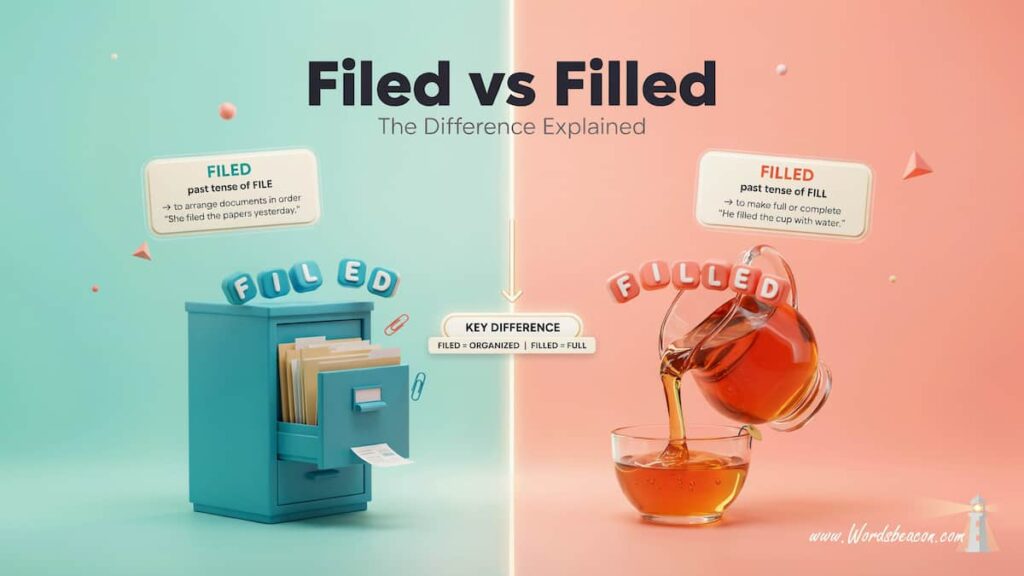
Filed vs filled may look like two versions of the same word, but they have very different meanings. That extra L isn’t just sitting there for decoration! You file a report, submit a complaint, or organize important documents, but you fill a glass with water, occupy an empty space, or fill out an application. Using the wrong word can quickly confuse your readers, especially in professional writing. So, how do you know which one belongs in your sentence? This guide explains filed vs filled with simple definitions, spelling rules, grammar tips, and practical examples to help you avoid common mistakes and write with confidence.
quick comparison
| Filed | Filled |
|---|---|
| Past tense of file | Past tense of fill |
| Means submitted, recorded, organized, or smoothed with a file | Means made full, occupied a space, or supplied information |
| Contains one L before -ed | Contains two Ls before -ed |
| Example: She filed the tax return. | Example: She filled the glass with water. |
| Pronounced /faɪld/ | Pronounced /fɪld/ |
Understand confusing English more words simply
Armor vs Armour Simple Spelling Differences Explained
Quick Answer Filed vs Filled
The main difference between filed and filled comes down to their root verbs.
- Filed is the past tense and past participle of file. It commonly means to submit an official document, organize information, record something, or smooth a surface with a tool.
- Filled is the past tense and past participle of fill. It means to make something full, occupy an empty space, or provide the information needed to complete a form.
For example:
- The accountant filed the company’s tax return before the deadline.
- The accountant filled the form with the required information.
Notice how both words can appear in an office setting. However, they describe different actions. The accountant submits the tax return but puts information into the form.
What Does Filed Mean?
Filed is the past tense and past participle of the verb file. It describes an action involving the submission, storage, organization, or official recording of information. It can also refer to using a tool called a file to smooth or shape an object.
In everyday English, you’ll often see filed in workplaces, legal documents, government offices, and administrative settings.
Common Meanings of Filed
The word filed has several meanings depending on the context.
1. Submitted an official document
When someone files a document, they formally sends it to an organization, authority, or office for consideration or recordkeeping.
Examples:
- She filed her tax return before April 15.
- The attorney filed a motion with the court.
- They filed an insurance claim after the accident.
- The company filed its annual report with the appropriate agency.
In each sentence, filed describes submitting something through an official process.
2. Organized or stored information
Filed can also mean placing documents or information in an organized system so someone can find them later.
Examples:
- The assistant filed the invoices by date.
- I filed the receipts in a separate folder.
- The employee filed the customer records alphabetically.
- She filed the paperwork in the correct cabinet.
Here, the word doesn’t mean submitting a document to an authority. Instead, it describes arranging and storing information.
3. Formally recorded something
In legal and administrative contexts, filed often refers to officially recording a document, complaint, charge, or other matter.
Examples:
- The police filed charges against the suspect.
- The family filed a formal complaint.
- The lawyer filed the divorce papers.
- The organization filed a report about the incident.
The exact procedure depends on the situation, but the central idea involves creating an official record.
4. Smoothed or shaped something with a tool
A file is also a tool with a rough surface used to smooth, shape, or remove material from an object. Therefore, filed can describe using that tool.
Examples:
- She filed her nails before the party.
- The technician filed the rough metal edges.
- He filed the wooden surface until it became smooth.
- The mechanic filed down the uneven edge.
Although this meaning appears less often in office writing, it’s still a correct use of filed.
Filed in Different Sentences
Here are more examples to help you recognize the word in different situations:
- The manager filed the employee’s performance report.
- We filed the documents after reviewing them.
- The journalist filed a story from the field.
- He filed a lawsuit against the company.
- The secretary filed the meeting notes in the shared folder.
As you can see, the meaning changes slightly with the context. Nevertheless, filed always comes from the verb file.
Understand confusing English more words simply
Behavior vs Behaviour difference and usage
What Does Filled Mean?
Filled is the past tense and past participle of the verb fill. It means making something full, occupying an empty space, or putting enough material or information into something.
You’ll commonly use filled when talking about containers, rooms, schedules, forms, positions, and spaces.
Five Common Uses and Examples
The word filled has several meanings in everyday English. Most commonly, it describes making something full, occupying an empty space, or adding information to a document. However, it can also refer to taking an available job position or causing someone to experience a particular emotion. Therefore, understanding its different uses will help you choose the right expression in everyday conversations and professional writing.
1. Filled Means Made Something Full
The most common meaning of filled is putting something into a container or space until it becomes full. In other words, it describes adding liquid, objects, or other materials to an empty or partly empty area.
For example:
- She filled the bottle with cold water.
- He filled the basket with fresh vegetables.
- They filled the tank before starting the journey.
- I filled my glass with orange juice.
In each example, something goes into an empty or partly empty space. As a result, the container holds more than it did before. You can use filled in similar situations involving bottles, boxes, bags, tanks, and other containers.
2. Filled Means Occupied a Space or Area
Another common use of filled describes people, objects, or things occupying a particular place. Instead of focusing on adding something to a container, this meaning emphasizes how something takes up space or spreads throughout an area.
For example:
- The audience filled the entire theater.
- Tourists filled the streets during the festival.
- Colorful flowers filled the garden.
- Smoke filled the kitchen after the food burned.
Here, filled explains how people or things occupied an area. For instance, the audience took up the available seats, while smoke spread throughout the kitchen. Similarly, you can use filled to describe a crowded room, a busy street, or a garden covered with flowers.
3. Filled Means Supplied Information on a Form
You can also use filled when someone writes the required information in a form, application, or document. In this context, the expressions filled out and filled in are especially common.
For example:
- She filled out the job application.
- I filled in the missing details.
- He filled out the registration form.
- They filled in their personal information.
In these examples, filled describes entering information into the appropriate spaces. However, there’s a small difference worth remembering: filled out commonly refers to completing an entire form, while filled in often refers to adding missing details or information in specific spaces.
Therefore, expressions such as filled out a form and filled in the details sound more natural than simply saying filled a form.
4. Filled Means Occupied a Job or Position
Filled can also describe assigning someone to an available job, role, or vacancy. In other words, when an organization hires someone for an open position, it fills that position.
For example:
- The company filled the vacant position.
- The school filled all the teaching vacancies.
- They filled the opening with an experienced candidate.
- The manager filled the position after several interviews.
In these sentences, filled means that an available role no longer remains vacant. For example, when a company hires a new employee, the position becomes filled rather than remaining open. Similarly, a school fills its teaching vacancies by hiring qualified teachers.
5. Filled Means Caused Someone to Experience an Emotion
Besides describing physical spaces and completed forms, filled can also express strong emotions or feelings. In this use, it often appears in the expression filled with, which describes an emotion someone experiences because of a particular event, action, or situation.
For example:
- The news filled her with happiness.
- His unexpected behavior filled me with worry.
- The achievement filled the family with pride.
- The sudden noise filled the children with fear.
Here, filled describes how a particular experience caused someone to feel an emotion. For instance, good news can fill someone with happiness, while an unexpected problem can fill someone with worry. Similarly, you can use this expression to describe excitement, confidence, sadness, or relief.
More Examples of Filled in Everyday Sentences
Now that you’ve explored the five common uses, let’s look at a few more examples. These sentences show how naturally filled appears in everyday situations and different writing contexts.
- She filled the pitcher with fresh lemonade.
- The children filled their bags with toys.
- The new furniture filled the empty room.
- He filled every blank with the correct answer.
- The restaurant filled up quickly on Saturday evening.
As these examples show, filled usually involves making something full, occupying an area, or adding something to an available space. However, its exact meaning depends on the words around it. Therefore, always consider the context before choosing the word.
Key Differences Between Filed vs Filled
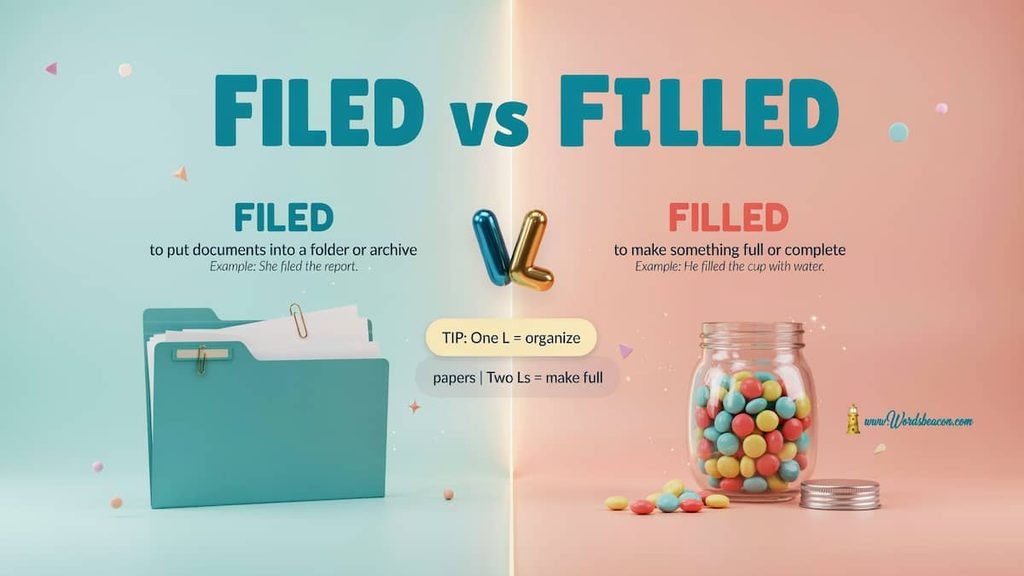
Although filed and filled look similar, their meanings, spelling patterns, and grammatical uses are different. Understanding these distinctions will help you choose the correct word without second-guessing yourself.
| Difference | Filed | Filled |
|---|---|---|
| Root verb | File | Fill |
| Word type | Past tense and past participle | Past tense and past participle |
| Main meaning | Submitted, recorded, or organized | Made full or occupied |
| Spelling | One L before -ed | Two Ls before -ed |
| Pronunciation | /faɪld/ | /fɪld/ |
| Common expressions | Filed a report, filed a claim, filed away | Filled a bottle, filled out a form, filled a vacancy |
| Example | He filed the complaint. | He filled out the complaint form. |
Difference in Meaning
The clearest difference is what each word describes.
Filed usually involves documents, records, official submissions, or using a tool to smooth an object. Filled, on the other hand, describes adding something to an empty space or making something complete.
For example:
- She filed the documents in the cabinet.
- She filled the cabinet with documents.
The first sentence describes organizing documents in a cabinet. The second explains that documents occupied the cabinet.
Difference in Spelling
The spelling difference comes from the original verbs.
- File becomes filed.
- Fill becomes filled.
When you add -ed to file, you remove the silent final e and add -ed. However, fill already ends in two Ls, so those letters remain when you add -ed.
Therefore, filed has one L before the ending, while filled has two.
Difference in Pronunciation
These words also have different vowel sounds.
- Filed rhymes with mild, child, and wild.
- Filled rhymes with build, killed, and skilled.
The vowel sound in filed is the long i sound /aɪ/. In filled, it’s the short i sound /ɪ/.
Although the final consonant sounds similar, the vowel makes the difference clear.
Emigrate vs Immigrate Difference and usage
Filed vs Filled Which One Is Correct?
Both words are correct English spellings. However, they aren’t interchangeable because they come from different verbs and express different actions.
Use filed when you mean submitted, recorded, organized, or smoothed something with a file.
Use filled when you mean made something full, occupied a space, completed a form, or supplied information.
Consider these examples:
- Correct: The lawyer filed the legal documents.
- Correct: The assistant filled out the application.
- Incorrect: The lawyer filled the legal documents with the court.
- Incorrect: The assistant filed out the application.
The last two sentences confuse the actions. You file documents with an authority, but you fill out a form by providing information.
The best way to choose is to focus on the intended meaning rather than how the words look.
Filed vs Filled Examples in Everyday English
Examples make confusing words easier to understand. So, let’s compare filed and filled in sentences you’ll commonly encounter at work, school, home, and in everyday communication.
Examples of Filed
- She filed her tax return before the deadline.
- The attorney filed a motion with the court.
- I filed the receipts in the appropriate folder.
- The company filed a complaint against the supplier.
- He filed the documents according to their dates.
- The journalist filed a report about the event.
- They filed an insurance claim after the accident.
- The secretary filed the meeting minutes.
- She filed her nails before applying polish.
- The organization filed its annual paperwork.
Examples of Filled
- She filled the glass with fresh water.
- He filled the application with accurate information.
- The children filled the room with laughter.
- We filled the empty boxes with books.
- The company filled the vacant position.
- She filled out the registration form.
- The heavy rain filled the streets with water.
- They filled the shelves with new products.
- His words filled her with confidence.
- The audience filled the auditorium.
Filed vs Filled in Side-by-Side Sentences
| Filed | Filled |
|---|---|
| She filed the report with the office. | She filled the report with useful details. |
| He filed the papers in a cabinet. | He filled the cabinet with papers. |
| The lawyer filed a complaint. | The customer filled out a complaint form. |
| The company filed its tax return. | The accountant filled in the missing figures. |
| She filed her nails. | She filled the container with water. |
Notice that the same nouns can sometimes appear with both words. However, the action changes according to the verb.
Understand confusing English more words simply
Realize vs Realise Which Spelling Is Correct?
Common Expressions With Filed and Filled
Some expressions make the difference between these words even clearer. In particular, certain combinations are standard in English, while others sound unnatural or communicate the wrong meaning.
Filed a Form vs Filled Out a Form
Both expressions can be correct, but they describe different steps.
- Filed a form means submitted it to an organization or authority.
- Filled out a form means entered the required information into it.
Examples:
- She filled out the application and checked every answer.
- He filed the completed application with the admissions office.
First, you fill out the form. Afterward, you may file or submit it.
Filed a Complaint vs Filled Out a Complaint Form
These expressions also have different meanings.
- Filed a complaint means formally submitted or registered a complaint.
- Filled out a complaint form means completed the form by entering the required details.
Examples:
- The customer filed a complaint about the damaged product.
- The customer filled out a complaint form at the service desk.
Therefore, use filed when referring to the formal complaint and filled out when referring to completing its paperwork.
Filed Documents vs Filled Documents
The difference depends on the action.
- Filed documents are documents that someone has organized, stored, or officially submitted.
- Filled documents usually refers to documents containing information or completed sections.
Examples:
- The assistant filed the documents in alphabetical order.
- The employee returned the filled documents to the manager.
However, when you mean that someone completed a form, filled-out documents may sound more natural.
Filed for Bankruptcy vs Filled for Bankruptcy
The correct expression is filed for bankruptcy.
Examples:
- The business filed for bankruptcy after several years of financial problems.
- The company filed for bankruptcy protection.
- He filed for bankruptcy after reviewing his financial situation.
Filled for bankruptcy is incorrect because filled doesn’t express the act of making an official legal filing.
Filed Away vs Filled Up
These are two different expressions.
- Filed away means stored or organized something for future reference.
- Filled up means made something full or became full.
Examples:
- She filed away the old contracts.
- We filled up the water bottles before leaving.
The expressions aren’t interchangeable, even though both can involve organizing or handling objects.
Learn how to use confusing more words correctly
Complement vs Compliment Difference and Correct Usage
Common Mistakes When Using Filed and Filled
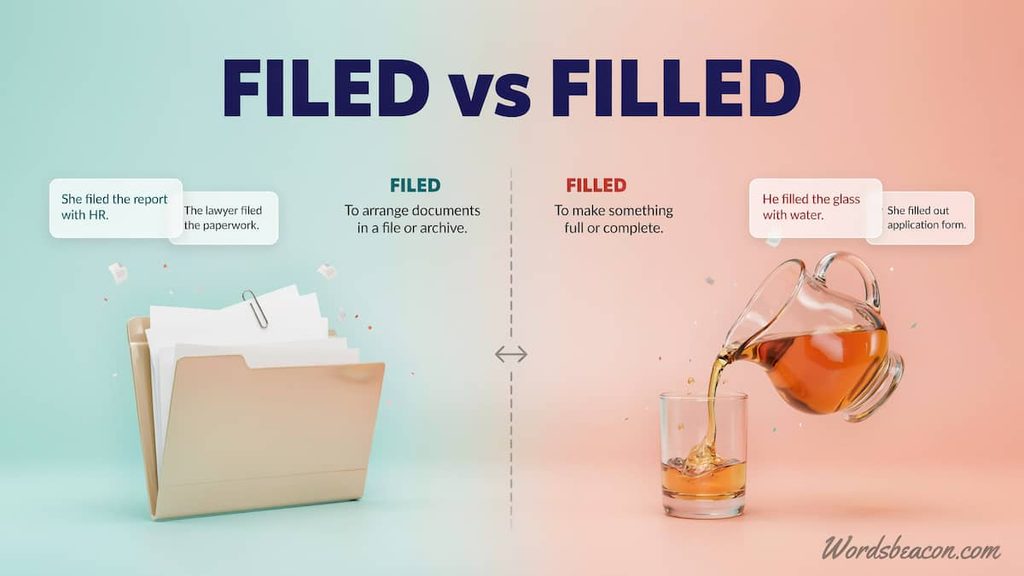
Because these words differ by only one letter, writers sometimes use the wrong form without noticing. Fortunately, a few simple corrections can prevent most mistakes.
Using Filled Instead of Filed
Incorrect: The attorney filled a lawsuit against the company.
Correct: The attorney filed a lawsuit against the company.
Why? A lawsuit is formally submitted or initiated through a legal process. Therefore, filed is the appropriate verb.
Using Filed Instead of Filled
Incorrect: She filed the glass with water.
Correct: She filled the glass with water.
Why? The sentence describes putting water into a glass. Since the action makes the glass full, filled is correct.
Confusing Filled Out With Filed
Incorrect: He filed out the registration form.
Correct: He filled out the registration form.
Why? Filled out means completed the form by providing the requested information. Filed out isn’t the standard expression for this action.
Confusing Filed With Filled in Office Writing
Incorrect: The assistant filled the invoices in the cabinet.
Correct: The assistant filed the invoices in the cabinet.
Why? The assistant organized and stored the invoices. Therefore, filed expresses the intended action.
Using Filled for an Official Submission
Incorrect: The company filled its tax return with the government.
Correct: The company filed its tax return with the government.
Why? Filing a tax return means officially submitting it. Filling out the return refers to entering the required information.
Grammar Rules for Filed vs Filled
Both words function as the past tense and past participle of their root verbs. However, their spelling patterns and sentence structures follow different rules.
Filed as a Past Tense and Past Participle
Filed comes from the verb file.
| Verb Form | Example |
|---|---|
| Base form | File the documents. |
| Third-person singular | She files the documents. |
| Past tense | She filed the documents. |
| Past participle | She has filed the documents. |
| -ing form | She is filing the documents. |
You can use filed in simple past sentences or with helping verbs such as has, have, and had.
Examples:
- I filed the paperwork yesterday.
- She has filed the required documents.
- They had filed the complaint before the meeting.
- The company is filing its annual report.
Filled as a Past Tense and Past Participle
Filled comes from the verb fill.
| Verb Form | Example |
|---|---|
| Base form | Fill the container. |
| Third-person singular | He fills the container. |
| Past tense | He filled the container. |
| Past participle | He has filled the container. |
| -ing form | He is filling the container. |
Similarly, filled can appear in simple past sentences and perfect tenses.
Examples:
- She filled the bottle yesterday.
- He has filled out the application.
- They had filled the room before the guests arrived.
- The staff is filling the shelves.
Common Prepositions and Expressions
Both verbs appear in common expressions, but the words that follow them can change their meaning.
| Expression | Meaning | Example |
|---|---|---|
| Filed with | Submitted to an authority or organization | She filed the report with the agency. |
| Filed under | Stored or categorized in a particular section | The papers were filed under her name. |
| Filed away | Stored for future reference | He filed away the old records. |
| Filed for | Formally requested or initiated something | They filed for bankruptcy. |
| Filled with | Made full of something | The room was filled with flowers. |
| Filled in | Completed missing information | She filled in the missing details. |
| Filled out | Completed a form | He filled out the application. |
| Filled up | Made or became completely full | The tank filled up quickly. |
These expressions are useful because they show how context determines the correct word.
Learn how to use confusing more words correctly
Ingage vs Engage Which Spelling Is Correct ?
Filed vs Filled in Professional and Everyday Contexts
Although both words appear in everyday communication, they often serve different purposes in professional settings.
In Offices and Workplaces
At work, filed usually describes organizing records, submitting reports, or maintaining official documents.
Examples:
- The assistant filed the invoices.
- The manager filed a formal complaint.
- The accountant filed the financial report.
Filled, meanwhile, describes completing paperwork, occupying positions, or adding information.
Examples:
- The employee filled out the expense form.
- The manager filled the vacant position.
- The assistant filled the spreadsheet with updated figures.
In Schools and Education
Students and teachers can use both words when discussing academic paperwork.
Examples with filed:
- The teacher filed the examination records.
- The student filed a formal appeal.
- The school filed the required documents.
Examples with filled:
- The student filled out the admission form.
- The teacher filled the board with examples.
- The children filled their notebooks with notes.
In Legal and Administrative Settings
Filed is especially common when discussing official legal procedures.
Examples:
- The lawyer filed a motion.
- The court filed the documents in its records.
- The employee filed a formal grievance.
Filled is more likely when someone completes a document or provides information.
Examples:
- The applicant filled out the legal form.
- The officer filled in the missing details.
- The employee filled the application with accurate information.
In Everyday Life
You don’t need to work in an office to use these words correctly.
Examples with filed:
- I filed the receipts after shopping.
- She filed her nails before dinner.
- He filed the documents in a drawer.
Examples with filled:
- I filled the kettle with water.
- She filled the basket with groceries.
- They filled the room with decorations.
Fix common more word mistakes in English
Theater vs Theatre Which Spelling Is Correct?
A Simple Workplace Example Filed vs Filled
Imagine an office employee named Sarah who needs to prepare and submit a monthly expense report.
First, Sarah fills out the expense form by entering the costs, dates, and payment details. Next, she checks the information to make sure everything is correct. Finally, she files the completed report with the accounting department.
Each word describes a different action:
- Filled out: Sarah entered the required information.
- Filed: Sarah submitted the completed report.
If Sarah says, “I filed out the report,” she’s using the wrong expression. Likewise, “I filled the report with the accounting department” doesn’t clearly communicate that she submitted it.
This example shows why understanding the meaning matters more than simply memorizing the spelling.
Easy Ways to Remember Filed vs Filled
If you still find these words confusing, try these simple memory tips.
Remember File and Filed
Think about a file folder. You put documents in a folder to organize and store them. You can also file a document with an office or authority.
For example:
- I filed the documents in the folder.
- She filed a complaint with the manager.
The word filed has one L before -ed because its root verb is file.
Remember Fill and Filled
Think about filling a glass with water. You add something until the container becomes full.
For example:
- He filled the glass with juice.
- She filled the empty box with books.
The word filled keeps the double L from its root verb, fill.
Use the Meaning Test
Before choosing either word, ask yourself one question:
Am I submitting or organizing something, or am I making something full?
- If you’re submitting, recording, or organizing something, use filed.
- If you’re making something full or completing a space or form, use filled.
This quick test works in most everyday situations.
Fix common more word mistakes in English
Career vs Carrer Correct Spelling and Difference
File vs Fill Understanding the Root Words
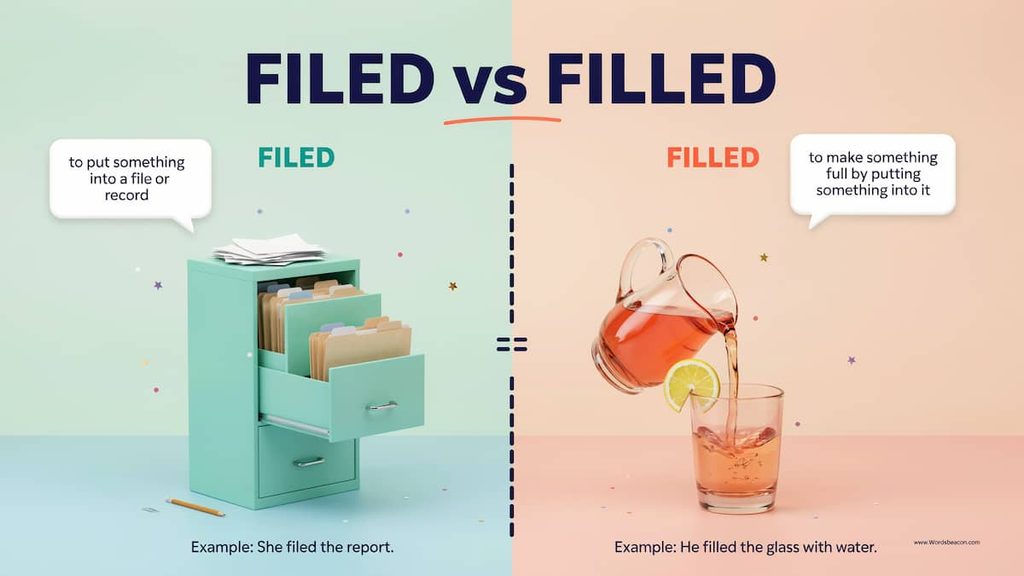
To understand filed vs filled completely, it helps to look at their original verbs.
File
File is a verb that can mean to submit, organize, record, or smooth something with a tool. It also functions as a noun referring to a folder, collection of information, or tool.
Related forms include:
- File: Please file the documents.
- Files: She files the reports every week.
- Filed: They filed the complaint yesterday.
- Filing: He is filing the paperwork.
Fill
Fill is a verb that means to make something full, occupy a space, or provide information. It can also function as a noun in certain expressions.
Related forms include:
- Fill: Please fill the container.
- Fills: Water fills the tank.
- Filled: She filled the bottle.
- Filling: He is filling the application.
Filing vs Filling
Filing and filling are the -ing forms of file and fill.
However, they describe different activities.
| Filing | Filling |
|---|---|
| Organizing or submitting documents | Making something full |
| Filing a complaint | Filling a container |
| Filing tax returns | Filling out a form |
| Filing documents away | Filling a vacant position |
For example:
- Filing the documents took an hour.
- Filling the boxes took an hour.
The first sentence describes organizing paperwork. The second describes putting things into boxes.
Learn the difference between tricky more English words
Focusing vs Focussing Which Spelling Is Correct ?
Practice session Filed vs Filled
Now that you’ve learned the meanings, grammar rules, and examples, test your understanding. Choose filed vs filled for each sentence.
- She ______ the water bottle before leaving home.
- The lawyer ______ a complaint with the court.
- He ______ out the application carefully.
- The assistant ______ the documents in alphabetical order.
- They ______ the empty room with furniture.
- The company ______ its annual tax return.
- The children ______ their bags with toys.
- The manager ______ the vacant position.
- She ______ her nails before the wedding.
- I ______ in the missing information.
- The journalist ______ a report about the accident.
- He ______ the glass with fresh lemonade.
- The employee ______ the receipts in a folder.
- The police ______ charges against the suspect.
- The audience ______ the entire auditorium.
- She ______ away the old paperwork.
- The accountant ______ out the financial form.
- The heavy rain ______ the streets with water.
- The company ______ a lawsuit against its former partner.
- He ______ the container to the top.
Answers
- Filled
- Filed
- Filled
- Filed
- Filled
- Filed
- Filled
- Filled
- Filed
- Filled
- Filed
- Filled
- Filed
- Filed
- Filled
- Filed
- Filled
- Filled
- Filed
- Filled
Here’s a trusted source for clear word meanings:
FAQs
What Is the Difference Between Filed vs Filled?
Filed is the past tense of file and usually means submitted, recorded, or organized something. Filled is the past tense of fill and means made something full or completed a space with information. For example, you file a report but fill out a form.
Which Is Correct Filed vs Filled?
Both spellings are correct, but they have different meanings. Use filed when referring to submitting or organizing documents. On the other hand, use filled when describing something made full or a form completed with information.
What Does Filed Mean?
Filed means officially submitted, recorded, or placed in an organized storage system. For example, when someone files a complaint with a court, they formally submit it for legal consideration. Similarly, filing documents in a cabinet means storing them systematically.
What Does Filled Mean?
Filled means made full, occupied a space, or supplied the information needed to complete something. For example, “She filled the bottle with water” describes adding liquid to a container. Likewise, “He filled out the application” means he entered the required information.
What Is the Difference Between Filing and Filling?
Filing involves submitting, recording, or organizing documents, whereas filling means adding something to a space or providing information. For instance, you may fill out an application before filing it with the appropriate department. Therefore, the two actions can happen one after another.
Is It Correct to Say Filled Out or Filed Out?
Filled out is the correct expression when you mean completing a form, application, or questionnaire. However, filed out isn’t standard English for this action. Instead, use filed when you mean officially submitting or recording a document.
What Is the Difference Between Filled In and Filled Out?
Both expressions can describe adding information to a form. However, filled in often refers to completing missing details or individual spaces, while filled out commonly means completing the entire form. Although usage varies between English varieties, both expressions are understood in American English.
Should You Fill In or Fill Up a Form?
You should fill in or fill out a form because both expressions refer to entering the required information. In contrast, fill up usually means making a container or space completely full. For example, you fill out an application but fill up a water bottle.
What Does It Mean to File a Document?
To file a document means to submit it officially or store it in an organized record system. For example, a lawyer may file a motion with a court, while an office assistant may file invoices in a cabinet. The intended meaning depends on the situation.
What Does It Mean for a Case to Be Filed?
When a case is filed, someone formally submits the required legal documents to a court or appropriate authority. This action generally begins or officially registers a legal proceeding. However, filing a case doesn’t necessarily mean the court has decided or approved it.
What Is the Difference Between Full and Filled?
Full is an adjective that describes something containing as much as it can hold. Filled is generally the past tense or past participle of fill and describes making something full. For example, “The glass is full” describes its condition, while “She filled the glass” describes the action.
What Is Another Word for Filed?
Depending on the context, suitable alternatives include submitted, recorded, registered, documented, and stored. For example, submitted works when someone sends paperwork to an official department. Meanwhile, stored or organized may be more appropriate when discussing office records.
What Is Another Word for Filled?
Possible alternatives include occupied, packed, loaded, completed, replenished, and supplied. However, the best choice depends on the sentence. For example, you can say a room was crowded instead of filled with people, or use completed instead of filled out when discussing a form.
What Does Fully Filled Mean?
Fully filled means completely occupied or containing as much as something can hold. For example, a fully filled container has no room for additional contents. However, in everyday American English, simply saying full is often more natural.
Is It Correct to Say Filled Up?
Yes, filled up is a correct expression when something becomes completely full or someone makes it full. For example, “He filled up the gas tank before leaving.” However, when discussing paperwork, filled out is the appropriate expression.
What Does Filing Mean?
Filing is the -ing form of file and refers to submitting documents, organizing records, or officially registering information. For example, filing a tax return means submitting the required tax information. Similarly, filing paperwork in a cabinet means arranging it for future reference.
What Is the Difference Between Filed a Form and Filled Out a Form?
Filled out a form means entering the required information into it. In comparison, filed a form means officially submitting it to an organization or authority. Therefore, you usually fill out a form first and file or submit it afterward.
How Do You Use Filed and Filled in a Sentence?
Use filed when describing an official submission or an act of organizing records. For example, “The lawyer filed the complaint yesterday.” In contrast, use filled when describing something made full or completed with information, as in “She filled out the application before the deadline.”
Learn the difference between tricky more English words
Contractor vs Contracter Which Spelling Is Correct?
Conclusion
Although filed vs filled look almost the same, they describe two very different actions. You file a report, submit a complaint, or organize important documents. However, you fill a glass with water, fill an empty space, or fill out an application. The easiest way to remember the difference is to connect each word with its root verb: file means to submit or organize, while fill means to make something full. Once you understand this simple distinction, you’ll have much less trouble choosing the correct spelling. So, the next time you write an email, complete a form, or organize paperwork, take a second to check your words. After all, you don’t want to file your water bottle or fill out a legal complaint by mistake!

Luna AJS is an experienced blogger and dedicated language enthusiast at Words Beacon. She specializes in making English grammar, spelling, vocabulary and commonly confused words easy to understand. She provides clear explanations, practical examples to help readers write with confidence.