
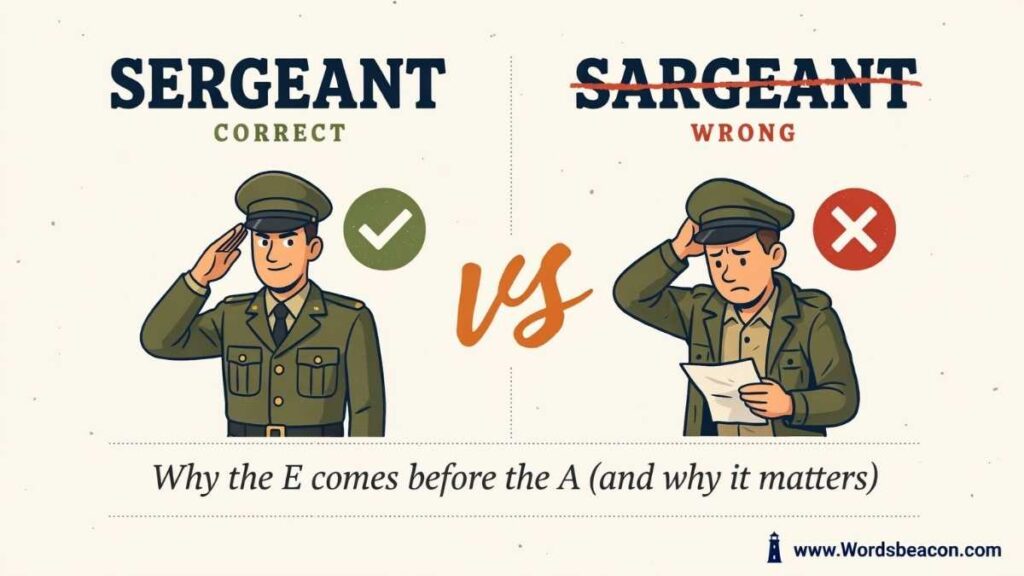
Sergeant vs sargeant looks like a tiny spelling problem, yet one missing letter can make the difference between correct and incorrect writing. Sergeant is the correct spelling for the military or police rank. Sargeant is a common misspelling that often appears because the word sounds like “sar-jent.” To make matters slightly trickier, Sargent can be a legitimate surname, but it isn’t the standard spelling of the rank. This guide makes the whole issue simple. You’ll see what sergeant means, how to spell and pronounce it, where the unusual spelling comes from, and when each form is appropriate. By the end, the spelling mystery will have nowhere left to hide.
Quick Answer
Sergeant is the correct standard spelling.
Sargeant is not the standard spelling of the military or police rank. Sargent is also not the standard spelling when you mean the rank.
For example:
The sergeant called the officers together.
Not:
The sargeant called the officers together.
And not:
The sargent called the officers together.
The same rule applies whether you’re writing about a police sergeant, military sergeant, army sergeant, or another organization that uses the rank.
| Spelling | Correct for the rank? | Explanation |
|---|---|---|
| Sergeant | Yes | Standard English spelling |
| Sargeant | No | Common misspelling |
| Sargent | No | Common misspelling when referring to the rank |
| Sargent | Yes, in some contexts | Can be a person’s surname |
So, if you’re asking, “is it sergeant or sargent?” the answer is sergeant when you’re talking about the rank.
Understand confusing English more words simply
Naive vs Nieve difference and usage?
What Does Sergeant Mean?
The sergeant meaning is fairly straightforward. Sergeant is a rank or title used in military organizations and law enforcement.
In the military, a sergeant is generally a noncommissioned officer, often called an NCO. NCOs play an important role between junior enlisted personnel and commissioned officers. Their responsibilities can include leading personnel, providing training, maintaining discipline, and carrying out the orders of senior leaders.
The exact position of a sergeant depends on the armed forces involved. Different countries and military branches have their own rank structures, titles, and responsibilities.
Law enforcement also uses the title. A police sergeant commonly supervises police officers and may coordinate work during a shift, review reports, assign duties, or help manage incidents. The exact responsibilities vary from one police department to another.
So, a simple sergeant definition is this: a sergeant is a military or law-enforcement rank generally associated with leadership or supervision.
That definition doesn’t mean every sergeant performs exactly the same job. Rank structure and command responsibilities can differ considerably between organizations.
Sergeant vs Sargeant the Difference?
The sergeant vs sargeant difference isn’t really a difference in meaning. Instead, it is a difference between the standard spelling and a common spelling mistake.
Sergeant is the correct spelling.
Sargeant is an incorrect spelling when someone intends to write the rank.
The confusion usually comes from pronunciation. Most US English speakers pronounce sergeant in a way that sounds roughly like “sar-jent.” Because the first sound resembles “sar,” someone who has only heard the word may naturally write sargeant.
That spelling makes sense phonetically, but English spelling doesn’t always follow pronunciation closely.
Consider words such as colonel or yacht. Their written forms don’t give you an obvious guide to their modern pronunciation either. Sergeant creates a similar problem.
Sergeant
The Sergeant is the standard spelling used in English.
You may see it in expressions such as police sergeant, military sergeant, army sergeant, staff sergeant, first sergeant, and sergeant major.
For example:
The sergeant reviewed the report before sending it to the commander.
Here, everything is spelled correctly because sergeant refers to the person’s rank.
Sargeant
Sargeant is a common misspelling of sergeant.
It doesn’t represent a separate military rank. It isn’t an American alternative to sergeant, and it isn’t a British alternative either.
When someone writes sargeant while referring to the rank, they almost always intend to write sergeant.
Sergeant vs Sargent Which One Is Correct?
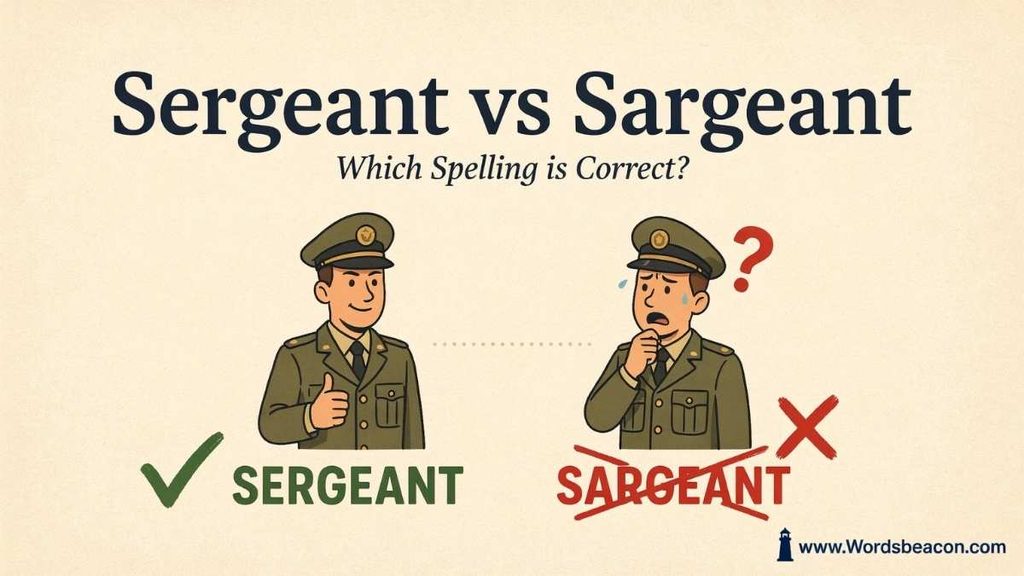
The sergeant vs sargent spelling question has the same answer.
Sergeant is the standard spelling of the rank.
Sargent is not.
For example:
Correct: The sergeant inspected the equipment.
Incorrect: The sargent inspected the equipment.
However, there’s an important exception. Sargent can be a surname.
If someone is named Sargent, you should keep that spelling because proper names belong to the people who use them.
For example:
Mr. Sargent signed the document.
In that sentence, Sargent may be the person’s last name. It has nothing to do with the military rank.
This distinction explains why a dictionary or spell-checking program might recognize Sargent even though it doesn’t accept it as the standard spelling of the rank.
| Word | Refers to the rank? | Can it be a surname? |
|---|---|---|
| Sergeant | Yes | Rarely relevant as a surname |
| Sargeant | No, when used for the rank | It can occur as a name |
| Sargent | No, when used for the rank | Yes |
So, the difference between sergeant and sargent depends heavily on context.
How Do You Spell Sergeant?
If you’re wondering how do you spell sergeant, the answer is:
S-E-R-G-E-A-N-T
The spelling looks unusual because the word doesn’t sound the way it appears on the page.
A useful way to look at it is:
ser + geant
Put those parts together and you get:
sergeant
The part that causes the most trouble is usually geant. When you hear the word pronounced, that section doesn’t sound the way you might expect.
That’s why the question “how do you spell sergeant correctly?” comes up so often.
The easiest approach isn’t to try to spell the word phonetically. Instead, remember its written form.
Sergeant begins with ser, not sar.
It contains the letters gea in the middle.
It ends with ant.
Put those pieces together and you have the correct spelling of sergeant.
Understand confusing English more words simply
Finaly vs Finally difference and usage?
Why Is Sergeant Spelled That Way?
The answer goes back several centuries.
The spelling of sergeant developed through French and ultimately traces back to Latin. English borrowed the word through forms associated with Old French sergent. Over time, the term developed into the military and administrative title we recognize today.
Historical spelling can survive even when pronunciation changes.
That’s exactly what happened here.
The word’s written form retained features connected to its historical development while its pronunciation evolved. Modern speakers therefore pronounce the word differently from what its spelling might suggest.
This is why the question “why is sergeant spelled that way?” doesn’t have an answer based purely on modern pronunciation.
The spelling comes from Old French, and sergeant has historical French and Latin roots. English has absorbed thousands of words from French and Latin, and many of those words carry spelling patterns that don’t perfectly match modern speech.
Sergeant is simply one of those words.
Why Do People Spell Sergeant as Sargent?
Pronunciation is the main reason.
When people hear sergeant, they generally don’t hear a clear “ser” followed by “geant.” The spoken word sounds much closer to “sar-jent.”
If someone has never seen the word written down, sargent can seem like a perfectly reasonable guess.
The brain naturally tries to connect sounds with letters. That’s useful most of the time, but English doesn’t always cooperate.
For example, someone who hears “sar-jent” may think:
sar + gent = sargent
Another person may try:
sar + geant = sargeant
Neither form is correct for the rank.
People often spell sergeant as sargent because pronunciation encourages them to replace the historical spelling with a more phonetic version.
This is a spelling mistake rather than a sign that the writer doesn’t understand the word.
Sergeant vs Sargent Pronunciation
The sergeant vs sargent pronunciation question can be slightly misleading because sargent isn’t the standard spelling of a separate word with its own pronunciation.
When someone writes sargent while referring to the rank, they generally intend the same pronunciation as sergeant.
In standard US English, sergeant is commonly pronounced approximately like “sar-jent.”
The exact sound can vary slightly with accent, but the difference isn’t enough to justify changing the spelling.
This creates a classic spelling-versus-pronunciation problem.
The word sergeant is pronounced differently from its spelling. The written form doesn’t give a beginner an easy way to predict the spoken form.
That’s why someone can pronounce the word correctly while still spelling it incorrectly.
How to Pronounce Sergeant
If you’re asking how to pronounce sergeant, most US English speakers use a pronunciation that sounds approximately like “sar-jent.”
The word has two syllables, and the first syllable receives the main stress.
Accent can affect the exact vowel and final sound. However, the pronunciation remains close enough across standard varieties of English that the spelling problem stays the same.
The key thing to remember is simple:
The word may sound like “sar-jent,” but you spell it sergeant.
Once that distinction becomes familiar, the word stops looking quite so mysterious.
Sergeant Spelling in American English
The sergeant spelling in American English is sergeant.
American English doesn’t use sargeant as an alternative spelling of the rank.
It also doesn’t use sargent as an accepted spelling of the rank.
You may encounter both forms online, particularly in informal posts, comments, user-generated content, or documents containing spelling errors. Seeing a spelling frequently doesn’t automatically make it standard.
For example:
The police sergeant arrived at the scene.
The army sergeant addressed the group.
The spelling remains sergeant in both sentences.
Learn the difference between tricky grammar words
Carmel vs Caramel difference and usage?
Sergeant Spelling in British English
The sergeant spelling in British English is also sergeant.
This means sergeant spelling UK vs US does not create the kind of difference you might see with words such as color and colour.
American English uses sergeant.
British English uses sergeant.
The spelling stays the same.
Military rank systems can still differ between countries. The responsibilities attached to a rank, the insignia used, and the exact place of the rank within the military hierarchy can vary.
However, those differences don’t change the spelling.
So if you’re wondering whether British English uses sargeant, it doesn’t as the standard spelling of the rank.
Is Sargent a Misspelling of Sergeant?
If you’re using Sargent to refer to the rank, yes.
The standard spelling is sergeant.
However, context matters because Sargent can be a legitimate surname.
For example:
Sergeant Brown reported for duty.
Here, sergeant is the rank.
Now compare:
James Sargent reported for work.
Here, Sargent may be the person’s last name.
Changing Sargent to Sergeant in the second sentence would change the person’s name rather than correct a spelling mistake.
This is also why spellcheck may not flag Sargent when it is used as a surname. Software can recognize it as a proper name even though it isn’t the correct spelling of the rank.
Is Sargent a Word?
The question “is sargent a word?” needs a little context.
If you mean the military or police rank, sargent is not the standard spelling. The correct spelling is sergeant.
If you’re referring to the surname Sargent, however, the name can be perfectly legitimate.
The same principle applies to other unusual-looking names. A proper name doesn’t become incorrect simply because it resembles a common misspelling.
So don’t automatically change someone’s surname just because your spellchecker suggests another form.
Is Sargeant a Correct Spelling?
If you’re asking “is sargeant a correct spelling?” the answer is no when you’re referring to the military or police rank.
The correct spelling is sergeant.
Sargeant is generally a common misspelling created by trying to write the word according to its pronunciation.
The correct spelling of police sergeant is police sergeant.
The correct spelling of military sergeant is military sergeant.
The word doesn’t change simply because the context changes from law enforcement to the armed forces.
Is Sargeant a Word?
Sargeant isn’t the standard spelling of the military or police rank.
If someone writes:
The sargeant gave the order.
The correct version is:
The sergeant gave the order.
However, names can follow different rules. If Sargeant appears as someone’s surname, it may be a legitimate proper name.
That’s why context matters when evaluating unusual spellings.
Learn how to use confusing more words correctly
Inquire vs Enquire difference and Usage?
Sergeant Rank Meaning Where Does a Sergeant Fit?
The sergeant rank meaning varies depending on the organization.
In many military systems, sergeant is an enlisted or noncommissioned rank. A noncommissioned officer, or NCO, usually has greater responsibility than junior enlisted personnel and often plays a practical leadership role.
A sergeant may train personnel, supervise daily activities, enforce standards, maintain discipline, and communicate instructions from higher-ranking leaders.
This makes the rank important within the chain of command.
The exact position, however, isn’t universal. One military service may place sergeant at a different point in its rank structure than another.
The same caution applies to police organizations.
A police sergeant often supervises police officers, but the exact duties can depend on the police department, assignment, and local regulations.
So while the word has a consistent basic meaning, the actual job attached to the rank can vary.
Sergeant vs Corporal
The comparison between sergeant vs corporal involves rank structure rather than spelling.
In many military organizations, sergeant ranks above corporal.
A corporal often serves as a junior leader and may supervise a small group of personnel. A sergeant typically carries greater responsibility and authority.
Still, military rank systems aren’t identical around the world. The exact titles, insignia, duties, and levels can vary.
The important point is that both are generally associated with the enlisted or NCO side of military hierarchy in systems that use these ranks.
Sergeant vs Staff Sergeant
Sergeant vs staff sergeant is another comparison that depends on the military organization.
Where both ranks exist, staff sergeant generally ranks above sergeant.
The difference usually involves greater seniority and broader responsibility.
However, rank titles aren’t universal. Different armed forces organize their NCO ranks differently, so you shouldn’t assume that every country uses the same hierarchy.
From a spelling perspective, there’s nothing complicated here.
Both titles contain the same correctly spelled word:
sergeant
Sergeant vs Master Sergeant
In military systems that use both ranks, master sergeant is generally senior to sergeant.
A master sergeant may have broader supervisory, training, leadership, or administrative responsibilities.
The exact position varies between services.
Again, the spelling doesn’t change.
Whether the title is sergeant or master sergeant, the correct spelling remains sergeant.
Sergeant vs Sergeant Major
Sergeant major is another military title that contains the word sergeant.
In many military systems, sergeant major represents a much more senior level of NCO responsibility than an ordinary sergeant.
Some armed forces also use several types of sergeant major positions.
Because military hierarchy varies from country to country, it’s best to check the specific service when discussing exact rank equivalencies.
The spelling question remains simple: sergeant is spelled sergeant.
Learn how to use confusing more words correctly
Honor vs Honour difference and usage?
Sergeant vs Captain and Lieutenant
The searches sergeant vs captain and sergeant vs lieutenant often reflect curiosity about military or police hierarchy.
In many organizations, a sergeant belongs to the noncommissioned or enlisted leadership structure, while lieutenant and captain are commissioned officer ranks.
That creates an important distinction.
A sergeant isn’t simply a junior version of a lieutenant. The two ranks can belong to different parts of the organizational structure.
A simplified example looks like this:
| General category | Examples |
|---|---|
| Junior enlisted | Organization-specific ranks |
| NCO | Corporal, sergeant, staff sergeant |
| Senior NCO | Master sergeant, sergeant major |
| Commissioned officer | Lieutenant, captain, and higher ranks |
This table is only a general illustration. Actual military hierarchy differs among countries, services, and organizations.
Sergeant Police Spelling
When you’re writing about law enforcement, use sergeant.
For example:
The police sergeant supervised the officers.
The patrol sergeant reviewed the incident reports.
The detective sergeant spoke with the investigators.
The incorrect versions would use sargeant or sargent in place of sergeant.
The correct spelling of police sergeant doesn’t change according to the department or assignment.
Whether you’re writing about a patrol sergeant, detective sergeant, or another police rank, the word is still spelled sergeant.
Military Sergeant Spelling
The military sergeant spelling is also sergeant.
For example:
The army sergeant inspected the equipment.
The military sergeant briefed the personnel.
The sergeant reported to the commanding officer.
Again, sargeant and sargent aren’t alternative military spellings.
If you’re writing a formal document, report, article, or academic paper, always use the standard spelling.
Sergeant Abbreviation
The common sergeant abbreviation in US English is Sgt.
For example:
Sgt. Davis reviewed the report.
You may also see the full title:
Sergeant Davis reviewed the report.
Abbreviation styles can vary by organization and publication. Some military or government documents may follow their own conventions.
In ordinary US English, however, Sgt. is a widely recognized abbreviation for sergeant.
The abbreviation doesn’t affect the spelling of the full word.
Is Sergeant Capitalized?
Capitalization depends on how you use the title.
When sergeant functions as a general rank, lowercase is usually appropriate:
The sergeant entered the room.
When the rank appears directly before a person’s name as a formal title, capitalization is commonly used:
Sergeant Davis entered the room.
The same principle applies to many titles.
For example:
The captain spoke to the sergeant.
Captain Davis spoke to Sergeant Brown.
Specific military, police, or publication style guides may have additional rules. If you’re writing for a particular organization, follow its preferred style.
Learn the difference between confusing more English words
Eyeing vs Eying difference and usage?
Common Sergeant Spelling Mistakes
The most common spelling mistake is sargeant.
The reason is easy to understand. The pronunciation makes the first part sound more like “sar” than “ser.”
Another common mistake is sargent. This version often appears when someone simplifies the middle of the word and writes it closer to the way it sounds.
Some writers also produce forms such as sargant or sergent.
All of these forms create the same basic problem: they try to make the spelling match the pronunciation.
The standard spelling is still sergeant.
| Common mistake | Correct form |
|---|---|
| Sargeant | Sergeant |
| Sargent | Sergeant |
| Sargant | Sergeant |
| Sergent | Sergeant |
The safest approach is to recognize the word visually rather than trying to reconstruct it from sound.
Real-Life Examples of Sergeant
The correct spelling becomes easier to recognize when you see it in different contexts.
The sergeant inspected the equipment before the exercise.
The police sergeant spoke with the witnesses.
She was promoted to sergeant after completing the required training.
Sergeant Miller reviewed the team’s reports.
The staff sergeant gave the new personnel their instructions.
The sergeant major addressed the formation.
In every example, the word remains sergeant.
Its spelling doesn’t change because the person works in law enforcement instead of the military. It doesn’t change because another rank appears beside it either.
A Simple Case Study Why Sargeant Looks Right
Imagine someone hears this sentence for the first time:
“The sergeant will speak to you.”
They understand the meaning but have never seen the word written. When they type it, they might choose “sargeant.” That choice makes sense from a phonetic perspective. The first sound resembles “sar,” while the ending sounds closer to “jent” than the spelling suggests.
This is one reason the Sergeant vs Sargeant mistake happens so often. The writer isn’t inventing a random word. They’re simply trying to turn a sound into letters. That’s exactly why the Sergeant vs Sargeant spelling confusion is so common.
Now imagine the same person sees the correct spelling several times:
police sergeant
army sergeant
Sergeant Miller
staff sergeant
After repeated exposure, the unusual letter pattern becomes familiar. The Sergeant vs Sargeant difference then becomes much easier to remember.
This gives you a simple way to avoid the mistake. Don’t try to spell “sergeant” only by sound. Remember its written form instead. Once you become familiar with the correct spelling, the Sergeant vs Sargeant confusion starts to disappear.
So, when you’re writing about the rank, choose “sergeant.” The word may sound like it wants a different spelling, but English has already made its decision.
Learn the difference between confusing more English words
Humour vs Humor difference and usage?
How to Remember the Spelling of Sergeant
The easiest way to remember the spelling is to focus on the unusual middle.
Think of the word as:
ser + geant
The first part is ser.
The second part is geant.
Together:
sergeant
Another useful method is to connect the word with phrases you’re likely to recognize.
Police sergeant.
Army sergeant.
Military sergeant.
Staff sergeant.
Sergeant major.
Seeing the word repeatedly in familiar phrases helps your brain remember the complete spelling instead of trying to spell it phonetically.
The most important thing to remember is this:
Don’t let the pronunciation decide the spelling.
The word sounds roughly like “sar-jent,” but its written form is sergeant.
Correct and Incorrect Examples
| Incorrect | Correct |
|---|---|
| The sargeant gave the order. | The sergeant gave the order. |
| She became a sargent. | She became a sergeant. |
| Ask the sargeant for help. | Ask the sergeant for help. |
| The police sargent arrived. | The police sergeant arrived. |
| He was promoted to sargeant. | He was promoted to sergeant. |
| The army sargent led the group. | The army sergeant led the group. |
These examples show the main rule clearly. If you’re referring to the rank, use sergeant.
Is Sargent a Surname?
Yes. Sargent can be a surname.
This explains why you might see Sargent written correctly in a sentence even though it isn’t the correct spelling of the rank.
For example:
Sarah Sargent submitted the report.
Here, Sargent is a last name.
But:
The sargent submitted the report.
If the sentence refers to the rank, it should read:
The sergeant submitted the report.
This difference matters in real writing. A person’s name shouldn’t be changed simply because it resembles a common spelling mistake.
Is Sargeant Ever Correct?
When you’re referring to the military or police rank, sargeant is not the standard spelling.
The correct form is sergeant.
However, proper names can be different. If a person has Sargeant as a surname, that spelling should remain unchanged when referring to that person.
So the useful rule is simple:
Rank: sergeant.
Surname: use the spelling that belongs to the person.
Sergeant vs Sargent Spelling The Easy Rule
If you’re writing about a rank, use sergeant. This is the correct form in the Sergeant vs Sargeant spelling question.
If you’re writing about someone whose surname is Sargent, use Sargent. In this context, Sargent is a person’s name, not the military rank.
That one distinction solves most of the Sergeant vs Sargeant confusion.
The same idea applies to Sargeant when it appears as a proper name. A name shouldn’t be “corrected” simply because it looks like a spelling mistake.
Context is the deciding factor. When you mean the rank, write sergeant. When you’re referring to a person’s surname, keep the spelling that belongs to their name. This simple rule makes the Sergeant vs Sargeant difference much easier to remember.
Learn how to use confusing more words correctly
Grey vs Gray difference and usage?
practice sesstion Sergeant vs Sargeant
Choose the correct word or form to complete each sentence. Sergeant vs Sargeant
- The correct spelling of the military rank is __________.
- The police __________ spoke to the witnesses after the incident.
- “Sargeant” is a common spelling __________ of “sergeant.”
- How do you __________ the word for this military rank?
- The word __________ refers to a military or police rank.
- She was promoted to __________ after several years of service.
- Is “__________” or “sargeant” the correct spelling?
- The correct spelling of police __________ is “sergeant.”
- A __________ often has supervisory or leadership responsibilities.
- The abbreviation for sergeant is commonly written as __________.
- “Sargent” is not the standard spelling for the military __________.
- People sometimes write “sargent” because the word __________ similar to its pronunciation.
- The spelling __________ is correct when referring to the military rank.
- The police department appointed a new __________ to supervise the team.
- In both American and British English, the standard spelling is __________.
- The word “sargeant” should be corrected to __________ when referring to the rank.
- A sergeant is generally considered a __________ commissioned officer in military systems that use NCO ranks.
- “Sargent” can be a person’s __________ even though it is not the standard spelling of the rank.
- The phrase “army __________” uses the standard spelling of the rank.
- The phrase “police __________” also uses the standard spelling __________.
- The word “sergeant” is pronounced differently from the way its letters might initially suggest. It is approximately pronounced “__________.”
- Which spelling is correct: “sergeant” or “__________”?
- A common spelling mistake is leaving out the “__________” in “sergeant.”
- If you are writing about a police rank, use “__________” rather than “sargeant.”
- Remember this simple rule: The rank is spelled __________, while “Sargent” may appear as a __________.
Answers
- sergeant
- sergeant
- mistake
- spell
- sergeant
- sergeant
- sergeant
- sergeant
- sergeant
- Sgt.
- rank
- sounds
- sergeant
- sergeant
- sergeant
- sergeant
- non
- surname
- sergeant
- sergeant, sergeant
- sar-jent
- sargeant
- e
- sergeant
- sergeant, surname
Here’s a trusted source for clear more words Comparison:
FAQs
Is Sargeant a word?
“Sargeant” isn’t the standard spelling of the military or police rank. The correct spelling is “sergeant.” You may still see “sargeant” because people often spell the word based on how it sounds.
Is it spelled sergeant vs sargeant?
The correct spelling is “sergeant.” “Sargeant” is a common misspelling. Although both forms may look similar, only “sergeant” is the standard spelling for the rank.
Is Sargent a correct spelling of sergeant?
No. “Sargent” isn’t the standard spelling of the military or police rank. The correct form is “sergeant.” However, Sargent can be a legitimate surname, so you may see it used correctly as a person’s last name.
What is the difference between sergeant vs sargeant?
There is no difference in rank or meaning. “Sergeant” is the correct spelling, while “sargeant” is a misspelling. If you’re talking about the military or police rank, always write “sergeant.”
Why do people spell sergeant as sargeant?
The pronunciation makes the spelling tricky. “Sergeant” is commonly pronounced something like “sar-jent.” Because the spoken form doesn’t clearly match the written form, some people naturally write “sargeant” instead.
Why is sergeant pronounced like sargent?
The spelling and pronunciation developed differently over time. “Sergeant” came into English through French from older Latin roots. Historical changes in pronunciation left the modern word with a spelling that doesn’t closely match how most English speakers say it today.
How do you spell sergeant correctly?
The correct spelling is S-E-R-G-E-A-N-T: “sergeant.” Pay special attention to the “e-a” sequence in the middle. That’s one of the parts people often change when they spell the word from its pronunciation.
How is sergeant pronounced?
In common American English, “sergeant” is pronounced approximately “SAR-jent.” The exact sound can vary slightly by accent. The spelling remains “sergeant” regardless of the pronunciation.
What does sergeant mean?
A sergeant is a military rank used in many armed forces. Police departments also use the title for certain supervisory positions. The exact responsibilities of a sergeant depend on the military service or police organization.
What is the correct spelling of police sergeant?
The correct phrase is “police sergeant.” The word “sargeant” should not be used when referring to the police rank.
What is the correct spelling of army sergeant?
The correct spelling is “army sergeant.” “Sargeant” and “sargent” are not standard spellings for the rank.
Is the spelling of sergeant the same in American and British English?
Yes. Both American English and British English use “sergeant” as the standard spelling. The word doesn’t become “sargeant” in British English.
Is Sargent a misspelling?
It depends on the context. “Sargent” is a misspelling if someone intends to write the military or police rank. However, Sargent is also a legitimate surname. In that case, the spelling is correct.
Can Sargent be a surname?
Yes. Sargent is an established surname. For example, “James Sargent” can be a person’s correct name. That doesn’t make “Sargent” the correct spelling of the rank.
Can Sargeant be a surname?
“Sargeant” can also occur as a surname. However, when you mean the military or police rank, “sergeant” is the correct form. A person’s actual surname should always be written exactly as that person spells it.
What is the abbreviation for sergeant?
The common abbreviation is “Sgt.” For example, “Sergeant Miller” can be written as “Sgt. Miller” when an abbreviation is appropriate.
Should sergeant be capitalized?
Usually, “sergeant” is lowercase when you use it as a general rank, such as “the sergeant arrived.” It is commonly capitalized when it appears directly before a person’s name as a title, such as “Sergeant Miller.”
Is “Sarge” the correct spelling of sergeant?
“Sarge” is an informal shortened form of “sergeant.” It can work in casual conversation or dialogue. It shouldn’t replace “sergeant” in formal writing, official documents, or professional communication.
Is “sargeant” ever correct for a military rank?
No. “Sargeant” isn’t the standard spelling of the military rank. The correct spelling is “sergeant,” even though the pronunciation can make “sargeant” seem reasonable.
Why is sergeant so difficult to spell?
The biggest problem is the difference between spelling and pronunciation. When you hear “sergeant,” you might naturally try to spell it as “sargent” or “sargeant.” English has several words with similar spelling quirks, so relying only on pronunciation can lead you in the wrong direction.
What is the easiest way to remember the spelling of sergeant?
Remember the word as “ser-geant” rather than trying to spell it exactly as it sounds. The key is to keep the “e-a” sequence in the middle. When you mean the rank, remember one simple rule: “sergeant” is standard, while “sargeant” is a misspelling.
Conclusion
The sergeant vs sargeant confusion is easy to clear up once you know the rule. When you’re talking about the military or police rank, the correct spelling is always sergeant. Sargeant is a common misspelling. Sargent can be a real surname, yet it isn’t the correct spelling of the rank.
The tricky part is pronunciation. Sergeant is usually pronounced something like “sar-jent,” so writing “sargeant” can seem perfectly logical. English, however, doesn’t always make spelling that simple.
So, is it sergeant vs sargeant? It’s sergeant. Remember that one spelling and you’ll avoid the most common mistake. The word may sound like it’s trying to hide a few letters, but they still belong there. When you mean the rank, give those letters their proper place and stick with “sergeant.”

Luna AJS is an experienced blogger and dedicated language enthusiast at Words Beacon. She specializes in making English grammar, spelling, vocabulary and commonly confused words easy to understand. She provides clear explanations, practical examples to help readers write with confidence.