

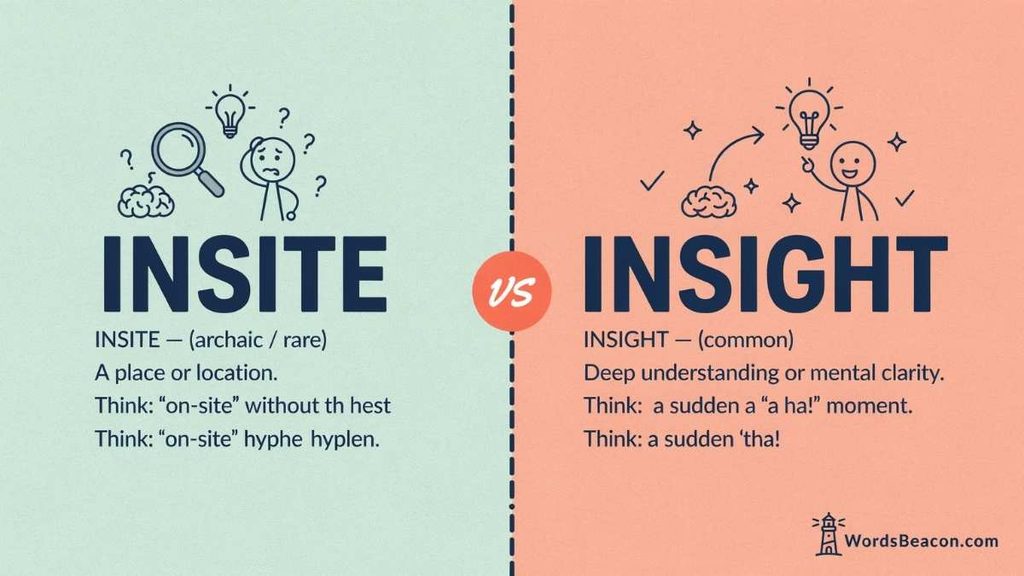
The “Insite vs Insight” question looks simple, yet one little spelling difference can change everything. If you mean a deep understanding, a useful realization, or a clearer view of something, “insight” is the correct word. “Insite” is usually just a spelling mistake when that is the intended meaning. Then there’s “incite,” which sounds similar but means something completely different: to encourage or provoke someone to act. No wonder these words cause trouble. English seems to enjoy hiding surprises in ordinary-looking words. The good news? Once you know what each word means and how to use it, the confusion becomes easy to clear up.
quick answer
If you want to talk about understanding, awareness, or a useful realization, use insight.
For example:
The interview gave us valuable insight into customer behavior.
Here, insight means a deeper understanding of why customers behave in a certain way.
Now look at this sentence:
The interview gave us valuable insite into customer behavior.
This spelling is incorrect in standard English. The writer almost certainly meant insight.
So, should I use insite or insight? If the sentence is about understanding something more clearly, use insight.
| Word | Meaning | Part of Speech | Standard Use |
|---|---|---|---|
| Insight | Deep understanding or realization | Noun | Correct |
| Insite | Usually a misspelling of insight | Not normally used this way | Usually incorrect |
| Incite | To encourage or provoke action | Verb | Correct, but different |
There is one exception worth remembering. Insite can appear as part of a company name, brand name, product name, website name, or another proper noun. In that case, the spelling depends on the official name.
Learn the difference between similar English words
Naive vs Nieve difference and usage?
What Does Insight Mean?
The insight meaning is closely connected to understanding.
Insight describes a clear or deeper understanding of something. It can involve a problem, situation, person, idea, experience, or pattern.
In simple terms, insight means seeing or understanding something more clearly than you did before.
For example:
The discussion gave me insight into why the project failed.
The sentence doesn’t simply say that the person learned that the project failed. It says the discussion helped explain why it failed.
That deeper understanding is what makes insight different from basic information.
Insight as Deep Understanding
One common use of insight is to describe a deeper understanding of something that may not be obvious at first.
Consider this example:
The research provides valuable insight into how people make purchasing decisions.
The research doesn’t just provide numbers. It helps explain the reasons behind people’s choices.
That’s insight.
You can use the word to describe:
- valuable insight
- useful insight
- personal insight
- expert insight
- professional insight
- new insight
- deeper insight
- fresh insight
Insight as a Realization
Insight can also describe a moment when something suddenly becomes clear.
Imagine a student who has struggled with a difficult math problem for an hour. Then a teacher explains one small part of the problem and everything suddenly makes sense.
That moment of understanding is an example of insight.
The student didn’t simply memorize another fact. The student finally understood how the problem worked.
That’s why insight often connects with words such as realization, awareness, clarity, perception, and comprehension.
Insight as Perspective
Insight can also mean a useful perspective.
For example:
Her experience gave her valuable insight into the challenges faced by new employees.
This sentence suggests that her experience helped her understand those challenges in a deeper way.
That type of insight appears frequently in business, education, research, psychology, journalism, and everyday conversations.
Learn the difference between similar English words
Finaly vs Finally difference and usage?
Insight Meaning and Examples

A simple way to understand the insight meaning is to think about the difference between information and understanding.
Suppose a store owner discovers this:
Sales dropped by 15% in March.
That’s information.
After looking at customer behavior, the owner discovers this:
Most customers abandoned their purchases after seeing the shipping costs.
That’s closer to an insight.
The first statement tells the owner what happened.
However, the second helps explain why it happened.
For example, here are more insight examples:
| Sentence | Meaning of Insight |
|---|---|
| The survey provides insight into customer preferences. | Understanding customer behavior |
| His experience gave him valuable insight into the industry. | Practical knowledge and perspective |
| The book offers insight into human behavior. | Deeper understanding |
| The conversation gave me insight into her decision. | Understanding her reasons |
| The research produced new insights into the problem. | New findings or realizations |
| She has remarkable insight into workplace behavior. | A strong ability to understand situations |
One of the most common phrases is insight into.
For example:
The study provides insight into consumer behavior.
The interview offered insight into the company’s decision.
His experience gave him insight into the challenges of leadership.
These sentences all use insight naturally.
Learn the difference between confusing word pairs
Carmel vs Caramel difference and usage?
Is Insite a Word?
So, is insite a word?
If you mean the standard English noun that means deep understanding, the answer is no. Insight is the correct word.
However, Insite can appear as a proper noun.
For example, a company might choose Insite as its official name. A software product could use the same spelling. A website or brand could also use it.
In those cases, Insite isn’t necessarily a spelling mistake because proper names can have unusual or creative spellings.
The important thing is context.
Compare these examples:
The report gave us useful insight into the problem.
Correct.
The report gave us useful insite into the problem.
Incorrect if the writer means understanding.
But:
Insite Solutions released a new product.
This could be completely correct if Insite Solutions is the company’s official name.
Is Insite a Real Word?
If by “real word” you mean a standard English word that can replace insight, then no.
If you mean whether the spelling Insite can appear legitimately in written English, then yes. It may appear as a proper noun, company name, brand name, product name, technical product, or stylized name.
This distinction prevents an important mistake: not every unusual spelling represents an ordinary vocabulary word.
Is Insite a Misspelling of Insight?
In ordinary writing, insite is often a misspelling of insight.
For example:
The article gives readers useful insite into the subject.
The writer almost certainly intended:
The article gives readers useful insight into the subject.
The spelling mistake probably happens because people remember the sound but not the exact spelling.
The word insight ends with sight, not site.
That little detail is worth remembering.
Change block type or style
Move Heading block from position 91 up to position 90
Move Heading block from position 91 down to position 92
Change alignment
Change text alignment
Displays more block tools
Learn the difference between confusing word pairs
Inquire vs Enquire difference and Usage?
Insight vs Insite Key Differences
The difference between insite and insight is straightforward.
Insight is the standard English noun used for deep understanding, perception, awareness, or realization.
Insite is usually a spelling mistake when someone uses it to mean insight.
| Feature | Insight | Insite |
|---|---|---|
| Standard English noun | Yes | No, not with the meaning of understanding |
| Meaning | Deep understanding or realization | Usually no standard meaning in this context |
| Part of speech | Noun | Usually a proper name or spelling error |
| Common phrase | Insight into | Not normally used |
| Correct example | She gained insight into the problem. | She gained insite into the problem. |
| Can appear as a name? | Yes | Yes |
| Correct spelling for understanding | Insight | No |
This makes the insight vs insite question much easier.
If the sentence describes understanding, insight is the word you need.
Why Do People Confuse Insite and Insight?
The confusion isn’t surprising.
The two spellings look almost identical. They also sound similar when spoken.
Pronunciation Can Cause the Mistake
The pronunciation of insight doesn’t clearly show that the word ends in sight.
As a result, someone may hear the final sound and connect it with site.
Therefore, pronunciation alone isn’t always enough to determine English spelling.
In fact, English has plenty of words that don’t spell exactly the way they sound.
The Word Site Looks Familiar
Site is a common English word.
Because of that, people may naturally write insite instead of insight.
The problem is that insight contains the word sight, not site.
Thinking about the meaning can help.
Sight relates to seeing. Insight uses that idea figuratively to describe seeing or understanding something clearly.
Fast Typing Creates Errors
Spelling mistakes often happen when people type quickly.
You might know exactly what you want to say but type insite without noticing. Since the word looks close to insight, the mistake can easily slip through proofreading.
That’s especially common in emails, messages, notes, and quick drafts.
How to Use Insight Correctly
The word insight is a noun, and it appears in several common sentence patterns.
Insight Into
First, insight into is one of the most common constructions.
It means gaining a deeper understanding of a particular subject or situation.
The study provides insight into consumer behavior.
The interview gave us insight into the company’s decision.
Her experience gave her insight into the challenges of leadership.
Gain Insight
Similarly, use gain insight when someone develops a better understanding.
The training helped employees gain insight into effective communication.
Reading the case study gave the students insight into the problem.
Provide Insight
Next, use provide insight when something helps someone understand a topic more clearly.
The survey provides insight into customer preferences.
The report provides valuable insight into the causes of the problem.
Offer Insight
Likewise, offer insight has a similar meaning.
The expert offered insight into the causes of the decline.
The discussion offered useful insight into the situation.
Have Insight
You can also describe someone as having insight.
For example, she has excellent insight into human behavior.
He has considerable insight into the industry.
In these sentences, insight describes the person’s ability to understand something deeply.
Learn the difference between confusing word pairs
Eyeing vs Eying difference and usage?
Insight Examples in Everyday Writing
The word insight works naturally in many areas of life.
Personal Example
For example, talking to my older brother gave me insight into the challenges of living alone.
The person gained a better understanding through conversation.
Workplace Example
At work, the manager’s experience provided valuable insight into the team’s problems.
Here, experience helped the manager understand what was happening.
Academic Example
In academic writing, the research offers new insight into how children develop language skills.
The research gives readers a deeper understanding of the subject.
Business Example
In business, customer feedback gave the company insight into why sales were falling.
The feedback helped explain the reason behind the decline.
Everyday Conversation
Finally, her advice gave me some insight into what he was thinking.
The advice helped the speaker understand another person’s thoughts.
Insight vs Information
Insight and information are related, but they don’t mean exactly the same thing.
Information gives you facts.
Insight helps you understand those facts.
Imagine that a business discovers:
Website traffic fell by 30%.
That’s information.
After analyzing the data, the business discovers:
Most visitors leave after reaching the payment page because the checkout process is too complicated.
That’s an insight.
The information tells you what happened.
The insight helps you understand why it happened.
This distinction is especially useful in academic and professional writing.
Not every fact deserves to be called an insight.
Insight vs Opinion
An opinion tells you what someone thinks.
Insight usually suggests a deeper or more useful understanding.
For example:
I think customers prefer shorter forms.
That’s an opinion.
Now consider:
Customer interviews showed that people often abandon long forms because they don’t understand why certain information is required.
That’s an insight.
The second statement identifies a meaningful pattern.
An insight doesn’t always have to come from formal research. People can gain personal insight through experience, conversation, observation, or reflection.
Learn the difference between tricky grammar words
Humour vs Humor difference and usage?
Insight vs Incite
Now for another common spelling mix-up.
Insight and incite are both real English words. They sound similar, but they have completely different meanings.
Insight is a noun.
On the other hand, incite is a verb.
Similarly, insight relates to understanding.
In contrast, incite relates to provoking or encouraging a reaction.
What Does Incite Mean?
In simple terms, incite means to encourage, provoke, or stir someone toward a particular action or feeling.
For example:
The speech could incite anger.
Here, incite means provoke anger.
Another example:
The group was accused of trying to incite violence.
Here, incite means encourage or provoke violent action.
The word can also describe strong reactions that aren’t necessarily violent.
The controversial announcement incited a heated debate.
The announcement caused or encouraged a strong reaction.
Insight vs Incite Meaning
A quick way to remember the insight vs incite meaning is:
First, insight means understanding.
In contrast, incite means provoke.
Similarly, one helps you see something more clearly.
On the other hand, the other pushes or stirs someone toward an action or reaction.
| Word | Meaning | Part of Speech | Example |
|---|---|---|---|
| Insight | Deep understanding | Noun | The report offers valuable insight. |
| Incite | Encourage or provoke | Verb | The speech could incite anger. |
| Insite | Usually a misspelling of insight | — | The report offers valuable insite. |
Learn the difference between confusing more English words
Grey vs Gray difference and usage?
Insite vs Insight vs Incite Examples
Seeing all three words together makes the difference even clearer
Understanding
For example, the report provides valuable insight into customer behavior.
This is correct.
Spelling Error
However, the report provides valuable insite into customer behavior.
This is incorrect if the intended meaning is understanding.
Provoking a Reaction
On the other hand, the speech was designed to incite anger.
This is correct.
Using Both Correct Words
Interestingly, the researcher gained insight into what might incite public concern.
Both insight and incite are correct here.
They simply have different jobs.
Proper Name
Finally, Insite Solutions released its latest software update.
This may also be correct if Insite Solutions is the official name of the company.
Insight and Incite in One Sentence
Using these two words together can make their different meanings easier to remember.
For example, her insight into the situation helped explain what might incite public anger.
Insight means understanding.
Incite means provoke.
Here’s another example.
The journalist’s insight into the conflict helped explain how inflammatory comments could incite violence.
Again, the words are completely different despite their similar appearance.
Insite vs Insight Grammar
Understanding the grammar can also prevent many mistakes.
Insight is a noun.
For example, you can say:
The report provides insight.
She gained insight.
They shared their insights.
However, you shouldn’t normally use insight as a verb.
For example, “The report insights the problem” is incorrect.
A better sentence would be:
The report explains the problem.
Or:
The report provides insight into the problem.
Incite, on the other hand, is a verb.
You can say:
The speech incited anger.
The comments incited a strong reaction.
Therefore, the noun-versus-verb difference is an important part of Insite vs Insight grammar and the Insight vs Incite distinction.
Is Insight a Word?
Yes. Insight is a standard English noun.
If you’re asking, “Is insight a word?” the answer is clearly yes.
The word has an established meaning connected with deep understanding, perception, awareness, and realization.
It can describe understanding in general.
For example, the book gave me insight into the subject.
It can also refer to individual discoveries or realizations.
For example, the researchers discovered several important insights.
Both uses are standard.
Learn the difference between confusing more English words
Honor vs Honour difference and usage?
How to Spell Insight Correctly
If you’re wondering how to spell insight, remember one simple detail.
The word ends with sight.
The correct spelling is insight, not insite.
A useful memory trick is to connect insight with the idea of seeing.
When you gain insight, you gain a clearer “view” of something.
You aren’t literally using your eyes. Instead, the word uses the idea of sight to describe understanding.
So, when you’re trying to remember the correct spelling of insight, think:
understanding → insight → sight
How to Pronounce Insight
If you’re wondering how to pronounce insight, the word has the same main vowel sound found in sight.
The important point is that the ending sounds like sight even though some people may instinctively connect it with site.
That pronunciation can explain why insite becomes such an easy spelling mistake.
Insight vs Incite Pronunciation
The Insight and incite have similar sounds, but their stress patterns differ.
Insight is commonly pronounced with the main stress at the beginning.
Incite has the main stress later in the word.
You don’t need to memorize complicated pronunciation rules to tell them apart. Focus on the meaning and grammatical role.
If you’re talking about understanding, use insight.
If you’re talking about provoking something, use incite.
Common Mistakes With Insite and Insight
Mistake Writing Insite Instead of Insight
For example, the article gives readers useful insite.
Correct it to: The article gives readers useful insight.
Mistake Treating Insight as a Verb
For instance, the report insights the problem.
This, however, isn’t standard usage.
Instead, write: The report explains the problem.
Or, you can write: The report provides insight into the problem.
Mistake Confusing Insight With Incite
These two words can create very different meanings.
For example, the report provides insight into the issue.
Here, the report provides understanding.
In contrast, the speech could incite anger.
Here, the speech could provoke anger.
Therefore, switching the words would make the sentence incorrect or change its meaning.
Mistake Assuming Every Fact Is an Insight
A fact and an insight aren’t always the same thing.
“The company lost 10,000 customers” is information.
“Customers left because the company introduced a complicated cancellation process” gives a deeper explanation and can be described as an insight.
Using the word carefully makes your writing more precise.
When Insite Can Be Correct
There is an important exception to the spelling rule.
Insite can be correct when it is part of an official name.
For example, a business might call itself Insite Consulting. A technology company might use Insite as a product name. A website or organization might also use the spelling.
In these situations, don’t automatically change Insite to Insight.
Proper names often use unusual spellings for branding or identification.
The key is context.
If you’re writing ordinary English and mean understanding, use insight.
If you’re reproducing an official name, use the spelling that belongs to that name.
Learn the difference between confusing more English words
Sergeant vs Sargeant difference and usage?
Insight in Professional, Academic, and Everyday Writing
Insight appears across many types of writing because the idea of deeper understanding is useful almost everywhere.
Business Writing
Businesses often use insight when discussing:
- customer behavior
- market research
- sales patterns
- employee feedback
- business strategy
- product development
For example:
Customer surveys provided valuable insight into changing buying habits.
Academic Writing
Researchers and students use insight when discussing:
- research findings
- human behavior
- historical events
- scientific observations
- social patterns
- analysis and interpretation
For example:
The study provides new insight into how children acquire language.
Everyday Writing
You don’t need a formal report to use insight.
People use it when talking about:
- relationships
- personal experiences
- advice
- decisions
- mistakes
- observations
For example:
That conversation gave me some insight into why she made that decision.
The word works because the conversation created a clearer understanding.
A Simple Way to Remember the Difference

When you’re proofreading, simply ask yourself one question:
What does this sentence mean?
- If it means understanding, awareness, or a useful realization, choose insight.
- However, if it means encouraging or provoking a reaction, choose incite.
- Finally, if it uses Insite as a company, brand, product, or other proper name, check the official spelling.
You can remember it like this:
Understanding = insight
Provoking = incite
Proper name = Insite may be correct
That’s much easier than trying to memorize a long grammar rule.
Practice Session Insite vs Insight
Choose the correct word for each sentence: “Insite vs Insight”
- The interview gave me valuable ______ into how the company operates.
- She gained new ______ into the problem after speaking with an expert.
- This report provides useful ______ into customer behavior.
- If you’re studying Insite vs Insight, remember that “insight” is the standard English word for deep understanding.
- The psychologist offered an interesting ______ into why people behave this way.
- The manager’s comments gave us greater ______ into the project’s challenges.
- Reading different perspectives can give you valuable ______ into a complicated issue.
- In the Insite vs Insight comparison, ______ is normally the correct spelling when you mean understanding.
- The research provides important ______ into the causes of the problem.
- Her personal experience gave her a unique ______ into the situation.
- The teacher’s explanation helped students gain ______ into the difficult topic.
- When discussing Insite vs Insight, use ______ when you mean a clear or deep understanding.
- The survey offers useful ______ into what customers really want.
- His experience gave him considerable ______ into the industry.
- The discussion provided fresh ______ into the reasons behind the decision.
- If you mean “deep understanding,” the correct word in the Insite vs Insight question is ______.
- The documentary gave viewers a fascinating ______ into life in the region.
- Good questions can help you gain ______ into a difficult problem.
- The expert provided valuable ______ into the situation during the meeting.
- In the Insite vs Insight spelling question, ______ is generally the correct English spelling for the noun meaning understanding.
- Her comments gave me a better ______ into what had happened.
- The study offers new ______ into how the brain processes information.
- Talking to experienced employees can give you useful ______ into the workplace.
- When you write about understanding or awareness, choose ______ rather than “insite.”
- The article gives readers a clear ______ into the difference between the two words.
Answers
- Insight
- Insight
- Insight
- Insight
- Insight
- Insight
- Insight
- Insight
- Insight
- Insight
- Insight
- Insight
- Insight
- Insight
- Insight
- Insight
- Insight
- Insight
- Insight
- Insight
- Insight
- Insight
- Insight
- Insight
- Insight
Here’s a trusted source for clear more words Comparison:
FAQs
Why is “insight” spelled with “gh”?
The word “insight” contains “sight.” This spelling connects the word to the idea of seeing or understanding something clearly. Writing “insite” removes the “gh” and creates a spelling error when you mean deeper understanding.
Is “insite” acceptable in formal English?
Generally, no. When you mean understanding, awareness, or a clear perception of something, “insight” is the correct standard English word. “Insite” may still appear as a company name, brand, product name, or other proper name.
Why does “insite” look like a possible spelling of “insight”?
The spelling can seem logical because “insite” looks like “in” + “site.” Pronunciation can also make the mistake easier to miss, especially when someone hears the word quickly. Still, “insight” is the established spelling when you mean understanding.
Does “insight” mean knowledge or understanding?
“Insight” usually means a deep or clear understanding of a person, situation, problem, or idea. It goes beyond simply knowing facts. For example, a report may give you information about customers, while an insight can help explain why they behave in a particular way.
Can “insight” describe a personal realization?
Yes. “Insight” can describe a realization that helps you understand yourself or a situation more clearly. For example, recognizing why you keep making the same mistake can give you personal insight into your behavior.
Can “insight” describe someone’s ability to understand things?
Yes. Someone who understands complicated situations well can be described as having insight. For example, “Her insight helped the team identify the real cause of the problem.”
Is “insight” countable or uncountable?
“Insight” can be either countable or uncountable, depending on how you use it. You can talk about “insight” as a general ability or understanding, or say “an insight” when referring to one particular realization or observation. The plural form is “insights.”
When should I use “insights” instead of “insight”?
Use “insight” when you mean understanding in general or one particular idea. Use “insights” when you are referring to several useful observations or findings. For example, “The interview gave us insight into the problem” refers to understanding, while “The interviews revealed several useful insights” refers to multiple findings.
Can “insight” describe something that changes your understanding?
Yes. An insight often gives you a new or deeper way of looking at something. It might reveal a hidden cause, explain a pattern, or help you understand a familiar situation from a different perspective.
Is “insight” suitable for business writing?
Yes. “Insight” is widely used in business writing when discussing customer behavior, market research, trends, strategy, and decision-making. However, it works best when you explain the actual finding instead of using “insight” as a vague substitute for “information.”
What makes something an insight rather than just a fact?
A fact tells you what happened or what exists. An insight helps you understand why something happened, what it means, or what you can do with that information.
For example, “Sales increased by 15%” is a fact. “Sales increased after the company simplified the checkout process” provides a useful insight into what may have caused the increase.
Can “insight” be used in academic writing?
Yes. Academic writers commonly use “insight” when research provides a deeper understanding of a subject. It can describe a finding that helps explain a pattern, behavior, theory, or problem.
Is “provide insight” grammatically correct?
Yes. “Provide insight” is a natural and commonly used expression. For example, “The study provides insight into how children develop language skills.”
Is “gain insight” grammatically correct?
Yes. “Gain insight” is a standard phrase meaning to develop a deeper understanding of something. For example, “The discussion helped students gain insight into the causes of the conflict.”
Can “insight” be followed by “into”?
Yes. “Insight into” is a standard and natural construction. It introduces the subject that someone understands more deeply.
For example: “The interview provided insight into the author’s creative process.”
Can “insight” be pluralized?
Yes. The plural form is “insights.” Use it when referring to multiple observations, discoveries, or useful conclusions.
For example: “The research revealed several important insights.”
Is “insightful” related to “insight”?
Yes. “Insightful” comes from “insight.” It describes something that shows or provides deep understanding.
For example: “She gave an insightful explanation of the issue.”
Can “insight” describe understanding another person?
Yes. You can use “insight” when someone develops a better understanding of another person’s feelings, motives, experiences, or behavior.
For example: “The conversation gave him greater insight into his colleague’s concerns.”
Can “insight” be used when talking about data?
Yes. In business, technology, and research, “insight” often refers to a useful conclusion drawn from data. For example, analyzing customer behavior may provide insight into why certain products sell better than others.
What is the easiest way to remember the spelling of “insight”?
Think of the word “sight.” The spelling of “insight” includes the complete word “sight.”
A simple memory trick is:
“Insight” = understanding something clearly.
If you mean deep understanding, use “insight,” not “insite.”
How can I avoid the Insite vs Insight spelling mistake?
Remember the phrase “in + sight.” When you mean understanding, awareness, or a useful realization, write “insight.” The “gh” at the end belongs there because the word contains “sight.”
Can “insite” ever be correct?
Yes, but context matters. “Insite” can appear as the official name of a company, product, website, software, or other organization. In such cases, the spelling is intentional. It shouldn’t automatically be changed to “insight.”
Can “insite” replace “insight” in standard English?
No. If you are talking about understanding, awareness, or a useful realization, “insite” isn’t the standard spelling. Use “insight.”
What should I write when I mean a deeper understanding?
Use “insight.” For example, you can write “The experience gave her valuable insight into the problem.” This is the correct word choice in standard English.
What is the simplest rule for Insite vs Insight?
Use “insight” when you mean deeper understanding, awareness, perception, or realization. Treat “Insite” as a possible proper name or spelling error depending on the context. If your meaning is understanding, “insight” is the correct choice.
conclusion
The Insite vs Insight confusion is actually pretty simple once you know what each word means.
Use “insight” when you mean a deep understanding, a useful realization, or a clearer view of something. For example, “The discussion gave me valuable insight into the problem.” The spelling is important because “insight” contains the word “sight.” Think of it as seeing something clearly with your mind.
“Insite” is usually a spelling mistake when you mean “insight.” It can still be correct when it appears as the official name of a company, brand, product, or website. In that case, it isn’t a mistake. It’s simply a name.
Then there’s “incite,” the word that likes to join the party and make things even more interesting. “Incite” is a verb meaning to encourage or provoke someone to take action, often an angry, harmful, or violent action. For example, “The speech could incite anger.”
So, remember this simple rule: insight means understanding, incite means provoke, and Insite usually needs a context check.
One tiny spelling difference can create a completely different meaning. English loves doing that just to keep you on your toes. Once you connect “insight” with “sight,” the Insite vs Insight confusion becomes much easier to avoid.

Luna AJS is an experienced blogger and dedicated language enthusiast at Words Beacon. She specializes in making English grammar, spelling, vocabulary and commonly confused words easy to understand. She provides clear explanations, practical examples to help readers write with confidence.