
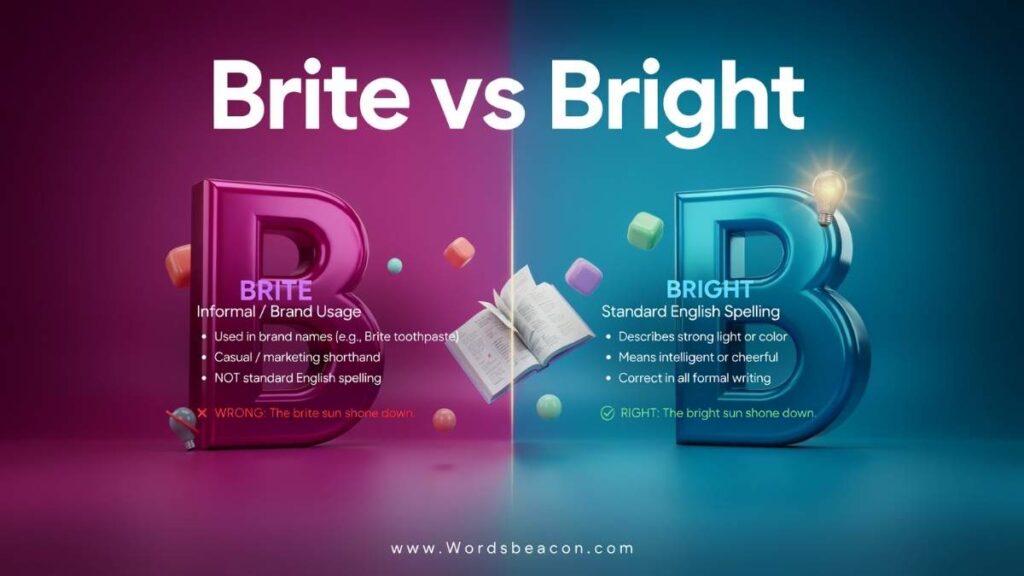
Brite vs Bright may look like a tiny spelling difference, but choosing the wrong word can leave readers scratching their heads. Bright is the correct spelling when you describe something full of light, an intelligent person, vivid colors, or a hopeful future. Brite, on the other hand, usually appears in brand and product names. So, how do you know which one to use? The good news is that the rule is simple. This guide explains the meaning of each spelling, shows you how to use them correctly, and clears up common mistakes with easy examples. By the end, you’ll know exactly when to use each one.
comparison table
| Topic | Bright | Brite |
|---|---|---|
| Standard English spelling | Yes | Generally nonstandard as an ordinary adjective |
| Meaning | Light, intelligent, vivid, cheerful, or promising | Usually depends on the name or context |
| Grammatical role | Primarily an adjective | Usually part of a proper name |
| Formal writing | Appropriate for ordinary descriptions | Appropriate when reproducing an official name |
| Brand usage | Appears in ordinary words and names | Appears in names such as Scotch-Brite and Lite-Brite |
| Example | The room looks bright. | She bought a Lite-Brite toy. |
Learn how to use confusing more words correctly
Shakey vs Shaky Which Spelling Is Correct?
Quick Answer Brite vs Bright?
Bright is the correct spelling when you want to describe something that gives off or reflects light, a person who is intelligent, a vivid color, a cheerful expression, or a hopeful situation. Brite is generally appropriate when it forms part of an established name or a deliberate stylized spelling.
Consider these examples:
- Correct: The bright sunlight warmed the garden.
- Nonstandard: The brite sunlight warmed the garden.
- Correct: She bought a Scotch-Brite cleaning pad.
- Correct: The child played with a Lite-Brite toy.
Notice that the brand examples preserve their official spelling. Although Brite and Bright may sound alike, their written forms serve different purposes.
What Does Bright Mean?
The bright meaning depends on the context. In everyday English, bright commonly describes light, colors, intelligence, moods, and future possibilities. These meanings share a general idea of intensity, clarity, or positive potential.
As an adjective, bright modifies a noun and gives readers more information about it. A bright lamp provides strong light, a bright student learns quickly, and a bright future suggests promising opportunities.
Bright Meaning Giving Off or Reflecting Light
The most direct meaning of bright relates to illumination. Something bright produces, reflects, or appears to contain a strong amount of light.
For example, sunlight streaming through a window can make a room bright. Similarly, a flashlight can produce a bright beam that helps someone see in the dark.
Examples:
- Bright sunlight filled the kitchen.
- The bright lamp illuminated the desk.
- Her phone screen was too bright for the dark room.
- We watched the bright stars in the clear night sky.
However, something doesn’t have to produce light to look bright. A white wall may appear bright because it reflects light from a nearby window.
Bright Meaning Intelligent or Quick to Learn
Bright can also describe someone who understands ideas quickly, solves problems effectively, or learns new skills with ease. In this context, the word has a meaning similar to intelligent, clever, or quick-witted.
A bright student might understand a difficult math problem after one explanation. Likewise, a bright colleague might notice a solution that others overlook.
Examples:
- The bright student understood the lesson quickly.
- Her teacher described her as bright and curious.
- He’s a bright young engineer with excellent problem-solving skills.
The phrase bright student refers to a learner who demonstrates intelligence or an ability to understand ideas quickly. It doesn’t necessarily mean that the student earns perfect grades in every subject.
Bright Meaning Cheerful or Lively
Writers also use bright to describe a cheerful mood, an energetic personality, or an expression that conveys happiness. This meaning is figurative rather than directly related to light.
For example, a bright smile suggests warmth and happiness. Similarly, a bright personality may make social situations feel more welcoming.
Examples:
- She greeted everyone with a bright smile.
- His bright personality made the meeting enjoyable.
- The children sounded bright and cheerful after their trip.
In this context, bright overlaps with cheerful, lively, and upbeat. However, the best alternative depends on the sentence.
Bright Meaning Vivid or Intense Colors
When describing color, bright refers to colors that appear vivid, intense, or visually striking. Bright colors often attract attention because they stand out against their surroundings.
Imagine a bright blue shirt against a gray background. Its vivid color may immediately catch your eye.
Examples:
- She wore a bright blue shirt to the party.
- The artist painted the walls bright yellow and orange.
- Bright flowers added color to the garden.
- The children carried bright balloons through the park.
The expression vivid colors has a closely related meaning. Both bright and vivid can describe striking colors, although vivid emphasizes the strength and clarity of the color more directly.
Bright Meaning Hopeful or Promising
A bright future is one that appears hopeful or full of potential. The phrase doesn’t refer to literal illumination. Instead, it suggests favorable opportunities, progress, or the possibility of success.
For example, a young athlete with strong skills and consistent discipline may have a bright future in sports. Similarly, a business that develops useful products and attracts loyal customers may have bright prospects.
Examples:
- Her hard work gives her a bright future.
- The company has a bright outlook after a successful launch.
- The young musician has a bright career ahead.
- Better planning could lead to brighter prospects.
Here, bright communicates optimism rather than physical light.
Learn how to use confusing more words correctly
Enrol vs Enroll correct Spelling and usage ?
What Does Brite Mean?
The meaning of Brite differs from the ordinary dictionary meaning of bright. In most everyday contexts, Brite is a nonstandard spelling rather than a separate adjective with all the meanings of bright. However, it can be entirely appropriate when it forms part of an established product name, company name, or other proper name.
For example, Scotch-Brite and Lite-Brite use distinctive spellings as part of their brand identities. These names aren’t ordinary spelling mistakes. They are intentional forms associated with specific products.
Brite in Brand Names and Products
Companies sometimes choose spellings that differ from conventional English because distinctive names can stand out in advertising, packaging, and logos. Brite offers a familiar sound while giving a name a particular visual identity.
Two recognizable examples are:
- Scotch-Brite: A brand associated with cleaning products, including scouring pads and other cleaning tools.
- Lite-Brite: A children’s creative toy that uses colored pegs and an illuminated display to create pictures.
These examples show why brand spelling matters. A company’s choice doesn’t change the standard spelling of the ordinary English word.
When writing about a product, preserve its official name. You wouldn’t ordinarily rewrite Lite-Brite as Lite-Bright simply because bright is the conventional spelling.
Brite as a Creative or Stylized Spelling
Writers and businesses sometimes use Brite in advertising slogans, logos, usernames, fictional names, and informal creative writing. The spelling may create a distinctive appearance or help a name stand out.
For example, a fictional business might call itself Brite Path Solutions. If that is the company’s official name, reproducing it accurately is appropriate.
However, context matters. If someone writes, “The path was brite and easy to see,” the spelling would normally be incorrect in standard English. The writer should use bright unless the sentence deliberately quotes a name, slogan, or other stylized text.
Creative spelling can serve a purpose, but it doesn’t automatically become standard spelling.
Is Brite a Word or a Misspelling?
The answer depends on how the word is used. Brite appears in real-world usage, particularly in proper names and commercial branding. Some dictionaries and reference sources may record particular variant or specialized uses. Nevertheless, Brite isn’t the standard spelling of the ordinary adjective meaning luminous, intelligent, vivid, or promising.
| Example | Usage | Explanation |
|---|---|---|
| The bright room felt welcoming. | Correct | Bright is the standard adjective. |
| The brite room felt welcoming. | Nonstandard | Brite incorrectly replaces the ordinary adjective. |
| She bought a Lite-Brite set. | Correct | Lite-Brite is a product name. |
| The company uses Brite in its official name. | Potentially correct | The spelling is appropriate if it matches the actual name. |
Therefore, Brite can appear as a name or stylized form without being an acceptable substitute for bright in ordinary writing.
Fix common more word mistakes in English
Panel vs Pannel Spelling and Correct usage?
Brite vs Bright Key Differences
The Bright vs Brite difference involves more than a single letter. It concerns the distinction between conventional vocabulary and stylized spelling.
Bright has established dictionary meanings and works naturally in a wide range of sentences. Brite, by contrast, usually depends on the identity of a particular product, business, or other named entity.
| Feature | Bright | Brite |
|---|---|---|
| Conventional meaning | Several established meanings | Usually context-dependent |
| Use as an adjective | Common and standard | Not standard for ordinary descriptions |
| Use in formal writing | Yes | Yes, when part of an accurate proper name |
| Use in advertising | Common | May be chosen for branding |
| Related forms | Brightly, brightness, brighter, brightest | No general set of standard adjective forms |
| Spelling status | Standard English | Usually stylized or nonstandard when used as a substitute |
Meaning and Definition
The bright definition is well established. Depending on context, the word can mean giving off or reflecting light, intelligent, cheerful, vivid in color, or likely to bring success.
The meaning of Brite is less straightforward because it often depends on the specific name in which it appears. In a product name, it may evoke ideas of light or brightness. However, readers shouldn’t assume that every use of Brite has an independent dictionary meaning equivalent to bright.
This distinction helps explain why two forms can look and sound similar without having the same grammatical status.
Standard Spelling and Grammar
Standard English spelling provides the conventional form readers expect in general writing. Bright follows that convention.
For instance:
- The bright headlights made the road easier to see.
- The bright child asked thoughtful questions.
- We chose bright colors for the classroom.
- She hopes for a bright future.
Replacing bright with brite in these examples would create nonstandard spelling unless a special context justified the choice.
The same principle applies to related forms. Standard English uses brighter, brightest, brightly, and brightness. Writers shouldn’t automatically apply these word-building patterns to Brite as though it were an ordinary adjective.
Formal and Informal Usage
The distinction between formal and informal spelling matters in academic and professional writing.
In an essay, research paper, business email, or news article, use bright when describing a light source, a person’s intelligence, a color, or an optimistic outlook. A nonstandard spelling can distract readers and make the writing appear unedited.
However, formal writing still requires accurate proper names. If a report discusses Scotch-Brite products, the name should retain its official spelling. Correct writing doesn’t mean replacing every unusual name with a conventional dictionary word.
Fix common more word mistakes in English
Grately vs Greatly difference and Correct usage?
When Should You Use Bright Instead of Brite?
The easiest way to decide between Brite or Bright is to ask what the word is doing in your sentence.
If it describes a quality, bright is usually the correct choice. If it identifies a particular brand or proper name, use the spelling officially associated with that name.
When to Use Bright
Use bright when describing any of the following:
- Light: a bright room, bright sunlight, or a bright flashlight.
- Intelligence: a bright student, a bright child, or a bright researcher.
- Color: a bright blue shirt, bright flowers, or bright decorations.
- Mood: a bright smile, a bright personality, or a cheerful expression.
- Potential: a bright future, bright prospects, or a promising career.
For example, “The bright student found a clever way to solve the problem” uses the standard adjective to describe intelligence.
Similarly, “Bright sunlight poured through the windows” uses the word to describe strong light. In both sentences, brite would be an inappropriate substitute in ordinary standard prose.
When to Use Brite
Use Brite when the context calls for that exact spelling.
Appropriate situations include:
- Writing the official name of a product such as Scotch-Brite.
- Referring to the Lite-Brite children’s toy.
- Reproducing a company’s established name accurately.
- Quoting a slogan or preserving a deliberate stylized spelling.
- Discussing Brite itself as a spelling variant or linguistic example.
One important distinction: a name isn’t necessarily a registered trademark just because a business uses it. Trademark status depends on the specific mark and its legal circumstances. The practical spelling rule remains the same: reproduce the name accurately.
Brite vs Bright Common Spelling Mistakes
Several habits lead writers to confuse these forms.
Mistake: Choosing a spelling based only on sound.
Because the words are generally pronounced alike, a writer may assume that either spelling works. However, English spelling depends on convention and context, not pronunciation alone.
Mistake: Treating a brand name as a general spelling rule.
Seeing Brite on packaging doesn’t make it acceptable to write “brite idea” in an ordinary sentence.
Mistake: Changing a proper name to match a dictionary word.
The opposite error can happen too. Rewriting an official product name with bright may make the name inaccurate.
Mistake: Assuming every unusual spelling is wrong.
Creative names and established brands can intentionally depart from ordinary spelling conventions. Always consider whether the word functions as a common adjective or as part of a name.
Fix common more word mistakes in English
Excel vs Accel Which Spelling Is Correct?
Brite vs Bright Pronunciation Guide
The Brite vs Bright pronunciation question is straightforward in ordinary usage: the two spellings are generally pronounced the same when Brite represents the word bright.
In American English, bright is commonly pronounced /braɪt/. It has one syllable and ends with the /t/ sound.
The pronunciation begins with the consonant blend /br/, followed by the vowel sound /aɪ/, as heard in words such as light and my.
Brite uses the same general sound when it represents the same word. However, the pronunciation of a particular proper name should be checked if its creator has established a different reading.
Are Brite and Bright Homophones?
In ordinary usage, they are homophones when pronounced identically. Homophones are words or forms that sound alike but differ in spelling or meaning.
English has many examples, including right and write, sea and see, and brake and break.
However, Brite and bright aren’t interchangeable simply because they sound alike. Their spelling and function still matter. This is one reason English spelling can confuse learners: pronunciation doesn’t always tell you which written form to choose.
Bright Grammar Rules and Word Forms
Understanding the grammar of bright helps explain why Brite cannot normally replace it in everyday writing.
Bright as an Adjective
An adjective describes a noun or gives more information about it. Bright can describe a lamp, a student, a color, a mood, or a future possibility.
Examples:
- The bright lamp lit the hallway.
- We welcomed a bright student into the program.
- She wore a bright blue shirt.
- They discussed several bright ideas.
In each sentence, bright tells readers something about the noun.
Bright After Linking Verbs
Bright can also follow linking verbs such as be, look, seem, and feel.
Examples:
- The room looks bright.
- Her future seems bright.
- The colors are bright.
- His smile was bright.
The adjective describes the subject rather than showing how an action occurs. This differs from an adverb such as brightly, which can describe the manner of an action.
For example, “The stars shone brightly” uses the adverb to explain how the stars shone.
Comparative and Superlative Forms of Bright
The standard comparative form is brighter. The standard superlative form is brightest.
| Form | Example |
|---|---|
| Base adjective | This lamp is bright. |
| Comparative | This lamp is brighter than the old one. |
| Superlative | This is the brightest lamp in the store. |
These forms can describe light intensity, color, intelligence, or other relevant qualities.
For example, “Maya is a bright student” describes her intelligence. “Maya is the brightest student in the group” compares her with the others.
Brightly and Brightness
Brightly is an adverb, while brightness is a noun.
- Brightly: The screen glowed brightly.
- Brightness: Reduce the screen’s brightness before bedtime.
Another related form is brighten, meaning to make or become brighter. Its past-tense form is brightened.
These are established English word forms. Brite doesn’t replace the standard spelling in these related words.
Understand confusing English more words simply
Journeys vs journies Correct Spelling and usage ?
Brite vs Bright Examples Correct and Incorrect Usage
Examples make the spelling distinction easier to remember. The following sentences show how bright works in different contexts and why Brite generally belongs in proper names rather than ordinary descriptions.
Ten Example Sentences Using Bright
- The bright sunlight made it difficult to see the road clearly.
- She wore a bright blue shirt to the family gathering.
- Our teacher praised the bright student for asking thoughtful questions.
- The children decorated the classroom with bright yellow balloons.
- His bright smile made everyone feel welcome.
- The company believes its new product has a bright future.
- A bright flashlight helped us find the keys under the sofa.
- The artist used bright colors to make the painting stand out.
- Despite the difficult start, the team has bright prospects for the season.
- The room looked brighter after we opened the curtains.
These examples demonstrate the range of meanings associated with bright. The word can describe physical light, visual intensity, intelligence, happiness, and future potential.
Five Example Sentences Using Brite
The following examples show how Brite may appear in established names or clearly identified creative contexts.
- She bought a Scotch-Brite sponge for cleaning the kitchen.
- The child used a Lite-Brite toy to create a colorful picture.
- The product label displayed the name Scotch-Brite.
- The fictional business called itself Brite Path Solutions.
- The advertisement used Brite as a deliberate spelling choice in its slogan.
The first three examples refer to established product names. The fourth and fifth illustrate hypothetical creative uses, not claims about actual companies or advertising campaigns.
Notice the difference: Brite identifies a particular name or deliberate spelling choice. It doesn’t function as a standard substitute for bright in ordinary writing.
Incorrect vs Correct Usage
| Incorrect or nonstandard | Correct standard English | Reason |
|---|---|---|
| The brite sunlight warmed the garden. | The bright sunlight warmed the garden. | Use the standard adjective for light. |
| She is a brite student. | She is a bright student. | Bright describes intelligence. |
| We painted the walls brite yellow. | We painted the walls bright yellow. | Bright describes vivid color. |
| He has a brite future ahead. | He has a bright future ahead. | Bright expresses promise or optimism. |
| She bought a Scotch-Bright pad. | She bought a Scotch-Brite pad. | Preserve the product’s official spelling. |
The last example is especially useful. Correct spelling isn’t always about replacing unusual forms with familiar ones. Sometimes the accurate choice is to preserve a brand’s distinctive name.
Understand confusing English more words simply
Drier vs Dryer Differences and Correct Usage ?
Brite vs Bright in Everyday and Professional Writing
The setting can help determine which spelling belongs in your sentence. Standard English conventions remain the same across most writing contexts, but proper names and creative language introduce a few exceptions.
Everyday Conversations and Messages
In everyday writing, use bright to describe a person, place, object, or situation.
For example:
- “It’s a bright, sunny morning.”
- “Your daughter is a bright kid.”
- “I love the bright colors in that painting.”
Even in text messages and social media posts, bright is the usual spelling when you mean the ordinary adjective.
Someone might write brite as a joke, nickname, or personal stylistic choice. That doesn’t make it the standard spelling.
Academic and Professional Writing
Academic writing, business communication, and journalism generally call for standard English spelling.
A student should write, “The experiment produced a bright light,” rather than “The experiment produced a brite light.” Similarly, a business report might describe an opportunity as a bright prospect.
Professional writing also requires accuracy when identifying products and companies. If a report discusses Scotch-Brite cleaning products, changing the brand’s spelling would be an error.
A useful editing rule is to check the role of the word:
- If it describes something, use bright.
- If it identifies a particular name, verify and preserve that name’s spelling.
Advertising, Branding, and Product Labels
Marketing often uses stylized spelling to create a distinctive brand identity. A business may choose an unconventional form because it looks memorable, fits a logo, or distinguishes the name from ordinary vocabulary.
Brite can serve this purpose because readers can readily connect its sound with bright. However, a brand’s decision reflects its naming strategy, not a change to general English spelling rules.
Commercial branding also involves more than spelling. Companies may use particular capitalization, hyphens, symbols, or word combinations as part of their visual identity. Writers should follow official naming conventions when referring to those products.
Brite vs Bright Etymology and Word Origin
The history of bright helps explain why it has such a broad range of meanings today.
Origin and History of Bright
Bright comes from Old English beorht, a word associated with brightness, radiance, and shining. Its historical roots connect the modern adjective with the idea of light.
Over time, English extended the word beyond physical illumination. A person described as bright could be understood as mentally sharp, while a bright future came to suggest favorable possibilities.
These related meanings remain common in modern English. A bright lamp, bright student, bright color, and bright future refer to different things, yet each conveys some form of intensity, clarity, or positive potential.
Origin and Use of Brite
Brite is commonly used as a simplified or stylized spelling of bright, especially in names and commercial branding. Its appearance in a particular product name reflects the naming choice associated with that product.
There isn’t one universal origin story for every name containing Brite. Different companies and creators may choose the spelling for different reasons.
It’s therefore more accurate to explain Brite through its context than to claim that all uses share a single historical source or independent meaning.
Understand confusing English more words simply
Whiny vs Whiney Correct Spelling and How to Use Each
Brite vs Bright Related Words and Synonyms
Readers searching for a Brite vs Bright synonym often want another word that conveys light, intelligence, vivid color, or optimism. The best replacement depends on the intended meaning.
| Word | Main meaning | Example |
|---|---|---|
| Brilliant | Very bright, highly intelligent, or exceptionally impressive | She offered a brilliant solution. |
| Luminous | Giving off or seeming to give off light | The luminous moon lit the landscape. |
| Radiant | Shining brightly or expressing great happiness | Her radiant smile lit up the room. |
| Vivid | Clear, intense, or striking, especially in color or description | The artist painted vivid flowers. |
| Smart | Intelligent or showing good judgment | He’s a smart problem-solver. |
| Clever | Quick to understand or skillful at finding solutions | That was a clever idea. |
| Cheerful | Happy, positive, or pleasant | She has a cheerful personality. |
| Promising | Showing signs of future success | The young athlete is promising. |
These words overlap with some meanings of bright, but they aren’t exact substitutes in every sentence.
For example, luminous sunlight may sound appropriate in a descriptive passage, while a luminous student would be unusual if you simply mean that the student is intelligent. In that context, bright, smart, or intelligent would sound more natural.
Likewise, vivid works particularly well for color, while promising may communicate future potential more directly.
Bright vs Brilliant
Both words can describe intelligence or light. However, brilliant often suggests exceptional intelligence, intense light, or an especially impressive achievement.
- The bright student understood the lesson.
- The brilliant student developed an original solution.
The second sentence emphasizes an unusually strong performance, although the exact difference depends on context.
Bright vs Smart
Bright and smart can both describe intelligence. Smart often refers to practical judgment, reasoning, or the ability to make good decisions. Bright can emphasize quick learning or natural ability.
For example, a bright student may understand a new concept quickly, while a smart decision may reflect careful judgment.
Bright vs Shiny
Bright can describe strong illumination or vivid color. Shiny describes a surface that reflects light and appears glossy.
A bright lamp produces light. A shiny spoon reflects light from its polished surface. The distinction becomes clearer when you focus on whether you’re describing illumination or a surface’s appearance.
Bright vs Vivid
Bright can describe light intensity as well as color. Vivid emphasizes strong, clear, or striking color and imagery.
A bright yellow jacket may stand out in a crowd. A vivid description may help readers imagine a scene in detail.
Bright vs Light
Light and bright sometimes overlap, but they don’t mean exactly the same thing.
Light can refer to illumination, low weight, or a pale color. Bright often describes strong illumination, vivid color, intelligence, or optimism.
For example, a light blue shirt has a pale shade of blue. A bright blue shirt has a vivid shade that attracts attention. Depending on the actual color, a shirt could be both light and bright, but the words emphasize different qualities.
Understand confusing English more words simply
Suing vs Sueing Which Spelling Is Correct?
British English vs American English Does the Spelling Change?
The standard spelling is bright in American English and British English. The distinction between Brite and Bright isn’t a regional spelling difference like color and colour.
The same general rule applies in Canadian and Australian English. Writers use bright as the standard adjective, while Brite may appear in particular names or stylized expressions.
| Variety of English | Standard spelling | Is Brite a standard substitute? |
|---|---|---|
| American English | Bright | No |
| British English | Bright | No |
| Canadian English | Bright | No |
| Australian English | Bright | No |
Regional vocabulary and spelling conventions can differ, but they don’t make brite a standard replacement for bright in ordinary descriptive writing.
Understand confusing English more words simply
Nosy vs Nosey Which one Is Correct?
practice session Brite vs Bright
Complete each sentence with the correct word: Brite vs Bright . Use “bright” for the standard English adjective and “brite” when referring to a brand name or a stylized product name.
- The sun was so ______ that we needed sunglasses.
- Mia is a ______ student who understands new ideas quickly.
- We bought a new cleaning pad made by Scotch-______.
- The room looked ______ after we opened the curtains.
- The artist used ______ colors to make the painting stand out.
- The children played with their ______ and colorful toys.
- My future looks ______ because I have several exciting opportunities.
- Dad bought a Lite-______ toy for my little brother.
- The stars looked especially ______ in the clear night sky.
- Her ______ smile made everyone feel welcome.
- The teacher praised Daniel for his ______ answer.
- Please use the correct spelling, “______,” when describing a well-lit room.
- The company created a new product and gave it the name “Super-______.”
- The yellow curtains made the living room feel ______ and cheerful.
- The scientist came up with a ______ solution to the problem.
- The flashlight was not ______ enough to light the entire path.
- We saw the official Scotch-______ logo on the package.
- The young athlete has a ______ future ahead of her.
- The designer chose ______ shades of blue and green for the website.
- Remember that “______” is the standard spelling when you mean intelligent, vivid, or full of light.
Answers
- bright
- bright
- Brite
- bright
- bright
- bright
- bright
- Brite
- bright
- bright
- bright
- bright
- Brite
- bright
- bright
- bright
- Brite
- bright
- bright
- bright
Here’s a trusted source for clear word meanings:
FAQs
What is the difference between Brite and Bright?
Bright is the standard English spelling used to describe light, intelligence, vivid colors, cheerful moods, or promising futures. Brite is a stylized spelling most often found in brand and product names.
Can you use Brite in formal writing?
Use bright in formal writing when describing something that shines, displays vivid colors, or shows intelligence. Use Brite only when referring to a brand or product that officially uses that spelling.
Why do some brands use Brite instead of Bright?
Some brands choose Brite to create a distinctive, memorable product name. This stylized spelling helps a name stand out, but it does not replace bright in standard English.
What are the different meanings of Bright?
Bright has several meanings depending on context. It can describe something that gives off light, a person who is intelligent, a vivid color, a cheerful mood, or a future full of promise.
How do you use Bright as an adjective in a sentence?
Use bright to describe a noun or to provide information after a linking verb. For example, “She wore a bright yellow jacket” and “The room looks bright” both use the adjective correctly.
What is the comparative form of Bright?
The comparative form is brighter. Use it to compare two people or things, as in “This lamp is brighter than the old one.”
What is the superlative form of Bright?
The superlative form is brightest. Use it when comparing three or more things, as in “That is the brightest star in the sky.”
What is the difference between Bright and Brightly?
Bright is an adjective that describes a person, place, or thing. Brightly is an adverb that describes how an action happens. For example, “a bright light” uses the adjective, while “the light shines brightly” uses the adverb.
What is the noun form of Bright?
The noun form is brightness. It describes the quality or degree of being bright, as in “The brightness of the screen hurt my eyes.”
Can Bright describe a person’s personality?
Yes. Bright can describe someone who is cheerful, lively, intelligent, or full of promise. For example, “Her bright personality makes everyone feel welcome.”
What is a good synonym for Bright in professional writing?
Choose a synonym that matches your intended meaning. Use “intelligent” for a capable person, “luminous” for something that gives off light, “vivid” for a strong color, or “promising” for a hopeful future.
Does Bright always have a positive meaning?
No. Bright often suggests intelligence, cheerfulness, or hope, but it can also describe light that feels harsh or uncomfortable. For example, “The bright headlights made it difficult to see the road.”
How can you remember when to use Brite or Bright?
Use bright for ordinary descriptions in everyday, academic, and professional writing. Remember Brite as a special spelling used in certain brand and product names. Unless you are referring to a name that officially uses Brite, choose bright.
Conclusion
The difference between Brite vs Bright is easy to remember once you know how to use each spelling. Bright is the correct choice in everyday English when you describe a light, an intelligent person, a vivid color, or a hopeful future. Brite, however, is usually used in specific brand and product names. So, if you want to describe a bright room or a bright idea, leave out the extra spelling confusion and choose bright.
Think of it this way: your ideas can be bright, your future can look bright, and a room can be bright enough to make you reach for your sunglasses. But if a product spells its name Brite, keep its official spelling. One small spelling mistake can distract readers, even when your meaning is clear. Remember this simple rule: use bright in regular sentences and Brite only when a name specifically calls for it. Now you can write with confidence without letting these two spellings dim your grammar skills!

Luna AJS is an experienced blogger and dedicated language enthusiast at Words Beacon. She specializes in making English grammar, spelling, vocabulary and commonly confused words easy to understand. She provides clear explanations, practical examples to help readers write with confidence.