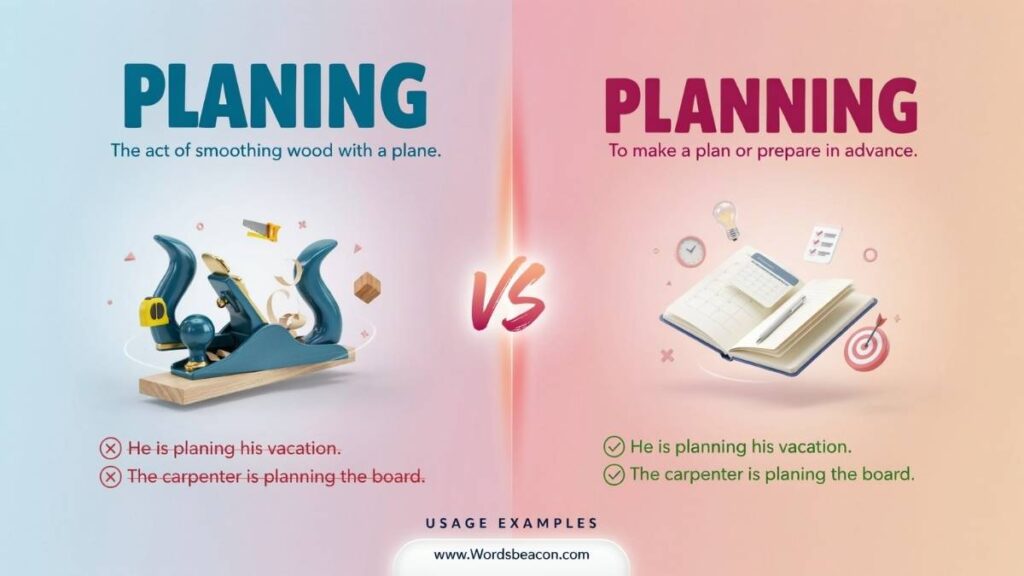
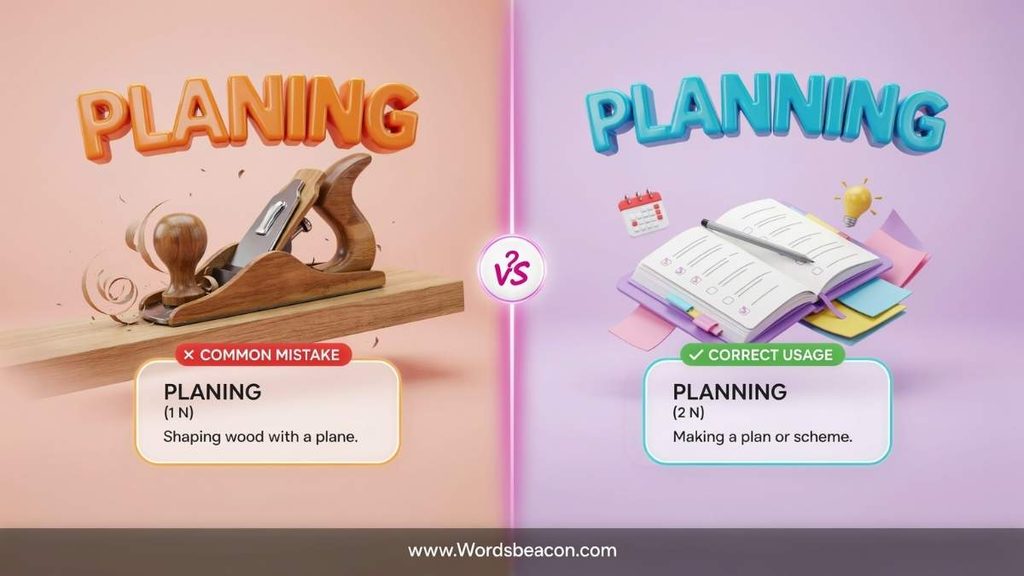
Planing vs Planning can be confusing because these two words look almost identical, yet they have completely different meanings. Imagine writing about planning a vacation but accidentally making it sound like you’re smoothing a wooden table. That’s quite a spelling mishap! The difference is simple once you understand it. Planning means organizing or preparing for something, while planing means smoothing wood with a special tool. One helps you get ready for the future, and the other belongs in a woodworking shop. In this guide, you’ll learn how to use each word correctly and avoid this common spelling mistake.
quick comparison
| Difference | Planning | Planing |
|---|---|---|
| Base word | Plan | Plane |
| Main meaning | Preparing or organizing something | Smoothing a surface with a plane |
| Spelling rule | Double the final n before adding -ing | Drop the silent e before adding -ing |
| Pronunciation | PLAN-ing | PLAY-ning |
| Common contexts | Work, school, travel, events, business | Woodworking, construction, marine terminology |
| Example | We’re planning a family vacation. | He’s planing the wooden door. |
| Common mistake | Writing “planing” when you mean making arrangements | Writing “planning” when you mean smoothing wood |
Understand confusing English more words simply
Blankie vs Blanky Which Spelling Is Correct?
What Does Planning Mean?
Planning means thinking ahead and deciding how to achieve a goal. It involves considering what you need to do, which resources you need, how much time you have, and what steps will help you reach your desired result.
You might plan a birthday party, organize a work project, prepare for an examination, or decide how to spend your weekend. In each situation, planning helps you turn an idea into an organized course of action.
For example:
- We’re planning a surprise party for my sister.
- The team is planning its next marketing campaign.
- Careful planning helped us finish the project on time.
- She spends Sunday evening planning her week.
- They’re planning to move into a larger house next year.
In every example, planning involves preparation, decisions, or arrangements. It doesn’t involve smoothing a physical surface.
Planning as a Noun
Planning often functions as a noun when you describe the process of preparing for something.
For example:
- Good planning makes a busy week easier to manage.
- The event requires careful planning.
- Financial planning can help people prepare for future expenses.
- The success of the project depends on detailed planning.
Here, planning names an activity rather than simply describing what someone is doing at a particular moment.
You’ll often see it in expressions such as:
- Event planning
- Business planning
- Career planning
- Travel planning
- Strategic planning
- Financial planning
- Project planning
- Urban planning
Although these phrases cover different subjects, they share the same basic idea: organizing decisions and actions to achieve a particular purpose.
Planning as a Verb Form
Planning also acts as the present participle of the verb plan. You can use it with a form of the verb be to describe an ongoing action.
For example:
- I’m planning a short trip.
- She’s planning her wedding.
- We’re planning a new website.
- They were planning a weekend getaway.
Planning can also function as a gerund, which means an -ing verb form acts as a noun.
For example:
- Planning takes time.
- I enjoy planning family gatherings.
- Planning ahead reduces unnecessary stress.
Notice the difference between these two sentences:
| Sentence | How planning functions |
|---|---|
| We’re planning a trip. | Part of the verb phrase describing an ongoing action |
| Planning a trip takes time. | Gerund phrase functioning as the subject |
| Careful planning matters. | Noun referring to the process |
The word keeps the same spelling in each case because every example comes from the verb plan.
Understand confusing English more words simply
Cocoon vs Cacoon which spelling is correct ?
What Does Planing Mean?
Planing is the present participle of plane. In woodworking, to plane something means to remove thin layers of material from a surface using a tool called a plane.
Woodworkers use this process to smooth rough boards, flatten uneven areas, adjust the thickness of a piece of wood, or help two wooden pieces fit together properly.
For example:
- The carpenter is planing the edge of the door.
- He spent the afternoon planing a rough wooden board.
- The cabinetmaker is planing the surface until it feels smooth.
- She is planing the tabletop to remove uneven spots.
In these sentences, planing describes a physical process involving a surface and a tool.
The difference becomes clearer when you compare the verbs themselves. You plan a project, but you plane a piece of wood.
Planing in Woodworking
Woodworking provides the clearest everyday example of the word planing.
Imagine that a carpenter makes a wooden door, but the bottom edge catches against the floor. Rather than replacing the door, the carpenter may remove a thin layer of wood to improve the fit.
The carpenter planes the bottom edge. The action is planing.
Planing can serve several purposes:
- Smoothing a rough wooden surface.
- Removing small imperfections.
- Reducing the thickness of a board.
- Making an edge more even.
- Helping wooden parts fit together accurately.
A hand plane uses a sharp blade to shave thin layers from wood. Power planers perform a similar task with a powered cutting mechanism.
The key point is that planing refers to working on a material, not preparing a schedule or deciding what to do.
Planing in Other Technical Contexts
Although woodworking is the most familiar use, planing also appears in specialized fields.
In road construction, planing can describe the removal of a layer from a road surface. Road crews may use machinery to remove worn or uneven pavement before resurfacing it.
In marine terminology, a boat can plane when it rises and skims across the water at sufficient speed. This meaning relates to the movement of the boat rather than the act of smoothing wood.
For example:
- The crew used a milling machine for planing the damaged road surface.
- The speedboat began planing as it accelerated across the lake.
These technical uses are less common in everyday conversation than planning a trip or planing a board. However, they demonstrate why the word planing is not simply a misspelling of planning.
Fix common more word mistakes in English
Brite vs Bright Correct Spelling and usage ?
Why Do Planning and Planing Have Different Spellings?
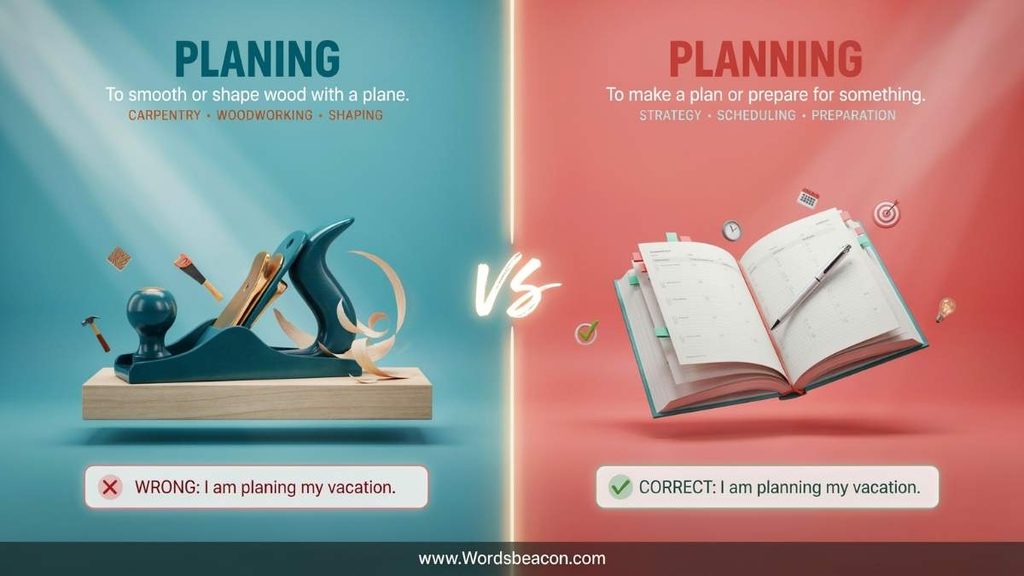
The difference comes from the spelling rules English uses when adding the suffix -ing to a verb.
The base words are plan and plane. Although they differ by only one letter, they follow two different spelling patterns.
The Rule for Planning Double the Final Consonant
The verb plan becomes planning because English usually doubles the final consonant of a short verb that ends in a consonant-vowel-consonant pattern when adding a suffix beginning with a vowel.
The spelling changes like this:
Plan + ing = planning
The word plan has three letters:
- p is the first consonant.
- a is the vowel.
- n is the final consonant.
Because the word ends in a consonant-vowel-consonant pattern, we double the final n before adding -ing.
The same general pattern appears in other verbs:
| Base verb | Correct -ing form | Spelling change |
|---|---|---|
| Run | Running | Double n |
| Sit | Sitting | Double t |
| Swim | Swimming | Double m |
| Stop | Stopping | Double p |
| Plan | Planning | Double n |
This rule explains why planning contains two n’s. The extra consonant isn’t decorative, and it isn’t optional in standard spelling.
Writing planing when you mean making arrangements removes the consonant that the spelling rule requires.
The Rule for Planing Drop the Silent E
The verb plane follows a different pattern. When a verb ends in a silent e, we usually remove that e before adding -ing.
Plane + ing = planing
The final e disappears, but the n remains single.
Other examples follow the same pattern:
| Base verb | Correct -ing form | Spelling change |
|---|---|---|
| Make | Making | Drop e |
| Write | Writing | Drop e |
| Bake | Baking | Drop e |
| Hope | Hoping | Drop e |
| Plane | Planing | Drop e |
The word plane contains a silent e at the end. When you add -ing, you remove that e instead of doubling the n.
That produces planing, not planeing.
Why the Rules Matter
Both words follow familiar English spelling patterns. The confusion arises because their base forms look so similar.
When you start with plan, you double the n:
Plan → planning
When you start with plane, you drop the e:
Plane → planing
Remember the base word first. Once you identify whether the verb is plan or plane, the correct spelling becomes much easier to determine.
Are There Exceptions to These Rules?
English spelling rules have exceptions, so you shouldn’t assume that every short verb follows exactly the same pattern.
For example, open becomes opening rather than openning. The final consonant doesn’t double because the word’s stress pattern and ending differ from those of a short verb such as plan.
Similarly, verbs ending in two consonants generally don’t double the last one before -ing. Think of help becoming helping or jump becoming jumping.
The useful lesson is to learn the pattern without treating it as a rule that applies to every verb.
For this particular pair, however, the standard spellings are straightforward:
- Plan becomes planning.
- Plane becomes planing.
Fix common more word mistakes in English
Shakey vs Shaky Which Spelling Is Correct?
Planing vs Planning Pronunciation Differences
The two words don’t sound the same in standard American English.
Planning is pronounced PLAN-ing, while planing is pronounced PLAY-ning. The main difference lies in the vowel sound.
| Word | Simple pronunciation | Vowel sound |
|---|---|---|
| Planning | PLAN-ing | Short a, as in cat |
| Planing | PLAY-ning | Long a, as in day |
In planning, the first syllable contains the short vowel sound heard in words such as cat, map, and hand.
In planing, the first syllable sounds like the word plane, which rhymes with train and lane.
The difference becomes easier to hear when you say the base words aloud:
- Plan sounds like the beginning of planning.
- Plane sounds like the beginning of planing.
If you struggle to distinguish the words in speech, focus on the vowel rather than the final -ing sound. The endings are similar, but the first syllables are different.
Pronunciation can vary slightly across accents. Nevertheless, the standard distinction between the short a in planning and the long a in planing remains a useful guide.
Planing vs Planning Examples in Everyday Sentences
Definitions explain the difference, but real sentences show you how each word works in context.
The following examples cover common situations involving work, school, home life, and practical tasks.
Examples of Planning
Use planning when someone prepares, organizes, or decides what to do.
- We’re planning a family vacation for December.
- Maya is planning her study schedule for the final exams.
- The company is planning to launch a new product.
- Careful planning helped the team meet its deadline.
- I enjoy planning birthday parties for my children.
- They spent weeks planning their wedding.
- The teacher is planning tomorrow’s classroom activities.
- He’s planning to start a small business.
- Our travel planning included hotel reservations and transportation.
- Planning ahead can help you avoid last-minute problems.
In each example, the word relates to an idea, an arrangement, a decision, or preparation for the future.
Examples of Planing
Use planing when the sentence describes the act of smoothing or removing material, or when it refers to an established technical meaning.
- The carpenter is planing the wooden frame.
- He finished planing the board before assembling the shelf.
- She is planing the door so it closes properly.
- The woodworker spent an hour planing the rough surface.
- The cabinetmaker is planing the edges to make them even.
- The boat began planing as it picked up speed.
- Road crews used specialized equipment for planing the pavement.
- The craftsman checked the board after planing it.
The woodworking examples describe removing or smoothing material. The boating example uses a separate technical meaning related to a vessel skimming across the water.
A Quick Comparison Table
Consider these similar-looking sentences. Each one uses a different word because the intended action changes.
| Incorrect or correct meaning | Sentence | Why |
|---|---|---|
| Planning | We’re planning a new kitchen. | The speakers are organizing a project. |
| Planing | We’re planing a new kitchen cabinet door. | The speakers are smoothing the wood. |
| Planning | She’s planning the furniture layout. | She is deciding where things should go. |
| Planing | She’s planing the wooden tabletop. | She is smoothing the surface. |
| Planning | They spent all morning planning the renovation. | They discussed and organized the work. |
| Planing | They spent all morning planing the boards. | They worked on the wood itself. |
Notice that both words can appear in conversations about woodworking or home improvement. The subject alone doesn’t determine the spelling. The action does.
Someone planning a renovation is deciding what to do. Someone planing a board is physically changing its surface.
Fix common more word mistakes in English
Enrol vs Enroll correct Spelling and usage ?
Common Mistakes When Using Planning and Planing
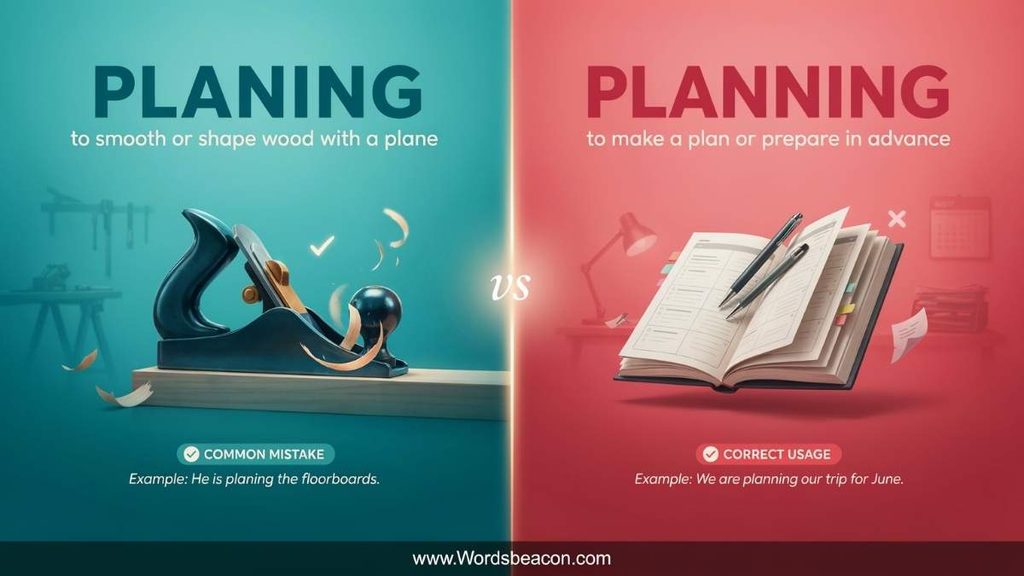
Even experienced writers sometimes confuse similar-looking words, especially when typing quickly or relying on spell-checking software.
Here are the most common errors and how to correct them.
Mistake 1 Writing Planing When You Mean Planning
Incorrect: We are planing our summer vacation.
Correct: We are planning our summer vacation.
The sentence describes organizing a trip, so planning is the right choice.
The incorrect version suggests that someone is using a plane on a surface, which doesn’t fit the intended meaning.
Mistake 2 Writing Planning When You Mean Planing
Incorrect: The carpenter is planning the wooden door.
Correct: The carpenter is planing the wooden door.
The carpenter is smoothing the door, not making arrangements for it.
However, the incorrect sentence could make sense in a different context. A carpenter can plan a door installation, for example, if the sentence describes organizing the work. The surrounding words determine the intended meaning.
Mistake 3 Writing Planeing
Incorrect: He is planeing the board.
Correct: He is planing the board.
The verb plane loses its final silent e before the suffix -ing. Therefore, planeing is not the standard spelling.
Remember familiar examples such as making, writing, and baking. The same rule applies to planing.
Mistake 4 Writing Planing for Every -Ing Form of Plan
Incorrect: I’m planing to study tonight.
Correct: I’m planning to study tonight.
When you use the verb plan, you must double the n before adding -ing.
The same applies to expressions such as planning a trip, planning a meeting, and planning ahead.
Mistake 5 Trusting Spell-Check Without Checking the Meaning
Spell-checking tools can catch many typographical errors, but they may not flag planning versus planing because both words exist.
For example, a program may accept this sentence:
“We’re planing a weekend trip.”
The spelling itself is valid in another context, but the meaning doesn’t match the sentence.
That is why proofreading requires more than checking whether a word appears in a dictionary. You must also confirm that it expresses the right idea.
Fix common more word mistakes in English
Panel vs Pannel Spelling and Correct usage?
How to Remember Planning vs Planing
If you frequently mix up these spellings, a simple memory trick can help.
Use the Double-N Reminder
Planning involves making plans, and both plan and planning begin with the same letters.
Think of it this way:
Plan + another n + ing = planning
When you write about schedules, goals, meetings, or future arrangements, remember the double n.
Connect Planing With Plane
Planing comes from plane, the tool used to smooth wood.
Imagine a carpenter holding a hand plane against a rough board. The word plane has a silent e, and that e disappears when you add -ing.
Plane becomes planing.
This mental image connects the spelling to the action, making it easier to recall.
Ask Yourself One Question
Before choosing either word, ask:
“Am I organizing something, or am I smoothing something?”
If you’re organizing, choose planning.
If you’re smoothing wood or describing another technical use of plane, choose planing.
This quick check works especially well when proofreading emails, school assignments, work documents, and blog posts.
Learn how to use confusing more words correctly
Grately vs Greatly difference and Correct usage?
Planing vs Planning in Different Contexts
The correct choice depends on the situation. Looking at the surrounding words can help you recognize which meaning fits.
At Work
Planning is common in business and professional writing because people often organize projects, budgets, deadlines, and meetings.
For example:
- The department is planning next quarter’s budget.
- Our planning process includes a review of project risks.
Planing is less common in ordinary office communication. However, it may appear in manufacturing, carpentry, construction, or technical documentation.
For example:
– The workshop is planing wooden panels before assembly.
At School
Students and teachers often use planning when discussing assignments, lessons, exams, and study routines.
For example:
- I’m planning my revision schedule for next week.
- The teacher is planning a science activity.
Planing would generally appear in a practical lesson involving woodworking or a related technical subject.
For example:
– The students practiced planing a piece of wood in the workshop.
At Home
Planning can describe organizing a family event, arranging furniture, preparing meals, or scheduling household tasks.
For example:
- We’re planning a family dinner.
- She’s planning the layout of her new kitchen.
Planing might appear during a home repair project.
For example:
– He’s planing the edge of a wooden door because it sticks against the frame.
The context changes, but the spelling rule stays the same.
In Construction and Manufacturing
Both words can appear in these fields, but they describe different activities.
Planning involves deciding how a project will proceed. It may include estimating costs, scheduling workers, choosing materials, and setting deadlines.
Planing involves removing material from a surface. Depending on the field, that material may be wood or pavement.
For example:
- The construction manager is planning the renovation schedule.
- The workshop is planing the timber for the new staircase.
A construction project might involve both activities at different stages. Workers plan the job before they begin, and a carpenter may plane the wood during the work itself.
Learn how to use confusing more words correctly
Excel vs Accel Which Spelling Is Correct?
Is Planing vs Planning Ever a Regional Spelling Difference?
No. Planning and planing aren’t British and American spelling variants of the same word.
Both forms exist in standard English, but they have different meanings. You should choose between them according to the action you want to describe, not the country where your audience lives.
American English and British English both use planning for preparing or organizing something. They also use planing for the relevant woodworking and technical meanings.
Some English words genuinely differ by region. For example, American English usually uses color, while British English uses colour. But planning versus planing doesn’t follow that pattern.
The difference is semantic and grammatical rather than regional.
Planing vs Planning Related Words You Should Know
Understanding the base words can prevent other spelling and usage errors.
Plan
Plan is a verb when it describes deciding how to do something.
Examples:
- I plan to visit my grandparents.
- We plan our meals every Sunday.
- They plan to open a new store.
Plan can also be a noun referring to an idea or arrangement.
Examples:
- We have a plan for the weekend.
- Her business plan includes a marketing budget.
Plane
Plane can refer to several things, including an aircraft, a flat surface, or a woodworking tool. As a verb, it can describe smoothing a surface with a plane.
Examples:
- The plane landed safely.
- The carpenter used a plane to smooth the wood.
- The carpenter will plane the rough edge.
The word’s meaning depends on how you use it in the sentence.
Planned
Planned is the past tense and past participle of plan.
Examples:
- We planned the event last month.
- She had planned a quiet weekend.
- The team planned its response carefully.
Notice that planned has two n’s, just like planning. The spelling rule for the past tense also doubles the final consonant.
Planes
Planes is the plural of plane when the word refers to aircraft or woodworking tools.
Examples:
- Three planes waited on the runway.
- The workshop has several hand planes.
In other contexts, planes can refer to flat surfaces or levels.
Learning these related forms makes the difference between plan and plane easier to recognize.
Learn how to use confusing more words correctly
Journeys vs journies Correct Spelling and usage ?
practice session Planning vs Planing
Choose the correct word, planning vs planing, to complete each sentence. Write your answers from 1 to 20, then check the answer key at the end.
1. We are __________ a family vacation for next summer.
2. The carpenter is __________ the rough wooden table.
3. Good __________ helps you finish tasks on time.
4. She is __________ her wedding for next spring.
5. The woodworker spent an hour __________ the edges of the board.
6. They are __________ to open a new restaurant.
7. The carpenter finished __________ the door so it would close properly.
8. Careful __________ can prevent many problems.
9. I enjoy __________ birthday parties for my friends.
10. He is __________ the wooden surface to make it smooth.
11. Our teacher is __________ a fun activity for the class.
12. The craftsman used a hand plane for __________ the piece of wood.
13. We spent the evening __________ our weekend trip.
14. The cabinetmaker is __________ the wooden panels before assembling the cabinet.
15. She believes that __________ ahead makes life easier.
16. The carpenter is __________ the edge of the door to remove a small amount of wood.
17. They are __________ a surprise party for their parents.
18. The workshop uses special tools for __________ wooden boards.
19. I’m __________ my study schedule for the final exams.
20. The carpenter completed the __________ of the board before painting it.
Answers
- planning
- planing
- planning
- planning
- planing
- planning
- planing
- planning
- planning
- planing
- planning
- planing
- planning
- planing
- planning
- planing
- planning
- planing
- planning
- planing
Here’s a trusted source for clear word meanings:
FAQs
What is correct, planing vs planning?
Both words are correct, but they have different meanings. Planning means preparing or organizing something, while planing usually refers to smoothing a wooden surface with a special tool.
Is it Planing vs Planning wood?
Planing is the correct word when you mean smoothing wood. A carpenter planes wood to remove thin layers, smooth rough surfaces, or make a wooden piece fit properly.
What is the meaning of planing?
Planing is the process of removing thin layers from a surface, especially wood, using a tool called a plane. In boating, planing can also describe a boat skimming across the water at sufficient speed.
Why does planning have two n’s?
Planning has two n’s because the verb plan doubles its final consonant before adding -ing. The word follows the consonant-vowel-consonant pattern, so plan becomes planning.
Why does planing have only one n?
Planing comes from the verb plane. When adding -ing to a verb that ends in a silent e, you usually drop the e. Therefore, plane becomes planing, not planeing.
How do you use planning in a sentence?
Use planning when describing preparation or organization. For example, “We are planning a family vacation” means you’re making arrangements for a trip.
How do you use planing in a sentence?
Use planing when describing the act of smoothing a surface. For example, “The carpenter is planing the wooden door” means the carpenter is removing a thin layer of wood.
Do planning and planing sound the same?
No. In standard American English, planning sounds like “PLAN-ing,” while planing sounds like “PLAY-ning.” The main difference is the vowel sound in the first syllable.
Is planing a real English word?
Yes, planing is a standard English word and the -ing form of plane. It commonly refers to smoothing wood, but it also appears in technical contexts such as road construction and boating.
What is the difference between plan, plane, planning, and planing?
Plan means to prepare or organize something, while plane can refer to a woodworking tool or the act of smoothing a surface. Planning is the -ing form of plan, and planing is the -ing form of plane.
Is Planing vs Planning correct in American and British English?
Both spellings are correct in American and British English. Neither is a regional spelling variation of the other. The correct choice depends on whether you mean organizing something or smoothing a surface.
What are the past-tense forms of plan and plane?
The past tense of plan is planned, while the past tense of plane is planed. For example, “We planned the project” describes preparation, whereas “The carpenter planed the board” describes smoothing wood.
Can spell-check distinguish planning from planing?
Not always. Both words are valid, so spell-check software may accept either spelling even when the meaning is incorrect. Always check the sentence’s context to make sure you’ve chosen the right word.
What is an easy way to remember planning vs. planing?
Remember that planning involves making plans, so it needs a double n. Planing comes from plane, the woodworking tool, and drops the silent e before adding -ing.
Is planning a noun or a verb?
Planning can function as a noun or a verb form. In “Planning takes time,” it acts as a gerund functioning as the subject. In “We are planning a trip,” it forms part of the verb phrase.
Learn how to use confusing more words correctly
Drier vs Dryer Differences and Correct Usage ?
Conclusion
Planning and planing differ by just one letter, but their meanings are worlds apart. Planning means preparing or organizing something, while planing means smoothing wood with a special tool. To remember the difference, think of planning a vacation versus planing a wooden board. One takes a calendar, and the other takes a tool!
Here’s the simple rule: use planning when you’re making arrangements, and use planing when you’re smoothing a surface. Remember the double n in planning and the silent e that disappears in planing. Once you know what each word means, choosing the correct spelling becomes easy.

Luna AJS is an experienced blogger and dedicated language enthusiast at Words Beacon. She specializes in making English grammar, spelling, vocabulary and commonly confused words easy to understand. She provides clear explanations, practical examples to help readers write with confidence.