
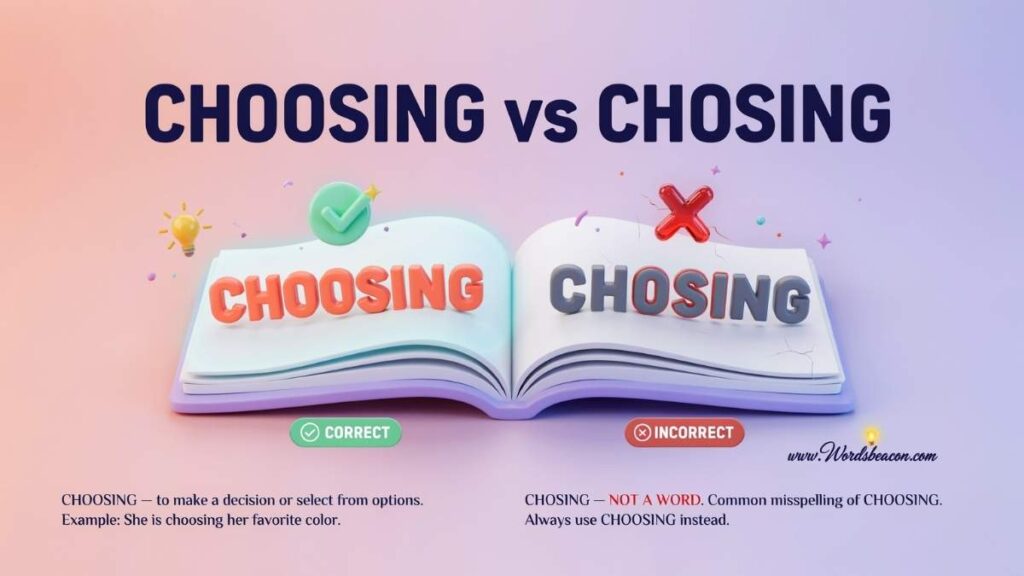
Choosing the right word seems simple until one small spelling mistake gets in the way. Is it “choosing vs chosing”? The two forms look almost identical, so it’s easy to see why people get confused. Luckily, the answer is straightforward: “choosing” is correct, while “chosing” is a misspelling. The trick is to remember that “choose” keeps both o’s when you add “-ing.” No disappearing letters or complicated grammar rules here! In this article, you’ll learn the meaning of “choosing,” how to use it in sentences, and how to avoid this common spelling mistake with confidence.
Quick Comparison
| Feature | Choosing | Chosing |
|---|---|---|
| Correct spelling | Yes | No |
| Meaning | Selecting or deciding between options | Usually intended to mean selecting or deciding |
| Grammatical role | Present participle or gerund | No standard role as the -ing form of choose |
| Standard English usage | Accepted | Incorrect as a spelling of choosing |
| Example | She is choosing a new phone. | Incorrect: She is chosing a new phone. |
Learn how to use confusing more words correctly
Developed vs Developped Which Spelling Is Correct?
Is Choosing vs Chosing Correct?
Choosing is the correct spelling in standard English. Chosing is a common spelling mistake that occurs when writers leave out one of the two o’s in the word.
The easiest way to understand the difference is to start with the base verb, choose. When you add the suffix “-ing,” the final e disappears, but both o’s remain.
- Correct: I am choosing a new book.
- Incorrect: I am chosing a new book.
- Incorrect: I am chooseing a new book.
Although readers can often understand the incorrect versions, they don’t follow standard English spelling conventions. Therefore, use “choosing” in emails, school assignments, business documents, articles, and everyday writing.
What Is the Difference Between Choosing and Chosing?
The difference concerns spelling rather than meaning. “Choosing” is an established English word, while “chosing” is generally a misspelling of the intended word.
| Question | Choosing | Chosing |
|---|---|---|
| Is it correct? | Yes | No, not as the standard verb form |
| Does it express a selection? | Yes | Usually intended to express the same idea |
| Is it suitable for formal writing? | Yes | No |
| How should you correct it? | Keep this spelling | Replace it with choosing |
When you see “chosing” in a sentence, the intended meaning will usually be clear from the context. However, understanding a word doesn’t make its spelling correct. Standard spelling helps readers process written English smoothly and keeps your message professional.
Choosing Meaning What Does Choosing Mean?
Choosing means selecting something from two or more possibilities. It can describe picking an item, deciding between alternatives, or selecting a course of action.
For example, choosing a college involves comparing schools and deciding which one best fits your goals. Choosing a snack might take only a moment. Although these decisions differ in importance, both involve making a choice.
The choosing definition is straightforward: it is the act or process of selecting, deciding on, or preferring something.
Consider these examples:
- Maya is choosing a dress for the wedding.
- Choosing a career requires careful thought.
- He is choosing between two job offers.
- Choosing kindness can help resolve a difficult conversation.
In each sentence, the word describes either the act of selecting something or the process of making a decision.
What Is the Chosing Meaning?
People searching for “chosing meaning” generally want to understand a word they have encountered. In standard English, however, “chosing” is not the accepted spelling of the -ing form of “choose.”
For example, consider this sentence:
Incorrect: I am chosing my favorite color.
Correct: I am choosing my favorite color.
Both sentences communicate the intended idea, but only the second uses the correct spelling. Unless “Chosing” appears as a deliberately created name or another special term, use “choosing” when you mean selecting something.
Is Choosing a Verb or a Noun?
Choosing can function as a verb form or a gerund. A gerund is an -ing form of a verb that acts as a noun.
As a verb form, choosing often describes an action in progress:
- She is choosing a new apartment.
- They were choosing a team captain.
As a gerund, choosing names an activity:
- Choosing takes time.
- He enjoys choosing gifts for his friends.
- Choosing the right words requires care.
The surrounding sentence determines the grammatical role. However, the spelling remains the same in every case.
Learn how to use confusing more words correctly
Planing vs Planning Spelling Rules, and Common Mistakes
Why Is Choosing Spelled With Two O’s?
The spelling becomes easier to remember when you examine the base verb, “choose.” It contains two o’s followed by a silent final e.
When you add “-ing,” the final e drops, but the two o’s stay in place.
The word formation follows this pattern:
Choose → remove the final e → add -ing → Choosing
This is an example of the drop-the-final-e rule, a common spelling pattern in English.
The Drop-the-Final-E Rule
Many English verbs ending in a silent e lose that e before taking the suffix “-ing.” The rest of the word usually stays the same.
| Base verb | Correct -ing form |
|---|---|
| Choose | Choosing |
| Make | Making |
| Write | Writing |
| Dance | Dancing |
| Bake | Baking |
| Ride | Riding |
Notice that the final e disappears in each example. However, the spelling of the remaining letters stays intact.
That is why “chooseing” is incorrect. It keeps the silent e when the standard spelling rule calls for removing it. Meanwhile, “chosing” removes an o that should remain.
Why Does Choosing Keep the Double O?
The double o belongs to the base word “choose.” Adding a suffix changes the grammatical form, but it doesn’t remove either o.
Think of the word as a structure that needs one small adjustment. You remove the final e and attach “-ing.” You don’t rebuild the word or change its original vowel sequence.
- Choose becomes choosing.
- Chose does not become chosing.
- Choose does not become chooseing.
The second example matters because “chose” is already the simple past form of the verb. The correct base form for making “choosing” is “choose,” not “chose.”
Is the Silent E Rule Always the Same?
English uses several spelling patterns when forming words with “-ing.” Many verbs drop a final silent e, while others double a final consonant or simply add the suffix.
For example:
- Make becomes making.
- Run becomes running.
- Help becomes helping.
The rule depends on the spelling of the base verb. In the case of “choose,” the process is straightforward: remove the final e and keep both o’s.
Fix common more word mistakes in English
Blankie vs Blanky Which Spelling Is Correct?
Choosing vs Chosing Grammar How to Use the Word Correctly
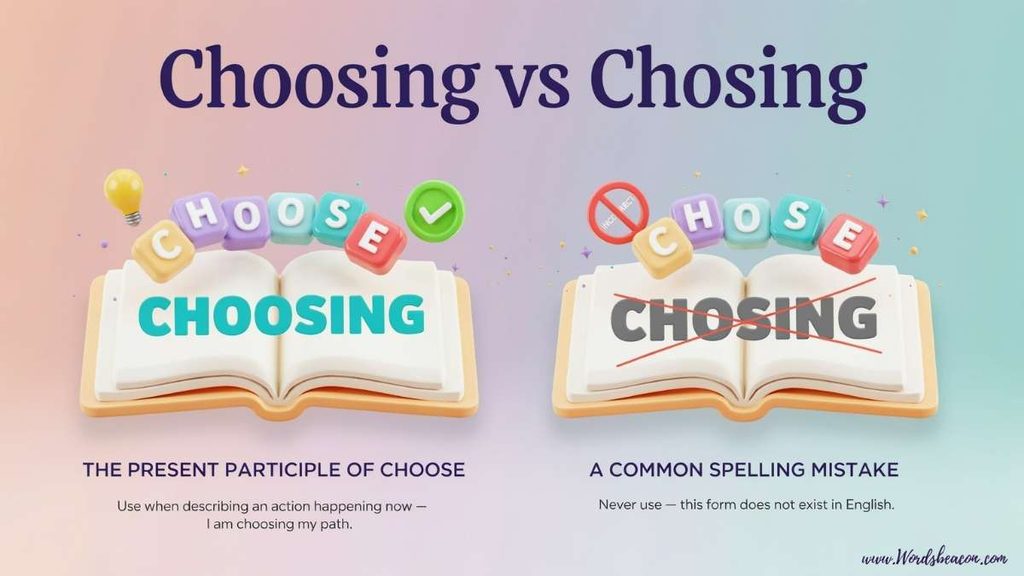
Knowing the spelling rule solves the main problem. However, understanding the grammar helps you use “choosing” correctly in different sentence structures.
Choosing is the present participle and gerund form of “choose.” Although both forms end in “-ing,” they serve different grammatical functions.
Choosing as a Present Participle
A present participle is the -ing form of a verb. It often works with a helping verb to form a continuous tense.
Examples include:
- Present continuous: She is choosing a new apartment.
- Past continuous: She was choosing a new apartment.
- Future continuous: She will be choosing a new apartment.
In each sentence, a form of “be” works as an auxiliary verb, helping express an action in progress.
The tense depends on the helping verb and the sentence structure. For example, “was choosing” describes an action in progress in the past, while “will be choosing” describes an action in progress at a future time.
Choosing as a Gerund
A gerund acts as a noun while retaining its connection to a verb. It can function as the subject, object, or complement of a sentence.
Examples:
- Subject: Choosing a reliable contractor requires research.
- Object: They enjoy choosing their own projects.
- Complement: Her favorite activity is choosing outfits.
A gerund can also take an object of its own. In “choosing a reliable contractor,” the phrase “a reliable contractor” identifies what someone is selecting.
Choosing After Prepositions
English commonly uses gerunds after prepositions. This pattern appears in expressions such as “before choosing,” “after choosing,” and “instead of choosing.”
Examples:
- Think carefully before choosing a school.
- After choosing a date, send the invitations.
- Instead of choosing the cheapest option, compare quality.
- She improved the process by choosing a more practical approach.
The spelling never changes to “chosing” after a preposition. The same standard form applies throughout.
Fix common more word mistakes in English
Cocoon vs Cacoon which spelling is correct ?
Choose, Chose, and Chosen Explained
The forms of “choose” can cause confusion because they don’t all follow the same spelling pattern. The simple past tense is “chose,” while the past participle is “chosen.”
These are different grammatical forms, not alternative spellings of “choosing.”
| Verb form | Grammatical use | Example |
|---|---|---|
| Choose | Base form | I choose the blue notebook. |
| Chooses | Third-person singular present | She chooses the blue notebook. |
| Chose | Simple past tense | She chose the blue notebook yesterday. |
| Chosen | Past participle | She has chosen the blue notebook. |
| Choosing | Present participle or gerund | She is choosing a notebook. |
Choose vs Chose What Is the Difference?
Choose is the base form of the verb. You use it for present-tense statements, instructions, and actions that haven’t happened yet.
Chose is the simple past tense. It describes a selection that someone made in the past.
Compare these examples:
- I choose my meals carefully. This describes a habit.
- I chose the vegetarian meal yesterday. This describes a completed past action.
- I will choose my meal when I arrive. This refers to a future decision.
The correct form depends on the time and structure of the sentence. Although “choose” and “chose” look similar, they aren’t interchangeable.
Chose vs Chosen Which Form Do You Need?
Chose is the simple past tense, while chosen is the past participle. The past participle usually appears with a helping verb such as “have,” “has,” or “had.” It can also appear in passive constructions.
Examples:
- Correct: We chose a new supplier.
- Correct: We have chosen a new supplier.
- Incorrect: We have chose a new supplier.
- Incorrect: We have choosen a new supplier.
The word “choosen” is a common spelling error. The correct past participle is “chosen,” with one o after the initial ch and no extra o before the final n.
Choosing vs Chosen What’s the Difference?
Choosing generally describes the act of making a selection, while chosen indicates that someone or something has been selected.
Compare these sentences:
- We are choosing a winner. The selection is in progress.
- We have chosen a winner. The selection is complete.
- The chosen candidate accepted the offer. The candidate has been selected.
The distinction helps you describe different stages of a decision-making process accurately.
Fix common more word mistakes in English
Enrol vs Enroll correct Spelling and usage ?
Choosing vs Chosing Examples in Everyday Sentences
Examples show how the spelling works in real situations. The following sentences cover personal decisions, education, shopping, and professional communication.
Correct Examples Using Choosing
- I am choosing a gift for my sister.
- They are choosing a name for their new puppy.
- Choosing the right course can shape your career.
- We spent the afternoon choosing paint colors.
- He is choosing between two job offers.
- Choosing fresh ingredients can improve a meal.
- The committee is choosing a suitable candidate.
- She enjoys choosing books for her collection.
- You should research your options before choosing a college.
- Choosing a reliable service provider takes time.
- The students are choosing topics for their presentations.
- Choosing the cheaper option isn’t always the best decision.
These examples demonstrate how “choosing” can describe an action in progress or an activity. The grammatical role changes, but the spelling stays the same.
Chosing vs Choosing Examples Correct the Mistake
| Incorrect sentence | Correct sentence | Explanation |
|---|---|---|
| I am chosing a new phone. | I am choosing a new phone. | Both o’s must remain. |
| She is chosing her college major. | She is choosing her college major. | The base verb is choose. |
| We are chooseing a restaurant. | We are choosing a restaurant. | Drop the final e before adding -ing. |
| Thank you for chosing our company. | Thank you for choosing our company. | Choosing is the standard gerund form. |
| He enjoys chosing his own clothes. | He enjoys choosing his own clothes. | The gerund requires the correct spelling. |
When correcting these sentences, start with the base verb. If the intended verb is “choose,” the correct -ing form is always “choosing” in standard English.
Choosing in a Sentence How Context Changes Its Role
| Sentence | Grammatical role |
|---|---|
| She is choosing a laptop. | Present participle in a continuous verb phrase |
| Choosing a laptop can be difficult. | Gerund acting as the subject |
| Before choosing a laptop, compare the features. | Gerund following a preposition |
| They were choosing a laptop when I called. | Present participle in the past continuous tense |
These examples illustrate why grammar matters alongside spelling. The word can perform different functions without changing its written form.
Choosing Pronunciation Guide
The correct spelling is easier to recognize when you understand how the word sounds. “Choosing” has two syllables and is commonly pronounced /ˈtʃuːzɪŋ/.
The first syllable carries the stress. The initial sound resembles the “ch” in “chair,” while the first vowel sounds like the “oo” in “moon.” The ending has a voiced z sound followed by “-ing.”
Pronunciation can help you recognize the word, but it can’t always reveal a spelling error. Since “chosing” is often intended to represent the same spoken word, listening alone may not reveal the missing o.
For accurate written English, connect the pronunciation to the base spelling: choose becomes choosing.
Understand confusing English more words simply
Brite vs Bright Correct Spelling and usage ?
Choosing vs Chosing in American and British English
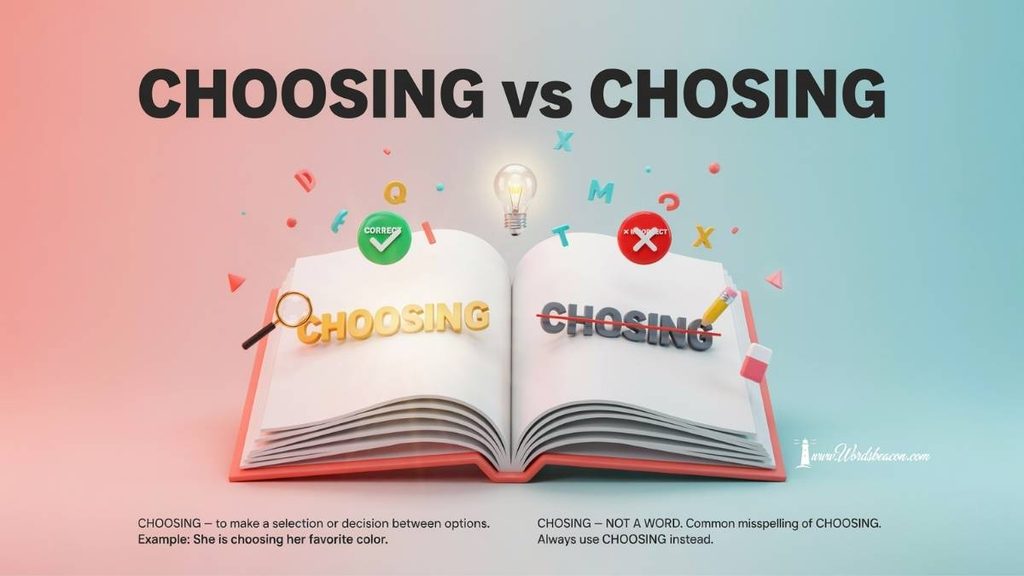
Some words have different spellings in American and British English. For example, American English generally uses “color,” while British English uses “colour.” However, “choosing” doesn’t have this regional variation.
Choosing is the standard spelling in both varieties. Chosing isn’t an accepted regional alternative.
| English variety | Correct spelling |
|---|---|
| American English | Choosing |
| British English | Choosing |
| Canadian English | Choosing |
| Australian English | Choosing |
Whether you’re writing a school essay in the United States, a business email in the United Kingdom, or a report for an Australian client, use “choosing.” You don’t need to change the spelling for an international audience.
Thank You for Choosing vs Chosing Which Is Correct?
The correct phrase is “Thank you for choosing.” Use it when expressing appreciation to a customer, client, guest, or another person who selected your product, service, or organization.
Examples include:
- Thank you for choosing our company.
- Thank you for choosing us for your special event.
- Thank you for choosing our hotel.
- Thank you for choosing to shop with us.
The phrase uses “choosing” because the preposition “for” introduces a gerund in this construction. Writing “Thank you for chosing” introduces an unnecessary spelling error.
Why Does Choosing Follow “For”?
In English, prepositions commonly take nouns or gerunds as their complements. In “thank you for choosing,” the word “choosing” names the action for which the speaker expresses thanks.
Compare these examples:
- Thank you for your support. Here, support is a noun.
- Thank you for helping us. Here, helping is a gerund.
- Thank you for choosing us. Here, choosing is a gerund with “us” as its object.
The same pattern appears in expressions such as “thanks for waiting,” “thank you for visiting,” and “thank you for shopping.”
Understand confusing English more words simply
Panel vs Pannel Spelling and Correct usage?
Choosing vs Chosing Synonyms and Related Words
Several words can replace “choosing,” depending on the sentence. However, synonyms don’t always express exactly the same idea, so consider the context before making a substitution.
Common Synonyms for Choosing
| Word | Meaning | Example |
|---|---|---|
| Selecting | Picking something from a group, often carefully | She is selecting the final candidates. |
| Picking | Choosing something, often informally | I’m picking a movie for tonight. |
| Deciding | Reaching a conclusion or making a decision | They are deciding where to travel. |
| Opting | Choosing one possibility over another | He is opting for a smaller car. |
| Preferring | Favoring one option over another | She prefers the quieter route. |
Each word emphasizes a slightly different aspect of the decision-making process. Selecting may sound more formal, while picking often feels more conversational. Deciding focuses on reaching a conclusion, and preferring expresses a favored option.
Choosing vs Selecting vs Deciding
Choosing usually emphasizes selecting an option from several possibilities. Selecting can suggest a careful or formal process, such as selecting candidates for an interview. Deciding focuses on reaching a conclusion after considering alternatives.
For example, a hiring manager might evaluate applications, decide which qualifications matter most, and select a candidate. These actions relate to one another, but each verb describes a different part of the process.
When replacing “choosing” with a synonym, focus on the intended meaning rather than simply swapping words.
Understand confusing English more words simply
Grately vs Greatly difference and Correct usage?
Common Choosing Spelling Mistakes and How to Avoid Them
Words with silent letters often cause spelling problems. Fortunately, a few practical habits can help you avoid errors with “choosing” and other commonly confused words.
Writing Chosing Instead of Choosing
This is the main mistake addressed by the choosing vs chosing spelling question. Writers may omit the second o because they type quickly or focus on pronunciation.
To correct it, remember the base verb “choose.” Remove the final e and add “-ing” without changing the two o’s.
Writing Chooseing Instead of Choosing
This error occurs when someone adds “-ing” without removing the silent e.
Incorrect: She is chooseing a new course.
Correct: She is choosing a new course.
Remember the drop-the-final-e rule. Many verbs that end in a silent e lose that e before taking “-ing.”
Confusing Choosing With Chose
The words belong to the same verb family, but their grammatical uses differ.
Incorrect: Yesterday, I choosing the red one.
Correct: Yesterday, I chose the red one.
If you want to describe an action in progress, you can write, “Yesterday, I was choosing the red one when the store closed.”
Writing Choosen Instead of Chosen
Some writers assume that the past participle should retain the vowel pattern of “choose.” However, the correct verb forms are choose, chooses, chose, chosen, and choosing.
“Choosen” is incorrect in standard English. Learning the complete verb family is more reliable than guessing each form.
Trusting Spell Check Without Proofreading
A spelling checker can catch many errors, but automated tools don’t replace careful proofreading. A tool may miss a typo, especially if the incorrect form resembles a proper name or another unusual term.
To improve spelling accuracy:
- Check the base verb before adding a suffix.
- Review words ending in “-ing.”
- Read the sentence again after using spell check.
- Check headings, captions, and email signatures.
- Consult a dictionary when you’re unsure of a word’s standard spelling.
These habits help you avoid common English spelling mistakes in casual and professional writing.
Understand confusing English more words simply
Shakey vs Shaky Which Spelling Is Correct?
How to Remember the Spelling of Choosing
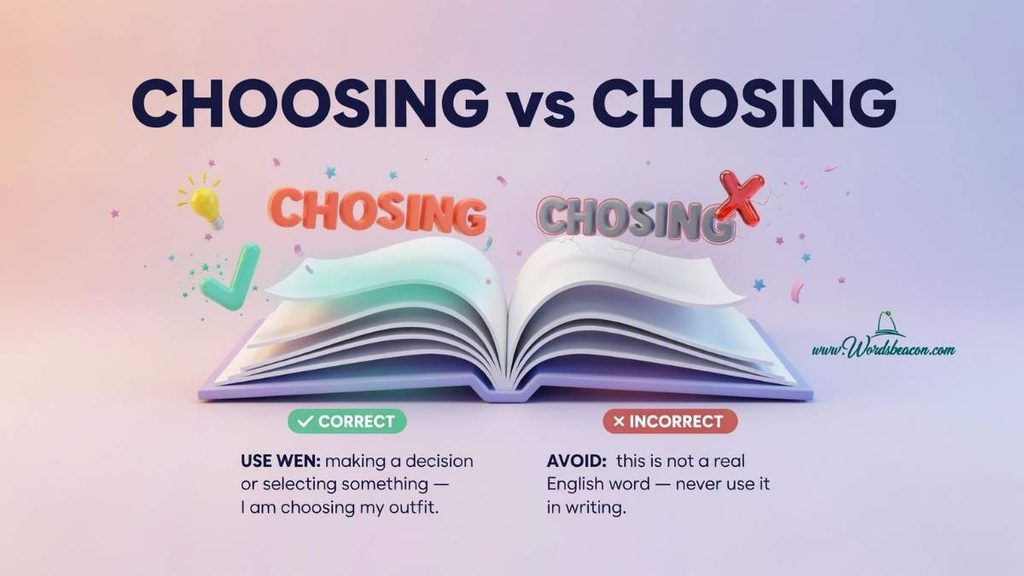
The easiest way to remember “choosing” is to learn how it develops from “choose.” Rather than memorizing the final form alone, follow the spelling process.
Start With the Word Choose
The base verb contains two o’s. When you add “-ing,” keep both o’s and remove the final e.
The process is simple:
- Choose
- Remove the final e: choos
- Add -ing: choosing
This method follows the actual spelling pattern rather than relying on how the word sounds.
Connect Choosing to Other Words
Comparing related words can strengthen your visual memory.
| Base word | Correct -ing form |
|---|---|
| Choose | Choosing |
| Lose | Losing |
| Use | Using |
| Close | Closing |
| Move | Moving |
These examples follow the same general silent-e pattern. The final e drops before the suffix, while the remaining letters stay in place.
Read and Write the Word in Context
Instead of repeating “choosing” on its own, practice it in complete sentences:
- I am choosing a new book.
- Choosing wisely takes patience.
- Thank you for choosing our service.
Reading and writing meaningful sentences helps you connect the spelling with its grammatical role. It also makes the correct form easier to recognize when you encounter it again.
Understand confusing English more words simply
Excel vs Accel Which Spelling Is Correct?
Choosing vs Chosing Practice Session
Fill in each blank with the correct form of the word: choosing vs chosing. Try all questions before checking your answers at the end.
1. She is ________ a birthday gift for her best friend.
2. We spent an hour ________ the right restaurant.
3. He had difficulty ________ between the two options.
4. ________ the correct answer will help you improve your score.
5. They are ________ a new name for their business.
6. I enjoy ________ books to read during the holidays.
7. The team is ________ its captain for the next season.
8. You should be careful when ________ your words.
9. My sister is ________ a dress for the wedding.
10. ________ the right career takes time and thought.
11. The students are ________ topics for their presentations.
12. She regretted ________ the more expensive option.
13. We are ________ a movie to watch tonight.
14. He is known for ________ practical solutions to problems.
15. ________ wisely can make a big difference in your life.
16. The committee is ________ a location for the event.
17. I had trouble ________ which laptop to buy.
18. They are ________ the best candidate for the job.
19. Thank you for ________ our service.
20. She is ________ between studying at home and going to the library.
Answers
- choosing
- choosing
- choosing
- Choosing
- choosing
- choosing
- choosing
- choosing
- choosing
- Choosing
- choosing
- choosing
- choosing
- choosing
- Choosing
- choosing
- choosing
- choosing
- choosing
- choosing
Here’s a trusted source for clear word meanings:
FAQs
What spelling mistake do people commonly make with “choosing”?
The most common mistake is writing “chosing” instead of “choosing.” The correct spelling keeps both o’s from “choose” before adding “-ing.”
Can “choosing” begin a sentence?
Yes. “Choosing” can begin a sentence when it functions as a gerund, which is a verb form used as a noun. For example, “Choosing the right words can prevent misunderstandings.”
Why does “choosing” have two o’s?
“Choosing” retains the spelling of its base verb, “choose.” Adding “-ing” does not remove either o, making “choosing” the correct form.
What does “choosing between two things” mean?
It means considering two options and deciding which one you prefer or want. For example, “I’m choosing between two colleges” means you’re deciding which college to attend.
Can “choosing” describe a decision that is still in progress?
Yes. “Choosing” can describe a decision that hasn’t been finalized. For example, “We’re choosing a venue for the wedding” means the final location is still being decided.
What does “choosing sides” mean?
“Choosing sides” means supporting one person, group, or viewpoint rather than another, especially during a disagreement. For example, “Their friends argued, but nobody wanted to choose sides.”
Is “choosing to” followed by a verb?
Yes. “Choosing to” is followed by the base form of a verb. For example, “She is choosing to stay home” and “They are choosing to wait.”
What does “choosing carefully” mean?
“Choosing carefully” means weighing your options before making a decision. It suggests taking time to consider the possible outcomes rather than rushing into a choice.
Is “choosing” appropriate for formal writing?
Yes. “Choosing” is appropriate for academic, professional, and everyday writing. For example, “Choosing an appropriate research method is essential for obtaining reliable results.”
What does “the choosing process” mean?
“The choosing process” refers to the steps involved in evaluating options and making a decision. It can describe selecting a school, hiring a candidate, purchasing a product, or deciding between different approaches.
Conclusion
The difference between choosing vs chosing comes down to one missing letter. “Choosing” is the correct spelling, while “chosing” is a common misspelling. Just remember that “choose” keeps both o’s when you add “-ing.” No letter gets left behind!
Whether you’re choosing a new job, choosing a gift, or choosing what to watch tonight, the spelling rule stays the same. English can be confusing enough without making an extra o disappear. Keep both o’s together, practice using “choosing” in sentences, and you’ll get it right every time.

Luna AJS is an experienced blogger and dedicated language enthusiast at Words Beacon. She specializes in making English grammar, spelling, vocabulary and commonly confused words easy to understand. She provides clear explanations, practical examples to help readers write with confidence.