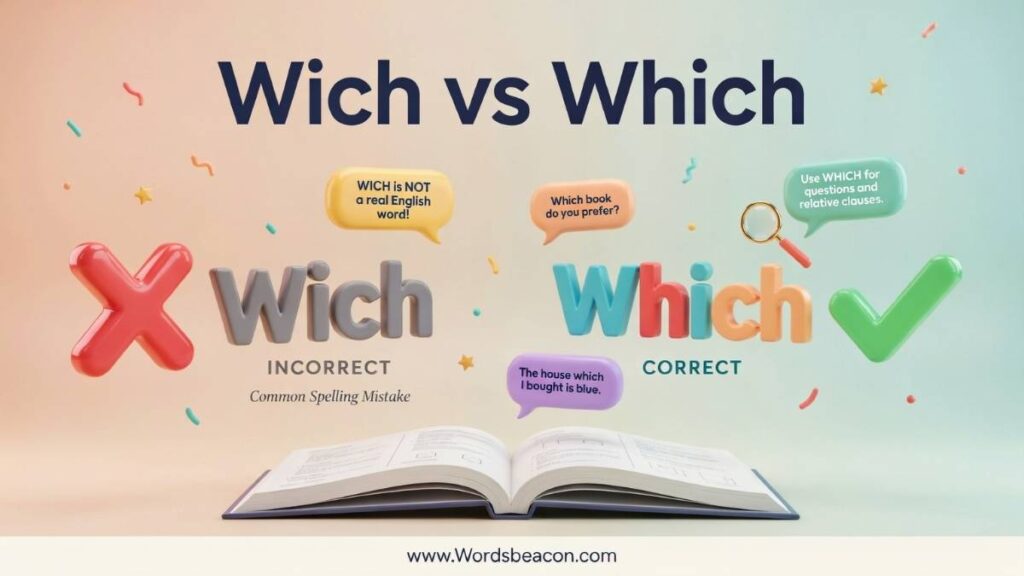
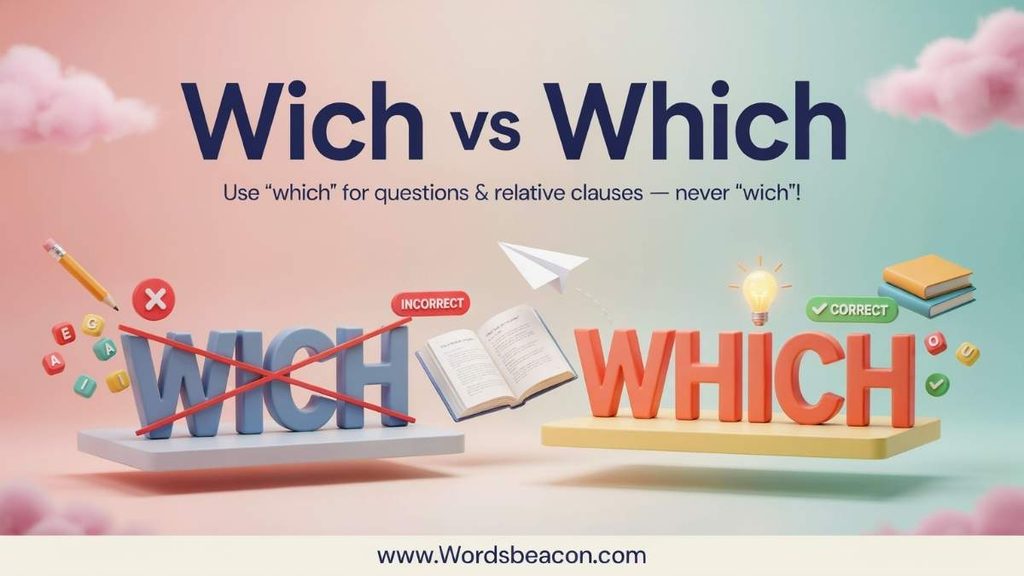
The Wich vs Which confusion is easy to make, especially when you are typing quickly and that little “h” decides to disappear. In standard English, which is the correct spelling when you ask about a choice, identify something, or add extra information to a sentence. Wich is usually a spelling mistake, although you may see it in some historical or place-name contexts. The good news is that the difference is simple once you know what to look for. This guide explains Wich vs Which in plain English, with clear examples and easy tips to help you remember the correct spelling every time.
quick answer
| Word | Correct in everyday English? | Main use | Example |
|---|---|---|---|
| Which | Yes | Choice, question, or added information | Which book do you want? |
| Wich | Usually no | Usually a spelling mistake | Wich book do you want? |
| Witch | Yes | Person associated with magic | The witch appears in the story. |
Fix common more word mistakes in English
Offense vs Offence difference and correct usage ?
Wich vs Which The Correct Spelling Explained
When you mean the common English word used to ask about a choice, which is correct.
For example:
- Which color do you prefer?
- Which restaurant should we choose?
- Which answer is correct?
- I don’t know which option to select.
The spelling wich is usually incorrect in these sentences.
For example:
- Wich color do you prefer? Incorrect
- Wich restaurant should we choose? Incorrect
- I don’t know wich option to select. Incorrect
The difference is easy to spot once you know what to look for. Which contains an h after the w.
However, there’s one detail worth knowing. Wich can appear as a specialized or historical English word, and it also occurs in some place names. Therefore, saying that wich can never appear in English would be too broad. The important point is that it isn’t the standard spelling of the everyday word which.
Is “Wich” a Word?
The answer to is wich a word isn’t simply yes or no.
In normal modern English, wich isn’t the spelling you should use when you mean which. If you write “Wich one do you want?” most readers will understand you, but they’ll usually recognize wich as an incorrect spelling.
At the same time, dictionaries record specialized meanings of wich. Historically and dialectally, the word has been connected with places or works associated with salt production. This explains why the spelling can appear in certain historical references or place names.
So, keep these points separate:
- Which is the standard everyday spelling.
- Wich is usually an incorrect spelling when you mean which.
- Wich can appear in specialized, historical, or dialectal contexts.
- Place names containing -wich don’t make wich an alternative spelling of which.
This distinction gives a more accurate answer to is wich a word in English?
Wich in Place Names
You may have noticed -wich in names such as:
- Norwich
- Ipswich
- Sandwich
- Greenwich
- Nantwich
- Northwich
- Droitwich
These names have their own historical origins. The -wich element doesn’t mean the same thing as the everyday word which.
That matters because spelling isn’t always enough to determine meaning. The same sequence of letters can appear in completely unrelated words, names, and historical terms.
Learn the difference between similar English words
Man vs Men difference and Correct Usage ?
What Does “Which” Mean?
The basic which meaning involves identifying or choosing something from a group of possibilities.
For example:
Which jacket should I wear?
The speaker has several jackets in mind and wants to identify one.
Likewise:
- Which route should we take?
- Which movie do you want to watch?
- Which answer is correct?
- Which student submitted the assignment?
The exact grammatical role can change depending on the sentence, but the central idea remains identification, selection, or reference.
Which as a Question Word
Which is commonly used as a question word when you want someone to identify a particular option.
For example:
- Which train leaves first?
- Which restaurant is open?
- Which phone belongs to you?
- Which route is faster?
Unlike a general question about something unknown, which often points toward a particular set of possibilities.
Compare:
- What do you want to eat?
- Which restaurant do you want to visit?
The first question asks generally. The second suggests a known or relevant group of restaurants.
Which as a Determiner
When which comes directly before a noun, it functions as a determiner.
The basic pattern is:
which + noun
Examples include:
- Which book are you reading?
- Which color do you prefer?
- Which road leads to the station?
- Which answer did you choose?
- Which day works best for you?
This is one of the most common uses of which in everyday writing and conversation.
Which as a Pronoun
Which can also stand alone as a pronoun when the noun is already clear from context.
For example:
- Which is yours?
- Which do you prefer?
- Which should we choose?
- Which looks better?
Consider this short exchange:
I have two jackets. Which do you want?
The word which stands for the jacket being selected. There’s no need to repeat the noun because the context already makes it clear.
Which as a Relative Pronoun
Another important use appears when which introduces a relative clause.
For example:
The laptop, which I bought last year, still works well.
The phrase which I bought last year adds information about the laptop.
More examples include:
- The car, which is parked outside, belongs to my brother.
- She showed me the article, which explained the problem clearly.
- We visited the museum, which opened more than a century ago.
Here, which doesn’t ask a question. Instead, it connects additional information to something already mentioned.
That’s why learning which grammar involves more than memorizing one simple definition.
Learn the difference between similar English words
Savior vs Saviour Difference and Usage?
How to Use “Which” in a Sentence
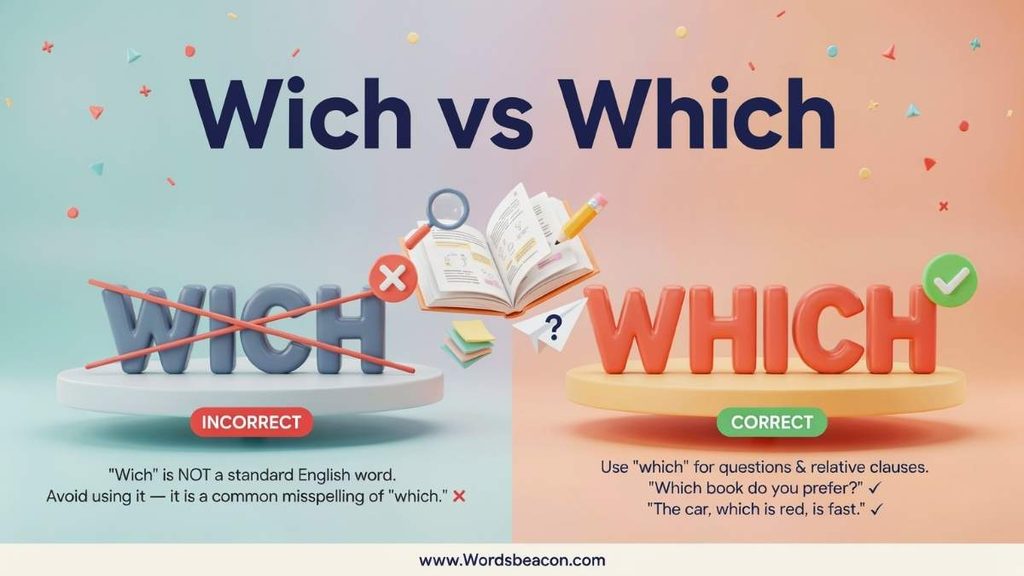
Once you understand its main roles, how to use which becomes much easier.
Use Which for a Choice
Use which when you want someone to identify one option from a group.
Examples:
- Which shirt should I wear?
- Which route is shorter?
- Which restaurant should we try?
- Which laptop would you recommend?
The options can be stated directly or left understood.
For example:
Which do you want, tea or coffee?
The choices are obvious from the sentence.
Use Which Before a Noun
A common sentence structure is:
Which + noun + verb
Examples:
- Which book belongs to you?
- Which team won the game?
- Which road goes downtown?
- Which answer makes sense?
This structure is especially useful when you’re asking about a specific group of things.
Use Which by Itself
You don’t always need a noun after which.
For example:
I have three options. Which should I choose?
Here, the word options doesn’t need to be repeated.
You can also say:
- Which one is yours?
- Which is better?
- Which should we order?
The surrounding context tells the reader what which refers to.
Use Which in Indirect Questions
Which also appears in indirect questions.
Compare:
Which train should I take?
with:
I don’t know which train I should take.
The first sentence asks a direct question. The second expresses uncertainty about the answer.
Other examples include:
- She asked which hotel we had booked.
- I wonder which answer is correct.
- They couldn’t decide which route to take.
- Please tell me which file I should open.
These structures are common in both everyday and professional writing.
Use Which in Relative Clauses
You can use which to add information about something already mentioned.
For example:
The phone, which I bought last month, has already stopped working.
The relative clause which I bought last month describes the phone.
This use is different from asking someone to make a choice.
Compare:
Which phone did you buy?
with:
The phone, which I bought last month, is already broken.
The word stays the same, but its grammatical function changes.
Learn the difference between similar English words
Parent’s vs Parents’ Difference and usage?
Wich vs Which Examples
The easiest way to understand wich vs which examples is to compare incorrect and correct sentences.
| Incorrect | Correct | Explanation |
|---|---|---|
| Wich book do you want? | Which book do you want? | Which asks about a choice. |
| Wich one is yours? | Which one is yours? | Which one identifies an option. |
| I don’t know wich road to take. | I don’t know which road to take. | Which appears in an indirect question. |
| The car, wich is blue, is mine. | The car, which is blue, is mine. | Which introduces a relative clause. |
| Wich answer is correct? | Which answer is correct? | The standard spelling includes h. |
The pattern remains the same regardless of the sentence type. When the intended word is the ordinary English term, the spelling is which.
Wich in a Sentence
If you’re searching for wich in a sentence, you’re probably trying to see whether the spelling works in context.
Consider:
Wich restaurant should we visit?
The meaning is clear, but the spelling isn’t correct.
The corrected version is:
Which restaurant should we visit?
Another example:
I forgot wich key opens the door.
Correct:
I forgot which key opens the door.
And:
This is the book wich I told you about.
Correct:
This is the book which I told you about.
The error doesn’t usually make the sentence impossible to understand. Instead, it makes the writing less accurate and can distract the reader.
Which in a Sentence
Here are several examples of which in a sentence:
- Which color do you like best?
- Which of these bags is yours?
- Do you know which bus goes to the station?
- Which should we order?
- The laptop, which was expensive, stopped working.
- She couldn’t decide which dress to wear.
- The restaurant, which opened recently, is already popular.
These examples show that which works in questions, indirect questions, and relative clauses.
Learn the difference between similar English words
Its vs It’s Difference and usage ?
Which vs Witch What Is the Difference?
The which vs witch confusion comes from pronunciation.
Which relates to selection or identification. Witch refers to a person traditionally associated with magic or sorcery.
| Word | Meaning | Example |
|---|---|---|
| Which | Used to identify or choose something | Which book should I read? |
| Witch | A person associated with magic | The witch appears in the story. |
| Wich | Usually a misspelling of which | Wich book should I read? Incorrect |
In many varieties of English, which and witch have the same pronunciation. These words are therefore commonly treated as homophones.
Their meanings are completely different.
One helps you choose a book.
The other belongs in a story about magic.
Witch Meaning
The witch meaning refers to a person who practices or is traditionally believed to practice magic or sorcery.
For example:
- The story features a powerful witch.
- The witch appears in the old legend.
- The novel follows a young witch learning magic.
The word witch has its own spelling and meaning. It shouldn’t replace which simply because the two words may sound alike.
Which Pronunciation
The common pronunciation of which is represented as /wɪtʃ/.
For many English speakers, that sounds the same as witch.
That creates an important spelling lesson: pronunciation doesn’t always tell you which spelling to use.
If you hear someone say:
Which book?
you need to understand the meaning and grammar to know that the correct written form is which.
Learn the difference between similar English words
Manual vs Manuel Difference and usage ?
Which and Witch in a Sentence
Putting both words in one sentence makes their difference easier to remember.
Which witch is in the story?
Here:
- Which asks for identification.
- Witch identifies the person being discussed.
Another example is:
Which witch won the competition?
The first word asks which person. The second tells you that the person is a witch.
The familiar phrase which witch is which is useful because it puts the two spellings side by side.
The lesson is straightforward:
Which relates to a choice.
Witch relates to magic.
Once you connect each word to its meaning, the spelling becomes easier to remember.
Why Is “Wich” a Common Spelling Mistake?
The most common explanation is simple: people leave out the h.
The Missing H
The correct spelling is:
W-H-I-C-H
The common mistake is:
W-I-C-H
One missing letter changes the spelling.
Because wich looks very similar to which, readers can sometimes overlook the error during a quick read.
Fast Typing
Typing quickly makes small errors more likely.
You might see this kind of mistake in:
- Text messages
- Search queries
- Social media posts
- Online comments
- Quick workplace messages
- Personal notes
Informal typing doesn’t change the correct spelling. It simply makes mistakes easier to produce.
Pronunciation Confusion
The which pronunciation can also contribute to the problem.
If a speaker pronounces which the same way as witch, a learner may remember the sound without remembering the spelling.
That’s why it’s better to connect the word with its meaning and grammatical role rather than relying only on sound.
Quick Reading
When people read quickly, the brain often recognizes familiar words by their overall shape and context rather than examining every letter.
As a result, a missing h can slip past during proofreading.
A slower final check can catch simple errors like this one.
Learn the difference between similar English words
Molding vs Moulding which one is correct and usage ?
A Simple Example Choosing Between Options
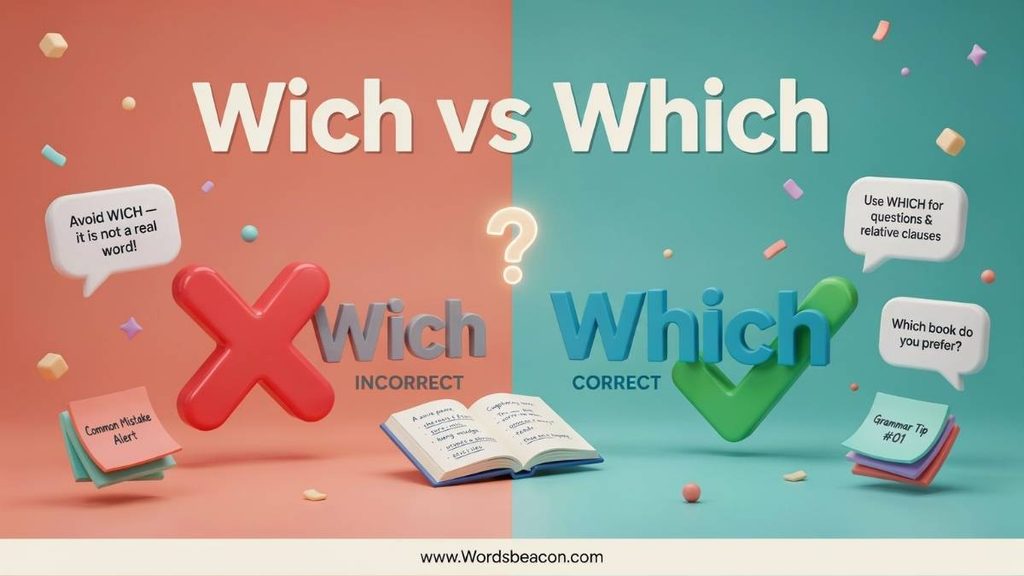
Imagine that you have two movie tickets.
You ask:
Which movie should we watch?
Here, which asks the other person to choose between the available movies.
Now imagine writing:
Wich movie should we watch?
The meaning is still understandable. However, the spelling is incorrect.
Now change the sentence again:
The movie, which we watched last night, was excellent.
In this sentence, which doesn’t ask for a choice. It introduces extra information about the movie.
This example shows why which grammar depends on how the word functions in the sentence.
A Simple Example in Professional Writing
Consider this workplace sentence:
Please confirm which version of the report you want me to send.
Here, which appears in an indirect question.
The direct question would be:
Which version do you want me to send?
Both sentences use which correctly.
Now replace it with wich:
Please confirm wich version of the report you want me to send.
The meaning remains clear, but the spelling error makes the sentence look less polished.
Small errors matter more in professional writing because readers often judge the quality of a message by its accuracy as well as its content.
How to Remember the Spelling of “Which”
You don’t need a complicated memory trick. A few simple connections can help.
Remember the WH Pattern
Think about common question words:
- what
- when
- where
- who
- why
- which
The wh beginning is a useful spelling pattern.
Remember the H
The simplest reminder is:
Which has an H.
If you’re about to type wich, pause for a second and check whether the h is there.
Use Meaning to Guide Spelling
Ask yourself what the word is doing.
If you’re asking someone to identify a choice, you’re looking for which.
For example:
Which dress should I wear?
If you’re talking about a magical person, you’re looking for witch.
For example:
The witch appears in the story.
This meaning-based approach is more reliable than trying to remember the sound alone.
Remember “Which Witch”
The phrase which witch puts both words together:
Which witch is which?
It may sound playful, but it creates a useful visual distinction.
Which = choice or identification.
Witch = magic.
Learn the difference between confusing more English words
Farther vs Further difference and usage ?
Common Mistakes With Which
Understanding the correct spelling is the first step. Knowing the common errors helps you avoid repeating them.
Writing Wich Instead of Which
Incorrect:
Wich one do you prefer?
Correct:
Which one do you prefer?
This is the most common wich spelling mistake.
Confusing Which and Witch
Incorrect:
Witch restaurant should we choose?
Correct:
Which restaurant should we choose?
The first sentence accidentally asks about a magical person. The second asks about a restaurant.
Assuming Which Only Starts Questions
Which isn’t limited to direct questions.
For example:
I don’t know which option is better.
This is an indirect question.
It can also introduce additional information:
The option, which was cheaper, became the popular choice.
Forgetting That Which Can Stand Alone
You can say:
Which do you prefer?
You don’t always need to add a noun.
The context can supply the missing information.
Learn the difference between confusing more English words
Quiet vs Quite difference and usage ?
Wich vs Which Grammar The Easy Version
For anyone searching specifically for wich vs which grammar, the distinction can be summarized simply.
Wich normally has no grammatical role when it appears as a typo for which.
Which, however, has several legitimate grammatical functions.
| Use | Role | Example |
|---|---|---|
| Choice before a noun | Determiner | Which book do you want? |
| Choice without a noun | Interrogative pronoun | Which do you want? |
| Indirect question | Question word | I don’t know which to choose. |
| Added information | Relative pronoun | The book, which I enjoyed, was long. |
This makes one point clear: learning the correct spelling of which solves the spelling problem, but understanding its grammar helps you use the word naturally.
Which One Meaning and Usage
The phrase which one is extremely common in everyday English.
The which one meaning is essentially “which particular person or thing from the available choices?”
For example:
- Which one is yours?
- Which one should I buy?
- Which one do you prefer?
- Which one costs less?
- Which one would you recommend?
Imagine three shirts on a table. Someone asks:
Which one do you like?
The phrase which one means “which shirt.”
You could also say:
Which shirt do you like?
Both are correct.
The shorter version works because everyone already knows what objects are being discussed.
How Do You Spell Which?
If you’re wondering how to spell wich, the answer is that the standard word you probably mean is spelled:
which
The letters are:
W-H-I-C-H
Therefore:
- Which = correct
- Wich = usually incorrect
- Witch = a different word
The easiest way to remember the spelling of which is to keep the wh beginning in mind.
Is “Wich” Ever Correct?
Yes, but only in particular contexts.
Wich can occur as a specialized English word and appears in historical and dialectal usage. It also appears as part of various place names.
However, those uses don’t make wich an alternative spelling of which.
So if you’re writing:
Wich one do you want?
you should correct it to:
Which one do you want?
The specialized uses of wich don’t change that everyday rule.
Learn the difference between confusing more English words
Learned vs Learnt difference and usage ?
Practice Session Wich vs Which
Fill in each blank with Wich vs Which .
- ______ book would you like to read first?
- I don’t know ______ restaurant is still open.
- ______ color do you prefer, blue or green?
- Can you tell me ______ bus goes to the airport?
- ______ one of these bags belongs to you?
- She asked ______ movie we wanted to watch.
- The laptop, ______ I bought last year, still works perfectly.
- ______ answer do you think is correct?
- Please choose ______ option you like best.
- The house, ______ stands near the river, is very old.
- ______ road should we take to reach the city?
- I can’t decide ______ dress to wear.
- ______ of these two phones has the better camera?
- He showed me the article, ______ explained the issue clearly.
- ______ one should I select for the project?
- Do you remember ______ teacher gave us this assignment?
- The restaurant, ______ opened recently, is already popular.
- ______ word fits best in this sentence?
- She couldn’t decide ______ route would be faster.
- ______ book did you say you wanted to borrow?
Answers
- Which
- Which
- Which
- Which
- Which
- Which
- Which
- Which
- Which
- Which
- Which
- Which
- Which
- Which
- Which
- Which
- Which
- Which
- Which
- Which
Here’s a trusted source for clear more words Comparison:
FAQs
Is “wich” a correct spelling of “which”?
No. Which is the correct spelling in standard English. Wich is usually a spelling mistake when someone means the common word used to ask about a choice or identify something.
What is the difference between “Wich vs Which”?
Which is a standard English word used to ask about choices, identify something, or add information to a sentence. Wich is generally not the correct spelling of this word, although it can appear in some historical, dialectal, and place-name contexts.
When should I use “which”?
Use which when you want to choose or identify something from a known or limited group. For example, “Which jacket should I wear?” You can also use which to introduce additional information, as in “The jacket, which I bought yesterday, is very warm.”
Does the word “wich” exist?
Yes, but not usually in the way people mean it. Wich has historical and dialectal uses and also appears in some English place names. However, in ordinary modern writing, use which when you mean the common question and relative word.
Is “wich” ever correct?
Yes, in certain specialized contexts. Wich can appear as a historical or dialectal word and as part of some place names. However, it should not replace which in normal English sentences.
What does “wich” mean?
Historically and dialectally, wich has been associated with places connected to salt production or salt works. Its meaning can vary depending on the context. In everyday English, however, wich is usually an incorrect spelling of which.
Why do some English towns end in “-wich”?
The ending -wich appears in several English place names and has historical roots connected with settlements, trading locations, and, in some cases, salt-producing sites. The exact meaning can differ depending on the history of each place.
Is “wich” a valid Scrabble word?
Scrabble word lists vary by country, edition, and dictionary. Therefore, whether wich is accepted can depend on the particular official word list being used. It is best to check the dictionary associated with your version of Scrabble.
How is “wich” pronounced?
The pronunciation of wich can depend on how it is used. In some place names, it forms part of a local pronunciation. If wich appears as a misspelling of which, the intended word is normally pronounced as which.
What does “which witch is which” mean?
“Which witch is which?” is a playful sentence that uses similar-sounding words with different meanings. Which asks someone to identify or choose something, while witch refers to a person traditionally associated with magic.
What is a homophone for “which”?
A common homophone of which is witch. In many varieties of English, both words have the same pronunciation, but their meanings and spellings are completely different.
What is the difference between “which” and “witch”?
Which is used when asking about a choice or identifying something. Witch is a noun traditionally associated with a person believed to practice magic. For example, “Which book should I read?” and “The witch appears in the story.”
How can I remember the spelling of “which”?
Remember the common WH pattern: what, when, where, who, why, which. Also, picture the h in which as part of the word rather than an optional letter. That small letter saves you from the very common “wich” mistake.
Can “which” begin a sentence?
Yes. Which can begin a direct question, such as “Which option is better?” It can also begin certain sentence structures when it refers back to information already mentioned.
Can “which” be used without a noun?
Yes. Which can stand alone when the noun is already understood. For example, “Which do you prefer?” Here, the listener already knows which choices the speaker is talking about.
What does “which one” mean?
Which one means “which particular person or thing from a group of choices.” For example, “Which one should I buy?” asks someone to select one option from the available choices.
How do you spell “which” correctly?
The correct spelling is which, with an h: W-H-I-C-H. If you write wich when you mean this everyday English word, you have left out the h.
Is “wich” a spelling mistake?
Usually, yes. If you are asking about a choice, wich is incorrect and which is the correct spelling. For example, “Wich movie should we watch?” should be “Which movie should we watch?”
Which is correct: “wich,” “which,” or “witch”?
For a question about a choice, which is correct. Witch is a completely different word associated with magic. Wich is generally a spelling mistake when you intend to write which, although it can have specialized historical or place-name uses.
conclusion
The wich vs which confusion is easy to fix. In everyday English, which is the correct spelling. You use it when you ask someone to choose or identify something, such as “Which book do you want?” or “Which color looks better?” Wich is usually just a spelling mistake caused by leaving out the h.
There is one small exception: wich can appear in some historical, dialectal, and English place-name contexts. However, you do not need to worry about that in normal writing. If you mean the common word for asking about a choice, use which. This makes the wich vs which difference much easier to understand.
So, remember one simple rule: choose which, not wich. When checking wich vs which, always choose which for standard English questions and choices. If you mix it up with witch, remember that which helps you make a choice, while a witch belongs in a completely different kind of story. Once that little h sticks in your memory, the wich vs which confusion becomes much easier to avoid.

Luna AJS is an experienced blogger and dedicated language enthusiast at Words Beacon. She specializes in making English grammar, spelling, vocabulary and commonly confused words easy to understand. She provides clear explanations, practical examples to help readers write with confidence.