
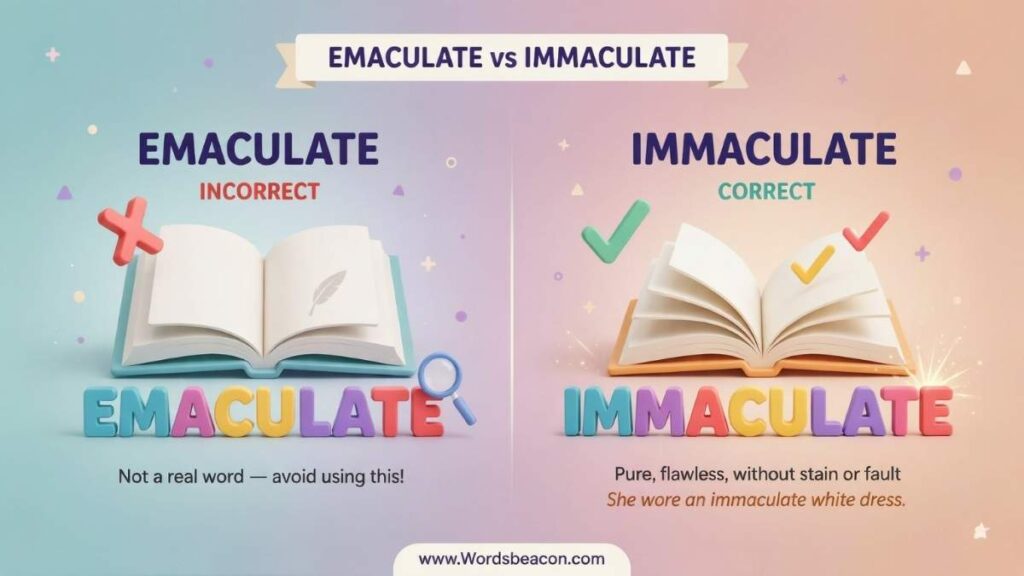
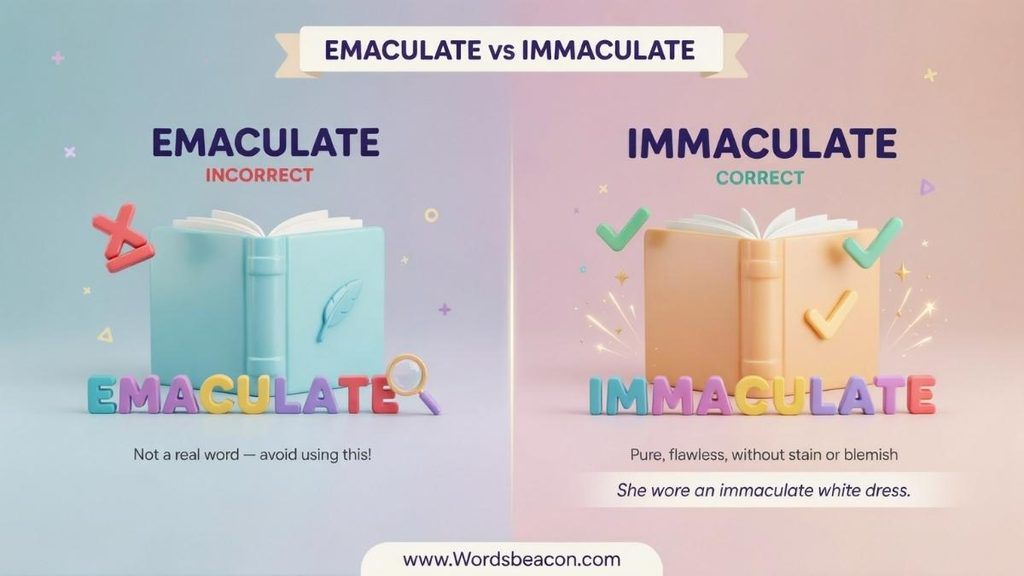
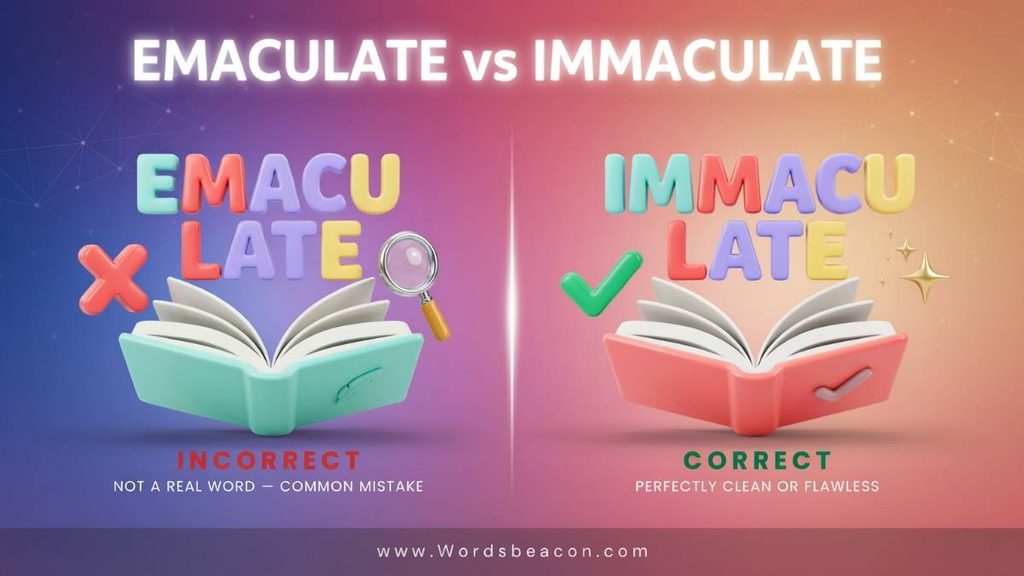
Some English words seem determined to make you question your spelling skills. Emaculate vs immaculate is one of them. You may know what the word means, yet still wonder whether it starts with an e or an i. The good news is that the answer is easy: immaculate is the correct spelling. It describes something extremely clean, neat, perfect, or free from mistakes. Emaculate is a common misspelling, so it should not replace the standard form. In this guide, you’ll learn what immaculate means, how to spell and pronounce it, and how to avoid this sneaky spelling mistake for good.
quick answer
| Feature | Immaculate | Emaculate |
|---|---|---|
| Standard English word | Yes | No |
| Correct spelling | Yes | No |
| Part of speech | Adjective | Not the standard adjective |
| Main meaning | Perfectly clean, flawless, or free from imperfections | No standard meaning in this usage |
| Example | The room was immaculate. | The room was emaculate. |
| Recommended in formal writing | Yes | No |
The key point is simple: immaculate is the correct spelling.
The word begins with imm-, not em-. It also contains two m’s at the beginning:
I-M-M-A-C-U-L-A-T-E
That small spelling pattern solves most of the confusion.
Fix common more word mistakes in English
Who’s vs Whose difference and correct usage ?
What Does Immaculate Mean?
The word immaculate has two closely related everyday meanings. It can describe something that is extremely clean or tidy. It can also describe something that has no noticeable mistakes, defects, or faults.
Cambridge Dictionary defines immaculate as an adjective meaning perfectly clean or tidy. It also uses the word for something perfect and without mistakes.
In simple English, immaculate can mean:
- perfectly clean
- spotless
- extremely neat
- free from flaws
- free from imperfections
- flawless
- faultless
- unblemished
- exceptionally well maintained
The exact meaning depends on the noun that follows it.
For example:
- An immaculate kitchen is extremely clean.
- An immaculate suit looks exceptionally neat and well presented.
- An immaculate record has no significant blemishes or losses in the relevant context.
- An immaculate performance contains very few, if any, noticeable mistakes.
Therefore, the immaculate meaning goes beyond simple cleanliness.
Emaculate vs Immaculate Immaculate Meaning and Definition
Immaculate Definition
A clear immaculate definition is:
Immaculate means perfectly clean, neat, or free from flaws and mistakes.
The word is an adjective, so it normally describes a person, thing, condition, appearance, performance, record, or other noun.
For example:
The hotel room was immaculate.
Here, immaculate means extremely clean and tidy.
Now consider this sentence:
The pianist gave an immaculate performance.
The performance cannot literally be scrubbed clean. Instead, immaculate means it was exceptionally accurate, polished, and free from noticeable mistakes.
That difference is important because it shows how English vocabulary often develops figurative meanings from physical ideas.
When learning Emaculate vs Immaculate, this meaning also helps you understand why immaculate is the correct word.
What Does Immaculate Mean in English?
If you are searching for what does immaculate mean in English, the simplest explanation is this:
Immaculate describes something that is exceptionally clean, flawless, pure, or without noticeable imperfections.
The word can describe both physical and abstract qualities.
That gives you a useful way to remember it:
Clean things can be immaculate.
Excellent things can also be immaculate.
The Emaculate vs Immaculate difference becomes much easier once you connect immaculate with these meanings.
Learn the difference between often confused words
Wich vs Which difference and correct usage ?
Is Emaculate a Word?
Is Emaculate a Word in English?
If you are asking, is emaculate a word in English, the practical answer is no when you mean the standard adjective that means spotless or flawless.
Emaculate is commonly used as a misspelling of immaculate. It can appear in informal online writing, user-generated content, or text containing spelling mistakes. However, that does not make it the standard spelling.
For standard English usage, use immaculate.
This is the main point to remember when checking Emaculate vs Immaculate in your writing.
Is Emaculate Correct Spelling?
No.
The correct spelling is immaculate.
Therefore:
- Emaculate = incorrect spelling
- Immaculate = correct spelling
The same rule applies whether you are writing an email, school assignment, article, report, résumé, or professional document.
In short, Emaculate vs Immaculate has a clear winner: immaculate.
Is Emaculate a Misspelling?
Yes. Emaculate is a common misspelling of immaculate.
The error usually happens because the beginning of the word is easy to mishear or because the writer forgets the second m.
Once you remember the opening pattern imm-, the spelling becomes much easier
Learn the difference between often confused words
Offense vs Offence difference and correct usage ?
Immaculate Correct Spelling How to Spell Immaculate
How Do You Spell Immaculate?
The correct spelling of immaculate is:
I-M-M-A-C-U-L-A-T-E
A useful way to break it down is:
IM + MACULATE
That gives:
IMMACULATE
The most important spelling points are:
- Start with i.
- Follow i with two m’s.
- Use c after ma.
- End with -ulate.
So, if you are asking how to spell immaculate, remember the first four letters: imma.
Common Incorrect Spellings
Several variations can appear when people try to spell the word from memory.
| Incorrect form | Correct form |
|---|---|
| emaculate | immaculate |
| imaculate | immaculate |
| immacculate | immaculate |
| immacullate | immaculate |
| emmaculate | immaculate |
The most common confusion in this group is emaculate because writers replace the initial i with e.
Another frequent error is imaculate, which keeps the initial i but drops one m.
Why Is Immaculate Spelled With an I?
The spelling makes more sense when you look at the word’s history.
Immaculate comes from Latin immaculatus, which means unspotted or unstained. The Latin word is connected with macula, meaning a spot or stain.
That history fits the modern meaning quite neatly. Something immaculate is free from spots, stains, or figurative blemishes.
The historical development also explains why the word starts with i rather than e.
You do not need to memorize its Latin origin every time you write it. Still, knowing the connection can make the spelling easier to remember.
Think of it this way:
macula = spot or stain
immaculate = without a spot or stain
That connection helps explain both the meaning and the spelling.
Learn the difference between tricky grammar words
Man vs Men difference and Correct Usage ?
Immaculate Pronunciation
How to Pronounce Immaculate
The standard American English pronunciation is commonly represented as:
/ɪˈmæk.jə.lət/
Cambridge gives the same basic pronunciation for both its UK and US entries.
The main stress falls on the second syllable.
The word is commonly heard as a four-syllable word:
im-MAC-u-late
Pronunciation can contribute to the spelling confusion because spoken English does not always reveal every letter clearly.
You may hear the word correctly while still forgetting that it begins with imm-.
That is why it helps to learn both the sound and the visual spelling.
Immaculate Pronunciation vs Spelling
English spelling often preserves historical patterns that pronunciation does not make obvious.
In this case, the repeated m is easy to overlook when you hear the word quickly.
So, do not rely only on sound when spelling immaculate. Remember its written form:
immaculate
Immaculate as an Adjective
The word immaculate functions primarily as an adjective in modern English.
An adjective describes a noun.
For example:
- an immaculate room
- an immaculate house
- an immaculate suit
- an immaculate appearance
- an immaculate record
- an immaculate performance
- an immaculate reputation
You can also place the adjective after a linking verb:
The room is immaculate.
Her presentation was immaculate.
His record remains immaculate.
In each case, immaculate describes the condition or quality of something.
Immaculate and Immaculately
The Immaculate and immaculately are related but perform different grammatical jobs.
Immaculate is an adjective:
She wore an immaculate dress.
Immaculately is an adverb:
She was immaculately dressed.
Cambridge lists immaculately as an adverb meaning in a perfectly clean, neat, or faultless way.
This distinction matters because an adjective modifies a noun while an adverb can modify a verb, adjective, or another adverb.
Compare:
- The room is immaculate.
- The room was immaculately maintained.
The first sentence describes the room. The second explains how someone maintained it.
Learn the difference between commonly mixed-up more words
Quiet vs Quite difference and usage ?
Immaculate Usage in Everyday English

The Immaculate for Physical Things
The most familiar use of immaculate involves physical cleanliness or condition.
You might describe these things as immaculate:
- a bedroom
- a kitchen
- a bathroom
- a car
- a garden
- clothing
- furniture
- a hotel room
- a workspace
For example:
The kitchen was immaculate after the cleaning crew finished.
The classic car remains in immaculate condition.
She arrived wearing an immaculate white suit.
In these sentences, immaculate suggests more than ordinary cleanliness. It creates the impression that the object looks exceptionally clean, neat, polished, or well cared for.
Immaculate for Abstract Qualities
Immaculate can also describe qualities that you cannot physically clean.
Consider an immaculate record.
A record cannot have dust wiped from it. Instead, immaculate means the record has no relevant blemishes.
The same idea applies to:
- immaculate reputation
- immaculate performance
- immaculate timing
- immaculate technique
- immaculate work
- immaculate design
- immaculate execution
For example:
The surgeon was known for an immaculate record.
The team delivered an immaculate performance.
The designer created an immaculate layout.
Here, the word has moved from physical cleanliness to figurative perfection.
Learn the difference between tricky grammar words
Savior vs Saviour Difference and Usage?
Immaculate Meaning With Examples
Seeing the word in context makes its different meanings much easier to understand.
| Phrase | Meaning | Example |
|---|---|---|
| immaculate room | Extremely clean and tidy | The guest room was immaculate. |
| immaculate clothing | Exceptionally clean and neat | He arrived in immaculate clothing. |
| immaculate condition | Excellent physical condition | The antique remains in immaculate condition. |
| immaculate record | Free from relevant blemishes or losses | She has an immaculate professional record. |
| immaculate performance | Extremely accurate or impressive | The dancers gave an immaculate performance. |
| immaculate reputation | Free from serious criticism or blemishes | He built an immaculate reputation. |
| immaculate design | Exceptionally polished design | The website has an immaculate design. |
Notice how the meaning shifts slightly depending on the noun.
That flexibility makes immaculate a useful word, but it also means that replacing it with a simple synonym does not always work.
Immaculate vs Similar Words
An immaculate synonym can often work, but the best replacement depends on context.
Immaculate vs Spotless
Spotless strongly emphasizes cleanliness.
The bathroom was spotless.
The bathroom was immaculate.
Both sentences work. However, immaculate can also suggest perfection beyond physical cleanliness.
You can say:
She has an immaculate record.
You would not normally say:
She has a spotless record in every situation where immaculate would work.
The two words overlap, but they are not identical.
Immaculate vs Flawless
Flawless focuses on the absence of mistakes or defects.
For example:
She delivered a flawless performance.
She delivered an immaculate performance.
Both can suggest excellent execution. However, flawless is often the more direct choice when the focus is on errors or defects.
Immaculate vs Impeccable
Impeccable means perfect or without faults and often describes qualities such as manners, taste, credentials, or behavior. Cambridge lists immaculate and impeccable among related synonyms for this sense.
For example:
His manners were impeccable.
Her appearance was immaculate.
The meanings overlap, but the usual associations differ.
Immaculate vs Pristine
Pristine often suggests something untouched, original, pure, or in excellent condition.
For example:
The forest remained pristine.
The antique was in immaculate condition.
Pristine works especially well when something has retained an untouched or natural quality.
Immaculate vs Perfect
Perfect has the broadest meaning.
You can use perfect for almost anything that meets an ideal standard. Immaculate tends to add a stronger sense of cleanliness, purity, polish, or freedom from blemishes.
Learn the difference between tricky grammar words
Parent’s vs Parents’ Difference and usage?
Can Immaculate Describe a Person?
Yes, but context matters.
You can describe a person’s:
- clothing
- appearance
- manners
- reputation
- record
- performance
- presentation
For example:
She looked immaculate before the ceremony.
Here, immaculate describes her overall appearance.
You can also say:
He has an immaculate reputation.
That sentence describes his reputation rather than his physical appearance.
However, simply saying someone is immaculate can sound more formal or dramatic than saying they are neat, polished, or well dressed.
The best choice depends on the exact meaning you want.
Can Immaculate Describe a Place?
Yes.
In fact, physical spaces are among the most natural contexts for the word.
Examples include:
- immaculate home
- immaculate room
- immaculate office
- immaculate garden
- immaculate hotel
- immaculate kitchen
For example:
The hotel room was immaculate when we arrived.
Here, the meaning is clear: the room was extremely clean and tidy.
Cambridge gives examples such as an immaculate garden and an immaculate house, reinforcing this everyday use.
Can Immaculate Describe a Performance?
Yes.
An immaculate performance is exceptionally polished, accurate, or free from noticeable mistakes.
For example:
The pianist delivered an immaculate performance.
The phrase does not mean the pianist cleaned the performance. Instead, it uses the idea of being free from flaws in a figurative way.
This same pattern appears in expressions such as:
- immaculate execution
- immaculate technique
- immaculate timing
- immaculate presentation
- immaculate work
Immaculate in Professional and Academic Writing
The Immaculate can work well in professional writing when it adds a specific meaning.
For example:
The company maintains an immaculate safety record.
The designer presented an immaculate final draft.
The laboratory was maintained in immaculate condition.
However, strong words work best when they match the evidence.
If a document is merely organized, saying it is immaculate may sound exaggerated. In that situation, words such as organized, polished, clear, or well structured may communicate the idea more accurately.
Good writing does not use the strongest word available. It uses the most precise word available.
Immaculate in Religious Usage
The word also appears in the specific phrase Immaculate Conception.
This expression has a particular theological meaning in Catholic teaching. It refers to the belief that Mary was conceived without original sin.
It does not refer to the conception of Jesus.
That distinction matters because the phrase can easily create confusion for readers who encounter it without religious context.
Outside this expression, immaculate generally carries its ordinary meanings of being spotless, pure, flawless, or free from imperfections.
Immaculate Etymology and Word Origin
The origin of immaculate connects closely with its modern meaning.
The word comes from Latin immaculatus, meaning unspotted or unstained. It relates to macula, a Latin word meaning spot or stain.
That gives the word a useful conceptual structure:
spot or stain → unspotted → spotless → free from flaws
Over time, English expanded the idea beyond physical marks. Today, immaculate can describe something that is figuratively free from faults as well.
That is why an immaculate room and an immaculate performance can both sound natural even though one is physically clean and the other is figuratively flawless.
Is Immaculate a Word?
Yes.
Immaculate is a standard English adjective with well-established meanings and uses.
If you are asking is immaculate a word, there is no spelling problem here. It appears in modern dictionaries and works naturally in everyday, professional, literary, and formal English. Cambridge classifies it as an adjective and gives both its cleanliness and flawlessness meanings.
The related adverb immaculately is also a standard English word.
So the distinction is very clear:
Immaculate = correct English word
Emaculate = common misspelling
Learn the difference between similar English words
Manual vs Manuel Difference and usage ?
Regional Usage of Immaculate
Unlike words such as color and colour, immaculate does not have separate standard American and British spellings.
| Variety of English | Standard spelling |
|---|---|
| American English | immaculate |
| British English | immaculate |
| Canadian English | immaculate |
| Australian English | immaculate |
Therefore, emaculate vs immaculate is not a regional spelling difference.
You should use immaculate regardless of whether your audience reads American, British, Canadian, or Australian English.
Common Immaculate Spelling Mistakes
Emaculate
Incorrect:
Emaculate
Correct:
Immaculate
This is the central spelling error discussed in emaculate vs immaculate.
Imaculate
Incorrect:
Imaculate
Correct:
Immaculate
This version drops the second m.
Immacculate
Incorrect:
Immacculate
Correct:
Immaculate
This version adds an unnecessary c.
Immacullate
Incorrect:
Immacullate
Correct:
Immaculate
This mistake changes the ending and adds an unnecessary l.
The best approach is not to memorize every incorrect version. Instead, memorize the correct word:
immaculate
Once the correct pattern becomes familiar, the common errors become much easier to spot.
Learn the difference between similar English words
Molding vs Moulding which one is correct and usage ?
Immaculate Synonyms and Related Words
If you need an immaculate synonym, choose according to the intended meaning.
1.For cleanliness:
- spotless
- clean
- neat
- tidy
- pristine
- well kept
2.For freedom from mistakes:
- flawless
- faultless
- impeccable
- perfect
- unblemished
3.For excellent condition:
- pristine
- flawless
- perfect
- excellent
- well maintained
These words overlap, but none carries exactly the same range as immaculate.
For example, pristine can suggest an untouched natural state, while impeccable often focuses on quality, manners, taste, or behavior.
A Simple Way to Remember the Spelling
If you repeatedly write emaculate, use this memory trick:
IM + MACULATE
That gives:
IMMACULATE
Pay special attention to the first four letters:
IMMA
Not:
EMA
Not:
IMA
Not:
IMMA C C
Just:
IMMA
You can also connect the spelling to the meaning. Since immaculate means something is free from spots, stains, or flaws, think:
No spots → immaculate.
That small association can make the word much easier to remember.
Learn the difference between similar English words
Farther vs Further difference and usage ?
Practice Session Emaculate vs Immaculate
Complete each sentence with the correct word or form. Choose carefully between Emaculate vs Immaculate .
- The hotel room was completely __________ when we arrived.
- She always keeps her desk __________ and organized.
- The correct spelling is __________, not emaculate.
- His performance during the final match was __________.
- The gardener maintains an __________ lawn throughout the year.
- Is “emaculate” the correct spelling of the adjective meaning perfectly clean? __________
- The chef’s kitchen was __________ and spotless.
- She looked __________ in her new white dress.
- The student submitted an __________ essay with no noticeable errors.
- Which spelling is correct: __________ or emaculate?
- The old house was surprisingly in __________ condition.
- His record remained __________ throughout his career.
- The correct word contains two m’s: __________.
- The museum’s exhibits were displayed in an __________ space.
- Her handwriting was neat, clear, and __________.
- The word __________ can describe something that is perfectly clean or free from mistakes.
- The team’s timing was __________ during the entire performance.
- Do not write “imaculate” when you mean __________.
- The bride’s dress was __________ and perfectly clean.
- The manager praised the employee for his __________ attention to detail.
Answers
- immaculate
- immaculate
- immaculate
- immaculate
- immaculate
- No
- immaculate
- immaculate
- immaculate
- immaculate
- immaculate
- immaculate
- immaculate
- immaculate
- immaculate
- immaculate
- immaculate
- immaculate
- immaculate
- immaculate
Here’s a trusted source for clear more words Comparison:
FAQs
Why does immaculate have two m’s?
The correct spelling is immaculate, with two m’s after the initial i. A simple way to remember it is to break the beginning into “i + mm.” Spell it as i-m-m-a-c-u-l-a-t-e.
What part of speech is immaculate?
Immaculate is an adjective. It describes someone or something that is exceptionally clean, neat, perfect, or free from noticeable faults.
Can immaculate describe someone’s appearance?
Yes. Immaculate can describe a person’s clothing or overall appearance when they look extremely neat, clean, and well presented. For example, “He arrived at the interview in an immaculate suit.”
Can you use immaculate for a house?
Yes. You can describe a house, room, office, kitchen, or other space as immaculate when it looks exceptionally clean and tidy. For example, “Her apartment was immaculate.”
Can immaculate describe someone’s work?
Yes. Immaculate can describe work that contains no noticeable errors or flaws. For example, “She submitted an immaculate report.”
Is immaculate only used for cleanliness?
No. Immaculate has more than one common use. It can describe something that is perfectly clean or tidy, but it can also describe something that is excellent, flawless, or free from mistakes.
What does immaculate condition mean?
Immaculate condition means that something is exceptionally clean, well maintained, and free from noticeable damage or flaws. For example, “The classic car is still in immaculate condition.”
What does immaculate appearance mean?
Immaculate appearance means looking extremely neat, clean, polished, and well groomed. It can describe a person, outfit, room, building, or object.
What does immaculate taste mean?
Immaculate taste refers to exceptionally refined or excellent taste. For example, “She has immaculate taste in interior design” means her choices are considered highly stylish and well judged.
Can immaculate describe a performance?
Yes. An immaculate performance is exceptionally accurate, impressive, and free from noticeable mistakes. You can use the word for sports, music, acting, presentations, and other types of performance.
Can immaculate describe a reputation?
Yes. An immaculate reputation is one without serious faults, scandals, or blemishes. In this context, immaculate suggests that someone’s reputation remains clean and unblemished.
What is the adverb form of immaculate?
The adverb form is immaculately. It means in a perfectly clean, neat, or flawless way. For example, “She was immaculately dressed.”
What are the noun forms related to immaculate?
The nouns immaculacy and immaculateness refer to the quality or state of being immaculate. They are less common than the adjective immaculate, especially in everyday conversation.
Is immaculacy a standard English word?
Yes. Immaculacy is a recognized noun that refers to the quality of being immaculate. However, immaculate is much more common in ordinary English.
Is immaculateness different from immaculacy?
The two words have essentially the same meaning. Both refer to the quality or state of being immaculate. However, neither noun appears as often in everyday English as immaculate.
Can immaculate come before a noun?
Yes. Immaculate commonly appears before a noun as an adjective. You can write phrases such as “an immaculate room,” “an immaculate record,” or “an immaculate performance.”
Can immaculate come after a linking verb?
Yes. You can use immaculate after linking verbs such as is, are, was, and were. For example, “The kitchen is immaculate” and “Her work was immaculate” are both correct.
Is immaculate a formal word?
Immaculate works in both everyday and formal English. You can use it in conversation, workplace writing, academic writing, journalism, and descriptive writing whenever its meaning fits the context.
Is immaculate stronger than clean?
Generally, yes. Clean means free from dirt or unwanted material. Immaculate suggests an even higher level of cleanliness, neatness, or perfection.
Can immaculate describe a record?
Yes. An immaculate record is one that has no significant mistakes, losses, violations, or other blemishes, depending on the context. For example, “The athlete has an immaculate record” suggests an exceptional record without a significant flaw.
Can immaculate describe clothing?
Yes. Immaculate clothing looks extremely clean, neat, polished, and well maintained. For example, “He wore an immaculate white shirt to the ceremony.”
Can immaculate describe food?
Yes, although the meaning depends on context. If someone calls a dish immaculate, they usually mean it is exceptionally good, beautifully prepared, or presented with great care. In everyday English, words such as delicious, excellent, or perfectly prepared may sound more natural when discussing food.
How can you remember the spelling of immaculate?
Focus on the first four letters: imm-a. Remember that immaculate begins with i followed by two m’s. If you write emaculate or imaculate, you have dropped a letter that belongs in the standard spelling.
Can immaculate be used in a sentence?
Yes. For example: “The designer kept the showroom immaculate.” Here, immaculate means exceptionally clean and tidy.
Does immaculate always mean flawless?
Not always. Immaculate can mean flawless or without mistakes, but it can also specifically describe something that is extremely clean or tidy. The surrounding context tells you which meaning applies.
Is immaculate generally a positive word?
Yes. Immaculate is usually positive because it praises something for being exceptionally clean, neat, excellent, or free from flaws.
Why is emaculate commonly confused with immaculate?
The pronunciation can make the spelling confusing, especially because the initial vowel sound does not strongly remind you that the word begins with i. In addition, people may accidentally drop one of the two m’s. However, the standard spelling is immaculate.
conclusion
The Emaculate vs Immaculate confusion is actually pretty simple once you know the correct spelling. The word you want is immaculate. It starts with an i and has two m’s: i-m-m-a-c-u-l-a-t-e. Emaculate is a common spelling mistake, not the standard spelling of the word.
Immaculate means extremely clean, neat, or free from mistakes and flaws. You can talk about an immaculate room, an immaculate outfit, an immaculate record, or an immaculate performance. In other words, when something looks almost too perfect, immaculate is a great word for it.
The easiest way to remember the Emaculate vs Immaculate spelling is to focus on the beginning: i + mm. If you accidentally write emaculate or imaculate, you have dropped a letter.
So, when you are stuck between Emaculate vs Immaculate, choose immaculate. Once you remember the two m’s, this spelling mix-up becomes much easier to avoid.
English has plenty of words that seem determined to test your spelling skills. Fortunately, the Emaculate vs Immaculate confusion has a simple fix: start with i, keep both m’s, and write immaculate with confidence.

Luna AJS is an experienced blogger and dedicated language enthusiast at Words Beacon. She specializes in making English grammar, spelling, vocabulary and commonly confused words easy to understand. She provides clear explanations, practical examples to help readers write with confidence.