
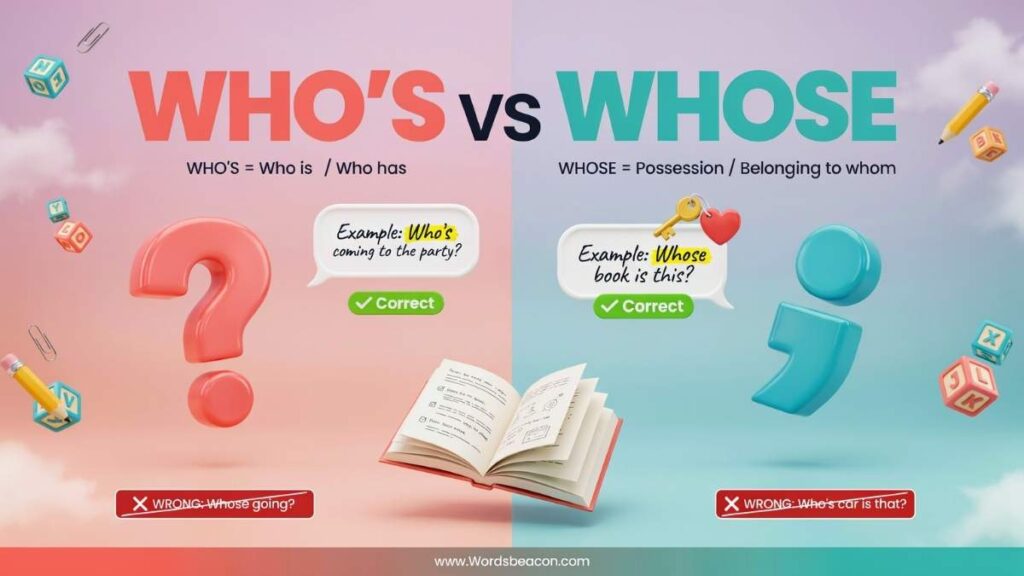
The who’s vs whose confusion can turn a simple sentence into a surprisingly tricky grammar question. Both words sound the same, but they have different meanings and jobs. Who’s is short for “who is” or “who has,” while whose shows possession, belonging, or connection. So, “Who’s calling?” means “Who is calling?” but “Whose phone is this?” asks who the phone belongs to. The tricky part is that your ears cannot tell these words apart. Luckily, the rule is simple once you know what to look for. This guide breaks down who’s vs whose meaning, usage, rules, and examples so you can choose the correct word confidently every time.
quick answer
The easiest way to understand the who’s and whose difference is to focus on what each word does.
| Word | Meaning | Main Use | Example |
|---|---|---|---|
| who’s | who is / who has | Contraction | Who’s calling? |
| whose | belonging to whom | Possession or connection | Whose phone is this? |
| whos | Usually incorrect | Not standard in ordinary sentences | Avoid “whos” |
In short:
- Who’s = who is or who has
- Whose = possession, ownership, or belonging
- Whos = generally not the correct spelling in ordinary English
That simple distinction solves most who’s vs whose questions.
Fix common more word mistakes in English
Wich vs Which difference and correct usage ?
What Does Who’s Mean?
Who’s is a contraction. It combines who with either is or has.
Therefore, who’s can mean:
- who is
- who has
The apostrophe matters because it shows that letters have been left out.
Who’s Meaning “Who Is”
Use who’s when you can replace it with who is.
For example:
“Who’s at the door?”
This means:
“Who is at the door?”
The meaning stays the same, so who’s is correct.
Here are a few more examples:
- Who’s ready for dinner?
- Who’s responsible for this project?
- Who’s waiting outside?
- Who’s coming to the meeting?
- Who’s calling your phone?
- Who’s the new teacher?
- Who’s in charge today?
In every example, who’s means who is.
Who’s Meaning “Who Has”
Who’s can also mean who has when has works as an auxiliary verb.
For example:
“Who’s finished the assignment?”
This means:
“Who has finished the assignment?”
Similarly:
- Who’s eaten all the cookies?
- Who’s been using my computer?
- Who’s taken my notebook?
- Who’s seen this movie before?
- Who’s left the door open?
Here, who’s does not mean who is. It means who has.
That distinction is important because many people learn only the “who is” rule and forget that who’s can also represent who has.
Learn the difference between similar English words
Offense vs Offence difference and correct usage ?
What Does Whose Mean?
Whose is the possessive form of who. It asks about possession, ownership, belonging, or a relationship.
You can usually think of whose as meaning “belonging to whom.”
For example:
“Whose jacket is this?”
The question asks:
“Who does this jacket belong to?”
So, whose is correct.
Other examples include:
- Whose book is on the desk?
- Whose car is parked outside?
- Whose phone is ringing?
- Whose house are we visiting?
- Whose idea was this?
- Whose bag is on the chair?
- Whose birthday is today?
- Whose turn is it?
- Whose fault was it?
- Whose name is on the list?
In each sentence, whose connects something with the person it belongs to or relates to.
Who’s vs Whose The Replacement Test
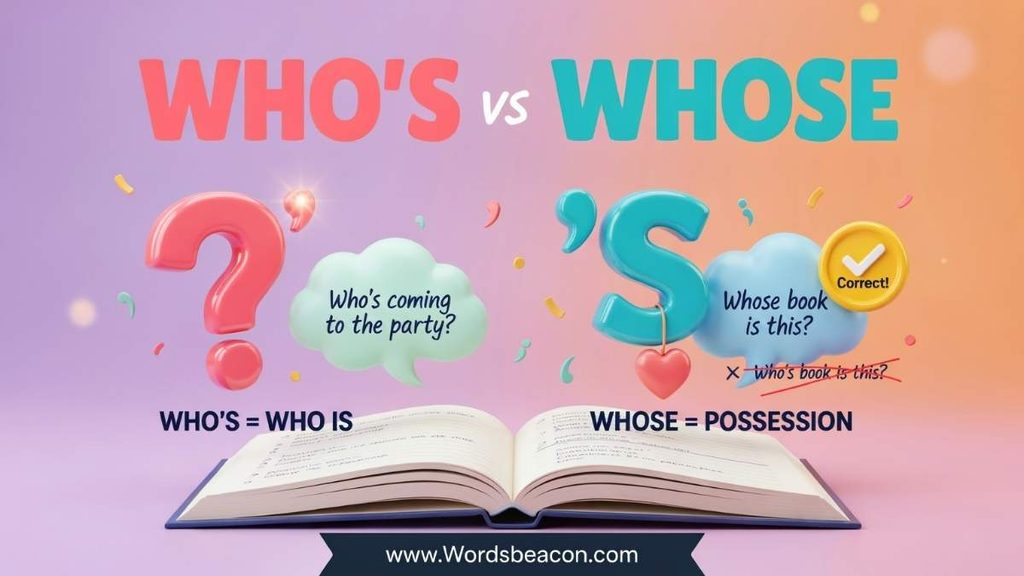
If you remember only one rule from this article, remember this one.
When you are unsure whether to use who’s vs whose, replace the word with “who is” or “who has.”
If the sentence still makes sense, use who’s.
If neither replacement works and the sentence deals with possession or belonging, use whose.
Example 1: Who’s
“Who’s coming to the party?”
Try the replacement:
“Who is coming to the party?”
That works perfectly.
Therefore:
“Who’s coming to the party?”
is correct.
Example 2: Whose
“Whose car is parked outside?”
Try the replacement:
“Who is car is parked outside?”
That does not work.
“Who has car is parked outside?”
That does not work either.
The sentence asks who owns the car, so whose is correct.
Example 3: Who’s
“Who’s been using my laptop?”
Try:
“Who has been using my laptop?”
That works.
Therefore, who’s is correct.
Example 4: Whose
“Whose laptop is on the table?”
Try replacing whose with who is:
“Who is laptop is on the table?”
The sentence falls apart immediately.
The question asks about ownership, so whose is correct.
This replacement test is one of the easiest ways to remember the who’s vs whose rules.
Learn the difference between similar English words
Man vs Men difference and Correct Usage ?
Who’s vs Whose Examples
Sometimes a side-by-side comparison makes the difference much clearer.
| Who’s | Whose |
|---|---|
| Who’s coming with us? | Whose coat is this? |
| Who’s calling? | Whose phone is ringing? |
| Who’s responsible? | Whose responsibility is this? |
| Who’s ready to leave? | Whose bag is on the floor? |
| Who’s been here before? | Whose name is on the form? |
| Who’s eaten the cake? | Whose cake is this? |
Notice the pattern.
Who’s introduces information about a person being, doing, or having done something. Whose identifies possession or connection.
Once you spot that pattern, the choice becomes much easier.
When to Use Who’s
Use who’s when the sentence needs a contraction of who is or who has.
Who’s + adjective
“Who’s responsible for the mistake?”
This means:
“Who is responsible for the mistake?”
More examples:
- Who’s ready?
- Who’s available?
- Who’s responsible?
- Who’s absent?
- Who’s nervous?
- Who’s excited?
Who’s + verb ending in -ing
Who’s can appear before a present participle when it means who is.
Examples:
- Who’s coming?
- Who’s working today?
- Who’s driving?
- Who’s waiting?
- Who’s talking?
- Who’s helping you?
For example:
“Who’s driving us home?”
means:
“Who is driving us home?”
Who’s + past participle
Who’s can also mean who has.
Examples:
- Who’s finished?
- Who’s eaten already?
- Who’s seen the movie?
- Who’s taken my pen?
- Who’s forgotten the instructions?
- Who’s been there before?
Here, who’s expands to who has.
Learn the difference between confusing more English words
Savior vs Saviour Difference and Usage?
When to Use Whose
Use whose when you need to show possession, ownership, association, or a relationship.
Whose + noun
This is one of the most common structures.
Examples:
- Whose jacket is this?
- Whose car is that?
- Whose book did you borrow?
- Whose phone is ringing?
- Whose house are we going to?
- Whose idea was it?
- Whose name is missing?
- Whose birthday is tomorrow?
The noun after whose tells you what belongs to or is connected with someone.
Whose Without a Noun
Whose can also appear without a noun when the thing being discussed is already understood.
For example:
“Whose is this?”
The listener understands that “this” refers to something whose owner needs to be identified.
You could also say:
“I found this jacket. Whose is it?”
Here, whose asks who the jacket belongs to.
Whose in Relative Clauses
Whose does not only appear in questions. It can also introduce a relative clause that shows possession or connection.
For example:
“She is the student whose essay won the prize.”
Here, whose connects the student with her essay.
Another example:
“I met a man whose daughter works here.”
The sentence tells us that the daughter belongs to or is connected with the man.
More examples:
- I know a teacher whose classes are always interesting.
- She adopted a dog whose leg had been injured.
- We visited a town whose history goes back centuries.
- He bought a car whose engine needed repairs.
- That is the company whose products we use.
This use sometimes confuses learners because the sentence does not directly ask a question. Still, the basic idea remains the same: whose shows possession or connection.
Learn the difference between confusing more English words
Parent’s vs Parents’ Difference and usage?
Is Whose a Possessive Pronoun?
In everyday grammar explanations, whose is commonly described as the possessive form of who or a possessive pronoun.
More precisely, whose can work as a possessive determiner when it comes before a noun.
For example:
“Whose jacket is this?”
Here, whose modifies jacket.
It can also stand on its own:
“Whose is this?”
So, the safest way to remember its grammatical role is simple: whose expresses possession or a relationship to someone or something.
The important point is not the label. The important point is what the word does.
Is Who’s Possessive?
No.
This is one of the biggest sources of confusion.
The apostrophe in who’s does not show possession. It shows that the word is a contraction.
Who’s means:
- who is
- who has
For example:
“Who’s phone is this?”
is incorrect if you mean to ask about ownership.
The correct sentence is:
“Whose phone is this?”
Why?
Because the sentence asks who the phone belongs to.
Compare:
“Who’s calling?”
and
“Whose phone is ringing?”
The first asks about an action. The second asks about ownership.
That small difference determines the spelling.
Why Doesn’t Whose Have an Apostrophe?
This question makes perfect sense because English often uses apostrophe plus s to show possession.
For example:
- Sarah’s book
- John’s car
- the teacher’s desk
However, whose works differently.
Whose is already the possessive form of who. It does not need an apostrophe.
Think about these familiar words:
- your
- yours
- its
- their
- theirs
- whose
These possessive forms do not use apostrophes simply because they show possession.
Meanwhile, who’s uses an apostrophe because it is a contraction.
So:
- who’s = contraction
- whose = possessive form
The apostrophe does not automatically mean possession.
Learn the difference between confusing more English words
Manual vs Manuel Difference and usage ?
Who’s vs Whose in Common Expressions
Certain phrases appear so often that they are worth learning as complete patterns.
Whose name
Correct:
“Whose name is on the document?”
Incorrect:
“Who’s name is on the document?”
The sentence asks about ownership or association with the name, so whose is required.
Whose birthday
Correct:
“Whose birthday is today?”
Incorrect:
“Who’s birthday is today?”
The question asks which person’s birthday it is.
Whose house
Correct:
“Whose house are we visiting?”
Incorrect:
“Who’s house are we visiting?”
The house belongs to someone, so use whose.
Whose car
Correct:
“Whose car is parked outside?”
Incorrect:
“Who’s car is parked outside?”
Again, the sentence asks about ownership.
Whose idea
Correct:
“Whose idea was this?”
Incorrect:
“Who’s idea was this?”
The sentence asks which person came up with the idea.
Whose fault
Correct:
“Whose fault was it?”
The question asks which person was responsible.
Whose turn
Correct:
“Whose turn is it?”
This asks who should act next.
These expressions are useful because they show how naturally whose connects with nouns.
Molding vs Moulding which one is correct and usage ?
Common Who’s vs Whose Mistakes
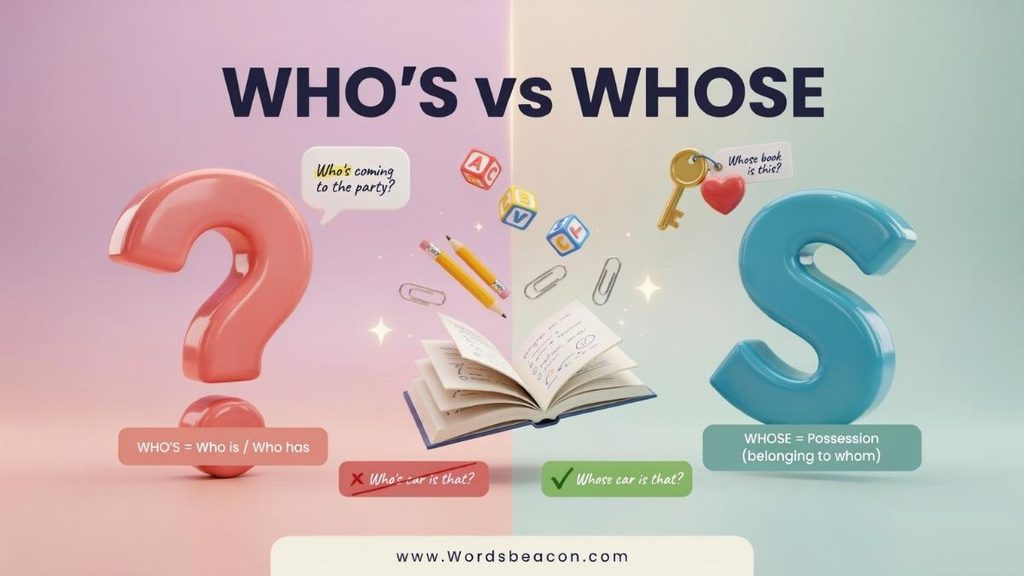
The confusion usually comes from pronunciation. Since who’s and whose sound alike, your ears cannot help much. Your grammar has to do the work.
Mistake: Who’s used for possession
Incorrect:
“Who’s bag is this?”
Correct:
“Whose bag is this?”
The sentence asks who owns the bag, so use whose.
Mistake: Whose used for “who is”
Incorrect:
“Whose coming to dinner?”
Correct:
“Who’s coming to dinner?”
You can replace who’s with who is:
“Who is coming to dinner?”
That makes the answer obvious.
Mistake: Whose used for “who has”
Incorrect:
“Whose finished the project?”
Correct:
“Who’s finished the project?”
Expand it:
“Who has finished the project?”
It works, so who’s is correct.
Mistake: Assuming every apostrophe shows possession
English makes this mistake surprisingly easy.
Apostrophes can show possession in many nouns:
“Maria’s phone.”
However, apostrophes also show missing letters in contractions:
“Who’s” = “who is” or “who has.”
So, do not choose who’s just because you think the sentence involves ownership.
Learn the difference between confusing more English words
Farther vs Further difference and usage ?
Who’s vs Whose vs Whom
Who, whose, and whom all relate to people, but they serve different grammatical purposes.
| Word | Main function | Example |
|---|---|---|
| who | Identifies a person | Who called you? |
| whose | Shows possession | Whose phone is this? |
| whom | Acts as an object in formal grammar | Whom did you invite? |
| who’s | Means who is or who has | Who’s calling? |
The easiest distinction is:
Who asks about the person.
Whose asks about possession.
Whom usually identifies the object of a verb or preposition.
Who’s is different from all three because it is a contraction.
Who Is vs Whose
The phrases “who is” and “whose” may appear close in some sentences, but they have completely different meanings.
Compare:
“Who is coming?”
This asks about a person.
“Whose bag is this?”
This asks about ownership.
You can shorten “who is” to “who’s”:
“Who’s coming?”
However, you cannot turn “whose” into “who is.”
That is why the replacement test works so well.
Who Has vs Whose
The same distinction applies to “who has.”
Compare:
“Who has finished the work?”
This asks which person has completed the work.
You can shorten it:
“Who’s finished the work?”
But:
“Whose work is finished?”
asks about whose work it is.
These sentences may sound similar when spoken quickly, but their meanings are different.
Learn the difference between confusing more English words
Quiet vs Quite difference and usage ?
Are Who’s and Whose Homophones?
Yes. In standard English pronunciation, who’s and whose are generally homophones.
That means they sound the same but have different spellings and meanings.
This is exactly why the confusion happens.
When you hear:
“Whose calling?”
you cannot determine the correct spelling from pronunciation alone.
You need to consider the sentence.
If the intended meaning is:
“Who is calling?”
then the correct spelling is:
“Who’s calling?”
If the sentence asks about ownership:
“Whose phone is ringing?”
then use whose.
So, when the sound gives you no clue, look at the meaning.
Is “Whos” Correct?
In ordinary English sentences, whos is generally not the correct spelling of either word.
You normally need:
- who’s
- whose
not:
- whos
For example:
Incorrect: “Whos coming?”
Correct: “Who’s coming?”
Incorrect: “Whos bag is this?”
Correct: “Whose bag is this?”
The missing apostrophe in who’s matters because who’s is a contraction. Meanwhile, whose has its own established spelling.
There are rare specialized contexts where “whos” can appear, but that does not make it a standard replacement for who’s vs whose in everyday writing.
For normal English writing, avoid whos.
How to Remember Who’s vs Whose
If grammar rules start turning into alphabet soup, use a simple memory trick.
Remember:
Who’s has an apostrophe because something is missing.
Who’s = who is
or
Who’s = who has
Whose has no apostrophe because it shows possession.
Whose = belonging to whom
You can also remember two example phrases:
“Who’s coming?”
“Whose jacket?”
If you associate who’s with an action and whose with ownership, the difference becomes much easier to recall.
A Three-Second Proofreading Trick
When proofreading your writing, stop whenever you see who’s vs whose.
Then ask one question:
Can I replace it with “who is” or “who has”?
If yes, keep who’s.
If no, check whether the sentence shows possession or belonging.And If it does, use whose.
For example:
“Who’s responsible?”
Replace it:
“Who is responsible?”
Works.
Now:
“Whose responsibility is this?”
Replace it:
“Who is responsibility is this?”
Does not work.
The second sentence needs whose.
This tiny habit can prevent a surprisingly large number of spelling mistakes.
Who’s vs Whose Which Is Correct?
Both are correct words. The right choice depends entirely on the sentence.
Use who’s when you mean who is or who has.
Examples:
- Who’s coming?
- Who’s ready?
- Who’s calling?
- Who’s been there?
- Who’s finished the work?
Use whose when you mean belonging to whom or when you show possession or connection.
Examples:
- Whose book is this?
- Whose car is parked outside?
- Whose idea was it?
- The writer whose book won the award.
- The student whose phone rang.
Therefore, asking “Is who’s vs whose correct?” does not have one universal answer. Both can be correct, but they cannot normally replace each other.
Who’s vs Whose Quick Sentence Comparison
Here is another useful way to see the grammatical difference.
| Sentence | Correct word | Why? |
|---|---|---|
| ___ coming with us? | Who’s | Who is coming |
| ___ jacket is this? | Whose | Shows ownership |
| ___ been here before? | Who’s | Who has been |
| ___ phone is ringing? | Whose | Shows ownership |
| ___ responsible for this? | Who’s | Who is responsible |
| ___ idea was that? | Whose | Shows possession |
The trick is not to memorize every sentence. Instead, identify the job of the word.
Who’s vs Whose in Formal Writing
Both forms can appear in correct English writing.
However, contractions such as who’s may sound more conversational. In very formal academic writing, some writers prefer to avoid contractions and write “who is” or “who has” in full.
For example:
Conversational:
“Who’s responsible for the report?”
More formal:
“Who is responsible for the report?”
This does not make who’s grammatically wrong. It simply reflects the tone of the writing.
Whose, on the other hand, remains the normal possessive form:
“Whose research influenced the study?”
There is no reason to replace whose simply because the writing is formal.
How to Use Who’s in a Sentence
Using who’s correctly becomes easy once you know what it represents.
Use it when it means who is:
“Who’s your manager?”
Use it when it means who has:
“Who’s completed the task?”
Here are more examples:
- Who’s going to the conference?
- Who’s waiting in the lobby?
- Who’s responsible for the decision?
- Who’s been working on this report?
- Who’s already submitted the form?
- Who’s calling at this hour?
- Who’s ready for the next question?
Before finalizing the sentence, expand who’s. If the expanded version works, you have probably chosen correctly.
How to Use Whose in a Sentence
Use whose when you want to identify ownership, possession, association, or a relationship.
Examples:
- Whose notebook is this?
- Whose house did you visit?
- Whose car needs repairs?
- Whose phone keeps ringing?
- Whose idea changed the plan?
- Whose name appears first?
- Whose birthday are we celebrating?
- The employee whose work impressed the manager received an award.
Whose can refer to people, animals, and sometimes things.
For example:
“The company whose products we use has expanded.”
Here, whose shows a relationship between the company and its products.
A Simple Way to Stop Making the Mistake
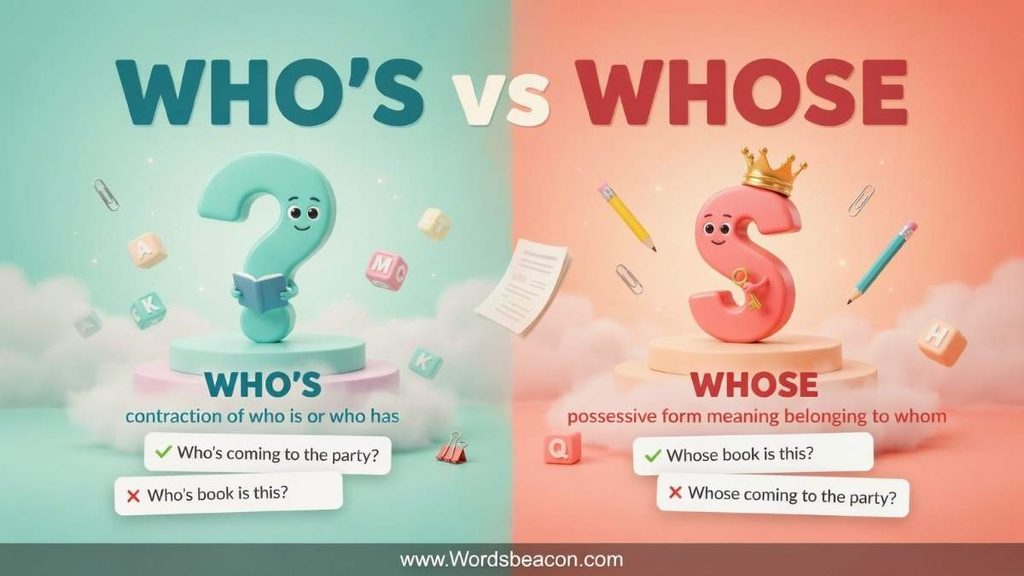
You do not need to memorize dozens of grammar rules. Use this three-step method.
Step one: Read the sentence
Do not focus on how the word sounds.
Step two: Expand who’s
Try:
“who is”
Then try:
“who has”
If either version fits, use who’s.
Step three: Check for possession
If the sentence asks who something belongs to or describes a relationship, use whose.
For example:
“___ phone is ringing?”
Try:
“Who is phone is ringing?”
No.
“Who has phone is ringing?”
No.
The sentence asks about ownership.
Therefore:
“Whose phone is ringing?”
That is the correct sentence.
Learn the difference between confusing more English words
Its vs It’s Difference and usage ?
practice session Who’s vs Whose
Choose the correct word, who’s vs whose, to complete each sentence.
- ______ coming to the office with us?
- ______ jacket is hanging by the door?
- Do you know ______ responsible for the project?
- ______ phone keeps ringing?
- ______ been using my laptop?
- ______ idea was it to change the meeting time?
- ______ calling you right now?
- ______ car is parked outside?
- ______ ready for the next question?
- ______ birthday are we celebrating today?
- I wonder ______ already finished the assignment.
- ______ bag did you leave on the chair?
- ______ going to lead the discussion?
- ______ name is written on the package?
- Do you know ______ been working on this report?
- ______ fault was it?
- ______ waiting for us at the entrance?
- The student ______ notebook was missing went back to the classroom.
- ______ turn is it to present?
- ______ responsible for locking the door?
Answers
- Who’s
- Whose
- Who’s
- Whose
- Who’s
- Whose
- Who’s
- Whose
- Who’s
- Whose
- Who’s
- Whose
- Who’s
- Whose
- Who’s
- Whose
- Who’s
- Whose
- Whose
- Who’s
Here’s a trusted source for clear more words Comparison:
FAQs
What is the easiest way to remember who’s and whose?
Use one simple test: who’s means “who is” or “who has,” while whose shows possession, belonging, or a connection. If you can replace who’s with “who is” or “who has,” use who’s. Otherwise, if the sentence asks who something belongs to, use whose.
Can whose refer to animals or things?
Yes. Whose can refer to people, animals, organizations, and things. For example, “The dog whose owner moved away still visits the park” uses whose to show the relationship between the dog and its owner.
Can who’s be used before a noun?
Who’s should not be used to show possession before a noun. For example, “Who’s phone is this?” is incorrect. The correct sentence is “Whose phone is this?” because the question asks who the phone belongs to.
Can whose be used without a noun?
Yes. Whose can stand alone when the thing being discussed is already clear. For example, “Whose is this?” asks who owns the object without repeating the noun.
Can who’s mean “who has”?
Yes. Who’s can mean either “who is” or “who has.” For example, “Who’s finished the assignment?” means “Who has finished the assignment?”
Can whose be used in a statement instead of a question?
Yes. Whose can introduce a relative clause that shows possession or connection. For example, “She is the teacher whose students won the competition.” Here, whose connects the teacher with her students.
Does whose always mean ownership?
Not necessarily. Whose can express ownership, belonging, association, or a relationship. For example, “The company whose products we use” shows a connection between the company and its products rather than simple personal ownership.
Why do who’s and whose sound the same?
Who’s and whose are generally pronounced alike in standard English. They are homophones, which means they sound the same but have different spellings, meanings, and grammatical functions.
Can who’s appear at the beginning of a sentence?
Yes. Who’s often begins questions when it means “who is” or “who has.” For example, “Who’s waiting outside?” means “Who is waiting outside?”
Can whose appear in a relative clause?
Yes. Whose can introduce a relative clause that explains possession or a relationship. For example, “I met a writer whose books are popular with young readers.”
Is whose correct in formal English?
Yes. Whose is standard English and works in both formal and informal writing. You can use it in academic papers, professional communication, questions, and relative clauses.
Is who’s appropriate in formal writing?
Yes, but the choice can depend on style. Who’s is grammatically correct, although some formal writing prefers the full forms “who is” or “who has.” The contraction itself is not incorrect.
Can whose be used to ask about responsibility?
Yes. Whose can identify the person associated with responsibility, fault, or a decision. For example, “Whose responsibility is it?” and “Whose fault was the mistake?” are both grammatically correct.
Can I use whose for a company or organization?
Yes. Whose can describe a relationship between an organization and something connected with it. For example, “The company whose website crashed issued an apology.”
Can I replace whose with “who is”?
No. Whose and “who is” have different functions. “Who is” identifies or describes a person, while whose expresses possession or connection. For example, “Who is calling?” and “Whose phone is ringing?” ask different questions.
Can I replace whose with “who has”?
No. Whose does not mean “who has.” If “who has” fits the sentence, the contracted form is who’s. For example, “Who’s finished the work?” means “Who has finished the work?”
Why does who’s have an apostrophe?
The apostrophe in who’s shows that letters have been omitted from “who is” or “who has.” It does not indicate possession. That is why who’s and whose have different grammatical roles.
Why doesn’t whose have an apostrophe?
Whose is already the possessive form of who, so it does not need an apostrophe. The absence of an apostrophe is part of its standard spelling.
Is “whos” correct in everyday English?
No. In ordinary sentences, whos is not the standard spelling of who’s vs whose. Use who’s when you mean “who is” or “who has,” and use whose when you mean possession or belonging.
What is the fastest way to choose between who’s and whose?
Use the replacement test. Replace who’s with “who is” or “who has.” If the sentence still makes sense, choose who’s. If neither replacement works and the sentence asks about possession, belonging, or connection, choose whose.
Conclusion
The who’s vs whose confusion is easy to fix once you stop listening to how the words sound and start looking at what they mean. Both words sound alike, but they do different jobs in a sentence.
Use who’s when you mean “who is” or “who has.” For example, “Who’s coming?” means “Who is coming?” On the other hand, use whose when you are talking about possession, belonging, or a connection. “Whose phone is this?” asks who the phone belongs to.
Still unsure? Use the replacement test. If “who is” or “who has” fits, choose who’s. If the sentence asks about ownership or belonging, choose whose.
That’s it. No grammar drama, no apostrophe panic, and no guessing. Once you learn this simple trick, choosing between who’s and whose becomes quick, clear, and almost automatic.

Luna AJS is an experienced blogger and dedicated language enthusiast at Words Beacon. She specializes in making English grammar, spelling, vocabulary and commonly confused words easy to understand. She provides clear explanations, practical examples to help readers write with confidence.