

English can be tricky when two words look almost the same but mean completely different things. Accept vs except is one of those common grammar mix-ups. They differ by just one letter, yet they do very different jobs in a sentence. Accept means to receive, agree to, or approve something. Except means to leave someone or something out. That sounds simple, but when you’re writing quickly, these two words can easily cause trouble. Luckily, the difference is easy to remember once you connect each word with its meaning. One lets something in, while the other leaves something out. Grammar drama, solved.
Quick Answer
The simplest way to understand the accept vs except meaning is to look at what each word does in a sentence.
| Word | Main meaning | Typical role | Example |
|---|---|---|---|
| Accept | Receive, agree, approve, or acknowledge | Verb | I accepted the offer. |
| Except | Exclude, leave out, or not include | Preposition or conjunction | Everyone came except Jake. |
So, what is the difference between accept and except?
Accept describes an action involving receiving, agreeing, approving, or acknowledging something. In contrast, except identifies a person or thing that does not belong to a particular group or situation.
To make the difference clearer, consider these two sentences:
She accepted the invitation.
In this case, the sentence tells us that she agreed to receive or take part in something. Therefore, accept is the correct choice.
On the other hand, everyone attended except Mark.
Here, the sentence tells us that Mark was left out. So, except is the correct choice.
That is the heart of the accept vs except difference.
Learn the difference between confusing more English words
Carmel vs Caramel difference and usage?
Why Are Accept and Except So Easy to Confuse?
The words accept and except are commonly confused because they look nearly identical. Both have two syllables, both end in “-cept,” and their sounds are close enough that the distinction can disappear in quick conversation.
Spelling makes the problem even worse. When you’re typing quickly, it’s easy for your fingers to choose accept when you meant except.
Meaning, however, gives you a much better clue.
Look at this sentence:
Everyone ___ Sarah was invited.
Sarah is the person being left out. The sentence means everyone was invited, but Sarah wasn’t.
Everyone except Sarah was invited.
Now change the sentence:
Sarah ___ the invitation.
Here, Sarah agreed to the invitation.
Sarah accepted the invitation.
Notice how the context makes the correct word clear. You don’t need to memorize a complicated grammar rule. You simply need to ask what the sentence means.
Accept Definition and Meaning
The accept definition centers on receiving, agreeing, approving, or acknowledging something.
Accept is a verb, which means it describes an action. However, that action can take several forms depending on the context.
Accept Meaning To Receive Something
One of the most common meanings of accept is to receive something willingly.
For example:
She accepted the gift from her friend.
Here, she received the gift rather than refusing it.
You can accept a gift, accept payment, accept an invitation, accept an offer, or accept a job offer.
Consider these examples:
The cashier accepted my payment.
Daniel accepted the job offer.
Maria accepted the invitation.
The university accepted her application.
He accepted the gift graciously.
In each example, accept involves willingly taking or receiving something.
That doesn’t always mean the person feels excited about it. You might accept a difficult situation without liking it. And You might accept criticism without agreeing with every point. You might accept an outcome simply because you recognize that it has happened.
Accept Meaning To Agree to Something
Accept can also mean agreeing to something that another person offers, suggests, or proposes.
For example:
The manager accepted the proposal after reviewing the changes.
Here, accepted means the manager approved or agreed to the proposal.
This meaning commonly appears with words such as offer, proposal, invitation, terms, agreement, request, and challenge.
For example:
They accepted the offer.
She accepted the proposal.
We accepted the invitation.
He accepted the terms of the agreement.
She accepted the challenge.
Accept and agree sometimes overlap, but they aren’t always interchangeable.
Compare these sentences:
I accepted the offer.
I agreed with his opinion.
The first sentence means I agreed to take the offer. The second means I shared the person’s opinion.
That small difference matters because correct word choice depends on context.
Accept Meaning To Acknowledge or Admit
Accept can also mean recognizing something as true, real, valid, or unavoidable.
For example:
She finally accepted that the plan wouldn’t work.
She may not have liked the conclusion, but she recognized it.
This meaning appears in expressions such as accept responsibility, accept the truth, accept the facts, accept criticism, and accept the consequences.
For example:
After reviewing the evidence, he accepted responsibility for the mistake.
Here, accepted means acknowledged. He recognized that he was responsible.
Accept as a Verb
Is accept a verb?
Yes. Accept is a verb, and its forms change depending on the sentence.
| Form | Example |
|---|---|
| Accept | I accept the offer. |
| Accepts | She accepts the decision. |
| Accepted | He accepted the apology. |
| Accepting | They are accepting applications. |
| Acceptance | Her acceptance surprised everyone. |
| Acceptable | The solution is acceptable. |
The related words acceptance and acceptable aren’t verbs, but they come from the same word family.
Recognizing these forms can also help you understand accept grammar and remember the spelling.
Learn the difference between confusing more English words
Inquire vs Enquire difference and Usage?
Accept Examples in Everyday English
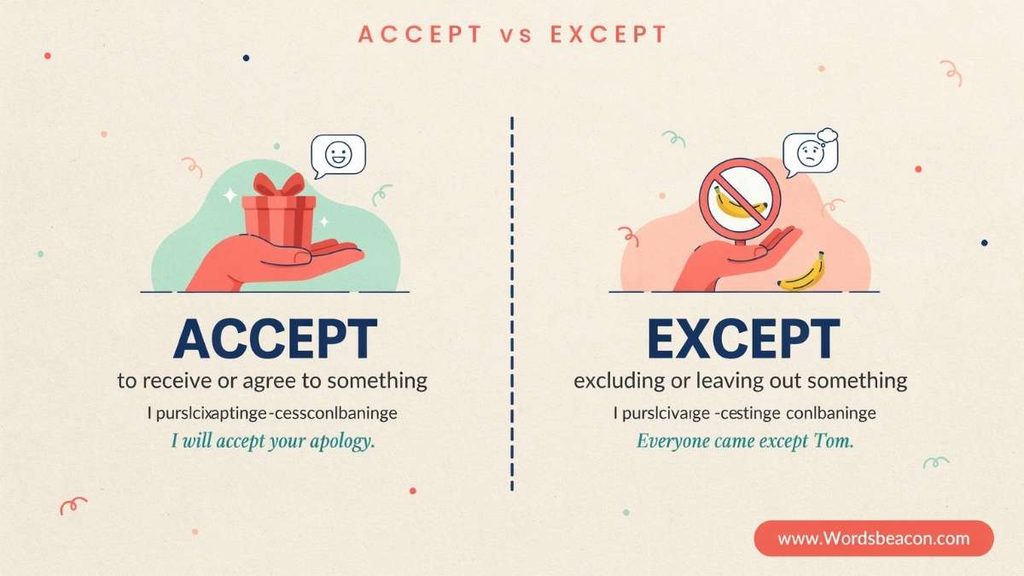
The meaning of accept becomes much clearer when you see it in natural sentences.
I accept your apology.
She accepted the job offer.
We accepted the invitation.
He accepted responsibility for the mistake.
They accepted the proposal.
The store accepts credit cards.
Please accept this gift as a token of appreciation.
She couldn’t accept the decision at first.
The company is accepting applications until Friday.
He accepted the terms of the agreement.
Each example involves receiving, agreeing, approving, or acknowledging something.
Except Definition and Meaning
The except definition is much more focused. Except usually means excluding, leaving out, or not including someone or something.
For example:
Everyone attended except Sarah.
The sentence tells us that Sarah did not attend while everyone else did.
That gives except a useful role in English. It identifies an exception within a larger group.
Except Meaning Not Including
The most common except meaning is “not including.”
You’ll often see it with words such as everyone, everything, all, nothing, nobody, and no one.
For example:
Everyone except me received a ticket.
Everyone except John finished the assignment.
We sell every color except yellow.
All except one student passed the exam.
Nothing except water was available.
No one except you knew the answer.
All students except Ali attended the meeting.
In every sentence, except points to the person or thing that has been excluded.
Except Meaning Apart From
Except can also mean apart from or other than.
For example:
I like all vegetables except spinach.
The speaker likes vegetables generally but doesn’t include spinach.
The phrase except for works in a similar way.
For example:
The report was excellent except for a few minor errors.
The report was strong overall, but those errors created an exception.
You could also write:
The room was clean except for the floor.
The trip was enjoyable except for the long delay.
Everything was ready except for the final report.
These sentences all point to something that stands outside an otherwise general statement.
Except as a Preposition
Is except a preposition?
Yes. Except can function as a preposition when it introduces the person or thing being excluded.
For example:
Everyone except John left early.
Here, except introduces John and shows that he was excluded from the group.
Other examples include:
Nobody except her knew the answer.
We invited everyone except them.
The road was clear except for one blocked lane.
Understanding this role helps make except grammar less confusing.
Except as a Conjunction
Can except be a conjunction?
Yes. Except can function as a conjunction when it introduces a clause that gives an exception or explains why something didn’t happen.
For example:
I would help you except I have an appointment.
The second clause explains the exception to the speaker’s willingness to help.
Another example is:
We would have stayed longer except it started raining.
Here, the rain prevented the speakers from staying longer.
Can Except Be a Verb?
Is except a verb?
Yes, although this use is far less common in everyday English.
As a verb, except can mean to exclude someone or something.
For example:
The rule excepts certain cases.
Most readers, however, encounter except as a preposition or conjunction. In ordinary conversation and writing, its most familiar job is showing an exception.
Learn the difference between confusing more English words
Eyeing vs Eying difference and usage?
Accept vs Except The Main Difference
The accept vs except difference becomes much easier when you reduce it to two ideas.
Accept brings something in.
Except leaves something out.
Imagine a guest list for a party. If you accept an invitation, you agree to attend. If the invitation says everyone is welcome except Jake, Jake isn’t included.
That simple image captures the basic difference.
| Meaning | Correct word |
|---|---|
| Receive something | Accept |
| Agree to something | Accept |
| Approve something | Accept |
| Acknowledge something | Accept |
| Exclude someone | Except |
| Leave something out | Except |
| Not include something | Except |
| Apart from something | Except |
Now compare:
I accepted the invitation.
Everyone attended except David.
The first sentence involves agreement or receiving. The second involves exclusion.
Once you see that pattern, many accept vs except grammar questions become much easier.
Learn the difference between tricky grammar words
Begun vs Began difference and usage?
Accept vs Except Grammar
The parts of speech provide another reliable way to separate these two words.
Accept Grammar
Accept functions primarily as a verb.
A common structure is accept followed by a noun:
She accepted the offer.
You can also use accept with a person or thing followed by “as”:
The committee accepted him as the new leader.
Another common structure uses a that-clause:
He accepted that he had made a mistake.
Accept also appears in familiar expressions such as accept responsibility and accept the consequences.
For example:
She accepted responsibility for the error.
These structures are common in business writing, academic English, formal communication, and everyday speech.
Except Grammar
Except commonly works as a preposition or conjunction.
As a preposition:
Everyone except Tom left early.
As a conjunction:
I would join you except I have work to finish.
The phrase except for also appears frequently:
The presentation was strong except for a few technical problems.
Although its grammatical role can change, the central meaning remains the same. Something is being treated as an exception.
Accept vs Except in a Sentence
If you’re looking for an accept sentence, consider:
I accepted the job offer after reviewing the salary and benefits.
Here, accepted means agreed to take the job.
For an except sentence:
The office is open every day except Sunday.
Here, Sunday is excluded from the schedule.
A few more examples make the difference even clearer.
She accepted the invitation immediately.
He accepted the decision with professionalism.
The company accepted the proposal after several revisions.
Everyone except Lisa completed the task.
The museum is open daily except Monday.
Nothing except the final page was missing.
The meaning determines the spelling.
Learn the difference between tricky grammar words
Humour vs Humor difference and usage?
Accept vs Except Examples in Real Situations

Context often teaches word usage better than definitions alone. When you see accept and except in everyday situations, the distinction becomes much more natural.
At Work
The director accepted the proposal.
In other words, the director approved or agreed to the proposal.
Meanwhile, everyone except the director attended the meeting.
Therefore, the director was the one person who didn’t attend.
At School
The teacher accepted my assignment late.
The teacher agreed to receive it even though it arrived after the deadline.
All students except Ali submitted their assignments.
Ali was the exception.
In Everyday Conversation
I accept your apology.
The speaker acknowledges the apology.
Everyone except me knew about the surprise.
The speaker was the only person excluded from the information.
While Shopping
This store accepts credit cards.
The store allows customers to pay with credit cards.
The discount applies to every item except clearance products.
Clearance products are excluded from the discount.
These examples show why context matters so much when you’re dealing with confusing English words.
Fix common more word mistakes in English
Grey vs Gray difference and usage?
Common Mistakes With Accept and Except
Even strong writers sometimes mix up accept and except. The mistakes tend to follow the same patterns.
“I Except Your Apology”
This sentence, however, uses the wrong word.
Instead, the correct version is:
I accept your apology.
After all, an apology is something you receive or acknowledge. You don’t exclude it.
“Everyone Accept John”
The correct sentence is:
Everyone except John was invited.
John is excluded from the group, so except fits the meaning.
“She Excepted the Offer”
The correct version is:
She accepted the offer.
Someone accepts an offer when they agree to take it.
“All Accept One”
The correct sentence is:
All except one student passed.
One student is the exception, so except is required.
“I Except Responsibility”
The correct sentence is:
I accept responsibility for the mistake.
Here, accept means acknowledge.
“No One Accept Her”
The correct sentence is:
No one except her knew the answer.
The phrase excludes everyone other than her.
These errors may look small, but they can make an otherwise polished sentence look careless. Fortunately, the fix is simple once you focus on meaning.
Accept vs Except With “For”
The phrase except for deserves special attention because it appears so often in everyday English.
Compare:
Everyone came except John.
The event went well except for the weather.
Both sentences express an exception, but they use slightly different structures.
Except John directly identifies John as the person who wasn’t included.
Except for the weather identifies a circumstance that prevents the overall statement from being completely positive.
For example:
The essay was strong, except for a weak conclusion.
Similarly, the room was clean, except for the floor.
Likewise, everything was ready, except for the final report.
Overall, the trip was enjoyable, except for the long delay.
However, one important point remains the same: accept doesn’t belong in these sentences.
Fix common more word mistakes in English
Honor vs Honour difference and usage?
Accept vs Except vs Expect
Another word often gets pulled into the confusion: expect.
Accept, except, and expect look similar, but they have three different meanings.
| Word | Meaning | Example |
|---|---|---|
| Accept | Receive, agree, approve, or acknowledge | I accepted the offer. |
| Except | Exclude or leave out | Everyone came except Sam. |
| Expect | Anticipate or believe something will happen | I expect Sam to arrive soon. |
Consider the difference:
I accept the invitation.
You agree to take part.
Everyone came except Sam.
Sam didn’t attend.
I expect Sam tomorrow.
You believe or anticipate that Sam will arrive.
The three words may look like distant cousins who showed up wearing similar outfits, but they have completely different jobs.
Accept vs Except Pronunciation
The accept pronunciation and except pronunciation differ mainly in their opening vowel sounds in standard US English.
Accept begins with an unstressed vowel sound, while except begins with a different initial vowel sound. Their endings are similar, which can make the words difficult to distinguish when someone speaks quickly.
The accept vs except pronunciation difference becomes easier to hear when you slow down and emphasize the first syllable.
Still, pronunciation shouldn’t be your only guide. Context is more reliable, particularly when you’re writing.
If you’re unsure which spelling belongs in a sentence, forget how the word sounds for a moment and ask what you mean.
Are you talking about receiving or agreeing?
Use accept.
Are you talking about excluding or leaving something out?
Use except.
Learn how to use confusing more words correctly
Sergeant vs Sargeant difference and usage?
Accept Synonyms and Antonyms
Learning related words can make the meaning of accept easier to remember.
Accept Synonym
Depending on the context, however, an accept synonym can include receive, approve, agree to, consent to, acknowledge, admit, take, or embrace.
However, these words don’t always work as direct replacements.
For example:
She received the package.
Here, this describes the physical arrival of the package.
In contrast, she accepted the package.
This can suggest that she willingly took it.
The difference may seem small, but context determines which verb sounds natural.
Accept Antonym
Common antonyms of accept include reject, refuse, decline, deny, and dismiss.
For example:
She accepted the offer.
She rejected the offer.
The contrast is straightforward. One describes agreeing to take the offer while the other describes refusing it.
Except Synonyms
Useful synonyms for except include excluding, apart from, other than, not including, leaving out, and with the exception of.
For example:
Everyone except Maria attended.
You could also say:
Everyone apart from Maria attended.
The meaning remains essentially the same.
However, these alternatives don’t fit every grammatical structure. Except is often the most natural choice in ordinary English.
Learn how to use confusing more words correctly
Insite vs Insight difference and usage?
How to Use Accept and Except Correctly

When you’re unsure whether to use accept vs except, don’t start by staring at the spelling. Start with the meaning.
Ask yourself what the sentence describes.
If someone receives, agrees to, approves, or acknowledges something, use accept.
If someone or something is excluded, left out, or treated as an exception, use except.
You can test the sentence by replacing the word mentally.
If “receive” or “agree to” makes sense, accept is probably the right choice.
If “exclude,” “apart from,” or “not including” makes sense, except is probably correct.
Consider:
Everyone ___ Sarah attended.
Replace the missing word with “excluding.”
Everyone excluding Sarah attended.
The meaning works. Therefore, the correct word is except.
Now try:
Sarah ___ the invitation.
Replace the missing word with “agreed to.”
Sarah agreed to the invitation.
The meaning works. Therefore, the correct word is accepted.
This method is much more useful than trying to memorize the spelling in isolation.
How Do You Remember Accept vs Except?
If you want a quick memory trick, keep the distinction short:
Accept means receive or agree.
Except means exclude.
Another helpful clue is the “ex” in except. Think of it as a reminder of exclusion.
Imagine a classroom. A teacher accepts a student’s assignment by taking it in. But if the teacher says every student submitted the assignment except Ali, Ali is the one person left out.
That mental picture can make the difference stick.
Learn how to use confusing more words correctly
Advise vs Advice difference and Usage?
Practice Session Accept vs Except
Fill in each blank with the correct word: accept vs except.
- I gladly ______ your invitation to the wedding.
- Everyone attended the meeting ______ Sarah.
- She decided to ______ the job offer after reading the contract.
- The store is open every day ______ Sunday.
- Please ______ my apology for the misunderstanding.
- All the students passed the test ______ one.
- He found it difficult to ______ the truth.
- Nobody ______ Maria knew about the surprise party.
- The company will ______ applications until Friday.
- I enjoy all kinds of fruit ______ grapefruit.
- They agreed to ______ responsibility for the mistake.
- Nothing ______ water was available during the hike.
- We decided to ______ the proposal after making a few changes.
- Everyone ______ me received an invitation.
- She eventually ______ the decision, even though she disagreed with it.
- No one ______ John knew where the keys were.
- The restaurant serves food every day ______ Monday.
- He was happy to ______ the gift from his friend.
- All employees ______ two were present at the meeting.
- The teacher agreed to ______ my late assignment.
- I like every subject at school ______ mathematics.
- She was willing to ______ the criticism and improve her work.
- The discount applies to all products ______ those on sale.
- He decided to ______ the terms of the agreement.
- Everyone was invited to the event ______ the new employees.
Answers
- accept
- except
- accept
- except
- accept
- except
- accept
- except
- accept
- except
- accept
- except
- accept
- except
- accept
- except
- except
- accept
- except
- accept
- except
- accept
- except
- accept
- except
Here’s a trusted source for clear more words Comparison:
FAQs
Can accept and except be used interchangeably?
No. Accept and except have different meanings, so they usually cannot replace each other. Accept generally means to receive, agree to, approve, or acknowledge something. Except means to leave someone or something out.
For example, “She accepted the invitation” means she agreed to it. “Everyone came except James” means James was not included.
What part of speech is accept?
Accept is a verb. It describes an action such as receiving something, agreeing to something, approving it, or acknowledging it.
For example, you can accept a gift, accept an offer, accept responsibility, or accept an explanation.
What part of speech is except?
Except can function as a preposition, conjunction, or, less commonly, a verb.
1.First, as a preposition, it shows exclusion: “Everyone came except Tom.”
2.Similarly, as a conjunction, it introduces an exception: “I would go, except I’m busy.”
3.As a verb, except means to exclude, although this use is uncommon in everyday English.
Why can one letter change the meaning of accept and except?
English has plenty of words that look nearly identical but have completely different meanings. Accept and except are a classic example.
The easiest way to separate them is to focus on direction. Accept generally brings something in, while except leaves something out. Once you connect each word with that basic idea, the spelling becomes much easier to remember.
Can accept be followed by an infinitive?
Accept can appear before an infinitive in some structures, particularly when the infinitive describes the purpose or content of something being accepted.
For example, “She accepted the offer to join the company.”
However, “accept to do something” is generally not natural in standard English. Instead, English commonly uses structures such as “agree to do,” “consent to do,” or “accept an offer to do.”
Can except appear at the beginning of a sentence?
Yes. Except can begin a sentence when it introduces an exception.
For example, “Except for one minor error, the report was excellent.”
This structure is perfectly natural and clearly shows that one detail is being excluded from an otherwise positive statement.
What is the difference between accept and acceptance?
Accept is a verb, while acceptance is a noun.
For example, “She accepted the proposal” describes an action. “Her acceptance of the proposal surprised everyone” refers to the act or state of accepting it.
In simple terms, accept names the action, while acceptance names the result or idea connected with that action.
What is the difference between except and exception?
Except is usually used to introduce or identify something that is excluded. Exception is a noun that refers to something or someone that doesn’t follow the usual rule.
For example, “Everyone was invited except David.”
Here, David is the exception because he is the one person who wasn’t included.
Can except mean “but”?
Yes. In some sentences, except can introduce a reason, condition, or exception in much the same way that “but” can.
For example, “I would help you, except I have an appointment.”
The word except explains why the expected action won’t happen.
Is “except that” grammatically correct?
Yes. “Except that” is a standard English expression used to point out a difference, limitation, or exception.
For example, “The two phones are almost identical, except that one has a larger screen.”
The phrase draws attention to the one detail that makes the two things different.
Can you say “accept responsibility”?
Yes. “Accept responsibility” is a common English expression. It means acknowledging that you are responsible for something.
For example, “The manager accepted responsibility for the mistake.”
Because the sentence describes acknowledging responsibility, accept is the correct word.
Can you say “accept an offer”?
Yes. “Accept an offer” is completely correct. It means agreeing to an offer that someone has made.
For example, “She accepted the job offer after reviewing the salary and benefits.”
The word except would not work here because the sentence has nothing to do with leaving something out.
Why is “everyone except John” correct?
The phrase is correct because John is being excluded from the group represented by “everyone.”
For example, “Everyone except John attended the meeting.”
The sentence means that everyone attended, but John did not. Whenever you need to identify someone or something that has been left out, except is usually the right choice.
Is “accept an apology” correct?
Yes. “Accept an apology” is a natural and common expression. It means receiving an apology and being willing to acknowledge or forgive the mistake behind it.
For example, “She accepted his apology and decided to move forward.”
Here, accept has its usual meaning of receiving or acknowledging something.
Is “except an apology” correct?
No, not when you mean receiving an apology. The correct expression is “accept an apology.”
For example, “I accept your apology” means that you acknowledge the apology.
Using except would introduce the idea of exclusion, which doesn’t fit the intended meaning.
How can you quickly choose between accept and except?
Start with the meaning rather than the spelling.
If the word means receive, agree to, approve, or acknowledge, use accept.
If it means exclude, leave out, or identify something that doesn’t belong, use except.
For example, “He accepted the invitation” involves agreement. “Everyone except him attended” involves exclusion.
What is the difference between accepted and excepted?
Accepted is the past tense and past participle of accept. It means received, approved, agreed to, or acknowledged.
Excepted comes from the verb except and means excluded or left out.
For example, “Her application was accepted” means it was approved.
“The usual restrictions were excepted” means they were excluded from the restrictions being discussed.
Do accept and except sound the same?
They can sound very similar, particularly in quick or casual speech and in some accents. However, they are different words with different vowel sounds in careful pronunciation.
Even when the distinction isn’t obvious when spoken, the surrounding words usually make the intended meaning clear.
Does except always indicate exclusion?
Except usually expresses exclusion, but the structure can vary.
It can identify someone or something that has been left out: “Everyone except Maya stayed.”
It can also introduce an exception to an expected situation: “I would call you, except I don’t have your number.”
In both cases, the central idea remains the same: something doesn’t fit within the larger statement.
What does except mean after “nothing”?
When except follows “nothing,” it identifies what remains in an otherwise empty category.
For example, “There was nothing except dust in the room.”
This means dust was the only thing in the room.
What does except mean after “no one”?
In a sentence such as “No one except Sarah knew,” except identifies the person who is excluded from the larger group of people who didn’t know.
In other words, Sarah knew, while nobody else did.
Why do we use accept with offers and invitations?
Offers and invitations are things you can receive and agree to, so accept naturally becomes the right choice.
For example, you can accept a job offer, accept an invitation, accept a proposal, or accept an award.
Overall, the underlying idea stays the same: something is presented to you, and you receive or agree to it.
Why is except often used with everyone, all, and nobody?
Words such as everyone, all, nobody, and everything describe broad groups or categories. Except then identifies the person or thing that doesn’t fit within that group.
For example, “All the employees attended except Lisa.”
The sentence creates a broad group and then removes Lisa from it. That’s the core function of except.
conclusion
Accept and except look almost the same, so it’s easy to mix them up. But their meanings are actually very different. Once you remember what each word does, the confusion becomes much easier to avoid.
Accept means to receive, agree to, approve, or acknowledge something. You can accept a gift, accept an invitation, accept a job offer, or accept an apology.
Except means to leave someone or something out. For example, “Everyone came except Tom” means Tom didn’t come. “The store is open every day except Sunday” means Sunday is the one day it isn’t open.
The easiest trick is simple: accept means “take it in,” while except means “leave it out.” One welcomes something in, and the other shows it the door. Grammar can be dramatic like that.
So, when you’re unsure which word to use, ask yourself one quick question: Am I receiving or agreeing to something, or am I leaving something out?
If you’re receiving, agreeing, approving, or acknowledging, use accept. If you’re excluding someone or something, use except.
Remember that one simple difference, and accept vs except will stop looking like a grammar trap. They may look like close relatives, but they have completely different jobs.

Luna AJS is an experienced blogger and dedicated language enthusiast at Words Beacon. She specializes in making English grammar, spelling, vocabulary and commonly confused words easy to understand. She provides clear explanations, practical examples to help readers write with confidence.