
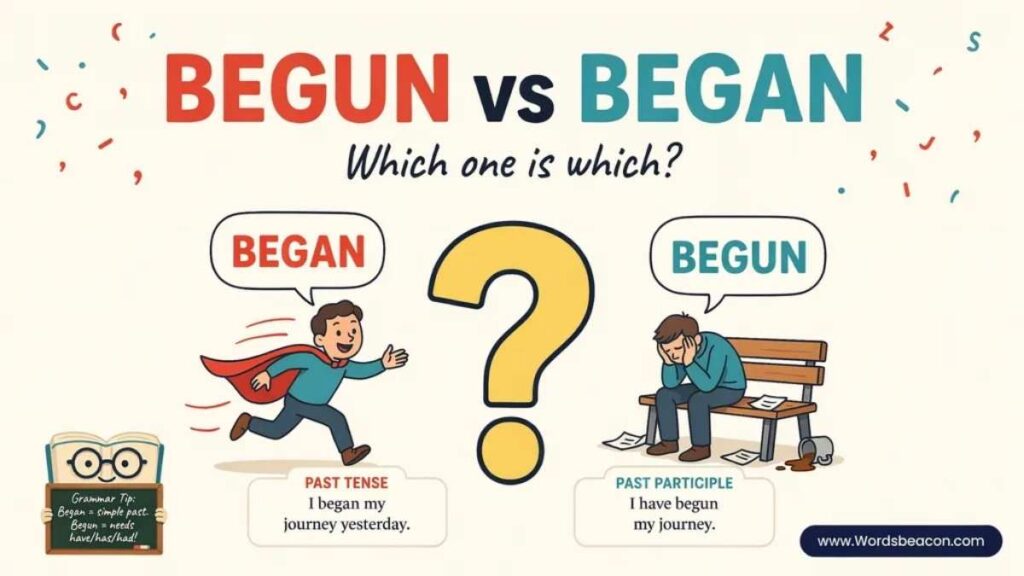
Began vs begun can seem confusing at first because both words come from the same verb, begin. The tricky part is that they don’t work the same way in a sentence. Use began when you’re talking about something that started in the past. Use begun when it follows a helping verb such as has, have, or had. For example, “The movie began at 8 PM” is correct, while “The movie has begun” is also correct. Once you understand this simple difference, choosing the right word becomes much easier. So, before began and begun turn into a grammar headache, let’s clear up the confusion and make the rule easy to remember.
So, the basic pattern is:
| Verb form | Word | Example |
|---|---|---|
| Base form | begin | We begin work at nine. |
| Simple past | began | We began work at nine. |
| Past participle | begun | We have begun work. |
The most important thing to remember is this: began can usually stand on its own, while begun normally needs a helping verb such as has, have, or had.
For example, “The movie began at 8 PM” is correct. However, “The movie has begun” is also correct because has works with the past participle begun.
Once you understand that difference, the began vs begun question becomes much easier.
Learn the difference between confusing more English words
Carmel vs Caramel difference and usage?
Begin, Began, Begun The Three Forms
The verb begin is an irregular verb. Unlike regular verbs such as “walk,” which become “walked” in the past, begin changes its form completely.
Its three main forms are begin, began, and begun.
Begin is the base form. You use it in the present tense and after certain helping verbs.
For example:
“We begin class at 9 AM.”
“Please begin the test.”
“They will begin the meeting soon.”
Began is the simple past tense of begin. Use it when an action started at a definite point in the past.
For example:
“The movie began at 8 PM.”
“The meeting began yesterday.”
“She began writing her report last night.”
Begun is the past participle. It normally appears with an auxiliary verb such as has, have, or had.
For example:
“The movie has begun.”
“They have begun the project.”
“She had begun working before I arrived.”
This gives you the basic begin began begun verb forms:
Begin → base form
Began → simple past
Begun → past participle
That pattern is the foundation for understanding began vs begun grammar.
What Does Began Mean?
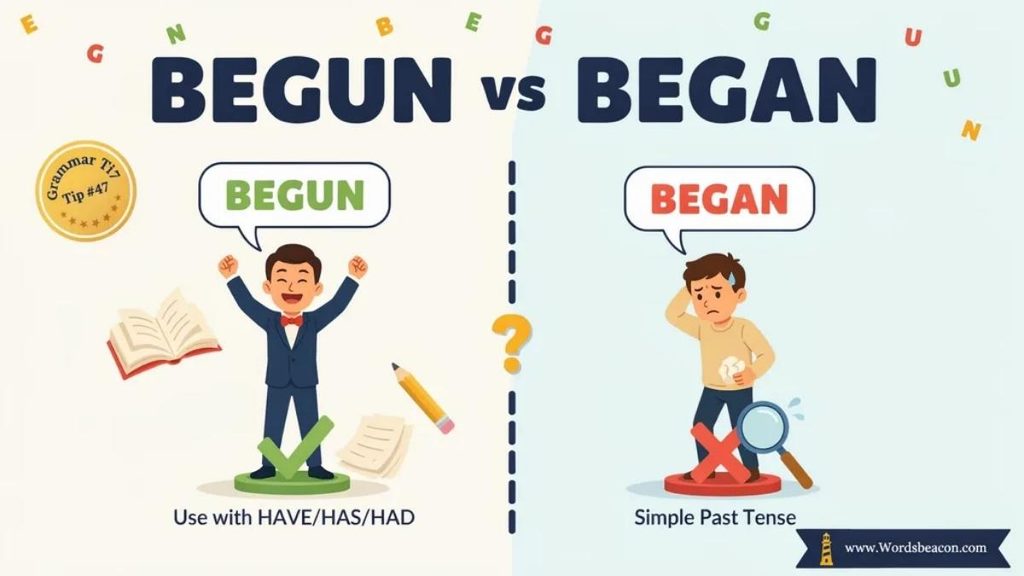
Began is the simple past tense of begin.
It tells you that something started in the past. The action may have finished, or it may still be continuing. The important point is that the sentence presents the beginning as a past event.
For example:
“The class began at nine.”
“The rain began suddenly.”
“The journey began in 2020.”
“The movie began at 8 PM.”
In each sentence, began tells you that the starting point happened in the past.
This is why began often appears with past-time expressions such as yesterday, last night, two years ago, in 2019, or at 8 PM.
For example:
“The concert began at 7 PM.”
“The discussion began yesterday.”
“The company began operations in 2015.”
The word began is therefore the correct choice when you need the simple past tense.
What Does Begun Mean?
Begun is the past participle of begin.
Unlike began, begun usually cannot function as the main past-tense verb by itself.
Instead, it normally works with a helping verb.
For example:
“The movie has begun.”
“The students have begun their work.”
“The project had begun before we arrived.”
“The process has begun.”
Here, has, have, and had are auxiliary verbs. They help create perfect tenses.
That’s the key difference between began and begun.
You can say:
“The meeting began at noon.”
You can also say:
“The meeting has begun.”
But you cannot normally say:
“The meeting begun at noon.”
The problem is that begun is a past participle, so it needs the appropriate grammatical structure.
Began vs Begun Grammar
The easiest way to understand began vs begun grammar is to look at the tense.
Use began for the simple past tense.
Use begun with has, have, or had in perfect constructions.
Consider these examples:
1.“The class began at 10 AM.”
2.“The class has begun.”
3.“The class had begun before I arrived.”
The first sentence uses the simple past. The second uses the present perfect. The third uses the past perfect.
The meaning is related in all three sentences, but the sentence structure changes the verb form.
This is where many common English mistakes happen. People know that begin changes to began and begun, but they aren’t always sure which form belongs in which sentence.
A useful test is to look for a helping verb.
If the sentence uses has, have, or had, you will normally need begun.
If you are simply describing something that started in the past, you will normally need began.
Learn the difference between confusing more English words
Insite vs Insight difference and usage?
Has Begun vs Began
The difference between has begun and began comes down to tense and context.
“Began” uses the simple past.
“Has begun” uses the present perfect.
Compare these sentences:
“The movie began at 8 PM.”
“The movie has begun.”
The first sentence focuses on a past starting point. The second tells you that the movie has started and that fact matters now.
You could say:
“The meeting began at 2 PM.”
This simply reports when the meeting started.
You could also say:
“The meeting has begun.”
This tells someone that the meeting is now underway.
That’s why “the movie has begun” is correct, while “the movie has began” is not.
The same rule applies to “the countdown has begun.”
“The countdown has begun” means the countdown has started and is now in progress.
“The countdown began at noon” simply tells you when it started.
Have Begun vs Began
The Have begun follows the same pattern.
Have + begun creates the present perfect tense.
For example:
“They have begun the project.”
“We have begun preparing for the event.”
“The students have begun their exams.”
In contrast, began is the simple past:
“They began the project last Monday.”
“We began preparing for the event yesterday.”
“The students began their exams at 9 AM.”
The time expression often gives you a useful clue.
When you mention a finished past time, began usually works naturally.
When you focus on an action that has started and has a connection to the present, have begun often works better.
Had Begun vs Began
Had begun is the past perfect form.
You use it when one past event happened before another past event.
For example:
“The movie had begun before we arrived.”
The movie started first. Then we arrived.
That sequence is important, so had begun makes the relationship between the two events clear.
Compare it with:
“The movie began at 8 PM.”
This sentence simply tells you when the movie started.
Now consider:
“The meeting had begun when I entered the room.”
The meeting started before I entered.
This is a common use of had begun in English grammar.
You can think of it as a way to look backward from one past event to an even earlier past event.
Where It All Began or Begun?
“Where it all began” is the standard expression.
For example:
“This is where it all began.”
“That small café is where their story began.”
“Let’s return to where it all began.”
You generally should not write “where it all begun” in this structure.
Why?
Because there is no helping verb before begun.
The sentence needs the simple past form, so began is the correct choice.
However, you can use begun when the sentence contains the right auxiliary verb.
For example:
“This is where the project has begun to grow.”
Here, has works with begun.
So remember the structure rather than memorizing one phrase alone.
“Where it all began” uses simple past.
“Where it has all begun” uses present perfect.
The first form is far more natural for the familiar expression “where it all began.”
Fix common more word mistakes in English
Inquire vs Enquire difference and Usage?
The Countdown Has Begun vs Began?
Both “the countdown has begun” and “the countdown began” can be correct. The context determines which one you need.
“The countdown has begun” is usually the natural choice when the countdown has started and is still relevant now.
For example:
“The countdown has begun. The launch is only ten minutes away.”
“The countdown began at exactly midnight.”
The first sentence connects the beginning to the present situation. The second focuses on a specific moment in the past.
This distinction applies to many other situations.
“The race began at 9 AM.”
“The race has begun.”
“The ceremony began at noon.”
“The ceremony has begun.”
“The class began ten minutes ago.”
“The class has begun.”
Neither form is automatically better. The tense depends on what you want the sentence to communicate.
Was Begun or Was Began?
This is another area where English grammar can become tricky.
“Was began” is generally incorrect when you are trying to create a passive construction.
“Was begun” can be grammatically correct because was can work with the past participle begun.
For example:
“The project was begun by a small team.”
“The construction was begun in early spring.”
However, active voice is often clearer:
“A small team began the project.”
“The builders began construction in early spring.”
This is one reason the phrase “was begun” may sound unusual even though it can be grammatically correct. Modern English often prefers a direct active sentence when the meaning is clear.
The important distinction is:
Was + begun can form a passive construction.
Was + began is not the standard form for that construction.
Is Begun vs Began?
The phrase “is begun” can be grammatical, but it has a different structure from “began.”
For example:
“The process is begun by pressing this button.”
This is passive.
In everyday writing, however, you would often make the sentence more direct:
“Press this button to begin the process.”
Or:
“The process begins when you press this button.”
On the other hand, “began” is the simple past:
“The process began after the button was pressed.”
So “is begun” and “began” aren’t interchangeable. They belong to different grammatical structures.
Learn the difference between tricky grammar words
Eyeing vs Eying difference and usage?
Began and Begun With “To” and “-ing”
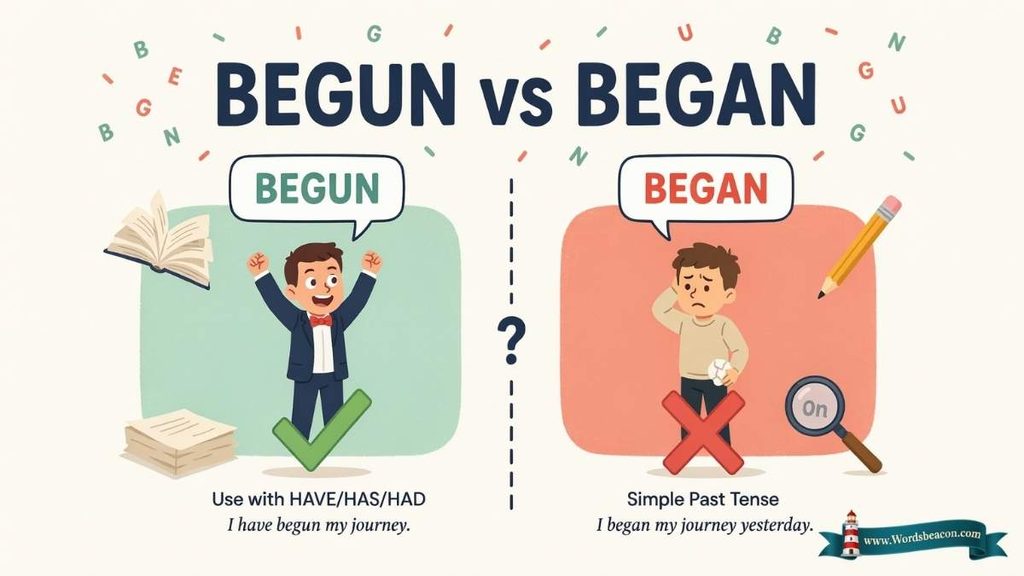
After begin, you can often use either “to” plus a verb or the “-ing” form.
For example:
“She began to laugh.”
“She began laughing.”
Both sentences are standard English.
You can also use the same pattern with begun:
“She has begun to laugh.”
“She has begun laughing.”
The meaning is usually very similar.
The choice can depend on style, rhythm, and the surrounding sentence. In everyday English, both forms are common.
For example:
“The child began to cry.”
“The child began crying.”
Neither sentence creates the began vs begun problem. The important point is that began and begun still follow their normal tense rules.
Began vs Begun Pronunciation
1.Began and begun also sound different.
2.Began is generally pronounced with a long “ay” sound in the second syllable, while begun uses a shorter “uh” sound.
3.Began sounds roughly like “bih-GAN.”
Begun sounds roughly like “bih-GUN.”
The pronunciation difference reflects the spelling difference, but hearing the words correctly can still take practice.
For example:
“The movie began at eight.”
“The movie has begun.”
When speaking quickly, the difference can become less obvious. That’s another reason learners sometimes mix the two forms in writing.
The best solution is to connect each pronunciation with its grammatical role.
Began = simple past.
Begun = past participle.
Began vs Begun Examples
Examples make the difference much easier to see.
“The movie began at 8 PM.”
“The movie has begun.”
“The meeting began after lunch.”
“The meeting has begun.”
“The journey began in 2020.”
“The journey has begun.”
“The class began at nine.”
“The class has begun.”
“The process began yesterday.”
“The process has begun.”
“The story began with a mysterious phone call.”
“The story has begun to unfold.”
Notice the pattern.
When began appears alone as the main past-tense verb, it describes a past starting event.
When begun appears, a helping verb usually comes before it.
Learn the difference between tricky grammar words
Humour vs Humor difference and usage?
Begin Past Tense and Begin Past Participle
If someone asks, “What is the past tense of begin?” the answer is began.
If someone asks, “What is the past participle of begin?” the answer is begun.
This distinction matters because past tense and past participle are not the same thing.
For example:
“The show began at seven.”
Here, began is the simple past.
“The show has begun.”
Here, begun is the past participle.
“The show had begun before we arrived.”
Again, begun is the past participle.
This is a useful pattern to remember with irregular verbs in English. Many irregular verbs have different simple past and past participle forms.
Begin is one of them.
Can Begun Be Used by Itself?
In standard English, begun normally needs an auxiliary verb when it functions as the past participle.
You wouldn’t normally write:
“The movie begun at 8 PM.”
Instead, write:
“The movie began at 8 PM.”
Or:
“The movie has begun.”
Similarly, avoid:
“She begun the project yesterday.”
Write:
“She began the project yesterday.”
Or:
“She has begun the project.”
The helping verb changes the grammatical structure, which is why begun works in the second example.
Can You Say Began Instead of Begun?
Not always.
You can replace begun with began only when the sentence structure also changes appropriately.
For example:
“The movie has begun.”
You cannot simply change it to:
“The movie has began.”
That is incorrect.
However, you can rewrite the sentence:
“The movie began at 8 PM.”
Now began works because the sentence uses the simple past.
So began and begun aren’t interchangeable forms of the same tense. Each has a specific grammatical job.
Learn the difference between often confused words
Advise vs Advice difference and Usage?
Common Mistakes With Began and Begun
One of the most common mistakes is using began after has, have, or had.
Incorrect:
“The meeting has began.”
Correct:
“The meeting has begun.”
Incorrect:
“They have began working.”
Correct:
“They have begun working.”
Incorrect:
“She had began the project.”
Correct:
“She had begun the project.”
Another common mistake is using begun as simple past.
Incorrect:
“The movie begun at 8 PM.”
Correct:
“The movie began at 8 PM.”
The same problem appears after did.
Incorrect:
“The movie did began at 8 PM.”
Correct:
“The movie did begin at 8 PM.”
After did, use the base form begin.
That gives you three useful patterns:
Did + begin
Has/have/had + begun
Simple past without an auxiliary + began
Once these patterns become familiar, many common verb errors disappear.
A Simple Tense Guide
The following table brings the main forms together:
| Tense or structure | Correct form | Example |
|---|---|---|
| Present | begin/begins | The class begins at nine. |
| Simple past | began | The class began at nine. |
| Present perfect | has/have begun | The class has begun. |
| Past perfect | had begun | The class had begun before I arrived. |
| Future | will begin | The class will begin soon. |
| After did | begin | The class did begin on time. |
This table shows why context matters more than simply asking which word is “correct.”
Began and begun are both correct words. They just belong in different grammatical structures.
When to Use Began
Use began when you need the simple past tense of begin.
For example:
“The concert began at 7 PM.”
“She began studying last night.”
“The company began operations in 2018.”
“The rain began suddenly.”
You can often use began with a clear past-time reference.
Words such as yesterday, last night, last year, in 2020, two hours ago, and at 6 PM often work naturally with began.
For example:
“The meeting began two hours ago.”
“The movie began at 8 PM.”
“The project began last year.”
These sentences describe a starting point in the past.
When to Use Begun
Use begun as a past participle, usually after has, have, or had.
For example:
“The meeting has begun.”
“They have begun the work.”
“She had begun preparing dinner before the guests arrived.”
“The project has begun.”
“The process had begun before anyone noticed.”
If you see has, have, or had in a perfect-tense structure, begun is usually the form you need.
How to Use Began in a Sentence
Began is straightforward because it works as the simple past form.
For example:
“The lesson began at ten.”
“The story began with a strange sound.”
“The rain began after sunset.”
“He began writing a new book.”
“The meeting began without delay.”
Each sentence describes something that started in the past.
You don’t need has, have, or had before began.
How to Use Begun in a Sentence
Begun normally appears with a helping verb.
For example:
“The lesson has begun.”
“They have begun their work.”
“She has begun studying.”
“The story has begun.”
“The process had begun before we arrived.”
You can also use begun in passive constructions.
For example:
“The project was begun by a small group of volunteers.”
However, active voice often sounds more natural:
“A small group of volunteers began the project.”
Learn the difference between often confused words
Grey vs Gray difference and usage?
A Quick Way to Remember Began vs Begun

Think of began as the word that can walk into the sentence by itself.
“The movie began.”
Begun usually needs a grammatical partner.
“The movie has begun.”
That simple image can help you remember the difference.
Another easy trick is to ask yourself whether has, have, or had appears before the verb.
If yes, begun is usually the right choice.
If you’re describing a simple past action, began is usually correct.
So:
1.“The race began.”
2.“The race has begun.”
3.“The race had begun.”
The first uses began.
The second and third use begun because has and had create perfect constructions.
A Small Editing Case Study
Imagine someone writes this paragraph:
“The meeting has began at noon. By the time I arrived, the discussion already begun. The manager said the project did began last week.”
At first glance, the paragraph may look almost correct because the writer clearly understands the meaning. The problem is that each sentence uses the wrong verb form.
A corrected version would be:
“The meeting began at noon. By the time I arrived, the discussion had already begun. The manager said the project did begin last week.”
Now each verb has the correct grammatical role.
“Began” works as the simple past.
“Had begun” uses the past perfect.
“Did begin” uses the base form after did.
This example shows why memorizing the three forms isn’t enough. You also need to understand how the forms behave inside a sentence.
Began and Begun in Everyday English
You’ll see began and begun everywhere in normal English.
People use began when telling stories about past events.
“The story began in a small village.”
They use begun when talking about something that has started and remains relevant.
“The story has begun.”
Both sentences are natural. They simply present the action from different grammatical viewpoints.
In conversation, this distinction often happens automatically. When you’re writing, especially in formal or academic English, checking the verb form can prevent small mistakes from distracting your reader.
Learn the difference between similar English words
Honor vs Honour difference and usage?
The Difference Between Began and Begun in One Sentence
If you want the shortest possible explanation, remember this:
Began is the simple past tense of begin.
Begun is the past participle of begin.
That means:
1.“The movie began at 8 PM.”
2.“The movie has begun.”
3.“The movie had begun before we arrived.”
The first sentence uses began because it describes a simple past event.
The second and third use begun because has and had require the past participle in these perfect constructions.
Practice Session Begin, Began, Begun
Fill in each blank with the correct form of the verb: begin, began vs begun.
- The movie ______ at 8 PM last night.
- The teacher will ______ the lesson in a few minutes.
- The meeting has already ______.
- She ______ learning English when she was ten.
- We have ______ preparing for the event.
- The concert ______ at exactly 7 PM.
- The new semester will ______ next Monday.
- The students had ______ their exam before the teacher entered the room.
- The rain ______ suddenly yesterday afternoon.
- Please ______ your assignment now.
- The countdown has ______.
- They ______ building the house last year.
- The project has ______ to make good progress.
- The class ______ before I arrived.
- He will ______ his new job next week.
- The story ______ with a mysterious phone call.
- We have ______ to understand the problem.
- The meeting had ______ before the manager arrived.
- The show will ______ after the short break.
- She ______ writing the report yesterday.
- The process has ______ already.
- The students ______ their work at nine o’clock.
- The discussion will ______ after lunch.
- By the time we arrived, the ceremony had ______.
- The journey ______ many years ago.
Answers
- began
- begin
- begun
- began
- begun
- began
- begin
- begun
- began
- begin
- begun
- began
- begun
- began
- begin
- began
- begun
- begun
- begin
- began
- begun
- began
- begin
- begun
- began
Here’s a trusted source for clear more words Comparison:
FAQs
Is it correct to say “has begun”?
Yes, “has begun” is grammatically correct. “Has” is the helping verb, while “begun” is the past participle of “begin.”
For example: “The meeting has begun.”
What does “began” mean?
“Began” means that something started in the past. It is the simple past form of “begin.”
For example: “The class began at nine.”
What does “begin” mean?
“Begin” means to start something or to start happening. It is the base form of the verb.
For example: “The show will begin shortly.”
What does “begun” mean?
“Begun” means started, but it is the past participle of “begin.” It usually appears with a helping verb such as “has,” “have,” or “had.”
For example: “The work has begun.”
Should I say “begun vs began”?
It depends on the sentence. Use “began” for the simple past tense and “begun” as a past participle.
For example, “The game began at six” is correct, while “The game has begun” is also correct.
What does the phrase “it’s just begun” mean?
“It’s just begun” means that something started very recently. It can describe an event, activity, process, or situation that has only recently started.
For example: “The competition has only just begun.”
What can I say instead of “began”?
“Started” is the simplest alternative to “began.” Depending on the context, you can also use words such as “commenced,” “launched,” “initiated,” or “got underway.”
For example: “The meeting began at noon” can become “The meeting started at noon.”
Which is correct: “began” or “started”?
Both are correct. “Began” is the simple past form of “begin,” while “started” is the simple past form of “start.”
For example: “The movie began at eight” and “The movie started at eight” have nearly the same meaning.
What is a sentence using “began”?
A simple example is: “The concert began at seven o’clock.”
Here, “began” shows that the concert started at a specific time in the past.
Which is correct: “I begin” or “I begun”?
“I begin” is correct when you need the present or base form of the verb.
For example: “I begin work at eight every morning.”
“I begun” is not correct as a standalone verb. You would say “I have begun” when using the present perfect tense.
Is it “the countdown has begun” or “the countdown began”?
Both can be correct, but the context is different.
“The countdown has begun” emphasizes that the countdown has started and is now underway.
“The countdown began at noon” focuses on the specific time when the countdown started.
What is the full meaning of “began”?
“Began” means started or came into action. It is the simple past form of “begin.”
For example: “The storm began during the night” means that the storm started during the night.
What is another word for “begun”?
Common alternatives include “started,” “commenced,” “launched,” and “initiated.” The best choice depends on the context.
For example: “The project has begun” can simply become “The project has started.”
What are the three forms of “begin”?
The three main forms are “begin,” “began,” and “begun.”
“Begin” is the base form, “began” is the simple past, and “begun” is the past participle.
Can you say “it has begun”?
Yes. “It has begun” is completely correct.
The phrase means that something has started and is usually still relevant or underway.
For example: “The ceremony has begun.”
How do you pronounce “begun”?
“Begun” is commonly pronounced approximately like “bih-GUN.” The second syllable has the vowel sound heard in words such as “fun.”
Which is correct: “I just begun” or “I just began”?
“I just began” is correct when you use the simple past.
For example: “I just began reading the book.”
You can also say, “I have just begun reading the book,” which uses the present perfect.
When should I use “begun”?
Use “begun” as the past participle of “begin.” It normally follows a helping verb such as “has,” “have,” or “had.”
For example: “She has begun her new job.”
What does “we just begun” mean?
“We just begun” is not standard English when used as a complete sentence.
Depending on the meaning, say “We just began” or “We have just begun.”
“We just began” uses the simple past, while “We have just begun” uses the present perfect.
What is another word for “began”?
“Started” is the most natural alternative to “began.” In more formal contexts, “commenced” or “initiated” may also work.
For example: “The ceremony began at noon” can become “The ceremony started at noon.”
What is a fancy way to say “start”?
For formal writing, alternatives to “start” include “commence,” “initiate,” “launch,” “inaugurate,” and “embark on.”
For example: “The ceremony will commence at noon” sounds more formal than “The ceremony will start at noon.”
What is the opposite of “begun”?
The opposite depends on the context. Words such as “ended,” “finished,” “stopped,” and “completed” can express the opposite idea.
For example, something that has begun may later end or be completed.
What does “it has begun” mean?
“It has begun” means that something has started. The phrase often suggests that an event, process, or activity is now underway.
For example: “The celebration has begun.”
What is a better word for “began”?
“Started” is usually the clearest replacement for “began.” For more formal writing, “commenced” or “initiated” may be suitable depending on the context.
What is the opposite of “began”?
Common opposites include “ended,” “stopped,” “finished,” “concluded,” and “completed.”
The best choice depends on what began. An event can end, a process can finish, and an activity can stop.
What are some synonyms for “begun”?
Depending on the sentence, synonyms for “begun” include “started,” “commenced,” “launched,” “initiated,” and “gotten underway.”
For example: “The investigation has begun” can become “The investigation has started.”
When should I use “begun” and “began”?
Use “began” for a simple past action.
For example: “The meeting began at ten.”
Use “begun” as the past participle, usually after “has,” “have,” or “had.”
For example: “The meeting has begun.”
Which is correct “haven’t begun vs began”?
“Haven’t begun” is correct when you use the present perfect negative form.
For example: “We haven’t begun the project yet.”
Use “began” in a simple past sentence such as “We began the project yesterday.”
Is “have already begun” correct?
Yes. “Have already begun” is grammatically correct because “have” is followed by the past participle “begun.”
For example: “The students have already begun the exam.”
Which is correct: “it has just began” or “it has just begun”?
“It has just begun” is correct.
The helping verb “has” requires the past participle “begun” in this structure. “It has just began” is incorrect.
Is it correct to say “we have begun”?
Yes. “We have begun” is grammatically correct.
For example: “We have begun planning the event.”
Here, “have” is the helping verb and “begun” is the past participle.
How do you spell “begun”?
The correct spelling is “begun.”
It is spelled B-E-G-U-N and is the past participle of the irregular verb “begin.”
Can you provide an example sentence using “begun”?
Certainly. “The construction has begun on the new library.”
In this sentence, “has” acts as the helping verb and “begun” functions as the past participle of “begin.”
Learn the difference between similar English words
Sergeant vs Sargeant difference and usage?
conclusion
Began vs begun may look like two versions of the same word, but they have different jobs in a sentence. The good news is that you don’t need to wrestle with complicated grammar rules to get them right.
Just remember the simple pattern: begin is the base form, began is the simple past, and begun is the past participle.
Use began when you’re talking about something that started in the past: “The movie began at 8 PM.” Use begun when it comes after has, have, or had: “The movie has begun.”
That’s really the trick. Once you check the helping verb and the tense, the confusion usually disappears. So, the next time began and begun try to cause trouble, don’t panic. Give the sentence a quick check, choose the right form, and let the grammar drama begin.

Luna AJS is an experienced blogger and dedicated language enthusiast at Words Beacon. She specializes in making English grammar, spelling, vocabulary and commonly confused words easy to understand. She provides clear explanations, practical examples to help readers write with confidence.