
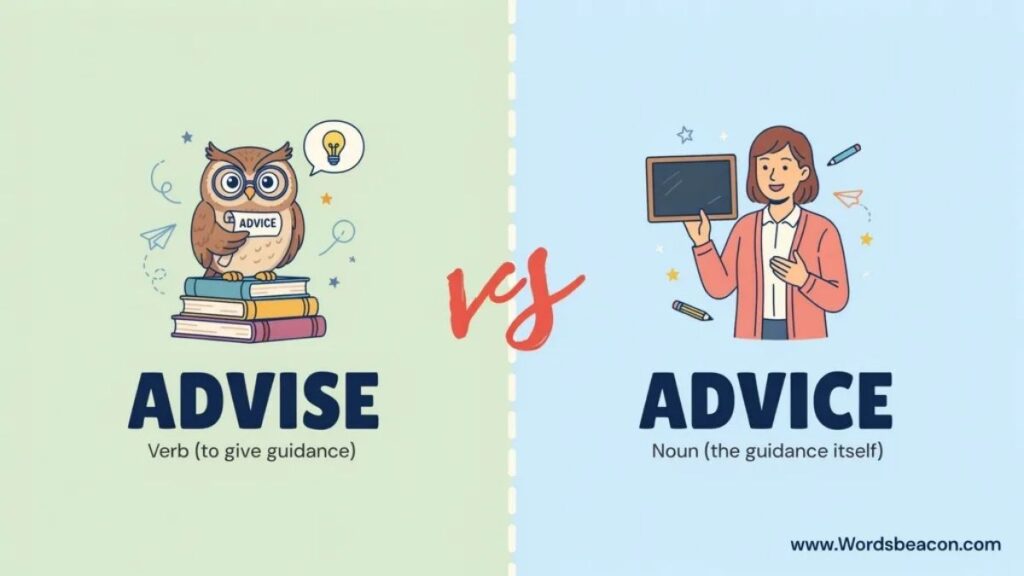
Advise and advice look almost identical, so it’s easy to mix them up. However, that one little letter changes how each word works in a sentence. The advise vs advice difference becomes simple once you know the basic rule. Advise is a verb that means to give someone guidance or a recommendation. Advice is a noun that means the guidance or recommendation itself. For example, you can advise a friend to wait, but you can also give that friend some advice. Once you know this difference, choosing the right word becomes much easier and saves you from an unnecessary grammar headache.
Quick Answer
The easiest way to understand the difference between advise and advice is to look at their grammatical roles.
| Word | Part of speech | Meaning | Example |
|---|---|---|---|
| Advise | Verb | To recommend, guide, or tell someone what you think they should do | “I advise you to check the details.” |
| Advice | Noun | A recommendation, suggestion, or guidance | “She gave me useful advice.” |
In simple terms, advise describes the action of giving guidance. Advice refers to the guidance itself.
For example, consider this sentence:
“My doctor advised me to rest.”
Here, advised tells us what the doctor did. The doctor gave guidance, so the verb advise is correct.
Now compare it with:
“My doctor gave me good advice.”
This time, advice refers to the guidance the doctor provided. Because it functions as a noun, advice is the correct word.
A useful rule to remember is this: you advise someone, but you give someone advice.
That one sentence can prevent many common mistakes.
Fix common more word mistakes in English
Naive vs Nieve difference and usage?
Advise Meaning and Advise Definition
The advise meaning is to give someone guidance, recommend a particular action, or tell someone what you think they should do.
The advise definition is closely connected to recommendation and guidance. When you advise someone, you use your knowledge, experience, judgment, or opinion to help that person make a decision.
Most importantly, advise is a verb.
That means it describes an action.
A teacher can advise a student. A doctor can advise a patient. A lawyer can advise a client. A friend can advise another friend. In each case, someone is performing the action of giving guidance.
For example:
“The teacher advised me to review the chapter.”
“My lawyer advised me to read the contract carefully.”
“She advised him against making a rushed decision.”
“The manager advised the employees to arrive early.”
“The doctor advised the patient to get more rest.”
Notice the pattern. Someone gives guidance, and advise describes that action.
The Advise Verb Meaning in Context
The advise verb meaning becomes even clearer when you look at common sentence patterns.
One of the most common structures is advise someone to do something.
For example:
“The instructor advised the students to arrive early.”
You can also use advise with against when you want to recommend that someone avoid something.
“The doctor advised against strenuous exercise.”
Another common structure is advise someone on something.
“The consultant advised us on the best approach.”
In more formal writing, advise can also appear with that.
“The committee advised that the policy be reviewed.”
The sentence structure may change, but the central idea stays the same. Someone is providing guidance or making a recommendation.
Advice Meaning and Advice Definition
The advice meaning is a recommendation, opinion, or guidance given to help someone make a decision or deal with a situation.
The advice definition identifies advice as a noun.
Unlike advise, advice does not describe the action of giving guidance. Instead, it refers to the guidance itself.
For example:
“Her advice helped me make a better decision.”
Here, advice refers to the recommendation she gave.
You can also say:
“He gave me excellent advice.”
“I need some advice about my career.”
“She asked her parents for advice.”
“We received professional advice before signing the agreement.”
“His advice was simple but useful.”
In each sentence, advice functions as a noun.
Advice Noun Meaning in Everyday English
The advice noun meaning becomes easier to recognize when you learn the words that commonly appear with it.
English speakers often say “give advice,” “offer advice,” “provide advice,” “seek advice,” “ask for advice,” “receive advice,” “follow advice,” and “take advice.”
For example:
“She gave me useful advice.”
“I asked my teacher for advice.”
“He offered some sound advice.”
“We sought professional advice before making a decision.”
These combinations are natural in standard English.
One important point is worth remembering: you generally don’t say “give advise” when you mean guidance. The correct expression is “give advice.”
Understand confusing English more words simply
Finaly vs Finally difference and usage?
Advise vs Advice Grammar Verb vs Noun

The heart of advise vs advice grammar is the difference between a verb and a noun.
A verb describes an action, while a noun names a person, place, thing, idea, or concept.
That gives us a simple contrast.
Advise describes the act of giving guidance.
Advice refers to the guidance itself.
Think about a coach helping an athlete.
When the coach tells the athlete what to change, the coach advises the athlete.
The recommendation itself is advice.
For example:
“My coach advised me to practice every morning.”
“My coach gave me some useful advice.”
Both sentences describe the same general situation. The first focuses on the action. The second focuses on the guidance.
That is the key advise and advice distinction.
Advise vs Advice Comparison
| Feature | Advise | Advice |
|---|---|---|
| Part of speech | Verb | Noun |
| Basic meaning | Give guidance or recommend something | Guidance or recommendation |
| Grammatical function | Describes an action | Names an idea or recommendation |
| Common pattern | Advise someone to do something | Give someone advice |
| Example | “I advise you to wait.” | “My advice is to wait.” |
| Final sound | Z sound | S sound |
| Countability | Not applicable | Usually uncountable |
If you’re trying to decide which word belongs in a sentence, the grammatical function matters more than the spelling.
Understand confusing English more words simply
Carmel vs Caramel difference and usage?
Advise vs Advice Pronunciation
The pronunciation difference between these words is small but important.
The advise vs advice pronunciation difference occurs mainly at the end of each word.
How to Pronounce Advise
The word advise ends with a voiced /z/ sound.
Its standard US pronunciation is /ədˈvaɪz/.
The stress falls on the second syllable.
The final sound is similar to the sound at the end of “rise.”
How to Pronounce Advice
The word advice ends with an unvoiced /s/ sound.
Its standard US pronunciation is /ədˈvaɪs/.
The stress also falls on the second syllable.
The final sound is similar to the sound at the end of “rice.”
So the main difference is:
Advise ends with /z/.
Advice ends with /s/.
The middle vowel sound remains the same.
Advise Pronunciation With S and Advice Pronunciation With C
The spelling can make this distinction slightly confusing.
In advise, the final s represents a /z/ sound.
In advice, the c represents an /s/ sound.
That means the advise pronunciation with s doesn’t match the sound many learners expect from the letter s. Likewise, the advice pronunciation with c produces the familiar /s/ sound.
A useful way to remember it is simple: advise sounds like it ends with a z, while advice sounds like it ends with an s.
Advise vs Advice Spelling Difference
The advise vs advice spelling difference is only one letter, but that letter separates two different words.
The spellings are:
advi-se
advi-ce
The advise spelling belongs to the verb.
The advice spelling belongs to the noun.
These aren’t simply alternative spellings of the same word. They have different grammatical functions.
For example:
“I advise you to check the report.”
The sentence needs a verb, so advise is correct.
Now consider:
“Thank you for your advice.”
The sentence refers to guidance, so advice is correct.
When you’re checking the advise vs advice spelling difference, don’t just look at the final letter. Ask what role the word plays in the sentence.
How to Use Advise and Advice
If you’re wondering how to use advise and advice correctly, start by identifying whether you need a verb or a noun.
Use advise when someone gives guidance or makes a recommendation.
“I advise you to check the instructions.”
“The teacher advised us to read the entire chapter.”
“The lawyer advised her against signing the document.”
“Experts advise consumers to compare prices.”
Use advice when you refer to the guidance or recommendation itself.
“I need your advice.”
“She gave me useful advice.”
“His advice helped us avoid a mistake.”
“We sought professional advice before making the decision.”
A helpful formula is:
Person + advise + person + to + verb.
For example:
“The coach advised the players to practice.”
Another useful formula is:
Person + give or offer or provide + advice.
For example:
“The coach gave the players useful advice.”
Once these patterns become familiar, choosing the correct word becomes much easier.
Learn the difference between tricky grammar words
Inquire vs Enquire difference and Usage?
Common Mistakes With Advise and Advice
The most common errors involving these words are predictable. They usually happen because the spelling is so similar.
Using Advice as a Verb
A common mistake is:
“I advice you to check the report.”
The correct sentence is:
“I advise you to check the report.”
The sentence needs a verb because the speaker is describing an action. Therefore, advise is correct.
Using Advise as a Noun
Another common mistake is:
“Thank you for your advise.”
The correct version is:
“Thank you for your advice.”
Here, the word refers to the guidance someone provided. It needs to function as a noun.
Writing “An Advice”
Another mistake involves countability.
People sometimes write:
“She gave me an advice.”
In standard English, advice is generally an uncountable noun. Instead, write:
“She gave me some advice.”
You can also say:
“She gave me a piece of advice.”
If you want to mention several individual recommendations, use pieces:
“She gave me three pieces of advice.”
Writing “Advices”
In standard English, advices isn’t normally used when you mean multiple recommendations.
Instead, use:
“I received some useful advice.”
Or:
“I received several pieces of advice.”
This distinction becomes particularly important in academic and professional writing.
Please Advise vs Advice
The phrase “please advise” causes a surprising amount of confusion.
The correct expression is:
“Please advise.”
Not:
“Please advice.”
Please Advise Meaning
The please advise meaning is essentially “please provide guidance,” “please let me know,” or “please give me the information I need,” depending on the context.
The word advise is correct because the phrase asks someone to perform an action.
Think about other common expressions:
1.“Please confirm.”
2.“Please respond.”
3.“Please advise.”
Each one uses a verb after “please.”
Is Please Advise Correct?
Yes. “Please advise” is grammatically correct.
It has traditionally been common in business communication, customer service, formal correspondence, and professional emails.
For example:
1.“Please advise on the next steps.”
2.“Please advise whether the meeting time works for you.”
3.“Please advise if you require additional information.”
All three sentences use advise correctly.
Please Advice or Please Advise?
If you’re asking someone to give you guidance, use advise.
“Please advise.”
If you’re referring to the guidance itself, use advice.
“Thank you for your advice.”
The grammatical difference is small, but the correct word depends on the role it plays in the sentence.
Learn the difference between tricky grammar words
Humour vs Humor difference and usage?
Please Advise in Professional Emails

The phrase please advise professional email writers often use has a formal tone.
For example:
“Please advise on how we should proceed.”
This sentence is grammatically correct. However, professional writing doesn’t always need to sound formal for the sake of sounding formal.
Depending on the situation, a more specific sentence may sound clearer.
Instead of:
“Please advise.”
You might write:
“Could you let me know which option you recommend?”
Or:
“Could you confirm the next steps?”
Or:
“Could you let me know how you would like us to proceed?”
The best choice depends on what you actually want from the reader.
Please Advise Meaning in Business
In business communication, please advise often asks the recipient to provide information, make a recommendation, or explain what should happen next.
For example:
“Please advise whether the revised schedule works for your team.”
Here, the writer isn’t necessarily asking for broad advice. The writer wants a specific response.
That distinction is useful because “please advise” can sometimes sound vague when the actual question is more specific.
Advise vs Advice in Email
The same grammar rules apply when using advise and advice in email.
Consider these examples:
| Incorrect | Correct | Why |
|---|---|---|
| “Please advice me.” | “Please advise me.” | The sentence needs a verb. |
| “Thank you for your advise.” | “Thank you for your advice.” | The sentence needs a noun. |
| “She advice us to wait.” | “She advised us to wait.” | The verb needs the correct form. |
| “Can you give me an advice?” | “Can you give me some advice?” | Advice is generally uncountable. |
| “I need your advise.” | “I need your advice.” | The word functions as a noun. |
These mistakes can happen quickly when people type emails in a hurry. A five-second grammar check can prevent them.
Advise vs Advice Doctor Medical Examples
The phrase advise vs advice doctor often appears because medical situations provide clear examples of the difference.
A doctor can advise a patient:
“The doctor advised me to rest.”
Here, advised is the verb.
The same situation can be described using advice:
“The doctor gave me useful medical advice.”
Here, advice is the noun.
You can also say:
“You should seek medical advice if the problem continues.”
In that sentence, advice refers to guidance from a medical professional.
The same pattern applies to other professional situations.
A lawyer can advise a client.
A client can receive legal advice.
A career counselor can advise a student.
The student can seek career advice.
The grammatical rule never changes.
Learn the difference between tricky grammar words
Grey vs Gray difference and usage?
Advise vs Advice Examples in Everyday English
Looking at real sentences is often more useful than memorizing definitions.
Examples of Advise
“I advise you to check the instructions.”
“The counselor advised him to apply early.”
“My parents advised me to save money.”
“The manager advised the team to leave on time.”
“Experts advise consumers to compare their options.”
“She advised against making a quick decision.”
“The consultant advised us on the best strategy.”
Each sentence describes someone giving guidance.
Examples of Advice
“My parents gave me good advice.”
“I need some advice.”
“Her advice helped me.”
“We asked for professional advice.”
“His career advice was practical.”
“She offered useful advice.”
“I decided to follow your advice.”
Each sentence refers to guidance rather than describing the act of giving it.
Advise in a Sentence vs Advice in a Sentence
A good advise in a sentence example is:
“I advise you to read the agreement before signing it.”
Here, advise is a verb because it describes what the speaker recommends.
Another example is:
“The consultant advised the company to review its pricing strategy.”
Again, advised describes an action.
Now look at an advice in a sentence example:
“The consultant gave the company useful advice.”
Here, advice is a noun because it refers to the guidance.
Another example is:
“Her advice helped me make a better choice.”
The word advice identifies the recommendation rather than the act of making it.
Learn the difference between tricky grammar words
Honor vs Honour difference and usage?
Advise vs Advice in a Sentence A Simple Test
When you’re deciding between advise or advice in a sentence, ask yourself one question:
Am I talking about the action of giving guidance, or am I talking about the guidance itself?
If you’re describing the action, use advise.
“My teacher advised me to study.”
If you’re referring to the guidance, use advice.
“My teacher gave me useful advice.”
This simple test handles most everyday cases.
Advise vs Advice Sentence Examples
The following examples show how the words can appear in nearly identical situations.
| Advise | Advice |
|---|---|
| “I advise you to wait.” | “My advice is to wait.” |
| “She advised me to apply.” | “She gave me advice about applying.” |
| “The doctor advised him to rest.” | “The doctor gave him medical advice.” |
| “They advised us against driving.” | “Their advice was not to drive.” |
| “The lawyer advised her to review the contract.” | “The lawyer gave her legal advice.” |
The pattern is consistent. Advise describes what someone does. Advice describes what someone gives or receives.
Advise and Advice in Different Contexts

At School
Teachers regularly advise students about studying, assignments, exams, and academic decisions.
“The teacher advised the class to review the material.”
Students can also ask for advice.
“I asked my teacher for advice about the assignment.”
At Work
Managers can advise employees about projects, deadlines, procedures, and workplace decisions.
“The manager advised the team to finish the report today.”
Employees can seek advice from supervisors or colleagues.
“I asked my supervisor for advice.”
With Friends and Family
The words also appear naturally in casual conversations.
“My friend advised me to wait.”
“My friend gave me some good advice.”
The context may be informal, but the grammar remains exactly the same.
In Professional Services
Professional settings provide especially clear examples.
“The attorney advised the client to review the agreement.”
“The client received legal advice before signing.”
Again, the first sentence uses a verb. The second uses a noun.
Learn the difference between confusing more English words
Sergeant vs Sargeant difference and usage?
Advise vs Suggest vs Recommend
The Advise, suggest, and recommend have related meanings, but they don’t always work in the same grammatical structures.
Advise often implies guidance based on experience, knowledge, or judgment.
“The doctor advised me to rest.”
Suggest often introduces an idea or possibility.
“She suggested taking a different route.”
Recommend often presents something as a good or suitable choice.
“The guide recommended the museum.”
The grammar can also differ.
You can say:
“I advise you to wait.”
But with suggest, the natural structure is:
“I suggest that you wait.”
You generally wouldn’t write:
“I suggest you to wait.”
Understanding these differences can improve overall English usage because it prevents one confusing word from being replaced with another word that has a different sentence structure.
Advice, Suggestion, and Recommendation
The nouns advice, suggestion, and recommendation overlap in meaning, but they aren’t identical.
Advice usually involves guidance about what someone should do.
A suggestion often introduces an idea for someone to consider.
A recommendation usually indicates that someone considers a particular choice suitable or preferable.
For example:
“My manager gave me advice about handling the situation.”
“She made a suggestion about changing the schedule.”
“The consultant gave us a recommendation.”
The right word depends on the context and the kind of guidance being offered.
Related Forms of Advise and Advice
Learning related forms can make the main distinction easier to remember.
Advised
Advised is the past tense and past participle of advise.
“The teacher advised us to practice.”
Advising
Advising is the present participle or gerund form.
“She is advising the company on the project.”
Advisory
Advisory is related to the idea of providing guidance or recommendations.
“The company issued an advisory notice.”
It can function as an adjective or a noun depending on how it appears in a sentence.
Adviser and Advisor
Both adviser and advisor are accepted spellings for a person who provides advice.
For example:
“She works as a financial advisor.”
You may also see:
“She works as a financial adviser.”
The spelling of adviser or advisor doesn’t change the basic rule involving advise and advice.
Why “Piece of Advice” Is Correct
One of the most useful grammar rules connected to advice involves countability.
Advice is generally an uncountable noun in standard English. That means you don’t normally say “one advice,” “two advices,” or “an advice.”
Instead, use expressions such as “some advice” or “a piece of advice.”
For example:
“My mentor gave me a piece of advice before the interview.”
If there are several individual recommendations, say:
“My mentor gave me three pieces of advice.”
You can also use the phrase “words of advice.”
“Here are a few words of advice before you start.”
These expressions allow you to talk naturally about individual recommendations without incorrectly treating advice as a countable noun.
Learn how to use confusing more words correctly
Eyeing vs Eying difference and usage?
Advise vs Advice Correct and Incorrect Usage
| Incorrect | Correct |
|---|---|
| “I advice you to wait.” | “I advise you to wait.” |
| “Thanks for your advise.” | “Thanks for your advice.” |
| “Please advice me.” | “Please advise me.” |
| “She gave me an advice.” | “She gave me some advice.” |
| “He gave me two advices.” | “He gave me two pieces of advice.” |
| “My lawyer gave me legal advise.” | “My lawyer gave me legal advice.” |
| “I need your advise.” | “I need your advice.” |
| “The doctor advice me to rest.” | “The doctor advised me to rest.” |
These errors often come from the fact that the words look almost identical. The solution isn’t to memorize every possible sentence. It’s to understand the grammatical role of each word.
Advise vs Advice A Practical Case Study
Imagine an employee writing an email to a manager about an upcoming project.
The employee wants guidance about the next step.
A common mistake would be:
“Please advice me on the next step.”
The correct version is:
“Please advise me on the next step.”
Why is advise correct?
Because the employee is asking the manager to perform an action. The manager needs to provide guidance. Therefore, the sentence needs the verb advise.
Now imagine the manager responds with a recommendation.
The employee might later write:
“Thank you for your advice.”
This time, advice is correct because the employee is referring to the guidance that the manager provided.
The situation is almost identical. The grammatical function changes.
That is the real key to understanding the advise vs advice meaning.
A Second Case Study Medical Advice
Consider this pair:
“The doctor advised the patient to rest.”
Here, advised is the verb.
Now change the sentence:
“The patient followed the doctor’s advice.”
Here, advice is the noun.
Both sentences describe the same basic situation. The first focuses on what the doctor did. The second focuses on the guidance the doctor gave.
This is why understanding sentence structure is more useful than simply trying to remember which spelling looks right.
When to Use Advice vs Advise
When deciding when to use advice vs advise, don’t rely only on how the word looks.
Instead, ask whether the sentence requires a verb or a noun.
If you need a verb, use advise.
“I advise you to compare the options.”
If you need a noun, use advice.
“I need your advice before I decide.”
Another helpful trick is to mentally replace the word with recommend or recommendation.
If recommend fits, you may need the verb advise.
“She advised me to wait.”
“She recommended that I wait.”
If recommendation fits, you may need the noun advice.
“She gave me advice.”
“She gave me a recommendation.”
This isn’t a perfect test for every sentence, but it works well in everyday writing.
Advise vs Advice in American English
In American English, the grammatical distinction remains the same.
Advise is a verb.
Advice is a noun.
Both words appear in everyday conversation, academic writing, professional communication, customer service, and formal documents.
British English follows the same basic distinction as well.
This isn’t a regional spelling issue. American English and British English both use advise and advice. The important difference is grammatical function.
Advise vs Advice Reddit Discussions
Searches for advise vs advice Reddit often show how frequently people mix up these words. Online discussions can be useful because they reveal the kinds of mistakes people actually make, but social media comments aren’t necessarily reliable grammar authorities.
A highly upvoted comment can still contain an error.
For standard English usage, a better approach is to ask whether the sentence needs a verb or a noun.
Instead of asking, “Which spelling looks right?” ask, “Am I describing the action of giving guidance, or am I naming the guidance?”
That question usually leads you to the correct word.
Learn the difference between confusing more English words
Insite vs Insight difference and usage?
How to Remember the Advise Advice Difference
The easiest way to remember the difference is to focus on three things: grammar, sound, and common phrases.
First, remember the grammar.
Advise is a verb.
Advice is a noun.
Second, remember the pronunciation.
Advise ends with a /z/ sound.
Advice ends with an /s/ sound.
Third, remember a few common expressions.
“Give advice.”
“Ask for advice.”
“Offer advice.”
“Seek advice.”
“Take advice.”
1.“Advise someone.”
2.“Advise someone to do something.”
3.“Advise against something.”
“Please advise.”
Once these patterns become familiar, correct word choice starts to feel natural instead of forced.
Practice Session Advise vs Advice
Choose the correct word or form of the word: advise, advice, advised, or advising.
- My teacher gave me some useful ______ before the final exam.
- I would ______ you to read the instructions carefully.
- She asked her parents for ______ about her career.
- The doctor ______ me to get plenty of rest.
- Please ______ us about any changes to the schedule.
- His ______ helped me make a better decision.
- The lawyer ______ her to review the contract before signing it.
- My friend gave me a valuable piece of ______.
- I strongly ______ you to check your work again.
- We need professional ______ before making such an important decision.
- The manager ______ the employees to arrive early.
- Can you ______ me on what I should do next?
- Thank you for your helpful ______.
- Experts ______ consumers to compare prices before buying.
- She offered me some good ______ about studying abroad.
- The counselor is ______ students on their academic choices.
- My parents always ______ me to save some money.
- He decided to follow his father’s ______.
- The doctor provided medical ______ about the treatment.
- I ______ you not to make a decision too quickly.
- She gave me a piece of sound ______.
- The consultant ______ the company to change its strategy.
- We should seek expert ______ before moving forward.
- Please ______ whether you can attend the meeting.
- Her ______ was simple, but it helped me solve the problem.
Answers
- advice
- advise
- advice
- advised
- advise
- advice
- advised
- advice
- advise
- advice
- advised
- advise
- advice
- advise
- advice
- advising
- advise
- advice
- advice
- advise
- advice
- advised
- advice
- advise
- advice
Here’s a trusted source for clear more words Comparison:
FAQs
What is the main difference between advise vs advice?
The main difference is their grammatical role. Advise is a verb that means to give guidance or a recommendation. Advice is a noun that refers to the guidance itself. For example, “I advise you to wait” uses advise as a verb, while “She gave me useful advice” uses advice as a noun.
Is advise a verb or a noun?
Advise is a verb. It describes the act of giving someone guidance, information, or a recommendation. For example, “The teacher advised him to study earlier.” You can also advise someone against doing something.
Is advice a verb or a noun?
Advice is a noun. It refers to guidance, recommendations, or suggestions that someone gives you. For example, “Her advice helped me make the right decision.” Since advice is a noun, you don’t use it as the action of giving guidance.
Why does advice end with C while advise ends with S?
The different spellings help distinguish the two words. They also have different final sounds. Advice ends with an /s/ sound, while advise ends with a /z/ sound. Although the words look almost identical, their spelling, pronunciation, and grammatical roles are different.
How do you pronounce advise and advice?
Advise ends with a /z/ sound, while advice ends with an /s/ sound. Advise sounds like “uhd-VIZE,” while advice sounds like “uhd-VICE.” This small sound difference can help you remember which word to use.
Can you use advice with “some”?
Yes. Because advice is an uncountable noun, “some advice” is correct. For example, “Could you give me some advice?” However, “some advices” is not normally correct in standard English.
What is the correct plural of advice?
Advice usually doesn’t have a plural form. Instead of saying “advices,” use expressions such as “pieces of advice,” “words of advice,” or “recommendations.” For example, “She gave me three pieces of advice.”
Can advise be followed by “to”?
Yes. Advise can be followed by someone and an infinitive with to. The common structure is “advise someone to do something.” For example, “The doctor advised me to rest.”
Can you advise someone against something?
Yes. Advise can be followed by “against” when you recommend that someone avoid an action. For example, “The lawyer advised her against signing the contract.” Here, advise clearly means to recommend that she should not do something.
What does “I advise you” mean?
“I advise you” means “I recommend that you” or “I strongly suggest that you.” It usually introduces guidance about what someone should or shouldn’t do. For example, “I advise you to check the details before submitting the form.”
Is “advise me” grammatically correct?
Yes, “advise me” is correct. It means “give me guidance” or “tell me what you recommend.” For example, “Please advise me on the best option.” Advise is a verb here because it describes the action of giving guidance.
Can advise mean “inform”?
Yes. Advise can also mean to inform someone, especially in formal or professional English. For example, “Please advise us of any changes to your address.” In this sentence, advise means “please inform us.”
What is the difference between advice and a recommendation?
Advice is guidance about what someone should consider or do. A recommendation usually points toward a particular choice or action. For example, a financial expert might give you advice about saving money and recommend a specific savings account.
Is “advising” a form of advise?
Yes. Advising is the -ing form of advise. It refers to the act of giving guidance or recommendations. For example, “She is advising students about their career options.”
What is the past tense of advise?
The past tense of advise is advised. For example, “The consultant advised us to review the agreement.” The spelling changes from advise to advised, but the word still relates to giving guidance or information.
What is an advisory?
An advisory is a formal notice, warning, or recommendation. It comes from the same word family as advise. For example, “The weather service issued a travel advisory because of heavy snow.”
What is the difference between adviser and advisor?
Adviser and advisor are both accepted spellings for someone who gives advice. Adviser follows the spelling pattern of advise more closely, while advisor is also widely used in professional titles. Both words refer to a person who provides guidance or recommendations.
Can advice describe something as good, useful, or helpful?
Yes. You can describe advice with adjectives such as good, useful, helpful, practical, sound, or valuable. For example, “She gave me practical advice about preparing for the interview.”
What does “sound advice” mean?
“Sound advice” means sensible and reliable guidance. For example, “Building an emergency fund is sound advice.” The phrase suggests that the recommendation is reasonable and worth following.
Is advice used only for serious situations?
No. People use advice in both serious and everyday situations. You might ask a lawyer for legal advice, a teacher for academic advice, or a friend for advice about what to wear. The word simply refers to guidance or recommendations.
Can you use advise in formal writing?
Yes. Advise is common in formal and professional writing. You’ll often see it in emails, workplace communication, official notices, and business documents. For example, “Please advise us if you require additional information.”
Does advise always mean giving an opinion?
No. Advise can mean recommending an action or informing someone about something. For example, “I advise you to leave early” gives a recommendation, while “Please advise us of any changes” means “Please inform us of any changes.”
Can advice be used as an action?
No. Advice is a noun, so it names the guidance rather than the action of giving it. You can give advice, offer advice, seek advice, or receive advice. When you describe the action, use advise instead.
What is the easiest way to remember advise vs advice?
Use this simple rule: you advise someone, but you give someone advice. Advise is a verb, while advice is a noun. You can also remember the pronunciation: advise ends with a /z/ sound, while advice ends with an /s/ sound.
Can advise and advice appear in the same sentence?
Yes. Both words can appear naturally in the same sentence because they have different grammatical roles. For example, “My manager advised me to follow the lawyer’s advice.” Advise describes the action, while advice refers to the guidance itself.
Conclusion
The confusion between advise vs advice is easy to fix once you remember one simple rule: advise is a verb, while advice is a noun.
You advise someone when you give them guidance or a recommendation. You give, offer, or receive advice when you’re talking about that guidance. For example, “I advise you to leave early” is correct, while “She gave me some advice” is also correct.
The spelling can help, too. Advise ends with a /z/ sound, while advice ends with an /s/ sound. That small difference makes the two words easier to tell apart.
So, next time you’re unsure, don’t let these two look-alike words cause a grammar headache. Just remember: you advise someone, but you give someone advice. Once that rule sticks, the confusion pretty much disappears.

Luna AJS is an experienced blogger and dedicated language enthusiast at Words Beacon. She specializes in making English grammar, spelling, vocabulary and commonly confused words easy to understand. She provides clear explanations, practical examples to help readers write with confidence.