
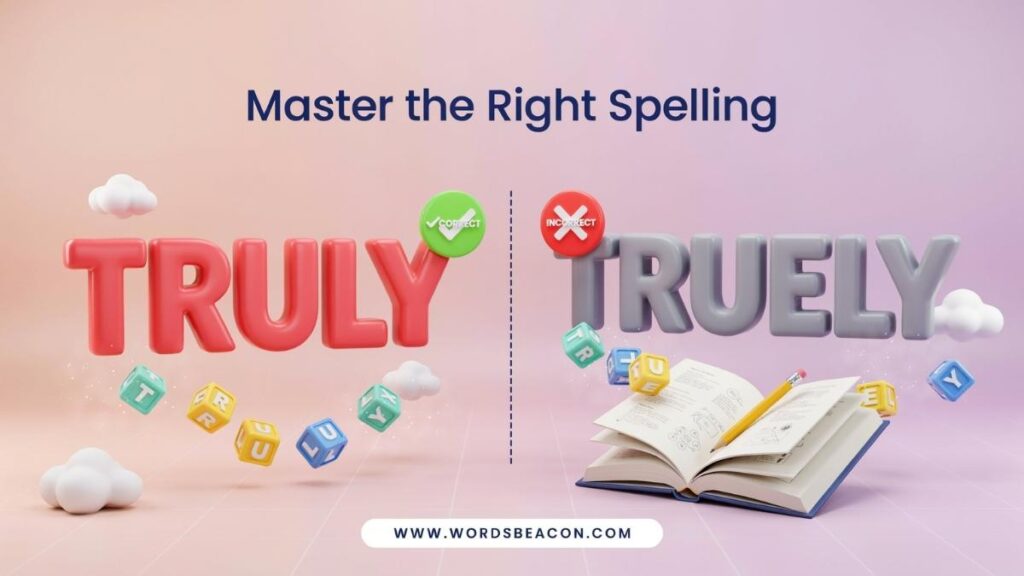
English spelling can turn a simple word into a surprisingly tricky little problem. Truly vs Truely is a perfect example. Because truly comes from the word true, writing truely may seem perfectly logical at first. However, that extra e does not belong there. Truly is the correct spelling, while truely is a common spelling mistake. This tiny difference can easily slip into emails, essays, articles, and everyday messages. Fortunately, you do not need a complicated grammar rule to remember it. Once you see how true changes into truly, the whole confusion becomes much easier to understand. So, let us clear up this spelling mix up once and for all.
Quick Answer
When comparing truly vs truely, truly is the correct spelling.
| Word | Correct Spelling | Meaning | Grammar | Example |
|---|---|---|---|---|
| Truly | Yes | Genuinely, sincerely, really, or in fact | Adverb | I truly appreciate your help. |
| Truely | No | Common misspelling of truly | Not the standard form | I truely appreciate your help. |
Truly is correct.
Truely is incorrect.
For example:
She truly appreciated your help.
He is truly talented.
I truly believe that she was telling the truth.
In each sentence, truly is the correct form.
Learn the difference between tricky more English words
Eyeing vs Eying difference and usage?
Truly vs Truely The Main Difference
The main difference between truly vs truely comes down to spelling and word formation.
Truly is formed from true by adding the adverb ending -ly. However, the final e in true disappears before the suffix is added. That gives us true + ly = truly.
This small spelling change causes a surprisingly large amount of confusion. Since true already looks complete, many people assume that adding -ly should produce truely. English, however, does not always allow a base word to keep every letter when a suffix is added.
That is why the correct spelling is truly, not truely.
Consider these examples:
She was truly happy with the result.
The story was truly remarkable.
I truly understand what you mean.
He truly cares about his work.
In every case, truly modifies another word or describes the manner, degree, or sincerity of something.
What Does Truly Mean?
The truly definition is fairly broad because the word can express several related ideas. Most often, truly means genuinely, sincerely, really, or in fact.
For example, when someone says, “I truly appreciate your support,” the word truly emphasizes sincerity. The speaker does not simply appreciate the support. The speaker wants to make it clear that the feeling is genuine.
Similarly, “She is truly talented” emphasizes the speaker’s strong belief in her ability.
Truly can also strengthen a statement. It can show that something is completely or genuinely true.
For example:
This is truly one of the best books I have read.
The experience was truly unforgettable.
He was truly surprised by the announcement.
The word can also emphasize accuracy or truth.
For example:
That is truly what happened.
She truly believed she had made the right decision.
So, depending on the sentence, the truly meaning can be close to genuinely, sincerely, really, actually, or completely.
Why Is Truly Spelled Without E?
One of the most common questions about truly spelling is, “Why is truly spelled without e?”
The answer comes from the way English forms adverbs from adjectives.
The base word is true. When you add the suffix -ly to create the adverb, the final e drops:
true + ly → truly
That spelling may look unusual at first, but it follows a familiar pattern in English word formation.
For example, similar changes occur in other words when suffixes are added. English spelling often changes slightly to make the resulting word easier to form or to preserve established spelling patterns.
The important point is that true does not simply become truely. The final e disappears, giving us truly.
Therefore, if you are searching for the correct spelling of truly, remember this simple transformation:
True → truly
Not:
True → truely
This is also why the answer to “Is truly spelled with an e?” is no. Standard English spells the word without an e after the u.
Is Truely a Word?
A common question is, “Is truely a word?”
In standard English, truely is not the accepted spelling of the adverb formed from true. Instead, truly is the standard form.
You may still see truely in emails, social media posts, informal writing, student work, or other online content. Its appearance does not make it the correct spelling. It usually represents a spelling error caused by the connection between true and truly.
This explains why “is truely a word in English” can be confusing. A spelling can appear frequently without being the standard dictionary form.
For example, people often make predictable spelling mistakes because they apply a logical pattern that does not work in that particular word. Truely is a good example. The spelling looks as though someone simply added -ly to true, but English changes the word to truly.
So, if you are proofreading an article, essay, email, or professional document, use truly.
Truly as an Adverb
Truly is an adverb. It usually modifies a verb, adjective, another adverb, or the whole statement.
For example:
I truly appreciate your kindness.
Here, truly modifies appreciate and emphasizes how sincere the appreciation is.
Consider another example:
The performance was truly impressive.
In this sentence, truly modifies impressive. It strengthens the adjective and tells the reader that the performance was genuinely impressive.
You can also use truly to emphasize a whole statement:
She truly understood the problem.
The word truly tells us that her understanding was genuine or complete.
Understanding the part of speech can make truly grammar much easier. When you need the adverbial form of true, truly is the correct choice.
True vs Truly
The difference between true and truly is mainly grammatical.
True is an adjective. Truly is an adverb.
An adjective describes a noun or gives information about a person, place, thing, or idea.
For example:
That statement is true.
She is a true friend.
The story is true.
In these examples, true describes the subject or noun.
Truly, however, describes how something happens or emphasizes the truth, sincerity, or degree of a statement.
For example:
She truly cares about her friends.
I truly believe him.
The movie was truly excellent.
This gives us a useful way to remember the true and truly difference:
True describes.
Truly modifies or emphasizes.
You would say, “The statement is true,” because true describes the statement. You would say, “I truly believe the statement,” because truly emphasizes the verb believe.
Learn the difference between tricky more English words
Humour vs Humor difference and usage?
True and Truly Difference in Everyday Writing
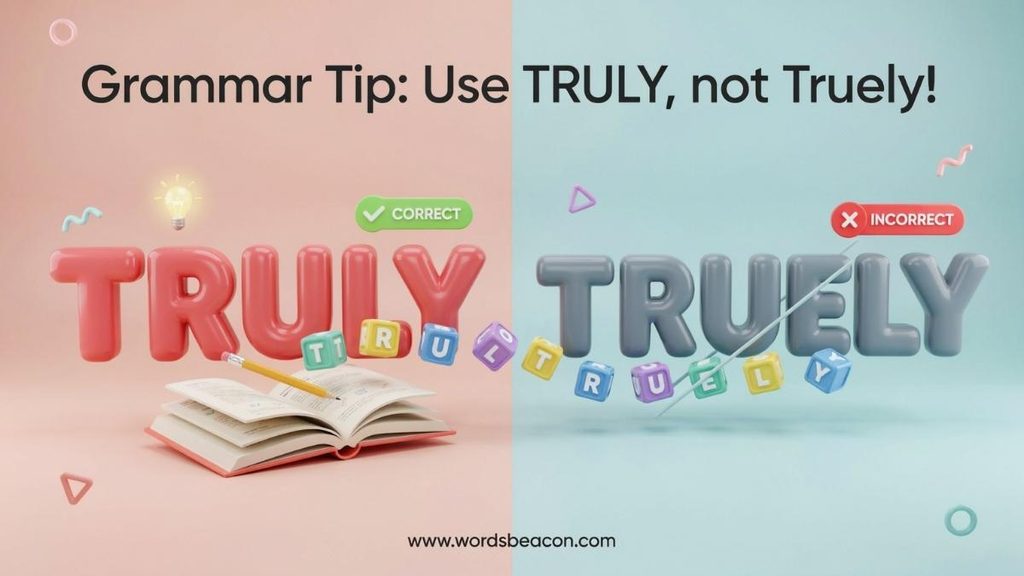
The true and truly difference becomes clearer when you place the words side by side.
Consider these sentences:
He is a true professional.
He truly understands the job.
In the first sentence, true describes the person as a professional who genuinely fits that description. In the second, truly modifies understands and emphasizes the depth or sincerity of his understanding.
Here is another example:
That is a true story.
She truly enjoyed the story.
The first sentence describes the story. The second tells us how genuinely she enjoyed it.
Although the words share the same root, they perform different grammatical jobs. Using the wrong form can make a sentence sound awkward or grammatically incorrect.
How to Spell Truly
If you are asking, “How to spell truly?” or “How do you spell truly?” the answer is:
T-R-U-L-Y
The correct spelling is truly.
A simple memory trick can help. Start with true, remove the final e, and then add ly:
TRUE → TRU → TRULY
The easiest version to remember is simply:
True becomes truly.
Do not add the e back before ly.
Once you remember this pattern, the truly spelling becomes much easier. You will also be less likely to write truely when typing quickly or proofreading your work.
Truly vs Truely Grammar
When it comes to truly vs truely grammar, only truly works as the standard adverb in modern English.
For example:
I truly appreciate everything you have done.
The sentence uses truly correctly because the word modifies appreciate.
Writing this instead would create a spelling error:
I truely appreciate everything you have done.
The meaning remains understandable, but the spelling is incorrect.
This distinction matters in academic writing, professional communication, applications, articles, and other situations where accurate English matters. A small spelling mistake can distract readers from an otherwise strong piece of writing.
The good news is that this particular mistake has a very simple solution. Remember the base word true, drop the final e, and add -ly.
True → truly.
That is the correct form.
Truly vs Truely Examples
Seeing truly vs truely examples in complete sentences makes the difference easier to recognize.
Correct:
I truly enjoyed the concert.
Incorrect:
I truely enjoyed the concert.
Correct:
She is truly grateful for the opportunity.
Incorrect:
She is truely grateful for the opportunity.
Correct:
This is truly an important decision.
Incorrect:
This is truely an important decision.
Correct:
He truly believes that everything will work out.
Incorrect:
He truely believes that everything will work out.
In each pair, the meaning stays the same. The only problem comes from the spelling. Truly is the accepted form, while truely represents the common mistake.
Learn how to use confusing more words correctly
Grey vs Gray difference and usage?
Truly Appreciated or Truely Appreciated?
The correct phrase is “truly appreciated.”
For example:
Your support is truly appreciated.
This phrase is common in professional messages, thank-you notes, customer communication, and everyday conversations.
The word truly emphasizes the sincerity of the appreciation. It tells the reader that the gratitude is genuine rather than simply polite.
“Truely appreciated” contains a spelling error.
So, when writing this phrase, remember:
Truly appreciated is correct.
Truely appreciated is incorrect.
The same spelling rule applies whether truly appears before a verb, adjective, or participle. The final e from true does not return.
Truly Grateful or Truely Grateful?
The correct phrase is “truly grateful.”
For example:
I am truly grateful for your support.
Here, truly emphasizes how sincere the speaker feels. The person is not simply grateful. The word adds extra emphasis to the feeling.
The incorrect form is:
I am truely grateful for your support.
Although readers will understand the sentence, truely is still a spelling mistake.
Therefore, when you want to express sincere gratitude, write truly grateful.
The same rule applies to other common expressions, including truly thankful, truly sorry, truly happy, and truly honored.
Truly Beautiful or Truely Beautiful?
The correct phrase is “truly beautiful.”
For example:
The garden looked truly beautiful in the morning light.
Here, truly strengthens the adjective beautiful. It tells the reader that the garden was genuinely or exceptionally beautiful.
The spelling “truely beautiful” is incorrect because truely is not the standard adverbial form of true.
This same pattern works with many other adjectives. You can write truly amazing, truly wonderful, truly impressive, truly special, or truly remarkable.
The important thing to remember is that the spelling stays truly, regardless of the word that follows it.
Learn how to use confusing more words correctly
Honor vs Honour difference and usage?
How to Use Truly in a Sentence
Knowing the correct spelling is only half the job. You also need to know how to use truly in a sentence naturally.
Truly often appears before a verb when it emphasizes an action, feeling, or belief.
For example:
I truly appreciate your kindness.
She truly understands the situation.
They truly value your opinion.
He truly believes that the plan will succeed.
Truly can also appear before an adjective to add emphasis.
For example:
The result was truly impressive.
She is truly talented.
That was a truly memorable experience.
The book is truly fascinating.
In some sentences, truly can emphasize the entire statement.
For example:
Truly, nothing could have prepared us for what happened.
Truly, this was an unforgettable experience.
This use gives the sentence a stronger and sometimes more formal tone.
Examples of Truly in a Sentence
The word truly works in many different situations, from casual conversations to formal writing.
Consider these examples:
I truly enjoyed our conversation.
She truly deserves the award.
He is truly one of the kindest people I know.
We are truly thankful for your support.
The experience was truly unforgettable.
I truly believe that honesty matters.
That was a truly remarkable achievement.
She truly understands what her customers need.
The examples show how flexible the word can be. In each sentence, truly adds emphasis while keeping the basic meaning clear.
You can also use truly when you want to show sincerity.
For example:
I truly mean what I said.
That sentence tells the reader that the speaker is being sincere. The word truly makes the statement feel stronger and more genuine.
Learn how to use confusing more words correctly
Sergeant vs Sargeant difference and usage?
Truly Definition and Different Meanings
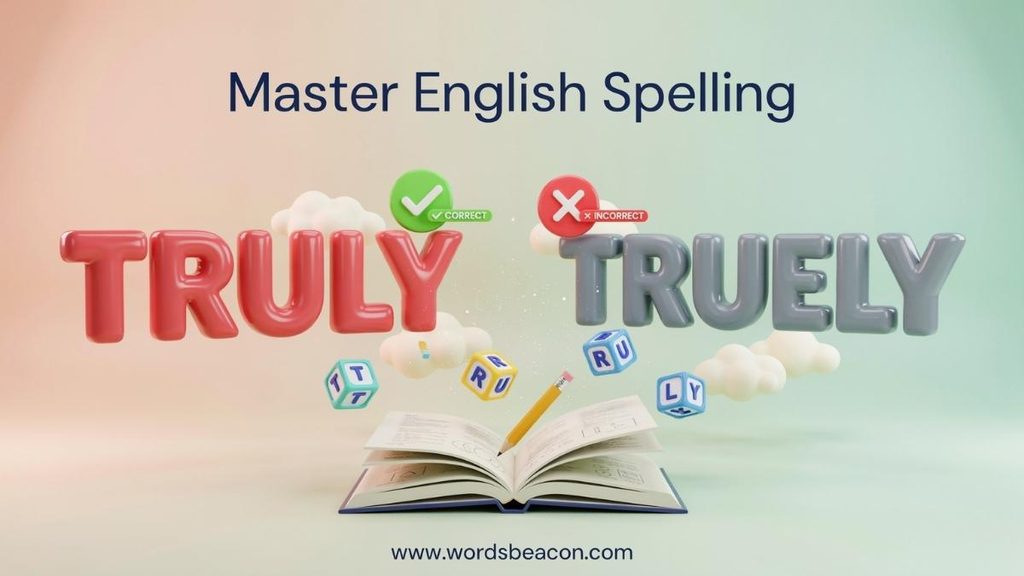
The truly definition changes slightly depending on the context. In general, truly can mean genuinely, sincerely, really, or in fact.
When it emphasizes sincerity, it shows that a feeling or statement is genuine.
For example:
I truly care about your opinion.
Here, truly means sincerely or genuinely.
When it emphasizes reality or truth, it can mean really or actually.
For example:
She truly is an excellent writer.
In this sentence, truly reinforces the speaker’s belief that she really is an excellent writer.
Truly can also emphasize the degree of something.
For example:
The view was truly breathtaking.
The word suggests that the view was genuinely or exceptionally breathtaking.
So, although the word has several uses, its central idea remains connected to truth, sincerity, and strong emphasis.
Truly Synonym and Synonyms for Truly
If you need a truly synonym, the best choice depends on the sentence.
Common synonyms for truly include genuinely, sincerely, really, actually, honestly, certainly, definitely, and indeed.
For example:
I truly appreciate your help.
I genuinely appreciate your help.
Both sentences express sincere appreciation.
However, these words do not always work in exactly the same way. Genuinely often focuses on sincerity or authenticity, while really can simply add emphasis. Sincerely often highlights honest feeling or intention.
Therefore, replacing truly with another word requires attention to the context.
For example:
She truly believes him.
She genuinely believes him.
These sentences have very similar meanings.
However:
She truly is talented.
She genuinely is talented.
The second sentence places more emphasis on the authenticity of the judgment, while truly can simply reinforce the statement.
Choosing the right synonym depends on the tone and meaning you want to create.
Truly vs Truthfully
The Truly and truthfully have similar meanings, but they do not always work in the same situations.
Truly often emphasizes sincerity, reality, or the strength of a statement.
For example:
I truly appreciate your help.
Truthfully usually means honestly or in accordance with the truth.
For example:
Truthfully, I did not expect the result.
The difference becomes clearer when you compare their usual roles.
Truly often adds emphasis to a feeling, belief, quality, or statement. Truthfully often introduces an honest statement or confession.
For example:
She truly cares about her family.
Truthfully, she was worried about the decision.
The first sentence emphasizes the sincerity of her feelings. The second signals that the speaker is about to give an honest answer.
Both words relate to truth, but they create slightly different effects.
Yours Truly or Yours Truely?
The correct expression is “yours truly.”
“Yours truely” is incorrect.
Yours truly has two common uses. It can serve as a polite closing in a letter or email, and it can also refer to the speaker in a playful or informal way.
For example, a traditional letter might end with:
Yours truly,
John Smith
The phrase can also appear in a sentence such as:
Yours truly was responsible for the surprise.
In that context, the speaker uses the phrase to refer to themselves.
The spelling does not change. It is always yours truly, not yours truely.
If you remember the true to truly spelling rule, this expression becomes easier to remember as well.
Yours Truly Meaning
The yours truly meaning depends on how you use the expression.
As a letter closing, yours truly is a polite and somewhat formal way to sign off. It has a traditional tone and appears especially often in American English.
For example:
Thank you for your time.
Yours truly,
Maria
In a more playful sentence, yours truly can mean “I” or “me.”
For example:
Yours truly forgot to bring the tickets.
This usage sounds informal and sometimes humorous.
Although the expression has different uses, the spelling remains the same in both cases. Truly always appears without the extra e.
Truly British Spelling
People sometimes ask whether truly is a British spelling or an American spelling.
The answer is that truly is used in both British and American English.
Unlike words such as colour and color or honour and honor, truly does not have separate standard British and American spellings. Both varieties use truly.
For example, a British writer can write:
I truly appreciate your help.
An American writer can use exactly the same spelling:
I truly appreciate your help.
Therefore, “truly British spelling” and “truly American spelling” refer to the same standard spelling.
The difference is not regional. Truly remains truly on both sides of the Atlantic.
Truly American Spelling
The Truly is also the standard American spelling.
American English does not normally use truely as an alternative spelling. Instead, writers use truly in everyday, professional, academic, and formal contexts.
For example:
She truly understands the importance of the project.
That sentence works naturally in American English, just as it does in British English.
So, if you are writing for an American audience, you should still use truly. You do not need to change the spelling based on the country of your readers.
Understand confusing English more words simply
Insite vs Insight difference and usage?
Truly Oxford Dictionary Usage
Major English dictionaries recognize truly as a standard adverb.
Oxford Learner’s Dictionaries lists truly as an adverb and gives several uses connected with sincerity, emphasis, and accuracy.
Cambridge Dictionary also identifies truly as an adverb and gives meanings related to truth, reality, sincerity, and emphasis.
These dictionary entries support the same basic conclusion: truly is the standard spelling, while truely is not the correct form of this word.
Dictionary references can be especially useful when a spelling question seems uncertain. Instead of relying only on how a word looks, checking a reliable dictionary gives you a clearer answer.
Truly Pronunciation
The pronunciation of truly is relatively straightforward.
It is pronounced roughly like “TROO-lee.”
The word has two syllables:
truly → troo-lee
The pronunciation does not include an extra sound for the missing e. This can help reinforce the correct spelling when you say the word aloud.
For example:
I truly understand.
The word sounds like “troo-lee,” not like a separate syllable added between true and ly.
Although pronunciation alone cannot determine spelling, saying the word can still help you remember its form.
Why Do People Spell Truly as Truely?
The question “Why do people spell truly as truely?” has a simple answer: the mistake makes visual sense.
People see the word true and naturally assume that adding -ly should produce truely.
That reasoning would look like this:
true + ly = truely
However, English spelling changes the base word in this case:
true + ly = truly
The final e disappears.
This mistake becomes even more understandable because many English words do keep their final e when another ending is added. As a result, writers may apply a familiar pattern to a word that follows a different spelling pattern.
Typing quickly can make the problem worse. Since truely looks close to the correct spelling, spellings errors can easily slip through during casual writing.
The solution is simple: remember the complete form rather than trying to build it from memory every time.
True becomes truly.
Why Is Truely Incorrect?
The reason truely is incorrect comes down to standard English word formation.
The standard adverb formed from true is truly. English does not normally keep the final e from true when forming this word.
Therefore:
True → truly
Not:
True → truely
The incorrect spelling may still appear in online writing, messages, or other informal settings, but frequency does not make a spelling standard.
Think of it this way: a common mistake can become familiar without becoming correct.
That is exactly what happens with truely. The spelling looks reasonable, but standard English uses truly.
Truly vs Truely Which Is Correct?
If you only remember one thing from this guide, remember this:
Truly is correct.
Truely is incorrect.
So, when you ask, “Truly vs truely which is correct?” the answer is truly.
When you ask, “Truly vs truely which is correct?” the answer is still truly.
And when you ask, “Is it truly vs truely?” choose truly.
The same answer applies in professional writing, academic work, everyday messages, articles, emails, and formal documents.
A Simple Memory Trick for Truly
A good memory trick can make this spelling almost impossible to forget.
Start with true.
Now remove the final e.
Then add ly.
The result is:
true → tru → truly
You can also remember the phrase:
True becomes truly.
That short pattern is much easier to recall than a complicated spelling rule.
Whenever you hesitate between truly vs truely, go back to the base word and mentally remove the final e before adding ly.
This quick check can save you from one of the most common spelling mistakes involving true.
Common Mistakes With Truly
One common mistake is adding the final e from true when forming the adverb.
For example:
Incorrect: I truely appreciate your help.
Correct: I truly appreciate your help.
Another mistake occurs when people assume that truely might be an acceptable alternative spelling because they have seen it many times online.
For example:
Incorrect: She is truely amazing.
Correct: She is truly amazing.
A third mistake involves the phrase yours truly.
For example:
Incorrect: Yours truely,
Correct: Yours truly,
These mistakes all have the same basic cause. Writers remember the word true but do not remember that the final e disappears when the word becomes truly.
Understand confusing English more words simply
Begun vs Began difference and usage?
Truly in Formal and Everyday Writing
Truly works in both formal and informal English, although the tone depends on the sentence.
In everyday conversation, someone might say:
I truly appreciate that.
That sounds natural and sincere.
In professional writing, you might see:
We truly appreciate your continued support.
The word adds warmth without making the sentence overly casual.
In formal or literary writing, truly can also create emphasis.
For example:
The decision was truly significant.
Therefore, truly is a flexible word. You do not need to reserve it for formal writing, nor should you avoid it in casual communication. The key is to use it when you want to emphasize sincerity, truth, reality, or degree.
Truly vs Truely Sentence Examples
A quick comparison makes the spelling difference easy to spot.
Correct: I truly understand your concern.
Incorrect: I truely understand your concern.
Correct: She truly deserves this opportunity.
Incorrect: She truely deserves this opportunity.
Correct: We are truly grateful for your support.
Incorrect: We are truely grateful for your support.
Correct: That was a truly beautiful performance.
Incorrect: That was a truely beautiful performance.
Correct: He truly believes in his team.
Incorrect: He truely believes in his team.
The pattern never changes. Whenever you need this adverb, use truly without the extra e.
Truly vs Truely A Quick Case Study
Consider a student who has finished writing an important essay. While proofreading the final paragraph, the student writes:
“I truely believe that hard work makes a difference.”
The sentence sounds perfectly natural, so the spelling mistake may be easy to miss. However, truely is not the standard spelling. The student should write:
“I truly believe that hard work makes a difference.”
The problem does not come from the meaning or grammar of the sentence. Instead, it comes from forming the adverb incorrectly. The student remembers the adjective true and simply adds ly without removing the final e.
This small example shows why truly vs truely causes so much confusion. The incorrect version looks logical, and most readers can understand it immediately. Still, when accuracy matters, truly is the form you should use.
The same issue can appear in professional emails, blog posts, school assignments, applications, and social media captions. A quick proofreading check can catch it before the mistake reaches your reader.
A Simple Grammar Check
When you are unsure whether to use truly vs truely, start by asking what role the word plays.
If you need the adverb related to true, use truly.
For example:
I truly appreciate your honesty.
She truly understands the situation.
They truly enjoyed the experience.
In each sentence, truly adds emphasis to the action or statement.
If you see truely in your writing, check it carefully. In standard English, you should normally replace it with truly.
This quick grammar check works especially well during proofreading. Rather than memorizing a long list of rules, focus on the one important transformation:
true → truly
Once you recognize truly as the adverb, the spelling becomes much easier to manage.
Fix common more word mistakes in English
Accept vs Except difference and usage?
Truly vs Truely in Professional Writing
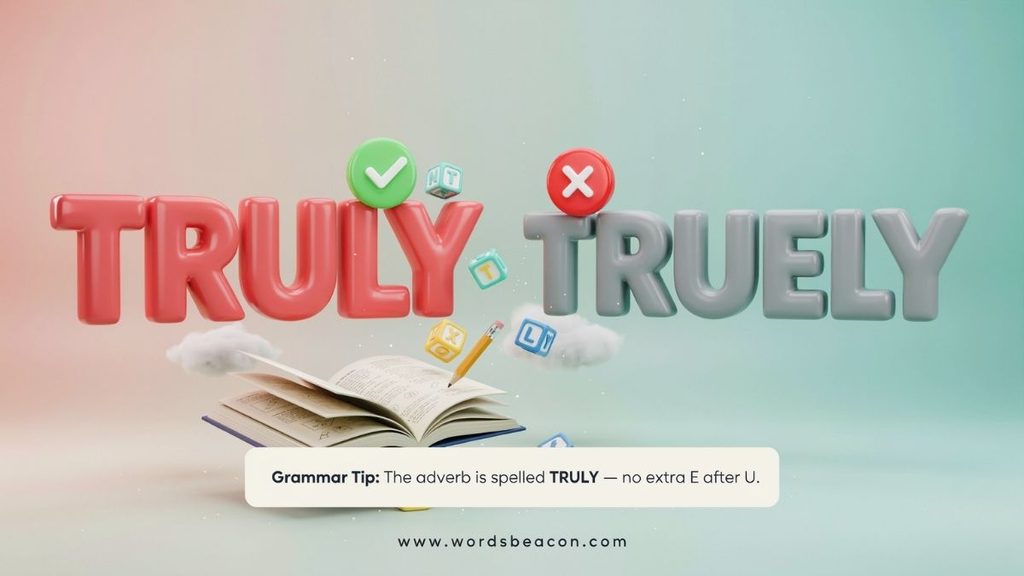
Correct spelling matters even more in professional writing because small errors can affect how polished your work appears.
Imagine receiving an email that says:
“We truely appreciate your patience.”
The meaning is clear, but the spelling mistake may make the message look less carefully prepared.
The corrected version is:
“We truly appreciate your patience.”
That single letter makes the sentence standard and professional.
This does not mean every spelling mistake will damage your writing. However, repeated errors can distract readers and weaken their confidence in the text. When you are writing for customers, colleagues, employers, teachers, or clients, accurate spelling helps your message look reliable.
Therefore, when you use this word in professional communication, remember to choose truly.
Truly in Academic Writing
Academic writing also benefits from accurate word choice and spelling.
For example:
The results were truly significant for the study.
The researchers truly understood the limitations of the experiment.
The second sentence uses truly to emphasize the researchers’ understanding.
However, academic writing often requires precise language. You should not use truly simply to make a sentence sound more impressive. Use it when the meaning genuinely calls for emphasis.
For example, instead of writing:
The results were truly, really, very important.
A more controlled sentence would be:
The results were truly important to the study.
Good academic writing does not depend on adding extra emphasis everywhere. Each word should have a clear purpose.
Truly in Everyday Conversation
Truly is not limited to formal writing. People use it naturally in everyday English when they want to emphasize sincerity or strong feelings.
For example:
1.I truly missed you.
2.I truly mean it.
3.I truly enjoyed the trip.
You truly made my day.
These sentences sound natural because truly adds emotional emphasis without changing the basic meaning.
It can also make a compliment sound more sincere.
For example:
You are truly kind.
That was truly thoughtful of you.
You are truly talented.
In these examples, truly tells the listener that the speaker genuinely means the compliment.
Can Truly Mean Really?
Yes. In many contexts, truly can mean really, although the exact meaning depends on the sentence.
For example:
She is truly talented.
This can mean:
She is really talented.
Likewise:
I truly enjoyed the experience.
This can mean:
I really enjoyed the experience.
However, truly can carry a stronger sense of sincerity or genuineness than really.
Compare these sentences:
I really appreciate your help.
I truly appreciate your help.
Both express appreciation, but truly can sound more heartfelt and deliberate.
The difference is subtle, so context matters. Still, both words can work as adverbs that add emphasis.
Can Truly Mean Sincerely?
Yes. Truly can express sincerity.
For example:
I truly apologize for the mistake.
Here, truly emphasizes that the apology is genuine.
Similarly:
I truly appreciate your kindness.
The speaker wants to make the sincerity of the appreciation clear.
This use appears frequently in personal messages, thank-you notes, professional communication, and emotional statements.
However, truly does not always mean sincerely. In another sentence, it may mean really, actually, or completely.
For example:
The painting was truly beautiful.
Here, truly emphasizes the degree of beauty rather than sincerity.
Therefore, always consider the surrounding words before choosing an exact synonym.
Can Truly Mean Actually?
In some contexts, truly can be close in meaning to actually or in fact.
For example:
He truly did finish the project on time.
Here, truly reinforces the truth of the statement.
Another example is:
She truly was there when it happened.
The word emphasizes that the statement is factual.
This use can sound more emphatic than ordinary conversation. Still, it remains grammatically correct.
The important point is that truly does not have only one fixed meaning. Its meaning changes slightly according to context, but it always connects to ideas such as truth, reality, sincerity, or emphasis.
Fix common more word mistakes in English
Gluing vs Glueing difference and usage?
Truly and the -ly Suffix
Understanding the -ly suffix can make the spelling of truly easier to remember.
In English, -ly frequently helps form adverbs from adjectives.
For example:
quick → quickly
slow → slowly
careful → carefully
honest → honestly
True follows the same general idea, but its spelling changes when -ly is added:
true → truly
The final e disappears.
This is why simply attaching ly to the complete spelling of true does not work.
You might naturally think:
true + ly = truely
But standard English gives us:
true → truly
Once you connect truly with the idea of a base word changing before a suffix, the spelling feels less mysterious.
Is Truly a Real Word?
Yes. Truly is a real and standard English word.
It appears in major English dictionaries and functions as an adverb. Writers use it to express sincerity, truth, reality, or emphasis.
For example:
She truly cares about her work.
The word is completely standard in both everyday and formal English.
The confusion comes from the alternative spelling truely. Because people frequently make this mistake, some readers may recognize truely immediately. Recognition, however, does not make it the standard form.
So, if you are asking, “Is truely a real word?” the safer and more accurate answer is that truely is not the standard spelling of the adverb. Use truly instead.
Truly vs Truely Reddit and Online Usage
Online discussions can sometimes make spelling questions more confusing. You may find people using truely in comments, posts, forums, or social media.
Seeing the spelling repeatedly can make it seem as though truely might be an accepted alternative.
However, online frequency is not the same as dictionary acceptance.
Fix common more word mistakes in English
Advise vs Advice difference and Usage?
Practice Session Truly vs Truely
Complete each sentence by choosing the correct spelling: truly vs truely.
- I ______ appreciate everything you have done for me.
- She was ______ happy with the final result.
- He ______ believes that honesty is important.
- Your kindness is ______ appreciated.
- The view from the mountain was ______ beautiful.
- I am ______ grateful for your support.
- She ______ understands how difficult the situation is.
- This was a ______ remarkable achievement.
- He ______ cares about his family.
- I ______ enjoyed the entire experience.
- The teacher ______ wanted to help her students succeed.
- We are ______ thankful for your generosity.
- She is ______ talented at what she does.
- I ______ mean what I said.
- The story was ______ inspiring.
- He ______ deserves the opportunity.
- Your help has been ______ valuable.
- She ______ believed that everything would work out.
- That was a ______ unforgettable moment.
- I ______ appreciate your honesty.
- The team was ______ proud of its achievement.
- She is ______ one of the most dedicated people I know.
- I am ______ sorry for the misunderstanding.
- He ______ understands the importance of hard work.
- Yours ______, Sarah
Answers
- truly
- truly
- truly
- truly
- truly
- truly
- truly
- truly
- truly
- truly
- truly
- truly
- truly
- truly
- truly
- truly
- truly
- truly
- truly
- truly
- truly
- truly
- truly
- truly
- truly
Here’s a trusted source for clear more words Comparison:
FAQs
Why is “truly” spelled without the final e?
“Truly” comes from the word “true.” When the -ly suffix is added, the final e drops, giving us truly instead of truely.
Is “truely” a common spelling mistake?
Yes. Truely is a common spelling mistake because it looks like the natural result of adding -ly to true. However, standard English uses truly.
Does “truly” come from the word “true”?
Yes. Truly comes from the adjective true. English changes the spelling slightly when it forms the adverb, resulting in truly.
What is the adverb form of “true”?
The standard adverb form of true is truly. For example, you can say, “She truly understands the situation.”
Why does “true” become “truly” instead of “truely”?
The final e in true drops before the -ly suffix is added. As a result, true becomes truly, not truely.
Is “truly” considered standard English?
Yes. Truly is a standard English word and works naturally in everyday, professional, academic, and formal writing.
Can “truly” emphasize a feeling?
Yes. Truly can show that a feeling is genuine or sincere. For example, “I truly appreciate your support” emphasizes the speaker’s sincere gratitude.
Can “truly” describe something as genuine?
Yes. Truly can emphasize that something is real or genuine. For example, “She is truly talented” shows that the speaker genuinely believes she has talent.
Does “truly” always mean “really”?
Not necessarily. Truly can mean really in some contexts, but it can also express sincerity, truth, genuineness, or strong emphasis. The exact meaning depends on the sentence.
Can “truly” modify an adjective?
Yes. Truly can modify an adjective and make its meaning stronger. For example, “The experience was truly amazing.”
Can “truly” modify a verb?
Yes. Truly can modify a verb when it adds emphasis to an action, belief, or feeling. For example, “I truly appreciate your kindness.”
Can “truly” appear at the beginning of a sentence?
Yes. Truly can begin a sentence when the writer wants to emphasize the statement. For example, “Truly, this was an unforgettable experience.”
Is “truly” suitable for professional emails?
Yes. Truly works well in professional emails when you want to express genuine appreciation or gratitude. For example, “We truly appreciate your patience.”
Is “truly” suitable for academic writing?
Yes. However, use it only when it adds a meaningful emphasis. Academic writing usually favors precise language, so avoid using truly simply to make a statement sound stronger.
Is “truly” used in both American and British English?
Yes. Truly is the standard spelling in both American and British English. Neither variety uses truely as the standard spelling.
What is the easiest way to remember the spelling of “truly”?
Remember this simple pattern: true becomes truly. The final e disappears before the -ly ending is added. This makes it easier to avoid the common spelling mistake truely.
Does “truly” have the same pronunciation as “true”?
No. True has one syllable, while truly has two. Truly is pronounced roughly like “troo-lee.”
Can “truly” show strong belief?
Yes. Truly can emphasize a strong or sincere belief. For example, “I truly believe that everyone deserves a second chance.”
What does “truly appreciated” mean?
“Truly appreciated” means genuinely valued or sincerely appreciated. For example, “Your help is truly appreciated” expresses heartfelt gratitude.
What does “truly grateful” mean?
“Truly grateful” means genuinely or sincerely thankful. The word truly adds emphasis to the speaker’s feeling of gratitude.
What does “truly beautiful” mean?
“Truly beautiful” means genuinely or exceptionally beautiful. Truly strengthens the adjective beautiful and emphasizes the speaker’s opinion.
What should I replace “truely” with?
Replace truely with truly when you need the standard adverb related to true. For example, write “I truly understand,” not “I truely understand.”
Why does “truely” look correct even though it is wrong?
Truely looks reasonable because it seems to come from simply adding -ly to true. However, English drops the final e in this word, giving us truly.
How can I avoid writing “truely” by mistake?
Keep the pattern true → truly in mind. When proofreading, check for an unnecessary e between the u and l. If you see truely, change it to truly.
Conclusion
The Truly vs Truely confusion is easy to clear up once you know the simple spelling rule. Truly is the correct spelling, while truely is a common spelling mistake. That extra e may look harmless, but it does not belong there.
The easiest way to remember the difference is to start with true. Drop the final e and add -ly, and you get truly. So, you should write “truly appreciated,” “truly grateful,” or “truly beautiful,” not “truely appreciated,” “truely grateful,” or “truely beautiful.”
In short, when truely shows up in your writing, do not let that extra e cause trouble. Send it packing and choose truly. One small spelling check can keep your writing clear, correct, and polished.

Luna AJS is an experienced blogger and dedicated language enthusiast at Words Beacon. She specializes in making English grammar, spelling, vocabulary and commonly confused words easy to understand. She provides clear explanations, practical examples to help readers write with confidence.