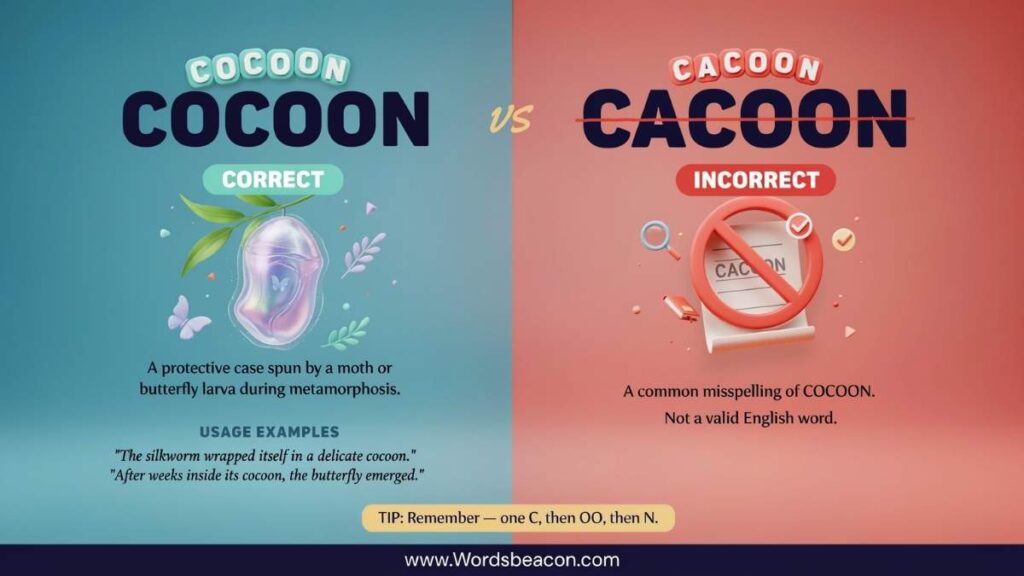
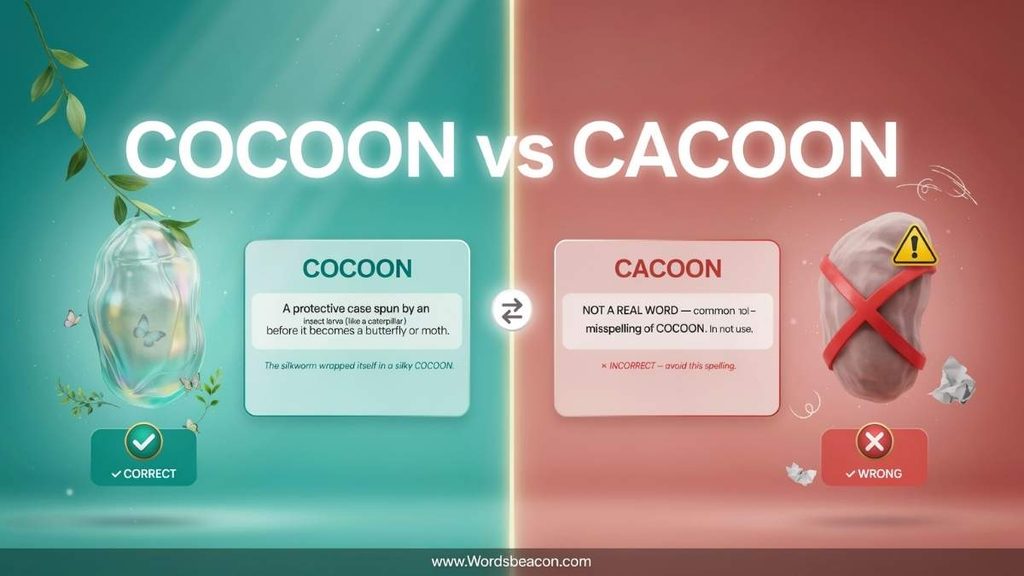
The difference between Cocoon vs Cacoon may seem like a tiny spelling detail, but it can easily cause confusion. Both words look similar, so it’s understandable to mix them up. However, only “cocoon” is the standard English spelling for the protective covering formed by certain insects. “Cacoon” is generally a misspelling, although it appears in some brand names, including Vivere Cacoon. The good news is that the rule is simple once you understand it. This article explains the meaning of each spelling, highlights the key differences, and helps you use the correct word without second-guessing yourself.
Quick Comparison
| Feature | Cocoon | Cacoon |
|---|---|---|
| Standard English spelling | Correct | Generally incorrect for the intended meaning |
| Dictionary meaning | A protective covering made by certain insects | Not the standard spelling of cocoon |
| Part of speech | Noun and verb | Not a standard substitute for cocoon |
| Figurative meaning | A sheltered, comfortable, or protected environment | Not standard for this meaning |
| Biological use | Describes a covering associated with insect development | Not a standard biological term for that covering |
| Brand use | May appear in ordinary descriptions | Used in the Vivere Cacoon product name |
| Example | The moth spun a cocoon. | The moth spun a cacoon. (Incorrect in ordinary writing.) |
The main difference is spelling. When you mean the insect covering or a sheltered environment, write cocoon. When you refer to an official product named Cacoon, preserve the brand’s spelling.
Learn how to use confusing more words correctly
Brite vs Bright Correct Spelling and usage ?
What Does Cocoon Mean?
A cocoon is a protective covering that certain insects produce during development. Many moth larvae spin silk to form a casing around themselves before entering the pupal stage.
The word also has a figurative meaning. It can describe a comfortable, protected environment or the act of surrounding someone with warmth and security.
Cocoon as a Noun
As a noun, cocoon refers to a covering made by certain insect larvae. The structure may consist of silk or a combination of silk and other materials, depending on the species.
For example, a silkworm produces a silken cocoon from fibers that people can process into silk. Other moth larvae make cocoons that blend into leaves, soil, or surrounding vegetation.
Examples include:
- The silkworm spun a cocoon.
- The moth developed inside its protective cocoon.
- The researcher examined several cocoons attached to branches.
- The insect’s cocoon helped protect it during development.
Not every insect makes a cocoon. Some insects develop inside other forms of protection, while others pupate without spinning a separate covering.
Cocoon as a Verb
Cocoon also works as a verb. It means to wrap, surround, or shelter someone or something protectively.
For example, a parent might cocoon a baby in a warm blanket. Someone might also cocoon themselves at home during a cold weekend.
Common forms include:
| Form | Example |
|---|---|
| Cocoon | I cocoon myself in a blanket. |
| Cocoons | She cocoons herself in a quiet room. |
| Cocooned | He cocooned himself away from distractions. |
| Cocooning | They are cocooning at home this weekend. |
| Cocoons (plural noun) | Several cocoons hung from the branches. |
Notice that each form retains the correct spelling of cocoon.
Cocoon as a Figurative Expression
In everyday English, Cocoon vs Cacoon can cause confusion because a cocoon represents comfort, privacy, protection, or isolation.
For example, someone might describe their bedroom as a cozy cocoon after a demanding day. When comparing Cocoon vs Cacoon, remember that the standard spelling is “cocoon,” which describes a space where someone can relax without outside distractions.
Writers also use the cocoon metaphor to describe emotional growth. A person might withdraw from social activities, reflect on their experiences, and eventually return with a fresh perspective.
However, staying in a cocoon of familiar routines can also mean avoiding new experiences or relationships.
For example: “After moving to a new city, Maya created a comfortable cocoon of familiar routines before exploring her new surroundings.”
Ultimately, Cocoon vs Cacoon depends on context, but “cocoon” remains the correct spelling in everyday English.
Learn how to use confusing more words correctly
Shakey vs Shaky Which Spelling Is Correct?
Why Do People Spell Cocoon as Cacoon?
The cacoon misspelling usually occurs when someone remembers a word imperfectly or types it too quickly. Since the two forms differ by only one vowel, the error can escape notice during proofreading.
Confusion About Vowels
English spelling doesn’t always follow predictable sound patterns. Writers sometimes substitute one vowel for another, especially when they haven’t memorized a word’s exact spelling.
Compare the two forms:
- Cocoon: C-O-C-O-O-N
- Cacoon: C-A-C-O-O-N
The first form is the correct spelling for the ordinary English word. Remembering the opening letters can help prevent the mistake.
Typing Errors and Spell-Checkers
A quick typing error can turn cocoon into cacoon. Spell-checking tools help catch many mistakes, but their results depend on the software and its dictionary.
Some tools may overlook unusual errors or recognize a word as a proper name. Therefore, don’t rely entirely on autocorrect when a spelling looks unfamiliar.
Instead, check a reputable dictionary and proofread the sentence before publishing it.
Repeated Errors Online
Seeing a spelling mistake repeatedly doesn’t make it correct. Websites, social posts, and copied articles can spread the same error across the internet.
For reliable spelling and definitions, established dictionaries such as Merriam-Webster, Cambridge Dictionary, and Oxford Learner’s Dictionaries are better references than an isolated online occurrence.
Learn how to use confusing more words correctly
Enrol vs Enroll correct Spelling and usage ?
Is Cacoon a Word?
The answer depends on what you mean by the word.
In ordinary English, cacoon is generally a misspelling when someone intends to write cocoon. It isn’t the standard spelling for the protective insect covering or the figurative meaning of a sheltered environment.
However, Cacoon appears in product branding. For example, Vivere uses this spelling for a range of hanging seats designed for indoor and outdoor relaxation.
This distinction matters because a proper name follows the name holder’s chosen spelling. It doesn’t change the spelling of the ordinary English word.
Does Cacoon Have a Botanical Meaning?
A claim that cacoon is a plant name or a botanical synonym needs verification in a reliable botanical reference.
For example, Enterolobium cyclocarpum is a tropical tree known by common names that include the ear-pod tree. That fact alone doesn’t establish cacoon as a standard name for the species.
If you encounter the term in a seed catalog, gardening guide, or regional plant reference, check the context and scientific name before drawing conclusions.
Fix common more word mistakes in English
Panel vs Pannel Spelling and Correct usage?
How to Spell Cocoon Correctly
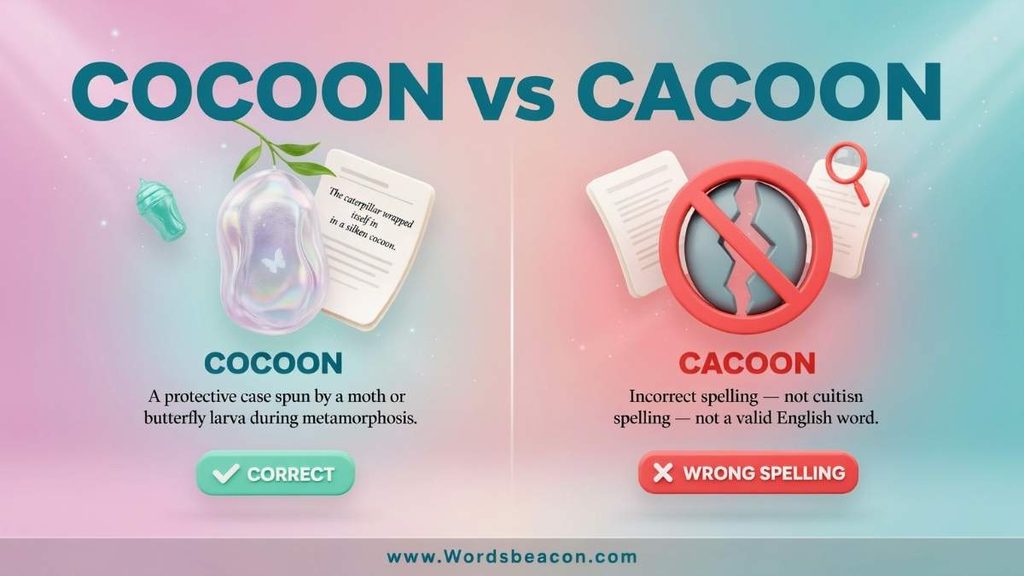
The easiest way to remember how to spell cocoon is to learn its six letters in order:
C-O-C-O-O-N
Pay particular attention to the opening co and the double oo near the end.
A Simple Memory Trick
Picture a silkworm surrounded by a silky covering. Then write cocoon while keeping that image in mind.
You can also practice the word in a sentence:
“The moth developed inside its cocoon.”
Writing the word in context helps reinforce both its spelling and its meaning. If you repeatedly write cacoon by mistake, focus on the first vowel and check your spelling before moving on.
Common Spelling Mistakes
| Incorrect form | Correct form |
|---|---|
| Cacoon | Cocoon |
| Cacoons | Cocoons |
| Cacooned | Cocooned |
| Cacooning | Cocooning |
The correct forms retain the original spelling. Learning the base word makes its other forms easier to remember.
Fix common more word mistakes in English
Whiny vs Whiney Correct Spelling and How to Use Each
Cocoon Pronunciation
In American English, cocoon is pronounced /kəˈkuːn/. It has two syllables, with the stress on the second syllable.
The first syllable contains an unstressed vowel. The second contains the long oo sound, similar to the vowel in moon.
To practice the pronunciation:
- Keep the first syllable light.
- Stress the second syllable.
- Pronounce the long oo clearly.
- Finish with the final n sound.
Cacoon doesn’t have a standard pronunciation as a spelling variant of cocoon. If it appears in a brand name, its pronunciation may depend on the brand’s intended reading.
Cocoon Word Origin
The English word cocoon comes from French cocon, with historical connections to terms for a shell or eggshell.
English adopted the word in the late seventeenth century to describe the silky covering made by certain insect larvae. Over time, the word developed additional uses.
The verb cocoon dates to the nineteenth century. It first described the formation of a cocoon and later expanded to include wrapping or surrounding someone protectively.
In modern English, cocoon can describe both physical protection and the feeling of withdrawing into a comfortable environment.
Its history helps explain the word’s development, but it doesn’t make cacoon an accepted alternative spelling.
Fix common more word mistakes in English
Grately vs Greatly difference and Correct usage?
Cocoon vs Chrysalis What’s the Difference?
A cocoon and a chrysalis are related to insect development, but they aren’t the same thing.
A cocoon is a protective covering made by certain insects. A chrysalis refers to the pupal stage of a butterfly or the hardened pupal form associated with that stage.
| Term | Meaning |
|---|---|
| Cocoon | A protective covering made by certain insects |
| Chrysalis | The pupal stage or hardened pupal form of a butterfly |
| Pupa | The developmental stage between larva and adult in insects with complete metamorphosis |
| Larva | The immature stage that follows hatching from an egg |
Many moth larvae spin cocoons before pupation. Butterflies, however, generally develop inside a chrysalis without making a separate silk cocoon.
Do Butterflies Live in Cocoons?
Butterflies generally develop inside a chrysalis. Many attach their pupae directly to a plant or another surface instead of constructing a separate silken covering.
The butterfly life cycle typically has four stages:
- Egg: The butterfly begins life inside an egg.
- Larva: The caterpillar feeds and grows.
- Pupa: The insect undergoes major changes inside the chrysalis.
- Adult: The butterfly emerges and eventually reproduces.
The details vary by species, so it’s best not to assume that every butterfly or moth makes a cocoon.
What Is a Cocoon Made Of?
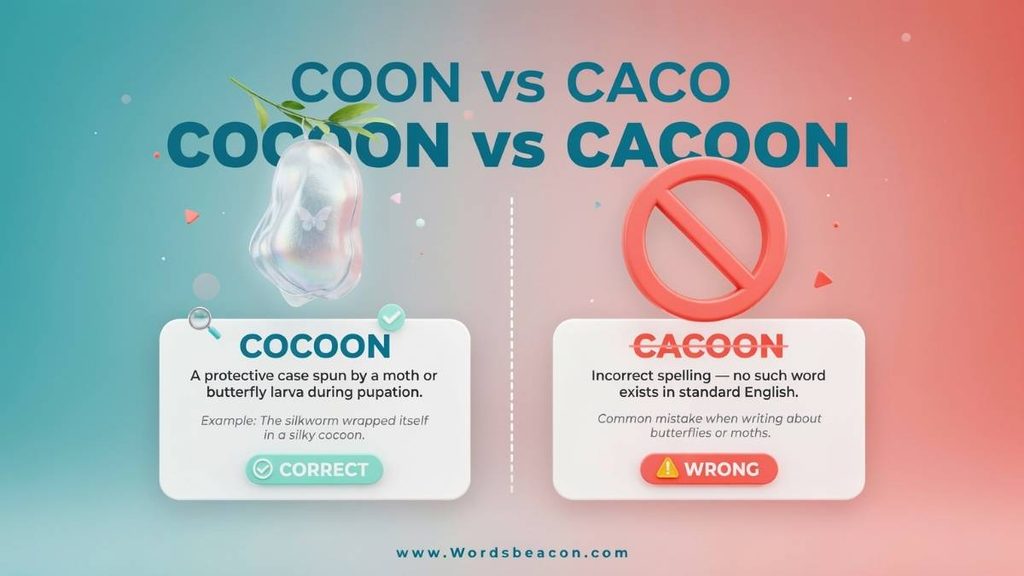
Many insect cocoons consist of silk or silk-like fibers produced by the larva. Some species combine silk with leaves, soil, or other materials.
A cocoon can serve several purposes:
- Physical protection from certain external hazards.
- A surrounding structure during development.
- Some buffering against environmental changes.
However, a cocoon isn’t an impenetrable shield. Its protective qualities depend on the species and its environment.
Silkworm cocoons are especially well known because their silk filaments can be collected and processed into silk fabric.
Fix common more word mistakes in English
Excel vs Accel Which Spelling Is Correct?
Cocoon Usage Examples
The best way to learn a word is to see how it works in different contexts.
Biological Examples
- The caterpillar spun a cocoon before entering the pupal stage.
- The researcher examined the moth cocoon under a microscope.
- Several cocoons hung from the branches.
- The study investigated the conditions that affect cocoon formation.
Everyday Examples
- I spent the weekend cocooned in warm blankets.
- Her bedroom felt like a cozy cocoon.
- We created a quiet, comfortable space for reading.
- He likes to cocoon at home after a busy workweek.
Professional and Academic Examples
- The study examined the relationship between temperature and insect development.
- The researcher distinguished the cocoon from the insect’s pupal stage.
- The office’s quiet reading area offered a sense of privacy.
- The report described the cocoon as a protective covering.
These examples show that cocoon works in both literal and figurative contexts.
Understand confusing English more words simply
Journeys vs journies Correct Spelling and usage ?
What Is a Cocoon Synonym?
The best synonym depends on the intended meaning.
In a biological context, protective covering, silken case, and protective casing can describe a cocoon. These phrases aren’t always exact scientific equivalents, but they communicate the general idea.
For figurative uses, consider these alternatives:
| Synonym | Best use |
|---|---|
| Haven | A place of safety or comfort |
| Shelter | A place or structure that provides protection |
| Sanctuary | A peaceful place of refuge |
| Retreat | A place to withdraw from everyday demands |
| Enclosure | Something that surrounds or contains an object |
For example, “The cabin became her cocoon” emphasizes comfort and seclusion. “The cabin became her sanctuary” emphasizes peace and refuge.
Choose the word that best fits the meaning rather than treating every synonym as interchangeable.
What Is a Vivere Cacoon Hanging Chair?
Cacoon is also the product name used by Vivere for a range of suspended seats. These products resemble enclosed hanging chairs or outdoor pods and provide a sheltered place to sit, read, or relax.
The spelling is intentional because it identifies the brand’s product. It isn’t an alternative spelling of the ordinary English word cocoon.
A Cacoon hanging seat may be used indoors or outdoors, depending on the model and installation requirements. Buyers should follow the manufacturer’s instructions for suspension, weight limits, and safe use.
This example highlights the central distinction: use Cacoon when referring to the branded product and cocoon when referring to the ordinary English word.
Understand confusing English more words simply
Drier vs Dryer Differences and Correct Usage ?
Practice Session Cocoon vs Cacoon
Fill in each blank with the correct word: Cocoon vs Cacoon .” Choose carefully based on the meaning and context.
1. A butterfly develops inside a protective ______ during part of its life cycle.
2. The correct spelling of the word for an insect’s protective covering is ______.
3. The child watched a caterpillar form a ______ on a branch.
4. I bought a hanging chair from the Vivere ______ collection.
5. The word “______” is generally considered a misspelling of “cocoon.”
6. The silkworm spins a silk ______ around itself.
7. She likes to relax in her outdoor hanging ______ chair.
8. Remember to use the spelling “______” when referring to an insect’s protective covering.
9. The sleeping insect remained protected inside its ______.
10. He accidentally wrote “______” instead of “cocoon” in his homework.
11. A ______ can provide protection while an insect develops.
12. The product name Vivere ______ is an example of a brand using a different spelling.
13. The caterpillar created a protective ______ before its transformation.
14. When writing about insect development, “______” is the standard English spelling.
15. She searched online for a Vivere ______ hanging chair.
16. The student corrected the spelling mistake and replaced “______” with “cocoon.”
17. A silk ______ protects the developing insect inside.
18. If you mean the insect’s protective covering, write “______,” not “cacoon.”
19. The family placed its hanging ______ chair in the garden.
20. Although “cacoon” appears in some product names, “______” is the standard spelling of the common noun.
Answers
- cocoon
- cocoon
- cocoon
- Cacoon
- cacoon
- cocoon
- Cacoon
- cocoon
- cocoon
- cacoon
- cocoon
- Cacoon
- cocoon
- cocoon
- Cacoon
- cacoon
- cocoon
- cocoon
- Cacoon
- cocoon
Here’s a trusted source for clear word meanings:
FAQs
What does “cacoon” mean?
“Cacoon” is generally a misspelling of “cocoon,” the protective covering spun by certain insect larvae during development. However, “Cacoon” may appear in brand and product names, such as Vivere Cacoon.
What is the difference between a cocoon and a chrysalis?
A cocoon is a protective covering spun by certain insects, often from silk. A chrysalis is the pupal stage of a butterfly. Most butterflies form a chrysalis without spinning a silk cocoon around it.
What shape is a cocoon?
A cocoon’s shape varies by insect species. It may be oval, elongated, rounded, or irregular. Silkworm cocoons are typically oval, while other insects produce protective coverings with different shapes and textures.
What is a fancy word for “cocoon”?
There is no exact synonym for “cocoon” in every context. In biology, “protective casing” or “silken covering” may describe it. In a figurative sense, “sanctuary,” “refuge,” or “shelter” can convey the idea of a safe, enclosed space.
What does “cocoon” mean in slang?
In informal English, “cocoon” can mean withdrawing from social activities and staying in a comfortable, private environment. For example, someone might cocoon at home after a stressful week to relax and avoid outside distractions.
What does “goon cocoon” mean?
“Goon cocoon” is an internet slang expression associated with prolonged isolation and becoming absorbed in a private online environment. Its precise meaning varies by context and online community, so it should not be confused with the biological meaning of “cocoon.”
What is the spiritual meaning of a cocoon?
A cocoon often symbolizes transformation, patience, inner growth, and renewal in spiritual interpretations. It can represent a period of reflection before a new stage of life. These meanings are symbolic rather than scientific or universally shared beliefs.
What does “broken cocoon into a butterfly” mean?
This phrase generally symbolizes overcoming challenges and emerging stronger or more independent. It compares personal growth to a butterfly’s transformation from a caterpillar into an adult, suggesting resilience, change, and new beginnings.
What is the correct spelling of “cocoon”?
The correct standard English spelling is “cocoon,” with a c at the beginning and two o’s in each syllable. “Cacoon” is generally incorrect when referring to an insect’s protective covering, although it may be used in a proper name.
Is it spelled “Cocoon vs Cacoon”?
“Cocoon” is the correct spelling for the biological term and its figurative uses. “Cacoon” may be appropriate when referring to a specific brand or product that uses that spelling, such as Vivere Cacoon.
Can two butterflies be in the same cocoon?
Butterflies do not normally share a single cocoon. Each butterfly develops individually inside its own chrysalis. Although caterpillars may live near one another, each forms its own pupal structure.
Do butterflies remember being in a cocoon?
Research suggests that some learned associations from a butterfly’s caterpillar stage can persist through metamorphosis. However, memory retention depends on the species and type of learning. This does not establish that butterflies remember the experience as humans remember personal events.
What is a butterfly cocoon called?
A butterfly’s pupal stage is called a chrysalis. Most butterflies do not spin a separate silk cocoon around it. Instead, the chrysalis itself forms the protective outer covering during this stage of development.
What is the opposite of a cocoon?
There is no single exact opposite of “cocoon.” Depending on the context, “exposure,” “openness,” or “vulnerability” may express the opposite idea of protection and enclosure. Figuratively, leaving a cocoon can mean stepping outside a familiar environment and embracing new experiences.
What is another name for a chrysalis?
A chrysalis is a type of pupa, the developmental stage between the larva and adult in insects that undergo complete metamorphosis. The term “chrysalis” specifically refers to the pupal stage of a butterfly, while “pupa” applies more broadly to insects such as butterflies, moths, beetles, and flies.
Is “cacoon” a real word?
“Cacoon” is not the standard spelling of the common noun “cocoon.” However, it may appear as a brand name, product name, or other proper noun. When discussing insect development, use “cocoon” unless you are quoting a name that uses a different spelling.
Is “butterfly cocoon” spelled correctly?
Yes, “butterfly cocoon” is spelled correctly as a phrase. However, “butterfly chrysalis” is generally more precise scientifically because butterflies usually develop inside a chrysalis rather than a silk cocoon.
How is “cocoon” pronounced?
“Cocoon” is pronounced /kəˈkuːn/, with the emphasis on the second syllable. The first syllable has a relaxed vowel sound, while the second rhymes with “soon.”
What is another word for “cocoon”?
Depending on the context, alternatives include “protective covering,” “silk casing,” and “silken enclosure.” For figurative uses, “shelter,” “refuge,” and “sanctuary” may fit. However, these words are not exact substitutes in every sentence.
What does “cocoon” mean in life?
In everyday language, a cocoon can represent a safe space for rest, reflection, or personal growth. The expression “coming out of your cocoon” often describes becoming more confident, connecting with others, or exploring unfamiliar opportunities.
Understand confusing English more words simply
Suing vs Sueing Which Spelling Is Correct?
Conclusion
The difference in Cocoon vs Cacoon is simple once you know the rule. When comparing Cocoon vs Cacoon, remember that “cocoon” is the correct standard English spelling for an insect’s protective covering or, figuratively, a safe, comfortable space. “Cacoon” is usually a spelling mistake, although it can be correct in a specific brand or product name, such as Vivere Cacoon.
The Cocoon vs Cacoon confusion is easy to understand because both spellings look convincing. However, only one is the standard word. Next time you write about a cocoon, remember that the caterpillar gets a cocoon, not an extra “a”!
Another important detail in the Cocoon vs Cacoon discussion is that butterflies usually develop inside a chrysalis, while many moths form cocoons. Knowing this difference helps you use these terms accurately.
In short, understanding Cocoon vs Cacoon helps you avoid spelling mistakes. Use “cocoon” in everyday writing and “Cacoon” only when a specific name uses that spelling. Now you can leave this spelling mystery behind no transformation required!

Luna AJS is an experienced blogger and dedicated language enthusiast at Words Beacon. She specializes in making English grammar, spelling, vocabulary and commonly confused words easy to understand. She provides clear explanations, practical examples to help readers write with confidence.