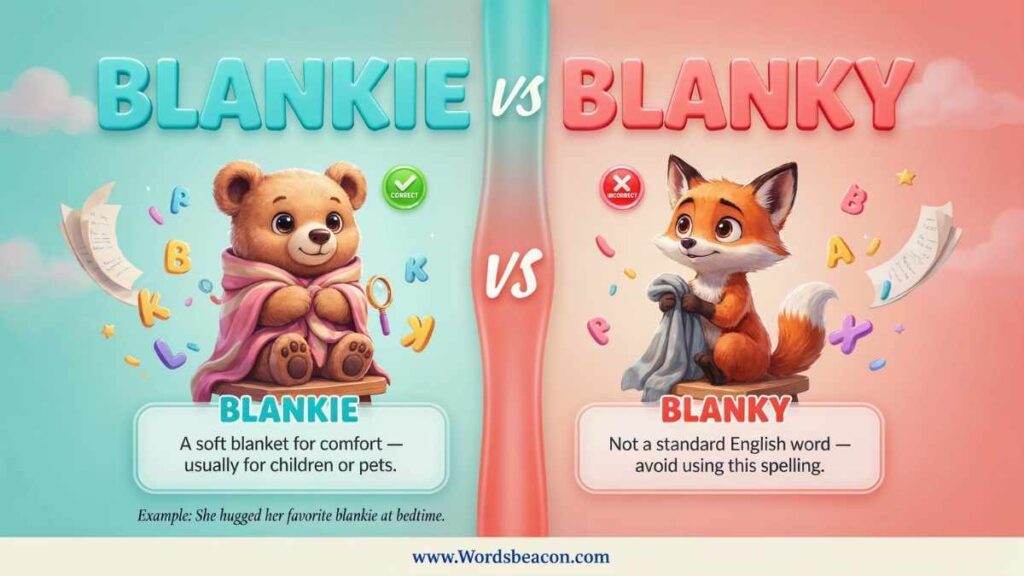
The words Blankie vs Blanky may look almost identical, but which spelling should you use? The good news is that all three appear in informal writing, so the confusion is understandable. Blankie is a common American English spelling, while blanky and blankey are alternative forms. More importantly, these words usually refer to a child’s favorite comfort blanket, not an ordinary blanket used for warmth. Although the differences may seem small, understanding their meanings and common usage helps you avoid spelling mistakes. Let’s explore the definitions, spelling variations, and correct usage of blankie vs blanky so you can write with confidence.
Quick Comparison
| Feature | Blankie | Blanky |
|---|---|---|
| Meaning | An informal name for a child’s favorite or comfort blanket | An informal name for a comfort blanket |
| Part of speech | Noun | Noun |
| Tone | Affectionate and casual | Affectionate and casual |
| Dictionary classification | Mainly US English; also spelled blankey | British English baby talk |
| Pronunciation | /ˈblæŋ.ki/ | /ˈblæŋ.kɪ/ in Collins’s transcription |
| Best use | Informal American English and family conversations | Contexts where this spelling is familiar or intentional |
| Formal alternative | Blanket or comfort blanket | Blanket or comfort blanket |
The key difference is spelling and documented usage, not a reliable difference in the object itself. Both terms can refer to a blanket that a child carries or holds for reassurance.
Fix common more word mistakes in English
Cocoon vs Cacoon which spelling is correct ?
Blankie vs Blanky The Key Differences
If you’re wondering, “Is it blankie vs blanky?” the answer is that both forms have documented use, but blankie is the more practical choice for general American English writing.
Use blankie when describing a child’s favorite blanket in a parenting article, family story, or children’s book. Choose blanky when it fits the language of a particular family, character, or audience. For neutral or formal writing, use blanket or comfort blanket instead.
For example:
- “The toddler brought her blankie to Grandma’s house.”
- “The toddler brought her blanky to Grandma’s house.”
Both sentences communicate the same basic idea. The spelling doesn’t change the child’s relationship with the blanket.
What Does Blankie Mean?
The blankie meaning is simple: an informal, affectionate word for a blanket, especially a small blanket or piece of fabric that a young child uses to feel safe and comfortable.
Cambridge Dictionary defines blankie as a blanket, particularly one that a young child uses to feel safe and happy. The word often refers to a specific blanket that the child recognizes and prefers over other blankets.
For example, a toddler might have several blankets but insist on carrying the same faded blue one everywhere. The family may call that particular item a blankie because it has become part of the child’s daily routine.
Why Do People Call a Blanket a Blankie?
English speakers often use affectionate endings to make familiar words sound friendlier or more personal. The ending -ie appears in words such as doggie, auntie, and sweetie.
Blankie follows a similar pattern. It takes the familiar word blanket and gives it an informal, affectionate form.
This doesn’t mean that the object must be small or that only children can use the word. Adults might also say blankie when recalling a childhood possession or speaking affectionately about a child’s favorite blanket.
When Do People Use Blankie?
The word fits naturally into everyday situations, including:
- Family conversations: “Did you pack your blankie?”
- Bedtime routines: “Let’s find your blankie before we read a story.”
- Parenting discussions: “My toddler won’t nap without her blankie.”
- Personal memories: “I still have my favorite baby blankie.”
- Children’s stories: A character might call a familiar blanket a blankie to make the dialogue sound natural.
Because blankie is informal, it doesn’t suit every setting. A product specification or formal childcare policy will usually benefit from the clearer, more neutral word blanket.
Fix common more word mistakes in English
Brite vs Bright Correct Spelling and usage ?
What Does Blanky Mean?
The blanky meaning is closely related to blankie. Collins Dictionary records blanky as a noun meaning a comfort blanket and classifies it as British English baby talk.
A comfort blanket is a familiar blanket that a young child feels attached to. It may help the child feel more comfortable at bedtime, during travel, or in unfamiliar surroundings.
For example, consider this sentence:
“Oliver wouldn’t settle down until his dad found his yellow blanky.”
The word blanky identifies the familiar object that Oliver wants. It doesn’t tell us the blanket’s size, material, or brand. Instead, it reflects the informal name used for the object.
Is Blanky Another Word for Blanket?
Yes, when someone uses blanky to mean a child’s comfort blanket. However, blanky doesn’t replace blanket in every context.
A blanket can cover a bed, keep someone warm on a sofa, or serve as an outdoor covering. Blanky usually carries a more affectionate, child-focused meaning.
Compare these examples:
| Sentence | What it communicates |
|---|---|
| “Please fold the blanket.” | A neutral instruction about a general blanket |
| “Bring your blanky to Grandma’s house.” | An informal reference to a child’s familiar blanket |
| “The toddler fell asleep holding his blanky.” | A child’s attachment to a comfort item |
The physical object may be identical. The main difference is the language used to describe it.
Is Blanky a Real Word?
Yes. Collins Dictionary recognizes blanky as an informal noun for a comfort blanket. That makes it a documented English word rather than a form that should automatically be dismissed as a spelling error.
However, dictionary recognition doesn’t mean every editor will prefer it. For general American English, blankie remains a sensible default. For a character or family that uses blanky, retaining that spelling may be more natural.
Learn how to use confusing more words correctly
Shakey vs Shaky Which Spelling Is Correct?
Blankie vs Blanky What Is the Difference?
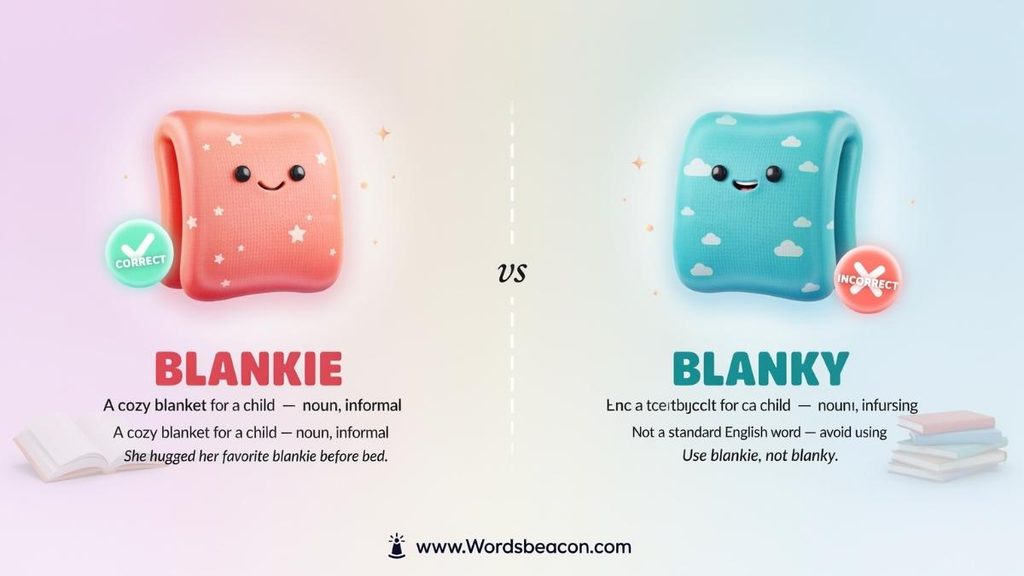
The two forms look different, but their meanings overlap considerably. To understand the distinction, consider their spelling, tone, regional associations, and intended audience.
Meaning Difference
Both blankie and blanky can refer to a child’s comfort blanket. Neither spelling automatically identifies a different fabric, size, or type of blanket.
For example, one family might call a small cotton blanket a blankie, while another calls the same type of object a blanky. The meaning remains essentially the same.
It’s therefore misleading to claim that a blankie is always a small blanket while a blanky is always a large one. The dictionary evidence doesn’t support that distinction.
Spelling Difference
The visible difference comes at the end of the word:
- Blankie ends in -ie.
- Blanky ends in -y.
Both spellings can represent the same final sound. Because people often learn informal words through conversation, they may recognize a word long before they know how to spell it.
That explains why the choice can feel confusing. Hearing someone say the word doesn’t necessarily reveal which spelling they use.
Tone and Register
Both words are informal and affectionate. Neither is inherently more loving or more childish in every situation.
Consider these sentences:
- “Have you seen Ella’s blankie?”
- “Have you seen Ella’s blanky?”
Both sound natural in casual conversation. The spelling doesn’t change the speaker’s meaning.
When editing an article, blankie is a useful default for American readers. However, preserving blanky may make more sense when quoting someone or reflecting a particular character’s speech.
Regional Usage
Dictionary labels provide helpful guidance, but they shouldn’t become rigid national rules.
Cambridge Dictionary classifies blankie as informal and mainly US English. It also records blankey as an alternative spelling. Collins Dictionary classifies blanky as British English baby talk.
These labels describe documented usage. They don’t prove that Americans never use blanky or that British speakers never use blankie.
Personal habits, family language, books, and media can all influence which form a person recognizes.
Context and Audience
The best spelling often depends on who will read your writing.
| Writing situation | Recommended choice | Reason |
|---|---|---|
| American parenting blog | Blankie | Familiar informal wording for a general US audience |
| Children’s story | Blankie vs blanky | Either may fit the character’s voice |
| Formal product specification | Blanket | Neutral and precise |
| Description of a child’s comfort item | Blankie or comfort blanket | Emphasizes the familiar, comforting role |
| Direct quotation | Preserve the original spelling | Maintains the speaker’s wording |
| Family keepsake description | Either form | An affectionate, personal tone fits the context |
Rather than forcing every writer to use one spelling, choose the form that communicates your meaning clearly and suits your readers.
Learn how to use confusing more words correctly
Enrol vs Enroll correct Spelling and usage ?
Which Spelling Should You Use Blankie vs Blanky?
If you’re still unsure which spelling to choose, start with your audience and purpose.
Blankie in American English
For a general American audience, blankie is the safest default when you want an affectionate, informal term for a child’s blanket.
It works well in parenting articles, family anecdotes, children’s stories, and everyday conversation.
Examples include:
- “Her baby blankie has a little embroidered rabbit.”
- “We packed his blankie before the family road trip.”
- “My daughter keeps her favorite blankie beside her bed.”
The spelling also works naturally in discussions about the blankie meaning or the correct spelling of blankie.
Blanky in British English
Blanky is a documented British English baby-talk term. It may suit a British character, a family that regularly uses the word, or a story that deliberately reflects that usage.
For example:
- “Have you packed the baby’s blanky?”
- “He took his blanky to nursery.”
- “She held her blanky while listening to the story.”
These examples show how the word can appear in dialogue. They don’t mean that every British family prefers blanky.
If you’re writing for readers who recognize the term, there’s no need to replace it automatically. Consistency matters more than enforcing a single spelling across every context.
Blankie or Blanket in Formal Writing?
In formal and professional writing, blanket is usually the better choice.
Imagine you’re writing a product description for a store. “Soft cotton blanket for infants” tells shoppers what the product is. “Baby blankie” sounds friendlier, but it may be less precise in a technical description.
Likewise, a childcare policy might refer to a blanket when discussing bedding. A parenting article about a toddler’s attachment to a particular object might use blankie because the informal tone fits the subject.
A useful rule is to match the term to the purpose:
- Use blanket for neutral descriptions and general references.
- Use comfort blanket when the object’s comforting role matters.
- Use blankie vs blanky when an affectionate, informal tone adds meaning.
Blankie in Children’s Stories and Dialogue
Children’s stories often use familiar words to make characters sound believable. A child who calls a favorite blanket a blankie may sound more natural than one who calls it a textile covering.
The same principle applies to blanky. If a character consistently uses that form, changing it throughout the story could weaken the character’s voice.
For example, a story might introduce a child who refuses to leave home without a worn blue blanket. If the family calls it “Blue Blanky,” that name becomes part of the story.
In this case, the spelling serves the character rather than a universal spelling rule.
Learn how to use confusing more words correctly
Panel vs Pannel Spelling and Correct usage?
Blankie Examples in Sentences
Examples help clarify how the word works in everyday language. The following sentences are original illustrations.
Blankie Examples
- Everyday conversation: “Can you bring your blankie into the living room?”
- Bedtime: “Lily hugged her blankie and closed her eyes.”
- Travel: “We packed the toddler’s blankie for the long flight.”
- Family memories: “My old blankie is still tucked away in a memory box.”
- Parenting article: “Some children carry a favorite blankie from room to room.”
- Product description: “This soft baby blankie makes a thoughtful gift for a newborn’s family.”
The word can sound affectionate in conversation, nostalgic in a family story, and friendly in a product description.
Blanky Examples
- Everyday conversation: “Where did you leave your blanky?”
- Bedtime: “He wanted his blanky before settling down for the night.”
- Travel: “Her blanky came along on every family vacation.”
- Family story: “Dad still remembers the yellow blanky he carried as a child.”
- Children’s dialogue: “I can’t find my blanky!” the little boy cried.
Each sentence uses blanky as an informal name for a comfort blanket. The spelling doesn’t change the word’s grammatical role.
Blankie vs Blanky in the Same Sentence
A side-by-side comparison makes the similarity clear.
| With blankie | With blanky |
|---|---|
| She took her blankie on the trip. | She took her blanky on the trip. |
| The toddler held his blankie. | The toddler held his blanky. |
| Where is your blankie? | Where is your blanky? |
The sentences communicate the same basic meaning. The choice comes down to spelling preference and context.
Understand confusing English more words simply
Grately vs Greatly difference and Correct usage?
How Do You Pronounce Blankie and Blanky?
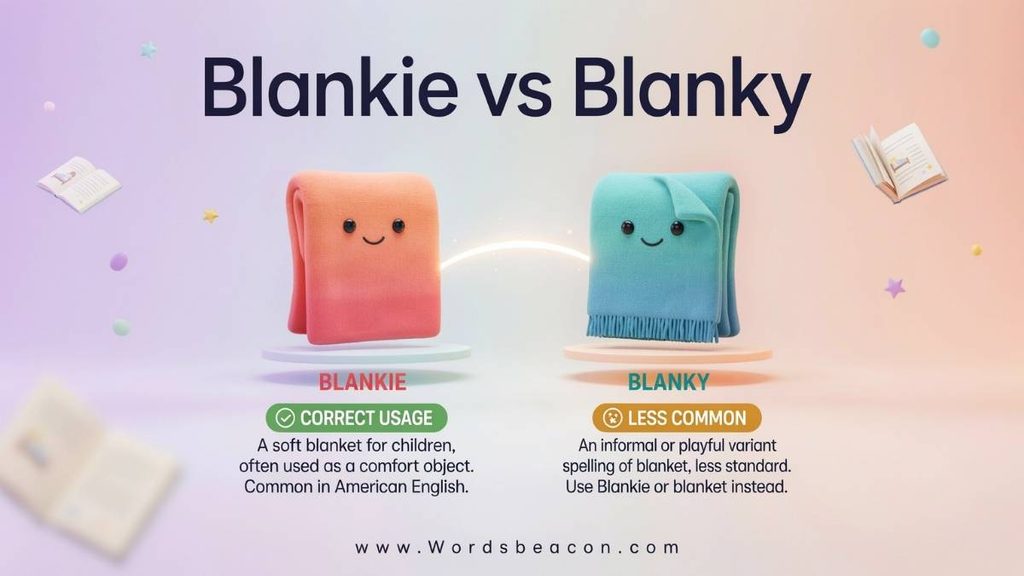
Cambridge Dictionary gives the pronunciation of blankie as /ˈblæŋ.ki/. The word has two syllables, with the stress on the first.
Here’s a simple breakdown:
- First syllable: The vowel sounds like the short a in cat.
- Second syllable: The ending has an ee sound.
- Stress: Emphasize the first syllable.
Blankie and blanky generally sound the same when people use them to mean a child’s comfort blanket. Therefore, pronunciation usually won’t help you decide which spelling a speaker has in mind.
That is one reason the spelling causes confusion. People can recognize the word immediately when they hear it but still wonder which letters to use when writing it.
Where Did the Word Blankie Come From?
The precise first use of blankie isn’t established by the dictionary entries discussed here. However, its formation fits a familiar pattern in English.
The word is closely related to blanket, with an affectionate ending that gives the ordinary noun a more personal tone.
The Role of the Diminutive Suffix -ie
English speakers often use endings such as -ie and -y to create affectionate or informal words. Examples include doggie, auntie, and sweetie.
These endings don’t always have a strict grammatical function. Depending on the word, they may suggest affection, familiarity, smallness, or a child-friendly tone.
Blankie follows this general pattern. The ending helps give the word a softer, more personal feel.
The same pattern helps explain why writers may choose blanky. When people learn words through speech, they sometimes represent the same final sound with different letter combinations.
When Did the Word Blankie Originate?
A precise origin date requires historical dictionary evidence or dated examples that establish the word’s early use. Without that evidence, assigning a specific year would be misleading.
What can be said confidently is that blankie is a documented informal English noun, and blanky is also recorded as a comfort-blanket term.
Current dictionary entries establish their meanings and usage labels. They don’t, by themselves, establish the exact date when either spelling first appeared.
Understand confusing English more words simply
Excel vs Accel Which Spelling Is Correct?
Blankie, Blanky, Blankey, and Blanket What’s the Difference?
The spelling question becomes more interesting when you include blankey and the standard word blanket.
Blankey vs Blankie
Cambridge Dictionary records blankey as an alternative spelling of blankie. Both refer to a blanket, particularly one a young child uses for comfort.
The three informal spellings are worth distinguishing:
- Blankie is a useful default for informal American English.
- Blankey is an alternative spelling recognized by Cambridge.
- Blanky is recorded by Collins as British English baby talk.
These forms overlap in meaning, but dictionaries don’t classify them identically.
If you’re writing an article, choose one spelling and use it consistently. If you’re quoting a family member or reproducing a character’s name, preserve the original form.
Blankie vs Blanket
The difference between blankie and blanket is more straightforward.
A blanket is the standard, neutral noun for a covering used for warmth or comfort. A blankie is an informal term that often carries an affectionate association with a child’s favorite blanket.
| Word | Meaning and tone | Example |
|---|---|---|
| Blanket | Neutral, general-purpose noun | “Please fold the blanket.” |
| Blankie | Informal, affectionate term | “The baby wants her blankie.” |
| Blanky | Informal comfort-blanket term | “He carried his blanky everywhere.” |
| Blankey | Alternative spelling of blankie | “She packed her blankey for the trip.” |
| Security blanket | A blanket associated with comfort and security | “The child held his security blanket.” |
The distinction matters when precision is important. A store might advertise a children’s blanket, while a parenting article might discuss why a toddler wants a particular blankie at bedtime.
Blankie vs Security Blanket
A blankie is an informal name for an object. A security blanket describes an object’s role in helping someone feel comfortable or secure.
A security blanket often refers to a child’s favorite blanket, but the phrase can also be used figuratively. For example, an adult might describe a familiar routine as a security blanket because it makes an uncertain situation feel more manageable.
The phrase comfort blanket also describes an object that a child feels attached to. In some contexts, it can refer to anything that provides reassurance.
A blankie may function as a security blanket, but the terms aren’t interchangeable in every sentence. One emphasizes the familiar name; the other emphasizes the comforting role.
Understand confusing English more words simply
Journeys vs journies Correct Spelling and usage ?
Why Do Toddlers Become Attached to a Blankie?
A toddler’s favorite blanket can become more than a soft piece of fabric. For some children, it becomes a familiar comfort object associated with sleep, home, and the people who care for them.
Developmental psychologists use the term transitional object for a familiar object that can help some children manage separation, changes in routine, or moments of uncertainty. A comfort blanket can serve this role, although children differ in whether they form such attachments and which objects they prefer.
For example, one toddler may carry a soft baby blanket everywhere. Another may prefer a stuffed animal, while a third finds comfort in a familiar song or bedtime routine.
A beloved blanket may help because it stays familiar when the surroundings change. A child who feels unsettled at a relative’s house might find reassurance in the same blanket they use at home.
Not every child needs a blankie. It’s simply one of several ways children may find comfort.
Is a Baby Blankie the Same as a Lovey?
Not necessarily. The terms overlap, but their usual meanings differ slightly.
A baby lovey or lovey blanket often combines a piece of fabric with a stuffed animal or another soft feature. A traditional blankie may be a simple blanket without an attached toy.
Both can become familiar comfort objects.
Common examples include:
- A small fleece blanket.
- A square of soft fabric with satin edging.
- A blanket attached to a plush animal.
- A sentimental baby blanket kept from infancy.
- A toddler’s favorite cuddly blanket.
Product names aren’t standardized across manufacturers. A retailer might use lovey, baby comfort blanket, security blanket, or blankie for products with overlapping features.
A Practical Note About Infant Sleep Safety
Although families often use the word blankie affectionately, a blanket that comforts an older toddler isn’t automatically safe for a sleeping infant.
The American Academy of Pediatrics recommends keeping loose blankets and other soft objects out of an infant’s sleep space during the first year of life because they can increase the risk of sleep-related injury or death.
For babies, follow current safe-sleep guidance rather than relying on a product’s comforting purpose or marketing name. A product can be soft and comforting without being appropriate for unsupervised infant sleep.
Blankie vs Blanky Common Mistakes to Avoid
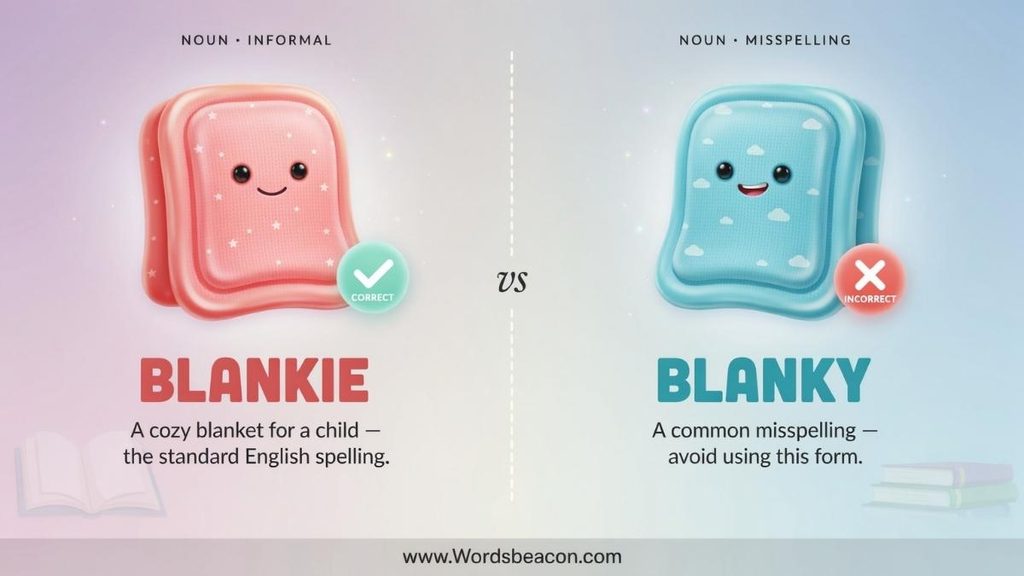
The spelling itself isn’t especially complicated. Most confusion comes from assuming that one form must be correct in every context.
Here are the mistakes worth avoiding:
- Calling blanky universally incorrect. Collins records it as a comfort-blanket term.
- Assuming the two spellings have different meanings. Both can refer to a child’s comfort blanket.
- Confusing informal with incorrect. Informal vocabulary has a place in English, especially in dialogue and family conversations.
- Claiming that every American uses blankie and every Briton uses blanky. Dictionary labels describe documented usage, not every individual’s speech.
- Mixing spellings without a reason. If you choose blankie for an article, don’t switch to blanky halfway through unless the context justifies the change.
- Using blankie when a neutral term would be clearer. In formal instructions, blanket or comfort blanket usually communicates the meaning more directly.
The best approach is to distinguish spelling preference from writing purpose. A spelling may suit a family conversation while another word works better in a formal document.
Understand confusing English more words simply
Drier vs Dryer Differences and Correct Usage ?
practice session Blankie vs Blanky
Complete the sentences with the correct word . This practice will help you understand the meanings, spellings, and uses of Blankie vs Blanky.
1. A small blanket that a child carries for comfort is often called a __________.
2. Both “blankie” and “blanky” can refer to a child’s __________ blanket.
3. The spelling “blankie” is commonly used in informal __________ English.
4. A familiar blanket can help a young child feel safe and __________.
5. The word “blanky” is an informal term for a comfort __________.
6. If you want to use the spelling commonly listed in American dictionaries, choose __________.
7. A child who takes a favorite blanket everywhere may have a strong emotional __________ to it.
8. A blanket that provides emotional comfort is sometimes called a security __________.
9. The word “blankie” is informal rather than a formal term used in academic __________.
10. A small blanket that helps a toddler feel secure may be called a __________ object.
11. “Blankie” and “blanky” have very similar __________.
12. A child may hold a favorite blanket when feeling tired, worried, or __________.
13. The plural of “blankie” is usually written as __________.
14. A familiar comfort blanket can help a child settle down at __________ time.
15. A comfort object that helps a child manage separation or change is sometimes called a transitional __________.
16. The word “blanket” is the standard term, while “blankie” is a more __________ form.
17. When discussing a child’s favorite comfort blanket, either “blankie” or “blanky” may be understood, depending on regional and personal __________.
18. A security blanket can provide a feeling of safety and __________.
19. The best spelling to use in your writing depends on the context and the spelling __________ you want to follow.
20. In the phrase “My toddler sleeps with her blankie,” the word “blankie” refers to a small blanket used for __________.
Answers
- Blankie
- Comfort
- American
- Happy
- Blanket
- Blankie
- Attachment
- Blanket
- Writing
- Comfort
- Pronunciation
- Upset
- Blankies
- Bed
- Object
- Informal
- Preferences
- Security
- Convention
- Comfort
Here’s a trusted source for clear word meanings:
FAQs
Is it spelled blanky vs blankie?
Both spellings are used informally. Blankie is a common spelling in American English, while blanky is an alternative spelling for a child’s favorite comfort blanket. Both are generally understood in this context.
Is blankie a real word?
Yes, blankie is a recognized informal English word. It refers to a small blanket, or a piece of one, that a child uses for comfort and reassurance.
What is the difference between a blanket and a blankie?
A blanket is a covering used mainly for warmth, while a blankie is usually a familiar blanket that provides emotional comfort. A blankie often has special meaning for a child, who may carry it around or use it at bedtime.
What does blankie mean?
Blankie means a favorite comfort blanket, especially one that a young child uses to feel safe, calm, or secure. It can be a small blanket, a soft piece of fabric, or a familiar item a child likes to keep nearby.
What does blanky mean?
Blanky is an informal spelling variant of blankie. It describes a comfort blanket that someone, usually a young child, feels attached to and uses for reassurance.
Is it normal to have a blankie as an adult?
Yes, it’s normal for some adults to keep a favorite blanket or childhood comfort object. It may provide a sense of familiarity, relaxation, or emotional reassurance. Having a blankie as an adult isn’t automatically a sign of immaturity or a problem.
How do you spell blankey as in blanket?
Blankey is an informal spelling used for a child’s comfort blanket. Blankie is another common spelling and is listed in American English dictionaries. For a standard bedding item, use blanket.
Is it blanky or blankey?
Blanky and blankey are both used informally, although blankie is a common dictionary-listed spelling in American English. Since these spellings are variants rather than a single universally fixed form, choose one that suits your audience and use it consistently.
What are blankies used for?
Blankies provide warmth and emotional comfort. Children may cuddle them, carry them around, or keep them nearby during naps and bedtime. A familiar blankie can also help a child feel more secure in unfamiliar situations.
What are blackies?
Blackies is a different word from blankies. Its meaning depends on the context, and it can be used to refer to dark-colored objects or as a nickname. In some contexts, it can also be an offensive racial term. It shouldn’t be confused with blankies, which are comfort blankets.
What does “blanket” mean in slang?
The word blanket can describe something that applies broadly to a whole group or situation. For example, a “blanket ban” applies to an entire category, rather than to just one specific case. The meaning depends on how the word is used.
What do Mexicans call a blanket?
In Mexico, the Spanish words manta and cobija are commonly used for a blanket. Cobija is especially common when referring to a covering used for warmth or sleep. The preferred word can vary by region and context.
Understand confusing English more words simply
Whiny vs Whiney Correct Spelling and How to Use Each
Conclusion
So, is it blankie vs blanky? Both spellings are used informally, but blankie is a common American English spelling, while blanky is an alternative. You may also come across blankey, another informal variant.
The meaning is simple: a blanket keeps you warm, while a blankie is often a favorite blanket that brings comfort and helps a child feel safe. Think of it this way: a blanket keeps you cozy, but a blankie may also be a little one’s best friend at bedtime.
To avoid confusion, remember that blanket is the standard word for everyday bedding, while blankie and blanky usually describe a cherished comfort blanket. If you’re unsure which spelling to choose, blankie is a reliable option for American English.
After all, spelling may be confusing, but a child’s love for a favorite blankie is easy to understand. To them, it’s not just a piece of fabric; it’s a little bundle of comfort that makes bedtime feel better.

Luna AJS is an experienced blogger and dedicated language enthusiast at Words Beacon. She specializes in making English grammar, spelling, vocabulary and commonly confused words easy to understand. She provides clear explanations, practical examples to help readers write with confidence.