
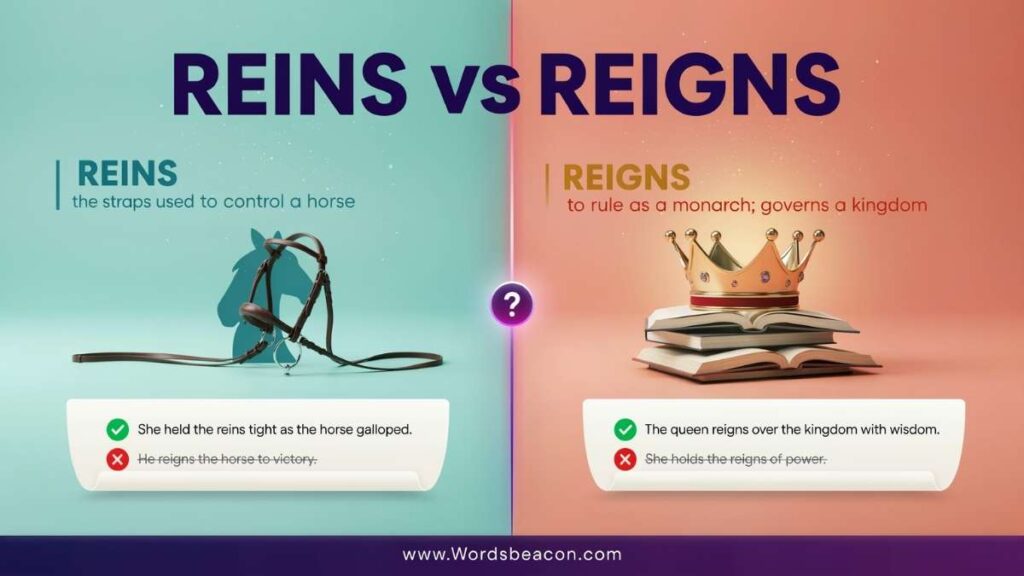
Reins and reigns sound the same, but they have different meanings. This small spelling difference can cause big confusion, even for confident writers. Using the wrong word can change your sentence’s meaning and lead to embarrassing grammar mistakes. The good news is that understanding reins vs reigns is simple once you know how each word works. Reins relate to controlling a horse or taking charge of a situation, while reigns relate to ruling or periods of authority. In this guide, you’ll learn the key differences, explore practical examples, and discover easy ways to use both words correctly without second-guessing yourself.
Quick Comparison
| Feature | Reins | Reigns |
|---|---|---|
| Main meaning | Straps used to guide a horse; control or responsibility | Rules, dominates, or refers to periods of rule |
| Part of speech | Plural noun | Plural noun or third-person singular verb |
| Common context | Horse riding, leadership, restraint | Royal authority, dominance, periods of rule |
| Example | She took the reins of the company. | The king reigns over the kingdom. |
| Related expression | Take the reins | Reigns supreme |
Both words are homophones, meaning they have the same pronunciation but different meanings and spellings. Therefore, you must use context to decide which word fits your sentence.
Learn how to use confusing more words correctly
Cancelation vs Cancellation Which Spelling Is Correct?
What Does Reins Mean?
The word reins has a literal meaning connected to horse riding and a figurative meaning associated with control. Both uses share the same basic idea: guiding or directing something.
Reins Definition The Literal Meaning
Reins are straps attached to a horse’s bridle that a rider holds to guide the animal. They help the rider communicate directions through pressure and movement.
A bridle is equipment fitted around a horse’s head. Depending on its design, it holds a bit or other components that help the rider guide the horse. The reins extend from the bridle to the rider’s hands.
Traditional leather reins remain common in horse riding, although manufacturers also make them from synthetic materials.
Consider this example:
The rider gently pulled the reins to guide the horse around the obstacle.
Here, reins refers to actual riding equipment. The rider uses the straps to communicate with the horse and direct its movement.
Other examples include:
- The rider held the reins firmly during the competition.
- She adjusted the leather reins before mounting the horse.
- The instructor taught the beginner how to hold the reins correctly.
- He loosened the reins as the horse slowed down.
In each sentence, the word refers to the equipment used to guide a horse.
The Figurative Meaning of Reins
Beyond horse riding, reins often represents control, leadership, or responsibility. English speakers use the image of a rider guiding a horse to describe someone directing a team, managing a business, or taking charge of a situation.
For example:
After the founder retired, Daniel took the reins of the company.
Daniel didn’t take hold of horse-riding equipment. Instead, he assumed leadership and became responsible for guiding the business.
This figurative meaning appears in several everyday situations:
- Business: A new executive takes the reins after a leadership change.
- Education: A teacher takes the reins when a classroom needs direction.
- Family: A parent takes the reins when organizing an important family event.
- Sports: A captain takes the reins when guiding a team through a difficult match.
- Project management: A team leader takes the reins when a project loses direction.
In every case, the word refers to someone’s ability or responsibility to guide what happens next.
Common Expressions With Reins
Several established English expressions use rein or reins to describe control.
- Take the reins: Assume responsibility or leadership. For example, the new manager took the reins after her predecessor resigned.
- Hold the reins: Remain in control. For example, the director continues to hold the reins of the organization.
- Hand over the reins: Transfer control or responsibility. For example, the founder handed over the reins to her successor.
- Keep a tight rein on: Exercise strict control. For example, the finance director keeps a tight rein on unnecessary expenses.
- Rein in: Restrain, limit, or bring something under control. For example, the company introduced new policies to rein in rising costs.
Notice that the final expression uses the singular verb rein rather than reign. It refers to restraint, which connects directly to the figurative meaning of a rein.
Fix common more word mistakes in English
Pricey vs Pricy Which Spelling Is Correct?
What Does Reigns Mean?
Reigns has two main grammatical uses. It can serve as a verb describing someone who rules, or it can function as the plural form of the noun reign, referring to multiple periods of rule.
Reigns Definition: The Verb
As a verb, reigns is the third-person singular present-tense form of reign. It describes a person or entity that rules, holds authority, or dominates a particular area.
For example:
The monarch reigns over the kingdom.
This sentence describes the monarch’s position as a ruler.
The word can also describe figurative dominance.
The reigning champion still reigns supreme in the division.
Here, the champion dominates the competition. The sentence doesn’t suggest royal authority. Instead, it describes someone who holds a leading position.
Other examples include:
- The queen reigns over the country under its constitutional system.
- Confidence reigns among the players after their victory.
- Silence reigns in the library during examination week.
- The reigning champion reigns supreme after another successful season.
These examples show how reigns can describe both authority and a dominant presence.
Reigns Definition The Plural Noun
Reigns can also function as a plural noun. In this form, it refers to two or more periods during which monarchs or other rulers hold power.
A reign is one period of rule. Two or more such periods are reigns.
For example:
The museum’s exhibition examines the reigns of several monarchs from the same dynasty.
The word reigns refers to the separate periods during which those monarchs ruled.
Compare these sentences:
- Singular: The king’s reign lasted forty years.
- Plural: The reigns of the two kings differed greatly in length.
This distinction matters because the ending -s doesn’t always indicate a verb. In the sentence “The king reigns,” the word functions as a verb. In the sentence “The exhibition covers several reigns,” it functions as a plural noun.
What Does Reign Mean in English?
The noun reign refers to the period during which a monarch or another ruler holds power. The verb reign means to rule or exercise authority.
Historically, the word often describes a king’s or queen’s period of sovereign power. However, English also uses it figuratively to describe dominance or influence.
For example:
During her reign, the queen oversaw several major changes in the kingdom.
Here, reign refers to her period as monarch.
Now consider this sentence:
For years, the company reigned supreme in its industry.
In this case, reigned describes dominance rather than royal government.
The different forms follow a straightforward pattern:
| Word form | Grammatical use | Example |
|---|---|---|
| Reign | Base verb or singular noun | The queen began her reign. |
| Reigns | Present-tense verb or plural noun | The king reigns; the exhibit covers several reigns. |
| Reigned | Past-tense verb | The monarch reigned for decades. |
| Reigning | Present participle or adjective | The reigning monarch attended the ceremony. |
Understanding these forms makes it easier to distinguish reign from rein and recognize when reigns is grammatically correct.
Fix common more word mistakes in English
Bellies vs Bellys Which Spelling Is Correct?
Reins vs Reigns Key Differences
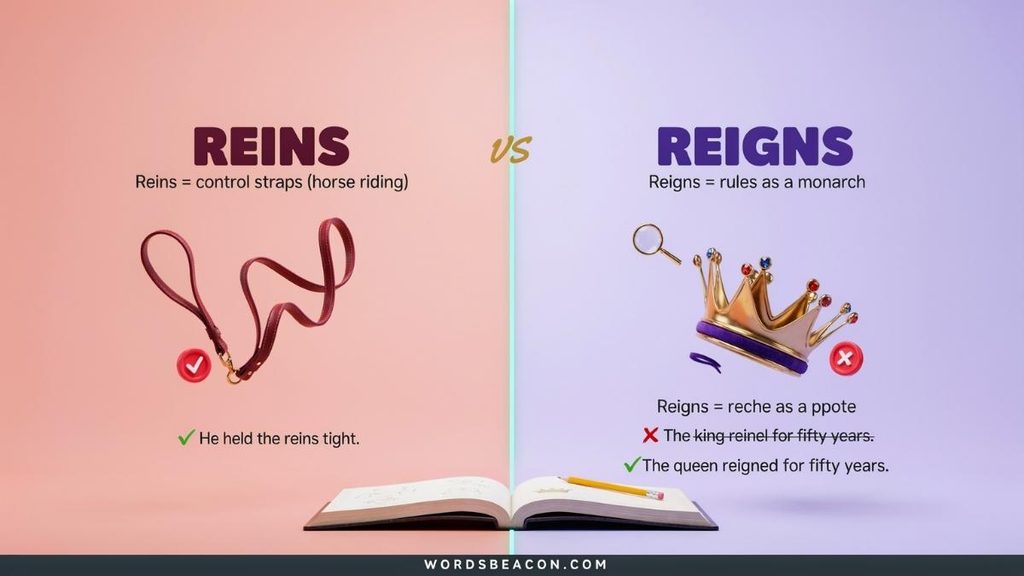
Although reins vs reigns sound identical, their meanings and grammatical functions differ. The best way to identify the correct spelling is to examine what the sentence describes.
Meaning and Usage
Reins relates to guiding, controlling, or directing. Reigns relates to ruling, holding a dominant position, or describing multiple periods of rule.
Compare these examples:
- Amira took the reins of the marketing team. She assumed responsibility.
- The queen reigns over the kingdom. She holds royal authority.
- The company must rein in its spending. It needs to limit expenses.
- The champion reigns supreme. The champion dominates the competition.
These examples show why the words aren’t interchangeable, even when both appear in sentences about power or authority.
Reins vs Reigns Grammar
The words also differ in their grammatical roles.
Reins is the plural form of the noun rein. It usually refers to horse-riding equipment or represents control metaphorically.
Reigns can function as either a plural noun or a third-person singular verb. Its role depends on the sentence.
Consider the following examples:
- The rider adjusts the reins. Here, reins is a noun.
- The monarch reigns over the kingdom. Here, reigns is a verb.
- The exhibit covers several reigns. Here, reigns is a plural noun.
- The rider must rein in the horse. Here, rein is a verb.
A useful grammar check is to look at the words surrounding the target word. If the sentence describes an action performed by a singular subject, reigns may be the correct verb. If it refers to straps or control, reins is likely the right noun.
Literal and Figurative Meanings
The literal meaning of reins comes from horse riding. Its figurative meaning develops from the idea of using reins to direct movement.
The word reign, by contrast, begins with the idea of ruling. Its figurative meaning extends that concept to dominance, influence, or a leading position.
For example:
Creativity reigns in the studio.
This sentence means creativity is the dominant force in the studio. It doesn’t mean anyone is holding horse reins.
Likewise:
The coach took the reins of the team.
This means the coach assumed control, not that the coach began a royal reign.
Reins vs Reigns Homophones Pronunciation
In standard English, rein and reign share the pronunciation /reɪn/. Their plural forms, reins vs reigns, share the pronunciation /reɪnz/.
The vowel sounds like the one in day, while the final consonant sounds like the ending in runs.
Because the words sound alike, listening alone won’t help you determine the correct spelling. You need to consider context and meaning.
These words are examples of homophones, a common source of confusion in English grammar and vocabulary.
Fix common more word mistakes in English
Shiny vs Shiney difference and Which Is Correct?
Reins vs Reigns Examples and Comparisons
Examples make the difference easier to understand. The following table compares the words in contexts where writers might confuse them.
| Sentence | Correct word | Why |
|---|---|---|
| The new director took the ___ of the department. | Reins | The director assumed control. |
| The king’s ___ lasted forty years. | Reign | The sentence describes a period of royal rule. |
| The company must ___ in unnecessary costs. | Rein | The company needs to limit expenses. |
| The reigning champion still ___ supreme. | Reigns | The champion dominates the competition. |
| The rider held the ___ as the horse approached the gate. | Reins | The word refers to riding equipment. |
| The exhibition covers several royal ___. | Reigns | The sentence refers to multiple periods of rule. |
Examples of Reins in Sentences
Here are several examples showing how to use reins in a sentence.
- The rider held the reins carefully while crossing the narrow bridge.
- She adjusted the horse reins before starting the lesson.
- After the founder stepped down, the new director took the reins.
- The manager keeps a tight rein on unnecessary spending.
- The organization handed over the reins to a younger leadership team.
- The coach took the reins after the previous coach resigned.
- The teacher gave students more freedom but kept a firm rein on classroom behavior.
The first two examples use reins literally. The remaining examples use the word in a figurative or idiomatic sense.
Examples of Reigns in Sentences
These sentences illustrate the verb and noun forms of reigns.
- The king reigns over the kingdom.
- The reigning monarch attended the official ceremony.
- The champion reigns supreme in the competition.
- The exhibition explores the reigns of several historical rulers.
- Silence reigns in the hall after the announcement.
- The company reigns supreme in its market for another year.
- Historians compared the reigns of two queens from the same dynasty.
The context helps determine whether reigns means ruling, dominating, or multiple periods of rule.
Fix common more word mistakes in English
Macaroon vs Macaron Difference and which is correct?
Take the Reins or Take the Reigns?
The correct expression is take the reins.
It means to take control, assume leadership, or accept responsibility for a situation. The expression draws on the literal act of holding the reins to guide a horse.
For example:
When the project manager resigned, Lena took the reins and helped the team meet its deadline.
Lena assumed responsibility for directing the project.
Other examples include:
- The new principal took the reins at the beginning of the school year.
- After years of working under her mentor, she was ready to take the reins of the business.
- The captain took the reins when the team struggled to coordinate its defense.
Why Is “Take the Reigns” Incorrect?
Writers sometimes choose reigns because it sounds appropriate for leadership and authority. After all, monarchs reign over kingdoms. However, take the reins is the established idiom for assuming control.
The phrase uses the metaphor of guiding a horse, not the concept of royal rule.
Compare:
- Correct: He took the reins of the organization.
- Incorrect for this idiom: He took the reigns of the organization.
The second version is a common spelling mistake. Although readers will often understand the intended meaning, the correct spelling remains reins.
Free Rein or Free Reign?
The traditional expression is free rein. It means freedom to act, make decisions, or pursue an idea without excessive restriction.
The expression comes from horse riding. When a rider gives a horse a free rein, the rider allows more freedom of movement rather than maintaining tight control.
For example:
The editor gave the writer free rein to develop the article’s structure.
The writer had considerable freedom to decide how to approach the work.
Other examples include:
- The teacher gave students free rein to choose their research topics.
- The designer had free rein to experiment with different layouts.
- The director gave the actors free rein to interpret their characters.
- The company gave the creative team free rein to develop new concepts.
Why Is “Free Reign” Commonly Confused With “Free Rein”?
The confusion makes sense. Reign relates to authority, and free rein often involves independence or freedom from someone else’s control. Because these ideas overlap, writers sometimes substitute reign for rein.
However, the established idiom is free rein, not free reign.
The expression doesn’t refer to a ruler’s authority. It refers to the freedom that comes from loosening the reins.
Compare:
- Correct: The artist was given free rein over the project.
- Common error: The artist was given free reign over the project.
For standard edited English, choose free rein when you mean unrestricted freedom to act.
Meaning of Free Rein in Business and Daily Life
The phrase often appears when someone receives broad discretion.
A supervisor might give an employee free rein to solve a customer problem. A teacher might let students choose their own presentation formats. A homeowner might give an interior designer free rein to select furniture and colors.
The important idea is freedom within a particular situation. It doesn’t necessarily mean unlimited freedom or the absence of all rules.
Learn the difference between often confused words
Realist vs Realest difference and usage ?
Rein In or Reign In?
The correct expression is rein in.
It means to restrain, limit, reduce, or bring something under control. People commonly use it when discussing spending, behavior, costs, emotions, and other things that have become excessive.
For example:
The company introduced a new budget to rein in rising expenses.
The company wants to reduce or control its spending.
Why Is Rein In Correct Instead of Reign In?
The phrase rein in comes from the idea of using reins to restrain or direct a horse. Its figurative meaning applies that same idea to situations that require control.
The verb reign means to rule. It doesn’t carry the same established meaning of restraint in this idiom.
Compare:
- Correct: The government introduced measures to rein in inflationary pressures.
- Correct: Parents may need to rein in excessive screen time.
- Correct: The manager tried to rein in unnecessary spending.
- Incorrect for the intended meaning: The manager tried to reign in unnecessary spending.
The distinction is straightforward: rein in means to limit or control something, while reign relates to ruling or dominance.
Meaning of Rein In in Everyday Situations
You can use rein in whenever a person or organization needs to bring something under control.
| Situation | Example | Meaning |
|---|---|---|
| Spending | We need to rein in our expenses. | Reduce unnecessary costs. |
| Behavior | The teacher asked the students to rein in their excitement. | Encourage more restraint. |
| Emotions | He struggled to rein in his frustration. | Control his emotional response. |
| Business growth | The company had to rein in rapid expansion. | Slow or limit growth. |
| Time management | She tried to rein in distractions during work hours. | Reduce interruptions. |
The phrase is especially useful in business and professional writing because it communicates the need for restraint without requiring a lengthy explanation.
Is “Reign In” Ever Correct?
If you intend to express the conventional meaning of restraint, use rein in. The spelling reign in is generally an error in that context.
A writer could construct a literal sentence in which a ruler brings something under their authority, but that wouldn’t make reign in the standard spelling of the idiom. In ordinary usage, the established phrase is rein in.
Learn the difference between often confused words
Unphased vs Unfazed difference and correct usage?
Reins vs Reigns vs Reign vs Rein vs Rain

Adding reign, rein, and rain to the comparison helps explain the broader pattern. These words share the same pronunciation in standard English, but their meanings differ.
| Word | Part of speech | Main meaning | Example |
|---|---|---|---|
| Rein | Noun or verb | A horse strap; to restrain or control | She pulled one rein gently. |
| Reins | Plural noun | Horse straps or figurative control | He took the reins of the project. |
| Reign | Noun or verb | A period of rule or the act of ruling | The queen began her reign. |
| Reigns | Plural noun or verb | Periods of rule; rules or dominates | The king reigns over the country. |
| Rain | Noun or verb | Water falling from clouds | Heavy rain delayed the match. |
| Rains | Plural noun or verb | Instances of rainfall; falls as rain | It rains frequently in spring. |
How to Remember the Difference Between Rein and Reign
Try connecting each spelling to a familiar image.
- Rein: Picture a rider holding horse reins.
- Reign: Picture a king or queen ruling a kingdom.
- Rain: Picture water falling from the sky.
The images make the meanings easier to recall.
For instance, if you’re writing about a leader who assumes responsibility, imagine that person holding the reins of a horse. If you’re writing about a monarch, picture the crown and think of a reign.
This method works because it links each spelling to a distinct idea rather than relying on pronunciation alone.
Common Mistakes With Reins vs Reigns
Many errors involving these words occur in fixed expressions. Learning the correct phrases is more reliable than trying to decide which spelling looks right.
| Incorrect or confused phrase | Correct phrase | Meaning |
|---|---|---|
| Take the reigns | Take the reins | Assume control or leadership |
| Free reign | Free rein | Freedom to act |
| Reign in spending | Rein in spending | Restrict or control spending |
| Pull the reigns | Pull the reins | Control a horse |
| The king’s reins | The king’s reign | The period of royal rule, when that is the intended meaning |
Using Reins for Royal Authority
Use reign when discussing a monarch’s period of rule.
For example:
The king’s reign lasted twenty-five years.
Here, reign refers to the time the king held power. The word reins would suggest straps used to guide a horse or metaphorical control.
Assuming the Words Are Interchangeable
Homophones often cause spelling errors because people can pronounce the correct word without recognizing its written form.
However, the fact that two words sound alike doesn’t mean you can swap them. Reins vs reigns have separate meanings, grammatical roles, and established uses.
When proofreading, look closely at sentences involving leadership, freedom, restraint, and royal authority. These contexts often reveal which spelling belongs.
Ignoring Idiomatic Usage
Expressions such as free rein and rein in have established spellings. You can’t change rein to reign simply because the sentence involves authority.
For example, a company might give an employee free rein to make decisions, then ask that employee to rein in costs. Both expressions involve control, but neither uses reign.
Remembering these common phrases will help you avoid many frequent errors.
Learn the difference between confusing word pairs
Dysregulated vs Disregulated correct usage ?
How to Remember the Difference Between Reins vs Reigns

If the spellings still seem confusing, use this simple memory trick: reins guide; reigns rule.
Imagine a rider holding the reins to steer a horse. That picture connects rein with direction, restraint, and control.
Now picture a king wearing a crown. The king’s reign is the period during which the king rules. That image connects reign with royal authority and dominance.
You can also use these quick associations:
- Take the reins: Take charge.
- Free rein: Allow freedom.
- Rein in: Reduce or restrain.
- Reigns supreme: Dominates or holds the leading position.
- The king’s reign: The period of royal rule.
Learn the difference between confusing word pairs
Offered vs Offerred which one is correct ?
Practice Session Reins vs Reigns
Fill in each blank with the correct word: reins vs reigns.
- The rider held the horse’s ______ tightly.
- The king ______ over the country for many years.
- It’s time to take the ______ and lead the team.
- The queen’s ______ lasted for more than four decades.
- The coach told the players to keep their emotions under control and not let anger ______ supreme.
- The young rider learned how to control the horse’s ______.
- This brand ______ supreme in the world of luxury fashion.
- After the manager resigned, Sarah took the ______ of the department.
- The king’s ______ came to an end after a historic event.
- You should give children free ______ to explore their creativity.
- The horse pulled hard against the rider’s ______.
- The new leader now ______ over the organization.
- She needs to ______ in her spending habits.
- Several rulers had long ______ in the ancient kingdom.
- He grabbed the ______ to stop the horse from running away.
- The company’s latest product ______ supreme in its category.
- The prince began his ______ after his father’s death.
- The teacher encouraged students to take the ______ during group activities.
- The athlete’s name ______ supreme among the greatest players in the sport.
- The rider gently pulled the ______ to guide the horse toward the gate.
Answers
- reins
- reigned
- reins
- reign
- reign
- reins
- reigns
- reins
- reign
- rein
- reins
- reigns
- rein
- reigns
- reins
- reigns
- reign
- reins
- reigns
- reins
Here’s a trusted source for clear more words Comparison:
FAQs
Is it “take the reins” or “take the reigns”?
“Take the reins” is the correct expression. It means to take control or accept responsibility for a situation. “Reigns” relates to ruling or periods of authority.
What does “reigns” mean?
“Reigns” can refer to multiple periods of rule or serve as a verb meaning to rule. For example, “The king reigns over the kingdom.”
Is it “horse reins” or “horse reigns”?
“Horse reins” is correct. Reins are the straps a rider uses to guide and control a horse.
What does “rein” mean?
A rein is a strap used to guide a horse. The word can also refer to control or restraint, as in “rein in your spending.”
What is the difference between “reigns” and “rein”?
“Reigns” relates to ruling or periods of authority, while “rein” refers to a horse-control strap or the act of restraining something. Both words have the same pronunciation but different meanings.
What does it mean to take the reins?
“To take the reins” means to assume control, leadership, or responsibility. For example, “After the manager left, Maya took the reins.”
What is another word for “reigns”?
Depending on the context, synonyms for “reigns” include rules, governs, dominates, leads, and prevails. The most suitable synonym depends on whether the word refers to ruling or being dominant.
What does it mean when someone reigns?
When someone reigns, they rule as a monarch or hold authority over a kingdom or territory. Figuratively, the word can describe someone or something that dominates a particular field.
Is it “rain down” or “reign down”?
“Rain down” is correct when describing something falling in large quantities. For example, “Confetti rained down on the crowd.” “Reign” refers to ruling, so “reign down” is generally incorrect in this context.
Is it “reins of power” or “reigns of power”?
“Reins of power” is correct. The expression refers to control or authority over a government, organization, or situation.
Which is correct: “hold the reins” or “hold the reigns”?
“Hold the reins” is correct. It means to maintain control or remain in charge of a situation.
What does “free rein” mean?
“Free rein” means the freedom to act or make decisions without unnecessary restrictions. For example, “The designer was given free rein to create the new collection.”
Are a bridle and a rein the same?
No. A bridle is a piece of headgear fitted to a horse, while reins are the straps attached to it that help the rider guide the horse.
What is another word for “reins”?
Depending on the context, alternatives include straps, lines, and controls. In figurative expressions, words such as authority, control, and leadership may convey a similar meaning.
What is the difference between “reign” and “reins”?
“Reign” refers to a period of ruling or the act of ruling. “Reins” are straps used to guide a horse or, figuratively, a means of control. For example, “Her reign lasted ten years” and “He held the reins firmly.”
Is it “rein me in” or “reign me in”?
“Rein me in” is correct. It means to help control or restrain someone’s behavior, emotions, or actions.
What does “reign supreme” mean?
“Reign supreme” means to be the most powerful, successful, or dominant in a particular area. For example, “The team reigns supreme in the league.”
Is it “take up the reins” or “take up the reigns”?
“Take up the reins” is correct. It means to accept responsibility or begin leading a person, team, or organization.
How do you pronounce “reins” and “reigns”?
Both words are pronounced the same way. They are homophones, meaning they sound alike but have different spellings and meanings. Context helps readers identify which word is correct.
Do kings rein or reign?
Kings reign because they rule a kingdom. “Rein” refers to control or restraint, as in “The king tried to rein in his advisers’ spending.”
Learn the difference between confusing word pairs
Stellar vs Steller difference and usage?
Conclusion
Confusing reins vs reigns is easy because both words sound the same. However, their meanings are quite different. The good news is that you only need to remember one simple rule to use them correctly.
Use reins when talking about controlling a horse or taking charge of a situation. For example, you hold the reins of a horse or take the reins of a team. Use reigns when talking about ruling or being in charge, as in “The king reigns over the kingdom” or “This team reigns supreme.”
Here’s an easy way to remember the difference: reins are for control, while reigns are for ruling. A king can reign over a kingdom, but if he wants to ride a horse, he needs reins!
Once you remember this simple distinction, choosing the right word becomes much easier. You won’t have to let these two confusing words reign over your grammar mistakes anymore.

Luna AJS is an experienced blogger and dedicated language enthusiast at Words Beacon. She specializes in making English grammar, spelling, vocabulary and commonly confused words easy to understand. She provides clear explanations, practical examples to help readers write with confidence.