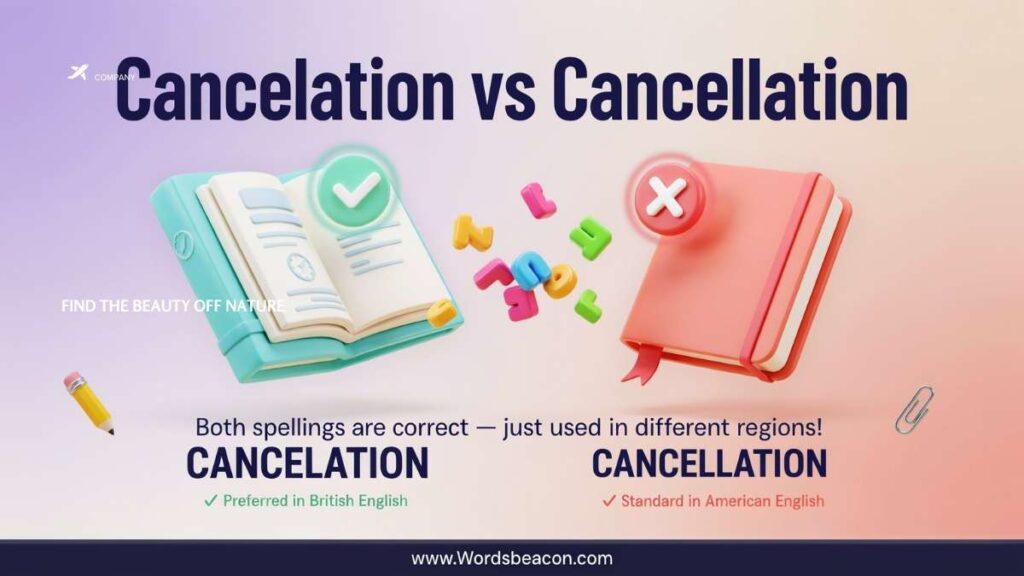
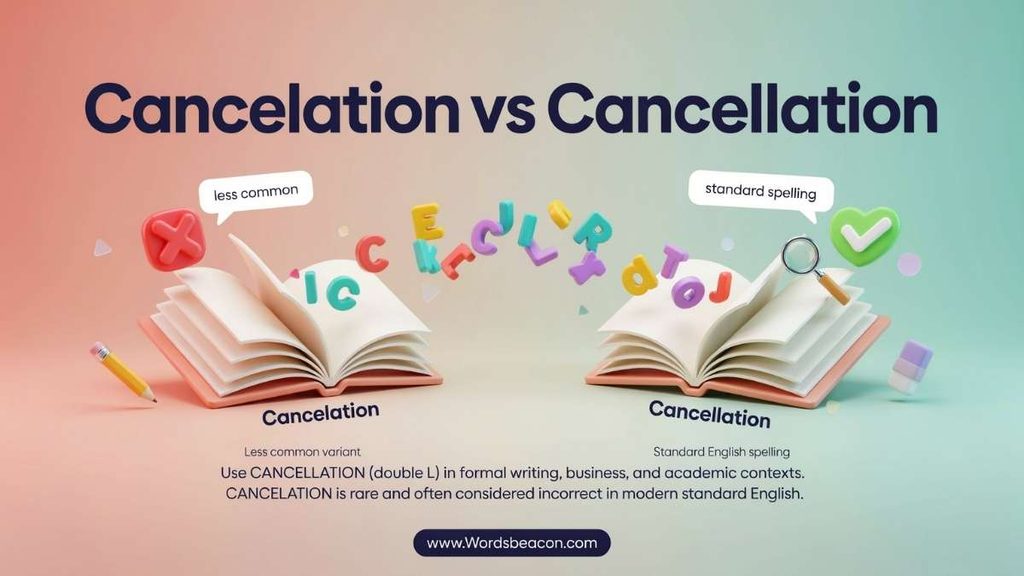
English spelling can be confusing, and cancelation vs cancellation is a perfect example. One word has one L, while the other has two, so which one should you use? The good news is that both spellings are correct, but one is much more common. Cancellation is the standard spelling in both American and British English, while cancelation is a less common variant. The confusion grows when you see canceled and cancelled, which are both correct, depending on the type of English you use. Let’s break down these differences with simple explanations and examples so you can spell each word correctly with confidence.
Quick Comparison
| Feature | Cancellation | Cancelation |
|---|---|---|
| Spelling | Two Ls | One L |
| Meaning | The act of canceling something | The act of canceling something |
| Grammatical role | Noun | Noun |
| American English | Standard and preferred | Less common variant |
| British English | Standard and widely used | Less common variant |
| Formal writing | Recommended | Use when a specific spelling convention requires it |
| Plural form | Cancellations | Cancelations |
| Best choice for most readers | Yes | Usually not |
In short, choose cancellation when you want the most familiar and widely accepted spelling. Although cancelation isn’t inherently wrong, cancellation is the safer choice for professional documents, academic writing, websites, and general communication.
Learn how to use confusing more words correctly
Pricey vs Pricy Which Spelling Is Correct?
What Is the Difference Between Cancelation vs Cancellation?
The difference between cancellation and cancelation is the spelling. Both words function as nouns and describe the act or result of stopping something that was planned, arranged, ordered, or previously agreed upon.
For example, if an airline stops a scheduled flight, you can describe the decision as a flight cancellation. The single-L variant communicates the same meaning, but readers are more likely to encounter the double-L spelling.
Neither form changes the meaning of a sentence, its pronunciation, or its grammatical structure.
Cancellation Meaning
Cancellation means the act of canceling something or the result of that action. It can describe anything from a routine appointment change to the formal ending of a contract.
Here are some common uses:
- Flight cancellation: An airline decides not to operate a scheduled flight.
- Appointment cancellation: A planned meeting or visit will not take place.
- Order cancellation: A customer or business stops an order.
- Subscription cancellation: A customer ends a recurring service.
- Event cancellation: An organizer calls off a concert, conference, or other gathering.
- Contract cancellation: A party ends an agreement under the applicable terms.
- Cancellation of a document: Someone marks a document, stamp, or other item as invalid.
The consequences depend on the situation. For instance, canceling a subscription may stop future payments without refunding previous charges. Similarly, canceling a contract may require advance notice or involve a fee.
Cancelation Meaning
Cancelation has the same meaning as cancellation. It refers to the act of stopping, withdrawing, or ending something that was previously planned or arranged.
For example:
- The company announced the cancelation of the meeting.
- The customer submitted a cancelation request.
- The website explained its cancelation policy.
These sentences are understandable and grammatically correct. However, cancellation remains the better choice for most readers because it is the more established spelling.
Is Cancelation a Word?
Yes. Cancelation is a recognized spelling variant in English dictionaries. It isn’t a different word with a separate definition, nor is it simply a spelling mistake in every context.
Some dictionary entries recognize both forms, although they don’t give them equal prominence. For example, Cambridge Dictionary uses cancellation as the main entry and identifies cancelation as an American alternative in its Business English dictionary.
That distinction matters. A spelling can be valid without being the most common or preferred choice. When you’re writing for a broad audience, the familiar form usually makes the most sense.
Fix common more word mistakes in English
Bellies vs Bellys Which Spelling Is Correct?
Why Is Cancellation Spelled With Two Ls?
English spelling doesn’t always follow one consistent pattern across related words. Cancellation illustrates this clearly because its spelling differs from the common American forms canceled and canceling.
To understand why, it helps to look at the word’s history and how English forms nouns from verbs.
Cancellation Word Origin
The verb cancel entered English through French and ultimately comes from the Latin word cancellare, meaning to cross out or mark with lines. The Latin cancelli referred to a lattice or grating.
Over time, English developed cancellation as the noun associated with cancel. Its double-L spelling became established through the history of the word and the conventions that shaped modern English spelling.
This history helps explain the spelling, but it doesn’t mean every word derived from cancel must follow the same letter pattern. English often preserves established forms even when related words look slightly different.
Why Does Cancel Have One L but Cancellation Has Two?
The answer lies in the difference between verb forms and noun formation.
In American English, writers generally use one L when forming the past tense and present participle of cancel:
- Cancel becomes canceled.
- Cancel becomes canceling.
However, the noun follows a different established spelling:
– Cancel becomes cancellation.
The suffix and the history of the resulting word both matter. You can’t always predict the spelling of a noun by copying the pattern used in its related verb forms.
Think of these as separate forms that belong to the same word family. Once you learn their standard spellings, the apparent inconsistency becomes easier to manage.
Is Cancellation Spelled With One L or Two?
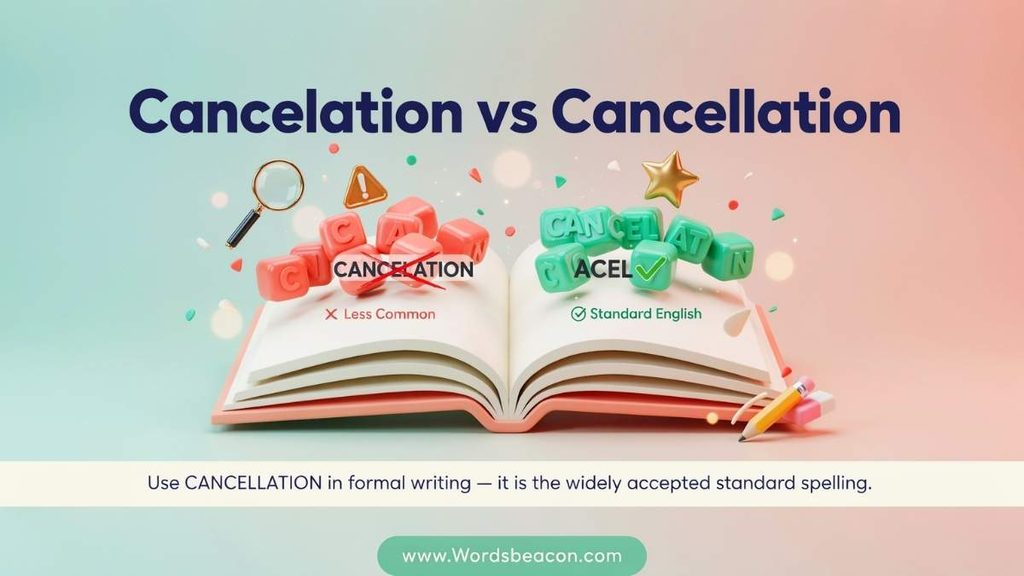
The standard spelling is cancellation, with two Ls. Cancelation, with one L, is a less common alternative.
A quick way to remember the difference is to group the forms by their grammatical role:
| Word form | Correct spelling | Usage |
|---|---|---|
| Base verb | Cancel | Please cancel the order. |
| American past tense | Canceled | The company canceled the order. |
| American present participle | Canceling | The company is canceling the order. |
| Standard noun | Cancellation | The cancellation surprised the customer. |
| Standard plural noun | Cancellations | Several cancellations followed the storm. |
The most important point is that the noun doesn’t automatically lose an L just because American English usually uses one L in the past-tense verb.
Fix common more word mistakes in English
Shiny vs Shiney difference and Which Is Correct?
Cancellation American vs British English
American and British English have several well-known spelling differences. For example, Americans usually write color and traveled, while British writers often use colour and travelled.
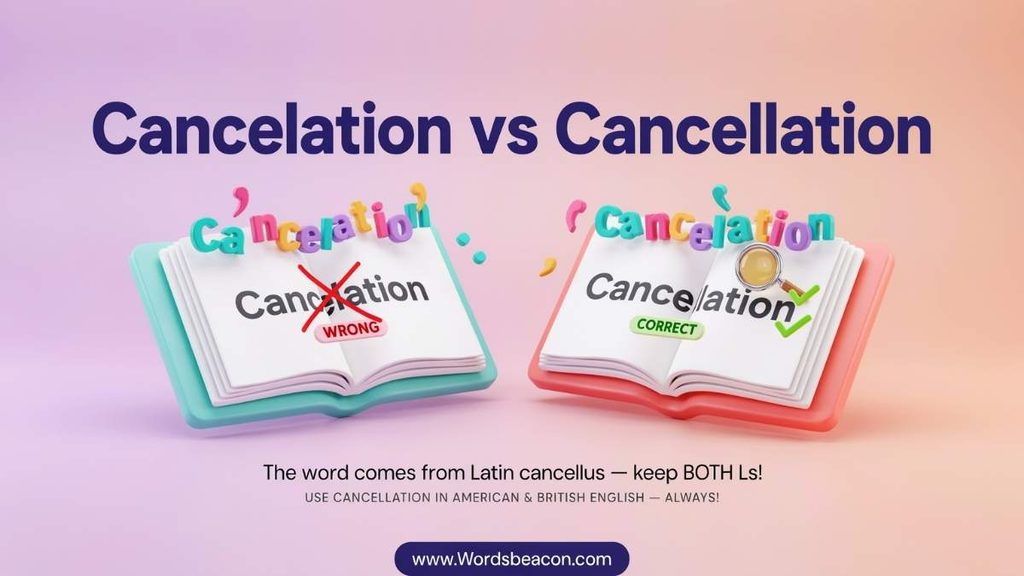
Cancellation doesn’t follow that same regional pattern. Both American and British English commonly use the double-L noun.
The main differences appear in related verb forms, so it’s useful to examine each variety separately.
Cancellation in American English
In American English, cancellation is the standard noun spelling. You’ll see it in business documents, news reports, customer notices, and everyday communication.
For example:
- The airline announced the cancellation of the flight.
- The manager confirmed the cancellation of the appointment.
- Customers can request cancellation of their subscriptions.
American English usually uses canceled and canceling for the corresponding verb forms. However, cancellation retains two Ls.
Although cancelation is recognized as an alternative, it isn’t the usual first choice in standard American writing. If you want your content to look familiar to American readers, stick with cancellation.
Cancellation in British English
British English also uses cancellation as its standard noun spelling.
The difference becomes clearer when you compare it with the past tense and present participle:
- The airline cancelled the flight.
- The company is cancelling several services.
- The airline announced the cancellation of the route.
Notice that cancellation keeps two Ls regardless of which variety of English you use. The noun doesn’t change simply because British English doubles the L in cancelled and cancelling.
Cancellation in Canadian English
Canadian English combines British and American spelling conventions. Some words follow British patterns, while others commonly follow American usage.
For the noun, cancellation is the reliable standard choice. Related verb forms may depend on the publication, organization, or style guide.
For example, a Canadian business might write, “We cancelled your appointment,” and then refer to its “cancellation policy.” These forms work together without creating a spelling inconsistency.
Cancellation in Australian English
Australian English generally follows British-style conventions for verb forms such as cancelled and cancelling. However, cancellation remains the common noun spelling.
Consider these examples:
- The event was cancelled because of heavy rain.
- The organizer is cancelling the afternoon session.
- The venue announced the cancellation of the performance.
The practical lesson is simple: don’t assume cancelation is the preferred American form just because American English usually uses one L in canceled.
Learn the difference between commonly mixed-up more words
Macaroon vs Macaron Difference and which is correct?
Cancelation vs Cancellation Examples in Everyday English
Examples make the spelling difference easier to understand. Since both forms have the same meaning, you can use the same sentence patterns with either spelling. Still, cancellation is the better default for most writing.
Cancellation Sentence Examples
Here are examples of cancellation in common situations.
| Context | Example sentence |
|---|---|
| Travel | The airline announced the cancellation of the morning flight. |
| Business | The supplier confirmed the cancellation of the order. |
| Healthcare | The clinic notified patients about the cancellation of appointments. |
| Education | The school announced the cancellation of classes because of severe weather. |
| Entertainment | Fans were disappointed by the cancellation of the television series. |
| Shopping | The customer requested the cancellation of an online purchase. |
| Subscriptions | You can request cancellation of your membership at any time. |
| Events | The organizer issued a notice about the cancellation of the festival. |
Each sentence uses cancellation as a noun. The word names an action or outcome rather than describing the person or organization performing it.
For example, in “The airline canceled the flight,” canceled describes what the airline did. In “The airline announced the cancellation of the flight,” cancellation names the action itself.
Cancelation Examples
The single-L spelling works in the same grammatical situations.
- The company confirmed the cancelation of the scheduled meeting.
- The customer received an email about the cancelation of the order.
- The contract outlined the conditions for cancelation of the service.
- The website explained its cancelation policy.
- The travel agency processed the cancelation request.
These examples demonstrate the meaning of the alternative spelling. However, if you’re preparing a website, formal report, or customer notice, cancellation is usually the more familiar choice.
How to Choose the Right Form in a Sentence
The best spelling doesn’t depend on the type of cancellation. It depends on the spelling convention you’re following.
For instance, you would generally write:
- Flight cancellation
- Appointment cancellation
- Cancellation fee
- Cancellation notice
- Cancellation request
- Cancellation policy
- Subscription cancellation
- Cancellation list
These phrases use the established double-L form. Keeping it consistent throughout a document helps readers focus on the information rather than the spelling.
Learn the difference between commonly mixed-up more words
Realist vs Realest difference and usage ?
Common Mistakes With Cancellation and Cancelation
Most mistakes happen when writers apply a familiar spelling pattern too broadly or assume that a less common form must be wrong.
A few simple distinctions can prevent these errors.
Assuming Cancelation Is Always Incorrect
Cancelation is a recognized spelling variant, so calling it universally incorrect would be too strong. However, its acceptance doesn’t make it equally common or equally suitable for every audience.
When you want the most familiar spelling, choose cancellation.
Assuming Cancellation Is Only British English
This misconception often comes from the difference between canceled and cancelled.
American English commonly uses canceled, but it also uses cancellation. The double-L noun isn’t exclusively British.
Writing Cancelation Because Canceled Has One L
The logic seems reasonable: if canceled has one L, cancelation should too. Unfortunately, English spelling doesn’t always work that way.
Learn cancellation as its own established form. That approach is more reliable than trying to apply one rule to every word in the same family.
Switching Between Both Spellings
Using cancellation in one section and cancelation in another can make a document look inconsistent. Readers will probably understand the text, but the variation may distract them.
Choose one spelling and apply it throughout the document. For most writers, cancellation is the best choice.
Confusing Cancellation With Canceled
Cancellation and canceled serve different grammatical roles.
Compare these sentences:
- The hotel canceled our reservation.
- The hotel confirmed the cancellation of our reservation.
The first sentence uses canceled as a verb. The second uses cancellation as a noun.
Both sentences are correct. The difference lies in how each word functions within the sentence, not in the event being described.
Learn the difference between commonly mixed-up more words
Unphased vs Unfazed difference and correct usage?
Which Spelling Should You Use in Formal Writing?
When you’re writing a report, article, email, policy, or academic assignment, cancellation is the safest choice unless your organization or publisher specifies another form.
This recommendation comes down to three practical reasons:
- Familiarity: Most English readers recognize cancellation immediately.
- Consistency: The spelling aligns with established dictionary usage and common editorial conventions.
- Professional presentation: It avoids distracting readers who aren’t familiar with the less common variant.
You don’t need to explain the difference in an ordinary email or business document. Simply use the standard spelling and focus on communicating your message clearly.
Cancellation in Business and Professional Writing
Businesses use the word in booking terms, subscription agreements, customer notices, and service policies. In these settings, clear language matters because cancellation can affect payments, refunds, deadlines, and contractual obligations.
Here are some examples you can adapt to your needs:
- Cancellation policy: “Please review our cancellation policy before confirming your reservation.”
- Cancellation notice: “We received your cancellation notice and have updated your booking.”
- Cancellation fee: “A cancellation fee may apply to appointments canceled less than 24 hours in advance.”
- Cancellation request: “We received your cancellation request and will notify you when processing is complete.”
- Subscription cancellation: “Your subscription cancellation will take effect at the end of the current billing period.”
These examples also highlight an important distinction. Receiving a cancellation request doesn’t necessarily mean the cancellation has been completed. If a business needs to explain the status of a request, it should say so directly.
For professional communication, choose cancellation consistently and explain any relevant terms in plain language.
Cancellation in Academic and Editorial Writing
Academic papers, reports, and published articles should follow the spelling conventions required by the institution, journal, or publisher.
If no specific guide applies, cancellation is a sensible default. When a spelling question arises, consult an authoritative dictionary rather than relying entirely on a word processor’s spell-checker.
Merriam-Webster, Cambridge Dictionary, and the Oxford English Dictionary serve as useful references for English spelling and word history. Editorial guidance from the Associated Press also provides a clear convention for writers who follow AP style.
Automated writing tools such as Grammarly can help identify spelling inconsistencies. However, a writing tool shouldn’t replace a dictionary or a publication’s style guide.
Learn the difference between tricky grammar words
Stellar vs Steller difference and usage?
Does AP Style Use Cancelation vs Cancellation?
AP style uses cancellation. Its published spelling guidance gives the related forms as cancel, canceled, canceling, and cancellation.
This combination illustrates the difference between the American verb forms and the established noun spelling. Even though AP style uses one L in canceled and canceling, it retains two Ls in cancellation.
Writers preparing news stories, press releases, and other AP-style content should follow that convention.
Learn how to use confusing more words correctly
Dysregulated vs Disregulated correct usage ?
What Is Another Word for Cancellation?
The best cancellation synonym depends on the situation. Some alternatives describe stopping a plan, while others suggest ending an agreement or withdrawing from an arrangement.
| Synonym | Typical use | Example |
|---|---|---|
| Termination | Ending an ongoing service, contract, or relationship | The contract allows early termination. |
| Revocation | Withdrawing permission, a right, or an authorization | The agency announced the revocation of the license. |
| Withdrawal | Removing an application, offer, or participation | The candidate announced the withdrawal of the application. |
| Rescission | Legally undoing an agreement under applicable rules | The parties discussed rescission of the contract. |
| Annulment | Formally declaring something invalid | The court considered the annulment of the agreement. |
| Discontinuation | Stopping a product, service, or activity | The company confirmed the discontinuation of the service. |
| Call-off | Informally stopping a planned event or activity | The organizer announced the call-off of the match. |
| Abandonment | Giving up a plan or project | The project faced abandonment after funding ended. |
These words aren’t always interchangeable. For example, termination often refers to ending an ongoing agreement, while cancellation may describe stopping a booking before it takes place.
Choose the word that best reflects the situation instead of replacing cancellation simply to avoid repetition
Learn the difference between tricky grammar words
Suit vs Suite correct spelling and usage ?
Practice Session Cancelation vs Cancellation
Fill in each blank with the correct word or spelling. Choose from the options in Cancelation vs Cancellation
1. The airline announced the ______ of several flights due to bad weather.
2. We received an email about the ______ of our hotel reservation.
3. The company decided to ______ the meeting at the last minute.
4. The event’s ______ disappointed many people.
5. She is responsible for ______ all unnecessary subscriptions.
6. The manager confirmed the ______ of the order.
7. The flight was ______ because of a technical problem.
8. Please check the policy before requesting a ______.
9. The school announced the ______ of tomorrow’s classes.
10. We are ______ our membership at the end of the month.
11. The customer asked for the ______ of the payment.
12. The company ______ the event because too few people registered.
13. In American English, the more common spelling is ______.
14. The hotel informed us about the ______ of our booking.
15. She sent a formal letter requesting the ______ of her contract.
16. In British English, the verb form often appears as ______.
17. The unexpected ______ caused problems for travelers.
18. I am thinking about ______ my gym membership.
19. The airline’s website explained how to request a flight ______.
20. Although “cancelation” is an accepted variant, “cancellation” is generally the more widely used spelling. This statement is ______. (true / false)
Answers
- cancellation
- cancellation
- cancel
- cancellation
- cancelling
- cancellation
- canceled
- cancellation
- cancellation
- canceling
- cancellation
- canceled
- cancellation
- cancellation
- cancellation
- cancelling
- cancellation
- canceling
- cancellation
- true
Here’s a trusted source for clear more words Comparison:
FAQs
Which is correct, cancelation vs cancellation?
Both spellings are accepted, but cancellation is the standard and more widely used form in American English. It is the best choice for professional, academic, and formal writing.
What does cancelation mean?
Cancelation means the act of stopping or calling off something that was planned or arranged. It is a less common spelling variant of cancellation.
Is it canceled or cancelled in the USA?
In American English, canceled is the preferred spelling. It uses one L. British English generally uses cancelled, with two Ls.
Why is cancelled spelled two ways?
The difference comes from regional spelling conventions. American English usually uses one L in canceled and canceling, while British English commonly doubles the L in cancelled and cancelling.
What does cancelled mean?
Cancelled means that a planned event, booking, appointment, or activity will no longer take place. For example, “The concert was cancelled because of heavy rain.”
Can you spell cancellation with one L?
No. The standard spelling is cancellation, with two Ls. This spelling is used in both American and British English.
What is another word for cancellation?
Depending on the context, alternatives include termination, withdrawal, revocation, annulment, and calling off. For everyday situations, “calling off” is often the simplest option.
Can you cancel a cancelation?
Yes. A previous cancellation can sometimes be reversed if the service provider allows it. For example, an airline may reinstate a booking that was previously canceled.
Is it canceled or cancelled in Merriam-Webster?
Merriam-Webster uses canceled as the standard American English spelling. Cancelled is also recognized as a variant commonly used in British English.
What is another way to say cancelled?
You can use called off, discontinued, withdrawn, or terminated, depending on the context. For example, “The meeting was called off” means that the meeting will not take place.
Has been cancelled or is cancelled?
Both phrases are grammatically correct. “Has been cancelled” emphasizes the action that occurred, while “is cancelled” describes the current status.
How is cancelled spelled correctly?
Cancelled, with two Ls, is standard in British English. In American English, canceled, with one L, is preferred. Choose the spelling that matches your audience.
Why do Americans spell canceled with one L?
American English generally uses one L in canceled and canceling. British English typically doubles the L in cancelled and cancelling. These differences reflect regional spelling conventions.
When did the spelling of cancelled change?
There was no single worldwide spelling change. American and British English developed different conventions over time, and both canceled and cancelled remain in use today.
What is the difference between Cancelation vs Cancellation?
Cancellation is the standard and widely used spelling in both American and British English. Cancelation is an accepted but less common variant. Both words have the same meaning.
Is it cancelled or canceled in Canada?
Both spellings appear in Canadian English, although usage can vary by publication and organization. Cancelled is common in Canadian writing. When writing professionally, follow your organization’s preferred style guide.
Does cancellation have two Ls?
Yes. Cancellation always has two Ls in standard American and British English. The American verb forms canceled and canceling use one L, but the noun remains cancellation.
How do Americans spell cancelling?
Americans generally spell it canceling, with one L. British English commonly uses cancelling, with two Ls.
What is a cancellation fee?
A cancellation fee is a charge a business may apply when a customer cancels a reservation, booking, service, or order. The amount and conditions depend on the provider’s policy and the agreement.
What is the opposite of cancellation?
The opposite depends on the context. Possible alternatives include reinstatement, continuation, confirmation, and proceeding. For example, reinstatement may mean restoring a booking after it was canceled.
What is it called when you cancel something?
The action is called cancellation. Depending on the situation, it may also be described as withdrawal, termination, revocation, or calling something off.
What is cancellation in English?
Cancellation is a noun that refers to the act of stopping or ending a planned event, booking, order, agreement, or service. For example, “The cancellation of the appointment surprised everyone.”
What does canceled mean according to Merriam-Webster?
Canceled is the standard American English past-tense and past-participle form of cancel. It means that something was called off, stopped, or made no longer valid.
What is the opposite of cancelled?
Possible opposites include confirmed, reinstated, continued, and approved. The most suitable word depends on the context. A canceled reservation, for example, might be reinstated.
What is a polite word for cancel?
In professional communication, phrases such as “withdraw the request,” “reschedule the appointment,” or “call off the meeting” may be appropriate. You can also say, “I need to cancel our appointment. I apologize for any inconvenience.”
Which is grammatically correct, canceled or cancelled?
Both spellings are grammatically correct. Canceled is preferred in American English, while cancelled is standard in British English. The difference is regional, not grammatical.
Is cancellation spelled correctly?
Yes. Cancellation is the standard spelling in both American and British English. It contains two Ls and ends in “-ation.”
Is canceled or cancelled the correct spelling on Reddit?
Both spellings are correct. American English users commonly write canceled, while British English users often write cancelled. The appropriate choice depends on the variety of English being used.
How do you use cancellation in a sentence?
Use cancellation as a noun when referring to the act of calling something off. For example, “The cancellation of the flight forced us to change our travel plans.”
What is another word for cancelling?
Depending on the context, alternatives include calling off, withdrawing, terminating, discontinuing, and revoking. These words have slightly different meanings, so choose the one that best fits the situation.
Learn the difference between tricky grammar words
Offered vs Offerred which one is correct ?
Conclusion
Still confused about cancelation vs cancellation? Don’t worry, you’re not alone. English spelling can be tricky, especially when two versions of a word look correct. The good news is that understanding cancelation vs cancellation is easier than it seems.
Here’s the simple rule to remember: cancellation is the standard spelling in both American and British English, while cancelation is a less common variant. When writing the verb forms, Americans usually use canceled and canceling, while British English commonly uses cancelled and cancelling.
For example, you can write, “The event was canceled,” but when describing the decision, you write, “The cancellation of the event.” Notice the two Ls in cancellation? They stay there regardless of which side of the Atlantic you’re on.
Once you understand cancelation vs cancellation, you’ll find it easier to avoid common spelling mistakes. So, whether you’re canceling a meeting, ending a subscription, or changing your weekend plans, remember the simple rule and stay consistent. After all, plans may get canceled, but your spelling doesn’t have to!

Luna AJS is an experienced blogger and dedicated language enthusiast at Words Beacon. She specializes in making English grammar, spelling, vocabulary and commonly confused words easy to understand. She provides clear explanations, practical examples to help readers write with confidence.