
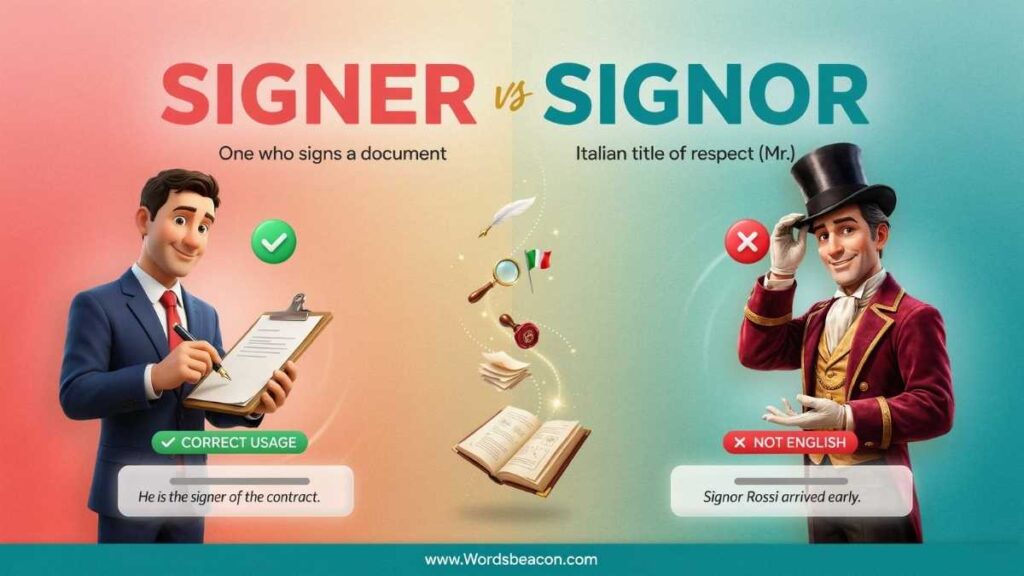
Signer vs signor can be confusing because these words look almost identical but have very different meanings. A signer is a person who signs a document, such as a contract or agreement. A signor, on the other hand, is an Italian title of respect for a man, similar to “Mr.” in English. Using one in place of the other can lead to awkward wording and misunderstandings. The good news? You don’t need to be a grammar expert to get them right. This guide explains their meanings, differences, and correct usage with simple examples to help you avoid common mistakes.
qick answer
| Main topic | Signer | Signor |
|---|---|---|
| Meaning | A person who signs something | An Italian title of respect for a man |
| Language | English | Italian origin |
| Common use | Contracts, forms, checks, and agreements | Italian names, conversations, and cultural writing |
| Example | The signer approved the agreement. | Signor Rossi greeted the guests. |
| Plural | Signers | Signori or signors |
| Quick replacement test | Person who signs | Mr. |
Learn how to use confusing more words correctly
Reins vs Reigns which spelling is correct ?
What Does Signer Mean?
Signer Meaning in English
A signer is a person who signs something, usually by writing their name on a document. The word comes from the verb sign, with the ending -er identifying the person who performs the action.
For example, when someone signs a contract, completes a consent form, or adds a signature to a business agreement, that person becomes a signer.
The term appears frequently in legal, financial, and professional writing because it identifies the person who provides a signature.
Examples include:
- The signer must complete every section of the form.
- Each signer received a copy of the agreement.
- The company requires an authorized signer to approve the transaction.
- The signer confirmed the details before submitting the application.
- Every signer must provide a valid identification document.
However, the word signer does not automatically mean that a person owns an account, represents an entire company, or accepts every possible legal responsibility. Those details depend on the document, the person’s authority, and the circumstances.
Signer Meaning in Legal and Business Documents
In legal and business settings, a signer is someone who places a signature on a document. The document might be a contract, lease, consent form, application, petition, or financial agreement.
For instance, when two people sign a rental agreement, both may be described as signers. Their precise legal responsibilities depend on the agreement’s terms.
Consider these examples:
- Contract signer: A person who signs a contract.
- Authorized signer: Someone permitted to sign documents or approve transactions for an account or organization.
- Co-signer: Someone who signs an agreement alongside another person and may accept additional financial or legal obligations.
- Digital signer: Someone who applies an electronic signature to a digital document.
- Petition signer: Someone who adds a signature to support a petition.
These expressions describe different signing situations. Therefore, choosing the correct term helps readers understand each person’s role.
Signer Meaning in Sign Language
Signer has another established meaning: a person who communicates through a sign language.
For example, a person who communicates in American Sign Language (ASL) may be called a signer. In this context, the word has nothing to do with signing a written contract.
Consider this sentence:
The ASL signer explained the announcement to the audience.
Here, signer refers to a person who communicates using sign language.
Context makes the intended meaning clear. If the sentence discusses a contract, signer usually refers to someone who provides a signature. If it discusses communication, accessibility, or sign language, the word may refer to someone who signs with their hands.
Is Signer a Word?
Yes. Signer is a standard English word. Dictionaries recognize it as a noun referring to someone who signs or, in a different context, someone who communicates through sign language.
Its plural form is signers.
Examples:
- One signer completed the form.
- Three signers approved the proposal.
- The signers gathered to finalize the agreement.
You can use signer in formal and informal writing whenever it accurately describes the person or people involved.
Fix common more word mistakes in English
Cancelation vs Cancellation Which Spelling Is Correct?
What Does Signor Mean?
Signor Meaning in English
Signor is a word borrowed from Italian. It functions as a respectful title for a man and generally corresponds to Mr. in English.
You may encounter it in Italian dialogue, translated literature, historical writing, opera, or descriptions of Italian culture. It can appear before a man’s name or as a form of address.
For example:
Signor Ferrari welcomed the visitors to his home.
In this sentence, Signor is a title of respect. It does not suggest that Ferrari signed a document.
Another example:
The waiter asked whether Signor Bianchi needed anything else.
Again, the word identifies the person respectfully rather than describing an action.
Signor Meaning in Italian
In Italian, signore is the fuller form associated with the title. Signor commonly appears before a man’s name, while signore can also serve as a respectful form of address.
For example, Signor Rossi can be understood in English as Mr. Rossi.
The plural form in Italian is signori. English-language dictionaries also recognize the plural signors in some contexts.
Here are a few related Italian forms:
| Word | Meaning or use |
|---|---|
| Signore | A respectful form of address for a man; also means gentleman or lord, depending on context |
| Signor | A form used before a man’s name |
| Signori | Plural form used for men or a group addressed respectfully |
| Signora | A respectful title for a woman, broadly similar to Mrs. or Ms. depending on context |
These words belong to Italian usage. They are not alternative spellings of the English word signer.
Is Signor a Word in English?
Yes. Although signor comes from Italian, English dictionaries recognize it as a borrowed word. It appears in English writing when the writer wants to preserve an Italian title or cultural setting.
However, it is not the standard English word for a person who signs a document.
For example:
- Correct: The signer dated the agreement.
- Incorrect for the intended meaning: The signor dated the agreement.
The second sentence uses an Italian title where the writer needs an English noun describing a signing action.
The distinction is important because spell-checking software may accept both words. A valid spelling can still be wrong for a particular sentence.
Is Signor a Legal Term?
Signor is not the standard English legal term for a person who signs a document. Legal and business writing normally uses signer, signatory, or another term that accurately describes the person’s role.
For example:
- Correct: The authorized signer must approve the payment.
- Correct: Each signatory must comply with the agreement.
- Incorrect for the intended meaning: The authorized signor must approve the payment.
The last sentence confuses an Italian title with a term for someone who has signing authority.
If you encounter signor in a legal document, consider the surrounding context. The writer might be referring to an Italian person by title rather than identifying the person who signed the document.
Learn the difference between often confused words
Pricey vs Pricy Which Spelling Is Correct?
Signer vs Signor Key Differences Explained
The main difference between signer and signor is meaning. One describes a person who performs an action; the other serves as a title of respect.
| Feature | Signer | Signor |
|---|---|---|
| Basic meaning | Someone who signs something | An Italian title for a man |
| Word type | Noun | Noun or title |
| Typical context | Documents, banking, business, and sign language | Italian names, literature, and cultural settings |
| Related expression | Signature, signatory, co-signer | Signore, signora, signori |
| Common plural | Signers | Signori or signors |
| Suitable for “person who signs” | Yes | No |
| Suitable as a title similar to Mr. | No | Yes |
Meaning Difference
Signer identifies someone who signs something. Signor identifies or addresses a man respectfully in an Italian context.
Compare these sentences:
The signer checked the contract before signing it.
Signor Moretti arrived at the restaurant at noon.
The first sentence discusses a document. The second identifies a person using an Italian title.
Although the words share several letters, their meanings are not interchangeable.
Language and Word Origin
Signer belongs to English word formation. It combines sign with the suffix -er, which commonly identifies someone who performs an action. A writer writes, a speaker speaks, and a signer signs.
Signor entered English from Italian. Its meaning developed through Italian forms associated with respectful address.
This difference in origin helps explain why the words behave differently. Signer connects naturally with words such as signature and signing. Signor connects with Italian forms such as signore and signora.
Usage in Everyday and Professional Writing
Use signer when writing about paperwork, agreements, authorizations, or people who communicate through sign language.
Use signor when referring to a man by an Italian title, particularly in a cultural, literary, or Italian-language setting.
For example:
- Business email: Please ask the signer to complete the final page.
- Banking form: The authorized signer must verify their identity.
- Accessibility context: The signer communicated the announcement in ASL.
- Italian dialogue: Signor Bellini entered the room.
The quickest way to choose is to check what the sentence means. If you can replace the word with “person who signs,” choose signer. If you can replace it with “Mr.” in an Italian context, signor may be correct.
Signer vs Signor Examples in Sentences
Examples make the distinction easier to remember. Notice how each word fits a different situation.
Examples of Signer in a Sentence
- The signer must initial every page of the contract.
- Each signer received a digital copy of the agreement.
- The bank verified the identity of the authorized signer.
- The final signer approved the revised proposal.
- Every signer must provide accurate information.
- The signer forgot to date the application.
- The petition needs one more signer to reach its goal.
- The company added a second signer to the account.
- The signer reviewed the terms before accepting them.
- The ASL signer helped make the presentation accessible.
In these sentences, signer identifies someone who signs a document or communicates through sign language.
Examples of Signor in a Sentence
- Signor Rossi greeted the guests at the entrance.
- The letter was addressed to Signor Conti.
- Signor Bianchi ordered coffee at the café.
- The novel describes Signor Moretti as a respected businessman.
- Signor Bellini welcomed the musicians.
- The guide introduced Signor Ferrari to the group.
- Signor Marino attended the cultural event.
- The waiter asked Signor Ricci whether he wanted dessert.
- Signor Lombardi arrived before the performance began.
- The opera featured a character addressed as Signor Verdi.
Here, signor acts as a title. None of these sentences uses the word to mean a person who signs a document.
Signer vs Signor Side-by-Side Examples
| Situation | Correct word | Example |
|---|---|---|
| Signing a contract | Signer | The signer approved the terms. |
| Opening a bank account | Signer | The authorized signer completed the form. |
| Communicating through sign language | Signer | The signer interpreted the announcement. |
| Addressing an Italian man | Signor | Good afternoon, Signor Rossi. |
| Writing Italian-inspired dialogue | Signor | Signor Bianchi entered the room. |
| Describing a petition | Signer | Each signer supported the proposal. |
The important lesson is that context determines the correct choice. Neither word is a variant spelling of the other.
Learn the difference between often confused words
Bellies vs Bellys Which Spelling Is Correct?
Signer vs Signatory What’s the Difference?
Signer and signatory are related terms, but they do not always carry precisely the same emphasis.
A signer is generally anyone who signs a document. The term is straightforward and common in everyday, financial, and business writing.
A signatory is a person or organization that has signed an agreement. The word often appears in formal legal, diplomatic, and contractual contexts.
For example:
- The signer dated the form.
- Each signatory agreed to the treaty’s terms.
The first sentence focuses on the act of signing. The second uses a more formal term for a party to an agreement.
| Term | Meaning | Common context |
|---|---|---|
| Signer | Someone who signs something | Forms, contracts, and general writing |
| Signatory | A person or organization that signs an agreement | Treaties, formal contracts, and official agreements |
| Co-signer | Someone who signs alongside another person and may share specified obligations | Loans, leases, and financial agreements |
| Signee | A term sometimes used for a person who signs or is asked to sign, depending on context | Some administrative or document workflows |
| Signor | An Italian title for a man | Italian names and cultural contexts |
In formal writing, choose the term that best describes the person’s role. Also, remember that the word alone does not determine a person’s legal obligations; the document and applicable rules matter.
What Does Authorized Signer Mean on a Bank Account?
An authorized signer is a person who has permission to sign documents or conduct specified transactions on behalf of a bank account or organization.
For example, a business may authorize a manager to sign certain checks. A nonprofit may also appoint an authorized signer to handle approved financial transactions.
An authorized signer does not necessarily own the account. Account ownership and signing authority are separate concepts, and the exact permissions depend on the bank’s rules and the authorization arrangements.
Authorized Signer vs Account Owner
| Term | Meaning |
|---|---|
| Account owner | The person or organization that owns the account |
| Authorized signer | Someone permitted to perform specified signing actions or transactions |
| Co-signer | Someone who signs alongside another party and may accept defined obligations |
| Signatory | A formal term for a person or organization that signs an agreement |
Consider this example:
The company owner added the finance manager as an authorized signer.
The sentence means the finance manager received signing authority. It does not automatically mean the manager became the account owner.
Should You Write Authorized Signer or Authorized Signor?
Use authorized signer when you mean someone who has permission to sign or approve transactions.
Correct: The authorized signer must submit identification.
Incorrect for the intended meaning: The authorized signor must submit identification.
The second version uses the Italian title instead of the standard English term.
This distinction matters on bank forms, internal policies, contracts, and professional emails. When you are unsure, check the institution’s official terminology and use it consistently.
Learn the difference between tricky grammar words
Shiny vs Shiney difference and Which Is Correct?
How to Pronounce Signer vs Signor
Signer and signor have different pronunciations, which can help you remember their meanings.
Signer Pronunciation
The Signer is commonly pronounced “SY-ner.” The g is silent, just as it is in the word sign.
The pronunciation follows the familiar English pattern found in words related to signing.
Signor Pronunciation
Signor has an Italian-derived pronunciation. English dictionaries record variations, including pronunciations similar to “seen-YOR,” with differences in stress and vowel sounds across English varieties.
Because signor is a borrowed word, its pronunciation may vary depending on whether someone follows an English pronunciation or an Italian one.
The practical distinction is simple: signer sounds like the English word sign, while signor follows a different pronunciation pattern associated with its Italian origin.
Is Signer vs Signor Correct in Legal Documents?
When a legal document refers to someone who signs it, signer is generally the correct choice. Signatory may suit a more formal context, especially when describing a party to an agreement.
Signor is appropriate only when the document uses it as an Italian title, not as a substitute for signer.
For example, a signature section might read:
Name of authorized signer: ____________________
Signature: ____________________
Date: ____________________
This wording identifies the person authorized to sign and provides space for their signature.
However, the best wording can vary by document type and jurisdiction. For an official legal form, follow the language supplied by the relevant organization or legal professional rather than changing established terms unnecessarily.
Learn the difference between tricky grammar words
Offered vs Offerred which one is correct ?
Grammar Rules for Signer vs Signor
Both words function as nouns, but their grammar and usage differ because they have different meanings.
Plural Forms
The standard plural of signer is signers.
Example: The signers completed the agreement.
Signor has the Italian plural signori. English also uses signors in some contexts.
Example: The story introduces several Italian gentlemen as signori.
Choose the plural that fits the language and style of your writing.
Capitalization
Use lowercase signer in ordinary sentences unless it begins a sentence or appears in a title or label that follows a capitalization style.
Examples:
- The signer completed the form.
- Please identify the authorized signer.
- Signer information must be accurate.
When signor appears before a name as a title in English writing, it is commonly capitalized.
Examples:
- Signor Rossi attended the meeting.
- The guests greeted Signor Bianchi.
Follow the style conventions of the document or publication when working with Italian titles.
Possessive Forms
Use an apostrophe to show possession when needed.
Examples:
- The signer’s name appears at the top of the page.
- The signers’ signatures appear at the bottom of the contract.
- Signor Rossi’s invitation arrived yesterday.
Use signer’s for one signer and signers’ for multiple signers. With names and titles, place the apostrophe according to the possessive form required by the sentence.
Learn the difference between confusing more English words
Macaroon vs Macaron Difference and which is correct?
Signor vs Señor Are They the Same?
The Signor and señor look similar, but they come from different languages.
Signor is associated with Italian and functions as a respectful title for a man. Señor is Spanish and is commonly equivalent to Mr. or Sir, depending on context.
For example:
- Italian: Signor Rossi
- Spanish: Señor García
Do not confuse either title with signer. Signer is the English noun for a person who signs something or, in another context, someone who communicates using sign language.
| Word | Language | Meaning |
|---|---|---|
| Signer | English | A person who signs |
| Signor | Italian | A respectful title for a man |
| Señor | Spanish | A respectful title for a man |
| Senior | English usage, from Latin roots | Older or higher-ranking person |
Although these words resemble one another, they serve different purposes. The correct choice depends on the language and meaning you intend.
Learn the difference between confusing more English words
Dysregulated vs Disregulated correct usage ?
Common Mistakes With Signer vs Signor

The most common mistake is choosing signor when the sentence needs signer. Since both are valid words, a spelling checker may not catch the problem.
Mistake Writing Signor on a Bank Form
Incorrect: The authorized signor must approve the transaction.
Correct: The authorized signer must approve the transaction.
The sentence describes a person who has permission to sign or approve the transaction, so signer fits.
Mistake Treating Signor as a Formal Version of Signer
Incorrect: The signor will execute the agreement tomorrow.
Correct: The signer will execute the agreement tomorrow.
Signor is not a more formal spelling of signer. If you want a more formal term, signatory may be appropriate, depending on the sentence.
Mistake Using Signer as an Italian Title
Incorrect: Good evening, Signer Rossi.
Correct: Good evening, Signor Rossi.
If you are addressing a man using an Italian title, signor is the relevant word.
Mistake Assuming Signer Only Refers to Paperwork
Signer can also refer to someone who communicates through sign language.
For example:
The signer conveyed the speaker’s message to the audience.
In this sentence, signer refers to a person communicating through sign language, not someone signing a written form.
A Simple Way to Remember the Difference
Connect signer with signature. Both words relate to signing.
Connect signor with an Italian title similar to Mr.
Before choosing a word, ask yourself what the sentence means:
- Does it describe someone who signs a document or communicates through sign language? Use signer.
- Does it address or refer to a man using an Italian title? Use signor.
Learn the difference between confusing more English words
Realist vs Realest difference and usage ?
practice session Signer vs Signor
Complete each sentence with the correct word: signer vs signor. Pay attention to the context to decide which word fits best.
1. The bank asked the authorized ______ to verify their identity.
2. ______ Rossi welcomed the guests to his home.
3. Every ______ must sign and date the agreement.
4. The waiter asked ______ Bianchi whether he wanted coffee.
5. The final ______ approved the contract.
6. ______ Ferrari arrived at the restaurant just before noon.
7. Each ______ received a copy of the signed document.
8. The company added a second authorized ______ to its bank account.
9. The letter was addressed to ______ Moretti.
10. The ______ forgot to write the date beside their signature.
11. ______ Bellini greeted the musicians before the performance.
12. The petition needs one more ______ to reach its goal.
13. The finance manager became an authorized ______ for the business account.
14. The guests respectfully addressed the Italian gentleman as ______ Rossi.
15. Every ______ must review the agreement before signing it.
16. ______ Marino attended the cultural event.
17. The lawyer explained the responsibilities of each ______ in the contract.
18. The guide introduced ______ Conti to the visitors.
19. The last ______ completed the online application.
20. ______ Lombardi thanked everyone for attending the ceremony.
Answers
- Signer
- Signor
- Signer
- Signor
- Signer
- Signor
- Signer
- Signer
- Signor
- Signer
- Signor
- Signer
- Signer
- Signor
- Signer
- Signor
- Signer
- Signor
- Signer
- Signor
Here’s a trusted source for clear more words Comparison:
FAQs
When should you use signor?
Use signor as an Italian title of respect for a man, similar to Mr. in English. For example, “Signor Rossi welcomed the guests.” When referring to someone who signs a document, use signer.
Is it signee vs signor?
Signee refers to a person who signs or is expected to sign a document, depending on the context. Signor is an Italian title for a man. For most everyday and professional writing, signer is the clearest choice when describing someone who signs a document.
Is “bank Signer vs Signor the correct term?
Bank signer is the correct term for someone authorized to sign documents or conduct permitted transactions on a bank account. Signor is an Italian title and has no standard banking meaning.
Is it correct to say “authorized signer” or “authorized signor”?
Authorized signer is correct when referring to someone permitted to sign documents or carry out approved transactions. Authorized signor is incorrect for this meaning because signor is an Italian title, not a term for signing authority.
What does signor mean in English?
Signor is an Italian-derived title used to address or refer to a man respectfully. It is broadly equivalent to Mr. in English and commonly appears before an Italian man’s surname.
What is the feminine form of signor?
The feminine form is signora, an Italian title of respect for a woman. Signor and signora are titles, whereas signer describes someone who signs a document or communicates through sign language.
What do you call someone who signs a document?
A person who signs a document is called a signer. In formal legal or business contexts, the person may also be called a signatory, depending on their role in the agreement.
Is signer a real word?
Yes, signer is a standard English noun. It refers to someone who signs a document or, in another context, someone who communicates using sign language.
What is a signer on a bank account called?
A person authorized to sign or perform certain transactions on a bank account is commonly called an authorized signer or account signer. The exact term may vary by bank and account arrangement.
What does signer mean?
Signer means a person who signs something, such as a contract, application, letter, or consent form. The word can also describe someone who communicates through a sign language.
What is a signer’s title?
A signer’s title usually refers to their professional or organizational position, such as manager, director, or treasurer. A form may request this information to establish the person’s role or authority to sign on behalf of an organization.
What is the difference between a signatory and a signer?
A signer is a general term for someone who signs a document. A signatory often refers to a person or organization that has signed a formal agreement, treaty, or contract. The terms overlap, but signatory is more common in formal contexts.
How do you spell signer vs signor?
Both spellings are correct, but they have different meanings. Signer refers to someone who signs something, while signor is an Italian title for a man. Choose the spelling that matches your intended meaning.
Do you say signer or signee?
Use signer when referring to someone who signs a document. Signee can describe a person who signs or is expected to sign, although its usage varies. In most professional writing, signer is the clearer choice.
What is the difference between a bank account signer and an account owner?
An account owner owns the bank account, while an authorized signer has permission to perform specified transactions or sign certain documents. An authorized signer does not necessarily own the account. The bank’s rules and account agreement determine the person’s exact rights.
Is “authorized signatory” spelled correctly?
Yes, authorized signatory is correctly spelled in American English. It refers to a person authorized to sign documents on behalf of an individual or organization. In British English, the usual spelling is authorised signatory.
What is another word for signer?
Depending on the context, alternatives include signatory, signee, co-signer, and authorized signer. However, these terms are not always interchangeable. For example, a co-signer may accept specific financial or legal obligations.
How do you pronounce signor?
Signor has an Italian-derived pronunciation, and English pronunciations vary. English dictionaries record pronunciations similar to “seen-YOR,” while Italian pronunciation follows Italian vowel and stress patterns.
What is the difference between signor and signore?
Signor commonly appears before an Italian man’s name as a title. Signore is a fuller Italian form that can mean gentleman or serve as a respectful form of address. The appropriate form depends on the sentence and Italian usage.
What language uses signor?
Signor comes from Italian, where it serves as a title of respect for a man. English also uses the borrowed word, particularly in literature, cultural writing, and references to Italian people.
What is an Italian equivalent of Mr.?
Signor is commonly used before an Italian man’s name, while signore is another related form of address. For example, Signor Rossi corresponds broadly to Mr. Rossi in English.
What is the difference between signor and señor?
Signor is Italian, whereas señor is Spanish. Both can serve as respectful titles for men, but they belong to different languages and should not be confused.
What is another term for an authorized signatory?
Depending on the organization and situation, an authorized signatory may also be called an authorized signer or authorized representative. Because these terms can carry different implications, use the title specified in the relevant agreement or policy.
Can a signer on a bank account also be an owner?
Yes. An account owner may also be an authorized signer. However, someone can sometimes have signing authority without owning the account. The bank’s account agreement determines which arrangement applies.
What is the difference between signor and signee?
Signor is an Italian title for a man. Signee refers to a person who signs or is expected to sign a document, depending on the context. If you mean someone who signs a contract or form, signer is usually the clearest choice.
What do you call the person who signed a letter?
The person who signed a letter can be called the signer or the person who signed it. If that person also wrote and sent the letter, sender may be appropriate, too.
What does “in-person signer” mean in DocuSign?
An in-person signer is someone who signs a document while another person is physically present to facilitate the signing process. The exact procedure depends on the electronic-signature service and the document’s requirements.
Which is better in legal writing signer or signatory?
Signer is a clear, general term for someone who signs a document. Signatory is often preferred when discussing parties that formally enter into or sign an agreement. Choose the term that best matches the document’s wording and purpose.
Which is correct signor or signer?
Both words are correct, but they are not interchangeable. Use signer for a person who signs a document or communicates through sign language. Use signor as an Italian title of respect for a man.
Learn the difference between confusing more English words
Unphased vs Unfazed difference and correct usage?
Conclusion
The difference between signer and signor is simple once you know what each word means. A signer is someone who signs a document, such as a contract, form, or agreement. A signor is an Italian title of respect for a man, similar to Mr. in English. Although the words look almost alike, they aren’t interchangeable. Using signor when you mean signer can create confusion, especially in legal documents and banking forms. Luckily, remembering the difference is easy: a signer signs, while a signor is an Italian gentleman. Keep this simple rule in mind, and you’ll avoid this common spelling mistake with confidence!

Luna AJS is an experienced blogger and dedicated language enthusiast at Words Beacon. She specializes in making English grammar, spelling, vocabulary and commonly confused words easy to understand. She provides clear explanations, practical examples to help readers write with confidence.