
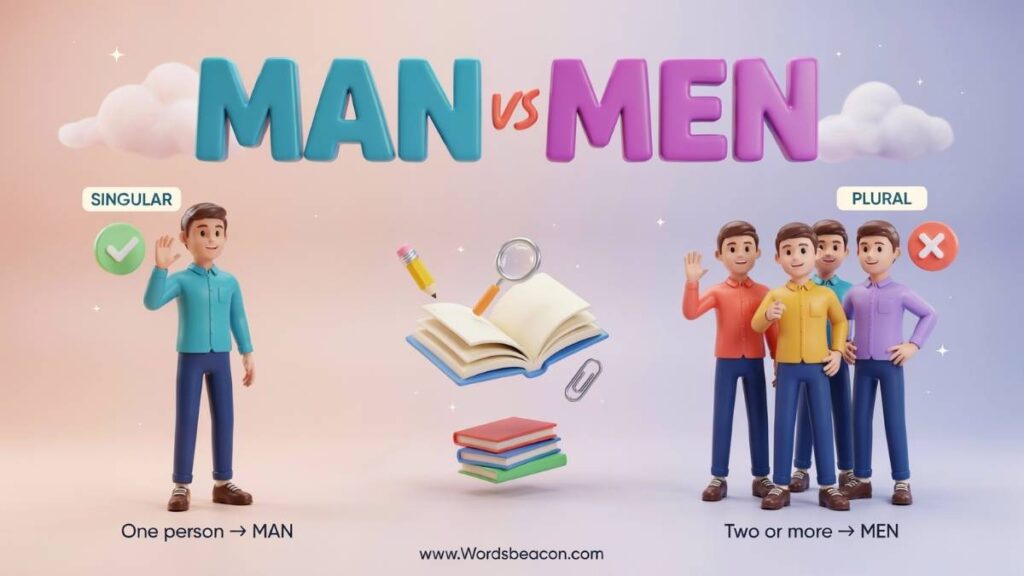
Ever get stuck on man vs men and wonder why English makes two nearly identical words so confusing? You are not alone. The difference is actually simple once you know what to look for. Man means one adult male, while men means two or more. The spelling changes slightly, but so do the pronunciation and grammar. That is why phrases like “two man,” “a men,” or “the man are” sound wrong. Fortunately, there is no need to wrestle with the rules. This guide breaks down man vs men in a clear, easy way, with simple examples, pronunciation tips, common mistakes, and useful grammar rules.
quick answer
| Feature | Man | Men |
|---|---|---|
| Number | Singular | Plural |
| Meaning | One adult male | Two or more adult males |
| Noun type | Singular noun | Plural noun |
| Pronunciation | /mæn/ | /men/ |
| Common verb | is, was, has | are, were, have |
| Example | The man is here. | The men are here. |
Fix common more word mistakes in English
Savior vs Saviour Difference and Usage?
Man vs Men What Is the Difference?
The man vs men difference is mainly about grammatical number. Man is the singular form, while men is the plural form.
When you use man, you’re referring to one adult male person:
- A man is waiting outside.
- The man lives nearby.
- One man answered the question.
When you use men, you’re referring to two or more adult males:
- Two men are waiting outside.
- The men live nearby.
- Several men answered the question.
This makes the difference between man and men quite direct. The word changes because the number of people changes.
One man. Two men. That’s the core rule.
Cambridge and Oxford both list men as the plural of man and define man in its ordinary noun sense as an adult male human.
What Does “Man” Mean?
The basic man meaning is an adult male human being. Grammatically, it is a countable singular noun when it refers to one person.
A simple man definition is:
Man is a noun that normally refers to one adult male human being.
For example:
- The man is wearing a black jacket.
- I spoke with a man at the station.
- One man solved the problem.
- That man works at the library.
The word can have other meanings depending on context. For example, man can refer to a male employee or a person serving in a particular role. It can also appear in older or broader expressions referring to humanity. However, the everyday meaning relevant to man vs men grammar is the singular noun referring to one adult male.
What Does “Men” Mean?
The men meaning is the plural of man.
A simple men definition is:
Men refers to two or more adult male people and is the plural form of man.
For example:
- The men are waiting outside.
- Two men entered the building.
- Several men joined the meeting.
- Many men work in the industry.
Collins and Oxford both identify men as the plural form of man.
Learn the difference between confusing word pairs
Parent’s vs Parents’ Difference and usage?
Man vs Men Grammar Singular and Plural Forms

The easiest way to understand man vs men grammar is to connect the nouns with grammatical number.
Man is a singular noun. It describes one person.
Men is a plural noun. It describes two or more people.
This distinction affects other parts of the sentence too, especially the verb.
Man With a Singular Verb
When man acts as the subject, it normally takes a singular verb.
For example:
- The man is here.
- The man was tired.
- The man has arrived.
- The man works nearby.
The pattern is easy:
man + singular verb
This is why the man is is correct, while the man are is incorrect when man functions as the singular subject.
Men With a Plural Verb
When men acts as the subject, it normally takes a plural verb.
For example:
- The men are here.
- The men were tired.
- The men have arrived.
- The men work nearby.
The pattern becomes:
men + plural verb
Therefore, the men are is correct, while the men is is incorrect in ordinary standard English.
Why Subject-Verb Agreement Matters
The noun and verb need to agree in number. This principle is called subject-verb agreement.
Compare these sentences:
- The man is ready.
- The men are ready.
- The man was outside.
- The men were outside.
- The man has finished.
- The men have finished.
The change from man to men isn’t just a spelling detail. It affects the grammatical structure around the noun.
Learn the difference between confusing word pairs
Manual vs Manuel Difference and usage ?
What Is the Plural of Man?
The plural of man is men.
That’s one of the most important facts to remember.
Man → men
You don’t normally create the plural by adding -s. Therefore:
one man
two men
Not:
one man
two mans
The word man belongs to a group of English nouns with irregular plural forms. An irregular noun doesn’t follow the most common pattern of simply adding -s or -es.
Other examples include:
- woman → women
- child → children
- foot → feet
- tooth → teeth
- mouse → mice
- goose → geese
So, if you’re wondering how man becomes men, the answer is that English inherited an irregular plural pattern rather than forming the plural with a regular -s ending. Dictionary sources identify men as the established plural form.
Is “Mans” the Plural of Man?
For ordinary noun usage, no.
If you mean more than one adult male, use men.
Incorrect:
Two mans were waiting outside.
Correct:
Two men were waiting outside.
There is one important detail, though. Mans can appear in English as a different grammatical form because man can also function as a verb. For example, mans can be the third-person singular present form of the verb man, meaning to operate or staff something. Collins lists mans as a verb form of man.
So don’t memorize “mans is never a word.” Instead, remember the more useful rule:
Men is the ordinary plural noun form of man.
Learn the difference between tricky grammar words
Molding vs Moulding which one is correct and usage ?
Man vs Men Pronunciation
Spelling isn’t the only thing that changes. Man and men pronunciation differs because the vowel sound changes.
The standard dictionary pronunciations are:
- man: /mæn/
- men: /men/
Cambridge lists these pronunciations for both UK and US English.
This means the man vs men pronunciation difference isn’t just a matter of spelling. The middle vowel sounds different.
Man Pronunciation
The standard man pronunciation is /mæn/.
The word contains the short a vowel sound found in words such as:
- cat
- hat
- map
- hand
- black
So, when practicing man pronunciation, pay attention to that short-a sound.
Men Pronunciation
The standard men pronunciation is /men/.
The vowel resembles the short e vowel sound found in:
- bed
- red
- ten
- head
- send
Consequently, man and men sound different, even though their first and final consonants are closely related.
How to Pronounce Man and Men
If you’re asking how to pronounce man and men, focus on the vowel.
Say:
man
Then:
men
Now put them into phrases:
one man
two men
Finally, use full sentences:
The man is here.
The men are here.
That contrast makes the pronunciation difference easier to hear.
Man Pronunciation American English vs British English
For ordinary use, there isn’t a major UK-US pronunciation split that changes the basic vowel in these words.
Cambridge gives /mæn/ for man and /men/ for men in both UK and US pronunciation entries.
So, whether you’re searching for man pronunciation British or man pronunciation American English, the core pronunciation remains the same.
Regional accents can naturally affect the exact quality of a vowel. However, learners should focus first on the important contrast:
man = /mæn/
men = /men/
For man pronunciation audio, a reputable dictionary’s audio recording can help you hear the difference more clearly than spelling alone.
Man vs Men When to Use Each Word
Knowing when to use man or men becomes much easier when you count the people first.
Use “Man” for One Person
Use man when you mean one adult male.
Common combinations include:
- a man
- one man
- the man
- this man
- that man
- each man
- every man
Examples:
- A man is standing outside.
- One man called earlier.
- The man is waiting.
- That man works here.
The article a is particularly useful as a clue because a man identifies one person.
Use “Men” for Two or More People
Use men when you mean two or more adult males.
Common combinations include:
- two men
- three men
- several men
- many men
- the men
- those men
- both men
Examples:
- Two men entered the room.
- Three men joined the team.
- Several men were waiting outside.
- Both men agreed with the proposal.
A quick test can solve most problems:
One person? Use man.
Two or more people? Use men.
Learn the difference between tricky grammar words
Farther vs Further difference and usage ?
Man vs Men Examples and Common Sentence Patterns
Real sentences make the difference easier to remember because they show how the nouns behave in context.
| Singular: Man | Plural: Men |
|---|---|
| A man is waiting. | Two men are waiting. |
| The man was tired. | The men were tired. |
| One man has arrived. | Several men have arrived. |
| That man works here. | Those men work here. |
| The man is ready. | The men are ready. |
Notice something important: the change isn’t limited to the noun.
Man often appears with singular forms such as is, was, has, while men appears with plural forms such as are, were, have.
That’s why these are useful man vs men sentences for grammar practice.
Man vs Men vs Men’s
Apostrophes create another small trap.
Man, men, and men’s are three different forms.
Man means one adult male.
Men means two or more adult males.
Men’s usually shows possession or association with men.
Compare:
- The man is outside.
- The men are outside.
- The men’s shoes are outside.
Here, the apostrophe in men’s doesn’t create the plural. The plural already exists in men.
The possessive structure simply adds ‘s to the irregular plural form.
You can see the same idea in common phrases such as:
- men’s clothing
- men’s shoes
- men’s sports
- men’s teams
- men’s health
Therefore, when comparing man vs men vs mens, remember that men’s is the normal possessive spelling. Writing mens without an apostrophe does not normally express the possessive form.
Man vs Male What’s the Difference?
The man vs male comparison causes a different kind of confusion.
Man is primarily a noun for an adult male person.
Male can work as an adjective or noun and has a broader biological and descriptive use.
For example:
- He is a man.
- He is a male athlete.
- The study included adult males.
- The animal was identified as male.
In everyday conversation, man often sounds more natural when referring to an adult human being. In scientific, medical, or biological contexts, male may be more appropriate because it can describe humans and animals and can function as an adjective.
So, man and male overlap in meaning in some contexts, but they aren’t interchangeable in every sentence.
Man vs Men vs Woman vs Women
The man vs men woman vs women comparison helps explain why English learners sometimes find these forms tricky.
| Singular | Plural |
|---|---|
| man | men |
| woman | women |
Both pairs use an irregular plural pattern rather than simply adding -s.
For example:
One man → two men
One woman → two women
The same general idea appears in other irregular pairs:
- person → people
- child → children
- foot → feet
- tooth → teeth
- mouse → mice
English has several irregular noun forms, so learning these words as pairs can make memorization easier.
Learn the difference between tricky grammar words
Quiet vs Quite difference and usage ?
Common Man vs Men Mistakes

Using “Man” After a Plural Number
Incorrect:
Two man are waiting.
Correct:
Two men are waiting.
A number greater than one normally requires the plural noun form.
Using “Men” After “A”
Incorrect:
A men is waiting.
Correct:
A man is waiting.
The article a introduces a singular countable noun.
Using a Singular Verb With Men
Incorrect:
The men is ready.
Correct:
The men are ready.
The plural noun men requires a plural verb when it acts as the subject.
Using a Plural Verb With Man
Incorrect:
The man are ready.
Correct:
The man is ready.
The singular noun man requires a singular verb in this structure.
Writing “Mans” for the Plural
Incorrect:
Five mans attended the event.
Correct:
Five men attended the event.
Again, men is the plural form of the noun man.
Learn the difference between tricky grammar words
Its vs It’s Difference and usage ?
How to Remember Man vs Men
Grammar rules are useful, but a good memory trick can make the rule stick.
Remember the Number
Think:
1 man
2 men
That’s the fastest shortcut.
Remember the Vowel Change
The spelling changes from:
man → men
The vowel changes from the short a sound to the short e sound.
Remember the Verb
Pair each noun with its most common linking verb:
The man is
The men are
This gives you a three-part memory system:
number → noun → verb
If those three agree, you’re usually on the right track.
Learn the difference between similar English words
To vs Too difference and usage?
Man vs Men in Everyday English
The distinction appears in almost every kind of English writing and conversation.
In Daily Conversation
You might say:
- I saw a man at the station.
- I saw two men at the station.
The number changes, so the noun changes.
In Workplace English
For example:
- A man from the repair company called.
- Three men from the repair company arrived.
The second sentence needs men because it refers to multiple people.
In Questions
The same rule works in questions:
- Who is that man?
- Who are those men?
Notice how the verb changes along with the noun.
In Negative Sentences
The difference remains clear:
- The man isn’t here.
- The men aren’t here.
These examples show why learning only the vocabulary isn’t enough. Man grammar and men grammar also involve the surrounding words.
Learn the difference between similar English words
Learned vs Learnt difference and usage ?
A Note About Older Uses of “Man”
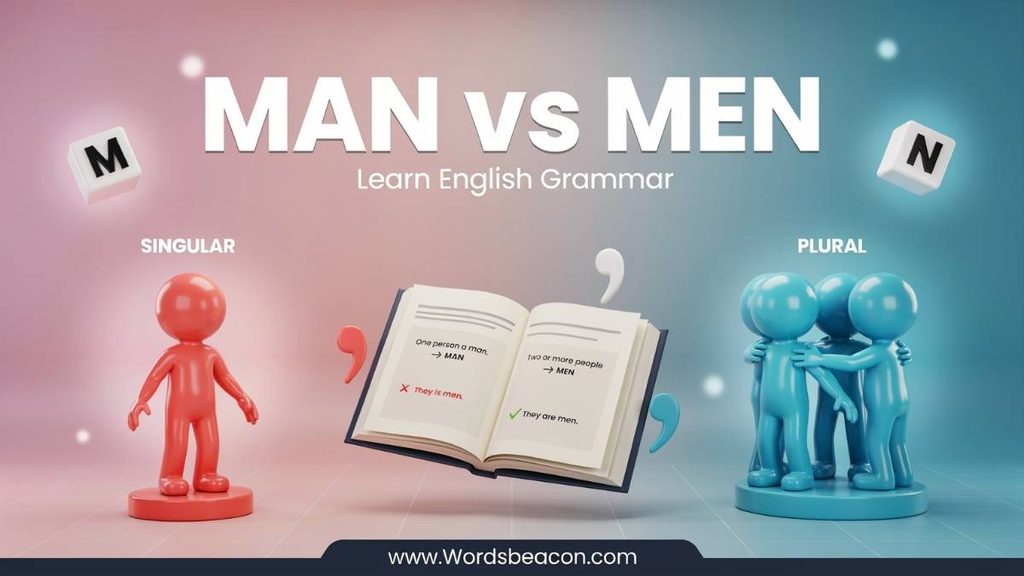
There is one broader use worth knowing because you may encounter it in older books, historical writing, or traditional expressions.
Historically, man has sometimes been used to refer to humanity or human beings generally rather than specifically to adult males. Dictionaries still record this use, but modern usage often favors terms such as people, human beings, humanity, or humankind when the intended meaning includes everyone. Cambridge specifically notes this usage and recommends more inclusive alternatives in many contexts.
For example, an older text might use man in a broad sense, while modern writing might say:
Human beings have always searched for answers.
This distinction matters because man meaning depends on context. In the ordinary modern sense discussed throughout this article, man means one adult male. In older or broader expressions, it can have a different meaning.
Man vs Men A Simple Grammar Test
When you’re unsure whether to use man or men, follow these steps.
First, count the people.
Ask whether you’re talking about one person or two or more people.
Second, choose the noun.
- One adult male → man
- Two or more adult males → men
Third, check the verb.
- The man is
- The men are
Finally, listen to the vowel.
- man → short a
- men → short e
This method handles most everyday cases without requiring a complicated grammar formula.
Learn the difference between similar English words
Breath vs Breathe which one is correct ?
practice session Man vs Men
Choose man vs men to complete each sentence.
- There is one ___ waiting outside the office.
- The two ___ are talking near the entrance.
- That ___ works at the local bookstore.
- Several ___ joined the meeting this morning.
- A ___ is standing beside the car.
- The ___ are playing football in the park.
- Every ___ in the group received a certificate.
- Many ___ attended the conference.
- I saw a ___ carrying a large suitcase.
- The three ___ walked into the restaurant together.
- One ___ called the manager about the problem.
- Those ___ are waiting for the bus.
- He is a kind ___ who helps his neighbors.
- The ___ were asked to leave their bags at the door.
- Which ___ is your brother?
- The ___ in the team work well together.
- A young ___ helped me find the correct street.
- Several ___ volunteered for the project.
- That ___ knows how to repair computers.
- The ___ are discussing their plans for the weekend.
Answers
- man
- men
- man
- men
- man
- men
- man
- men
- man
- men
- man
- men
- man
- men
- man
- men
- man
- men
- man
- men
Here’s a trusted source for clear more words Comparison:
FAQs
What is the difference between “man” and “men”?
Man is the singular form used for one adult male, while men is the plural form used for two or more adult males. For example, “That man is my neighbor” refers to one person, while “Those men are my neighbors” refers to more than one.
What is the singular form of “men”?
The singular form of men is man. For example, you would say one man, but two men.
Why does “man” become “men” in the plural?
Man has an irregular plural form. Instead of adding -s like many English nouns, its vowel changes from a to e, creating men. This spelling comes from the historical development of English.
Are “man” and “men” pronounced differently?
Yes. Man and men have different vowel sounds. Man uses the short a sound, while men uses the short e sound. Therefore, they should sound different when you pronounce them.
Which verb goes with “man”?
Because man is singular, it takes a singular verb. For example, “The man is waiting outside” is correct. You would not say, “The man are waiting outside.”
Which verb goes with “men”?
Because men is plural, it takes a plural verb. For example, “The men are waiting outside” is correct. The verb are matches the plural noun men.
Can “mans” be the plural of “man”?
No. Mans is not the standard plural form of man. The correct plural is men. However, mans can appear as a verb, such as in “He mans the front desk.”
Can “man” be used as a verb?
Yes. As a verb, man can mean to operate, staff, or work at a particular position. For example, “Two employees man the information desk.” However, depending on the context, alternatives such as staff or operate may sound more natural.
Can “man” refer to humans in general?
Historically, man has sometimes been used to refer to humanity in general. However, this use can sound old-fashioned or unclear in modern English. When you mean people generally, words such as people, humans, or human beings are often clearer.
Can “man” refer to one person after “a”?
Yes. A man is the standard singular expression. For example, “A man called the office this morning.” Since a introduces a singular countable noun, a man is correct, not a men.
Can “men” be used after “a”?
No. Men is plural, so a men is incorrect. Use a man when referring to one person and men when referring to two or more.
Can I use “man” after “one”?
Yes. One man is correct because one refers to a single person. For example, “One man helped us carry the boxes.”
What should I use after “many”: man or men?
Use men. The word many refers to more than one person, so the plural form is required. For example, “Many men attended the event” is correct.
What is the possessive form of “man”?
The possessive form of singular man is man’s. For example, “The man’s car is outside.” The apostrophe shows that the car belongs to one man.
What is the possessive form of “men”?
The possessive form of plural men is men’s. For example, “The men’s jackets are in the closet.” Because men is already an irregular plural, you add ’s rather than simply an apostrophe.
Why is “men’s” written with an apostrophe?
Men’s is a possessive form, so it needs an apostrophe. It means something belongs to or relates to men. For example, men’s clothing means clothing intended for or associated with men. Mens without an apostrophe is not the standard possessive spelling.
Does “men” always refer to a group?
Yes, when men functions as the noun plural of man, it refers to two or more adult males. For example, “Three men entered the building.” The word men itself does not refer to just one adult male.
Can numbers be used with “man” and “men”?
Yes, but the noun must match the number. Use man with one: one man. Use men with two or more: two men, five men, or twenty men.
What is the easiest way to remember “man” vs “men”?
Use the one-versus-more-than-one test. If you mean one adult male, use man. If you mean two or more, use men. Think of the simple pair: one man, two men.
conclusion
The man vs men confusion is easy to fix once you remember one simple rule: man means one, while men means more than one. So, you say one man, but two men. The same rule applies to verbs: the man is correct, while the men are correct. Also, remember that men’s is the possessive form, as in men’s shoes, while mens is not the standard spelling. As for mans, leave it alone when you mean more than one person. English may enjoy changing a single vowel and causing a little chaos, but with this rule in mind, choosing between man and men becomes simple.

Luna AJS is an experienced blogger and dedicated language enthusiast at Words Beacon. She specializes in making English grammar, spelling, vocabulary and commonly confused words easy to understand. She provides clear explanations, practical examples to help readers write with confidence.