
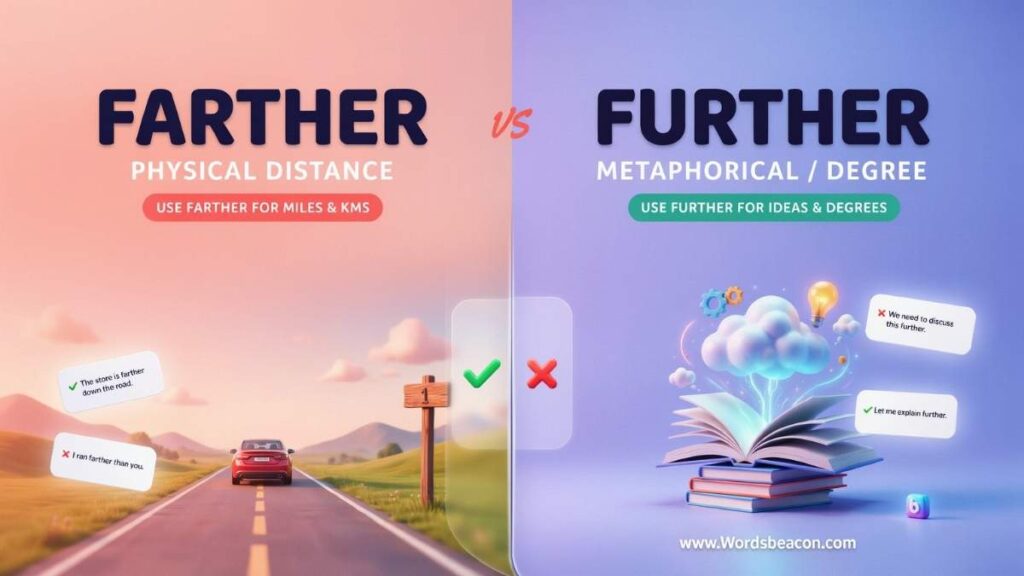
Farther and further are two small words that can create a surprisingly big grammar headache. If you have ever paused before writing one, you are not alone. The farther vs further confusion usually comes from their similar meanings and overlapping use. In simple terms, both can describe distance, while further can also mean more, additional, or continued. For example, you can walk farther down the road, ask for further information, or take a project further. The good news is that the rules are not as scary as they look. Once you understand the meaning and context, choosing between farther and further becomes much easier.
quick answer
The easiest way to remember farther vs further is to look at the meaning and context.
| Word | Main Use | Example |
|---|---|---|
| Farther | Greater physical distance | We walked farther down the road. |
| Further | More, additional, or continued | We need further information. |
| Both | Greater distance | We cannot go any further or farther. |
| Further | Advance or develop | The training will further her career. |
Both farther and further can describe distance, so further is not automatically wrong for physical distance. However, further has additional meanings that farther does not normally have.
Fix common more word mistakes in English
Quiet vs Quite difference and usage ?
Farther vs Further What Is the Difference?
Farther traditionally refers to a greater physical distance.
For example:
We walked farther than we planned.
Further has a wider range of meanings. It can describe physical distance, but it can also mean additional, more, continued, or at a more advanced stage.
For example:
We need further information.
The important point is that further can also describe physical distance.
For example:
We walked further down the road.
That sentence is perfectly natural in modern English. Cambridge Grammar explains that farther and further can both function as comparative forms of far when talking about distance, with further being more common in some usage.
So, when deciding between farther or further, consider the meaning first. If you are clearly talking about physical distance, farther is often the most precise traditional choice. If you mean additional information, continued discussion, progress, or advancement, further is usually the correct choice.
What Is the Difference Between Farther and Further?
The main farther vs further difference comes from the range of meanings each word can express.
Farther is strongly connected with distance. It works naturally when something is located at or moves to a greater distance.
For example:
The next town is farther away.
She walked farther than I did.
The airport is farther from here.
In each case, the sentence deals with physical space.
Further, however, can do much more. It can refer to physical distance, but it can also describe something additional, a greater degree, continued activity, or advancement.
For example:
We need further research.
Please provide further details.
The discussion needs to go further.
The training could further her career.
Here, further has nothing to do with miles, feet, or physical space.
That broader meaning explains why further appears so often in academic writing, business communication, formal notices, and everyday conversation. It can mean more, additional, or continued depending on the sentence.
Farther Meaning and Definition
The basic farther definition is “to a greater distance.” It functions as both an adverb and an adjective.
As an adverb, farther describes movement or position in relation to distance.
For example:
We drove farther than expected.
She moved farther away.
How much farther do we need to go?
As an adjective, farther describes something located at a greater distance.
For example:
The farther shore was difficult to see.
The farther entrance is less crowded.
Therefore, the traditional farther meaning focuses on physical distance. When the distance can be pictured as actual space between two points, farther is often a natural choice.
Cambridge defines farther as the comparative form of far and gives examples involving greater distance from a particular place or point.
Further Meaning and Definition
The further definition is broader than the farther definition.
Further can mean greater distance, but it can also mean more, extra, additional, continued, or more advanced.
For example:
We need further information.
She asked for further assistance.
The company requires further development.
The researchers called for further investigation.
The project needs further consideration.
In these examples, further means something similar to additional or more.
Further can also describe progress:
The discussion moved further toward a solution.
The project has moved further than expected.
In addition, further can work as a verb. As a verb, it means to advance, promote, develop, or help something progress.
For example:
The program aims to further education.
She took additional training to further her career.
The organization wants to further scientific research.
This verb use is one of the clearest differences between farther and further.
Learn the difference between often confused words
Its vs It’s Difference and usage ?
Farther Physical Distance vs Further Figurative Distance

The traditional rule becomes easier when you picture the type of distance involved.
Farther physical distance refers to actual space.
For example:
The second gas station is farther down the highway.
The hikers walked farther into the forest.
The school is farther from my house.
These sentences describe literal distance.
Further figurative distance works differently. The distance exists as an idea, relationship, degree, or state rather than as physical space.
For example:
That decision moved us further from our goal.
His argument took the discussion further from the original issue.
Nothing could be further from the truth.
In these examples, nobody is measuring miles or feet. Instead, further expresses a figurative relationship.
Still, this traditional distinction should not be treated as an absolute grammar law. Modern dictionaries recognize further for physical distance too. Cambridge specifically states that farther and further have no difference in meaning when they refer to distance.
Is Further Correct for Physical Distance?
Yes, further can be correct for physical distance.
This point clears up one of the biggest myths about farther vs further grammar.
Many grammar lessons teach the rule this way:
Farther means physical distance.
Further means figurative distance.
That rule is useful as a learning shortcut. However, it does not cover every real-world use of English.
For example:
I cannot walk any further.
We drove further south.
The store is further down the road.
All three sentences use further for distance. Cambridge’s dictionary and grammar resources explicitly recognize this use.
So, if someone says that further can never describe physical distance, that statement is too strict.
A better rule is this: farther is strongly associated with physical distance, while further can describe physical distance as well as several abstract meanings.
When to Use Farther vs Further
When to use farther vs further depends mainly on the meaning you want to express.
Use farther when physical distance is the main focus and you want that meaning to be especially clear.
For example:
The airport is farther away than I expected.
The hikers went farther into the mountains.
She lives farther from the city center.
We traveled farther than planned.
However, use further when you mean additional, more, continued, or advanced.
For example:
We need further information.
The report requires further research.
Let’s discuss the issue further.
The company needs further development.
The committee requested further investigation.
Therefore, a useful practical rule is simple: farther is a strong choice for literal distance, while further is the natural choice for additional or abstract meaning.
At the same time, remember that further can also refer to literal distance.
Learn the difference between often confused words
Learned vs Learnt difference and usage ?
Farther vs Further Grammar How the Words Function
Both farther and further are comparative forms related to far. They can function as adjectives or adverbs when they express distance. Further has an additional grammatical role because it can also function as a verb.
Consider these examples:
She walked farther.
Here, farther is an adverb because it describes how far she walked.
The farther road leads to the village.
Here, farther functions as an adjective.
Now consider further:
We discussed the matter further.
Here, further is an adverb.
We need further information.
Here, further is an adjective.
The training will further her career.
Here, further is a verb.
That final example is important because farther cannot normally replace further as a verb.
You can further a cause, further a career, further education, or further a project. You cannot use farther in the same way.
Can Further Mean Additional?
Yes. In fact, this is one of the most common uses of further.
When further means additional, you can often replace it with more or additional without changing the basic meaning.
For example:
1.We need further information.
2.We need additional information.
3.We need more information.
All three sentences communicate essentially the same idea.
The same pattern appears in:
Further details are available.
Further research is required.
Please contact us for further assistance.
No further action is necessary.
The matter requires further consideration.
In each case, further expresses the idea of something extra, additional, or continued. Cambridge specifically lists further as meaning more, extra, or additional.
Learn the difference between often confused words
To vs Too difference and usage?
Can Further Be Used as a Verb?
Yes.
This is another important part of further vs farther meaning.
As a verb, further means to advance, promote, develop, or help something progress.
For example:
Education can further your career.
The project aims to further scientific research.
The organization works to further its goals.
The new policy could further economic development.
In these sentences, further describes an action that helps something move toward greater progress.
Therefore, if you are asking, “Can further be used as a verb?” the answer is clearly yes.
Is Farther a Verb?
No. Farther does not normally function as a verb in standard modern English.
Instead, it generally works as an adjective or adverb related to distance.
For example:
We walked farther.
The farther shore was hidden by fog.
The distinction becomes especially useful when you compare these two sentences:
The program will further her education.
The program will farther her education.
Only the first sentence works because further has the verb meaning “advance” or “promote.”
Learn the difference between often confused words
More Than vs More Then difference and usage ?
Farther vs Further Examples
The best way to understand the farther vs further meaning is to see the words in context.
Examples of Farther
We walked farther than expected.
The next town is farther away.
The airport is farther from here.
She moved farther down the path.
How much farther do we have to travel?
The mountain looked farther away in the fog.
These examples focus on physical or literal distance.
Examples of Further
We need further research.
Please provide further details.
Let’s discuss the issue further.
The company requested further information.
The investigation requires further consideration.
The course could further her career.
These examples use further for additional meaning, continued activity, or advancement.
Farther vs Further Sentence Examples
Consider these pairs:
We walked farther than yesterday.
We discussed the matter further than yesterday.
The first sentence concerns physical distance. The second concerns the extent of a discussion.
Another pair makes the distinction even clearer:
The cabin is farther from the road.
We need further information about the cabin.
The first sentence describes physical space. The second means additional information.
However, this pair shows why the traditional rule cannot be absolute:
We walked farther down the road.
We walked further down the road.
Both can be used because further can also describe physical distance.
Learn the difference between confusing word pairs
Breath vs Breathe which one is correct ?
Farther vs Further Down the Road?
Both farther down the road and further down the road can be correct.
For literal travel, you might write:
We drove farther down the road before stopping.
You could also write:
We drove further down the road before stopping.
Modern English allows both.
However, further down the road can also have a figurative meaning.
For example:
We can discuss the budget further down the road.
Here, the phrase does not describe a physical road. Instead, it means later in the process or at a later point.
Therefore, context determines the meaning.
If you are literally traveling, farther and further can both work. If the phrase describes a future stage or point in a process, further is the natural choice.
Farther or Further From the Truth?
The usual expression is:
Nothing could be further from the truth.
This sentence uses figurative distance. The statement is not physically located away from the truth. Instead, further expresses the degree of difference between the statement and reality.
The same pattern appears in:
His claim could not be further from reality.
That assumption takes us further from the facts.
The decision moved the discussion further from the original issue.
Therefore, when considering farther or further from the truth, further is the established choice.
The expression nothing could be further from the truth is also recognized as a standard idiom in dictionary usage.
Farther vs Further in American English
The farther vs further American English distinction is often presented through the traditional physical-distance rule.
In American English, farther is commonly associated with physical distance.
For example:
The second exit is farther away.
The lake is farther from the town.
We drove farther than expected.
At the same time, American English uses further for physical distance as well:
I cannot walk any further.
How much further do we need to go?
The American Dictionary entry for further specifically gives both the meaning of “more, extra, or additional” and the meaning of moving to a greater distance in space or time.
Therefore, farther vs further in American English is not a strict either-or rule.
A practical American English approach is to use farther when physical distance is clearly the focus and further when the meaning is additional, abstract, or related to progress. However, further remains acceptable for physical distance.
Learn the difference between confusing word pairs
Yours vs Your’s which one is correct ?
Farther vs Further in British English
British English also uses both words for distance.
In fact, Cambridge Grammar notes that farther and further have no difference in meaning when they refer to distance and states that further is more common in such contexts.
For example:
We cannot go any further.
How much farther are we going?
Both forms can occur.
British English also uses further for meanings that have nothing to do with physical distance.
For example:
Further information is available.
The issue requires further investigation.
The company needs further development.
Consequently, farther vs further UK usage should not be reduced to the claim that British speakers always use one word while Americans always use the other.
Farther vs Further Usage Rules
The most useful farther vs further usage rules are practical rather than absolute.
1.For physical distance, farther is a strong traditional choice.
2.For additional information, further is the correct choice.
3.For continued discussion, use further.
4.For progress or advancement, use further.
5.For figurative distance, further is generally the natural choice.
6.For physical distance, further can also be correct.
That last rule matters because modern English does not always follow the traditional physical-versus-figurative boundary. Merriam-Webster and the Chicago Manual of Style both recognize the historical and continuing overlap between the two words.
Learn the difference between confusing more English words
Lose vs Loose which one is correct ?
Further vs Farther Pronunciation

The farther vs further pronunciation difference is straightforward.
In American English, farther begins with the vowel sound found in words such as far. Further begins with the vowel sound found in words such as fur.
The difference becomes clearer when the words are spoken slowly.
Cambridge gives the American pronunciation of farther as /ˈfɑrðər/ and further as /ˈfɝːðər/.
Although the endings sound similar, the first vowel separates the two words.
Farther vs Father
The Farther vs father creates a different kind of confusion because the words look and sound similar in some accents.
Farther relates to distance:
The store is farther away.
Father refers to a male parent:
My father lives nearby.
The meanings have nothing in common.
When speaking quickly, the distinction can become less obvious, particularly in accents where vowel differences are reduced. However, the spelling and context usually make the intended word clear.
Further vs Farther vs More
Further and more often overlap in meaning.
For example:
We need further discussion.
We need more discussion.
Both sentences mean that additional discussion is needed.
However, farther does not normally have this meaning.
You cannot replace further with farther in:
1.We need further information.
2.We need further research.
3.We need further assistance.
Therefore, when comparing further vs farther vs more, remember that further can often mean more or additional, while farther primarily relates to distance.
Learn the difference between confusing more English words
Tweek vs Tweak difference and usage?
Common Mistakes With Farther and Further
One common mistake is using farther when the intended meaning is additional.
For example:
Please send farther information.
The correct form is:
Please send further information.
Another mistake is believing that further can never describe physical distance.
That rule is too strict because modern English uses further for physical distance regularly. Cambridge explicitly recognizes this usage.
A third mistake is treating the two words as completely interchangeable.
They overlap when they describe distance, but further has meanings that farther does not.
For example:
The team needs further research.
Farther cannot replace further in that sentence.
Likewise, further can function as a verb:
The training will further her career.
Farther cannot perform that job.
Further and Farther in Formal Writing
Formal writing rewards clarity, so the traditional distinction can still be useful.
When discussing measurable distance, farther can make the meaning immediately obvious.
For example:
The second research site is farther from the river.
When discussing additional work, further is the natural choice.
For example:
Further research is required.
The committee requested further analysis.
The findings require further consideration.
However, formal writing does not require writers to reject further when it describes physical distance. The Chicago Manual of Style notes that further and farther have historically been used interchangeably in contexts involving spatial, temporal, and metaphorical distance.
Therefore, good writing should prioritize clear meaning rather than forcing an artificial rule.
A Simple Case Study One Road, Two Meanings
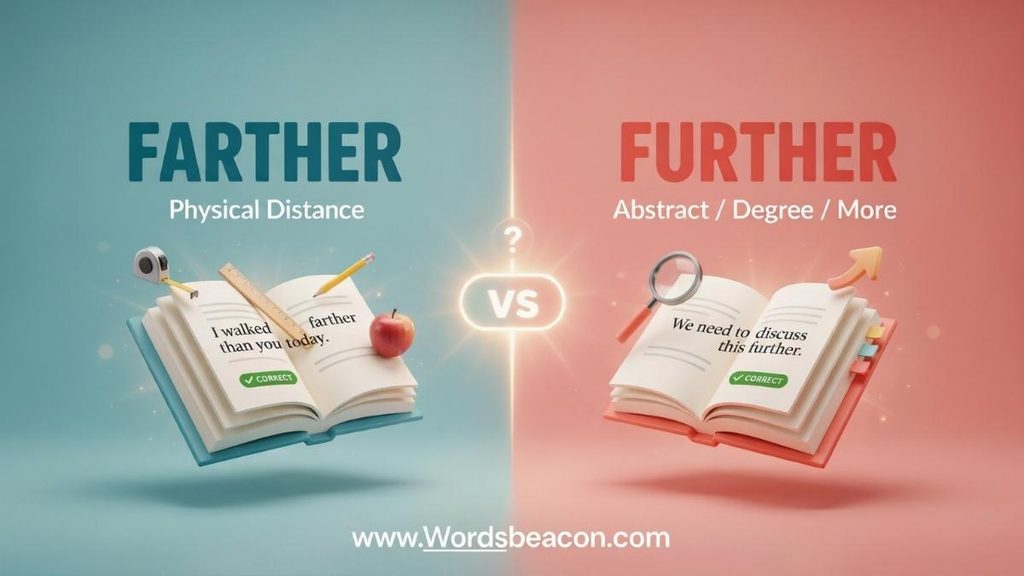
Imagine that you are traveling to another city.
After driving for two hours, you ask:
How much farther do we have to go?
Here, farther refers to the remaining physical distance.
Later, you arrive and start discussing your travel plans:
We need further information before booking the hotel.
Now further means additional.
Then you discuss whether to change the itinerary:
Let’s discuss the plan further.
Again, further means more or in greater detail.
Finally, someone suggests driving to another town:
We could go further south tomorrow.
Here, further returns to physical distance.
The same word can therefore move between literal distance and abstract meaning depending on the sentence.
That is the central lesson behind farther vs further grammar.
How to Remember Farther vs Further
The easiest traditional memory trick is to look at the word farther.
It contains far.
That makes farther easy to associate with physical distance.
For example:
We walked farther.
Then remember that further has a wider meaning.
It can mean:
more
additional
continued
more advanced
greater in degree
greater in distance
A useful replacement test can make the decision even easier.
If you can replace the word with additional or more, further is usually the right choice.
For example:
We need further information.
We need additional information.
The meaning remains clear.
Now try:
We walked farther.
We walked additional.
That does not work.
So, when deciding when to use further vs farther, first ask whether the sentence expresses distance or something additional.
Learn the difference between confusing more English words
Courtesy vs Curtesy Difference and usage ?
Practice Session Farther vs Further
Choose the correct word, farther or further, to complete each sentence.
- How much ______ is the nearest gas station?
- We walked ______ down the road before stopping for lunch.
- For ______ information, please contact the office.
- Nothing could be ______ from the truth.
- The hikers went ______ into the forest than they had planned.
- Do not go any ______ without a map.
- We need to discuss this matter ______ before making a decision.
- The new training program will help ______ her career.
- The hotel is ______ away than I expected.
- If you have any ______ questions, feel free to ask.
- The children ran ______ across the field to catch the ball.
- The company needs to conduct ______ research before launching the product.
- We cannot take this project any ______ without additional funding.
- The village is ______ from the city than we thought.
- The manager asked for ______ details about the proposal.
- The team hopes to ______ its goal through better planning.
- Which building is ______ from the entrance?
- We drove ______ north before finding a suitable place to stop.
- Please read the instructions ______ before starting the test.
- The discussion went no ______ because nobody could agree.
Answers
- farther
- farther
- further
- further
- farther
- further
- further
- further
- farther
- further
- farther
- further
- further
- farther
- further
- further
- farther
- farther
- further
- further
Here’s a trusted source for clear word meanings:
FAQs
What is the main difference between farther and further?
Farther and further can both describe greater distance. However, further also means more, additional, or more advanced. For example, “The store is farther away” refers to distance, while “We need further information” means we need more information.
Can further be used for physical distance?
Yes. Further can describe physical distance, and modern English commonly uses it this way. For example, “We walked further down the street” and “We walked farther down the street” are both correct.
When should I use farther rather than further?
Use farther when you want to emphasize physical or measurable distance. For example, “The next town is farther away” clearly refers to location. However, further is also acceptable for physical distance, so the distinction is not absolute.
Can further mean more or additional?
Yes. Further can mean more, extra, or additional. For example, “Please provide further details” means “Please provide additional details.” Farther cannot normally replace further in this meaning.
Can further be used as a verb?
Yes. Further can be a verb meaning to advance, develop, or help something progress. For example, “The training will further her career.”
Is farther a verb?
No. Farther normally functions as an adjective or adverb. Unlike further, it is not normally used as a verb meaning to advance or promote something.
Is “further away” or “farther away” correct?
Both are correct when you are talking about distance. “Farther away” strongly emphasizes physical distance, while “further away” is also widely used. Modern English does not require farther in every physical-distance sentence.
Is “farther down the road” or “further down the road” correct?
Both can be correct. When the phrase refers to actual physical distance, either word can work. However, “further down the road” can also describe a later point in time or a later stage of a process.
Is “before we go any further” correct?
Yes. “Before we go any further” is a standard expression. Here, further usually refers to continuing an activity, discussion, project, or process rather than simply traveling a greater physical distance.
Is “look no further” correct?
Yes. “Look no further” is a standard expression meaning that there is no need to continue searching. The word further refers to continuing the search rather than moving farther in physical space.
Is “further from the truth” correct?
Yes. “Further from the truth” is the established expression, especially in the phrase “nothing could be further from the truth.” Here, further refers to a figurative degree of difference rather than physical distance.
What is the difference between farther and farthest?
Farther is the comparative form of far, while farthest is the superlative form. Farther describes a greater distance between two points, while farthest describes the greatest distance. For example, “The second house is farther away” and “That is the farthest house on the street.”
What are the superlative forms of far?
Far has two commonly used superlative forms: farthest and furthest. Both can refer to distance, although further and furthest also have broader meanings involving degree, progress, or additional ideas.
What does “go further” mean?
“Go further” can mean to travel a greater distance, continue an activity, make more progress, or take something to a more advanced stage. The meaning depends on the context.
What does farther mean?
Farther means to or at a greater distance. It is commonly used for physical or measurable distance, such as in “How much farther is the airport?”
What does further mean?
Further can mean a greater distance or degree, but it can also mean more, additional, or more advanced. It can also function as a verb meaning to develop or advance something.
Is farther more formal than further?
No. Farther is not simply a more formal version of further. Both words can describe distance, while further has additional meanings that make it suitable in contexts involving extra information, progress, or advancement.
Does “farthest” exist as a word?
Yes. Farthest is a standard English word and the superlative form of far. It means to or at the greatest distance, as in “What is the farthest you have ever traveled?”
Why can further be used where farther cannot?
Further has developed meanings beyond physical distance. It can mean additional, more, or more advanced, and it can also work as a verb. For example, “further research” means additional research, while “further her career” means advance her career.
What is the easiest way to remember farther vs further?
A useful shortcut is to associate farther with physical or measurable distance and further with additional or abstract meanings. However, do not treat this as an absolute rule because further is also widely used for physical distance.
Conclusion
Farther vs further can seem confusing at first, but the difference is actually easier than it looks. Both words can describe distance, so you can use either one when talking about going or traveling a greater distance. However, further has some extra jobs. It can mean more, additional, or continued, and it can even mean to advance or develop something.
A simple way to remember it is this: farther often feels natural when you are thinking about physical distance, while further works especially well for additional information, progress, or abstract ideas. For example, you can walk farther down the road, ask for further information, or further your career.
So, do not let these two little words send you farther into a grammar maze. Focus on the meaning of your sentence, and the right choice will usually become clear. Once you understand how each word works, farther vs further becomes one less grammar problem to worry about.

Luna AJS is an experienced blogger and dedicated language enthusiast at Words Beacon. She specializes in making English grammar, spelling, vocabulary and commonly confused words easy to understand. She provides clear explanations, practical examples to help readers write with confidence.