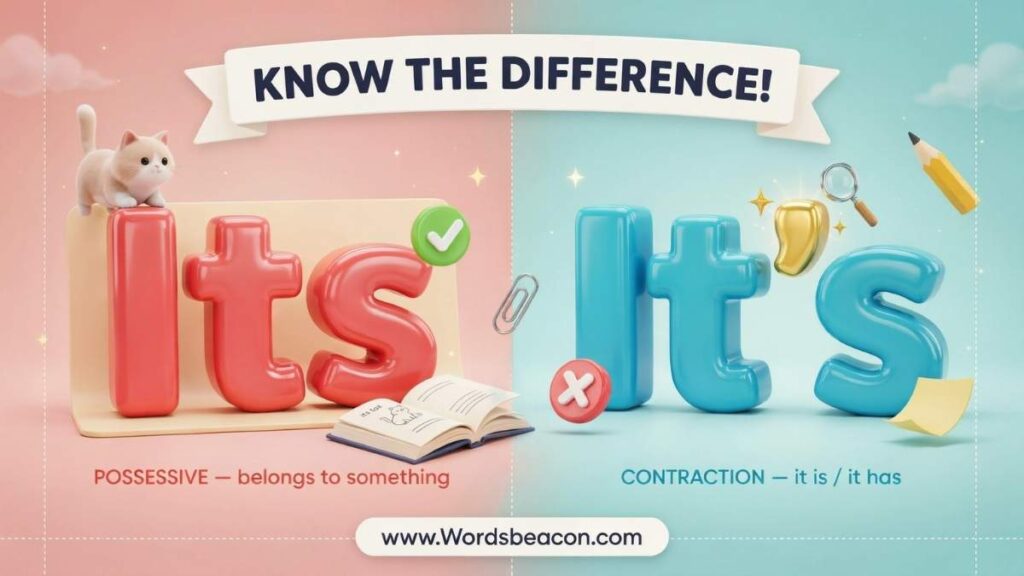
The difference between its and it’s looks tiny, but that little apostrophe can cause a lot of grammar confusion. Both words sound the same, yet they have completely different jobs. Use its to show possession or a connection, as in “The dog wagged its tail.” However, use it’s when you mean “it is” or “it has,” as in “It’s raining” or “It’s been a long day.” Once you know this simple rule, the confusion becomes much easier to clear. This guide explains its vs it’s with simple rules, clear examples, common mistakes, and easy tips to help you choose the correct form every time.
Quick answer
A tiny apostrophe creates a big difference. This quick table makes the rule easy to remember.
| Word | Meaning | Example |
|---|---|---|
| Its | Shows possession or connection | The dog wagged its tail. |
| It’s | Means “it is” | It’s a sunny day. |
| It’s | Means “it has” | It’s been a long day. |
Once you remember this simple rule, the confusion becomes much easier: its shows belonging, while it’s means “it is” or “it has.”
Fix common more word mistakes in English
Learned vs Learnt difference and usage ?
Its vs It’s The Simple Difference
The easiest way to understand its vs it’s is to ignore how the two words sound and focus on what they do in a sentence.
Its shows possession, belonging, or association. It usually appears before a noun.
For example:
The dog wagged its tail.
Here, its connects the tail with the dog. The tail belongs to the dog.
Now look at this sentence:
It’s getting late.
Here, it’s means it is.
You can expand the sentence:
It is getting late.
The sentence still makes sense, so it’s is correct.
There is another possible meaning:
It’s been a busy morning.
In this sentence, it’s means it has.
The expanded version is:
It has been a busy morning.
Therefore, the basic its vs it’s rules are straightforward:
Its means belonging to or relating to it.
It’s means it is or it has.
That distinction answers most questions about the difference between its and it’s.
What Is “Its”?
Its is the possessive form connected with the pronoun it. More precisely, major grammar references describe its as a possessive determiner because it normally comes before a noun. It identifies something as belonging to, connected with, or associated with something already mentioned.
Consider this sentence:
The company changed its policy.
The policy relates to the company. Therefore, its is the correct form.
The same pattern appears in:
The cat cleaned its paws.
The school updated its website.
The tree lost its leaves.
The phone lost its signal.
The restaurant changed its menu.
In each sentence, its connects the subject with a noun.
Importantly, possession does not always mean literal ownership. A company does not physically own a policy in the same way a person owns a bicycle. Instead, the policy belongs to or is associated with the company.
That broader idea of connection makes its usage easier to understand.
Its Meaning in English Grammar
The simplest way to understand its meaning is “belonging to it” or “relating to it.”
For example:
The machine has lost its power.
The power is associated with the machine.
The country changed its policy.
The policy belongs to or is associated with the country.
The bird returned to its nest.
The nest is associated with the bird.
This pattern also explains why its usually appears directly before a noun.
The dog hurt its paw.
The word its modifies the noun paw.
The company increased its profits.
Again, its identifies whose profits the sentence discusses.
Cambridge Dictionary also identifies its as a possessive determiner and gives examples involving animals, companies, houses, cities, and other things.
Learn the difference between confusing more English words
To vs Too difference and usage?
What Is “It’s”?
It’s works differently. It is a contraction, which means it combines two words into a shorter form.
The two possibilities are:
It is → it’s
It has → it’s
The apostrophe marks letters that have been omitted during the contraction. In other words, the apostrophe does not indicate possession here. It signals a shortened form.
It’s Means It Is
Use it’s when the full meaning is it is.
For example:
It’s cold today.
The expanded version is:
It is cold today.
Both sentences have the same meaning.
Likewise:
It’s important to check your work.
becomes:
It is important to check your work.
Another example is:
It’s difficult to explain.
That means:
It is difficult to explain.
The substitution works because it’s represents the two-word expression it is.
It’s Means It Has
It’s can also represent it has.
For example:
It’s been a long day.
Expand the contraction:
It has been a long day.
The sentence still works.
Consider another example:
It’s already started.
This means:
It has already started.
So, it’s has two standard meanings. Context determines which one applies.
Cambridge Dictionary gives both meanings and specifically identifies it’s as the short form of it is and it has.
Learn the difference between confusing more English words
Breath vs Breathe which one is correct ?
Its vs It’s How to Know Which One to Use

When you are unsure when to use its or it’s, use the replacement test.
First, look at it’s.
Try replacing it with it is.
If the sentence still makes sense, it’s is probably correct.
For example:
It’s too late to call.
Change it:
It is too late to call.
The sentence works perfectly.
Now consider:
The dog hurt its paw.
Try replacing its with it is:
The dog hurt it is paw.
That does not work.
The sentence expresses possession, so its is correct.
If it is does not work with it’s, try it has.
For example:
It’s been a strange week.
Change it to:
It has been a strange week.
That works.
Therefore, it’s is correct.
This replacement test provides a practical answer to the question, is it its or it’s?
Its vs It’s Comparison
The central difference becomes much easier to see when the two forms sit next to each other.
| Word | Meaning | Grammatical Function | Example |
|---|---|---|---|
| Its | Belonging to or associated with it | Possessive determiner | The dog wagged its tail. |
| It’s | It is | Contraction | It’s getting dark. |
| It’s | It has | Contraction | It’s been a long day. |
The key point is simple: its shows a relationship with a noun, while it’s shortens either it is or it has.
Why Does Its Not Have an Apostrophe?
This question causes much of the confusion.
English often uses apostrophe plus s to show possession:
Sarah’s book.
The dog’s collar.
The teacher’s desk.
So it seems logical to write it’s when something belongs to it.
However, that logic does not apply here.
Pronouns have their own possessive forms. For example:
I becomes my.
You becomes your.
He becomes his.
She becomes her.
It becomes its.
We becomes our.
They becomes their.
These possessive forms do not need an apostrophe.
Therefore:
The company changed its policy.
is correct.
The company changed it’s policy.
is incorrect.
The apostrophe in it’s serves a different purpose. It marks a contraction.
That distinction is one of the most important parts of this entire grammar explanation.
Its vs It’s Grammar and the Apostrophe
An apostrophe has more than one function in English. One important use involves contractions.
For example:
Do not becomes don’t.
Cannot becomes can’t.
I am becomes I’m.
They are becomes they’re.
It is becomes it’s.
It has becomes it’s.
The apostrophe tells the reader that part of the original expression disappeared when the words became shorter.
However, apostrophes can also show possession with nouns.
For example:
The teacher’s book.
The company’s office.
Maria’s phone.
That difference creates a common trap. Many writers learn that apostrophes indicate possession and then apply the rule to every possessive expression.
Unfortunately, English does not work that neatly.
Its is already the established possessive form of it. Therefore, adding an apostrophe creates the wrong word for possessive use.
Learn the difference between confusing more English words
Yours vs Your’s which one is correct ?
Common Mistakes With Its and It’s
The most common grammar mistakes involving these words happen when writers focus on punctuation instead of meaning.
Using It’s for Possession
Consider this sentence:
The company changed it’s policy.
The sentence is incorrect because the policy belongs to or relates to the company.
You cannot expand it’s into it is:
The company changed it is policy.
That makes no grammatical sense.
The correct version is:
The company changed its policy.
The same problem appears in:
The dog hurt it’s paw.
The correct version is:
The dog hurt its paw.
The bird spread it’s wings.
The correct version is:
The bird spread its wings.
Using Its When You Mean It Is
Now consider the opposite mistake:
Its important to check the details.
The intended meaning is:
It is important to check the details.
Therefore, the correct version is:
It’s important to check the details.
The same error appears in:
Its getting late.
The correct version is:
It’s getting late.
Because the sentence means it is getting late, the contraction needs an apostrophe.
Using Its Instead of It Has
Another common mistake appears with phrases such as it has been.
Incorrect:
Its been a busy week.
Correct:
It’s been a busy week.
Why?
Because it’s means it has.
The expanded sentence is:
It has been a busy week.
The replacement test exposes the error immediately.
Writing Its’
Some writers try to make its possessive by adding an apostrophe after the s.
That creates its’.
In standard English, this is not the correct possessive form.
Use its:
The organization announced its decision.
Use it’s when the meaning is it is or it has:
It’s ready.
It’s been completed.
The spelling its’ does not belong in these standard constructions. Cambridge grammar guidance specifically notes that possessive its does not take an apostrophe.
Learn the difference between tricky grammar words
Lose vs Loose which one is correct ?
Its vs It’s Examples in Real Sentences
The best way to understand its vs it’s examples is to see the forms working in different contexts.
Examples of Its as a Possessive Form
The dog carried its toy across the yard.
The company updated its website.
The phone lost its connection.
The bird returned to its nest.
The tree dropped its leaves.
The school changed its schedule.
The restaurant revised its menu.
The computer restarted its system.
The organization published its report.
The country announced its new policy.
Each example shows possession, belonging, or association.
Examples of It’s as It Is
1.It’s too early to leave.
2.It’s a beautiful morning.
3.It’s difficult to predict the result.
4.It’s important to read the instructions.
5.It’s getting colder outside.
6.It’s not the right answer.
7.It’s a useful tool.
It’s already dark.
In each sentence, you can replace it’s with it is.
Examples of It’s as It Has
1.It’s been a long day.
2.It’s already happened.
3.It’s changed since last year.
4.It’s become easier.
5.It’s been raining all morning.
6.It’s started again.
7.It’s grown considerably.
8.It’s improved over time.
Here, it’s means it has.
These examples make one point especially clear: context determines the correct form.
Learn the difference between tricky grammar words
Tweek vs Tweak difference and usage?
Its vs It’s in Questions and Negative Sentences
The rule does not change simply because the sentence becomes a question.
For example:
Has the company changed its policy?
Here, its still expresses association with the company.
Now consider:
It’s ready, isn’t it?
Here, it’s means it is.
Negative sentences follow the same pattern.
The machine is not working with its current settings.
The word its identifies the relationship between the machine and its settings.
Now compare:
It’s not working properly.
Here, it’s means it is.
Therefore, sentence structure may change, but the grammatical distinction stays the same.
Its vs It’s in Formal and Informal Writing
Some writers assume that it’s belongs only in casual conversation. However, it’s is a standard English contraction. It appears in everyday writing as well as many forms of professional and general communication.
Compare:
It’s important to review the document.
It is important to review the document.
Both sentences are grammatically correct.
However, the expanded form can sound slightly more formal or deliberate in certain contexts. A writer may also use it is for emphasis.
For example:
It is important to understand the difference.
The sentence gives slightly more weight to the phrase it is.
Meanwhile, its remains the correct possessive form regardless of the level of formality.
So, the choice between its and it’s is not really about formal versus informal English. It is about grammatical function.
Its vs It’s vs Its’
These three spellings often appear together in searches because writers want to know whether each one is correct.
| Form | Standard English | Meaning |
|---|---|---|
| Its | Correct | Possession or association |
| It’s | Correct | It is or it has |
| Its’ | Incorrect in standard usage | Not the standard possessive form |
Consider these examples:
The company improved its website.
It’s a new design.
The company improved its’ website.
The first sentence uses the possessive form correctly. The second uses the contraction correctly. The third contains an incorrect apostrophe.
Therefore, if you ever see yourself typing its’, stop and check the sentence.
Its vs It’s and Their vs They’re
The same type of confusion appears with their and they’re.
Their shows possession:
The students brought their books.
They’re means they are:
They’re ready for class.
The pattern resembles its and it’s.
Their = possession.
They’re = they are.
Likewise:
Its = possession.
It’s = it is or it has.
This comparison can help because it demonstrates a broader English grammar pattern. Possessive forms and contractions often look similar, but they perform different grammatical jobs.
The same idea applies to your and you’re.
Your shows possession:
Your phone is ringing.
You’re means you are:
You’re late.
Once you recognize the pattern, these commonly confused words become much easier to separate.
Learn the difference between tricky grammar words
Courtesy vs Curtesy Difference and usage ?
Its Usage How to Use Its in a Sentence

If you want to know how to use its in a sentence, start by finding the noun that owns, contains, controls, or relates to something else.
For example:
The company improved its customer service.
The subject is company. The customer service relates to the company.
Another example is:
The dog opened its mouth.
The mouth belongs to the dog.
However, literal ownership is not necessary.
The government announced its decision.
A government does not physically own a decision. Instead, the decision belongs to or is associated with that government.
Similarly:
The website changed its design.
The design belongs to the website in the sense that it is part of the website.
Therefore, its can express ownership, association, connection, or belonging.
How to Use It’s in a Sentence
When you want to know how to use it’s in a sentence, start with the replacement test.
Try it is.
For example:
It’s difficult to understand.
Becomes:
It is difficult to understand.
That works.
Now try it has:
It’s been a difficult day.
Becomes:
It has been a difficult day.
That works too.
This gives you a reliable method for choosing it’s.
If neither it is nor it has fits the sentence, you probably need its instead.
Learn the difference between tricky grammar words
More Than vs More Then difference and usage ?
When to Use Its or It’s A Quick Method
When you hesitate, pause for a moment and examine the meaning.
1.If the word shows belonging or association, use its.
2.If the word means it is, use it’s.
3.If the word means it has, use it’s.
For example:
The company updated its website because it’s launching a new service.
The first its shows association with the company.
The second it’s means it is.
Now consider:
The company changed its policy because it’s been losing customers.
The first its shows association.
The second it’s means it has.
Therefore, both forms can appear in the same sentence without causing a problem.
How to Remember Its vs It’s
The easiest memory trick is:
Its means belonging to it.
It’s means it is or it has.
You can also remember the apostrophe as a signal that something has been shortened.
It is becomes it’s.
It has becomes it’s.
The apostrophe marks the missing letters.
Meanwhile, its needs no apostrophe because it already functions as the possessive form.
This is much more useful than memorizing dozens of isolated sentences.
Why Its and It’s Sound the Same
Another reason this confusion survives is pronunciation.
Its and it’s have the same pronunciation in standard English. Cambridge Dictionary lists the same pronunciation for both forms.
That means you cannot normally hear the difference in ordinary conversation.
For example:
The dog hurt its paw.
It’s getting late.
When spoken aloud, the listener relies on context rather than punctuation.
Writing creates the visible distinction. Therefore, proofreading matters more than pronunciation when choosing between the two forms.
Learn the difference between confusing more English words
Weiner vs Wiener Which one Is Correct?
Its vs It’s UK Does British English Use a Different Rule?
If you search for its vs it’s UK, the answer is reassuringly simple: the basic distinction remains the same.
British English uses its to show possession or association.
It uses it’s as the contraction of it is or it has.
For example:
The company changed its policy.
It’s a difficult decision.
The same grammatical distinction applies in American English.
Therefore, this is not a US versus UK spelling difference. The rule is consistent across these major varieties of English. Cambridge Dictionary, which provides British English grammar guidance, makes the same distinction between its and it’s.
Common Editing Mistakes With Its and It’s
Because both forms are legitimate English words, automated spelling tools may not catch every mistake. The issue is usually word choice rather than spelling.
That is why proofreading should focus on meaning.
When editing a document, check every occurrence of it’s.
Try replacing it with it is.
1.If that works, keep it’s.
I2.f it does not, try it has.
3.If neither version works and the sentence expresses possession or association, use its.
Also, search specifically for its’. If you find it in ordinary possessive usage, remove the apostrophe.
This method works well for essays, articles, reports, emails, assignments, and other English writing.
Its vs It’s Practical Sentence Pairs
Sometimes the clearest explanation comes from placing the two forms side by side.
The dog lifted its paw.
It’s lifting its paw.
In the first sentence, its shows possession.
In the second sentence, it’s means it is, while its still shows possession.
Another pair makes the difference even clearer:
The company changed its policy.
It’s changing its policy.
Again, the first its shows association with the company. In the second sentence, it’s means it is, while the second its still expresses association.
This is why the two forms can appear together:
It’s important to protect its reputation.
Here, it’s means it is.
Its refers to something associated with the subject.
Understanding the role of each word prevents confusion.
Its vs It’s Rules to Remember
The essential its vs it’s rules can be reduced to a few practical ideas.
1.Use its when you mean belonging to it or relating to it.
2.Use it’s when you mean it is.
3.Use it’s when you mean it has.
Do not write its’ as the standard possessive form.
When you feel unsure, expand it’s.
1.If it is works, choose it’s.
2.If it has works, choose it’s.
3.If neither works and the sentence expresses possession, choose its.
These rules cover the overwhelming majority of everyday situations involving this word pair.
Difference Between It Is and Its
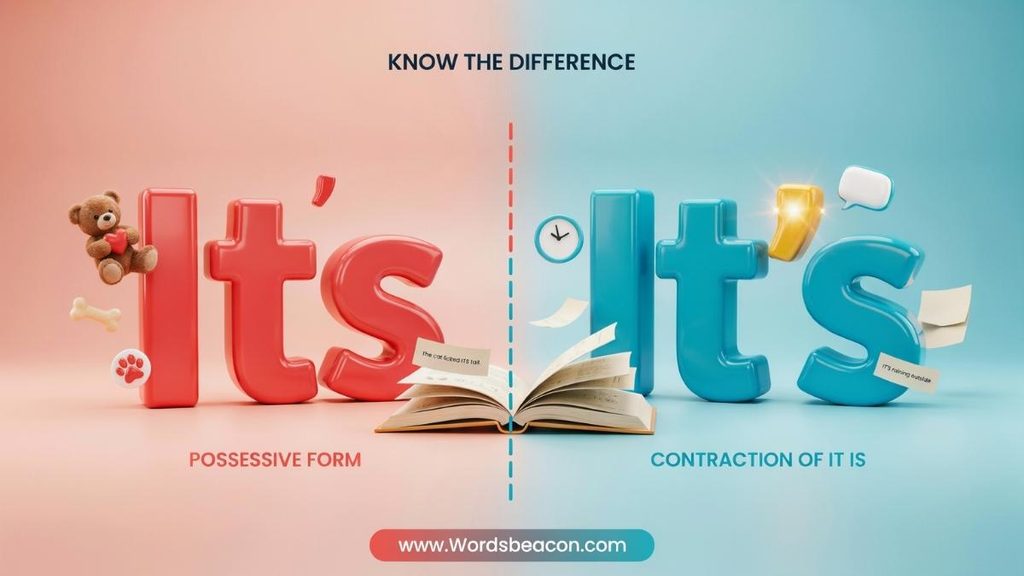
The difference between it is and its comes from their grammatical roles.
It is contains the pronoun it and the verb is.
For example:
1.It is cold.
2.It is difficult.
3.It is ready.
Its, on the other hand, shows possession or association.
For example:
The dog wagged its tail.
The company changed its policy.
The phone lost its connection.
You cannot substitute one for the other because they perform different jobs within a sentence.
This is why it is vs its is not simply a spelling preference. The two forms communicate different grammatical information.
Difference Between It Has and Its
The difference between it has and its follows the same principle.
Consider:
It has changed.
The contracted form is:
It’s changed.
Now compare:
The company changed its policy.
The first expression contains a verb phrase. The second contains a possessive form.
So:
It has → it’s
Belonging to it → its
This simple contrast explains many difficult-looking examples.
Correct Use of Its and It’s
The correct use of its and it’s becomes much easier when you focus on function instead of punctuation.
Ask what the word needs to do.
If it needs to connect something with a noun through possession or association, use its.
If it needs to shorten it is or it has, use it’s.
For example:
The company improved its service because it’s responding to customer feedback.
The first word expresses association with the company.
The second means it is.
Both forms are correct because each one performs a different grammatical job.
Learn the difference between confusing more English words
Flakey vs Flaky which one is correct ?
Practice session Its vs It’s
Fill in each blank with either Its vs It’s.”
- The dog wagged _____ tail when it saw its owner.
- _____ important to check your work before submitting it.
- The company changed _____ logo last year.
- I think _____ going to rain this afternoon.
- The phone lost _____ connection during the call.
- _____ been a long day, so I am ready to relax.
- The bird returned to _____ nest before sunset.
- _____ difficult to understand the instructions at first.
- The school updated _____ website with new information.
- _____ already finished the assignment.
- The car needs _____ tires replaced.
- _____ clear that we need more time.
- The restaurant changed _____ menu for the summer.
- _____ been three weeks since we last met.
- The computer shut down because _____ battery was empty.
- _____ a good idea to read the question carefully.
- The cat cleaned _____ paws after eating.
- _____ easier than you might think.
- The museum is famous for _____ beautiful artwork.
- _____ been a busy week at work.
Answers
- its
- it’s
- its
- it’s
- its
- it’s
- its
- it’s
- its
- it’s
- its
- it’s
- its
- it’s
- its
- it’s
- its
- it’s
- its
- it’s
Here’s a trusted source for clear word meanings:
FAQs
What is the easiest way to remember its vs it’s?
Use the replacement test. If you can replace “it’s” with “it is” or “it has,” use “it’s.” If the word shows belonging or a connection to something, use “its.” For example, “The cat cleaned its paws” shows possession, while “It’s sleeping” means “It is sleeping.”
Why does its not have an apostrophe?
“Its” does not need an apostrophe because it is the possessive form used with “it.” In contrast, the apostrophe in “it’s” shows that letters have been left out of “it is” or “it has.” Therefore, write “The dog hurt its paw,” not “The dog hurt it’s paw.”
Can it’s mean it has?
Yes. “It’s” can mean “it has” when “has” works as part of the verb phrase. For example, “It’s been a busy morning” means “It has been a busy morning.”
Can it’s mean it is?
Yes. “It’s” is commonly used as the contraction of “it is.” For example, “It’s too cold outside” means “It is too cold outside.”
Can its be used before a noun?
Yes. “Its” usually comes before a noun to show possession, belonging, or association. For example, “The company updated its website” means the website belongs to or is connected with the company.
Can it’s be used before a noun?
Yes, but only when “it’s” means “it is” or “it has.” For example, “It’s a new phone” means “It is a new phone.” However, “it’s” cannot show possession.
What does its mean in a sentence?
“Its” means belonging to or relating to something already mentioned. For example, “The school changed its schedule” shows that the schedule belongs to or is associated with the school.
What does it’s mean in English grammar?
“It’s” is a contraction of either “it is” or “it has.” The meaning depends on the sentence. For example, “It’s ready” means “It is ready,” while “It’s changed” can mean “It has changed.”
Are its and it’s interchangeable?
No. Although they usually sound the same, they have different grammatical functions. “Its” shows possession or association, whereas “it’s” means “it is” or “it has.”
How do you use its correctly?
Use “its” before a noun when you want to show that something belongs to or relates to “it.” For example, “The bird spread its wings” uses “its” because the wings belong to the bird.
How do you use it’s correctly?
Use “it’s” when you can expand it to “it is” or “it has.” For example, “It’s difficult” becomes “It is difficult,” while “It’s been raining” becomes “It has been raining.”
What is the difference between its and it’s in writing?
The main difference is their grammatical function. “Its” is used as a possessive determiner before a noun, while “it’s” is a contraction of “it is” or “it has.”
Is “its’” a correct spelling?
No. “Its’” is not the standard spelling. When “its” shows possession, write it without an apostrophe. For example, “The company changed its policy” is correct.
Can you use it’s in formal writing?
Yes. “It’s” is grammatically correct in formal writing when it means “it is” or “it has.” However, some formal styles may prefer the full forms “it is” or “it has,” especially when a more formal tone is desired.
How can context help you choose between its and it’s?
First, check whether the word shows possession or association. If it does, use “its.” Next, try replacing the word with “it is” or “it has.” If either replacement works, use “it’s.” This quick check can prevent many common grammar mistakes.
What is an easy memory trick for its and it’s?
Think of the apostrophe in “it’s” as a signal that two words have been shortened. “It’s” contains the missing letters from “it is” or “it has.” Meanwhile, “its” has no apostrophe when it shows possession.
Why do people confuse its and it’s?
The two words usually sound alike, so pronunciation does not provide much help. In addition, English often uses apostrophes to show possession with nouns, which can make “it’s” look correct when you actually need “its.”
Can its show ownership?
Yes. “Its” can show that something belongs to or is connected with an animal, object, organization, or other thing. For example, “The company announced its decision” shows a connection between the company and the decision.
Can it’s ever show possession?
No. “It’s” does not express possession. If you mean that something belongs to or relates to “it,” use “its.” For example, “The machine lost its power” is correct.
Is its a possessive pronoun?
The terminology can vary slightly between grammar resources. Cambridge describes “its” as a possessive determiner when it comes before a noun, such as “its color” or “its name.” In some dictionary contexts, it may also be described as a possessive form of “it.”
Can its be used by itself?
Usually, no. In standard English, “its” normally appears before the noun it modifies, as in “The dog wagged its tail.” Cambridge notes that “its” is generally not used alone as a possessive pronoun.
What is the fastest way to proofread its and it’s?
Look for the apostrophe first. Then ask whether you can replace “it’s” with “it is” or “it has.” If the sentence still makes sense, “it’s” is likely correct. If you are showing possession or association, choose “its.”
Which is correct: “its color” or “it’s color”?
“Its color” is correct when you mean the color belonging to or associated with something. For example, “The car is known for its color.” “It’s color” would be incorrect because “it’s” means “it is” or “it has.”
Which is correct: “its own” or “it’s own”?
“Its own” is correct. For example, “The company has its own office.” Here, “its” shows possession, while “it’s” would mean “it is” or “it has.”
Does the rule change in British or American English?
The basic distinction remains the same in both British and American English. “Its” expresses possession or association, while “it’s” is the contraction of “it is” or “it has.”
conclusion
The confusion between its and it’s is easy to clear once you know what that little apostrophe is doing. Use its when you mean that something belongs to or relates to something else. For example, “The dog wagged its tail.” Use it’s when you mean “it is” or “it has,” as in “It’s cold today” or “It’s been a busy week.”
When you get stuck, try the simple replacement test. Replace it’s with “it is” or “it has.” If the sentence still makes sense, it’s is the right choice. If it does not, you probably need its.
So, do not let one tiny apostrophe boss you around. Remember: its shows belonging, while it’s means “it is” or “it has.” Once you get this simple difference, one of English’s most common grammar mistakes becomes much easier to avoid.

Luna AJS is an experienced blogger and dedicated language enthusiast at Words Beacon. She specializes in making English grammar, spelling, vocabulary and commonly confused words easy to understand. She provides clear explanations, practical examples to help readers write with confidence.