
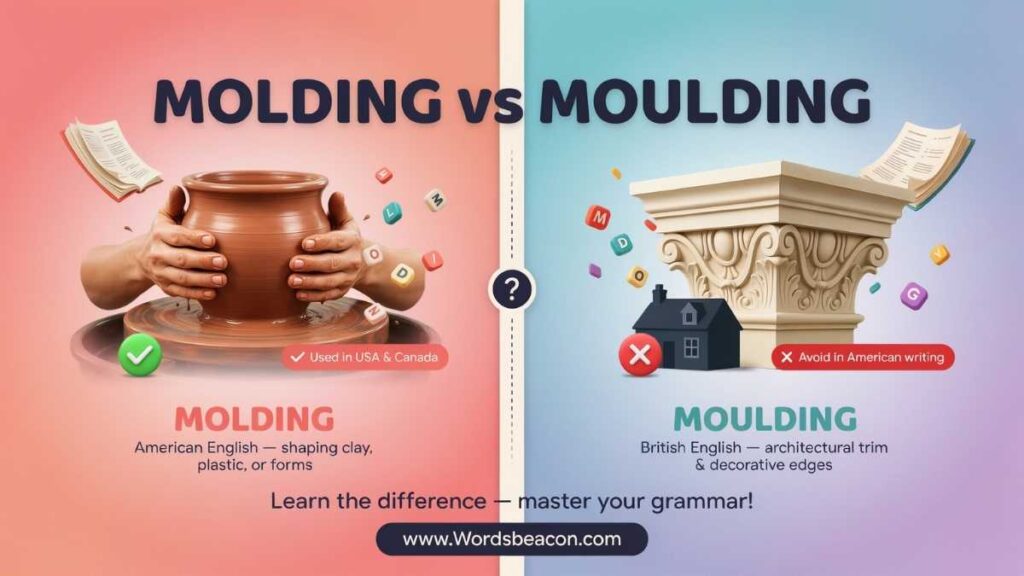
English loves making simple things look complicated, and molding vs moulding is a perfect example. At first, the extra “u” makes these words seem different, but the difference is actually quite simple. Molding is the standard American English spelling, while moulding is the standard British English spelling. Both words have the same basic meaning. They can describe the process of shaping something or a decorative feature used on walls, ceilings, doors, or furniture. So, which one should you use? The answer depends on your audience. If you write for Americans, choose molding. If you follow British English, choose moulding. Once you know this rule, the confusion disappears.
quick answer
Molding and moulding have the same basic meaning. The main difference is the spelling used in American and British English.
| Molding | Moulding |
|---|---|
| American English | British English |
| Standard US spelling | Standard UK spelling |
| Same meaning | Same meaning |
| Example: crown molding | Example: crown moulding |
Use molding for American English and moulding for British English. The key is to choose one spelling and keep it consistent throughout your writing.
Fix common more word mistakes in English
Farther vs Further difference and usage ?
Molding vs Moulding Key Spelling Difference
The Molding and moulding are generally the same word with different regional spellings. Molding is preferred in American English, whereas moulding is preferred in British English. Both forms can describe decorative architectural trim, the process of shaping a material, or the figurative process of influencing someone’s development.
For example, an American writer might say, “The room has beautiful crown molding.” A British writer would normally write, “The room has beautiful crown moulding.”
Nothing about the room changes. The trim does not suddenly become different because one writer adds a u. Only the spelling convention changes.
The pattern is straightforward:
| American English | British English |
|---|---|
| mold | mould |
| molding | moulding |
| molded | moulded |
| moldings | mouldings |
This spelling difference follows the same broader pattern found in other American and British English pairs. Consequently, you can think of molding and moulding as regional variants rather than two separate words.
What Is the Difference Between Molding and Moulding?
The primary difference is spelling. American English generally uses mold without the u, while British English generally uses mould with the u. As a result, the present participle becomes molding in American English and moulding in British English.
The meaning remains essentially the same.
Molding can describe a shaped decorative feature, such as trim around a wall, ceiling, door, or window. It can also describe the act of shaping a material into a particular form. In addition, the verb can have a figurative meaning when something influences the development of a person, idea, habit, or character.
Moulding carries those same meanings in British English and other varieties that use British-style spelling.
Cambridge Dictionary defines moulding as a piece of material such as wood, plastic, or stone shaped for decoration around walls, doors, windows, or furniture. It lists molding as the US spelling.
Therefore, the difference between molding and moulding is primarily a matter of regional usage.
What Does Molding Mean?
The molding meaning depends on the context, but the central idea is shaping.
As a noun, molding can describe a decorative or architectural feature made from materials such as wood, plastic, plaster, or stone. These pieces can appear around walls, ceilings, doors, windows, furniture, and other parts of a building.
For example, crown molding is commonly installed where a wall meets a ceiling. Baseboard molding appears along the lower section of a wall. Door molding can frame a doorway, while window molding can provide a finished border around a window.
Molding also has a manufacturing meaning. In this context, it describes a process used to shape materials into specific forms. Injection molding, for instance, is widely used to produce manufactured plastic components.
The word can also work as a verb form. Someone can mold clay into a figure, mold plastic into a component, or mold an idea through repeated influence.
The figurative meaning is especially useful because it connects physical shaping with personal development. Parents, teachers, experiences, and cultures can all be described as molding someone’s character or behavior.
Cambridge Dictionary also gives the verb mold the meaning of shaping something into a particular form and influencing how someone develops.
Learn the difference between confusing word pairs
Quiet vs Quite difference and usage ?
What Does Moulding Mean?
The moulding meaning is essentially the same as the meaning of molding. The difference lies in the spelling convention.
In British English, moulding can refer to decorative architectural trim, a manufacturing process, the shaping of materials, or the figurative influence that changes someone’s development.
For example, a British writer might say, “The house has traditional wooden moulding around the windows.”
The same sentence in American English would normally use molding.
Moulding can also describe the shaping of clay. An artist might spend an afternoon moulding clay into small figures. Likewise, a manufacturer might use injection moulding to create plastic parts.
The verb mould can also describe influencing a person. Someone’s upbringing can mould their personality, while education can mould their ideas and habits.
Cambridge Dictionary lists mould as the UK form corresponding to the US spelling mold and gives both physical shaping and figurative influence among its meanings.
Is Moulding the Same as Molding?
Yes. In most ordinary contexts, moulding is the British spelling of molding.
Both words can describe the same decorative trim, manufacturing technique, physical shaping process, or figurative influence. They also generally have the same pronunciation.
This point clears up one of the most common misunderstandings. Seeing moulding in a British article does not mean the writer is referring to something different from molding in an American article.
For example, these sentences communicate the same basic idea:
“The contractor installed new crown molding.”
“The contractor installed new crown moulding.”
The first follows American spelling. The second follows British spelling.
Therefore, if you ask, “Is molding and moulding the same?” the practical answer is yes, when the words are being used in their ordinary senses.
Learn the difference between confusing word pairs
Its vs It’s Difference and usage ?
Molding vs Moulding Meaning in Architecture
Architecture is one of the most familiar areas where this spelling difference appears.
Molding or moulding can refer to a decorative strip or shaped feature used to give a building more visual detail. Depending on the design, it can create transitions between surfaces, frame openings, cover joints, or simply add an ornamental finish.
Common examples include crown molding, baseboard molding, door molding, window molding, and ceiling trim.
In American English, you will normally see terms such as crown molding and baseboard molding. In British English, crown moulding and related forms are more typical.
The material can also vary. Traditional architectural trim may use wood or plaster, while modern products can use plastic, composite materials, or other manufactured substances.
Consequently, molding is not limited to one particular material or design style.
Crown Molding vs Crown Moulding
The Crown molding and crown moulding refer to the same type of architectural trim.
Crown molding is the usual American spelling. Crown moulding is the usual British spelling.
The trim is generally positioned where the wall meets the ceiling. Depending on the building, it may have a simple profile or a highly decorative architectural design.
For example, a homeowner in the USA might search for “crown molding installation.” Someone in the UK might search for “crown moulding installation.”
The search terms differ, but the product being discussed can be the same.
Baseboard Molding vs Baseboard Moulding
Baseboard molding and baseboard moulding also illustrate the regional spelling difference.
In American English, baseboard molding commonly describes decorative trim installed along the bottom of a wall. In British English, related terminology can vary, and skirting board is also widely used for this part of a room.
That difference is useful because it shows that regional vocabulary can involve more than spelling alone. Sometimes English varieties use different words for the same object. However, when the word molding or moulding appears, the spelling distinction itself remains predictable.
Molding vs Moulding in Construction
Construction provides plenty of real-world examples of this regional spelling variation.
Architectural molding can add detail to walls, ceilings, doors, windows, cabinets, and other structures. It may also conceal small transitions or joints between surfaces.
A construction company serving an American audience might advertise decorative molding, custom molding, or crown molding. A British company might advertise decorative moulding, custom moulding, or crown moulding.
The choice depends on the regional spelling convention.
Furthermore, consistency becomes especially important in construction documents. Specifications, product descriptions, catalogs, and installation instructions should normally follow the spelling system used by the organization and its intended audience.
Learn the difference between tricky grammar words
Learned vs Learnt difference and usage ?
Molding vs Moulding in Manufacturing
The word takes on a more technical meaning in manufacturing.
A molding process or moulding process shapes a material into a desired form. Depending on the manufacturing method, the material can be plastic, rubber, metal, composite material, wax, or another substance that can be shaped under controlled conditions.
Injection molding is one of the most familiar examples.
In American English, the standard term is injection molding. British English uses injection moulding.
The process itself does not change because of the spelling. Manufacturers use molds or moulds with specially designed cavities. Material enters the cavity, takes its shape, and then becomes a finished component after the relevant cooling, curing, or solidification stage.
This technique is important in mass manufacturing because it can produce repeated components with consistent dimensions and shapes.
Injection Molding vs Injection Moulding
Injection molding and injection moulding are regional forms of the same technical term.
American technical writing generally uses injection molding.
British technical writing generally uses injection moulding.
The same distinction applies to related terminology. A US document may discuss a molding machine, molding process, or molded plastic component. A British document may use moulding machine, moulding process, and moulded plastic component.
Therefore, when reading technical material, the spelling can help you identify the regional English convention being followed.
Learn the difference between tricky grammar words
To vs Too difference and usage?
Plastic Molding vs Plastic Moulding
The Plastic molding and plastic moulding describe the same broad concept when used in corresponding regional varieties of English.
Plastic can be shaped through several manufacturing techniques, and molding is one important category. The exact process depends on the type of plastic, product design, equipment, production requirements, and desired properties.
For example, injection molding can create detailed plastic components with consistent dimensions. Other molding techniques can suit different materials, shapes, and production conditions.
So, although plastic molding and plastic moulding look different on the page, the spelling does not tell you that two different manufacturing technologies are being discussed.
Clay Molding vs Clay Moulding
The same distinction appears in art and crafts.
An American writer might describe clay molding, while a British writer might describe clay moulding.
In both cases, the basic idea involves shaping clay into a desired form. Artists can use their hands, tools, molds, or a combination of methods depending on the type of work they want to create.
For example, a sculptor may mold clay into a figure before allowing it to dry or preparing it for another stage of production.
Here again, the regional spelling changes while the underlying action remains the same.
Molding and Moulding as a Figurative Verb
The word becomes particularly interesting when it moves beyond physical objects.
To mold or mould someone can mean to influence how that person develops. The idea comes from the physical process of shaping material into a particular form.
For example, a teacher can help mold a student’s confidence. A difficult experience can mold someone’s worldview. A person’s family environment can mould their habits and values.
This use does not suggest that a person literally changes shape. Instead, it describes gradual influence.
That is why expressions about molding character, molding behavior, or moulding attitudes appear in education, psychology, literature, journalism, and everyday conversation.
The physical and figurative meanings share the same basic concept: something influences the eventual form of something else.
Learn the difference between tricky grammar words
Breath vs Breathe which one is correct ?
Molding Pronunciation and Moulding Pronunciation
Molding pronunciation and moulding pronunciation are generally the same.
The spelling difference does not normally add another syllable. Both forms are generally pronounced with two syllables, and the spelling difference mainly appears on the page rather than in ordinary speech.
Cambridge Dictionary gives different phonetic representations for the US and UK accents, reflecting the broader pronunciation differences between American and British English. However, the presence or absence of the u in the spelling does not itself create a separate word or a separate meaning.
Therefore, the question “Do molding and moulding have the same pronunciation?” can usually be answered yes.
The exact sound can naturally vary with accent. American English and British English do not pronounce every vowel in exactly the same way. Nevertheless, the two spellings represent the same lexical item in their respective regional varieties.
Molding vs Moulding and the Word Mold
Understanding mold and mould makes the entire comparison easier.
In American English, mold can refer to a container used to give soft or liquid material a particular shape. It can also refer to fungal growth.
British English uses mould for these corresponding meanings.
For example, a cook might pour gelatin into a mold in American English. A British writer might refer to a jelly mould.
At the same time, mold and mould can refer to fungus.
American English commonly uses black mold, food mold, and mold growth. British English commonly uses black mould, food mould, and mould growth.
These meanings can seem confusing because the same spelling family connects several concepts. However, context normally makes the intended meaning clear.
Do Not Confuse Molding With Mold Growth
Molding and mold are related in spelling, but they can refer to completely different things in a sentence.
Consider this example:
“The carpenter installed new molding around the door.”
Here, molding means decorative trim.
Now compare it with:
“The homeowner discovered mold behind the wall.”
Here, mold means fungal growth.
British English can use mould in the second sentence, while moulding remains the architectural or shaping-related form.
Therefore, context matters more than the letters alone.
Learn the difference between confusing more English words
Yours vs Your’s which one is correct ?
Molding British vs American Spelling

The phrase molding British vs American often appears because readers want to know whether molding belongs to one English variety or the other.
The answer is straightforward: molding is the standard American spelling, while moulding is the standard British spelling.
The difference extends through the word family.
American English uses mold, molding, molded, and moldings.
British English uses mould, moulding, moulded, and mouldings.
This consistency matters in professional writing. If a document uses British spelling throughout, suddenly switching to molding can make the text look inconsistent. Similarly, an American document that uses moulding in an otherwise American spelling system may appear unusual.
Moulding American vs British Spelling
The reverse question works in exactly the same way.
Moulding is strongly associated with British English and is also used in other varieties that retain British-style spelling conventions.
Molding is the usual American form.
However, English varieties do not always follow perfectly rigid rules. Canadian English, Australian English, and New Zealand English have their own histories and style preferences. Therefore, regional usage should be understood as a general convention rather than an absolute rule for every writer and publication.
Australian and New Zealand writing commonly retains many British spelling patterns. Canadian English can show a mixture of British and American influences.
As a result, the safest professional approach is to follow the style guide or established convention used by your target publication or organization.
Is Molding American or British?
Molding is the standard American English spelling.
British English normally uses moulding.
That distinction also applies to the base word. American English uses mold, while British English uses mould.
So the pattern is easy to remember:
American English: mold → molding
British English: mould → moulding
Is Moulding British English?
Yes. Moulding is the standard British English spelling corresponding to American molding.
You will encounter it in British writing about architecture, construction, manufacturing, art, design, and figurative language.
For example:
“The house has traditional decorative moulding.”
A US writer would normally use:
“The house has traditional decorative molding.”
Both sentences express the same idea.
Learn the difference between confusing more English words
Lose vs Loose which one is correct ?
Is Moulding Used in American English?
Moulding can certainly be understood by American readers, and it can appear in American publications, especially in names, quotations, international material, or contexts that retain British spelling.
However, molding is the normal American spelling.
Therefore, if your target audience is specifically American, molding is generally the preferred spelling.
Which Spelling Should You Use?
The best choice depends on your target audience.
If you are writing for the USA, use molding. And If you are writing for the UK, use moulding. If you are writing for Canada, Australia, New Zealand, or another English-speaking market, check the relevant style convention when consistency matters.
The important point is not to treat one spelling as universally correct.
Instead, choose a regional convention and stick with it.
For example, an American article could consistently use mold, molding, molded, and moldings. A British article could consistently use mould, moulding, moulded, and mouldings.
That approach creates clean writing consistency and prevents unnecessary spelling confusion.
Common Molding vs Moulding Mistakes
One common mistake is assuming that moulding must be wrong because it contains an extra letter. It is not. The spelling is standard in British English.
Another mistake is assuming that molding is incomplete because it drops the u. It is not. The spelling is standard in American English.
A third mistake involves mixing regional forms within the same piece of writing. For example, a document may use moulding in one paragraph and molding in the next without any reason. Readers can understand both, but the inconsistent style can make the document look poorly edited.
Another frequent problem appears in related words. Writers may remember molding but then write moulded or vice versa. Checking the base spelling solves this problem quickly.
If you choose mold, use molding and molded.
If you choose mould, use moulding and moulded.
Learn the difference between confusing more English words
Tweek vs Tweak difference and usage?
Molding vs Moulding in Everyday Writing
In everyday writing, the choice is usually simple.
An American writer might write:
“The old house has beautiful wooden molding.”
A British writer might write:
“The old house has beautiful wooden moulding.”
An American manufacturer might advertise injection molding.
A British manufacturer might advertise injection moulding.
An American artist might describe clay molding.
A British artist might describe clay moulding.
The context stays the same. The spelling changes with the regional convention.
Molding vs Moulding A Simple Rule to Remember
When you are unsure, look at the base word.
If your writing uses mold, write molding.
If your writing uses mould, write moulding.
That gives you a quick consistency check:
Mold → molding → molded → moldings
Mould → moulding → moulded → mouldings
Once the pattern becomes familiar, the spelling becomes much easier to remember.
Learn the difference between confusing more English words
Courtesy vs Curtesy Difference and usage ?
Practice session molding vs moulding
Fill in each blank with molding or moulding.
- In American English, the preferred spelling is __________.
- In British English, the preferred spelling is __________.
- The designer added decorative __________ around the ceiling. (US)
- The designer added decorative __________ around the ceiling. (UK)
- The factory uses injection __________ to produce plastic parts. (US)
- The factory uses injection __________ to produce plastic parts. (UK)
- The house has beautiful crown __________ in the living room. (US)
- The house has beautiful crown __________ in the living room. (UK)
- The carpenter installed wooden __________ around the doors. (US)
- The carpenter installed wooden __________ around the doors. (UK)
- The artist is __________ the clay into a small bowl. (US)
- The artist is __________ the clay into a small bowl. (UK)
- A British writer would normally use the spelling __________.
- An American writer would normally use the spelling __________.
- The two spellings have the same basic meaning, but their __________ differs.
- The architect chose traditional wall __________ for the historic building. (US)
- The architect chose traditional wall __________ for the historic building. (UK)
- If your audience is mainly American, choose __________ for consistency.
- If your audience is mainly British, choose __________ for consistency.
- The simplest rule is: US English uses __________, while UK English uses __________.
Answers
- molding
- moulding
- molding
- moulding
- molding
- moulding
- molding
- moulding
- molding
- moulding
- molding
- moulding
- moulding
- molding
- spelling
- molding
- moulding
- molding
- moulding
- molding, moulding
Here’s a trusted source for clear word meanings:
FAQs
Can I use “molding” in British English?
Yes, readers in Britain will understand molding, but moulding is the standard British spelling. If you are writing specifically for a British audience, moulding is the more natural choice.
Can I use “moulding” in American English?
Yes, the meaning will still be clear. However, American English normally uses molding without the “u.” For US-focused writing, molding is the standard spelling.
Does the “u” in moulding change its meaning?
No. The “u” does not create a different meaning. Moulding and molding are regional spellings of the same word, so the difference is mainly a matter of English variety.
Are “moulding” and “molding” different words?
Not in their ordinary uses. They represent the same word in British and American English. Both can describe the shaping of material or a decorative shaped feature used in buildings and furniture.
Can “molding” refer to the process of shaping something?
Yes. Molding can describe the process of giving a material a particular shape. The same idea is expressed with moulding in British English.
Can “moulding” refer to a decorative architectural feature?
Yes. Moulding can describe a shaped strip made from materials such as wood, plastic, stone, or plaster that adds decoration to walls, doors, windows, ceilings, or furniture.
Does the spelling change in “molded” and “moulded”?
Yes. American English generally uses molded, while British English uses moulded. The same regional spelling pattern appears in the related forms mold/mould and molding/moulding.
Is “molding” used in manufacturing?
Yes. Molding is widely used when discussing manufacturing processes that shape materials into specific forms. For example, American English uses the term injection molding.
What is the British form of “injection molding”?
The British form is injection moulding. Both terms describe the same manufacturing process; only the regional spelling changes.
Does “molding” always refer to construction?
No. Although molding commonly appears in architecture and interior design, the word also has uses in manufacturing, crafts, sculpture, and other situations involving shaping or forming materials.
Can “moulding” be used for furniture?
Yes. Moulding can describe decorative shaped material added to furniture. American English would normally use molding for the same feature.
Does “molding” have the same pronunciation as “moulding”?
The two forms have corresponding US and UK pronunciations, and the spelling difference does not create a completely different word or sound. Regional accents can produce small pronunciation differences.
Why is there a “u” in moulding?
The “u” reflects the British spelling of mould. American English commonly uses mold instead, so the related form becomes molding. This pattern also appears in other British-American spelling differences.
Is “molding” acceptable in professional writing?
Yes. Molding is completely acceptable in professional American English. In British professional writing, moulding is normally preferred. The important point is to follow the spelling convention appropriate for your audience.
Should I change “moulding” to “molding” when writing for US readers?
If you are adapting a document to standard American English, changing moulding to molding can make the spelling consistent with US conventions. The meaning remains unchanged.
Should a British website use “molding”?
A British website can use molding, particularly when quoting a US source or referring to an American product name. However, ordinary British English generally uses moulding.
Is “molding” a noun or a verb?
It can function as a noun or as the present participle of the verb mold. As a noun, it can describe a decorative feature or the process of shaping. As a verb form, it describes the act of shaping or influencing something.
Is “moulding” only used for physical objects?
No. Moulding can also have figurative uses when it comes from the verb mould. For example, someone may say that an experience is moulding a person’s character. The physical and figurative meanings depend on context.
How can I remember whether to write molding or moulding?
Start with the base word. If you use American English, remember mold → molding. If you use British English, remember mould → moulding. This simple connection makes the spelling much easier to remember.
Which spelling is better for an international article?
Neither spelling is universally better. Choose the variety that matches your main audience or your publication’s style guide. Then use that spelling consistently throughout the article.
conclusion
The confusion between molding vs moulding may look bigger than it really is. In fact, the difference comes down to one little letter. Molding is the standard American English spelling, while moulding is the standard British English spelling. Both have the same basic meaning and can describe either the process of shaping something or a decorative feature used on walls, doors, ceilings, and furniture.
So, which one should you use? Simply match the spelling to your audience. If you are writing for American readers, choose molding. If you are following British English, choose moulding. The same pattern applies to related words, such as mold and mould or molded and moulded.
Most importantly, do not treat one spelling as a mistake just because you are more familiar with the other. English has plenty of regional spelling differences, and this is simply one of them. Once you remember the easy rule, US English uses mold → molding, while British English uses mould → moulding. That tiny “u” may cause a little confusion, but it certainly does not need to cause a grammar headache.

Luna AJS is an experienced blogger and dedicated language enthusiast at Words Beacon. She specializes in making English grammar, spelling, vocabulary and commonly confused words easy to understand. She provides clear explanations, practical examples to help readers write with confidence.