
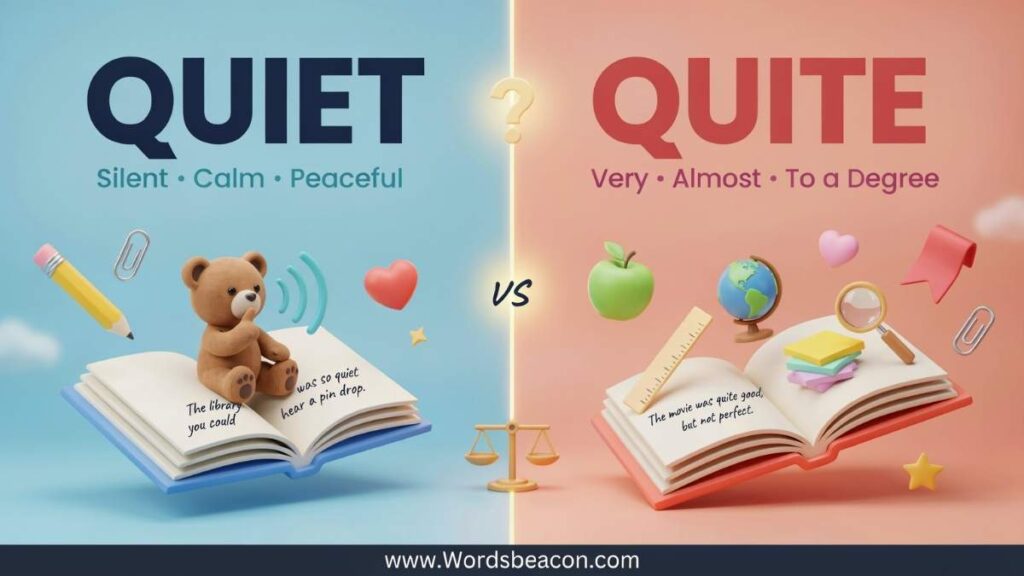
Quiet and quite look almost identical, so it is easy to mix them up. However, they have completely different meanings. Quiet describes something with little noise or activity, while quite is used to show degree, such as “fairly,” “very,” or “completely,” depending on the context. That small spelling difference can create a surprisingly big grammar mistake. For example, “The room is quiet” means there is little noise, while “The room is quite large” tells us about its size. Once you understand this simple difference, quiet vs quite becomes much easier to remember, spell, pronounce, and use correctly in everyday English without second-guessing yourself.
Quick answer
Quiet and quite may look similar, but their meanings and uses are completely different.
| Word | Meaning | Example |
|---|---|---|
| Quiet | Little noise or activity | The room is quiet. |
| Quite | Shows degree or emphasis | The room is quite large. |
| Part of speech | Quiet: adjective, noun, verb | Quite: adverb |
| Pronunciation | /ˈkwaɪ.ət/ | /kwaɪt/ |
Remember: use quiet for silence or calm, and quite for degree or emphasis.
Fix common more word mistakes in English
Its vs It’s Difference and usage ?
Quiet vs Quite What Is the Difference?
The basic quiet vs quite difference comes down to meaning.
Quiet describes something that makes little or no noise. It can also describe a person who does not talk much, a place with little activity, or a situation that feels calm and peaceful. Cambridge Dictionary defines quiet as an adjective that can describe something with very little noise or activity. It also uses quiet for people who do not talk much.
Quite, on the other hand, normally works as an adverb. It expresses degree or extent. Depending on the context, it can mean fairly, rather, very, completely, or entirely. Cambridge notes that the exact strength of quite can depend on the word or expression it modifies.
Consider these two sentences:
| Sentence | What the word means |
|---|---|
| The library is quiet. | The library has little noise. |
| The library is quite large. | The library is fairly or noticeably large. |
So, if you are asking, “What is the difference between quiet and quite?” the simplest answer is this: quiet relates to noise or calm, while quite expresses degree or extent.
That distinction also answers the common question, “Is it quiet or quite?” Look at the meaning first. If the sentence concerns silence or low noise, use quiet. If the sentence describes how much, how strongly, or to what extent something is true, use quite.
What Does Quiet Mean?
The quiet meaning centers on low noise, calmness, silence, or limited activity. However, quiet can describe more than a completely silent environment.
The quiet definition includes situations where there is little sound or activity. It can also describe a person who does not speak much. For example, a quiet neighborhood may still have cars, conversations, and birds. It simply has relatively little noise or activity compared with a busy area.
Consider these sentences:
The library is quiet.
The street becomes quiet after midnight.
She is a quiet person.
We had a quiet evening at home.
In each sentence, quiet points toward low noise, calmness, or limited activity.
Quiet as an Adjective
The most common grammatical role of quiet is an adjective. Therefore, the phrase quiet adjective is useful for understanding how the word behaves.
An adjective describes a noun or gives information about a person, place, thing, or situation. Quiet can describe a room, neighborhood, person, voice, evening, restaurant, street, or conversation.
For example:
The baby has a quiet voice.
They live on a quiet street.
We found a quiet restaurant.
He is usually quiet during meetings.
The town has a quiet atmosphere.
Notice that quiet does not always mean silent. Instead, it usually suggests that noise or activity stays at a low level.
That distinction becomes important when comparing quiet with silent. A silent room has virtually no sound, while a quiet room can still contain soft conversations, background noise, or occasional movement.
Quiet as a Noun
Quiet can also function as a noun. In this form, it refers to a state or period of little or no noise.
For example:
I enjoyed the quiet after everyone left.
She needed some quiet after a busy day.
The house finally returned to quiet.
This use appears naturally in expressions such as peace and quiet. In that expression, quiet refers to a calm condition without much noise or activity. Cambridge also lists quiet as a noun meaning a state in which there is little or no noise.
Therefore, the answer to “Can quiet be a noun?” is yes.
Quiet as a Verb
Quiet can also work as a verb. In this form, it means to become calmer or less noisy, or to make someone or something calmer or less noisy.
For example:
The teacher quieted the class.
The crowd quieted when the speaker arrived.
The baby finally quieted down.
She tried to quiet the barking dog.
American English commonly uses quiet as a verb, while quieten appears more often in British English. Cambridge specifically lists quiet as a verb meaning to become or cause someone or something to become calmer or less noisy.
As a result, quiet has more grammatical flexibility than quite. Quiet can function as an adjective, noun, or verb.
Fix common more word mistakes in English
Learned vs Learnt difference and usage ?
What Does Quite Mean?
The quite meaning is completely different.
Quite is mainly an adverb that expresses degree, extent, or emphasis. In other words, it tells you how much or to what extent something applies.
For example:
The movie was quite interesting.
The test was quite difficult.
She speaks quite clearly.
The room is quite large.
The weather is quite warm.
In each sentence, quite modifies another word. It does not describe noise or silence.
That is why the phrase quite adverb matters when learning the quiet vs quite grammar difference.
Quite Can Mean Fairly or Rather
In many everyday sentences, quite means something similar to fairly or rather.
For example:
The restaurant is quite expensive.
The book is quite interesting.
The road is quite narrow.
The assignment was quite difficult.
Here, quite indicates a noticeable degree without necessarily meaning the strongest possible degree.
However, context matters. The exact force of quite can change depending on the word that follows it and the variety of English being used. Cambridge explains that quite can have different strengths with different types of adjectives and expressions.
Therefore, English learners should avoid treating quite as a perfect synonym for one word such as very. In some sentences, fairly or rather may capture the meaning better. In other contexts, quite can mean completely or entirely.
Quite Can Mean Completely
Quite can also express completeness.
For example:
The two situations are quite different.
I am not quite ready.
The colors almost match but not quite.
In the first sentence, quite can mean completely or totally different. In “not quite ready,” it means not completely ready.
Cambridge specifically lists completely as one meaning of quite and explains the use of not quite for something that falls short of being complete.
Consequently, context matters more than a simple one-word translation.
Quite Can Express a Large Degree
Quite can also emphasize the degree or amount of something.
For example:
We have quite a lot of work today.
There were quite a few people at the event.
She has been waiting for quite a while.
He has quite a bit of experience.
Here, quite adds emphasis to the amount or duration. Cambridge specifically recognizes expressions such as quite a lot, quite a few, quite a bit, and quite a while.
So, when asking what does quite mean in English, the safest answer is that it is a degree or emphasis word whose exact meaning depends on context.
Fix common more word mistakes in English
To vs Too difference and usage?
Quiet vs Quite Grammar Parts of Speech

Grammar provides one of the easiest ways to separate these commonly confused words.
Quiet can work as an adjective, noun, or verb. Quite primarily works as an adverb.
| Word | Part of speech | Main grammatical function |
|---|---|---|
| quiet | Adjective | Describes low noise, calmness, or limited activity |
| quiet | Noun | Refers to a state of calm or silence |
| quiet | Verb | Means to become or make something less noisy or calmer |
| quite | Adverb | Expresses degree, extent, or emphasis |
Consider how the words behave in actual sentences.
The classroom is quiet.
Here, quiet describes the classroom.
I enjoyed the quiet.
Here, quiet acts as a noun.
The teacher quieted the students.
Here, quiet acts as a verb.
The classroom is quite spacious.
Here, quite modifies the adjective spacious.
Therefore, if you are unsure whether a sentence needs quiet or quite, checking the grammatical function can help you find the correct word.
Quiet vs Quite Pronunciation
The quiet vs quite pronunciation difference makes these words easier to separate when you hear them.
In standard US English, quiet has two syllables and quite has one syllable. Cambridge gives the US pronunciation of quiet as /ˈkwaɪ.ət/ and quite as /kwaɪt/.
The difference becomes obvious when you say them slowly.
Quiet contains an additional unstressed syllable after the first sound.
Quite ends after one syllable.
That means quiet takes slightly longer to pronounce, while quite ends with a clear final t.
How Do You Pronounce Quiet?
If you are wondering how do you pronounce quiet, remember that it has two syllables.
The standard US pronunciation is /ˈkwaɪ.ət/.
The first syllable carries the main stress. The second syllable has a weaker vowel sound.
How Do You Pronounce Quite?
Quite has one syllable. Its standard US pronunciation is /kwaɪt/.
The word begins with the same broad opening sound as quiet, but it ends immediately after the final t.
As a result, the pronunciation difference provides a useful memory aid.
Are Quiet and Quite Homophones?
No. Quiet and quite are not homophones in standard English.
Homophones have the same pronunciation but different meanings or spellings. Quiet and quite do not meet that definition because quiet has two syllables while quite has one.
Therefore, although quiet and quite look similar, they are not simply two spellings of the same sound.
Breath vs Breathe which one is correct ?
Quiet vs Quite Spelling Difference
The quiet vs quite spelling difference looks tiny, but the missing letter changes everything.
Quiet is spelled:
q-u-i-e-t
Quite is spelled:
q-u-i-t-e
The main visual difference appears near the end of each word.
Quiet contains the sequence iet.
Quite contains the sequence ite.
That distinction becomes easier to remember when you connect spelling with pronunciation. Quiet has an extra syllable, while quite has only one syllable.
For example:
Quiet room.
Quite large.
Quiet person.
Quite difficult.
Quiet street.
Quite interesting.
Therefore, when asking how do you spell quiet, remember q-u-i-e-t. When asking how do you spell quite, remember q-u-i-t-e.
Quiet vs Quite Examples
Context makes the quiet vs quite difference much easier to understand. Instead of memorizing isolated definitions, compare the words inside complete sentences.
Talking About a Room
The room is quiet.
Here, the room has little noise.
The room is quite large.
Here, quite describes the degree of the room’s size.
Talking About a Person
Maria is quiet during meetings.
Here, Maria does not talk much.
Maria is quite confident during meetings.
Here, quite tells us the degree of her confidence.
Talking About a Street
The street becomes quiet at night.
Here, the street has little noise or activity.
The street is quite narrow.
Here, quite modifies the adjective narrow.
Talking About a Movie
The movie became quiet near the end.
Here, the sound or activity decreased.
The movie was quite entertaining.
Here, quite expresses the degree of entertainment.
Talking About Weather
It was a quiet afternoon.
The afternoon felt calm and uneventful.
It was quite warm that afternoon.
Quite describes the degree of warmth.
These examples show why context matters so much in English vocabulary.
Learn the difference between confusing more English words
Yours vs Your’s which one is correct ?
Quiet vs Quite Sentence Comparison
A side-by-side comparison can make the distinction even clearer.
| Quiet sentence | Quite sentence |
|---|---|
| The baby is quiet. | The baby is quite happy. |
| This is a quiet street. | This street is quite narrow. |
| Please keep quiet. | The task is quite easy. |
| We need a quiet room. | We need quite a large room. |
| The office is quiet today. | The office is quite comfortable. |
| He became quiet. | He became quite nervous. |
Notice the pattern. Quiet describes sound, calmness, activity, or a person’s tendency to speak. Quite changes the degree of another description.
That pattern gives you a practical answer to the question, “What is the difference between quiet and quite?”
Quiet vs Quite Synonyms
The quiet vs quite synonym question can cause confusion because each word belongs to a different group of meanings.
Depending on context, quiet can relate to words such as calm, peaceful, silent, still, hushed, tranquil, or soundless.
However, these words do not always mean exactly the same thing.
For example, silent usually suggests an absence of sound. Quiet can allow some sound while still describing the environment as peaceful or low in noise.
Quite has a different group of possible replacements. Depending on context, it can relate to fairly, rather, very, completely, entirely, considerably, or to a large degree.
For example:
1.The movie was quite good.
2.The movie was fairly good.
3.The movie was rather good.
These substitutions can work in some contexts, although they do not always create exactly the same tone or strength.
Therefore, synonym choice should always follow context rather than spelling.
When to Use Quiet vs Quite
The easiest way to understand when to use quiet vs quite is to ask what the sentence actually means.
If you are talking about noise, silence, calmness, or limited activity, use quiet.
For example:
The house is quiet.
Please be quiet.
We found a quiet place.
She enjoys quiet mornings.
If you are talking about degree or extent, use quite.
For example:
The house is quite large.
The movie was quite good.
The assignment was quite difficult.
She arrived quite early.
This simple distinction handles most everyday uses.
Learn the difference between confusing more English words
Lose vs Loose which one is correct ?
Common Quiet vs Quite Mistakes

Because the words look similar, spelling mistakes happen quickly. Fortunately, the errors are usually easy to fix once you understand the meaning.
“Please Be Quite”
This sentence is incorrect if the speaker wants someone to stop making noise.
The correct sentence is:
Please be quiet.
Here, the word relates to silence or low noise.
“The Test Was Quiet Difficult”
This sentence is incorrect because the writer wants to express the degree of difficulty.
The correct version is:
The test was quite difficult.
Quite modifies difficult, so the sentence needs the adverb.
“The Classroom Was Quite”
If the intended meaning is that the classroom had little noise, the correct sentence is:
The classroom was quiet.
Quite alone does not describe the classroom as silent or calm.
“She Is Quite During Meetings”
If the writer means that she does not talk much, the correct sentence is:
She is quiet during meetings.
However, this sentence is different:
She is quite confident during meetings.
Here, quite modifies confident and expresses degree.
That small distinction changes the entire meaning.
Learn the difference between confusing more English words
Tweek vs Tweak difference and usage?
Quiet, Quite, and Quit
The confusion does not stop with quiet and quite. Quit often joins the group because its spelling looks similar.
Still, quit has a completely different meaning.
| Word | Meaning | Example |
|---|---|---|
| quiet | Little noise, calmness, or silence | The room is quiet. |
| quite | Degree, extent, or emphasis | The room is quite large. |
| quit | Stop or leave | He decided to quit. |
Quit vs Quiet
Quit is a verb that means to stop doing something or leave something.
For example:
She quit her job.
He quit smoking.
They quit the game.
Quiet, however, concerns noise or calmness.
For example:
Please be quiet.
The room became quiet.
The children grew quiet.
Therefore, quit and quiet may look similar, but their meanings have almost nothing in common.
Quit vs Quite
Quite expresses degree or extent.
Quit means stop or leave.
Compare these sentences:
The movie was quite interesting.
He decided to quit watching the movie.
The first sentence describes the movie. The second describes an action that someone stopped.
Quiet Quite Quit Pronunciation
Pronunciation helps separate all three words.
Quiet has two syllables.
Quite has one syllable.
Quit also has one syllable.
However, quite and quit do not have the same vowel sound. Quite contains the vowel sound found in words such as “time,” while quit uses the short vowel sound found in words such as “sit.”
As a result, listening carefully can help prevent the spelling confusion.
Learn the difference between similar English words
Courtesy vs Curtesy Difference and usage ?
How to Use Quiet and Quite in a Sentence
When learning how to use quiet and quite, start with meaning and then check grammar.
If you want to describe a calm or low-noise environment, use quiet.
The library is quiet in the morning.
If you want to express the degree of an adjective, use quite.
The library is quite comfortable.
If you want to describe a person who does not speak much, use quiet.
He is quiet during large meetings.
If you want to emphasize an adjective, use quite.
He is quite confident when discussing his work.
This method works because the words perform different grammatical jobs.
A Simple Memory Trick for Quiet vs Quite
The question how to remember quiet vs quite has a very simple answer.
Think of quiet as the word connected with silence.
1.Quiet room.
2.Quiet street.
3.Quiet voice.
4.Quiet evening.
Then think of quite as the word connected with degree.
1.Quite good.
2.Quite difficult.
3.Quite large.
4.Quite interesting.
5.Quite often.
In other words:
Quiet = noise and calm.
Quite = degree and extent.
That small mental connection can prevent a surprising number of spelling mistakes.
Learn the difference between similar English words
More Than vs More Then difference and usage ?
Quiet vs Quite in Everyday English

These words appear frequently in normal conversations and everyday writing.
At home, someone might say:
The house is finally quiet.
At work, someone might write:
The office is quite busy today.
At school, a teacher might say:
Please keep quiet during the test.
A student might later say:
The test was quite difficult.
In a conversation, someone might ask:
Why are you so quiet?
Another person might respond:
I am quite tired today.
Although the words appear close together in these examples, their meanings remain separate.
That is exactly why learning them through context works so well.
Quiet vs Quite for English Learners
English learners often struggle with these words because their spelling looks more similar than their meanings suggest.
Both words begin with q-u-i-t. However, quiet adds an e before the final t, while quite places the e at the end.
Their pronunciation also differs.
Quiet has two syllables.
Quite has one syllable.
Their grammatical functions differ as well.
Quiet can work as an adjective, noun, or verb.
Quite mainly works as an adverb.
Therefore, memorizing spelling alone does not provide the full answer. Instead, connect spelling, pronunciation, meaning, and grammar.
Once those four pieces fit together, the distinction becomes much easier.
Learn the difference between similar English words
Weiner vs Wiener Which one Is Correct?
Practice Session Quiet vs Quite
Fill in each blank with the correct word: quiet vs quite. These sentences test meaning, grammar, spelling, and everyday usage.
- Please be ______ while the baby is sleeping.
- The movie was ______ interesting.
- The library is usually very ______ in the afternoon.
- I am ______ sure that I locked the door.
- The students became ______ when the teacher entered the room.
- She is ______ good at playing the piano.
- We enjoyed the peace and ______ of the countryside.
- The street becomes ______ after midnight.
- That was ______ an impressive performance.
- He spoke in a ______ voice during the meeting.
- The two answers are ______ different.
- Could you keep ______ for a few minutes?
- The restaurant was ______ crowded last night.
- I need some ______ so I can finish my work.
- She is ______ shy around new people.
- The weather is ______ pleasant today.
- The children were surprisingly ______ during the trip.
- I do not ______ understand what you mean.
- The room became ______ after everyone left.
- We had ______ a lot of work to finish before Friday.
Answers
- quiet
- quite
- quiet
- quite
- quiet
- quite
- quiet
- quiet
- quite
- quiet
- quite
- quiet
- quite
- quiet
- quite
- quite
- quiet
- quite
- quiet
- quite
Here’s a trusted source for clear word meanings:
FAQs
Can quiet describe a situation instead of a sound?
Yes. Quiet can describe a situation, place, period, or activity that has little noise, movement, or excitement. For example, “It was a quiet evening at home” suggests a calm evening with little activity.
Can quite appear before a noun?
Yes. Quite can appear in the structure “quite a/an + noun” to add emphasis. For example, “It was quite a surprise” emphasizes how surprising the event was. Similarly, “She is quite an expert” gives extra emphasis to the noun phrase.
What does “not quite” mean?
“Not quite” usually means not completely or not exactly. For example, “The report is not quite finished” means the report is almost finished but still needs some work. Therefore, quite can express a sense of incompleteness when it appears with not.
Can quite be used with verbs?
Yes. In informal English, quite can appear with verbs such as like, enjoy, understand, and agree. For example, “I quite like this restaurant” expresses a positive opinion, although the exact strength can depend on context.
Does quiet always mean completely silent?
No. Quiet does not necessarily mean total silence. Instead, it can mean that there is little noise or activity. For example, a quiet restaurant may still have people talking, while a quiet street may still have occasional traffic.
Can quiet describe a person’s personality?
Yes. Quiet can describe someone who does not talk much or who tends to be calm and reserved. For example, “Daniel is quiet in large groups” describes his usual behavior.
Can quiet describe a voice?
Yes. Quiet can describe a voice that is low in volume. For example, “She answered in a quiet voice” means she spoke softly enough that others could barely hear her.
Why does “quite” sometimes mean “fairly” and sometimes “completely”?
The meaning of quite depends on the word and context around it. With some gradable adjectives, it can mean fairly or moderately. With certain non-gradable or stronger expressions, it can mean very, totally, or completely. Therefore, the surrounding sentence helps determine its exact meaning.
Is “quite” used to show degree?
Yes. Quite commonly works as a degree adverb. It can show how strongly, how much, or to what extent something applies. For example, “The lesson was quite difficult” expresses a noticeable degree of difficulty.
Can quiet be used as a noun in English?
Yes. As a noun, quiet refers to a state or period of little or no noise. For example, “I enjoy the quiet early in the morning.”
Can quiet be used as a verb?
Yes. As a verb, quiet means to make someone or something calmer or less noisy. For example, “The teacher tried to quiet the students.”
Is there a difference between a quiet place and quite a place?
Yes, and the difference is significant. A quiet place has little noise or activity. However, “quite a place” uses quite for emphasis and can suggest that the place is notable, unusual, or impressive. The two expressions therefore have completely different meanings.
Can quite be used with “few,” “bit,” and “lot”?
Yes. Expressions such as “quite a few,” “quite a bit,” and “quite a lot” are standard English. They can refer to a considerable number or amount. For example, “We spent quite a lot of time preparing for the event.”
Is “quite” always placed directly before an adjective?
No. Although quite often comes before an adjective, it can appear in several other structures. For example, you can say “quite a difficult task,” “quite a few students,” or “I quite enjoyed the show.” Its position depends on the grammatical structure of the sentence.
Can quiet be used before another adjective?
Yes, although its role depends on the sentence. For example, “a quiet little town” uses quiet to describe the town, while little provides additional description. Quiet can also appear in phrases such as “quiet and peaceful.”
How can context help identify quiet and quite?
Context usually provides the quickest clue. If the sentence refers to noise, silence, calmness, or low activity, quiet is likely correct. If it refers to degree, amount, or emphasis, quite is usually the right choice. For example, “The room is quiet” concerns noise, while “The room is quite large” concerns degree.
Why is quiet longer in pronunciation than quite?
Quiet contains two syllables in standard American pronunciation, /ˈkwaɪ.ət/, while quite has one syllable, /kwaɪt/. As a result, they sound different even though their spellings look similar.
What is the easiest test for choosing the correct word?
Try replacing the word with “silent” or “calm.” If the sentence still makes sense, quiet may be correct. If the sentence needs a word meaning “fairly,” “very,” “completely,” or “to a certain degree,” quite is more likely correct. This quick meaning test can prevent many spelling mistakes.
Why does the spelling of quiet and quite cause confusion?
Both words begin with “qui,” and their letters appear in a similar order. However, quiet contains an extra vowel sound and ends in “-et,” whereas quite ends in “-ite.” More importantly, their meanings and grammatical functions differ, so spelling alone should not determine your choice.
Can quiet and quite appear in the same sentence?
Yes. In fact, using both words together can make their meanings especially clear. For example, “The quiet library was quite crowded.” Here, quiet describes the low noise level, while quite adds emphasis to the degree of crowding.
Can quite modify an entire idea rather than just one adjective?
Yes. Quite can work in expressions that emphasize an idea or statement. For example, “That is quite a change” emphasizes the significance of the change. Therefore, its role can extend beyond simply modifying one descriptive word.
What is one simple rule for remembering quiet and quite?
Remember the meaning first: quiet connects with silence, calmness, and little noise, while quite connects with degree, amount, and emphasis. Therefore, if the sentence is about sound, think quiet. If it is about how much or how strongly, think quite.
conclusion
Quiet vs quite may look almost like twins, but they do completely different jobs. Quiet relates to little noise, calmness, or a lack of activity. Quite, on the other hand, is an adverb that shows degree, amount, or emphasis. Their pronunciation is different too: quiet has two syllables, while quite has one.
So, when you mean silence or calm, use quiet: “The room is quiet.” When you want to show degree, use quite: “The room is quite large.” See the difference? One describes the room’s noise level, while the other tells us more about its size.
The easiest trick is to focus on meaning, not just spelling. If the sentence is about noise, think quiet. If it is about how much, how strongly, or to what degree, think quite. Once you remember that simple rule, these two little troublemakers become much easier to handle. Your grammar can finally enjoy some peace and quiet.

Luna AJS is an experienced blogger and dedicated language enthusiast at Words Beacon. She specializes in making English grammar, spelling, vocabulary and commonly confused words easy to understand. She provides clear explanations, practical examples to help readers write with confidence.