
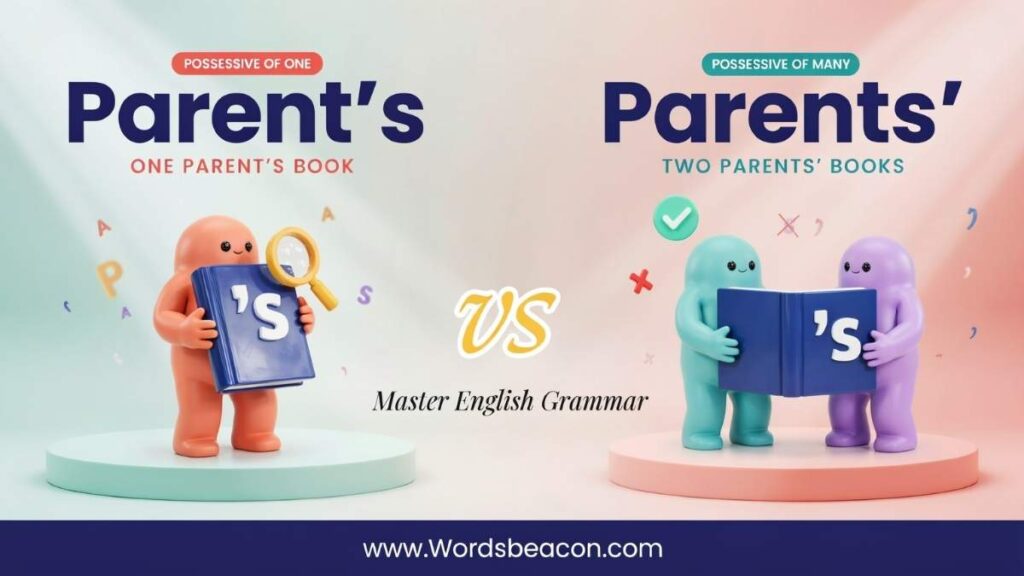
A tiny apostrophe can create a surprisingly big grammar headache, especially with “parent’s vs parents’.” The two forms look almost identical, but they do not mean the same thing. “Parent’s” usually refers to something connected to or belonging to one parent, while “parents’” refers to something connected to or belonging to two or more parents. Then there is “parents,” which simply means more than one parent and needs no apostrophe at all. Confused already? Don’t worry. This guide breaks down parent’s vs parents’ with simple rules and clear examples, so you can understand the difference and use each form correctly without second-guessing yourself.
quick answer
The easiest way to remember the difference is to count the parents first. Then check whether you are showing possession.
| Form | Meaning | Example |
|---|---|---|
| Parent | One parent | My parent called me. |
| Parents | Two or more parents | My parents called me. |
| Parent’s | One parent’s possession | My parent’s car is new. |
| Parents’ | Two or more parents’ possession | My parents’ car is new. |
In short, parent’s = one, parents’ = two or more, and parents = plural without possession. This simple rule makes the apostrophe much easier to place correctly.
Fix common more word mistakes in English
Manual vs Manuel Difference and usage ?
Parent’s vs Parents’ Key Spelling Difference
The simplest parent’s vs parents’ rule is based on two questions: How many parents are involved, and does the sentence show possession or a close relationship?
Parents means more than one parent. It does not need an apostrophe when it simply refers to a group.
Parent’s normally means that one parent possesses something or has a close relationship with something. The apostrophe comes before the s.
Parents’ normally means that multiple parents possess something or have a close relationship with something. The apostrophe comes after the s.
Consider these examples:
“The parents attended the meeting.”
“The parent’s car was parked outside.”
“The parents’ meeting begins at six.”
In the first sentence, parents simply names a group. And In the second, one parent has a car. In the third, the meeting relates to multiple parents.
Therefore, if you are wondering parent’s or parents’ which is correct, neither form works in every situation. The meaning of your sentence determines the correct choice.
Parent, Parents, Parent’s, and Parents’ The Basic Difference
The difference between parent’s and parents’ becomes clearer when you look at all four forms together.
| Form | Meaning | Grammatical use | Example |
|---|---|---|---|
| Parent | One parent | Singular noun | The parent called. |
| Parents | More than one parent | Plural noun | The parents called. |
| Parent’s | One parent’s possession or connection | Singular possessive | The parent’s car is outside. |
| Parents’ | Multiple parents’ possession or connection | Plural possessive | The parents’ car is outside. |
The important point is that parents and parent’s do not simply represent different spellings of the same word.
Parents is a plural noun. Parent’s is normally a singular possessive noun. Parents’ is a plural possessive noun.
That grammatical difference explains why apostrophe placement matters so much.
Parent as a Singular Noun
Parent is a singular noun because it refers to one person who has a parental role. That person may be a mother, father, adoptive parent, or another recognized caregiver depending on the context.
For example:
“The parent signed the permission slip.”
Here, the sentence refers to one parent.
If that one parent has something, you normally form the possessive by adding ’s.
“The parent’s signature appears at the bottom.”
The first sentence uses a singular noun. The second uses its singular possessive form.
Parents as a Plural Noun
Parents is the plural form of parent. It refers to two or more parents.
For example:
“The parents attended the school meeting.”
“The parents spoke with the teacher.”
“Both parents signed the form.”
No apostrophe appears because these sentences do not express possession. The word simply identifies multiple people.
This is an important point in parents grammar. An apostrophe does not normally make a noun plural. Instead, the ordinary plural of parent is simply parents.
Parent’s as a Singular Possessive
Parent’s is normally the singular possessive form of parent.
For example:
“The parent’s name appears on the form.”
The phrase means that the name belongs to or identifies one parent.
The same pattern appears in:
1.“The parent’s car is outside.”
2.“The parent’s permission is required.”
3.“The parent’s signature is missing.”
4.“The parent’s concern was understandable.”
In each example, the apostrophe comes before the s because the noun represents one parent.
This is the basic parent’s apostrophe rule.
Parents’ as a Plural Possessive
Parents’ is the plural possessive form of parents.
For example:
1.“The parents’ meeting begins at six.”
2.“The parents’ concerns were discussed.”
3.“The parents’ signatures are required.”
Here, multiple parents have the possessive or relational connection.
Because parents already ends in s, you add only an apostrophe at the end. You do not write parents’s.
That gives you the standard pattern:
Parent → parent’s
Parents → parents’
This apostrophe placement follows the broader rule for regular plural possessive nouns.
Fix common more word mistakes in English
Molding vs Moulding which one is correct and usage ?
What Does “Parents” Mean?
The parents meaning is simple: it means more than one parent.
You use parents when the word functions as an ordinary plural noun rather than a possessive.
For example:
“The parents waited outside.”
“Several parents volunteered.”
“The parents discussed the issue.”
“Both parents attended the event.”
In each case, parents refers to multiple people. Nothing belongs to them within the grammatical structure of the sentence.
That is why adding an apostrophe would change the function of the word.
Compare these sentences:
“The parents arrived.”
“The parents’ meeting started.”
The first sentence uses parents as a plural noun. The second uses parents’ as a plural possessive.
The distinction may seem small, but it gives the reader important information.
What Does “Parent’s” Mean?
The parent’s meaning usually involves one parent and possession or association.
For example:
“The parent’s name is on the form.”
This means the name belongs to or identifies one parent.
Likewise:
“The parent’s car needs repairs.”
The car belongs to or is associated with one parent.
The same structure works with many other nouns:
1.“The parent’s house is nearby.”
2.“The parent’s permission is required.”
3.“The parent’s signature is missing.”
4.“The parent’s decision surprised the teacher.”
The apostrophe before the s tells you that the noun remains singular while taking a possessive form.
Parent’s Can Also Be a Contraction
There is one additional use worth knowing. Parent’s can sometimes represent a contraction of parent is or parent has.
For example:
“The parent’s concerned about the schedule.”
Here, parent’s means parent is.
Another example is:
“The parent’s already spoken with the teacher.”
Here, parent’s can mean parent has.
Context makes the meaning clear.
However, in a phrase such as “parent’s car,” the apostrophe normally signals possession rather than a contraction. English uses ’s for both purposes, so the surrounding words determine the meaning. Apostrophes can mark possession as well as contractions.
What Does “Parents’” Mean?
The parents’ meaning usually involves multiple parents and possession or association.
For example:
“The parents’ meeting starts at seven.”
The meeting relates to multiple parents.
Similarly:
“The parents’ concerns were addressed.”
Multiple parents have concerns.
“The parents’ signatures are required.”
Multiple parents need to provide signatures.
“The parents’ house is near the school.”
The house belongs to or is associated with multiple parents.
The important detail is that parents’ does not necessarily mean multiple objects. It means multiple parents have the possessive relationship.
For example:
“The parents’ house is large.”
This can describe one house shared by two parents.
Likewise:
“The parents’ car is parked outside.”
This can describe one car that both parents share.
So, do not assume that a plural possessive must always be followed by a plural noun. The number of the following noun depends on what the sentence actually means.
Fix common more word mistakes in English
Farther vs Further difference and usage ?
Parent’s vs Parents’ How the Apostrophe Changes the Meaning
The difference between parent’s and parents’ comes down to the number of people connected to the possession.
Consider the phrase parent’s car.
“The parent’s car is outside.”
The sentence points to one parent.
Now change only the apostrophe position:
“The parents’ car is outside.”
Now the phrase points to multiple parents.
The difference is easy to miss when you read quickly. However, the apostrophe tells the reader where the possessive relationship begins.
The same idea works with house:
“The parent’s house is nearby.”
“The parents’ house is nearby.”
The first phrase refers to one parent. The second refers to multiple parents.
This is why apostrophe placement matters in English grammar. It is not decorative punctuation. It can change the grammatical meaning of a phrase.
Parents vs Parents’ Why the Apostrophe Matters
The difference between parents and parents’ is particularly important because both forms can refer to multiple parents.
Parents is simply plural.
Parents’ is plural possessive.
Compare:
“The parents arrived early.”
“The parents’ meeting started early.”
In the first sentence, parents performs the action. In the second, parents’ describes the meeting.
You can think of the apostrophe as a signal that the word has moved from simply naming a group to showing a relationship with another noun.
That is why parents grammar and parents’ grammar should not be treated as the same thing.
Learn the difference between similar English words
Quiet vs Quite difference and usage ?
Parent’s vs Parents’ Comparison Table
| Form | Number | Possessive? | Example |
|---|---|---|---|
| Parents | Plural | No | The parents arrived. |
| Parent’s | Singular | Yes | The parent’s car is outside. |
| Parents’ | Plural | Yes | The parents’ car is outside. |
The quickest memory trick is simple.
One parent plus possession gives you parent’s.
Multiple parents plus possession gives you parents’.
Multiple parents without possession gives you parents.
Learn the difference between similar English words
Its vs It’s Difference and usage ?
How to Choose Between Parent’s and Parents’
When you are unsure about when to use parent’s vs parents’, do not guess based on how the word looks. Instead, identify the number first.
First, Ask How Many Parents You Mean
If the sentence refers to one parent, start with parent.
If the sentence refers to two parents or multiple parents, start with parents.
This first step establishes whether your noun is singular or plural.
Next, Ask Whether You Need Possession
Once you know the number, ask whether something belongs to, relates to, or is associated with the parent or parents.
One parent plus possession gives you parent’s.
Multiple parents plus possession gives you parents’.
Multiple parents without possession gives you parents.
This two-step method makes the parent’s or parents’ grammar rule much easier to apply.
Apply the Rule to Real Sentences
Consider:
“The parent’s name is missing.”
One parent has a name on the form.
Now compare:
“The parents’ names are missing.”
Multiple parents have names on the form.
Finally:
“The parents are waiting.”
Multiple parents are waiting, but the sentence does not express possession.
The difference becomes obvious once you ask what the apostrophe actually does.
Learn the difference between similar English words
Learned vs Learnt difference and usage ?
Common Parent’s vs Parents’ Mistakes
Many common grammar mistakes happen because writers know that apostrophes have something to do with possession but forget to check the number of owners.
Using Parent’s for Multiple Parents
A common mistake is writing:
“The parent’s meeting starts at six.”
If the event involves multiple parents, the standard form is:
“The parents’ meeting starts at six.”
The first version suggests one parent. The second identifies multiple parents.
Writing Parents When Possession Is Needed
Another common mistake is:
“The parents house is nearby.”
If multiple parents own or are associated with the house, the correct possessive form is:
“The parents’ house is nearby.”
Without the apostrophe, the sentence lacks the possessive marker.
Using Parent’s as an Ordinary Plural
Consider:
“Several parent’s attended the meeting.”
That spelling incorrectly uses a possessive form where an ordinary plural is needed.
The correct sentence is:
“Several parents attended the meeting.”
This mistake happens because writers sometimes think the apostrophe helps make a word plural. It does not. Regular plural nouns normally do not need an apostrophe.
Putting the Apostrophe in the Wrong Place
Another frequent problem involves confusing parent’s with parents’.
Remember the basic pattern:
Parent’s = one parent.
Parents’ = multiple parents.
Therefore, the answer to parent’s apostrophe before or after s is before the s.
The answer to parents’ apostrophe before or after s is after the s.
Learn the difference between confusing word pairs
To vs Too difference and usage?
Parent’s vs Parents’ in Common Phrases
Some expressions appear so often that their apostrophe patterns become worth memorizing.
Parents’ Meeting vs Parent’s Meeting
When a school organizes a meeting for multiple parents, parents’ meeting is normally the appropriate possessive construction.
For example:
“The parents’ meeting begins at 6 p.m.”
The phrase connects the meeting with multiple parents.
Parent’s meeting could make sense in a context involving one particular parent, but it would not normally describe a general meeting for a group of parents.
Parents’ Name vs Parent’s Name
Both forms can be correct because the intended number can change.
“The parent’s name is listed.”
This refers to one parent.
“The parents’ names are listed.”
This refers to multiple parents.
The number of parents determines the possessive form. The number of names depends on how many names the sentence discusses.
Parents’ House vs Parent’s House
Both are grammatically correct when their meanings fit the context.
“The parent’s house is nearby.”
One parent is connected to the house.
“The parents’ house is nearby.”
Multiple parents are connected to the house.
Therefore, when someone asks, “Is parents’ house or parent’s house correct?” the answer depends on whether one parent or multiple parents are involved.
Parents’ Cars vs Parent’s Car
Again, number determines the form.
“The parent’s car needs repairs.”
One parent has one car.
“The parents’ cars need repairs.”
Multiple parents have multiple cars.
However, this sentence can also be correct:
“The parents’ car needs repairs.”
That version can describe one car shared by multiple parents.
The apostrophe tells you about the owners. The noun after it tells you about the thing being possessed.
Parent’s Permission vs Parents’ Permission
Both forms can be correct.
“The student needs a parent’s permission.”
This can mean permission from one parent.
“The student needs the parents’ permission.”
This refers to permission from multiple parents.
Therefore, context matters more than memorizing one fixed phrase.
Parents’ Anniversary vs Parent’s Anniversary
The phrase parents’ anniversary often refers to an anniversary associated with both parents as a couple.
For example:
“My parents’ anniversary is next week.”
Here, multiple parents share the relationship being described.
Parent’s anniversary can also be grammatically possible when the sentence refers to one parent and a particular anniversary connected with that person.
The important point is that anniversary itself does not decide the apostrophe. The intended relationship does.
Parents’ Evening
Parents’ evening is a familiar school expression, especially in British English, for an event where parents meet teachers.
In American English, parent-teacher conference or parent-teacher conferences is often more natural in school contexts.
Regardless of the regional phrase, the possessive construction parents’ follows the same grammatical rule: multiple parents are associated with the event.
Learn the difference between confusing word pairs
Breath vs Breathe which one is correct ?
Parent’s vs Parents’ in Everyday Writing

The distinction matters in school forms, emails, notices, family communication, and everyday messages.
A school form might request a parent’s signature when one parent needs to sign.
Another form might require both parents’ signatures when two parents need to sign.
A school notice might announce a parents’ meeting.
A family message might mention the parents’ house.
A personal story might refer to a parent’s car.
The pattern remains consistent even though the situations change.
School Emails and Notices
School communication frequently uses these forms because schools often need to distinguish between one parent and multiple parents.
For example:
“A parent’s signature is required.”
This refers to one parent.
“Both parents’ signatures are required.”
This refers to multiple parents.
“The parents’ meeting has been moved to Friday.”
This refers to a meeting involving multiple parents.
These examples show why correct apostrophe usage matters in practical writing. A misplaced apostrophe can create ambiguity rather than simply making a sentence look untidy.
Forms and Permission Slips
Permission slips provide another clear example.
“A parent’s permission is required.”
One parent must provide permission.
“Parents’ permission is required.”
Multiple parents are expected to provide permission or approval.
The difference may matter when a form has a specific legal or administrative requirement. Therefore, writers should not treat parent’s and parents’ as interchangeable.
Shared Ownership and Multiple Parents
One useful detail often gets overlooked in explanations of possessive nouns: multiple owners do not always possess multiple things.
Suppose two parents share one house.
You can write:
“The parents’ house is near the school.”
There are multiple owners but only one house.
Likewise:
“The parents’ car needs repairs.”
Two parents might share one car.
On the other hand:
“The parents’ cars need repairs.”
Now the sentence describes multiple cars associated with multiple parents.
The possessive form tells you how many owners exist. The noun that follows tells you how many things exist.
That distinction makes possessive grammar much more logical.
Parent’s vs Parents’ Examples in Context
Consider the following examples carefully.
“The parent’s signature is missing.”
One parent’s signature is missing.
“The parents’ signatures are missing.”
Multiple parents’ signatures are missing.
“The parents signed the forms.”
Multiple parents performed the action.
“The parent’s car is parked outside.”
One parent has the car.
“The parents’ car is parked outside.”
Multiple parents share or are associated with the car.
“The parents’ cars are parked outside.”
Multiple parents have multiple cars.
Notice how the apostrophe never works alone. You always interpret it together with the noun and the rest of the sentence.
Learn the difference between confusing word pairs
Lose vs Loose which one is correct ?
How to Make Parent Possessive
If you want to know how to make parent possessive, begin with the singular noun.
Parent becomes parent’s.
For example:
1.“the parent’s car”
2.“the parent’s name”
3.“the parent’s house”
4.“the parent’s permission”
The pattern is straightforward because parent is a regular singular noun.
This is a broader English grammar pattern. Most regular singular nouns form the possessive by adding ’s.
How to Make Parents Possessive
If you already have the plural noun parents, do not add another s.
Instead, place the apostrophe after the existing s.
Parents becomes parents’.
For example:
1.“the parents’ house”
2.“the parents’ meeting”
3.“the parents’ names”
4.“the parents’ concerns”
5.“the parents’ permission”
This is the standard plural possessive parents pattern.
So, if you ask where does the apostrophe go in parents, the answer is simple: after the s when you need the possessive form.
Does Parents Need an Apostrophe?
Not always.
If parents simply means more than one parent, do not add an apostrophe.
“The parents arrived.”
“The parents spoke with the teacher.”
“Many parents attended.”
However, if parents shows possession or a close relationship with another noun, use parents’.
“The parents’ meeting begins at six.”
“The parents’ concerns were addressed.”
This distinction is part of standard apostrophe rules. An apostrophe normally marks possession rather than ordinary plurality.
Is Parent’s Grammatically Correct?
Yes. Parent’s is grammatically correct when you need the singular possessive form or when context makes it a contraction.
1.“The parent’s car is outside.”
2.“The parent’s name appears on the form.”
3.“The parent’s already left.”
The first two examples use possession. The last example uses a contraction.
Therefore, the question is not whether parent’s is correct by itself. The real question is whether its grammatical function fits the sentence.
Is Parents’ Grammatically Correct?
Yes. Parents’ is grammatically correct as the plural possessive form of parents.
1.“The parents’ meeting begins at six.”
2.“The parents’ house is nearby.”
3.“The parents’ concerns were addressed.”
Because parents already ends in s, the possessive form takes only an apostrophe.
Writing parents’s would be incorrect for the standard plural possessive form.
Is Parents Grammatically Correct?
Yes. Parents is the ordinary plural form of parent.
“The parents arrived early.”
“Several parents volunteered.”
“Both parents attended.”
No apostrophe belongs in these examples because the word simply refers to multiple parents.
So, if someone asks, “Is parents grammatically correct?” the answer is yes. It is the standard plural noun.
Parent’s vs Parents’ Which Is Correct?
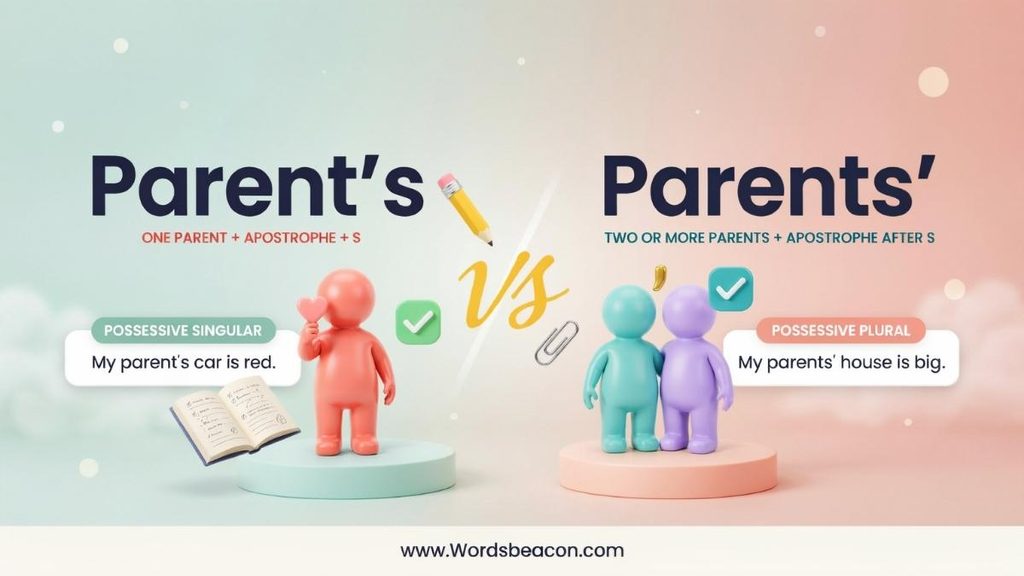
The phrase parent’s or parents’ which is correct has no single answer because the meaning controls the grammar.
1.Use parent’s when one parent has the possessive relationship.
2.Use parents’ when multiple parents have the possessive relationship.
3.Use parents when you simply mean more than one parent.
For example:
“The parent’s signature is required.”
“The parents’ signatures are required.”
“The parents signed the form.”
All three sentences are correct because each one communicates a different idea.
Parent’s vs Parents’ Rule: The Fastest Way to Remember It
When you need a quick answer, use this mental test.
First, count the parents.
If there is one, think parent.
If there are multiple, think parents.
Next, check for possession.
1.If one parent possesses or relates to something, write parent’s.
2.If multiple parents possess or relate to something, write parents’.
3.If there is no possession, write parents.
The pattern looks like this:
One parent + possession = parent’s
Multiple parents + possession = parents’
Multiple parents + no possession = parents
That is the most useful parent’s vs parents’ rule to remember.
Learn the difference between confusing word pairs
Yours vs Your’s which one is correct ?
practice session Parent’s vs Parents’
Choose the correct word: parent, parents, parent’s vs parents’.
- My ______ house is near the school.
- Both ______ attended the school meeting.
- The ______ car is parked outside.
- My ______ advice helped me make the right decision.
- The ______ names are written on the form.
- Every ______ received a permission slip.
- My ______ phone is on the kitchen table.
- The ______ meeting starts at 6 p.m.
- Her ______ anniversary is next month.
- The teacher spoke with the student’s ______.
- My ______ permission was required for the trip.
- Both ______ signed the document.
- The ______ bedroom needs to be cleaned.
- The ______ cars were parked in the driveway.
- A ______ responsibility can be difficult at times.
- The ______ house has a large garden.
- My ______ name appears on the application.
- The school sent an email to all ______.
- The ______ decision affected the whole family.
- Both ______ attended their child’s graduation.
Answers
- parent’s
- parents
- parent’s
- parent’s
- parents’
- parent
- parent’s
- parents’
- parents’
- parents
- parent’s
- parents
- parent’s
- parents’
- parent’s
- parents’
- parent’s
- parents
- parents’
- parents’
Here’s a trusted source for clear word meanings:
FAQs
Can “parent’s” and “parents’” mean the same thing?
No. “Parent’s” usually refers to one parent, while “parents’” refers to two or more parents. The apostrophe placement changes the meaning.
How can I remember the difference between “parent’s” and “parents’”?
Think about the number of parents first. One parent takes “parent’s” when showing possession. Two or more parents take “parents’” when showing possession.
Why does “parent’s” have an apostrophe before the s?
“Parent” is singular, so its possessive form normally adds an apostrophe and s: “parent’s.” This shows a connection or possession involving one parent.
Why does “parents’” have an apostrophe after the s?
“Parents” is already a regular plural noun ending in s. To make it possessive, add only an apostrophe after the s: “parents’.”
Can “parent’s” describe a relationship instead of ownership?
Yes. Possessive forms can show a close relationship or connection, not only ownership. For example, “the parent’s child” identifies the child’s relationship to one parent.
Can “parents’” describe a relationship rather than ownership?
Yes. “Parents’” can show a relationship or connection involving multiple parents. For example, “parents’ concerns” refers to concerns associated with parents.
Is “parent’s” used only when one parent owns something?
No. It can show ownership, association, or another close connection involving one parent. For example, “the parent’s role” does not necessarily mean the parent owns the role.
Is “parents’” used only when parents own something?
No. It can also show association or connection. For example, “parents’ rights” refers to rights associated with parents rather than something they physically own.
Can “parent’s” appear before a plural noun?
Yes. The noun after “parent’s” can be plural. For example, “The parent’s children attended the event” refers to the children of one parent.
Can “parents’” appear before a singular noun?
Yes. For example, “The parents’ car is outside” can refer to one car that belongs to or is associated with multiple parents.
What is the difference between “parent’s” and “parents” without an apostrophe?
“Parent’s” can show possession involving one parent or work as a contraction for “parent is” or “parent has.” “Parents” simply means more than one parent and does not show possession by itself.
Can “parent’s” be a contraction?
Yes. Depending on context, “parent’s” can mean “parent is” or “parent has.” For example, “The parent’s coming” can mean “The parent is coming,” while “The parent’s finished the form” can mean “The parent has finished the form.”
How can I test whether “parent’s” is a contraction?
Try replacing “parent’s” with “parent is” or “parent has.” If the sentence still makes sense, “parent’s” is functioning as a contraction rather than a possessive noun.
Is “parents’” ever a contraction?
No. “Parents’” is not a standard contraction. It is normally the plural possessive form of “parents.”
Can “parents” show possession without an apostrophe?
No. When “parents” shows possession or a close connection, it needs the possessive form “parents’.” Without the apostrophe, “parents” is simply plural.
Why is “parents’s” not the standard possessive form?
“Parents” already ends in s because it is plural. Regular plural nouns ending in s form the possessive by adding only an apostrophe, so the standard form is “parents’,” not “parents’s.”
Can “parent’s” and “parents’” both be correct in different sentences?
Yes. Both forms are grammatically correct, but they express different meanings. “Parent’s” generally refers to one parent, while “parents’” refers to multiple parents.
How do I choose the correct apostrophe position in “parent”?
Start with the basic noun. “Parent” is singular, so the possessive form is “parent’s.” “Parents” is plural, so its possessive form is “parents’.”
What is the simplest rule for “parent’s vs parents’”?
Use “parent’s” for possession involving one parent. Use “parents’” for possession involving two or more parents. If you simply mean more than one parent, use “parents” without an apostrophe.
Why is apostrophe placement important in “parent’s” and “parents’”?
The apostrophe tells the reader whether the noun is singular possessive or plural possessive. “Parent’s” points to one parent, while “parents’” points to multiple parents. That small punctuation mark can completely change the meaning.
conclusion
The difference between “parent’s” and “parents’” is small, but that tiny apostrophe can change the meaning. “Parent’s” usually shows possession or a connection to one parent, while “parents’” shows possession or a connection to two or more parents. On the other hand, “parents” simply means more than one parent, so it does not need an apostrophe.
The easiest way to remember the rule is to count first. If you mean one parent, use “parent’s.” And If you mean two or more parents, use “parents’.” If you are simply talking about more than one parent, use “parents.” Once you know this simple trick, the confusion disappears. After all, one little apostrophe should not be allowed to start a whole family argument.

Luna AJS is an experienced blogger and dedicated language enthusiast at Words Beacon. She specializes in making English grammar, spelling, vocabulary and commonly confused words easy to understand. She provides clear explanations, practical examples to help readers write with confidence.