
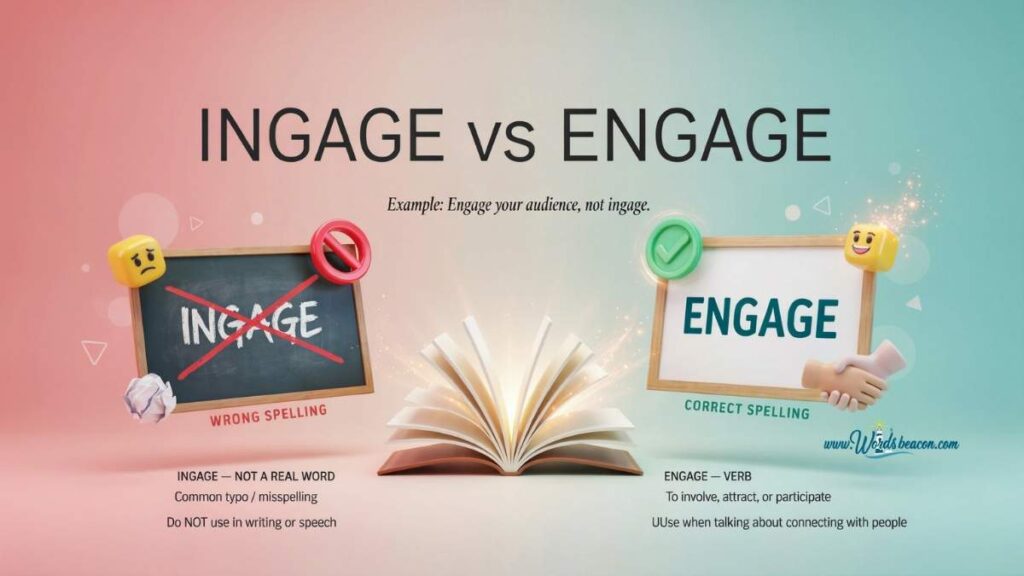
The Ingage vs Engage spelling confusion is easy to understand, but it can still catch you off guard while writing. One spelling looks familiar, while the other has an extra letter that makes you second-guess yourself. So, which one should you choose? The answer is simple: engage is the correct spelling in modern English, while ingage is an outdated form found mainly in older texts. But there’s more to this word than its spelling. From engaging in conversations to keeping an audience interested, engage has several useful meanings. Let’s explore the difference with clear explanations and everyday examples!
quick comprasion
| Comparison point | Engage | Ingage |
|---|---|---|
| Spelling status | Correct modern spelling | Obsolete historical spelling |
| Meaning | To participate, involve, attract, or hire | Historical form of engage |
| Part of speech | Verb | Historical verb form |
| Modern usage | Common and accepted | Not standard |
| Pronunciation | /ɪnˈɡeɪdʒ/ | Historically associated with the same word |
| American English | Correct | Not recommended |
| British English | Correct | Not recommended |
| Example | Students engage in discussions. | Students ingage in discussions. |
Understand confusing English more words simply
Theater vs Theatre Which Spelling Is Correct?
Is It Ingage vs Engage?
Engage is the correct spelling in modern standard English. Although ingage appeared in older English writing, it no longer serves as a standard alternative. Therefore, when you’re writing an article, preparing a school assignment, or sending a professional email, always choose engage.
The confusion makes sense because both forms look and sound similar. However, English spelling doesn’t always follow pronunciation. A word can begin with a particular sound without using the letter you might expect.
For example:
- Correct: The teacher encouraged students to engage in classroom discussions.
- Incorrect: The teacher encouraged students to ingage in classroom discussions.
- Correct: Our company wants to engage more customers.
- Incorrect: Our company wants to ingage more customers.
The same rule applies to every form of the verb. You should write engaged, engaging, and engagement rather than ingaged, ingaging, or ingagement.
There is one exception worth understanding. A business or product can use Ingage as its official name. In that case, the spelling identifies a brand rather than the ordinary English verb.
What Does Ingage Mean?
The ingage meaning becomes clearer when you look at the history of English spelling. Ingage is an obsolete spelling of engage that appeared in historical English texts. It doesn’t have a separate, established meaning in contemporary standard English.
In earlier periods, English spelling wasn’t as consistent as it is today. Writers sometimes used different forms of the same word because spelling conventions continued to develop. As dictionaries, education, and publishing became more standardized, engage became the accepted modern form.
Historical examples show that writers used ingage in the 18th and 19th centuries. Some older publications contain forms such as ingaged and ingaging as well.
However, historical use doesn’t mean you should use those spellings today.
Is Ingage a Real Word?
Yes, ingage has a genuine history in English. However, its status needs a little explanation. It is an obsolete spelling rather than a separate modern vocabulary word.
An obsolete word or spelling once appeared in the language but has fallen out of ordinary use. That distinction matters because not every unfamiliar spelling is automatically a recent mistake.
Consider these three situations:
- Historical writing: An old book may contain the spelling ingage.
- Modern writing: A contemporary writer should use engage.
- Business branding: A company may deliberately choose Ingage as its name.
For example, an older text might contain a sentence such as “He did ingage himself in the matter.” A modern writer would normally change it to “He did engage himself in the matter.”
Therefore, ingage isn’t simply a random combination of letters. It has historical evidence behind it, but engage remains the correct choice for modern English.
When Is Ingage Used as a Name?
Sometimes, unusual spellings appear in company names, software products, and business branding. Companies may choose a distinctive spelling to make their identity easier to recognize.
Ingage can appear in this way. When a business uses it as its official name, the spelling functions as a proper noun.
For example:
- The company introduced its new Ingage platform.
- Ingage announced an update to its software.
- Customers can access the service through the Ingage application.
Notice that capitalization helps identify the name. However, a brand’s spelling doesn’t change standard English grammar.
You can use a company’s official name as written without treating it as an alternative spelling of the verb engage.
Understand confusing English more words simply
Across vs Accross Which Is the Correct Spelling?
What Does Engage Mean?
Engage is a common English verb with several meanings. It can describe participation, communication, attention, employment, commitment, conflict, and even the movement of mechanical parts.
The exact engage meaning depends on the sentence. For example, engaging in a discussion means participating in it, while engaging a lawyer means hiring one.
Here are its main meanings in everyday English.
Engage Meaning: To Participate or Become Involved
One of the most common uses of engage describes taking an active part in something. It suggests involvement rather than simply being present.
For example, attending a meeting doesn’t necessarily mean you engage in it. However, asking questions, sharing ideas, and responding to other people show active participation.
Examples:
- Students should engage in classroom discussions.
- She enjoys engaging in community projects.
- Employees regularly engage in team activities.
- Children learn through activities that engage their curiosity.
This meaning frequently appears in education, workplace communication, and everyday conversations.
Engage Meaning To Attract Someone’s Attention
Engage can also describe something that captures someone’s interest and keeps them focused.
Writers, teachers, filmmakers, and marketers often use the word in this sense. Their goal is to engage an audience rather than allow its attention to drift elsewhere.
Examples:
- The documentary managed to engage viewers from beginning to end.
- Her storytelling skills engage young readers.
- The teacher used illustrations to engage the students.
- An interesting introduction can engage potential readers.
In marketing, customer engagement refers to the ways people interact with a brand. These interactions might include reading articles, commenting on social media posts, watching videos, or asking questions.
Engage Meaning To Hire or Employ Someone
In professional communication, engage can mean hiring someone or arranging to use their services.
This usage often sounds more formal than hire, but both words can express the same basic idea.
Examples:
- The company decided to engage an experienced accountant.
- We need to engage a lawyer before signing the contract.
- The school engaged a specialist to train its teachers.
- They engaged a professional photographer for the event.
This meaning is especially useful in business documents, contracts, and formal discussions.
Engage Meaning in a Relationship
The engage meaning in relationship discussions relates to a promise or commitment to marry.
When two people become engaged, they have agreed to marry each other. An engagement usually follows a marriage proposal and may involve an engagement ring, a family announcement, or a celebration.
Examples:
- Sarah and Michael got engaged last weekend.
- My sister is engaged to her college friend.
- They announced their engagement during a family dinner.
- He asked her to marry him, and she accepted.
It’s helpful to understand the difference between these related words:
- Engage: The verb associated with involvement or commitment.
- Engaged: An adjective describing someone who has agreed to marry.
- Engagement: The noun describing the commitment or the period before marriage.
For example, “They are engaged” describes a couple’s relationship status, while “Their engagement lasted six months” describes the time between their agreement to marry and their wedding.
Engage Meaning in Conflict or Competition
In military and competitive situations, engage can mean entering a confrontation or beginning a fight with an opponent.
Examples:
- The soldiers were ordered to engage the enemy.
- The two teams engaged in a fierce competition.
- The aircraft engaged the opposing forces.
This meaning appears in military reports, historical accounts, and discussions about conflict. It has a more formal tone than everyday words such as fight or compete.
Engage Meaning in Mechanical and Technical Contexts
Another useful meaning appears in engineering and machinery. In this context, engage describes mechanical parts connecting or fitting together so they can perform a function.
Examples:
- Engage the clutch before moving the vehicle.
- The gears must engage properly for the machine to operate.
- The safety mechanism engages when the system detects a problem.
- The brake mechanism failed to engage.
For example, when a driver engages a gear, the transmission system connects the necessary mechanical components to transfer power.
The opposite action is often called disengage. This describes disconnecting parts that previously worked together.
Understand confusing English more words simply
Contractor vs Contracter Which Spelling Is Correct?
Ingage vs Engage Key Differences
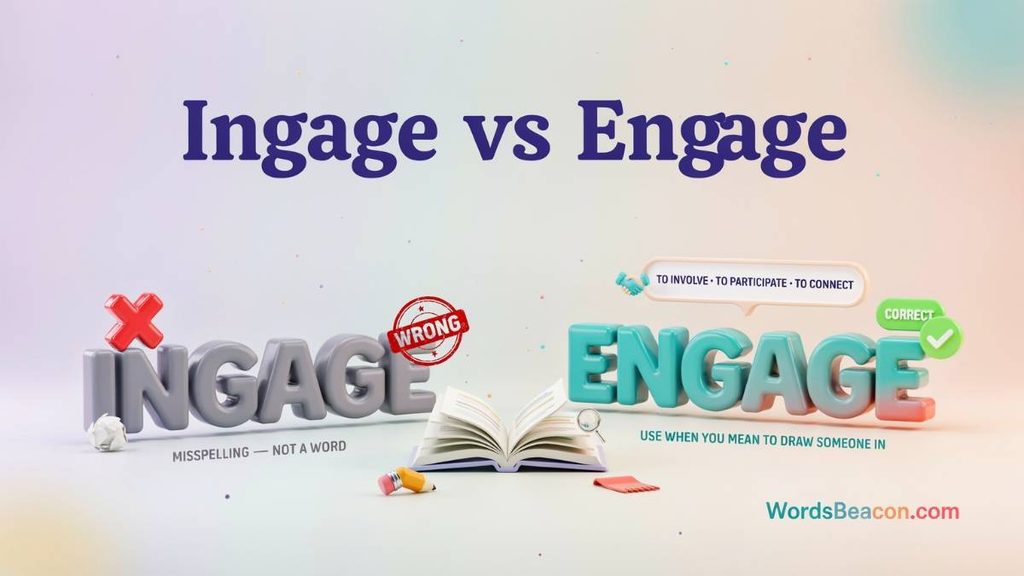
The main difference between ingage vs engage involves their historical and modern spelling status. Both forms have appeared in English, but only engage serves as the standard spelling today.
| Feature | Engage | Ingage |
|---|---|---|
| Modern spelling | Standard | Obsolete |
| Meaning | Participate, involve, attract, hire, or commit | Historical form of engage |
| Everyday communication | Appropriate | Avoid |
| Academic writing | Appropriate | Avoid |
| Professional documents | Appropriate | Avoid |
| Historical documents | Common modern form | May appear in older texts |
| Proper noun usage | Possible | Possible |
Engage vs Ingage Difference in Everyday Writing
Imagine you’re preparing a business email about improving customer relationships.
You might write:
“Our team needs to engage customers through regular communication.”
This sentence uses the correct spelling and communicates the intended message clearly.
However, writing “Our team needs to ingage customers” introduces an unnecessary spelling error in contemporary English.
The same principle applies to school assignments, website content, reports, and personal messages. Unless you’re reproducing an original historical text or referring to a proper name, use engage.
Learn the difference between tricky more English words
Different vs Diffrent Which Spelling Is Correct?
Why Do People Spell Engage as Ingage?
The ingage spelling mistake often happens because English spelling doesn’t always match pronunciation. Although engage begins with E, its initial vowel sound resembles the short I sound.
As a result, someone who hasn’t memorized the correct spelling might assume that the word begins with I.
However, pronunciation alone cannot determine the correct spelling. Several factors contribute to this confusion.
Similar Pronunciation
The standard American pronunciation of engage is /ɪnˈɡeɪdʒ/. It has two syllables, with the primary stress on the second syllable.
You can think of the pronunciation as “in-GAYJ.”
Because the first sound resembles the short vowel sound in words such as in and inside, some writers naturally assume that the word should begin with I.
However, English contains many words whose written vowels don’t match what a learner might expect from their pronunciation.
For example:
- Enough begins with E but has an initial vowel sound similar to the short I sound.
- English begins with E but has a different vowel sound.
- Engage begins with E even though its first spoken vowel sounds like /ɪ/.
Therefore, hearing a word correctly doesn’t always reveal its spelling.
Influence of Similar English Words
English contains many words with similar sounds but different spelling patterns. This can encourage writers to make assumptions about unfamiliar words.
For instance, someone might associate the beginning of engage with words such as inside, include, or interest. That connection can make ingage look reasonable at first glance.
Nevertheless, the correct spelling follows the established word form, not an imagined spelling pattern.
Typing and Autocorrect Errors
Fast typing can also cause an ingage spelling mistake. You might accidentally press I instead of E, especially when writing quickly or switching between devices.
Autocorrect doesn’t always catch unusual spellings. In particular, a tool may treat a company name or unfamiliar term as an acceptable entry.
To reduce these mistakes:
- Slow down when typing unfamiliar words.
- Review important emails before sending them.
- Check questionable spellings in a reliable dictionary.
- Don’t assume every autocorrect suggestion is correct.
- Proofread repeated keywords in articles and reports.
Exposure to Historical or Brand Names
Older books, historical documents, and specialized business names can introduce unusual spellings.
For example, someone might encounter ingage in an old publication and assume that it remains acceptable today.
However, historical spelling and modern writing conventions aren’t the same. A form can have a genuine place in language history without remaining suitable for contemporary writing.
Learn the difference between tricky more English words
Career vs Carrer Correct Spelling and Difference
Ingage vs Engage Examples Correct and Incorrect Usage
The easiest way to understand the spelling difference is to compare incorrect and corrected sentences.
| Incorrect sentence | Correct sentence |
|---|---|
| Students should ingage in discussions. | Students should engage in discussions. |
| The company wants to ingage new customers. | The company wants to engage new customers. |
| We need to ingage a professional designer. | We need to engage a professional designer. |
| The book failed to ingage my interest. | The book failed to engage my interest. |
| They decided to ingage in the project. | They decided to engage in the project. |
| The gears did not ingage properly. | The gears did not engage properly. |
| She wants to ingage with her audience. | She wants to engage with her audience. |
| They got ingaged last summer. | They got engaged last summer. |
A Practical Writing Example
Imagine that a marketing manager is preparing a report about customer participation.
The manager writes:
“Our new campaign helped ingage customers and increase interaction across social media platforms.”
Although the sentence communicates the intended idea, ingage isn’t the correct modern spelling.
The corrected version reads:
“Our new campaign helped engage customers and increase interaction across social media platforms.”
The change is small, but it improves the accuracy and professionalism of the report.
This example also shows why proofreading matters. A single incorrect letter can make an otherwise clear sentence look careless.
Common Expressions and Phrases With Engage
The verb engage appears in many everyday English expressions. Learning these combinations can help you use it naturally in conversations and writing.
| Expression | Meaning | Example |
|---|---|---|
| Engage in conversation | Participate in a discussion | She likes to engage in conversation with visitors. |
| Engage with an audience | Interact with listeners or viewers | The presenter knows how to engage with an audience. |
| Engage someone’s attention | Attract someone’s interest | The opening scene engaged everyone’s attention. |
| Engage in an activity | Take part in something | Children engage in outdoor activities. |
| Engage someone’s services | Hire someone | We engaged the services of a lawyer. |
| Become engaged | Agree to marry | They became engaged in December. |
| Engage the clutch | Connect a mechanical system | Engage the clutch before moving. |
| Engage in debate | Participate in a discussion | The candidates engaged in a public debate. |
These expressions show how one verb can work in different situations without changing its spelling.
Grammar Rules and Word Forms of Engage
Understanding engage English grammar helps you use the word correctly in different sentence structures.
Engage is primarily a verb. It can function as both a transitive and an intransitive verb.
A transitive verb takes a direct object, while an intransitive verb doesn’t require one.
For example:
- Transitive: The teacher engaged the students in a discussion.
- Intransitive: The students engaged in a lively discussion.
Both sentences are correct, but their grammatical structures differ.
Engage Verb Forms
Engage follows a regular verb pattern. Its past tense and past participle use the ending -ed.
| Verb form | Word | Example |
|---|---|---|
| Base form | Engage | We engage with our readers. |
| Third-person singular | Engages | She engages her students. |
| Present participle | Engaging | They are engaging in a project. |
| Simple past | Engaged | He engaged a professional. |
| Past participle | Engaged | The company has engaged a consultant. |
These forms appear in everyday conversations, formal writing, and professional communication.
Engage vs Engaged vs Engaging
Although these words share the same root, they don’t always perform the same grammatical function.
Engage is the base verb. It describes an action.
Example: We need to engage more customers.
Engaged is the simple past and past participle. It can also function as an adjective, particularly when describing someone who has agreed to marry.
Example: They got engaged last year.
Engaging is the present participle. It can also work as an adjective describing something interesting or attractive.
Example: The speaker gave an engaging presentation.
Common Grammatical Patterns
The word engage appears in several useful sentence patterns.
- Engage in something: She engages in volunteer work.
- Engage with someone or something: Students engage with their teachers.
- Engage someone in something: The host engaged the guests in conversation.
- Engage someone to do something: The company engaged an expert to review its plans.
- Engage someone’s attention: The opening paragraph engaged my attention.
One important distinction is the use of in and with.
Use engage in when describing participation in an activity. Meanwhile, engage with emphasizes interaction or involvement with a person, subject, or issue.
Learn the difference between tricky more English words
Focusing vs Focussing Which Spelling Is Correct ?
Engage Pronunciation How Do You Pronounce Engage?
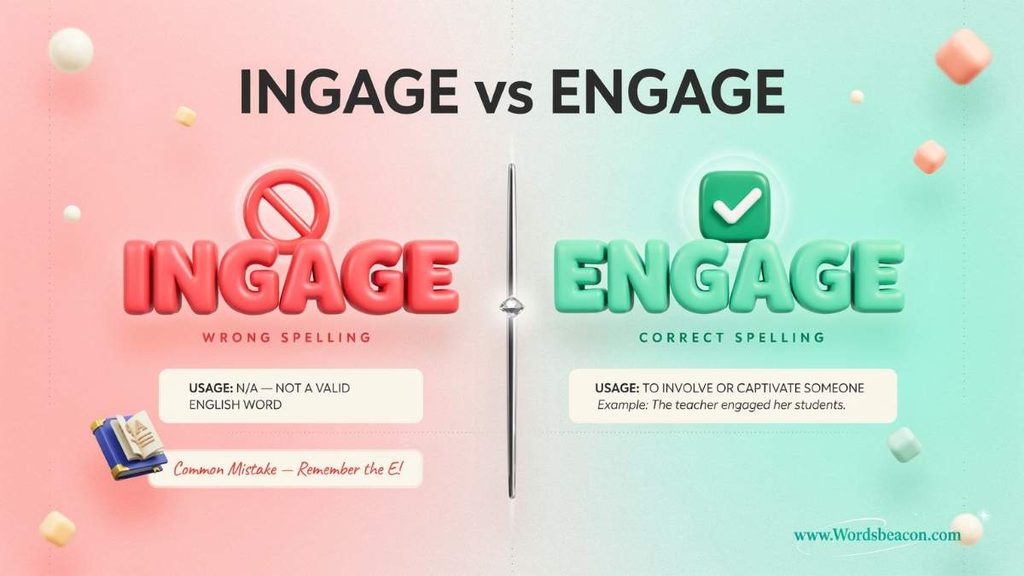
The standard American pronunciation commonly uses /ɪnˈɡeɪdʒ/.
The word has two syllables, and the primary stress falls on the second syllable.
Here’s a simple breakdown:
- First syllable: /ɪn/
- Second syllable: /ɡeɪdʒ/
- Primary stress: Second syllable
The pronunciation sounds approximately like “in-GAYJ.”
The initial vowel sound helps explain the ingage vs engage confusion. Although the word begins with E, its pronunciation starts with the short /ɪ/ sound.
Common Pronunciation and Spelling Mistakes
Some writers assume that every word should begin with the letter that represents its first spoken vowel sound. However, English doesn’t follow that rule consistently.
Remember these points:
- Write E at the beginning, not I.
- Keep the G before A.
- Use the final letters GE.
- Maintain the same spelling throughout the word family.
Whether you’re writing engage, engaged, or engaging, the spelling follows the same established pattern.
History and Etymology of Engage
The history of engage explains why its spelling begins with E rather than I.
The word entered English through Old French engagier, which carried the meaning of pledging, binding, or giving something as security. Its roots connect with the French expression en gage, meaning under pledge.
Originally, engage had a stronger connection with promises and obligations than it does in many everyday situations today.
Over time, its meaning expanded to cover participation, employment, attention, conflict, and mechanical connections.
| Historical development | Meaning |
|---|---|
| Old French engagier | To pledge, bind, or give as security |
| Early English usage | To pledge something or commit oneself |
| Later development | To employ, involve, or participate |
| Modern English | To attract attention, participate, hire, commit, or connect mechanically |
The word’s history also explains its relationship with the idea of commitment.
For example, when someone engages a professional, they arrange to use that person’s services. Similarly, when two people become engaged, they make a commitment to marry.
Interestingly, Oxford’s dictionary records ingage as a former spelling of engage. Historical examples also appear in English publications from 1703 and 1705.
However, spelling conventions have changed. Modern English settled on engage as the standard form.
Why Is Engage Spelled With E?
The spelling reflects the word’s historical development through French engagier and the expression en gage.
The initial E isn’t a random choice based on pronunciation. It belongs to the established historical form that modern English retained.
Therefore, even though the word sounds as if it might begin with I, its correct spelling begins with E.
Fix common more word mistakes in English
Persuing vs Pursuing Difference and Correct Spelling
Regional Usage Is Engage Spelled the Same in American and British English?
Some English words have different spellings depending on the country. For example, American English uses color, while British English generally uses colour.
However, engage doesn’t have this regional spelling difference.
| English variety | Correct spelling | Example |
|---|---|---|
| American English | Engage | We engage with our customers. |
| British English | Engage | We engage with our customers. |
| Canadian English | Engage | Students engage in activities. |
| Australian English | Engage | The campaign will engage viewers. |
Therefore, you don’t need to change the spelling when writing for different English-speaking audiences.
Engage remains the standard form across these varieties. The historical spelling ingage doesn’t become correct simply because someone uses British or American English.
Synonyms and Alternatives for Engage
The ingage vs engage synonym search can be slightly misleading because ingage isn’t a separate modern English word with its own set of synonyms.
Since it is an obsolete spelling of engage, the relevant synonyms belong to engage. The best alternative depends on the meaning you want to express.
Synonyms of Engage
| Synonym | Meaning | Example |
|---|---|---|
| Involve | Bring someone into an activity | Involve the students in the project. |
| Participate | Take part in something | Participate in the discussion. |
| Interact | Communicate or work with someone | Interact with your audience. |
| Interest | Attract someone’s attention | The topic interests young readers. |
| Attract | Draw attention toward something | The headline attracts visitors. |
| Employ | Hire someone | The company employed a consultant. |
| Commit | Dedicate yourself to something | Commit to improving your skills. |
| Occupy | Keep someone busy or focused | The activity occupied the children. |
Although these words have related meanings, you shouldn’t replace engage with every synonym automatically.
For example, employ works when you mean hiring someone, but it doesn’t fit naturally when you mean participating in a classroom discussion.
Antonyms of Engage
An antonym expresses the opposite meaning. Depending on the context, useful opposites include:
- Disengage: Withdraw from involvement or disconnect something.
- Ignore: Pay no attention to someone or something.
- Withdraw: Remove yourself from an activity or situation.
- Avoid: Stay away from a person, activity, or issue.
- Detach: Separate or disconnect something.
For example:
Engage: The students participated in the discussion.
Disengage: The students stopped participating in the discussion.
In mechanical contexts, disengage is particularly useful because it describes disconnecting parts that were previously connected.
Fix common more word mistakes in English
Holistic vs Wholistic Difference and Correct Spelling
How to Remember the Correct Spelling of Engage
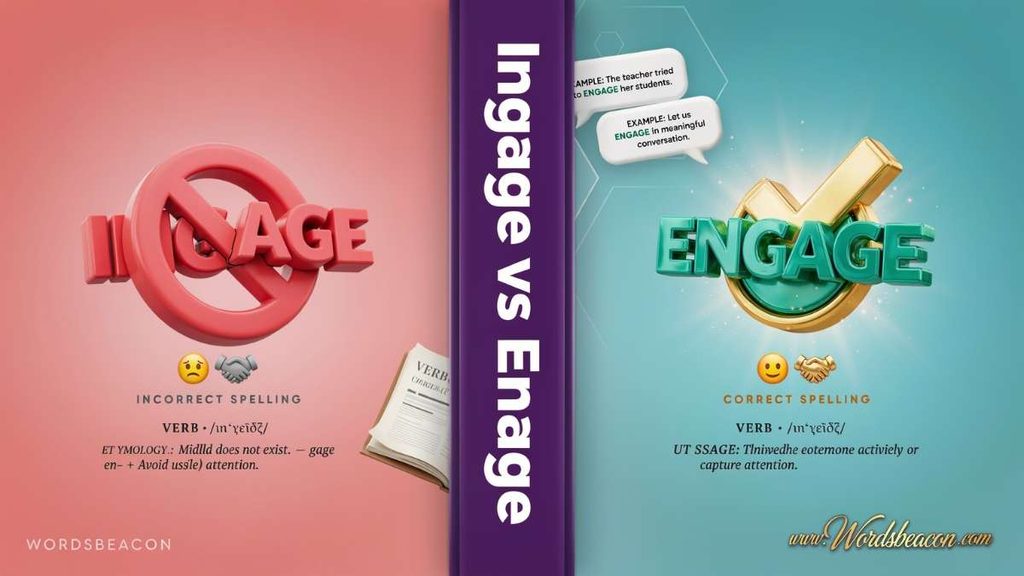
If you frequently confuse ingage vs engage, a simple memory trick can help.
Remember the established spelling: E-N-G-A-G-E.
Don’t replace the first letter just because the word sounds like it starts with I.
You can also remember these related words:
- Engage
- Engaged
- Engaging
- Engagement
- Disengage
All these words share the same established spelling pattern.
Try these practical tips:
- Read the word in complete sentences rather than memorizing isolated letters.
- Connect engage with engagement to reinforce its spelling.
- Use a dictionary when you encounter unfamiliar historical forms.
- Check your work before submitting important documents.
- Practice writing the word in different contexts.
A little repetition can prevent the same spelling mistake from appearing in emails, assignments, and professional documents.
Learn how to use confusing more words correctly
Center vs Centre Difference and Which one Is Correct?
Practice session Ingage vs Engage
Now it’s time to check whether you can recognize the correct spelling in different situations Ingage vs Engage. Complete each sentence using the appropriate form of engage.
- Teachers should encourage students to ______ in classroom discussions.
- The company wants to ______ more customers through social media.
- Sarah and Daniel got ______ last December.
- We decided to ______ a professional photographer for the wedding.
- The documentary failed to ______ the audience.
- Employees should ______ with their managers regularly.
- The students are ______ in a science project.
- The organization plans to ______ local volunteers.
- The gears must ______ properly for the machine to work.
- She hopes to ______ in meaningful conversations.
- The company has ______ an experienced consultant.
- The speaker delivered an ______ presentation.
- They announced their ______ during a family gathering.
- The teacher ______ the children in a practical activity.
- You should ______ the clutch before moving the vehicle.
- The campaign aims to ______ younger audiences.
- He wants to ______ in community service.
- The two teams ______ in a competitive match.
- The manager encouraged everyone to ______ with the new project.
- Their ______ lasted almost a year before the wedding.
Answers
- Engage
- Engage
- Engaged
- Engage
- Engage
- Engage
- Engaging
- Engage
- Engage
- Engage
- Engaged
- Engaging
- Engagement
- Engaged
- Engage
- Engage
- Engage
- Engaged
- Engage
- Engagement
Here’s a trusted source for clear word meanings:
FAQs
Is it Ingage vs Engage?
Engage is the correct spelling in modern English. Ingage is an obsolete spelling that occasionally appears in historical texts. For all contemporary writing, use engage.
What does engage mean in simple terms?
Engage means to get involved, take part in an activity, communicate with someone, or capture another person’s attention. Its meaning changes slightly depending on how you use it.
What is the difference between engage and engaged?
Engage is the base form of the verb, while engaged is its past tense and past participle. For example, “I engage in regular exercise” describes a habit, whereas “I engaged in a discussion” refers to a past activity. Engaged can also describe someone who has agreed to marry.
Is “ingaged” a correct spelling?
No, ingaged is a misspelling in standard modern English. The correct form is engaged. For example, “My sister got engaged last weekend.”
When should you use the word engage?
Use engage when describing participation, involvement, communication, interaction, or attracting attention. For instance, “The teacher uses creative activities to engage students” means the activities encourage students to pay attention and participate.
How do you use engage in a sentence?
You can use engage in several contexts. For example, “The speaker knows how to engage an audience,” “Employees engage in regular training,” and “The two companies agreed to engage in further discussions.”
What does it mean to engage with someone?
To engage with someone means to communicate, interact, or show an active interest in that person. Asking thoughtful questions, listening carefully, and responding meaningfully are all ways to engage with someone.
What does engage mean in a relationship?
In a relationship, engage can describe becoming involved, communicating, or building a connection with someone. However, when someone says they are engaged, it usually means they have agreed to marry their partner.
Is it correct to say “I got engaged”?
Yes, “I got engaged” is grammatically correct and widely used in American English. It describes the moment when you and your partner agree to marry. “I am engaged” is also correct, but it describes your current relationship status.
Is being engaged the same as being married?
No, engagement and marriage are two different stages of a relationship. Being engaged means you have agreed to marry, while being married means you have officially entered into a marriage.
Can engaged mean busy or occupied?
Yes. Engaged can mean busy, occupied, or involved in an activity. For example, “She is engaged in a meeting” means she is currently taking part in that meeting. In a romantic context, however, engaged usually refers to a promise to marry.
What is another word for engage?
Depending on the context, synonyms for engage include involve, attract, participate, interact, occupy, and connect. For example, involve may describe taking part in an activity, while attract may describe capturing someone’s attention.
What is another way to say “engage in conversation”?
You can use phrases such as converse, communicate, talk, discuss, or have a conversation. For example, instead of saying “They engaged in conversation,” you could write “They discussed their plans.”
What is the opposite of engage?
Disengage is one of the closest opposites of engage. Other alternatives include withdraw, avoid, ignore, and detach. The best choice depends on the context. For example, disengage means to stop participating or become less involved.
Where does the word engage come from?
The word engage comes from the Old French engager, which referred to making a pledge, promise, or commitment. Its meaning gradually expanded to include involvement, participation, employment, and interaction.
Is engaged the correct spelling?
Yes, engaged is the correct spelling. It is the past tense and past participle of engage. It can also describe someone who has agreed to marry, as in “They are engaged to be married.”
Learn how to use confusing more words correctly
Sleeve vs Sleave Difference and which is correct ?
Conclusion
The Ingage vs Engage confusion may look like a tiny spelling problem, but choosing the wrong version can make your writing look less polished. The good news? You only need to remember one simple rule: engage is the correct spelling in modern English, while ingage is an outdated form you may find in older texts. Use engage when talking about joining an activity, getting someone’s attention, or taking part in a conversation. When you write engaged, remember that it can also describe someone who plans to get married. So, don’t let one little letter trip you up! Stick with engage, use its correct forms, and keep your writing clear, confident, and error-free.

Luna AJS is an experienced blogger and dedicated language enthusiast at Words Beacon. She specializes in making English grammar, spelling, vocabulary and commonly confused words easy to understand. She provides clear explanations, practical examples to help readers write with confidence.