
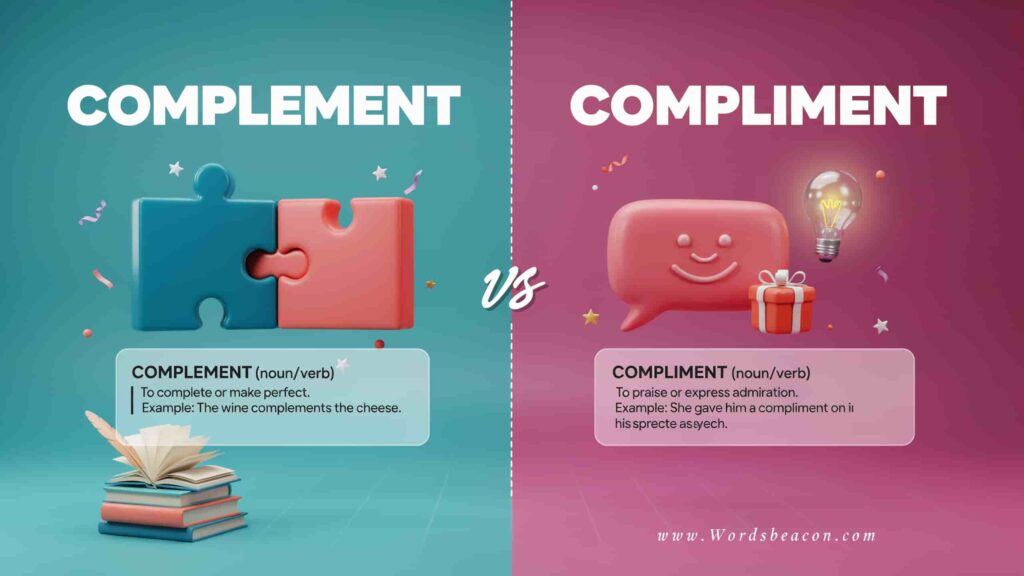
Choosing between Complement vs Compliment can be tricky because these two words sound exactly alike. Yet, their meanings are quite different! One helps you praise someone’s lovely outfit, while the other describes how that outfit goes perfectly with their shoes. That’s where the Complement vs Compliment confusion begins. Fortunately, telling them apart is easier than you might think. Complement means to complete, balance, or enhance something, whereas compliment means to express praise or admiration. Once you understand this simple difference, you’ll know which spelling to use and avoid those little grammar mistakes that can change your meaning.
quick comprasion table
| Main Topic | Complement | Compliment |
|---|---|---|
| Meaning | Something that completes, improves, or enhances another thing | An expression of praise, admiration, or appreciation |
| As a noun | Something that completes or improves something else | A kind or admiring remark |
| As a verb | To complete, enhance, or match | To praise or express admiration |
| Example | The necklace complements her dress. | She complimented me on my necklace. |
| Related adjective | Complementary | Complimentary |
| Memory trick | E stands for complete. | I stands for I admire you. |
| Common usage | Colors, food, clothing, skills, and design | Praise, appearance, achievements, and appreciation |
Understand confusing English more words simply
Ingage vs Engage Which Spelling Is Correct ?
Complement vs Compliment What’s the Difference?
The main difference between complement vs compliment lies in their meanings, not their pronunciation. Although both words sound alike, they serve different purposes in a sentence.
Complement means to complete, enhance, improve, or go well with something else. You use it when two things work together or when one adds value to another.
For example:
- The blue curtains complement the white walls.
- Her experience complements his technical skills.
- Fresh lemon juice complements the flavor of grilled fish.
In each example, one thing improves or works well with another.
On the other hand, compliment means to express praise, admiration, or appreciation. You use it when you say something positive about someone’s appearance, personality, abilities, or achievements.
For example:
- She gave me a compliment about my new haircut.
- My manager complimented me on my presentation.
- He received several compliments for his excellent work.
Here, the focus is on appreciation rather than improvement or compatibility.
The easiest way to understand the difference is to remember that you complement something, but you compliment someone.
Complement vs Compliment Key Differences
| Feature | Complement | Compliment |
|---|---|---|
| Main idea | Completion or enhancement | Praise or admiration |
| Part of speech | Noun and verb | Noun and verb |
| Noun example | A scarf is a perfect complement to her outfit. | She received a lovely compliment. |
| Verb example | The colors complement each other. | I complimented him on his work. |
| Common phrase | A perfect complement | Pay someone a compliment |
| Related word | Complementary | Complimentary |
Both spellings are correct. Neither is an alternative spelling of the other. Your sentence determines which one you need.
Understand confusing English more words simply
Holistic vs Wholistic Difference and Correct Spelling
What Does Complement Mean?
The word complement describes something that completes, improves, balances, or enhances another thing. It can refer to objects, people, qualities, skills, colors, flavors, or other elements that work well together.
Think about a simple meal. A bowl of tomato soup tastes good on its own, but a grilled cheese sandwich makes the combination even more satisfying. The sandwich complements the soup because the two foods work particularly well together.
The same idea applies to fashion, interior design, professional relationships, and everyday situations.
Consider these examples:
- A wooden table complements the modern design of the dining room.
- Her calm personality complements his energetic nature.
- The garlic sauce complements the flavor of the chicken.
- His communication skills complement the team’s technical knowledge.
In every example, one element adds something useful or attractive to another.
Complement as a Noun
As a noun, complement refers to something that completes, enhances, or balances another thing. It often describes two or more elements that create a pleasing or useful combination.
For example:
- The silver necklace is a beautiful complement to her evening dress.
- Fresh fruit makes a healthy complement to breakfast.
- Her creative ideas are a valuable complement to the team’s experience.
- The wooden furniture provides a warm complement to the modern interior.
- A suitable soundtrack is a wonderful complement to a film.
Notice that a complement doesn’t always mean something is missing or incomplete. It can simply describe an addition that makes an existing thing better.
For instance, a black dress doesn’t need a silver necklace to be complete. However, the necklace may complement its appearance by adding elegance and visual interest.
The noun also appears in expressions such as:
- A perfect complement
- An ideal complement
- A natural complement
- A valuable complement
- A full complement of staff
The last expression has a slightly different but related meaning. A full complement refers to the complete number of people or things needed or expected.
Example: “The hospital has a full complement of medical staff today.”
This means the hospital has all the staff members it needs for its operations.
Complement as a Verb
When you use complement as a verb, it describes the action of completing, improving, or enhancing something.
The verb often appears when two things work well together.
Examples:
- The blue curtains complement the gray walls.
- Her leadership style complements his problem-solving skills.
- The spicy sauce complements the sweetness of the chicken.
- These shoes complement your formal outfit.
- The new software complements our existing tools.
You can use the verb in several common sentence structures:
- Complement something
- Complement each other
- Complement someone’s skills
- Complement the overall design
- Complement an existing feature
For example, consider this sentence:
“Good communication skills complement strong technical knowledge.”
This means communication and technical abilities work together to create a stronger professional skill set.
Also, remember that complement doesn’t mean the two things must be identical. In fact, different qualities often complement each other precisely because they bring something different to the combination.
Complement in Different Contexts
The meaning of complement stays connected to improvement and compatibility, but its application changes depending on the situation.
Complement in fashion and clothing
In fashion, one item complements another when its colors, patterns, shapes, or styles create an attractive combination.
Examples:
- Your brown belt complements your leather shoes.
- The gold earrings complement her black dress.
- This jacket complements the overall outfit.
Complement in food and cooking
Food ingredients complement one another when their flavors, textures, or aromas create a pleasing combination.
Examples:
- Garlic complements the flavor of roasted vegetables.
- A fresh salad complements a heavy meal.
- Lemon juice complements grilled fish.
Complement in work and teamwork
People complement one another when they bring different but compatible skills to a team.
For example, a designer might have excellent creative abilities, while a developer understands technical systems. Their skills complement each other because they contribute different strengths toward the same goal.
Complement in colors and design
Designers use complementary colors to create contrast and visual interest.
In traditional color theory, complementary colors sit opposite each other on a color wheel. Red and green, blue and orange, and yellow and purple are familiar examples.
However, exact complementary color pairs depend on the color model. In modern RGB color theory, for example, the complementary pairs differ from those in the traditional red-yellow-blue art model.
Complement Synonyms and Related Words
Several words share part of the meaning of complement. However, they don’t work as interchangeable replacements in every sentence.
| Synonym | Meaning | Example |
|---|---|---|
| Enhance | To improve the quality or effect of something | Fresh herbs enhance the flavor. |
| Complete | To make something whole or finished | The final chapter completes the story. |
| Improve | To make something better | The new design improves the website. |
| Balance | To create a suitable combination | The acidity balances the sweetness. |
| Enrich | To add value or depth | The discussion enriched the lesson. |
| Accompany | To go along with something | Rice accompanies the main dish. |
| Supplement | To add extra material or support | The workbook supplements classroom lessons. |
These words have related meanings, but context determines the best choice. For example, enhance often replaces complement when something improves another thing. However, complete may work better when something makes an unfinished task whole.
Understand confusing English more words simply
Theater vs Theatre Which Spelling Is Correct?
What Does Compliment Mean?
A compliment is an expression of praise, admiration, approval, or appreciation. You use this word when you say something positive about another person or recognize the value of their work.
Compliments appear in everyday conversations. You might compliment a friend on a new haircut, praise a colleague for completing a difficult project, or appreciate someone’s kindness.
For example:
- Your presentation was excellent.
- You have a wonderful sense of humor.
- That color looks great on you.
- You handled that situation very well.
Each statement expresses a positive opinion about someone or something.
Unlike complement, which describes how things work together, compliment focuses on appreciation and praise.
Compliment as a Noun
As a noun, compliment means a positive remark or expression of admiration.
People give compliments to recognize someone’s appearance, personality, effort, abilities, or achievements.
Examples:
- She received a compliment about her new hairstyle.
- His teacher gave him a compliment for his excellent writing.
- Your kind words were the nicest compliment I received today.
- The manager paid her a compliment after the successful presentation.
- He took the criticism as a compliment because it showed that people respected his work.
Several common expressions use compliment as a noun.
Pay someone a compliment: To say something positive about someone.
Example: “I paid my colleague a compliment about her creative ideas.”
Receive a compliment: To hear or accept praise from someone.
Example: “He received a compliment from his supervisor.”
Take it as a compliment: To interpret someone’s remark as praise.
Example: “If people say you have high standards, take it as a compliment.”
Return a compliment: To respond to praise with praise of your own.
Example: “She complimented my presentation, so I returned the compliment by praising her research.”
Compliment as a Verb
As a verb, compliment means to praise someone or express admiration for something they have done.
You can compliment someone on their appearance, performance, behavior, abilities, or achievements.
Examples:
- I complimented her on her beautiful handwriting.
- The teacher complimented the students on their progress.
- My boss complimented me on my problem-solving skills.
- She complimented her friend on the delicious dinner.
- Everyone complimented him on his excellent presentation.
A common grammatical structure is:
Compliment + someone + on + something
For example:
“She complimented her sister on her new hairstyle.”
Here, “complimented” is the verb, “her sister” is the person receiving praise, and “on her new hairstyle” explains the reason.
You can also use the verb without mentioning a specific reason.
Example: “The guests complimented the host.”
This sentence means the guests praised the host, even though it doesn’t explain exactly what they appreciated.
Compliment in Everyday and Professional Communication
Compliments appear in different situations, and the type of praise often depends on your relationship with the person.
Compliments between friends and family
People often compliment their loved ones to express affection or appreciation.
Examples:
- You always know how to make people smile.
- I love your new hairstyle.
- You’re incredibly thoughtful.
Compliments about appearance
These comments recognize someone’s clothing, hairstyle, or personal style.
Examples:
- That jacket looks fantastic on you.
- Your shoes are beautiful.
- I love the way you’ve styled your hair.
Compliments in the workplace
Professional compliments recognize someone’s skills, behavior, or contribution.
Examples:
- Your report was clear and well-organized.
- You handled the client meeting professionally.
- Your attention to detail made a real difference.
Compliments about achievements
These statements recognize effort, progress, and success.
Examples:
- Congratulations on completing the project.
- You did an excellent job organizing the event.
- Your hard work really paid off.
Sincere Compliments vs Flattery
Although compliment and flattery share related meanings, they don’t always carry the same message.
A sincere compliment expresses genuine appreciation. Flattery often involves excessive or exaggerated praise and may sometimes aim to influence someone.
Consider these examples:
- Sincere compliment: “Your presentation explained a difficult topic clearly.”
- Flattery: “Nobody in the entire company could ever give a presentation as brilliant as yours!”
The first statement recognizes a specific achievement. The second exaggerates the praise.
Compliment Synonyms and Related Words
The following words share meanings with compliment, although each has its own usage.
| Synonym | Meaning | Example |
|---|---|---|
| Praise | To express approval or admiration | The manager praised her work. |
| Admire | To respect or appreciate someone | I admire your dedication. |
| Commend | To formally express approval | The director commended the team. |
| Applaud | To show approval or appreciation | Everyone applauded his efforts. |
| Appreciate | To recognize the value of something | I appreciate your help. |
| Congratulate | To express pleasure about an achievement | We congratulated her on her promotion. |
| Flatter | To praise, sometimes excessively | He tried to flatter his supervisor. |
These words have related meanings, but they don’t always fit the same sentence. For example, you can congratulate someone on an achievement, but you wouldn’t normally use congratulate as a direct replacement for compliment in every situation.
Understand confusing English more words simply
Contractor vs Contracter Which Spelling Is Correct?
Complement vs Compliment Examples in Sentences

Definitions explain the difference, but practical examples make the distinction easier to understand. These Complement vs Compliment examples show how one letter changes the meaning.
Complement Examples in Sentences
As a noun:
- The red wine is a perfect complement to the steak.
- Her artistic talent is a wonderful complement to his technical skills.
- The gold frame is an elegant complement to the painting.
- A good introduction is an important complement to a detailed report.
- The fresh flowers make a lovely complement to the dining table.
As a verb:
- The blue curtains complement the gray walls.
- Your experience complements the team’s existing knowledge.
- The lemon dressing complements the sweetness of the vegetables.
- The new features complement the original design.
- Their personalities complement each other.
Compliment Examples in Sentences
As a noun:
- She gave me a compliment about my writing.
- His teacher offered a compliment after reading his essay.
- That was a wonderful compliment.
- The chef received several compliments from the guests.
- I appreciated the compliment about my presentation.
As a verb:
- I complimented her on her excellent work.
- The manager complimented the team on its performance.
- She complimented her friend on the beautiful dress.
- Everyone complimented him on his cooking.
- The customer complimented the staff on their helpful service.
Complement vs Compliment Side-by-Side Sentence Examples
| Complement | Compliment |
|---|---|
| The shoes complement your dress. | I complimented you on your shoes. |
| The sauce is a perfect complement to the meal. | The chef received a compliment for the sauce. |
| Her skills complement his experience. | Her manager complimented her skills. |
| The curtains complement the furniture. | My neighbor complimented the curtains. |
| The necklace complements her outfit. | She received a compliment about her necklace. |
Notice the difference: In the complement sentences, two things work well together. In the compliment sentences, someone expresses praise or appreciation.
A Real-Life Example Choosing Between Complement vs Compliment
Imagine that Emma attends a wedding wearing a navy-blue dress with silver jewelry.
Her friend looks at her and says:
“Your silver necklace complements your dress.”
This sentence uses complements because the necklace enhances the appearance of the dress.
Later, another guest approaches Emma and says:
“Your necklace is beautiful!”
This statement is a compliment because the guest expresses admiration.
Now consider a third situation. Emma tells her friend:
“I received a lovely compliment about my necklace.”
The word compliment remains correct because she is talking about praise rather than the relationship between two objects.
These situations show why context matters more than pronunciation. Even when the words sound identical, their meanings tell you which spelling belongs in the sentence.
Learn how to use confusing more words correctly
Career vs Carrer Correct Spelling and Difference
Complement vs Compliment How to Remember the Difference
You don’t need complicated grammar rules to choose the correct spelling. A few simple memory tricks can help you distinguish these commonly confused English words.
Complement Has an E for Complete
The easiest memory trick connects complement with complete.
Both words contain the letter E and relate to the idea of completion or improvement.
For example:
“The curtains complement the room.”
This means the curtains make the room look better or create a pleasing combination with its other features.
Remember:
Complement = Complete, enhance, or match.
Compliment Is About Praise
The word compliment contains the letter I.
You can connect that letter with the phrase “I admire you.”
For example:
“I complimented my friend on her new haircut.”
The sentence describes an expression of admiration.
Remember:
Compliment = I admire you, I appreciate you, or I praise you.
A Quick Test to Choose the Correct Word
Whenever you’re unsure about compliment vs. complement, ask yourself one question:
Am I describing something that enhances another thing, or am I expressing praise?
- If you’re talking about completing, improving, or matching something, choose complement.
- If you’re talking about praise, admiration, or appreciation, choose compliment.
Try these examples:
- The new curtains ______ the furniture.
- She gave me a lovely ______.
- His skills ______ her experience.
- The teacher ______ the student on her progress.
Correct answers:
- Complement
- Compliment
- Complement
- Complimented
This quick test works for most everyday writing situations.
Learn how to use confusing more words correctly
Across vs Accross Which Is the Correct Spelling?
Complementary vs Complimentary What’s the Difference?
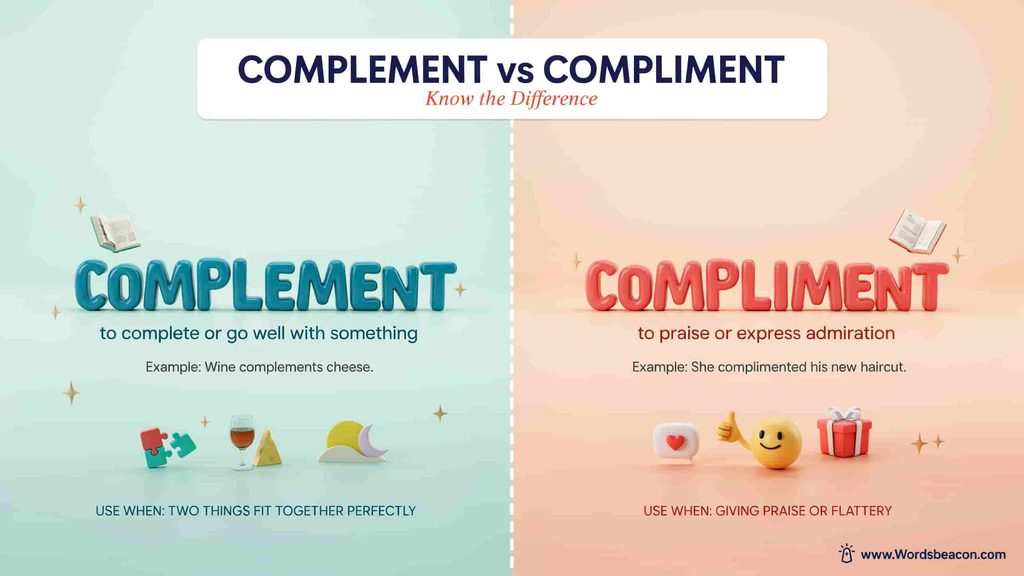
The confusion doesn’t end with complement vs compliment. Their adjective forms, complementary and complimentary, create another common spelling problem.
Although they look almost identical, they have different meanings.
Complementary describes things that complete, enhance, balance, or work well with one another.
Complimentary has two common meanings. It can describe something that expresses praise or something provided free of charge.
For example:
- The two colors are complementary.
- She made complimentary remarks about his work.
- The hotel offers complimentary breakfast.
The last example is particularly important because complimentary doesn’t always describe praise.
What Does Complementary Mean?
Complementary is the adjective form of complement. It describes things that work well together or enhance each other.
Examples:
- The designer chose complementary colors for the living room.
- Their complementary skills helped the company grow.
- The two approaches are complementary.
- These ingredients create a complementary flavor combination.
- The complementary features make the product more useful.
The word also appears in specific fields.
Complementary colors: Colors positioned opposite each other on a color wheel.
Complementary angles: Two angles whose measures add up to 90 degrees.
For example, an angle measuring 30 degrees and another measuring 60 degrees are complementary because their total is 90 degrees.
Complementary skills: Different abilities that work well together.
For instance, writing and editing skills can be complementary because they support different stages of the same process.
What Does Complimentary Mean?
Complimentary is the adjective form of compliment. It can describe praise or something provided without charge.
Complimentary meaning: Expressing praise
Examples:
- She made complimentary comments about the new design.
- The manager wrote a complimentary review of the employee.
- He offered complimentary remarks about the speaker.
Complimentary meaning: Free of charge
Examples:
- The hotel provides complimentary breakfast.
- Guests received complimentary tickets to the event.
- The restaurant offers complimentary drinks with selected meals.
- The airline provided complimentary snacks during the flight.
When a hotel advertises a complimentary breakfast, it means guests can enjoy breakfast without paying an additional charge under the advertised offer’s terms.
Complementary vs Complimentary Comparison Table
| Feature | Complementary | Complimentary |
|---|---|---|
| Root word | Complement | Compliment |
| Main meaning | Completing or enhancing | Praising or free of charge |
| Common use | Colors, skills, angles, combinations | Praise, services, gifts, meals |
| Example | Complementary colors create contrast. | The hotel offers complimentary breakfast. |
| Memory trick | E for complete | I for praise |
A useful way to remember both forms is to connect each adjective to its original word:
- Complement → Complementary → Completion or enhancement.
- Compliment → Complimentary → Praise or something free.
Fix common more word mistakes in English
Focusing vs Focussing Which Spelling Is Correct ?
Complement vs Compliment vs Supplement
The word supplement adds another layer to the confusion because it shares part of the meaning of complement.
However, these three words describe different ideas.
Complement refers to something that completes, improves, or enhances another thing.
Compliment refers to an expression of praise or admiration.
Supplement refers to something added to provide extra support, information, or value.
Consider these examples:
- The sauce complements the meal.
- The chef received a compliment for the sauce.
- The restaurant added a side dish to supplement the meal.
The difference becomes clearer when you focus on what each word describes.
| Word | Meaning | Example |
|---|---|---|
| Complement | Something that enhances another thing | Fresh herbs complement the soup. |
| Compliment | An expression of praise | The chef received a compliment. |
| Supplement | Something added to provide extra support or content | The textbook includes a supplement. |
When Are Complement and Supplement Different?
Although complement and supplement can sometimes appear in similar contexts, they don’t always mean the same thing.
A complement works well with something else or makes it better through compatibility.
A supplement adds something extra, often to fill a gap or provide additional material.
For example:
“A salad complements the main course.”
This means the salad works well with the meal.
“A salad supplements the main course.”
This suggests the salad adds extra food or nutritional value.
The distinction is subtle in some situations, but it matters when you want to communicate a precise meaning.
Fix common more word mistakes in English
Persuing vs Pursuing Difference and Correct Spelling
Common Mistakes When Using Complement vs Compliment
Even experienced writers sometimes confuse these words because their pronunciation is identical in American English. However, understanding their meanings can prevent several common grammar mistakes.
Using Compliment When You Mean Enhance
Incorrect: The blue curtains compliment the white walls.
Correct: The blue curtains complement the white walls.
Why? The sentence describes how the curtains work with the walls. It doesn’t describe someone praising them.
Using Complement When You Mean Praise
Incorrect: My teacher gave me a complement for my essay.
Correct: My teacher gave me a compliment for my essay.
Why? The teacher expressed approval of the essay. The correct word is compliment.
Confusing Complimentary With Complementary
Incorrect: The hotel provides complementary breakfast.
Correct: The hotel provides complimentary breakfast.
Why? The hotel offers breakfast free of charge. It isn’t describing how breakfast works with another item.
Assuming Complimentary Always Means Free
Incorrect assumption: Complimentary only describes something provided without charge.
Correct understanding: Complimentary can describe praise or something provided free of charge.
For example:
“She made complimentary remarks about the new employee.”
Here, the word describes positive comments, not a free service.
Replacing Complement With Supplement
Incorrect: The blue tie supplements the gray suit.
Better: The blue tie complements the gray suit.
Why? The sentence describes how the tie matches the suit. Complements communicates that relationship more naturally.
Choosing the Spelling Based on Sound
Incorrect approach: Choosing whichever spelling looks right when you say the sentence aloud.
Correct approach: Identify the intended meaning first.
Since both words sound the same in American English, pronunciation alone won’t help you select the correct spelling.
Fix common more word mistakes in English
Different vs Diffrent Which Spelling Is Correct?
Practice session Complement vs Compliment
Now that you understand the difference between Complement vs Compliment test your knowledge with these questions.
Choose the correct word or word form for each sentence.
- The silver earrings ______ her black evening dress.
- My manager gave me a wonderful ______ after the presentation.
- Fresh lemon juice can ______ the flavor of grilled fish.
- She ______ her colleague on his excellent work.
- The two colors ______ each other beautifully.
- I received a lovely ______ about my new hairstyle.
- His communication skills ______ her technical knowledge.
- The teacher ______ the students on their progress.
- A fresh salad is a perfect ______ to the main course.
- He paid her a sincere ______ for her kindness.
- The hotel provides ______ breakfast to its guests.
- Red and green are examples of ______ colors.
- The director made several ______ remarks about the employee’s performance.
- Their different personalities ______ each other.
- The chef received a ______ from the customers.
- The new software will ______ the existing system.
- The two angles are ______ because their measures add up to 90 degrees.
- She ______ me on my writing skills.
- The company offers ______ tickets to selected guests.
- The necklace is a beautiful ______ to her wedding dress.
Answers
| No. | Correct Answer | Explanation |
|---|---|---|
| 1 | Complement | The earrings enhance the dress. |
| 2 | Compliment | The manager expressed praise. |
| 3 | Complement | Lemon juice enhances the flavor. |
| 4 | Complimented | She praised her colleague. |
| 5 | Complement | The colors work well together. |
| 6 | Compliment | The remark expresses admiration. |
| 7 | Complement | The skills work well together. |
| 8 | Complimented | The teacher praised the students. |
| 9 | Complement | The salad enhances the meal. |
| 10 | Compliment | A sincere expression of praise. |
| 11 | Complimentary | The breakfast is provided free of charge. |
| 12 | Complementary | The colors sit opposite each other on a traditional color wheel. |
| 13 | Complimentary | The remarks express praise. |
| 14 | Complement | Their personalities work well together. |
| 15 | Compliment | The customers expressed appreciation. |
| 16 | Complement | The software enhances the existing system. |
| 17 | Complementary | The angles add up to 90 degrees. |
| 18 | Complimented | She praised my writing skills. |
| 19 | Complimentary | The tickets are provided free of charge. |
| 20 | Complement | The necklace enhances the wedding dress. |
Here’s a trusted source for clear word meanings:
FAQs
What is the difference between complement vs compliment?
Complement refers to something that completes, improves, or goes well with something else. In contrast, compliment means an expression of praise or admiration. For example, a blue tie complements a gray suit, while saying “Your suit looks great” is a compliment.
When should you use complement instead of compliment?
Use complement when you mean that something completes, balances, or enhances another thing. For instance, “The new curtains complement the room’s decor.” However, when you want to express praise, use compliment, as in “She complimented my presentation.”
Can complement vs compliment be used as verbs?
Yes, both words work as verbs, but they express different ideas. To complement means to complete or enhance something, whereas to compliment means to praise someone or something. For example, “The sauce complements the pasta,” while “The chef complimented the kitchen staff.”
Are complement vs compliment pronounced the same way?
Yes, complement vs compliment are homophones in American English. Although they have different spellings and meanings, they sound alike. Therefore, you need to consider the context to choose the correct word.
Is a person a complement or a compliment?
A person can be described as a complement when they complete or balance another person or a group. For example, “Her experience makes her a valuable complement to the team.” On the other hand, a compliment is something you say to praise that person.
What does “a full complement” mean?
A full complement refers to the complete number or amount of people or things needed for a particular purpose. For example, “The hospital has a full complement of nurses on the night shift.” In other words, it has all the staff members it needs.
What is the difference between complement and supplement?
A complement completes, balances, or enhances something, while a supplement adds something extra. For example, a side dish can complement a meal by making it more satisfying. Meanwhile, an additional nutritional product may supplement someone’s diet.
What is the difference between complementary and complimentary?
Although these words sound alike, they have different meanings. Complementary describes things that complete, match, or enhance each other. Complimentary, however, refers to praise or something provided free of charge. For example, complementary colors work well together, while a complimentary breakfast is free for guests.
Why is “complimentary breakfast” correct instead of “complementary breakfast”?
Complimentary breakfast is correct when you mean breakfast provided free of charge. Hotels and restaurants often use complimentary to describe items guests receive without paying extra. By comparison, complementary breakfast would suggest that the meal completes or enhances something else, which isn’t the intended meaning in a hotel offer.
What does “complimentary” mean on a restaurant menu?
On a restaurant menu, complimentary usually means that an item is provided free of charge. For example, a complimentary dessert is a dessert you receive without paying an additional amount. Similarly, a restaurant might offer complimentary bread or coffee before your meal.
What does “complement each other” mean?
When two or more things complement each other, their qualities work well together because they match, balance, or enhance one another. For example, warm colors and natural wood may complement each other in a room. Likewise, two coworkers with different strengths can complement each other on a project.
What is an example of a complementary good?
A complementary good is a product that people commonly use with another product. For instance, printers and printer ink are complementary goods because owning a printer often creates a need for ink. Similarly, a smartphone and its compatible charger are complementary products.
What are gross complements in economics?
Gross complements are goods for which an increase in the price of one product reduces the demand for another product, assuming other factors remain unchanged. For example, if printer prices rise, fewer people may buy printers. Consequently, demand for printer ink may also decrease.
What is the easiest way to remember complement vs compliment?
A simple trick is to connect the E in complement with complete. A complement completes or enhances something. Meanwhile, remember the I in compliment as a clue for admiration: when you say something nice, you are expressing what you like about someone or something.
Do you give someone a compliment or a complement?
You give someone a compliment when you praise them. For example, “I gave my coworker a compliment about her excellent work.” However, use complement when describing something that completes or enhances a person, such as a skill or quality that balances a team.
Learn the difference between tricky more English words
Center vs Centre Difference and Which one Is Correct?
Conclusion
Complement vs Compliment may sound alike, but their meanings are worlds apart. The good news? You don’t need to memorize complicated grammar rules to tell them apart. Just remember that a complement completes, balances, or enhances something, while a compliment expresses praise or admiration. For an easy memory trick, think of the E in complement as complete and the I in compliment as I admire you. Now, the confusion should be much easier to avoid! After all, you want to compliment someone’s beautiful outfit, not accidentally suggest that their outfit completes something. Get the spelling right, and your words will always say exactly what you mean.

Luna AJS is an experienced blogger and dedicated language enthusiast at Words Beacon. She specializes in making English grammar, spelling, vocabulary and commonly confused words easy to understand. She provides clear explanations, practical examples to help readers write with confidence.