
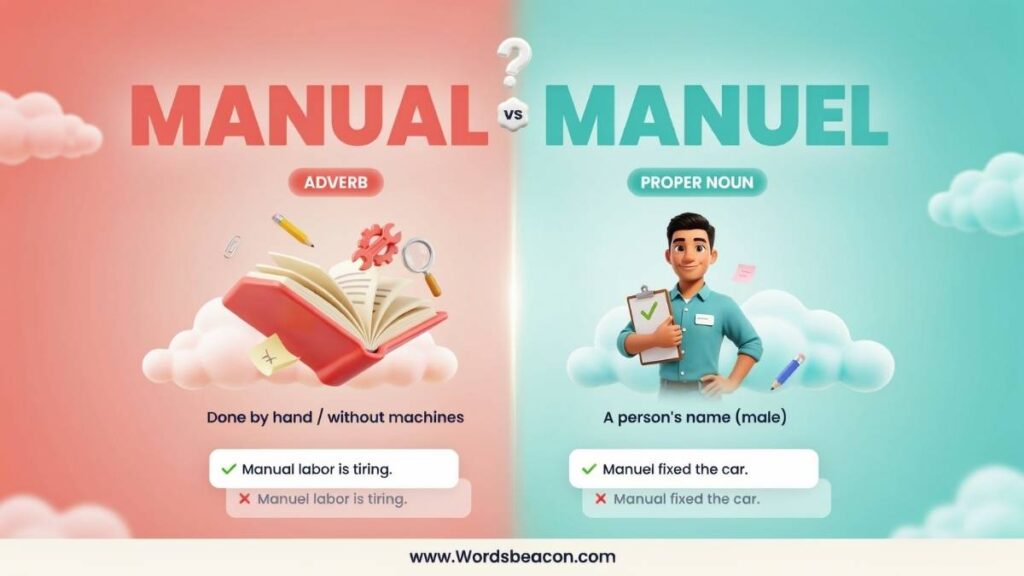
A single letter can create a surprisingly big spelling headache. That is exactly what happens with Manual vs Manuel. The two words look almost the same, but their meanings are completely different. Manual can describe something done by hand, a task that needs human control, or a book that explains how to use something. Manuel, however, is usually a person’s name. So, mixing them up can make an ordinary sentence sound unintentionally funny. In this guide, you will learn the difference between manual and Manuel, including their meanings, spelling, pronunciation, and everyday use. By the end, the confusion should be much easier to avoid.
quivk answer
| Word | Meaning | Use |
|---|---|---|
| Manual | Done by hand or an instruction book | Manual work, user manual |
| Manuel | A person’s given name | Manuel is my friend. |
| Part of speech | Noun or adjective | Common English word |
| Capitalization | Usually lowercase | Capitalized as a name |
In short, manual is the correct English word for work, processes, or instructions, while Manuel is generally a person’s name.
Fix common more word mistakes in English
Molding vs Moulding which one is correct and usage ?
Manual vs Manuel What’s the Difference?
The correct choice depends on context. Manual is the standard English word when you mean an instruction book, a task performed by hand, or something controlled by a person rather than automatically. Manuel is normally a personal name.
For example, consider these two sentences:
Please read the manual before operating the machine.
Manuel called earlier and left a message.
In the first sentence, manual means an instruction book. In the second, Manuel identifies a person.
Therefore, when someone asks, “Manual or Manuel which spelling is correct?” there is no single spelling that works in every situation. Manual is correct for the common English word, while Manuel is correct when you mean the personal name.
The capitalization gives you another useful clue. Manual usually appears in lowercase because it is a common noun or adjective. Manuel begins with a capital letter when it functions as a person’s name because it is a proper noun.
Manual Meaning and Definition
The manual meaning changes slightly depending on how the word functions in a sentence. In English, manual commonly works as both a noun and an adjective.
As an adjective, manual describes something performed by hand or controlled directly by a person. As a noun, it usually refers to a book or document containing instructions.
This explains why the word appears in such different expressions as manual labor, manual work, manual process, manual transmission, user manual, and instruction manual.
Manual as an Adjective
When manual functions as an adjective, it describes an activity, process, system, or object that involves human effort or direct human control.
For example, a company might use a manual process to enter information into a system. A technician might perform a manual inspection instead of relying entirely on an automated system. Likewise, a driver can operate a vehicle with a manual transmission.
The basic idea is simple: a person performs or controls the action rather than a system doing everything automatically.
Consider this example:
The technician completed a manual inspection of the equipment.
Here, manual describes the inspection. It tells you that the inspection involved direct human work.
Similarly:
The operator switched the machine to manual control.
In this sentence, manual describes the type of control. The operator controls the machine directly instead of allowing an automatic system to handle the operation.
This meaning also explains phrases such as manual task, manual work, and manual process.
Manual as a Noun
When manual functions as a noun, it usually means an instruction book or guide.
For example:
The manual explains how to install the software.
The owner’s manual contains information about vehicle maintenance.
Please check the instruction manual before assembling the table.
In each sentence, manual refers to written information that helps someone understand, operate, maintain, or use something.
A manual can therefore be similar to a handbook or instruction book, although those words are not always exact substitutes. A handbook may provide general information or guidance, while a manual often focuses on specific instructions, procedures, operation, or maintenance.
The context makes the intended meaning clear.
Learn the difference between commonly mixed-up more words
Farther vs Further difference and usage ?
Manual Definition in English Grammar
A useful manual definition is straightforward. As an adjective, manual means involving human action, physical effort, hand operation, or direct control rather than automatic operation. As a noun, manual means a book or document that provides instructions or information.
That gives you two main grammatical uses.
When manual acts as an adjective, it describes another word:
The company introduced a manual approval process.
When manual acts as a noun, it names an instruction document:
The manual explains the safety procedures.
This distinction is important because English often uses the same word in more than one grammatical role. The spelling does not change, but the meaning depends on the sentence.
What Does Manuel Mean?
The Manuel meaning is quite different. Manuel is generally a masculine given name. It is especially associated with Spanish and Portuguese usage and has historical connections with forms of the name Emmanuel and Immanuel.
As a personal name, Manuel functions as a proper noun.
For example:
Manuel works at the local bookstore.
I spoke with Manuel yesterday.
Manuel sent the documents this morning.
In all three sentences, Manuel identifies a specific person.
That is why the word begins with a capital M. Proper names receive capitalization in standard English writing.
The name Manuel is not simply an alternative spelling of the English word manual. Although the two forms look similar, they have different meanings and grammatical functions.
Manuel Definition and Name Meaning
A simple Manuel definition is “a masculine personal name.” Its deeper history connects it with Emmanuel and Immanuel, names traditionally associated with the meaning “God is with us.”
Manuel has a long history of use in Spanish and Portuguese-speaking cultures. Therefore, Manuel can appear in many different personal names and cultural contexts.
For example:
Manuel arrived before everyone else.
I sent the message to Manuel.
The first name of the author is Manuel.
In each case, the word identifies a person rather than an object, action, or instruction book.
This distinction answers another common question: is Manuel a word or a name? In everyday English, Manuel is primarily encountered as a personal name.
Learn the difference between tricky grammar words
Quiet vs Quite difference and usage ?
Manuel vs Manual The Main Difference

The manual and Manuel difference becomes much clearer when you compare their roles.
Manual is a common noun or adjective. Manuel is generally a proper noun when it identifies a person.
Manual can describe something done by hand:
The workers performed the task manually.
Manual can also describe a non-automated process:
The company still uses a manual approval system.
Furthermore, manual can refer to an instruction book:
I downloaded the user manual.
Manuel, however, normally identifies someone:
Manuel joined the meeting.
That difference affects capitalization, grammar, pronunciation, and meaning.
The words may look like close spelling relatives, but they should not be treated as synonyms.
Manual vs Manuel Comparison
| Feature | Manual | Manuel |
|---|---|---|
| Main use | Common English word | Personal name |
| Grammar | Noun or adjective | Proper noun |
| Meaning | Done by hand or an instruction book | Masculine given name |
| Capitalization | Usually lowercase | Capitalized as a name |
| Example | Read the manual. | Manuel called. |
The table shows the essential difference without making the distinction more complicated than it needs to be.
Learn the difference between tricky grammar words
Its vs It’s Difference and usage ?
Manual Spelling vs Manuel Spelling
The spelling difference is small, which explains why these words can cause confusion.
Manual is spelled M-A-N-U-A-L.
Manuel is spelled M-A-N-U-E-L.
The most useful visual clue is the ending.
Manual ends in “ual.”
Manuel ends in “uel.”
That one-letter difference changes the word.
If you are asking how to spell manual, remember the “ual” ending. If you are asking how to spell Manuel, remember the “uel” ending.
The meaning then gives you a second check.
If the word refers to instructions or something done by hand, manual fits. If it refers to a person, Manuel fits.
Manual or Manuel Correct Spelling
The phrase manual or Manuel correct spelling often appears because people remember the general shape of the word but forget which vowel belongs near the end.
The solution is not to memorize the two spellings separately without context. Instead, connect each spelling to a familiar example.
Read the manual.
Ask Manuel.
The first sentence refers to instructions. The second refers to a person.
That simple contrast makes the spelling difference easier to remember.
How to Spell Manual Correctly
If you want to know how to spell manual correctly, use manual when you mean the English word associated with hand operation or instructions.
For example:
The manual explains how to use the printer.
She completed the task manually.
The vehicle has a manual transmission.
Notice that all three examples use manual or its related form manually.
The spelling does not become Manuel simply because the pronunciation may sound similar in fast speech.
How to Spell Manuel Correctly
If you want to know how to spell Manuel correctly, use Manuel when referring to the personal name.
For example:
Manuel lives in Lisbon.
I met Manuel at the conference.
The letter was addressed to Manuel.
Because Manuel is a personal name, the first letter should normally be capitalized.
The spelling should also remain Manuel even when the name appears in the middle of a sentence.
Manual vs Manuel Pronunciation
The manual vs Manuel pronunciation can add another layer of confusion because both forms contain similar letters. However, they do not represent the same word or necessarily the same pronunciation.
In American English, manual commonly has three syllables. Its pronunciation begins with the sound associated with “man” and continues with the vowel sequence found in the middle of the word.
Manuel, meanwhile, is a personal name with pronunciations that can vary according to language and regional usage. A Spanish pronunciation will not necessarily sound identical to an English pronunciation of the name.
Therefore, manual vs Manuel pronunciation is not simply a matter of changing one letter while keeping exactly the same sound.
Learn the difference between tricky grammar words
Learned vs Learnt difference and usage ?
When to Use Manual
Use manual when the sentence concerns human effort, direct control, physical work, a non-automated process, or an instruction document.
For example, manual labor involves physical work performed by people. Manual work can describe tasks that require direct human effort. A manual process requires people to complete steps rather than allowing a system to automate the entire process.
The word also appears frequently in technology and manufacturing.
A technician might use manual controls. An employee might complete a manual data-entry task. A driver might use a manual transmission. A customer might consult a user manual.
These uses all connect to the central idea of human involvement.
Manual Labor and Manual Work
Manual labor generally refers to work that involves physical effort. Construction, agriculture, warehouse work, cleaning, maintenance, and manufacturing can all involve manual labor.
Manual work does not necessarily mean that a person uses no tools or machinery. Instead, the phrase emphasizes the human effort involved in completing the task.
For example:
The workers performed manual labor during the installation.
The phrase tells you that people carried out the physical work.
Manual Process and Manual Task
A manual process requires people to complete steps directly instead of relying entirely on automation.
A manual task is a specific activity that requires human action.
For example:
The employee entered the information through a manual process.
The software reduced the number of manual tasks required each day.
In both cases, manual contrasts with automated.
Manual Transmission
A manual transmission allows the driver to select gears and operate a clutch rather than relying on a conventional automatic transmission to change gears.
For example:
He learned to drive a car with a manual transmission.
Here, manual does not mean an instruction book. It describes the type of transmission.
That example shows why context matters so much when understanding manual word meaning.
User Manual and Instruction Manual
A user manual provides information that helps people use a product, system, or device.
An instruction manual generally provides directions for operating, assembling, installing, or using something.
For example:
The user manual explains all the camera settings.
The instruction manual shows how to assemble the equipment.
An owner’s manual serves a similar purpose for many vehicles and other products. It can contain operating instructions, maintenance information, warnings, specifications, and other practical details.
Learn the difference between tricky grammar words
To vs Too difference and usage?
When to Use Manuel
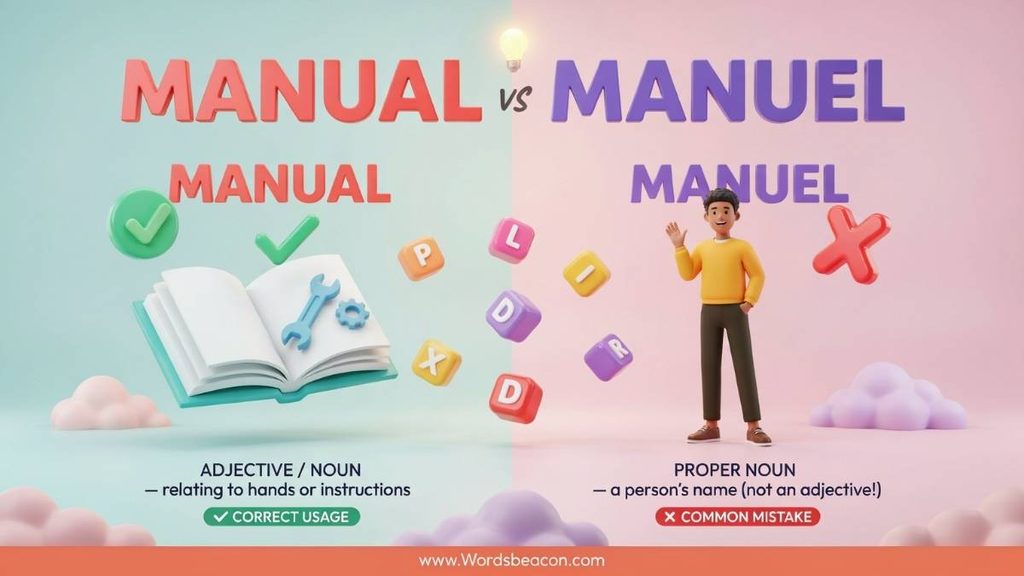
Use Manuel when you mean the personal name.
For example:
Manuel lives nearby.
I emailed Manuel yesterday.
Manuel attended the meeting.
Because Manuel is a proper noun in these examples, capitalization matters.
If you write “manuel” when referring to a person, the spelling may look like the common English word and can create unnecessary confusion.
Therefore, the safest approach is to treat the name as a name and capitalize it correctly.
Common Mistakes With Manuel and Manual
The first common mistake occurs when someone writes Manuel when they actually mean manual.
For example:
Please read the manuel before using the machine.
The correct version is:
Please read the manual before using the machine.
The second mistake happens in the opposite direction:
Manual called me yesterday.
If the person’s name is Manuel, the correct sentence is:
Manuel called me yesterday.
Another mistake occurs when people assume that manual and Manuel are simply two spellings of the same word. They are not. Their meanings and grammatical roles differ.
Finally, spelling confusion can occur because the words share several letters. A quick check of the final vowel pattern usually solves the problem.
Manual uses “ual.”
Manuel uses “uel.”
Learn the difference between confusing more English words
Breath vs Breathe which one is correct ?
Manual and Manuel in Real-Life Sentences
Context often provides the fastest answer.
Consider a workplace example:
The manager introduced a manual approval process.
Here, manual describes a process that depends on people rather than complete automation.
Now compare it with:
Manuel introduced the new approval process.
Here, Manuel identifies the person who introduced it.
The same pattern appears in technology:
Read the user manual before changing the settings.
The manual contains instructions.
Now compare:
Manuel changed the settings.
The second sentence refers to a person.
Education provides another clear example:
The students received an instruction manual for the laboratory equipment.
In contrast:
Manuel received the laboratory assignment.
Again, the spelling difference reflects a difference in meaning.
Manual People Search and Manuel
The word manual can also appear in phrases related to searching for information. For example, manual people search, manual lookup, manual research, and manual information gathering describe processes that a person performs directly rather than relying entirely on an automated service.
A manual online search might involve checking publicly available search-engine results, official directories, professional profiles, or other legitimate public sources.
The word Manuel can appear in the same context for a completely different reason.
For example, a search for “Manuel” might simply be a name search for someone with that first name.
Therefore, the phrase manual people search does not mean a search for a person named Manuel.
Instead, manual describes how the search happens.
A manual search is carried out step by step by a person. An automated search relies more heavily on software or a database to collect and organize information.
This distinction becomes especially useful when search terms contain both concepts.
Learn the difference between confusing more English words
Yours vs Your’s which one is correct ?
Manual People Search vs Automated People Search
A manual people search generally involves examining publicly available information yourself. Depending on the purpose, that might include checking search engines, public professional pages, government directories that provide public access, official organization websites, or public social media profiles.
An automated people search usually involves a service that gathers or organizes information through software and databases.
The difference can be summarized simply.
Manual search means a person performs the research step by step.
Automated search means software performs much of the retrieval or organization.
However, public availability does not mean that every piece of personal information should be collected or used without limits. Privacy expectations, access restrictions, website terms, and applicable laws still matter.
For legitimate research, the safest approach is to use information that has been intentionally made public and to avoid bypassing privacy or security controls.
Is Manuel a Word or a Name?
The question “Is Manuel a word or a name?” has a fairly simple answer.
Manuel is primarily a personal name in everyday English usage. It is a masculine given name associated especially with Spanish and Portuguese usage.
It can appear in historical names, surnames, titles, and other proper-name contexts as well. However, that does not make it an alternative spelling of the common English word manual.
So, if someone asks, “Is Manuel a correct spelling of manual?” the answer is no when the intended meaning is an instruction book or something performed by hand.
Is Manual the Correct Spelling?
Yes, manual is the correct spelling when you mean the English word.
You should write:
Please read the manual.
The worker performed the task manually.
The vehicle has a manual transmission.
You should not replace manual with Manuel simply because the two words look similar.
At the same time, manual is not the correct spelling of someone’s name if that person’s name is Manuel.
Learn the difference between confusing more English words
Lose vs Loose which one is correct ?
Manual Correct Word or Manuel Correct Word?

The question of which is the manual correct word or the Manuel correct word depends entirely on meaning.
1.If you are referring to instructions, choose manual.
2.If you are referring to work done by hand, choose manual.
3.If you are describing a non-automated process, choose manual.
4.If you are referring to a person named Manuel, choose Manuel.
For example:
I need the manual for this camera.
Manuel needs the camera.
The first sentence refers to a document. The second identifies a person.
That is the clearest way to understand the difference.
How to Remember Manuel vs Manual
A simple memory trick can make the distinction stick.
Think of manual as being connected with machines, instructions, and human effort.
Then think of Manuel as a person’s name.
The spelling pattern reinforces the memory:
manual ends with “ual.”
Manuel ends with “uel.”
You can also remember the contrast through two short sentences:
Read the manual.
Ask Manuel.
Once you associate each spelling with a different meaning, the words become much harder to mix up.
Learn the difference between confusing more English words
Tweek vs Tweak difference and usage?
Practice session manual vs Manuel
Fill in each blank with manual vs Manuel.
- I read the car’s ______ before changing the oil.
- ______ is my new classmate from Spain.
- The machine requires ______ operation.
- Please ask ______ to send me the report.
- She prefers a ______ transmission instead of an automatic one.
- ______ helped his father repair the bicycle.
- The workers completed the task by ______ labor.
- I could not understand the instructions, so I checked the user ______.
- ______ is a common masculine given name.
- The company uses a ______ process to check every order.
- My brother’s name is ______.
- This device must be operated ______.
- ______ brought his instruction book to class.
- The employee performed the task ______ rather than using a machine.
- Always keep the owner’s ______ in a safe place.
- ______ is often used as a Spanish and Portuguese given name.
- The factory reduced the amount of ______ work by using robots.
- I need to read the instruction ______ before using the equipment.
- ______ called me this morning about the meeting.
- The word ______ can describe something done by hand or a guide that explains how to use something.
Answers
- manual
- Manuel
- manual
- Manuel
- manual
- Manuel
- manual
- manual
- Manuel
- manual
- Manuel
- manually
- Manuel
- manually
- manual
- Manuel
- manual
- manual
- Manuel
- manual
Here’s a trusted source for clear word meanings:
FAQs
Can “Manuel” be used as a regular English word?
Usually, no. “Manuel” is primarily used as a personal name, while “manual” is the standard English word for something done by hand or a book that provides instructions.
Why do “manual” and “Manuel” look so similar?
The words share several letters, which makes them easy to confuse when typing or reading quickly. However, their meanings are different. “Manual” is a common English word, while “Manuel” is generally a proper name.
Can “manual” be both a noun and an adjective?
Yes. As a noun, “manual” can mean a book that provides instructions. As an adjective, it describes something done by hand or controlled directly by a person rather than automatically.
Should “Manuel” always start with a capital letter?
When “Manuel” is used as a person’s name, yes. It is a proper noun, so the first letter should be capitalized. “Manual,” on the other hand, is normally lowercase unless it appears at the beginning of a sentence or in a title.
Does the spelling change the meaning of the word?
Yes. The difference between “manual” and “Manuel” is more than a single letter. “Manual” can describe hands-on work, a process, or an instruction book, whereas “Manuel” usually identifies a person.
Can “manual” describe work that is not physically demanding?
Yes. “Manual” does not always mean hard physical labor. A person can perform a manual task by entering information, checking records, or completing a process by hand instead of using an automated system.
Can “Manuel” refer to a person’s name?
Yes. Manuel is an established masculine given name. It is especially associated with Spanish- and Portuguese-speaking naming traditions and is also used in other countries.
What does “manual” mean in technology?
In technology, “manual” often means that a person performs an action directly instead of allowing a program, machine, or automated system to perform it. For example, manually entering data means entering it yourself rather than importing it automatically.
What is meant by “manual control”?
“Manual control” means that a person directly operates or adjusts something. It contrasts with automatic control, where a system performs the action without direct human operation.
Is “user Manuel” the correct phrase?
No, unless Manuel is the actual name of the person being mentioned. If you mean a guide that explains how to use a product, the correct phrase is “user manual.”
Can “manual” and “Manuel” appear in the same sentence?
Yes. For example, “Manuel read the manual before using the machine.” In this sentence, “Manuel” is a person’s name, while “manual” refers to the instruction book.
How can you easily remember the difference between manual and Manuel?
Connect “manual” with instructions, hands-on work, or human control. Connect “Manuel” with a person’s name. A simple memory trick is: “Read the manual, then ask Manuel.”
Why is capitalization useful when distinguishing manual from Manuel?
Capitalization gives readers an immediate clue. “Manuel” is capitalized because it is normally a proper name, while “manual” is usually lowercase because it is a common noun or adjective. This small difference can prevent confusion in written English.
Conclusion
The difference between manual vs Manuel is simple once you know what each word means. Manual is the correct English word when you are talking about something done by hand, a hands-on process, or a book of instructions. Manuel, on the other hand, is usually a person’s name.
So, if you are reading an instruction book, driving a manual car, or doing a task by hand, use manual. If you are talking about a person named Manuel, use Manuel with a capital M.
Here is an easy way to remember it: read the manual, then ask Manuel. One is a word for work or instructions, and the other is a name. Keep that small difference in mind, and this spelling confusion becomes much easier to avoid.

Luna AJS is an experienced blogger and dedicated language enthusiast at Words Beacon. She specializes in making English grammar, spelling, vocabulary and commonly confused words easy to understand. She provides clear explanations, practical examples to help readers write with confidence.