
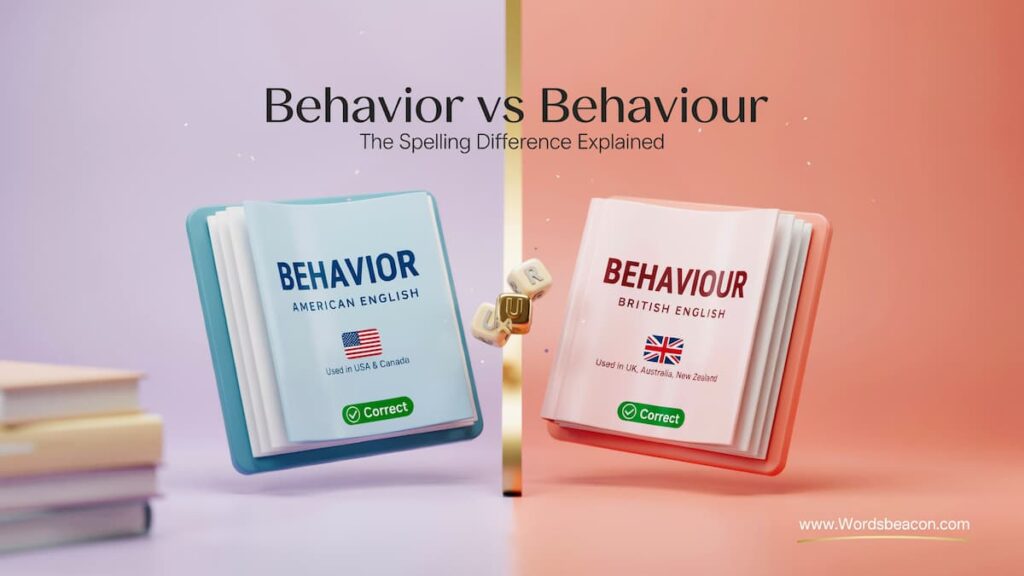
Behavior vs behaviour can leave you wondering whether that little “u” belongs there or has simply wandered into the wrong word. The good news? Both spellings are correct! They have the same meaning, pronunciation, and grammatical use. The only difference is where each spelling is preferred. American English uses “behavior,” while British English uses “behaviour.” However, choosing the right version can still cause confusion, especially when you’re writing for different audiences or using related words such as behavioral and behavioural. Let’s make things simple. This guide explains the spelling differences, provides clear examples, and helps you avoid common mistakes so you can write with confidence.
quick comparison
| Feature | Behavior | Behaviour |
|---|---|---|
| English variety | American English | British English |
| Spelling | Without U | With U |
| Meaning | The way someone acts or responds | The way someone acts or responds |
| Pronunciation | Same | Same |
| Part of speech | Noun | Noun |
| Adjective | Behavioral | Behavioural |
| Plural | Behaviors | Behaviours |
| Common usage | United States | United Kingdom, Australia, New Zealand |
| Example | His behavior was polite. | His behaviour was polite. |
Learn how to use confusing more words correctly
Emigrate vs Immigrate Difference and usage
What Does Behavior Mean?
Behavior refers to the way a person, animal, or organism acts or responds in different situations. It includes actions, habits, reactions, and patterns of conduct that help describe how someone or something interacts with its surroundings.
In everyday life, behavior can take many forms. Helping someone carry groceries, interrupting a conversation, following instructions, or remaining calm during an argument are all examples of behavior. Some actions happen deliberately, while others occur as automatic responses to particular situations.
The behavior definition also extends beyond human actions. Scientists use the term when studying how animals respond to their environments, find food, communicate, protect themselves, and interact with other members of their species.
In psychology, behavior has an important role because researchers examine people’s actions and responses to understand how they learn, develop habits, and interact with others. They may study the effects of rewards, social environments, personal experiences, and external influences on human actions.
Behavior functions as a noun. Depending on the context, it can describe someone’s general conduct or specific types of actions.
Examples of Behavior in Sentences
Here are some examples that show how Americans use behavior in everyday and professional situations:
- His behavior during the interview impressed the hiring manager.
- Parents should encourage positive behavior in young children.
- The dog’s behavior changed after moving to a new home.
- Scientists study animal behavior to understand wildlife interactions.
- Her calm behavior helped prevent a serious argument.
- The school introduced new rules to improve student behavior.
- Social behavior often changes depending on the surrounding environment.
- The manager addressed the employee’s inappropriate behavior.
- Regular exercise can influence sleep patterns and daily behavior.
- The child’s behavior improved after receiving consistent support.
Notice how naturally behavior fits into each sentence. You don’t need to change the sentence structure when using this noun. Simply choose the spelling that matches your intended audience.
What Does Behaviour Mean?
Behaviour is the British English spelling of behavior. It describes the same actions, habits, reactions, and patterns of conduct. The only difference is the additional U, which follows traditional British spelling conventions.
For example, a British teacher might discuss classroom behaviour, while a wildlife researcher might investigate the behaviour of birds during migration. In both situations, the word describes how someone or something acts.
The behaviour definition remains identical to its American counterpart. It functions as a noun and appears in everyday conversations, educational materials, scientific research, and professional documents.
Although British English uses behaviour, this spelling also appears in Australia, New Zealand, and Canada. However, Canadian spelling conventions allow more variation than British conventions, so writers should check the preferences of their intended publication or institution.
Examples of Behaviour in Sentences
The following examples demonstrate how British writers use behaviour:
- His behaviour during the meeting surprised his colleagues.
- Parents play an important role in developing good behaviour.
- The dog’s behaviour became more relaxed after training.
- Researchers observed the behaviour of birds in their natural habitat.
- Her positive behaviour encouraged other students.
- The school introduced new policies to address disruptive behaviour.
- Social behaviour can vary across different cultures.
- The manager discussed inappropriate behaviour with the employee.
- The child’s behaviour improved after a change in routine.
- Scientists examined the behaviour of insects under different conditions.
Each sentence follows the same grammatical rules as its American counterpart. Only the spelling changes.
Learn how to use confusing more words correctly
Realize vs Realise Which Spelling Is Correct?
Behavior vs Behaviour in American and British English
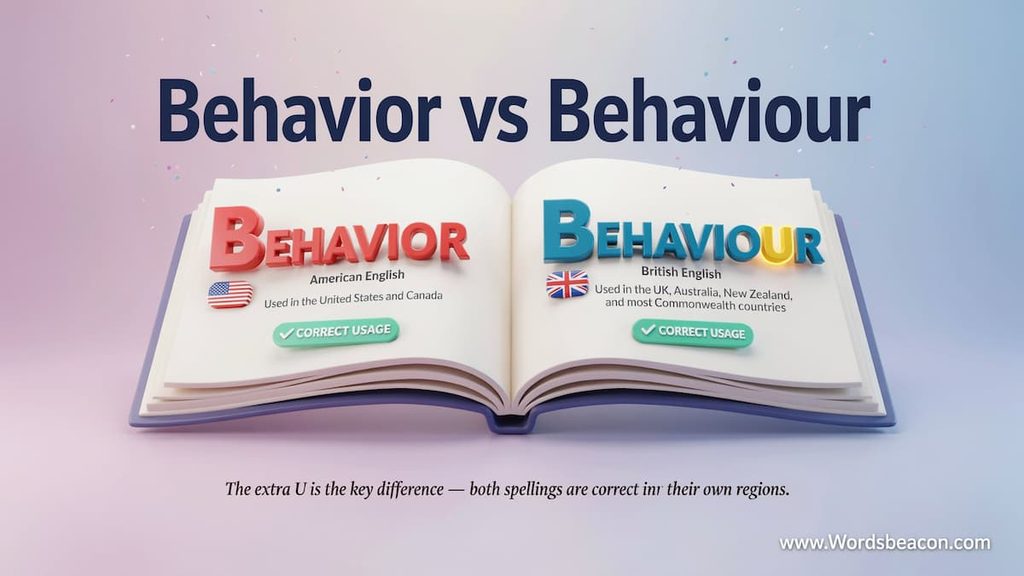
Regional spelling preferences explain why both forms appear in dictionaries, newspapers, textbooks, and online publications.
American English and British English share the same language foundation. However, they developed different conventions for spelling, vocabulary, and certain grammatical preferences.
The main American vs British spelling difference in this word comes from the endings -or and -our. American English generally uses -or, while British English retains -our in this word family.
For example:
| American English | British English |
|---|---|
| Behavior | Behaviour |
| Color | Colour |
| Favor | Favour |
| Honor | Honour |
| Labor | Labour |
| Neighbor | Neighbour |
These examples show a familiar pattern of regional spelling differences. However, English spelling contains exceptions, so you shouldn’t assume that every word follows exactly the same rule.
Behavior in American English
In the United States, behavior is the standard and expected spelling. American dictionaries, schools, universities, newspapers, and professional organizations generally follow this convention.
You’ll find behavior in psychology textbooks, educational resources, research papers, workplace policies, and everyday writing. American writers also use the same spelling pattern in related words.
Consider these examples:
- Good behavior is important in the classroom.
- The researcher examined human behavior.
- Parents should address aggressive behavior early.
- The company has a strict code of employee behavior.
- Scientists studied the behavior of different animal species.
The same American spelling convention applies to these related forms:
| Word form | American spelling | Example |
|---|---|---|
| Noun | Behavior | Children’s behavior matters. |
| Adjective | Behavioral | The school introduced behavioral support. |
| Plural noun | Behaviors | Researchers studied different behaviors. |
| Negative form | Misbehavior | The teacher addressed classroom misbehavior. |
| Adverb | Behaviorally | The groups responded behaviorally in different ways. |
If your primary readers live in the United States, behavior is the appropriate choice.
Behaviour in British English
In the United Kingdom, behaviour is the standard spelling. British dictionaries, educational institutions, newspapers, and professional publications generally retain the U.
For example:
- Good behaviour helps create a positive classroom.
- The researcher examined human behaviour.
- Parents should address aggressive behaviour early.
- The company has a strict code of employee behaviour.
- Scientists studied the behaviour of different animal species.
British English also retains the U in related forms:
| Word form | British spelling | Example |
|---|---|---|
| Noun | Behaviour | Children’s behaviour matters. |
| Adjective | Behavioural | The school introduced behavioural support. |
| Plural noun | Behaviours | Researchers studied different behaviours. |
| Negative form | Misbehaviour | The teacher addressed classroom misbehaviour. |
| Adverb | Behaviourally | The groups responded behaviourally in different ways. |
Therefore, behaviour is the natural choice when writing for British readers.
Learn how to use confusing more words correctly
Career vs Carrer Correct Spelling and Difference
Which Countries Use Behavior vs Behaviour?
The difference between American and British spelling extends beyond the United States and the United Kingdom. Other English-speaking countries also follow their own language conventions.
However, not every country uses one spelling system without exceptions. Canadian English, in particular, combines British and American influences.
Here’s how the two forms generally appear in different countries.
| Country | Common spelling | General convention |
|---|---|---|
| United States | Behavior | American English |
| United Kingdom | Behaviour | British English |
| Canada | Behaviour | Canadian English often favors British forms |
| Australia | Behaviour | Australian English |
| New Zealand | Behaviour | New Zealand English |
Behavior in Canadian English
Canadian English has a distinctive mixture of British and American spelling conventions. Canadians generally prefer behaviour, although behavior also appears in Canadian writing.
For example, Canadian writers commonly use colour, favour, and neighbour. They often follow the same U-retaining convention with behaviour.
However, Canadian English doesn’t simply copy British spelling. Some American forms are also accepted, and individual dictionaries and institutions may show different preferences.
If you’re preparing a document for a Canadian audience, check the relevant Canadian dictionary or institutional style guide. Most importantly, avoid switching between spelling systems in the same document.
Behaviour in Australian English
Australian English generally follows British spelling conventions. As a result, behaviour is the preferred form in Australian newspapers, educational materials, government documents, and professional writing.
Other familiar examples include:
- Colour
- Favour
- Honour
- Neighbour
- Behaviour
For example, an Australian school might discuss positive student behaviour or introduce a policy to address inappropriate classroom behaviour.
Therefore, behaviour is the safer choice when writing specifically for Australian readers.
Behaviour in New Zealand English
New Zealand English also generally follows British spelling conventions. Writers commonly use behaviour in schools, universities, newspapers, and professional publications.
For instance, a New Zealand educational resource might discuss children’s behaviour, classroom expectations, or positive behavioural development.
Although American media influences everyday language in New Zealand, the traditional British spelling remains the standard choice in formal writing.
Fix common more word mistakes in English
Complement vs Compliment Difference and Correct Usage
Behavioral vs Behavioural What’s the Difference?
The difference between behavioral vs behavioural follows the same American and British spelling pattern.
Behavioral is the American adjective, while behavioural is the British adjective. Both describe something connected to behavior vs behaviour.
You’ll frequently encounter these words in psychology, education, healthcare research, and discussions about human actions.
For example:
- American English: The therapist recommended behavioral changes.
- British English: The therapist recommended behavioural changes.
The meaning remains exactly the same.
Behavioral Spelling in American English
American writers use behavioral without the U. This spelling appears in academic papers, psychology textbooks, research publications, and educational materials.
Here are some common examples:
- Behavioral problems can affect classroom performance.
- The researcher examined behavioral patterns among children.
- Behavioral science explores human actions and responses.
- The therapist recommended behavioral changes.
- Parents attended a behavioral training program.
Behavioural Spelling in British English
British writers use behavioural with the additional U. This convention also appears in Australian and New Zealand English.
For example:
- Behavioural psychology examines patterns of conduct.
- The school introduced a behavioural support program.
- Researchers identified several behavioural patterns.
- The study examined behavioural responses to stress.
- The university offers a course in behavioural science.
Behavioral vs Behavioural Examples
The following table makes the difference easier to remember.
| American English | British English |
|---|---|
| Behavioral problems | Behavioural problems |
| Behavioral changes | Behavioural changes |
| Behavioral patterns | Behavioural patterns |
| Behavioral science | Behavioural science |
| Behavioral therapy | Behavioural therapy |
| Behavioral research | Behavioural research |
The spelling difference also appears in the related adverbs behaviorally and behaviourally. American writers use the first form, while British writers generally use the second.
Fix common more word mistakes in English
Focusing vs Focussing Which Spelling Is Correct ?
Behaviors vs Behaviours Correct Plural Forms
The plural form follows the same regional spelling pattern as the singular noun.
In American English, the plural of behavior is behaviors. In British English, the plural of behaviour is behaviours.
Both forms refer to multiple actions, patterns, or types of conduct. However, behavior and behaviour can also function as uncountable nouns.
When you discuss someone’s conduct in a general sense, you don’t always need a plural form.
For example:
- Her behavior was unacceptable.
- Children’s behaviour can change over time.
- The company expects professional behavior.
- Parents should encourage positive behaviour.
In these sentences, the words describe conduct generally rather than separate types of actions.
Behavior Plural Form
American English uses behaviors when discussing multiple identifiable actions or patterns.
Examples:
- Researchers identified three common behaviors among the participants.
- The teacher rewarded positive behaviors in the classroom.
- Certain behaviors may develop through repeated experiences.
- The study compared the behaviors of two animal groups.
- Scientists observed several unusual behaviors during the experiment.
Behaviour Plural Form
British English uses behaviours for the same purpose.
Examples:
- Researchers identified three common behaviours among the participants.
- The teacher rewarded positive behaviours in the classroom.
- Certain behaviours may develop through repeated experiences.
- The study compared the behaviours of two animal groups.
- Scientists observed several unusual behaviours during the experiment.
| Singular form | American plural | British plural |
|---|---|---|
| Behavior/Behaviour | Behaviors | Behaviours |
| Behavioral/Behavioural | Behavioral patterns | Behavioural patterns |
One important point: behavior vs behaviour can be uncountable when you describe conduct as a general concept. Use the plural when you mean separate types or instances of actions.
Understand confusing English more words simply
Ingage vs Engage Which Spelling Is Correct ?
Behavior vs Behaviour in Psychology
Psychology provides an excellent example of how both spellings appear in formal and scientific writing.
In psychology, behavior refers to the actions and responses of individuals. Researchers examine how people interact with their surroundings, respond to different situations, and develop patterns of conduct.
The spelling depends on the English variety used by the researcher or publication. American psychology textbooks generally use behavior, while British publications generally use behaviour.
The scientific meaning doesn’t change.
Human Behavior and Behaviour
Human behavior includes the actions, reactions, and patterns that people display in everyday situations.
These actions include:
- Communicating with other people.
- Responding to stressful situations.
- Learning new skills.
- Following social expectations.
- Developing personal habits.
- Making decisions.
- Cooperating with others.
Psychologists study these actions to understand how individuals think, learn, interact, and respond to different influences.
For example, a researcher might examine how children respond to rewards or how workplace environments influence employee conduct. Another study might investigate how social pressure affects people’s decisions.
It’s also important to distinguish observable behavior from private thoughts and feelings. Researchers may examine thoughts and emotions alongside actions, but they don’t treat every internal experience as directly observable behavior.
Animal Behavior and Behaviour
Animal behavior describes how animals act and respond to their environments.
Scientists study feeding habits, mating patterns, communication, migration, territorial responses, and social interactions.
For example, observing how birds respond to seasonal changes can help researchers understand migration patterns. Similarly, studying how dogs react to different training methods can provide information about learning and conditioning.
Animal behavior also helps scientists understand how species adapt to environmental changes and interact with other organisms.
Behavioral Psychology vs Behavioural Psychology
Behavioral psychology focuses on observable actions and how environmental factors influence them.
American publications generally use behavioral psychology, while British publications often use behavioural psychology.
Both terms refer to the same field of study.
For example, a behavioral psychologist in the United States might investigate how rewards influence learning. A British researcher could examine the same subject using the term behavioural psychology.
The regional spelling changes, but the scientific subject remains identical.
Behavior vs Behaviour Examples in Different Situations

Seeing both spellings in similar situations makes the difference easier to understand. Whether you’re writing about education, workplace conduct, parenting, or scientific research, the regional spelling follows the same pattern.
The following examples show how the words appear in everyday contexts.
| Context | American English | British English |
|---|---|---|
| School | Good behavior is encouraged. | Good behaviour is encouraged. |
| Workplace | His behavior was professional. | His behaviour was professional. |
| Parenting | Positive behavior deserves praise. | Positive behaviour deserves praise. |
| Psychology | Human behavior is complex. | Human behaviour is complex. |
| Animals | The study examined animal behavior. | The study examined animal behaviour. |
| Social life | Social behavior varies across cultures. | Social behaviour varies across cultures. |
| Research | The study analyzed behavioral patterns. | The study analysed behavioural patterns. |
| Discipline | The school addressed misbehavior. | The school addressed misbehaviour. |
Examples in Everyday Writing
Consider a teacher preparing a report about a student’s conduct.
An American teacher might write:
The student’s behavior improved after the school introduced a consistent reward system.
A British teacher might write:
The student’s behaviour improved after the school introduced a consistent reward system.
Both sentences communicate the same information. The writer simply follows the spelling convention of the intended audience.
A Practical Writing Case Study
Imagine a student preparing a psychology research paper for a university in the United States. The paper discusses human actions, classroom conduct, and the effects of rewards on children’s learning.
The student initially writes behavior, behavioral patterns, and positive behaviors. However, while editing, the student copies a paragraph from a British educational resource and accidentally includes behavioural.
Now the paper contains both American and British spelling forms.
Although the meaning remains clear, the document looks inconsistent. The student should either retain the original British spelling inside a direct quotation or adjust the surrounding original writing to follow the American convention.
For the rest of the paper, the consistent American forms would be:
- Behavior
- Behavioral
- Behaviors
- Misbehavior
- Behaviorally
This example highlights an important lesson: spelling consistency makes academic and professional writing easier to read and more polished.
Understand confusing English more words simply
Theater vs Theatre Which Spelling Is Correct?
Behavior vs Behaviour in Academic Writing
Choosing the correct spelling matters in academic writing because universities, publishers, and research organizations often follow specific language conventions.
If you’re preparing an essay, dissertation, research paper, or journal article, check the required English variety before writing. An assignment for an American university may expect behavior, while a British university may prefer behaviour.
The same principle applies to psychology research and other scientific subjects.
Should I Use Behavior vs Behaviour in an Essay?
Your institution’s requirements should guide your decision.
Consider these situations:
- American university: Use behavior and behavioral.
- British university: Use behaviour and behavioural.
- Australian university: Generally use behaviour and behavioural.
- Canadian university: Follow the institution’s Canadian English guidelines.
- International journal: Follow the journal’s instructions for authors.
Academic style guides also matter. For example, APA Style generally follows American English spelling conventions in its editorial guidance. However, individual assignments and publishers may specify different requirements.
Therefore, don’t assume that every academic publication uses the same spelling system.
Behavior vs Behaviour in Formal Writing
Consistency is more important than choosing one version over the other.
Imagine writing a research paper that begins with behavior and later switches to behaviour. Readers can understand both spellings, but the inconsistency makes the document look less carefully edited.
The same problem can occur with related words.
Inconsistent American spelling:
The study examined human behavior and several behavioural patterns.
Consistent American English:
The study examined human behavior and several behavioral patterns.
Consistent British English:
The study examined human behaviour and several behavioural patterns.
A quick proofreading check can help you catch these differences before submitting your work.
Is Behaviour Accepted in American English?
American readers can understand behaviour without difficulty. However, it isn’t the standard American spelling.
You might encounter it in British publications, international research, direct quotations, or documents that follow British English conventions.
If you’re writing an American essay or professional report, behavior is the safer choice.
Similarly, behavior is understandable in Britain, but British editors generally expect behaviour.
Understand confusing English more words simply
Contractor vs Contracter Which Spelling Is Correct?
Common Mistakes When Using Behavior vs Behaviour
Although the spelling difference is simple, writers sometimes make avoidable mistakes when choosing between these forms.
Understanding the most common problems will help you maintain clear and consistent writing.
Mixing American and British Spellings
One of the most frequent mistakes involves using both spelling systems in the same document.
For example:
The school introduced a new program to improve student behavior and encourage positive behavioural changes.
This sentence mixes behavior with behavioural.
A consistent American version would use behavior and behavioral. A consistent British version would use behaviour and behavioural.
Assuming Behaviour Is Incorrect
Some American writers assume behaviour is a spelling mistake because it contains an extra U. However, this spelling is completely correct in British English.
Likewise, British writers shouldn’t assume that behavior is incorrect simply because it follows American conventions.
Both forms belong to standard English.
Using the Wrong Regional Spelling
Another common problem occurs when writers ignore their target audience.
For example, an American business website that consistently uses British spellings may appear inconsistent with its overall English writing style.
Similarly, a British educational article should generally use British spelling conventions.
Before writing, identify your audience and choose the appropriate dictionary setting.
Changing the Spelling in Related Words
Writers sometimes remember the spelling of behavior but overlook its related forms.
For example, someone might write behavior in one paragraph and behavioural in another without realizing that these words follow the same regional pattern.
Check the entire word family:
| American English | British English |
|---|---|
| Behavior | Behaviour |
| Behavioral | Behavioural |
| Behaviors | Behaviours |
| Behaviorally | Behaviourally |
| Misbehavior | Misbehaviour |
Using a consistent pattern throughout your work prevents unnecessary spelling errors.
How to Choose Between Behavior vs Behaviour

Choosing between these spellings becomes straightforward once you know your audience.
You don’t need to memorize complicated English grammar rules. A few practical steps can help you make the right choice.
- Identify your audience. Determine whether your readers primarily use American, British, Canadian, Australian, or New Zealand English.
- Follow the relevant spelling convention. Use behavior for standard American English and behaviour for standard British English.
- Check your style guide. Academic institutions, publishers, and businesses may have specific spelling requirements.
- Keep related words consistent. Use behavioral with behavior vs behavioural with behaviour.
- Proofread your document. Search for both spellings to catch accidental mixing.
If you’re writing for an international audience, select one recognized English variety and apply it consistently. You can also follow the publication’s preferred dictionary or editorial guidelines.
Learn the difference between tricky more English words
Persuing vs Pursuing Difference and Correct Spelling
practice session Behavior vs Behaviour
Now that you understand the difference, try these questions to check your knowledge. Choose the spelling that best fits each sentence’s regional context.
- The teacher praised the students for their good ________.
- American researchers often study human ________.
- The British school introduced new rules to improve classroom ________.
- His professional ________ impressed the manager.
- The scientist examined animal ________ in its natural habitat.
- The therapist recommended several ________ changes.
- The school introduced a ________ support program.
- The study compared the ________ of two animal groups.
- Researchers identified several unusual ________ among the participants.
- The company expects professional ________ from every employee.
- The teacher addressed classroom ________.
- The psychologist examined patterns of human ________.
- Australian publications generally use ________.
- The researchers identified several ________ patterns.
- Positive ________ can help children develop healthy relationships.
- The university follows British spelling conventions and uses ________.
- The report examined changes in employee ________.
- Scientists studied the social ________ of dolphins.
- The researcher recorded three different ________ during the experiment.
- The teacher discussed the students’ ________ with their parents.
Answers
- Behavior
- Behavior
- Behaviour
- Behavior
- Behaviour
- Behavioral
- Behavioural
- Behaviors
- Behaviours
- Behavior
- Misbehaviour
- Behavior
- Behaviour
- Behavioural
- Behavior
- Behaviour
- Behavior
- Behaviour
- Behaviors
- Behaviour
Here’s a trusted source for clear word meanings:
FAQs
Is behaviour grammatically correct?
Yes, behaviour is grammatically correct. It is the standard British English spelling of the noun that describes how a person, animal, or group acts. American English uses behavior instead. Both spellings are correct, but the appropriate choice depends on your audience and writing style.
Should I use behavior vs behaviour?
Use behavior when writing in American English and behaviour when following British English conventions. If you’re writing for a specific publication, school, or organization, follow its preferred spelling guide. Otherwise, choose the version that matches your target audience and use it consistently throughout your writing.
How do Americans spell behaviour?
Americans spell the word as behavior, without the letter “u.” This follows the American English spelling pattern found in words such as color, favor, and neighbor. Therefore, use behavior in US-based articles, academic papers, professional documents, and everyday writing.
What is the difference between behave and behaviour?
Behave is a verb, while behaviour is a noun. The verb describes how someone acts, whereas the noun refers to the actions themselves or a person’s general manner of acting. For example, “Please behave politely” uses behave, while “Polite behaviour makes a good impression” uses behaviour.
What is behaviour in simple words?
Behaviour means the way a person, animal, or other living thing acts or responds in a particular situation. It includes everyday actions such as speaking, listening, helping others, following instructions, and reacting to different experiences.
What are some examples of everyday behavior?
Everyday behavior includes ordinary actions and responses that occur throughout the day. For example, greeting a neighbor, waiting in line, listening during a conversation, helping a coworker, following directions, and expressing frustration are all examples of human behavior.
What is another word for behavior?
Common alternatives to behavior include conduct, actions, manner, attitude, and demeanor. The best choice depends on the context. Conduct often refers to how someone acts, while demeanor describes the way a person appears or carries themselves around others. These words have related meanings, but they aren’t always interchangeable.
Is it behavioral or behavioural?
Both spellings are correct. Behavioral is the standard American English form, while behavioural is the standard British English form. For example, American writers use “behavioral patterns,” whereas British writers use “behavioural patterns.” The same regional spelling difference applies to the noun behavior vs behaviour.
Is behavior a countable or uncountable noun?
Behavior can function as both a countable and an uncountable noun. As an uncountable noun, it describes someone’s general conduct, as in “Her behavior was polite.” As a countable noun, it refers to a particular action or pattern, as in “The study examined several behaviors.” The British spelling follows the same grammatical pattern: behaviour and behaviours.
Do behavior vs behaviour have the same meaning?
Yes, behavior vs behaviour have the same meaning. Both words describe the way a person, animal, or group acts or responds in different situations. The difference is regional spelling: behavior is used in American English, while behaviour is used in British English.
Learn the difference between tricky more English words
Holistic vs Wholistic Difference and Correct Spelling
Conclusion
Now that you’ve explored behavior vs behaviour, choosing the right spelling should be much easier. Both words are correct, so there’s no need to let one little letter cause a big spelling headache! The only difference is where you use them. American English prefers behavior, while British English uses behaviour. They share the same meaning, pronunciation, and grammatical role.
One common mistake is assuming that behaviour is wrong because it doesn’t follow American spelling rules. Another is switching between behavior vs behaviour in the same article or document. Remember, your choice should match your audience and remain consistent throughout your writing. The same rule applies to behavioral and behavioural.
So, here’s an easy way to remember the difference: if you’re writing for American readers, drop the “u.” If you’re following British English, keep it. That’s all there is to it! Once you know this simple spelling rule, you can stop worrying about that extra letter and focus on making your writing clear, natural, and grammatically correct.

Luna AJS is an experienced blogger and dedicated language enthusiast at Words Beacon. She specializes in making English grammar, spelling, vocabulary and commonly confused words easy to understand. She provides clear explanations, practical examples to help readers write with confidence.