
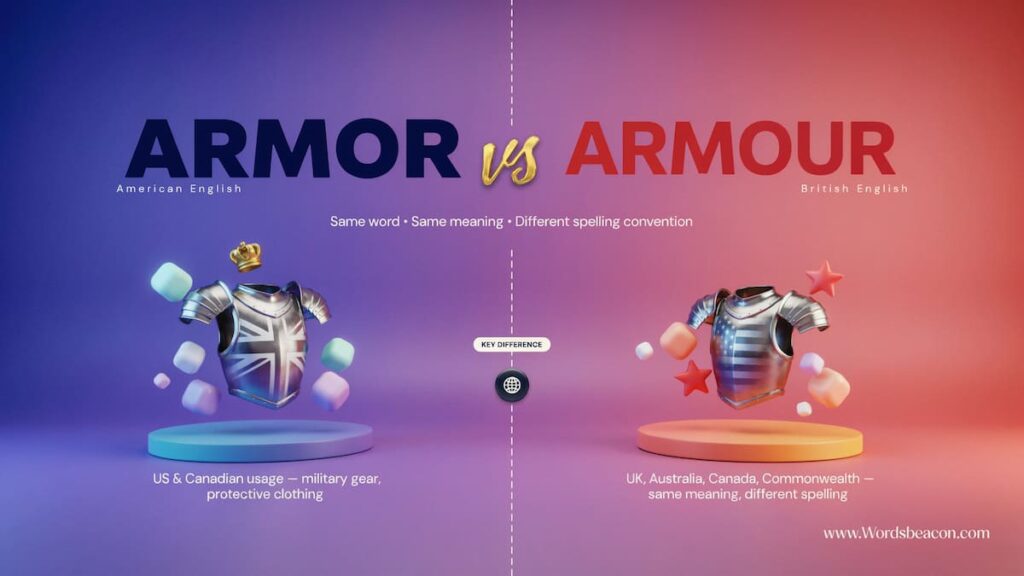
Armor vs armour? Just one extra letter can make you pause and question your spelling! However, there’s no need to turn this small difference into a grammar battle. Both spellings are correct, and both have the same meaning. The only difference is regional usage: American English uses armor, while British English prefers armour. This simple rule makes the choice much easier. Whether you’re writing about a medieval knight, a soldier’s protective gear, or an armored vehicle, knowing which spelling to use will help you avoid mistakes and keep your writing clear, natural, and consistent.
quick comprasion
| Topic | Armor | Armour |
|---|---|---|
| Regional spelling | American English | British English |
| Meaning | Protective covering | Protective covering |
| Pronunciation | Generally /ˈɑːrmər/ in US English | Generally /ˈɑːmə/ in non-rhotic British English |
| Part of speech | Noun and verb | Noun and verb |
| Related adjective | Armored | Armoured |
| Related person | Armorer | Armourer |
| Related place | Armory | Armoury |
| Common example | Body armor | Body armour |
Fix common more word mistakes in English
Behavior vs Behaviour difference and usage
Armor vs Armour Quick Answer
The difference between armor and armour is straightforward: armor is the standard American English spelling, whereas armour is the standard British English spelling. Both forms are correct, and neither changes the original meaning of the word.
For example:
- American English: The soldier wore heavy armor during the battle.
- British English: The soldier wore heavy armour during the battle.
Both sentences describe the same protective equipment.
The spelling difference also appears in related words. American writers use armored, armoring, and armorer, while British writers generally prefer armoured, armouring, and armourer.
Therefore, when deciding whether to use armor vs armour, consider your audience and the spelling conventions of the publication you’re writing for.
What Does Armor vs Armour Mean?
The Armor vs armour meaning is identical in both English varieties. The word describes a protective covering or equipment that helps defend a person, animal, vehicle, or object against physical damage.
Historically, warriors wore armor to protect their bodies during battles. Early forms included leather coverings, metal helmets, shields, chain mail, and protective plates. As weapons developed, armor technology changed to provide better protection against different threats.
Today, the word covers a much wider range of equipment. For example, police officers may wear body armor, military vehicles use reinforced plating, and certain animals have natural protective coverings.
The word also appears in figurative expressions. Someone might describe confidence as emotional armor because it helps them handle criticism or difficult situations.
Here are some common contexts in which you may encounter the word:
- Military protection: Equipment that protects soldiers during combat.
- Historical protection: Metal or leather coverings worn by knights and warriors.
- Vehicle protection: Reinforced materials used in tanks and other military vehicles.
- Personal protection: Protective clothing worn by police officers and security personnel.
- Animal protection: Natural coverings such as shells, scales, and bony plates.
- Figurative protection: Emotional or psychological defenses against difficult experiences.
Armor Meaning
Armor is the standard American English spelling. It refers to protective clothing, equipment, or material designed to reduce the risk of physical injury.
The word has strong historical connections with warfare. Soldiers and knights once depended on metal armor to protect themselves against swords, arrows, and other weapons. Modern military forces use different protective materials to address threats that earlier generations never faced.
Armor can refer to several things, including:
- Protective clothing worn by soldiers and police officers.
- Metal plates installed on tanks and military vehicles.
- Historical equipment worn by medieval knights.
- Protective coverings found on certain animals.
- Emotional defenses that help people handle difficult experiences.
For example:
- The soldier wore heavy armor during the operation.
- The museum displayed a collection of medieval armor.
- Engineers developed stronger armor for military vehicles.
- The police officer checked his body armor before leaving.
- She used humor as armor against criticism.
In American dictionaries and publications, armor is the conventional spelling. Therefore, use it when writing for a primarily American audience.
Armour Meaning
Armour is the standard British English spelling of the same word. It describes protective coverings or equipment that defend people, animals, and objects against physical harm.
The additional letter u doesn’t create a different definition. It simply reflects the traditional British spelling convention.
You will commonly encounter armour in British historical books, military reports, educational materials, and everyday writing.
For example:
- The knight polished his armour before the ceremony.
- The soldiers received new body armour.
- The museum displayed medieval armour from the 15th century.
- The vehicle’s armour protected its occupants.
- The warrior carried a shield and wore heavy armour.
Both spellings communicate the same idea. However, British publications generally prefer armour, while American publications use armor.
Fix common more word mistakes in English
Emigrate vs Immigrate Difference and usage
Armor vs Armour Key Differences Explained
The Difference between armor and armour involves regional spelling rather than meaning. Both words function similarly in sentences, describe the same protective equipment, and follow the same basic grammatical rules.
However, a few details deserve attention, especially when you’re writing for an international audience.
Spelling Difference
The most noticeable Armor vs armour spelling difference is the additional letter u in the British version.
American English generally removes this letter from certain words, while British English retains it.
Consider these familiar examples:
| American English | British English |
|---|---|
| Armor | Armour |
| Color | Colour |
| Honor | Honour |
| Favor | Favour |
| Labor | Labour |
| Neighbor | Neighbour |
| Rumor | Rumour |
This pattern is one of the familiar British and American spelling differences.
However, don’t assume that every word containing ou follows the same rule. Words such as shoulder, soul, and country retain their spelling in both varieties.
The basic armor spelling rule is easy to remember: choose armor for standard American English and armour for standard British English.
Meaning and Usage
The meaning doesn’t change when you add or remove the letter u.
For example, body armor and body armour both describe protective clothing designed to reduce the risk of injury. Similarly, medieval armor and medieval armour refer to the protective equipment worn by historical warriors.
Consider these sentences:
- The soldier inspected his armor.
- The soldier inspected his armour.
Both sentences describe the same action.
Neither spelling refers to a different material, protective strength, or military system. The choice simply reflects the regional English convention.
Armor vs Armour Pronunciation
Although the spellings differ, both words have closely related pronunciations. However, their exact sounds can vary between accents.
In American English, armor is commonly pronounced /ˈɑːrmər/. The first syllable receives the main stress, and American speakers generally pronounce the r sound clearly.
In many British accents, armour is pronounced /ˈɑːmə/. The final r usually disappears when it isn’t followed by a vowel sound. However, some British accents pronounce it.
Here are the main pronunciation points:
- Both words have two syllables.
- Both place the main stress on the first syllable.
- The American pronunciation generally includes pronounced r sounds.
- Many British accents use a non-rhotic pronunciation.
- The additional u doesn’t create another syllable.
Therefore, don’t assume that every American and British speaker pronounces the word identically. Regional accents influence pronunciation, even though the two spellings represent the same word.
Armor vs Armour Grammar
Both forms can function as nouns and verbs. Their grammatical roles don’t change between American and British English.
As a noun, the word describes protective equipment or a protective covering.
Examples:
- The soldier wore heavy armor.
- The knight’s armour protected his chest.
- The vehicle needs additional armor.
As a verb, it describes the action of equipping or covering something with protection.
Examples:
- The military armored its vehicles.
- Engineers armoured the transport vehicle.
- Workers armored the structure against external damage.
The related verb forms follow regional spelling conventions. American English generally uses armored and armoring, while British English uses armoured and armouring.
Tone and Context
Neither spelling sounds more formal, technical, or sophisticated than the other.
The choice depends on your intended audience and the publication’s preferred English variety.
For example, an American military report would generally use armor plating, while a British report would prefer armour plating.
Likewise, American academic writing normally uses armor, whereas British academic writing generally uses armour.
The important thing is to maintain consistency throughout your document.
Fix common more word mistakes in English
Realize vs Realise Which Spelling Is Correct?
Armor vs Armour Which Spelling Should You Use?
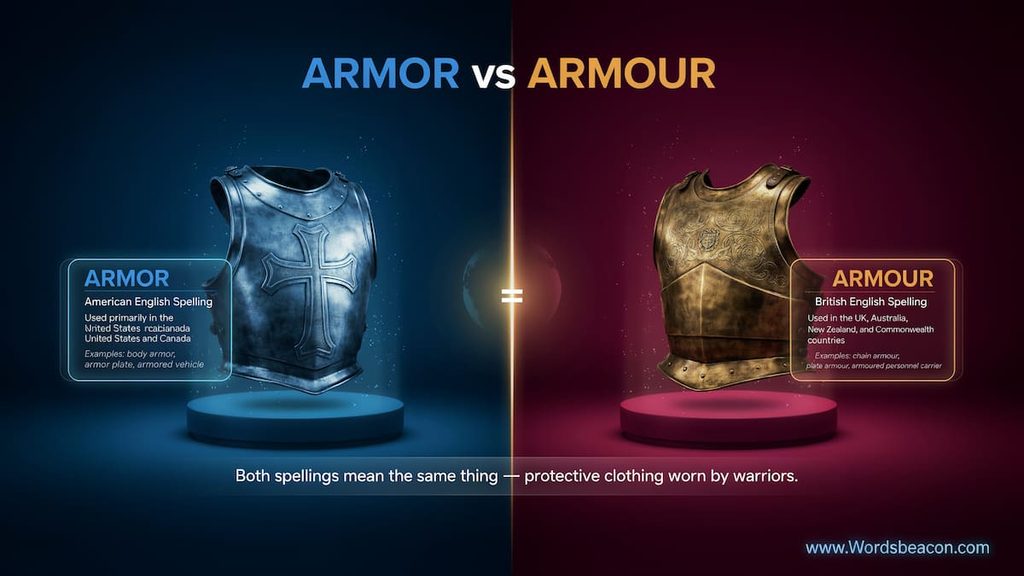
If you’re asking, Is it armor vs armour?, consider where your readers live and which English spelling system your publication follows.
Both forms are correct. However, using the appropriate regional version makes your writing more consistent and professional.
When to Use Armor in American English
Use armor when writing for readers in the United States. American English generally removes the u from certain words that retain it in British English.
You’ll find this spelling in American dictionaries, newspapers, educational materials, and military publications.
Examples include:
- The soldiers wore protective armor during the mission.
- The tank has reinforced armor plating.
- Modern body armor provides protection against certain ballistic threats.
- The museum has an impressive collection of medieval armor.
- Engineers are developing stronger armor for military vehicles.
The American spelling of armor also applies to its related forms:
- Armored vehicle
- Armored personnel carrier
- Armoring process
- Armorer
- Armory
If you’re preparing an American blog post, school assignment, business document, or news article, armor is the preferred choice.
When to Use Armour in British English
Use armour when writing for readers in the United Kingdom. British English traditionally retains the u in this word.
You’ll encounter this spelling in British dictionaries, historical publications, educational materials, and military discussions.
Examples include:
- The knight wore heavy armour during the battle.
- The military vehicle has additional armour plating.
- The museum preserves several examples of medieval armour.
- The soldiers received improved body armour.
- Engineers designed stronger armour for military vehicles.
British spelling also carries the u into related words:
- Armoured vehicle
- Armoured personnel carrier
- Armouring process
- Armourer
- Armoury
Therefore, if you’re writing for a British audience, choose armour and maintain the same spelling pattern throughout your content.
What About Canadian and Australian English?
Canada, Australia, and New Zealand generally follow British spelling conventions for this word. However, individual publications and organizations may establish their own preferences.
| Country | Common spelling | Regional convention |
|---|---|---|
| United States | Armor | American English |
| United Kingdom | Armour | British English |
| Canada | Armour | Generally follows British spelling |
| Australia | Armour | Generally follows British spelling |
| New Zealand | Armour | Generally follows British spelling |
Canadian English often retains the u in words such as colour, honour, and armour. Therefore, armour is the conventional choice in Canadian writing.
Similarly, Australian and New Zealand English generally prefer armour. These countries follow many traditional British spelling conventions, although their English varieties have their own vocabulary and grammar preferences.
If you’re writing for an international publication, check its editorial guidelines before choosing one form.
Armor vs Armour in Different Countries
Regional spelling becomes easier to understand when you consider actual writing situations.
1.In the United States, a newspaper would generally report that a military vehicle has reinforced armor.
2.In the United Kingdom, a newspaper would normally describe the same vehicle as having reinforced armour.
3.In Canada, a formal publication would usually prefer armour, although its house style may influence the choice.
4.In Australia, a historical article would typically describe a medieval knight’s armour rather than armor.
Likewise, a New Zealand educational publication would generally follow the British spelling convention.
The main point is consistency. Once you’ve selected a regional spelling system, use it throughout your document.
Different Forms of Armor and Armour
The spelling difference doesn’t stop with the main word. Several related terms follow the same American and British patterns.
Learning these forms will help you avoid mistakes when writing about military equipment, historical protection, or modern technology.
Armor vs Armored vs Armoring
American English uses the following forms:
| Word | Meaning | Example |
|---|---|---|
| Armor | Protective equipment | The soldier wore armor. |
| Armored | Equipped with protection | The army deployed armored vehicles. |
| Armoring | The process of adding protection | The company specializes in vehicle armoring. |
| Armorer | A person who makes, repairs, or maintains weapons and armor | The armorer inspected the equipment. |
| Armory | A place where weapons and military equipment are stored | The weapons were kept in the armory. |
Notice that the spelling remains consistent throughout these related words.
For example, American writers use armored vehicle rather than armoured vehicle when following standard American English.
Armour vs Armoured vs Armourer
British English generally retains the u in the corresponding forms.
| Word | Meaning | Example |
|---|---|---|
| Armour | Protective equipment | The knight wore armour. |
| Armoured | Equipped with protection | The army deployed armoured vehicles. |
| Armouring | The process of adding protection | The vehicle required additional armouring. |
| Armourer | A person who makes, repairs, or maintains weapons and armor | The armourer checked the equipment. |
| Armoury | A place where weapons and military equipment are stored | The weapons were kept in the armoury. |
The most important forms to remember are armored/armoured, armorer/armourer, and armory/armoury.
One useful distinction: an armorer or armourer works with weapons and related equipment, while an armory or armoury refers to a place or collection associated with weapons.
Armor vs Armory What’s the Difference?
Although armor and armory look similar, they don’t mean the same thing.
Armor refers to protective equipment or a covering that shields someone or something from damage.
Armory refers to a place where weapons and military equipment are stored, maintained, or supplied. It can also describe a collection of weapons.
British English generally spells armory as armoury.
Examples:
- The soldier wore protective armor.
- The weapons were stored in the military armory.
- The museum displayed an ancient suit of armor.
- The castle’s armoury contained historical weapons.
Remember this simple distinction: armor protects, while an armory stores or houses weapons and related equipment.
Learn how to use confusing more words correctly
Complement vs Compliment Difference and Correct Usage
Types of Armor and Their Uses
Armor isn’t limited to medieval knights or historical battles. Modern protective equipment uses different materials and designs to defend people, vehicles, and other objects.
Here are some important types and their practical uses.
Body Armor
Body armor is protective equipment worn on the body to reduce the risk of injury from bullets, fragments, and other threats.
Police officers, military personnel, and certain security workers use body armor as part of their protective equipment.
Common examples include:
- Ballistic vests
- Protective plates
- Soft body armor
- Hard body armor
- Protective helmets
The term body armour is the corresponding British spelling.
However, body armor doesn’t provide complete protection against every weapon or impact. Its performance depends on its materials, design, condition, and tested protection level.
Medieval Armor
Medieval armor protected warriors from swords, arrows, and other battlefield weapons.
Knights gradually adopted different protective designs as weapons and military tactics developed. Their equipment often included several separate pieces rather than one solid metal covering.
Some well-known types include:
- Chain mail: Interlocking metal rings that form a flexible protective covering.
- Plate armor: Shaped metal plates designed to protect major body areas.
- Helmets: Protective head coverings that reduce the risk of head injuries.
- Greaves: Protective plates worn over the lower legs.
- Gauntlets: Protective coverings for the hands.
A knight’s armor often included a helmet, breastplate, arm protection, leg protection, and other pieces.
By the late Middle Ages, full plate armor offered extensive protection while allowing trained wearers to move and fight. Its design reflected the engineering skills and military needs of its period.
American writers call it medieval armor, while British writers generally use medieval armour.
Vehicle Armor
Vehicle armor protects military vehicles and their occupants from external threats.
Tanks, armored personnel carriers, and other military vehicles use specialized protective structures to reduce damage from bullets, fragments, and certain explosive weapons.
Common approaches include:
- Steel armor: Traditional protective metal plating.
- Composite armor: Multiple materials combined to improve protection.
- Reactive armor: Specialized panels designed to respond to certain incoming attacks.
- Additional armor plating: Extra protective material installed to improve a vehicle’s defense.
The terms vehicle armor and vehicle armour describe the same general concept.
Likewise, armored vehicles is standard American spelling, while armoured vehicles is standard British spelling.
Animal Armor
Not all armor comes from human engineering. Some animals have natural body structures that protect them from predators and environmental threats.
For example:
- Armadillos have bodies covered with bony plates and tough skin.
- Turtles have shells that provide structural protection.
- Pangolins have overlapping keratin scales that form a protective outer covering.
These natural structures are sometimes described as biological armor.
However, they aren’t identical to manufactured military armor. Each animal has evolved its protective features to meet specific survival needs.
Figurative Armor
Armor also appears in everyday language as a metaphor.
In this context, it describes something that protects a person emotionally or mentally rather than physically.
Consider these examples:
- Humor became his armor against criticism.
- She built emotional armor after several difficult experiences.
- Confidence served as armor during the stressful interview.
The expression emotional armor describes the mental defenses people develop to handle uncomfortable situations, criticism, or emotional pain.
It doesn’t refer to physical protective equipment. Instead, it uses the familiar idea of protection to explain an abstract experience.
Learn how to use confusing more words correctly
Ingage vs Engage Which Spelling Is Correct ?
Armor vs Armour in Different Contexts
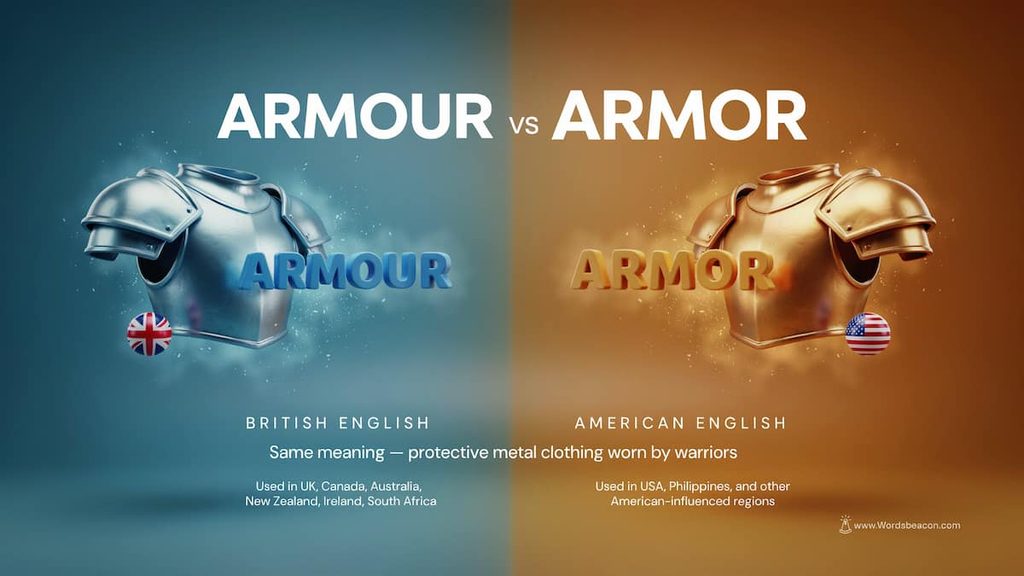
The correct spelling can also depend on the type of document you’re writing. The regional rule stays the same, but the surrounding vocabulary changes with the subject.
Military and Defense Writing
Military writing frequently uses armor to describe protective equipment, vehicle plating, and defensive systems.
For example:
- The armored vehicle entered the restricted area.
- The new armor plating improved the vehicle’s protection.
- The soldiers received updated body armor.
British publications generally use armour, armoured, and armour plating in equivalent contexts.
Historical and Medieval Literature
Historical writing often discusses knights, castles, battles, and protective equipment.
For example:
- The knight’s armor reflected the sunlight.
- The museum preserved a rare suit of medieval armor.
- The soldiers wore heavy armour during the battle.
Writers should follow the regional spelling system used throughout their historical account.
Everyday Conversations
In casual conversations, both spellings are easy to understand.
An American might say, The vehicle has reinforced armor.
A British speaker might say, The vehicle has reinforced armour.
Neither expression is incorrect within its respective regional variety.
Academic Writing
Academic writing requires particular attention to spelling consistency.
If you’re preparing a research paper for an American university, use armor and its American derivatives. For a British university, follow the institution’s preferred spelling conventions.
Don’t switch between armor and armour without a specific reason. Consistent spelling makes academic work easier to read and edit.
News Articles and Journalism
News organizations generally follow an established editorial style.
An American publication will normally use armor, while a British publication will generally choose armour.
This applies to headlines, captions, image descriptions, and article text.
Fiction, Movies, and Video Games
Armor also appears frequently in entertainment.
Fantasy novels, historical films, and video games often describe characters wearing protective armor or using special defensive equipment.
A popular related expression is plot armor.
Plot armor describes a fictional situation in which a character survives dangerous events because the story needs that character to remain alive.
For example, imagine a hero who escapes several explosions, survives countless battles, and walks away from situations that defeat every other character. Viewers might jokingly say that the hero has plot armor.
The expression is figurative. It doesn’t describe an actual protective suit or physical equipment.
American writers generally use plot armor. British writers may use plot armour when following British spelling conventions.
Understand confusing English more words simply
Career vs Carrer Correct Spelling and Difference
Armor vs Armour Sentence Examples
Sentence examples make the difference between armor and armour easier to remember. The following examples show how both spellings work in everyday writing and specialized contexts.
American English Examples Using Armor
Here are natural examples of armor usage in a sentence:
- The soldier wore heavy armor to protect himself during combat.
- The museum displayed a rare collection of medieval armor.
- Modern body armor helps protect police officers during dangerous operations.
- Engineers added reinforced armor plating to the military vehicle.
- The knight’s armor included a helmet, breastplate, and metal gloves.
- The military developed stronger armor for its next generation of tanks.
- She used confidence as armor when facing criticism.
British English Examples Using Armour
These sentences demonstrate armour usage in a sentence:
- The soldier wore heavy armour to protect himself during combat.
- The museum displayed a rare collection of medieval armour.
- Modern body armour helps protect police officers during dangerous operations.
- Engineers added reinforced armour plating to the military vehicle.
- The knight’s armour included a helmet, breastplate, and metal gloves.
- The military developed stronger armour for its next generation of tanks.
- She used confidence as armour when facing criticism.
Armor vs Armour Examples Side-by-Side Comparison
Notice how the meaning remains unchanged in each pair.
| American English | British English |
|---|---|
| The knight wore heavy armor. | The knight wore heavy armour. |
| The soldier received new body armor. | The soldier received new body armour. |
| The army purchased armored vehicles. | The army purchased armoured vehicles. |
| The vehicle needs additional armor plating. | The vehicle needs additional armour plating. |
| The museum displayed medieval armor. | The museum displayed medieval armour. |
| The armorer checked the equipment. | The armourer checked the equipment. |
| The weapons were stored in the armory. | The weapons were stored in the armoury. |
These examples demonstrate that armor and armour are interchangeable in meaning. However, you should choose the spelling that matches your intended regional variety.
Understand confusing English more words simply
Theater vs Theatre Which Spelling Is Correct?
Common Armor vs Armour Mistakes
Although the difference looks simple, writers sometimes mix up the two forms or apply the spelling pattern incorrectly.
Here are common mistakes worth avoiding.
Using Armour in American English
British spelling isn’t automatically incorrect in an American context. However, American publications generally expect armor.
Less suitable for standard American spelling:
The soldier wore heavy armour.
Preferred American version:
The soldier wore heavy armor.
If you’re writing for an American audience, use the American spelling consistently.
Using Armor in British English
The same principle works in the opposite direction.
Less suitable for standard British spelling:
The knight wore a suit of armor.
Preferred British version:
The knight wore a suit of armour.
The American spelling remains understandable, but armour is the conventional British form.
Mixing American and British Spellings in One Article
This is one of the most noticeable writing problems.
Imagine an American article that uses:
- Armor
- Colour
- Armoured vehicles
- Honour
These choices don’t follow one consistent regional spelling system.
A polished American article should use armor, color, and honor. A British article should generally use armour, colour, and honour.
Confusing Armored and Armoured
Both words are correct, but their regional spelling conventions differ.
- Armored: American English
- Armoured: British English
For example:
American: The army deployed several armored vehicles.
British: The army deployed several armoured vehicles.
Don’t remove or add the u randomly. Follow the same pattern used for the base word.
Confusing Armor With Armory
Armor and armory are related in meaning, but they aren’t interchangeable.
Armor refers to protective equipment.
Armory refers to a place where weapons and military equipment are stored or maintained, or a collection of weapons.
British English generally spells the latter word armoury.
For example:
The knight wore armor from the castle’s armory.
Both words have different grammatical and practical purposes.
Assuming Armor and Armour Have Different Meanings
Some readers assume that the American and British versions describe different kinds of equipment.
That’s incorrect.
Both spellings have the same definition and grammatical function. Their pronunciation follows regional accent patterns, but the additional u doesn’t create a different word or meaning.
Etymology Where Do Armor and Armour Come From?
The history of armor goes back much further than modern American and British spelling conventions.
The word entered Middle English through Old French armure and armeure, which referred to weapons and protective equipment. Its earlier roots connect to Latin armatura, meaning equipment or the act of equipping with weapons.
The Latin word comes from arma, meaning weapons or implements of war.
Over time, English developed different spelling forms, including armor and armour. Both forms have historical roots in the same word.
The American form became established through the broader movement toward simplified spelling in the United States. Noah Webster, an American lexicographer, helped popularize spelling reforms that removed certain letters from English words.
This pattern appears in several familiar spelling pairs:
| American form | British form |
|---|---|
| Armor | Armour |
| Color | Colour |
| Favor | Favour |
| Labor | Labour |
| Neighbor | Neighbour |
However, the spelling difference doesn’t mean Americans invented a completely new word. Both forms developed from the same historical source.
British English retained the u in armour, while American English established armor as its standard form.
Today, both versions remain accepted parts of English.
Understand confusing English more words simply
Contractor vs Contracter Which Spelling Is Correct?
Special Uses and Related Expressions
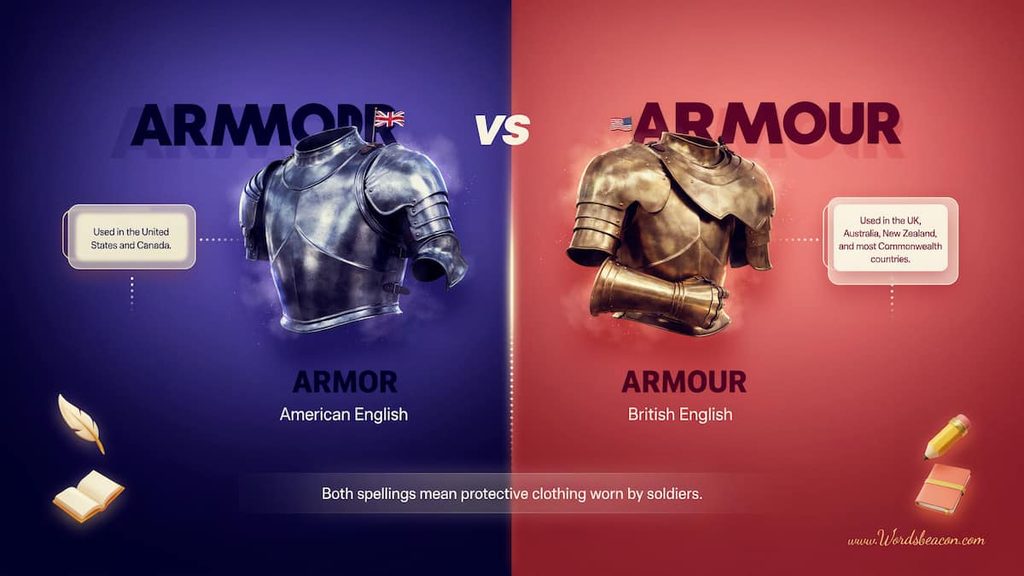
Some searches involving armor and armour refer to specific brands, religious expressions, or entertainment terms rather than the ordinary dictionary definition. These uses deserve a little clarification.
Under Armour Is the Brand Spelled Correctly?
Under Armour is the official name of an American sportswear company.
The brand deliberately uses the spelling Armour rather than the standard American dictionary spelling Armor.
That doesn’t make the brand name incorrect. Proper names follow their official spelling, even when they differ from ordinary regional spelling conventions.
For example:
- Under Armour is the correct brand name.
- Armor is the standard American common noun.
- Armour is the standard British common noun.
Therefore, an American article about protective equipment should generally use armor, but an article discussing the company should preserve its official name, Under Armour.
What Does Armour of God Mean?
The Armor of God, also written as the Armour of God in British English, is a biblical expression from Ephesians 6:10–18 in the New Testament.
It describes spiritual protection through the image of a soldier’s equipment.
The passage identifies several symbolic elements:
- Belt of truth
- Breastplate of righteousness
- Shoes associated with readiness from the gospel of peace
- Shield of faith
- Helmet of salvation
- Sword of the Spirit
These elements represent spiritual qualities rather than physical military equipment.
American Bible editions generally use armor, while British editions may use armour, depending on their translation and editorial conventions.
What Does Plot Armor Mean?
Plot armor is an informal expression used in discussions of books, movies, television shows, and video games.
It describes a situation in which a character survives an apparently fatal or extremely dangerous event because the story requires that character to continue.
For example, imagine a fictional hero who survives several explosions, escapes dangerous battles, and walks away from situations that defeat every other character.
Viewers might jokingly say that the hero has plot armor.
The expression uses armor metaphorically. It suggests that the character has an invisible layer of protection supplied by the storyline.
American writers usually spell it plot armor, while British writers may choose plot armour.
Learn the difference between tricky more English words
Focusing vs Focussing Which Spelling Is Correct ?
practice session Armor vs Armour
Choose the correct spelling, armor vs armour, to complete each sentence. Remember, armor is standard American English, while armour is standard British English.
- The medieval knight wore heavy steel __________ during the battle.
- American soldiers use protective body __________ in dangerous situations.
- The museum displayed a collection of ancient Roman __________.
- The British tank has reinforced __________ to protect its crew.
- The warrior polished his __________ before the tournament.
- Modern military vehicles need strong __________ to withstand attacks.
- The soldier’s body __________ protected him from flying debris.
- The king ordered his blacksmith to make new __________ for the royal guards.
- In American English, the correct spelling is __________.
- In British English, writers generally prefer __________.
- The knight’s __________ included a helmet, chest plate, and leg guards.
- Some animals have natural __________ that protects their bodies.
- The military added extra __________ to the vehicle.
- The museum guide explained how medieval __________ protected knights.
- She bought a book about the history of medieval __________.
- The soldiers wore lightweight body __________ during training.
- The castle displayed a complete suit of knight’s __________.
- The American textbook uses the spelling __________ throughout.
- The British newspaper used the spelling __________ in its article.
- The engineer designed additional __________ for the military vehicle.
Answers
- Armour
- Armor
- Armour
- Armour
- Armour
- Armor
- Armor
- Armour
- Armor
- Armour
- Armour
- Armor
- Armor
- Armour
- Armour
- Armor
- Armour
- Armor
- Armour
- Armor
Here’s a trusted source for clear word meanings:
FAQs
Which spelling is correct armor vs armour?
Both spellings are correct. Armor is the standard American English spelling, while armour is commonly used in British English. Both words have the same meaning and refer to protective covering for people, animals, or vehicles.
Is armour a British spelling?
Yes. Armour is the traditional British English spelling. American English drops the letter u and uses armor instead. The same spelling pattern appears in words such as color/colour and honor/honour.
What is the difference between armor and armour?
There is no difference in meaning. The only difference is regional spelling. Use armor when writing for an American audience and armour when following British English conventions.
How do you spell a knight’s armor?
The American spelling is a knight’s armor, while the British spelling is a knight’s armour. Both describe the protective equipment knights wore in battle, including helmets, breastplates, and metal coverings.
Is it body armor or body armour?
Both forms are correct. Body armor is the standard American spelling, whereas body armour is preferred in British English. The phrase refers to protective clothing designed to reduce injuries from weapons or other threats.
Is armor a countable or uncountable noun?
Armor is generally an uncountable noun when it refers to protective covering as a material or general concept. For example, you can say, “The soldier wore armor” or “The knight’s suit of armor.” When discussing individual items, use phrases such as “pieces of armor.”
What are the plural forms of armor and armour?
Armor and armour are generally uncountable nouns, so they don’t usually take a regular plural ending. However, you can use “suits of armor” or “pieces of armour” when referring to separate sets or items.
What are the related forms of armor and armour?
Both spellings have related forms. American English uses armored, armoring, and armorer, while British English generally uses armoured, armouring, and armourer. Keep the regional spelling consistent throughout your writing.
Can armor be used as a verb?
Yes. Armor can function as a verb meaning to protect or cover something with a defensive material. For example, “The engineers armored the vehicle.” In British English, the corresponding form is armour.
What is the difference between armor, armory, and armorer?
These words have different meanings. Armor refers to protective covering, an armory is a place where weapons and military equipment are stored, and an armorer is someone who makes, repairs, or maintains weapons and armor.
Why does American English spell armor without a U?
American English follows a spelling convention that removes the u from many British words ending in -our. This pattern appears in armor, color, favor, and behavior. American spelling reforms helped establish these shorter forms in the United States.
Does the word armor have a figurative meaning?
Yes. Armor can describe emotional or mental protection rather than physical equipment. For example, someone might say, “Humor was her armor against criticism.” In this sentence, armor represents a way of protecting yourself from emotional harm.
What is the difference between armor and armored?
Armor is a noun or verb, while armored is its past-tense or adjective form in American English. For example, “The vehicle has armor” uses the noun, whereas “The soldiers traveled in an armored vehicle” uses the adjective. British English generally uses armoured.
Is armor used only for soldiers and knights?
No. Armor can describe protective coverings used by animals, vehicles, and military equipment. For example, a turtle’s shell provides natural protection, while a tank uses metal armor to protect its crew and important components.
Should I use armor vs armour in an American English article?
Use armor. American readers expect the spelling without the u, so phrases such as body armor, medieval armor, and armored vehicles are appropriate. Consistent spelling also makes your article look more polished and professional.
Learn the difference between tricky more English words
Persuing vs Pursuing Difference and Correct Spelling
Conclusion
The difference between armor and armour is easier than it looks. Both spellings are correct, and both have the same meaning. The only thing that changes is where you use them. American English prefers armor, while British English uses armour. So, if you’re writing for American readers, drop the extra u. For a British audience, keep it. Just remember to follow the same spelling throughout your article. After all, you don’t want your knight wearing armor in one sentence and armour in the next! Once you know this simple rule, choosing the right spelling becomes easy. No battle, no confusion, just better writing.

Luna AJS is an experienced blogger and dedicated language enthusiast at Words Beacon. She specializes in making English grammar, spelling, vocabulary and commonly confused words easy to understand. She provides clear explanations, practical examples to help readers write with confidence.