
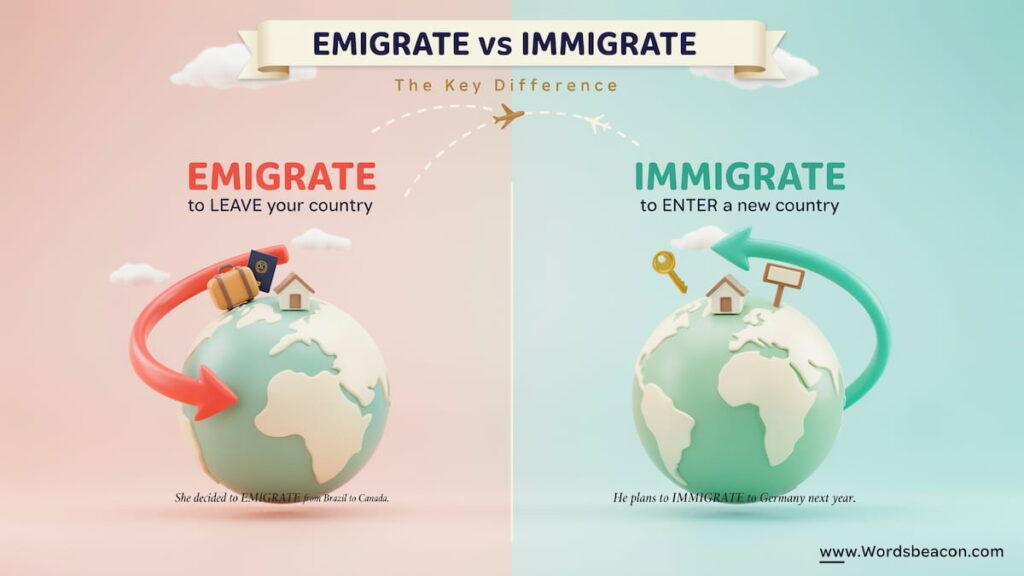
Moving to another country is a big step, but describing that move shouldn’t feel like crossing a confusing maze of grammar rules. Should you say someone emigrated or immigrated? Both words describe moving between countries, which is why people often mix them up. However, emigrate vs immigrate has one simple difference: emigrate focuses on the country you leave, while immigrate focuses on the country you enter. Think of it as two sides of the same journey! Once you understand this small distinction, you’ll know which word fits your sentence and won’t have to second-guess yourself every time someone moves abroad.
quick comprasion
| Comparison | Emigrate | Immigrate |
|---|---|---|
| Meaning | To leave one country to live in another | To enter another country to live there |
| Direction | Out of a country | Into a country |
| Point of view | Country of departure | Destination country |
| Common preposition | From | To |
| Related noun | Emigrant | Immigrant |
| Process noun | Emigration | Immigration |
| Example | She emigrated from Mexico. | She immigrated to the United States. |
Understand confusing English more words simply
Realize vs Realise Which Spelling Is Correct?
What Is the Difference Between Emigrate vs Immigrate?
The difference between emigrate vs immigrate comes down to whether someone is leaving a country or entering another one. Both verbs describe moving across national borders to establish a life somewhere else. However, each word highlights a different side of that move.
Emigrate means leaving your home country to settle in another country. Immigrate means entering a foreign country to establish a new home. Therefore, the words describe opposite perspectives on the same international move.
Consider this example:
Maria lives in Brazil but decides to move to the United States permanently.
- From Brazil’s perspective, Maria emigrates from Brazil.
- From the United States’ perspective, Maria immigrates to the United States.
- From a broader perspective, Maria migrates from Brazil to the United States.
Notice that Maria doesn’t make two separate moves. She makes one relocation, but each country describes it differently.
Emigrate vs Immigrate Quick Comparison
| Feature | Emigrate | Immigrate |
|---|---|---|
| Main action | Leaving | Arriving |
| Direction | Out of a country | Into another country |
| Perspective | Country of origin | Destination country |
| Typical preposition | From | To |
| Related person | Emigrant | Immigrant |
| Example | They emigrated from Ireland. | They immigrated to the United States. |
This distinction also explains why the two words aren’t interchangeable in every sentence. If you say someone immigrated from France, readers may become confused because immigrate normally focuses on the country someone enters rather than the one they leave.
Is Emigrate the Opposite of Immigrate?
Yes. In terms of direction, emigrate vs immigrate are opposites. One describes leaving a country, while the other describes entering a different country.
However, this doesn’t mean a person can experience only one of these actions. Someone who moves from Japan to the United States can emigrate from Japan and immigrate to the United States.
The easiest way to understand their relationship is to imagine a doorway. Walking out means you leave one place. Walking in means you enter another. The journey connects both actions, but the direction changes.
Understand confusing English more words simply
Focusing vs Focussing Which Spelling Is Correct ?
What Does Emigrate Mean?
The emigrate meaning refers to leaving your native or current country to establish a home in another country. It describes the departure side of international relocation.
For example, if a family leaves Italy and settles in the United States, the family emigrates from Italy. The word focuses on the country they leave rather than the country where they eventually settle.
Emigrate Definition and Word Usage
Emigrate is an intransitive verb. In everyday English, it commonly appears with the preposition from when you identify the country someone leaves.
The most common grammatical pattern is:
Emigrate from + country or place
Examples:
- He plans to emigrate from Pakistan next year.
- Thousands of families emigrated from Ireland during the nineteenth century.
- My grandparents emigrated from Poland after the war.
- She hopes to emigrate from Brazil and start a business abroad.
You can also use the verb without naming the country of departure when the context already makes it clear.
For instance:
- Many young professionals choose to emigrate for better career opportunities.
- Her parents emigrated when she was a child.
- Some families emigrate because they want better educational opportunities for their children.
Although from is the most useful preposition when identifying the country of departure, emigrate can also appear with to when a sentence mentions the destination. For example, “They emigrated from Germany to America.” The word still emphasizes leaving the original country.
The emigrate definition doesn’t necessarily mean someone leaves forever. The word usually describes moving to another country to live there permanently or for the long term. However, people may eventually return to their country of origin.
Emigrate Examples in Sentences
Here are several emigrate sentence examples that show how the word works in everyday English.
| Sentence | Explanation |
|---|---|
| My uncle decided to emigrate from Germany. | He left Germany to settle elsewhere. |
| Many families emigrated from Ireland during difficult economic periods. | They left Ireland to find better opportunities. |
| She wants to emigrate from Mexico to Canada. | Mexico is her country of departure. |
| The couple emigrated after receiving job offers overseas. | They left their original country to relocate. |
| His parents emigrated when he was young. | His parents moved away from their home country. |
These examples also show that emigrate works in different tenses. You can use emigrates for present-tense statements, emigrated for past events, and emigrating for ongoing or planned movement.
Emigrant vs Emigration
Two related words help explain the emigrate meaning more clearly: emigrant and emigration.
Emigrant is a noun that describes a person who leaves their country to settle somewhere else.
Examples:
- My grandfather was an emigrant from Greece.
- The emigrants left their hometown in search of better opportunities.
- She interviewed several Irish emigrants living in the United States.
Emigration is the noun form that describes the act or process of leaving a country to live elsewhere.
Examples:
- Emigration increased during the economic crisis.
- The government studied the effects of emigration on rural communities.
- Family reunification influenced the country’s emigration patterns.
Remember the distinction:
- Emigrate: The action of leaving.
- Emigrant: The person who leaves.
- Emigration: The process of leaving.
Understand confusing English more words simply
Complement vs Compliment Difference and Correct Usage
What Does Immigrate Mean?
The immigrate meaning refers to entering a country with the intention of establishing a new home there. It focuses on the destination rather than the country someone leaves.
For example, when a family moves from South Korea to the United States to build a new life, the family immigrates to the United States.
The word describes the arrival side of international relocation. Therefore, the destination country becomes the central point of view.
Immigrate Definition and Word Usage
Immigrate is also an intransitive verb. It commonly follows this grammatical pattern:
Immigrate to + country or place
Examples:
- They plan to immigrate to Australia.
- My parents immigrated to the United States in 2005.
- She hopes to immigrate to Canada after completing her studies.
- Many skilled workers immigrate to countries with strong employment opportunities.
You can also use immigrate without mentioning the destination when readers already understand where someone is moving.
For example:
- Her family immigrated when she was five.
- Many people immigrate to build safer and more stable lives.
- His grandparents immigrated several decades ago.
The immigrate definition focuses on entering another country to establish residence. However, immigration laws determine whether someone can legally enter or remain in that country. The word itself doesn’t guarantee legal status, citizenship, or permanent residency.
Immigrate Examples in Sentences
The following immigrate sentence examples demonstrate how to use the word correctly.
| Sentence | Explanation |
|---|---|
| My cousin immigrated to the United States last year. | The United States is his destination. |
| They hope to immigrate to Canada after retirement. | They plan to establish a new home in Canada. |
| Her grandparents immigrated from Italy to Argentina. | Argentina is the country they entered. |
| Many professionals immigrate to countries offering better career prospects. | They move into those countries. |
| He immigrated as a child and grew up in Australia. | He entered Australia with his family. |
You can also use immigrate in different tenses. For example, “She immigrates to Canada” describes a present-tense action, while “She immigrated to Canada” describes a completed move.
Immigrant vs Immigration
Like emigrate, immigrate has two important related noun forms.
Immigrant refers to a person who enters another country to establish a new home.
Examples:
- My neighbor is an immigrant from Colombia.
- The immigrant opened a small restaurant in New York.
- Several immigrants shared their experiences of moving abroad.
Immigration describes the process of entering another country to establish residence.
Examples:
- Immigration has influenced the country’s population growth.
- The government introduced changes to its immigration policies.
- Family reunification remains an important reason for immigration.
Here’s a simple breakdown:
- Immigrate: The action of entering.
- Immigrant: The person who enters.
- Immigration: The process of entering.
Learn how to use confusing more words correctly
Ingage vs Engage Which Spelling Is Correct ?
Emigrate vs Immigrate Key Differences
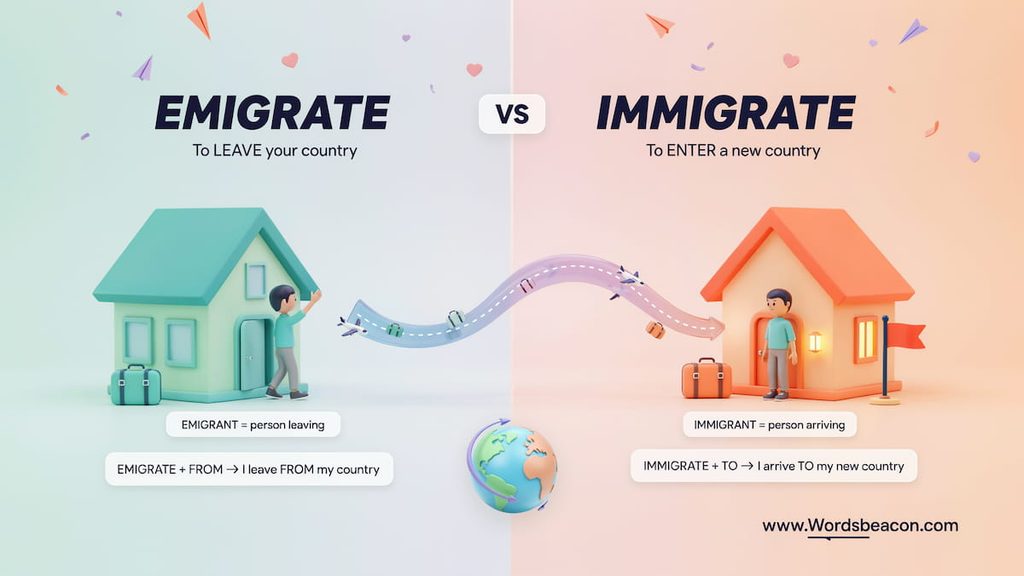
Although these words describe closely related actions, their grammar and meanings differ in several important ways. Understanding these differences helps you choose the correct word in formal writing, everyday conversations, and academic discussions.
| Difference | Emigrate | Immigrate |
|---|---|---|
| Basic meaning | Leave a country | Enter another country |
| Direction | Away from the origin | Toward the destination |
| Main perspective | Country of departure | Country of arrival |
| Common preposition | From | To |
| Related noun | Emigrant | Immigrant |
| Process noun | Emigration | Immigration |
| Example | He emigrated from Spain. | He immigrated to Brazil. |
Emigrate From vs Immigrate To
Prepositions provide one of the easiest ways to distinguish these verbs. In most ordinary contexts, emigrate pairs with from, while immigrate pairs with to.
Use emigrate from when you identify the country someone leaves.
Examples:
- She emigrated from India.
- My family emigrated from Germany.
- They decided to emigrate from the Philippines.
Use immigrate to when you identify the country someone enters.
Examples:
- She immigrated to the United States.
- My family immigrated to Germany.
- They decided to immigrate to Canada.
You can combine both expressions in one sentence:
“My family emigrated from India and immigrated to the United States in 2018.”
This sentence clearly identifies the country of departure and the destination country.
A common mistake is writing emigrate to Canada when the intended meaning is entering Canada. In that situation, immigrate to Canada communicates the idea more directly. However, emigrate to Canada can also be grammatically correct when the speaker describes the journey from the perspective of leaving their original country.
Point of View Leaving vs Arriving
Point of view is the central idea behind the difference between emigration and immigration. The same person can receive different descriptions depending on which country you discuss.
Consider James, who moves from the United Kingdom to New Zealand.
| Perspective | Correct description |
|---|---|
| United Kingdom | James emigrated from the UK. |
| New Zealand | James immigrated to New Zealand. |
| General description | James migrated from the UK to New Zealand. |
Neither description changes what happened. The words simply highlight different sides of the relocation.
This distinction becomes especially important in geography, history, and population studies. Researchers may discuss emigration when examining why residents leave a country. Meanwhile, they may study immigration to understand how newcomers affect the destination country’s population, workforce, and communities.
Learn how to use confusing more words correctly
Theater vs Theatre Which Spelling Is Correct?
Emigrate vs Immigrate vs Migrate
The emigrate vs immigrate vs migrate comparison introduces a third word with a broader meaning.
Migrate means moving from one place to another. Depending on the context, it can describe movement between countries, regions, cities, or even seasonal animal movements.
Unlike emigrate vs immigrate, migrate doesn’t automatically identify whether someone is leaving or entering a particular country.
Migrate Meaning and Definition
The migration meaning refers to the movement of people, animals, or sometimes other things from one location to another.
For example:
- Many families migrate from rural areas to cities.
- Birds migrate south during colder months.
- Workers migrate to regions with more employment opportunities.
- Some communities migrate because of environmental changes.
Migration doesn’t always involve crossing an international border. A person moving from Texas to California migrates within the United States. However, that person doesn’t emigrate vs immigrate in the usual international sense because the move doesn’t involve leaving one country for another.
Difference Between Migrate and Immigrate
The difference between migrate and immigrate lies in how specific each word is.
Migrate describes movement from one location to another. Immigrate specifically describes entering another country to establish residence.
For example:
- People migrate from rural communities to large cities.
- People immigrate to Canada from other countries.
The first sentence describes internal population movement. The second specifically describes international relocation.
Difference Between Migrate and Emigrate
The difference between migrate and emigrate is also important.
Emigrate focuses on leaving a country, while migrate can describe movement within a country or across national borders.
For example:
- Thousands of people emigrated from Venezuela.
- Thousands of people migrated from rural areas to urban centers.
The first sentence identifies international departure. The second describes movement between different types of locations without necessarily involving another country.
Migration in Humans and Animals
Human migration and animal migration share the general idea of movement, but their purposes and patterns can differ.
Human migration
People move for several reasons, including:
- Employment and business opportunities.
- Education and professional development.
- Family reunification.
- Safety and protection from conflict.
- Environmental changes and natural disasters.
- Better living conditions.
Human migration can be temporary, seasonal, or permanent. For example, a worker might move to another country for a two-year contract and later return home.
Animal migration
Animals also migrate, often because of seasonal changes or survival needs.
Examples include:
- Monarch butterflies traveling between breeding and wintering areas.
- Arctic terns moving between Arctic and Antarctic regions.
- Wildebeest traveling across parts of East Africa in search of grazing land and water.
- Salmon moving between freshwater and marine environments during their life cycles.
These examples demonstrate why migrate is more flexible than emigrate vs immigrate. Animal movement doesn’t normally involve immigration or emigration in the human residential or legal sense.
Learn how to use confusing more words correctly
Contractor vs Contracter Which Spelling Is Correct?
Emigrate vs Immigrate Examples in Everyday English
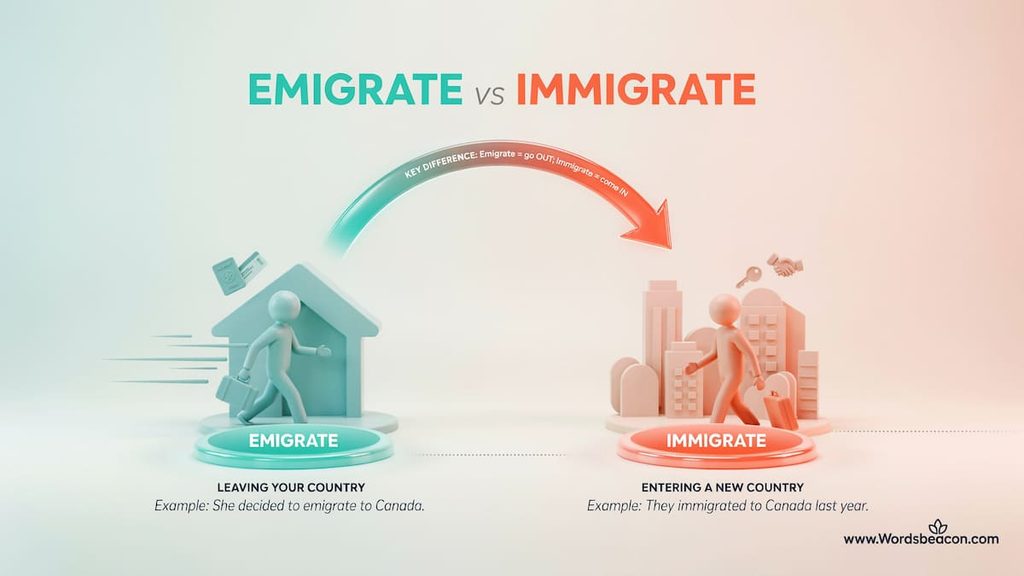
Real-life situations make the emigrate vs immigrate difference easier to understand. The following examples show how both words work when people move between countries.
Moving From Mexico to the United States
Suppose Carlos lives in Mexico and receives a permanent job offer in Texas. After making the necessary arrangements, he moves to the United States.
You can describe his relocation in three ways:
- Carlos emigrated from Mexico.
- Carlos immigrated to the United States.
- Carlos migrated from Mexico to the United States.
All three sentences describe the same event. However, each one emphasizes a different aspect of his move.
Moving From Canada to Australia
Now imagine Sarah, who lives in Toronto and decides to settle in Sydney.
Here’s how you would describe her relocation:
- From Canada’s perspective: Sarah emigrated from Canada.
- From Australia’s perspective: Sarah immigrated to Australia.
- From a general perspective: Sarah migrated from Canada to Australia.
Notice how the destination and origin determine which verb works best.
Moving Within the United States
Consider a family that moves from Chicago to Miami for better weather and employment opportunities.
Would you say they emigrated from Chicago or immigrated to Miami?
Neither expression is appropriate in the usual international sense because both cities belong to the same country.
The better sentence is:
“The family migrated from Chicago to Miami.”
You can also say that the family relocated or moved. These alternatives describe domestic movement without suggesting international immigration.
Emigrating From Canada and Immigrating to the United States
Consider another example involving someone moving from Canada to the United States.
| Situation | Correct expression | Reason |
|---|---|---|
| Leaving Canada | Emigrating from Canada | Focuses on departure |
| Entering the United States | Immigrating to the United States | Focuses on arrival |
| Describing the whole journey | Migrating from Canada to the United States | Describes the overall movement |
This example also answers a common question: Is it emigrate from Canada or immigrate to Canada? The answer depends on the direction. If someone leaves Canada, they emigrate from Canada. If someone enters Canada to settle there, they immigrate to Canada.
How to Remember Emigrate vs Immigrate
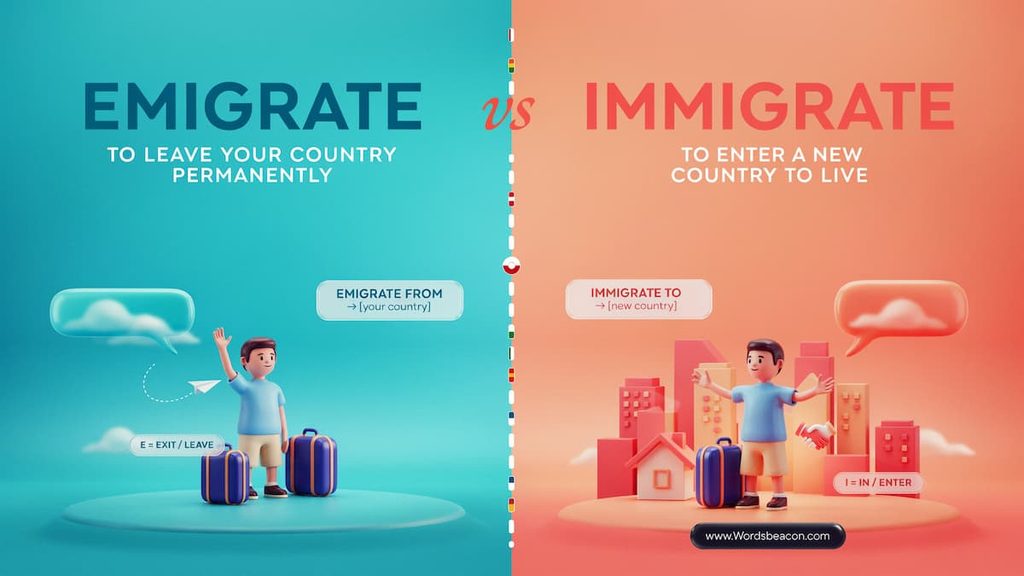
The easiest way to remember emigrate vs immigrate is to connect each word with its direction.
- E = Exit: You leave your original country.
- I = In: You enter another country.
Think of the first letter as a small directional clue.
The prefix e- in emigrate is associated with movement out. Meanwhile, im- in immigrate comes from a prefix meaning into.
Emigrate vs Immigrate Memory Trick
Try this simple memory trick:
E for Exit and I for In.
Whenever you’re unsure which word to use, ask yourself one question:
“Am I talking about leaving the country or entering a new one?”
If you’re describing departure, choose emigrate. If you’re describing arrival, choose immigrate.
For example:
- “We emigrated from France.” You focus on leaving France.
- “We immigrated to the United States.” You focus on entering the United States.
How to Remember Emigrate and Immigrate With One Example
Imagine a person standing between two countries.
They leave Country A and enter Country B.
- Country A sees an emigrant leaving.
- Country B welcomes an immigrant.
- The overall movement is migration.
This simple picture works for students, English learners, and anyone who frequently mixes up these terms.
Fix common more word mistakes in English
Career vs Carrer Correct Spelling and Difference
Common Mistakes When Using Emigrate and Immigrate
Even fluent English speakers sometimes confuse these words. Their similar spelling and pronunciation make the mistake understandable. Fortunately, a few basic grammar rules can help you avoid it.
Using the Wrong Preposition
One of the most frequent mistakes involves mixing up from and to.
Incorrect: She immigrated from Canada to establish a new life there.
Correct: She emigrated from Canada to establish a new life elsewhere.
The problem is that the first sentence identifies Canada as the country she leaves. Therefore, emigrated is the appropriate verb.
Treating Both Words as Interchangeable
Although the words describe the same overall journey, they don’t have identical meanings.
Incorrect: My parents immigrated from Italy and left for the United States.
Better: My parents emigrated from Italy and immigrated to the United States.
The improved version clearly identifies both sides of their move.
Confusing Migration With Immigration
Another mistake is assuming that every migration involves international relocation.
For example, a person who moves from one American state to another has migrated domestically. That person hasn’t immigrated because they haven’t entered a different country.
Assuming Emigration Always Means Permanent Departure
Although emigrate commonly describes long-term relocation, the word doesn’t establish someone’s future plans with absolute certainty.
People may eventually return to their country of origin. Therefore, context matters when discussing whether a move is temporary or permanent.
Confusing Immigrants With Emigrants
An immigrant and an emigrant can be the same person. The difference lies in which country you use as your reference point.
For example, someone who leaves Canada to settle in Australia is an emigrant from Canada and an immigrant in Australia.
Fix common more word mistakes in English
Persuing vs Pursuing Difference and Correct Spelling
Emigrate vs Immigrate Pronunciation
The emigrate vs immigrate pronunciation difference is relatively small. Both words contain three syllables and place the primary stress on the first syllable.
However, their opening vowel sounds differ.
| Word | American English IPA | Syllables | Primary stress |
|---|---|---|---|
| Emigrate | /ˈem.əˌɡreɪt/ | Three | First |
| Immigrate | /ˈɪm.əˌɡreɪt/ | Three | First |
Emigrate pronunciation: The word begins with the short e sound, as in egg.
Immigrate pronunciation: The word begins with the short i sound, as in it.
Both words share a similar ending, which makes their first syllable especially important when speaking.
For English learners, practicing the words side by side can help:
- Emigrate from Ireland.
- Immigrate to Ireland.
The difference in their opening vowels becomes easier to recognize with repetition.
Emigrate vs Immigrate in American and British English
The meanings of emigrate vs immigrate remain essentially the same in American and British English. Both varieties use emigrate for leaving a country and immigrate for entering another country.
However, their pronunciation can differ slightly between the two varieties.
In American English:
- Emigrate: /ˈem.əˌɡreɪt/
- Immigrate: /ˈɪm.əˌɡreɪt/
British English generally uses a slightly different vowel quality in the unstressed middle syllable. Nevertheless, the opening sounds still help distinguish the words.
The spelling also remains unchanged. Unlike words such as center and centre, these two verbs don’t have separate standard American and British spellings.
Therefore, you can use the same definitions and grammatical patterns in both varieties of English.
Learn the difference between tricky more English words
Holistic vs Wholistic Difference and Correct Spelling
Practice session Emigrate vs Immigrate
Test your understanding with these questions. Choose the correct form of emigrate, immigrate, or migrate based on the context.
- My grandparents decided to ______ from Italy after World War II.
- She hopes to ______ to Canada next year.
- Many families ______ from rural communities to large cities.
- His parents ______ from Germany before he was born.
- Thousands of people ______ to the United States every year.
- Birds ______ south when winter approaches.
- My uncle plans to ______ from Brazil and settle abroad.
- They ______ to Australia to start a new business.
- Several families ______ from the island after the natural disaster.
- My cousin wants to ______ to New Zealand for work.
- The family ______ from Mexico and established a home in Texas.
- Many workers ______ to cities with better employment opportunities.
- Her grandparents ______ from Poland in search of a safer future.
- He hopes to ______ to France after graduation.
- Monarch butterflies ______ over long distances.
- My neighbors ______ from South Korea and now live in California.
- The couple plans to ______ to Japan next spring.
- Many people ______ because of economic difficulties.
- She ______ from Ireland and ______ to the United States.
- The seasonal movement of animals is known as ______.
Answers
| Question | Answer |
|---|---|
| 1 | Emigrate |
| 2 | Immigrate |
| 3 | Migrate |
| 4 | Emigrated |
| 5 | Immigrate |
| 6 | Migrate |
| 7 | Emigrate |
| 8 | Immigrated |
| 9 | Emigrated |
| 10 | Immigrate |
| 11 | Emigrated |
| 12 | Migrate |
| 13 | Emigrated |
| 14 | Immigrate |
| 15 | Migrate |
| 16 | Emigrated |
| 17 | Immigrate |
| 18 | Migrate |
| 19 | Emigrated; immigrated |
| 20 | Migration |
Here’s a trusted source for clear word meanings:
FAQs
What is the difference between emigrate vs immigrate?
Emigrate means leaving your home country to live in another country. Immigrate means entering a new country to settle there. For example, if you move from Canada to Australia, you emigrate from Canada and immigrate to Australia.
Do you emigrate vs immigrate to a country?
You immigrate to a country when you move there to live. You emigrate from the country you leave. The correct word depends on whether you are describing your arrival or departure.
What does emigrate mean?
Emigrate means to leave your native country and move to another country to live. For example, a family that leaves Germany to settle in the United States has emigrated from Germany.
Is moving to another country called immigration?
Yes. Moving to another country to establish a home is called immigration from the destination country’s perspective. From the perspective of the country you leave, the same move is called emigration.
Is emigrating the same as leaving your country?
Not exactly. Emigrating means leaving your country with the intention of living somewhere else. A vacation or short business trip does not usually count as emigration because you aren’t moving abroad to establish a new home.
What’s the difference between an immigrant and a migrant?
An immigrant is someone who moves to another country to live there. A migrant is a broader term for someone who moves from one place to another, either within their own country or across international borders. Migration can be temporary or permanent.
Do humans migrate or emigrate?
Humans can do both. Migration describes movement from one place to another, while emigration specifically means leaving a country to live elsewhere. For example, someone moving from Brazil to Spain migrates internationally and emigrates from Brazil.
Can you emigrate from one country and immigrate to another?
Yes. These terms describe two sides of the same international move. If you relocate from India to the United States, you emigrate from India and immigrate to the United States.
Why do people choose to emigrate?
People emigrate for different reasons, including better career opportunities, higher education, family reunification, safety, and improved living conditions. Others leave because of political instability, conflict, or limited opportunities in their home countries.
What is the difference between emigration, immigration, and migration?
Emigration means leaving a country to live elsewhere. Immigration means entering another country to settle there. Migration is the broader term for moving between places, whether within one country or across national borders.
Learn the difference between tricky more English words
Across vs Accross Which Is the Correct Spelling?
Conclusion
The confusion between emigrate vs immigrate comes down to one simple thing: direction. When you leave your home country to settle somewhere else, you emigrate from that country. When you arrive in a new country to make it your home, you immigrate to that country. Both words describe the same move, just from different sides of the border.
Here’s an easy way to remember: emigrate means exit, while immigrate means enter. Once you understand this small difference, choosing the right word becomes much easier. So, whether you’re writing about a family moving abroad or planning your own international adventure, you won’t have to let these two confusing words send your sentence in the wrong direction!

Luna AJS is an experienced blogger and dedicated language enthusiast at Words Beacon. She specializes in making English grammar, spelling, vocabulary and commonly confused words easy to understand. She provides clear explanations, practical examples to help readers write with confidence.