
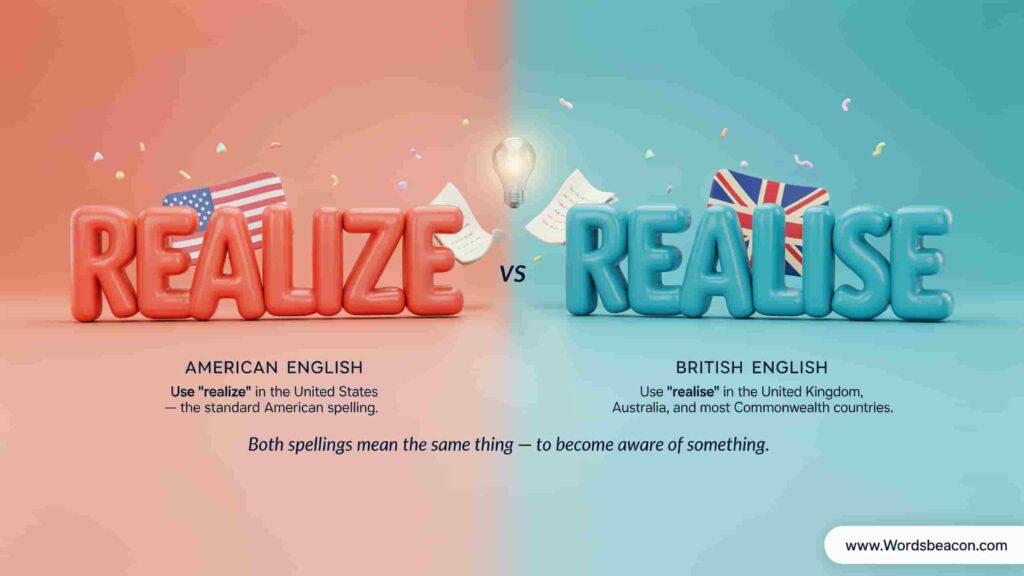
One small letter can create a surprisingly big spelling dilemma. Should you write realise vs realize? Both look correct, so it’s easy to wonder whether one is a mistake. Here’s the simple answer: neither is wrong! The difference comes down to the type of English you’re using. American English prefers realize, while British English commonly uses realise. Both words have the same meaning and pronunciation. In this guide, we’ll clear up the confusion surrounding realise vs realize, explain when to use each spelling, and share helpful examples so you can write confidently without getting stuck on one little letter.
quick comprasion table
| Feature | Realize | Realise |
|---|---|---|
| Spelling | Uses Z | Uses S |
| Main regional preference | American English | Traditional British English |
| Meaning | Become aware or make something real | Become aware or make something real |
| Pronunciation | /ˈriːəlaɪz/ | /ˈriːəlaɪz/ |
| Past tense | Realized | Realised |
| Present participle | Realizing | Realising |
| Third-person singular | Realizes | Realises |
| Noun form | Realization | Realisation |
| Common usage | United States and Canada | United Kingdom, Australia, and New Zealand |
| Oxford convention | Accepted and preferred by Oxford University Press | Accepted in other British spelling styles |
Understand confusing English more words simply
Complement vs Compliment Difference and Correct Usage
Realize vs Realise What’s the Difference?
The difference between Realize vs Realise comes down to one letter: Z or S. American English generally uses the Z spelling, whereas traditional British English commonly uses the S spelling. Both forms represent the same verb and communicate the same ideas.
For example, an American writer might say, “I didn’t realize how difficult the assignment would be.” A British writer could express the same thought as, “I didn’t realise how difficult the assignment would be.”
Neither sentence changes the message. The writer simply follows a different regional spelling convention.
This distinction also appears in other English words. For example, American writers generally use organize, recognize, and apologize. British writers often prefer organise, recognise, and apologise. These differences belong to a broader group of regional spelling variations.
However, British English doesn’t always require S. Oxford University Press uses Z in many Greek-derived words, including realize and organize. Therefore, the idea that every Z spelling is American isn’t entirely accurate.
Realize vs Realise Meaning
The Realize vs Realise meaning is exactly the same. Both words describe becoming aware of something, understanding a fact, or making something happen.
The verb has two main uses.
The first meaning involves awareness or understanding. When you realize something, you recognize a fact, discover an important detail, or become conscious of a situation you previously overlooked.
Examples:
- I didn’t realize that the store closed at six.
- She suddenly realised why her friend had stopped calling.
- He began to realize the importance of saving money.
- We finally realized that the original plan wouldn’t work.
The second meaning relates to achievement. You can use the verb when someone turns an idea into reality, fulfills an ambition, or achieves a particular goal.
Examples:
- She worked hard to realize her dream of becoming a doctor.
- The company hopes to realise its long-term objectives.
- They finally realized their ambition of opening a restaurant.
- The team wants to realize its full potential.
In both situations, the spelling doesn’t change the meaning. The surrounding words help readers understand whether you’re discussing awareness or achievement.
What Does Realize Mean?
The realize meaning centers on awareness, understanding, and achievement. When you realize something, you become conscious of information that you didn’t previously understand. You might discover a mistake, recognize the truth, or understand why something happened.
The word also describes bringing an idea, ambition, or plan into reality.
Here are its common meanings:
- Become aware: Discover or notice something that you didn’t know before.
- Understand: Recognize the truth or comprehend a situation.
- Acknowledge: Accept an important fact or recognize its significance.
- Achieve: Fulfill a dream, ambition, or personal goal.
- Make something real: Turn an idea or plan into an actual result.
Consider these examples:
- I didn’t realize that my phone was still recording.
- She realized how much her parents had sacrificed for her.
- The business hopes to realize its expansion plans next year.
- He wants to realize his ambition of becoming a successful writer.
- We soon realized that the original approach wouldn’t work.
In each sentence, realize communicates awareness, understanding, or achievement.
What Does Realise Mean?
The realise meaning in English matches the meaning of realize. The S spelling is common in British English and other varieties that follow traditional British spelling conventions.
For example:
- I didn’t realise that the appointment had changed.
- She began to realise the importance of regular exercise.
- They hope to realise their dream of traveling around the world.
- He realised that he had made a serious mistake.
- The organization wants to realise its long-term objectives.
You can replace realise with realize in each sentence without changing its meaning.
Remember that neither spelling describes a different level of understanding. Both belong to the same English verb and follow the same grammatical rules.
Understand confusing English more words simply
Ingage vs Engage Which Spelling Is Correct ?
Realize vs Realise American vs British English
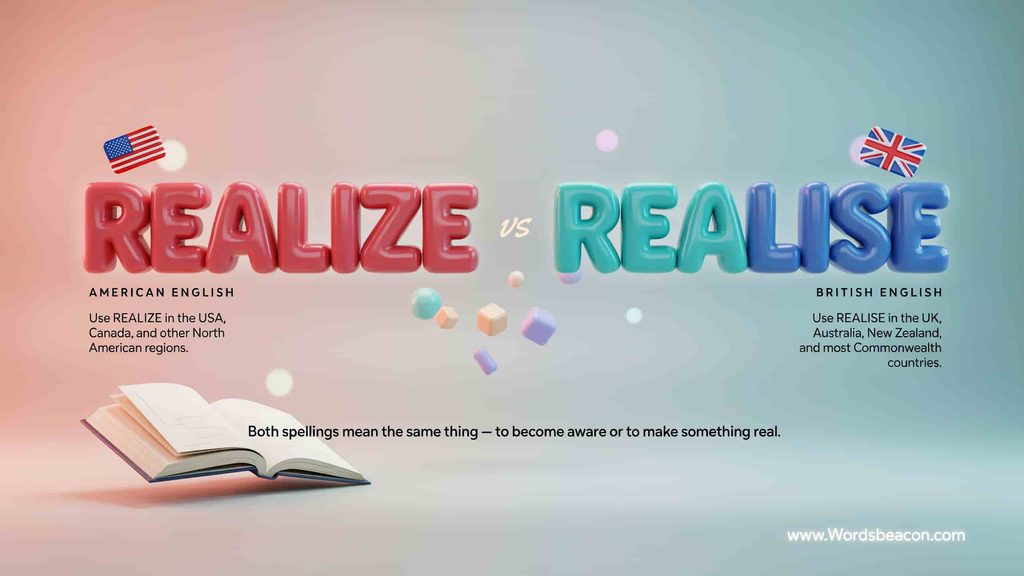
The choice between Realize or Realise depends mainly on your regional spelling standard. American and British English have developed different preferences for several word endings, and this verb follows one of those patterns.
If you’re writing for an American audience, realize is the usual choice. However, if you’re following a traditional British spelling style, realise is generally preferred.
Realize in American English
In American English, realize is the standard spelling. You’ll find it in American dictionaries, newspapers, school textbooks, business documents, and everyday writing.
American English generally uses Z in this group of verbs and their related forms.
For example:
- I didn’t realize how much time the project would take.
- She realized that she had forgotten her passport.
- They want to realize their business ambitions.
- He is realizing the importance of hard work.
- The manager realizes that the deadline is approaching.
The same spelling convention applies to related words:
| Word form | American spelling | Example |
|---|---|---|
| Base verb | Realize | I realize my mistake. |
| Past tense | Realized | She realized the truth. |
| Present participle | Realizing | He is realizing his potential. |
| Third-person singular | Realizes | She realizes the importance of teamwork. |
| Noun | Realization | His realization changed everything. |
| Negative form | Unrealized | It remained an unrealized ambition. |
The Merriam-Webster dictionary uses realize as its standard headword. Therefore, if you’re writing an American article, assignment, or professional document, the Z spelling is the safest choice.
Realise in British English
In traditional British English, realise is a common and widely accepted spelling. British writers often use S in this group of verbs because it follows a familiar regional convention.
You’ll commonly encounter it in British publications, educational materials, newspapers, and everyday communication.
Examples:
- I didn’t realise how late it had become.
- She realised that she had forgotten her passport.
- They want to realise their plans for the future.
- He is beginning to realise his true potential.
- The organization hopes to realise its objectives.
The same convention applies to its related forms:
| Word form | British spelling | Example |
|---|---|---|
| Base verb | Realise | I realise my mistake. |
| Past tense | Realised | She realised the truth. |
| Present participle | Realising | He is realising his potential. |
| Third-person singular | Realises | She realises the importance of teamwork. |
| Noun | Realisation | Her realisation changed everything. |
| Negative form | Unrealised | It remained an unrealised ambition. |
However, British English doesn’t reject every Z spelling. Oxford University Press follows a different convention and generally prefers Z in words such as realize, organize, and recognize. As a result, both spellings appear in British publications.
Why Does American English Use Realize and British English Use Realise?
The difference comes from the history of English spelling. Over time, different publishers and language communities developed their own preferences for words ending in -ize and -ise.
The Z ending has historical roots in the Greek suffix -izo. It appeared in English long before modern American spelling became established. British writers also used this form for centuries.
Later, the S ending became increasingly popular in British publications. Consequently, many British publishers adopted realise, organise, and recognise as their preferred forms.
American spelling conventions generally retained the Z ending in these words.
Today, both conventions remain in use. The main distinction is regional preference rather than a difference in grammar or meaning.
Here are some familiar examples:
| American English | Common British English |
|---|---|
| Realize | Realise |
| Organize | Organise |
| Recognize | Recognise |
| Apologize | Apologise |
| Modernize | Modernise |
| Specialize | Specialise |
| Finalize | Finalise |
| Organizing | Organising |
However, this isn’t a rule for every English word ending in S or Z. Words such as advertise, advise, exercise, and revise normally retain their S spelling in both American and British English.
Understand confusing English more words simply
Theater vs Theatre Which Spelling Is Correct?
Realize vs Realise in Different Countries
American and British English aren’t the only spelling systems worth considering. Other English-speaking countries have developed their own conventions, often combining British and American preferences.
Therefore, the spelling you encounter may depend on the country, publication, or organization.
| Country | Common spelling | General preference |
|---|---|---|
| United States | Realize | American English |
| United Kingdom | Realise | Traditional British English |
| Canada | Realize | Canadian English generally favors Z |
| Australia | Realise | Australian English |
| New Zealand | Realise | New Zealand English |
| India | Both | Depends on institutional and publication style |
Realize vs Realise in Canada
Canadian English combines features of American and British spelling. For example, Canadians often write colour and centre but generally prefer realize and organize.
This combination can seem unusual if you expect Canadian English to follow every British spelling convention. However, Canadian spelling has its own established preferences.
Examples:
- I didn’t realize how much the weather had changed.
- She realized that her application needed an update.
- They want to realize their business objectives.
The Z spelling is generally preferred in Canadian writing. Nevertheless, realize and realise can both appear in Canadian publications.
Realise vs Realize in Australia
Australian English generally follows British spelling conventions for words ending in -ise. Therefore, realise is the common choice.
You’ll often see related forms such as realised, realising, and realisation.
Examples:
- I didn’t realise that the appointment had changed.
- She realised that the opportunity was too good to miss.
- They are realising their long-term business goals.
Australian writers should also consider their organization’s style guide. Some international businesses and publications use Oxford spelling or American conventions.
Realise vs Realize in New Zealand
New Zealand English shares many spelling conventions with British English. As a result, realise is generally preferred over realize.
For example:
- I didn’t realise that the examination date had changed.
- She realised the value of education.
- The organization hopes to realise its objectives.
Although the S form is common, individual universities, publishers, and international organizations may follow different spelling standards.
Understand confusing English more words simply
Persuing vs Pursuing Difference and Correct Spelling
Realize vs Realise Examples in Sentences
Examples make spelling differences easier to understand because they show how both forms work in everyday situations.
Since realize and realise have identical meanings, you can use the same sentence structures with either spelling. The only change involves the regional spelling convention.
Examples Using Realize
Here are examples using standard American spelling.
Becoming aware of something
- I didn’t realize that you were waiting outside.
- She suddenly realized that she had taken the wrong bus.
- They realize how important good communication is.
- He didn’t realize that his words had hurt his friend.
- We finally realized why the machine wasn’t working.
Understanding a fact or situation
- Parents often realize the value of time as their children grow older.
- The students realized that the assignment required more research.
- She began to realize the consequences of her decision.
- I realize that learning a new language takes patience.
- He finally realized that honesty was the best approach.
Achieving a dream or ambition
- She worked for years to realize her dream of becoming a writer.
- The young entrepreneur hopes to realize his business vision.
- They realized their goal of building a successful company.
- Hard work helped him realize his full potential.
- The team wants to realize its plans before the end of the year.
Examples Using Realise
The following examples express the same ideas using common British spelling.
Becoming aware of something
- I didn’t realise that you were waiting outside.
- She suddenly realised that she had taken the wrong bus.
- They realise how important good communication is.
- He didn’t realise that his words had hurt his friend.
- We finally realised why the machine wasn’t working.
Understanding a fact or situation
- Parents often realise the value of time as their children grow older.
- The students realised that the assignment required more research.
- She began to realise the consequences of her decision.
- I realise that learning a new language takes patience.
- He finally realised that honesty was the best approach.
Achieving a dream or ambition
- She worked for years to realise her dream of becoming a writer.
- The young entrepreneur hopes to realise his business vision.
- They realised their goal of building a successful company.
- Hard work helped him realise his full potential.
- The team wants to realise its plans before the end of the year.
Realize vs Realise Side-by-Side Examples
The comparison below shows how the spelling changes without affecting the meaning.
| American English | British English |
|---|---|
| I realize my mistake. | I realise my mistake. |
| She realized the truth. | She realised the truth. |
| He is realizing his potential. | He is realising his potential. |
| They realize their dreams. | They realise their dreams. |
| Her realization came suddenly. | Her realisation came suddenly. |
| We realized the importance of teamwork. | We realised the importance of teamwork. |
Notice that the grammar remains exactly the same. You don’t need to change the sentence structure, verb tense, or intended meaning when switching between these regional forms.
Learn how to use confusing more words correctly
Contractor vs Contracter Which Spelling Is Correct?
Realise vs Realize Different Forms of the Word
Changing the spelling of realize also affects its related grammatical forms. American English generally retains Z, while traditional British English uses S in the same word family.
Understanding these forms helps you maintain consistent spelling throughout an article, email, or academic assignment.
Realized vs Realised
Both realized and realised are past-tense and past-participle forms of the verb.
- Realized: American English.
- Realised: Common British English.
Examples:
- American: I realized that I had forgotten my keys.
- British: I realised that I had forgotten my keys.
- American: She realized her dream of becoming a doctor.
- British: She realised her dream of becoming a doctor.
You can also use these forms with helping verbs:
- He has realized his mistake.
- He has realised his mistake.
- They had realized the importance of the decision.
- They had realised the importance of the decision.
Both forms follow the regular past-tense pattern. You add -ed to the base verb while retaining the spelling convention you selected.
Realizing vs Realising
Realizing and realising are present participles and gerunds. You can use them to describe an ongoing action or express the process of becoming aware of something.
Examples:
- American: She is realizing her full potential.
- British: She is realising her full potential.
- American: Realizing your mistakes is the first step toward improvement.
- British: Realising your mistakes is the first step toward improvement.
More examples:
- I am realizing how much I have learned this year.
- He is realising that success takes time.
- Realizing the truth changed her perspective.
- Realising the consequences helped them make a better decision.
Both forms are grammatically correct. Choose the spelling that matches your preferred English convention.
Realization vs Realisation
Realization and realisation are nouns that describe the process of becoming aware of something. They can also refer to the achievement or fulfillment of a plan, ambition, or goal.
- Realization: American English.
- Realisation: Common British English.
Examples:
- Her realization came after a long conversation.
- His realisation changed the way he viewed the situation.
- The realization of their dream took several years.
- The realisation of the project required teamwork.
The noun can describe a sudden understanding:
“After reading the letter, she had an important realization.”
It can also describe the achievement of something:
“The realization of the company’s vision required careful planning.”
Realizes vs Realises
Realizes and realises are third-person singular present-tense forms. Use them with subjects such as he, she, it, or a singular noun.
| American English | British English |
|---|---|
| She realizes her mistake. | She realises her mistake. |
| He realizes the truth. | He realises the truth. |
| The manager realizes the problem. | The manager realises the problem. |
| My brother realizes his potential. | My brother realises his potential. |
The spelling changes, but subject-verb agreement stays the same.
Unrealized vs Unrealised
The same regional pattern appears in negative forms.
Unrealized is the American spelling, while unrealised is common in British English. Both describe something that hasn’t been achieved, developed, or brought into reality.
Examples:
- She still has several unrealized ambitions.
- He regrets leaving his unrealised potential unexplored.
- The project represents an unrealized opportunity.
- Their unrealised plans may become possible in the future.
These forms follow the same spelling convention as the original verb.
Learn how to use confusing more words correctly
Career vs Carrer Correct Spelling and Difference
Does Oxford Dictionary Prefer Realize or Realise?
This question causes confusion because people often assume that every British dictionary and publisher follows the same spelling rules. However, British English includes more than one accepted convention.
Oxford University Press uses Oxford spelling, which generally favors -ize endings in certain words derived from the Greek suffix -izo. Under this convention, the preferred forms include:
- Realize
- Organize
- Recognize
- Modernize
- Specialize
- Realization
- Organization
This approach reflects the historical origins of these words rather than treating Z as an exclusively American letter.
However, the University of Oxford’s own institutional style guide prefers -ise endings because they are more common in British usage and require fewer exceptions.
That means the following distinction matters:
| Spelling authority or style | Preferred form |
|---|---|
| American English | Realize |
| Traditional British -ise style | Realise |
| Oxford University Press spelling | Realize |
| University of Oxford institutional style | Realise |
| Common Australian spelling | Realise |
Therefore, both spellings can appear in British writing. The choice depends on the dictionary, publisher, or organization you’re following.
One useful point is that Oxford spelling doesn’t mean every word ending in -ise should change to -ize. Words such as advertise, advise, exercise, and revise retain their S endings.
Realize vs Realise Pronunciation Do They Sound Different?
Despite their different spellings, realize and realise have the same standard pronunciation. The S and Z don’t create two separate pronunciations in this word.
Both forms are commonly pronounced as three syllables:
- rea-lize
- rea-lise
The final consonant has a voiced /z/ sound. It matches the Z sound in words such as zebra and zero.
Here are a few useful pronunciation points:
- Both forms have three syllables.
- Both follow the same stress pattern.
- Both end with a voiced Z sound.
- The spelling difference doesn’t require a different accent.
- Regional accents may affect vowel sounds slightly, but the S and Z spellings don’t create a pronunciation contrast.
If you’re learning English, remember that the written letter doesn’t always tell you exactly how to pronounce a word. In this case, the S in realise produces the same final sound as the Z in realize.
Is Realise vs Realize Ever Incorrect?
Neither spelling is universally incorrect. However, one form may be unsuitable for a particular audience or publication.
For example, if you’re writing an American academic paper, realize is the expected spelling. Using realise may look inconsistent with the rest of your American spelling.
Similarly, a British publication that follows a traditional -ise style guide will generally expect realise.
Consider these situations:
| Writing situation | Recommended spelling |
|---|---|
| American school assignment | Realize |
| US business email | Realize |
| American newspaper article | Realize |
| British school assignment following -ise style | Realise |
| Australian government report | Realise |
| New Zealand academic writing | Realise, unless its style guide specifies otherwise |
| Oxford-style publication | Realize |
| Canadian business document | Realize is generally preferred |
Why Does a Spell Checker Flag Realise or Realize?
Have you ever typed a perfectly valid word only to see a red underline beneath it? Your spelling checker might be using a different regional dictionary.
For example, if your software uses American English settings, it may flag realise and suggest realize. When you switch to British English, it may accept realise as the preferred form.
The same thing happens with other regional spelling differences:
- Color vs colour
- Organize vs organise
- Recognize vs recognise
- Center vs centre
- Traveling vs travelling
To avoid these problems:
- Open your word processor’s language settings.
- Select the English variety you need.
- Check your document’s spelling.
- Review the suggested corrections.
- Keep the same spelling convention throughout your work.
A spelling checker can catch many errors, but it can’t always determine which regional style your audience expects. That’s why choosing the right language setting matters.
Fix common more word mistakes in English
Focusing vs Focussing Which Spelling Is Correct ?
How to Choose Between Realise and Realize
Choosing between these spellings becomes simple once you understand your audience.
If you’re writing for readers in the United States, use realize. If you’re following traditional British, Australian, or New Zealand spelling conventions, realise is generally the more familiar choice.
However, your audience isn’t the only factor. Your organization’s writing rules matter too.
Here are some practical tips:
- Know your audience: Choose the spelling commonly used by your intended readers.
- Follow your style guide: Publishers, universities, and companies may have specific requirements.
- Use a reliable dictionary: Merriam-Webster helps with American spelling, while British dictionaries provide guidance for UK usage.
- Check related words: If you choose realise, use realised, realising, and realisation consistently.
- Avoid unnecessary switching: Don’t alternate between S and Z forms without a clear reason.
A Practical Case Study Choosing the Right Spelling for Two Audiences
Imagine a company that publishes educational articles for readers in the United States and Australia.
Its American article contains this sentence:
“Our students realize that consistent practice improves their writing skills.”
The Australian version reads:
“Our students realise that consistent practice improves their writing skills.”
The message stays the same. However, each version follows the spelling convention familiar to its intended audience.
Now imagine that the company accidentally uses realize in one paragraph and realisation in another paragraph written in traditional Australian English.
Readers will probably understand the content. Nevertheless, the inconsistent spelling may make the article look poorly edited.
The solution is simple: establish a regional spelling standard before writing and apply it throughout the article.
This example highlights an important writing principle. Correct spelling isn’t only about choosing a valid word. It’s also about maintaining a consistent style that makes your content clear and professional.
Fix common more word mistakes in English
Holistic vs Wholistic Difference and Correct Spelling
Common Mistakes to Avoid When Using Realise and Realize
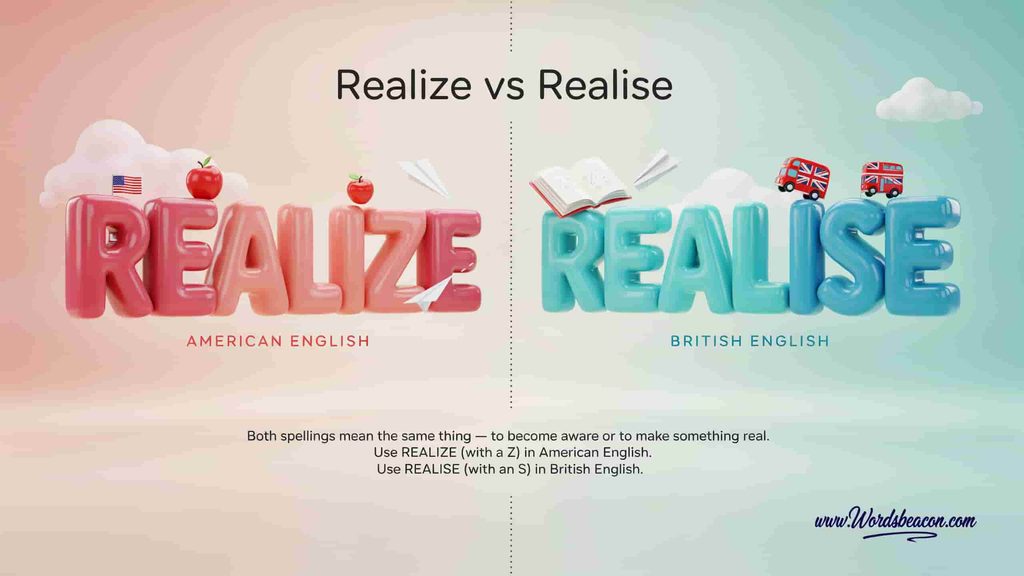
Even though both spellings are correct, writers sometimes make mistakes when applying them. Most problems come from mixing regional conventions or misunderstanding how the word works in a sentence.
Here are some common errors to avoid.
Treating One Spelling as Universally Incorrect
Some writers assume that realise is always wrong because American dictionaries prefer realize. Others believe that realize is incorrect everywhere outside the United States.
Neither assumption is accurate. Both forms have legitimate uses across English-speaking regions.
Mixing American and British Spellings
Consider these examples:
- I realize that the decision was difficult.
- She realised that the situation had changed.
- Their realization came after several discussions.
Each spelling has a recognized use. However, switching between conventions without a clear reason makes the document inconsistent.
Instead, choose one style and follow it throughout your writing.
Assuming the Two Words Have Different Meanings
Realize and realise don’t describe different actions. Both can refer to understanding a fact, acknowledging the truth, or achieving an ambition.
Use the surrounding sentence to determine the intended meaning rather than the spelling.
Confusing Spelling With Pronunciation
The S in realise doesn’t create a different final sound. Both forms use the same standard pronunciation.
Therefore, you don’t need to learn two pronunciations for this spelling difference.
Forgetting Related Word Forms
Consistency also applies to the rest of the word family.
If you use realize, continue with realized, realizing, realizes, and realization. If you follow the common British -ise convention, use realised, realising, realises, and realisation.
Keeping these forms consistent makes your writing easier to read and edit.
Learn the difference between tricky more English words
Across vs Accross Which Is the Correct Spelling?
Practice Session Realise vs Realize
Fill in each blank with the correct spelling: realise vs realize. Choose the form that matches the English spelling convention used in each sentence.
- I didn’t ______ how much time the project would take.
- She began to ______ her dream of becoming a writer.
- Did you ______ that the meeting starts at 9 a.m.?
- He hopes to ______ his full potential this year.
- They finally ______ that they had made a mistake.
- I want to ______ how important teamwork is.
- She didn’t ______ the truth until much later.
- We need to ______ our goals before the end of the year.
- He suddenly ______ that he had left his phone at home.
- You may ______ your mistake after reviewing the report.
- I didn’t ______ how serious the problem was.
- The company plans to ______ its long-term vision.
- She will ______ her ambition through hard work.
- Do you ______ how lucky you are?
- They didn’t ______ the impact of their decision.
- He worked hard to ______ his childhood dream.
- I hope you ______ that your efforts matter.
- The students began to ______ the value of education.
- She wants to ______ her plans before making a decision.
- We finally ______ that success requires patience.
Answers
- realize
- realise
- realize
- realize
- realized
- realize
- realise
- realize
- realized
- realize
- realise
- realize
- realise
- realize
- realise
- realize
- realize
- realise
- realise
- realized
Here’s a trusted source for clear word meanings:
FAQs
Is there a difference in meaning between realise and realize?
No. Both spellings have exactly the same meaning. They describe becoming aware of something, understanding a fact, or making an idea or goal happen. The only difference is regional spelling preference.
Why does realize have two accepted spellings?
The two forms come from different English spelling traditions. American English generally uses realize, while British English commonly prefers realise. Both spellings have a long history and remain acceptable.
Can I use realise in American English writing?
Yes, readers will understand it. However, realize is the standard American spelling. If you’re writing for a US audience, use realize to match American spelling conventions and maintain consistency.
Is realisation or realization correct?
Both are correct. Realisation is the common British spelling, while realization is standard in American English. Both refer to the process of understanding something or making something happen.
What is the difference between realizing and realising?
There is no difference in meaning or pronunciation. Realizing follows American spelling conventions, whereas realising follows the common British style.
Is unrealized or unrealised correct?
Both forms are accepted. American English uses unrealized, while British English commonly uses unrealised. The word describes something that hasn’t been achieved, developed, or fully brought into existence.
Does the Oxford English Dictionary accept realize?
Yes. The Oxford English Dictionary recognizes realize as a correct spelling. The -ize ending has a long history in British English, although many British writers prefer realise.
Should I use realise or realize in academic writing?
Follow the spelling guide required by your university, publisher, or academic journal. If no specific style guide applies, use realize for American English and realise for common British English. Most importantly, remain consistent throughout your work.
Is it correct to write “I have realized”?
Yes. I have realized is grammatically correct. It uses the present perfect tense to describe something you understood in the past that still matters in the present. In common British English, the spelling is I have realised.
What is the difference between realize and recognize?
Realize usually means to become aware of something or understand a fact. Recognize means to identify someone or something you have encountered before. For example, you might realize you’ve met someone before when you recognize their face.
Can realize mean to achieve a goal?
Yes. Realize can also mean to make an idea, ambition, plan, or dream happen. For example, “She worked hard to realize her dream of opening a bakery.” In this context, the word describes turning an idea into reality.
Is the Z in realize pronounced like Z or S?
The Z in realize has a /z/ sound, like the Z in zebra. Both realise and realize have the same pronunciation, even though their spellings differ.
Do British dictionaries list both realise and realize?
Yes. Major British dictionaries recognize both spellings. However, realise is more common in everyday British writing, while realize is also used by writers and publishers who follow the Oxford spelling convention.
Should a website use realise or realize?
Choose the spelling that matches your target audience. If your website focuses on American readers, use realize. For readers who follow common British English conventions, choose realise. Keep the spelling consistent across your articles, headings, and website content.
What are the common spelling mistakes related to realize?
Common misspellings include realizee, realizeing, and realiztion. The correct American forms are realize, realizing, and realization. In common British English, write realise, realising, and realisation.
Learn the difference between tricky more English words
Different vs Diffrent Which Spelling Is Correct?
Conclusion
The confusion between realise vs realize comes down to one little letter: S or Z. Fortunately, choosing the correct spelling is easier than it looks. Both words have the same meaning and pronunciation, so you don’t need to learn two different definitions. Just remember that American English uses realize, while British English commonly uses realise. The same pattern applies to related words such as realizing/realising and realization/realisation. Once you know your audience, the choice becomes simple. So, don’t let one letter trip you up! Pick the spelling that matches your style of English and use it consistently. Now you can write with confidence and leave this little spelling mystery behind.

Luna AJS is an experienced blogger and dedicated language enthusiast at Words Beacon. She specializes in making English grammar, spelling, vocabulary and commonly confused words easy to understand. She provides clear explanations, practical examples to help readers write with confidence.